Texas Baptists avoid vote on ‘pastoral roles’ for women

MCALLEN—When asked to approve a motion calling on the Baptist General Convention of Texas to help churches “interested in calling and employing women in ministerial and pastoral roles,” messengers to the BGCT annual meeting instead adopted an amended motion referring to “women in ministry and leadership roles.”

During the Tuesday business session of the annual meeting in McAllen, Matthew Richard, pastor of First Baptist Church in Llano and chair of the committee on the annual meeting, reported the committee considered “out of order” two motions related to women in ministry introduced the previous day.

Meredith Stone, a messenger from Calvary Baptist Church in Waco and executive director of Baptist Women in Ministry, had introduced a motion that the BGCT “affirm women in all ministry and pastoral roles, and that the BGCT Executive Board be instructed to have staff create programs, resources and advocacy initiatives to assist churches in affirming, appointing and employing women in ministerial and pastoral roles.”

Richard explained the committee considered Stone’s motion in violation of Article 1, Section 2 of the BGCT constitution.

It states: “This Convention is and always shall remain, only and solely a medium through which Baptist churches may work harmoniously in cooperation with each other, promoting the work and objects set forth in this constitution. It has not, to any degree, and shall never have any ecclesiastical authority. It shall not have and shall never attempt to exercise a single attribute of power or authority over any church, or over the messengers of the churches in such wise as to limit the sovereignty of the churches, but shall recognize the sovereignty of the churches under the one Sovereign, Jesus Christ our Lord.”

Stone told the Baptist Standard she had consulted an attorney and a parliamentarian who did not consider her original motion in violation of the convention’s constitution. She also noted both the Cooperative Baptist Fellowship and American Baptist Churches affirm women in ministry and pastoral roles, while also stating they do not exercise ecclesiastical authority over churches.

Revised motion presented, debated
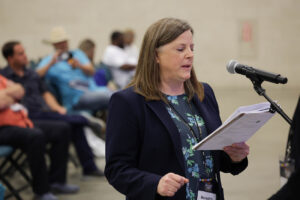
After the committee on the annual meeting ruled her original motion out of order, Meredith Stone offered a motion calling on the BGCT Executive Board staff to develop resources “to assist churches interested in calling and employing women in ministerial and pastoral roles.” (Photo / Robbie Rogers)

However, she presented a revised motion on Tuesday the committee found in order: “I move that the Baptist General Convention of Texas Executive Board be instructed to have staff create programs, resources, and initiatives to assist churches in affirming, appointing, and employing women in ministerial and pastoral roles.”

The motion sparked extended debate. Some messengers spoke against women occupying “pastoral roles.”

Alex Guerra, pastor of Bateman Baptist Church in Red Rock, asserted the Bible clearly teaches the principle of “male leadership,” and he said churches that support women pastors are “in rebellion against the word of God.”

Others asserted the BGCT needed to clearly differentiate itself from the position taken by the Southern Baptist Convention, limiting the pastoral office only to men and ousting churches that have women pastors on staff.

Jill Hudson, messenger from First Baptist Church in Abilene and coordinator of Texas Baptist Women in Ministry, said female students who feel called by God and are preparing for ministry are “unsure where the BGCT stands.”

“Half of the ministers of tomorrow are female,” she said.

Still others stated their personal affirmation of women in all kinds of ministerial roles, but they insisted the motion as presented would be divisive.

Collin Bullard, pastor of First Baptist Church in Longview, said he was “broadly supportive of women in ministry,” and he said Texas Baptists should “make space” for women to serve. However, he acknowledged not all churches view women in ministry the same way.

“This is not an issue we should divide over,” he said.

Amendment offered as alternative

Dustin Slaton, pastor of First Baptist Church in Round Rock, offered an alternative, making a motion “that we request the BGCT Executive Board to resource BGCT staff to continue developing more strategies, resources and advocacy initiatives to assist churches in affirming, appointing and employing women in ministry and leadership roles.”

Slaton said the amended motion commits the BGCT to helping churches that want to affirm and employ women in ministry, but it “still provides room for churches on both sides of the issue to cooperate together for the sake of the gospel of Jesus Christ.”

Stone spoke against the amendment, saying it “substantially changes” the intent of the original motion.

In light of action taken last month at the Southern Baptist Convention annual meeting, women in ministry “have been hurting deeply,” she said. “This is a moment when women in ministry need us.”

Andrew Bedo, pastor of Oak Ridge Baptist Church in San Antonio, said the motion allows the BGCT a way to “straddle the fence” and include churches that hold varied positions on women in ministry.

Hannah Coe, senior pastor of Calvary Baptist Church in Waco, asserted the amended motion “doesn’t do what we need to do” in taking “concrete action” to affirm women who feel called to pastoral ministry.

Steve Vernon, messenger from First Baptist Church in Belton and former associate executive director of the BGCT, said he has demonstrated longstanding support for women in ministry throughout his career.

However, he said, “Change happens slowly.”

Vernon voiced support for the amendment over the original motion, saying it “differentiates us from the SBC” and “moves us along” toward providing more opportunities for women without alienating churches that disagree with women in pastoral roles.

The language in the amended motion calling on the BGCT to “continue developing more” strategies and resources also acknowledges what Texas Baptists already are doing, particularly through affiliated universities and seminaries, he said.

‘Women are not a secondary issue’

The amendment passed, leaving Stone saying she felt “disappointed” the convention would not approve a statement that included language about “women in pastoral roles.”

Baptist Women in Ministry subsequently posted a statement on Facebook: “While BWIM is hopeful that the motion will provide measures of support for women ministering and leading in Texas, we are also grieved that the BGCT has communicated that women in pastoral roles of all kinds, are not included among the support the BGCT offers.

“It was also not clear if women in pastoral roles who are targeted by the SBC will be supported by the BGCT.

“BWIM will join with Texas BWIM to continue advocating for the BGCT, as well as all Baptists, to do more to demonstrate full and complete affirmation for women.

“Women are not a secondary issue and are worthy of knowing that they have a home and value among Baptists.”

On Monday, Ellis Orozco, a messenger from First Baptist Church in Richardson, had introduced a motion that the BGCT “uphold the autonomy of the local church to affirm a member church’s authority to call women to congregational and vocational ministry as they, under the Lordship of Jesus Christ and the guidance of sacred Scripture, see fit.”

The committee on the annual meeting considered the motion out of order because it lacked a specific call to action. The committee consulted with Orozco to draft a motion that it would consider in order. However, after messengers approved Slaton’s amended motion, Orozco chose to rescind his motion.

Note: When the story initially was posted at 5 p.m. on Tuesday, the speaker in the ninth paragraph was incorrectly identified as “Alex Meadows.” The paragraph has been corrected to identify him as “Alex Guerra.” The excerpt of Meredith Stone’s revised motion also was replaced with the full text as provided by Stone.

Motions on women in ministry introduced at BGCT meeting

MCALLEN—Messengers to the Baptist General Convention of Texas annual meeting in McAllen introduced two motions related to women in ministry during the July 17 business session.

Meredith Stone, a messenger from Calvary Baptist Church in Waco, introduced a motion that the BGCT “affirm women in all ministry and pastoral roles, and that the BGCT Executive Board be instructed to have staff create programs, resources and advocacy initiatives to assist churches in affirming appointing and employing women in ministerial and pastoral roles.”

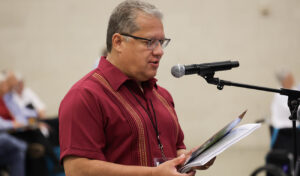
Ellis Orozco, a messenger from First Baptist Church in Richardson, introduced a motion that the BGCT “uphold the autonomy of the local church to affirm a member church’s authority to call women to congregational and vocational ministry as they, under the Lordship of Jesus Christ and the guidance of sacred Scripture, see fit.” (BGCT Photo)

Ellis Orozco, a messenger from First Baptist Church in Richardson, introduced a motion that the BGCT “uphold the autonomy of the local church to affirm a member church’s authority to call women to congregational and vocational ministry as they, under the Lordship of Jesus Christ and the guidance of sacred Scripture, see fit.”

President Julio Guarneri referred both motions to the committee on the annual meeting for consideration at the second business session of the annual meeting on Tuesday, July 18.

Contrast to SBC action

Both motions stand in sharp contrast to actions taken last month during the Southern Baptist Convention annual meeting, where messengers upheld the ouster of two congregations—Fern Creek Baptist Church in Louisville, Ky., and Saddleback Church in Southern California—for allowing women to serve as pastor.

Messengers to the SBC also granted initial approval to a constitutional amendment that limits the office of pastor to men. The amendment—which stipulates a cooperating Southern Baptist church “affirms, appoints, or employs only men as any kind of pastor or elder as qualified by Scripture”—requires two-thirds approval at two consecutive annual meetings. So, it will face a second vote at the 2024 SBC annual meeting.

In an opinion article published in the Baptist Standard last week, Stone noted both the BGCT and the Baptist General Association of Virginia “hold unique positions as state Baptist conventions that endorse local church autonomy with regard to women’s roles in leadership as ministers and pastors.”

Stone, executive director of Baptist Women in Ministry, asserted, “In moments like these, neutrality is not enough.”

“Pointing to local church autonomy is the equivalent of taking a neutral position on women in ministry. When a neutral position is taken on any issue of oppression, the dominant position and practice simply continues. When we are silent, nothing changes,” Stone insisted.

Orozco, in an interview with the Baptist Standard, said he introduced his motion to accomplish two goals—“to affirm the high role of women in ministry of women in our churches who serve in myriad ways and to affirm the actions of every local church to call anyone to any position.”

“It is a decision left to the local church, not mandated by a convention,” he said.

In other business, messengers to the BGCT:

  • Re-elected Guarneri, pastor of Calvary Baptist Church in McAllen, to a second one-year term as president and elected Ronny Marriott, pastor of First Baptist Church in Burleson, as first vice president.

Messengers marked ballots to determine the outcome of the only contested race—between Debbie Potter, minister of children at Trinity Baptist Church in San Antonio, and Glenn Lackey, layman at Canyon Creek Baptist Church in Temple and co-founder of the First Blessings ministry. Results will be announced during the July 18 business session.

Two officers were elected by unanimous consent—Bernie Spooner from Plymouth Park Baptist Church in Irving as secretary of the corporation and David Cozart from Meadowbrook Baptist Church in Waco as registration secretary.

  • Heard a report on actions taken by the BGCT Executive Board presented by Chair Bobby Contreras. He reported the board voted to create a task force to study and recommend responses to sexual abuse issues in Texas Baptist churches. The nine-member task force will include three Executive Board members, three Texas Baptist pastors who are not on the board and three licensed counselors who are not on the board.

The Executive Board report included action taken in executive session on May 23 to declare two congregations—Woodland Baptist Church in San Antonio and Second Baptist Church in Lubbock—outside of “harmonious cooperation” with the convention for not complying with the BGCT position on human sexuality.

  • Approved new relationship agreements with Hendrick Medical Center and the Baptist Standard.

The relationship agreement with Hendrick Medical Center calls for the BGCT to elect no more than 20 percent of the medical center’s board of directors. Currently, messengers to the BGCT annual meeting elect 75 percent of the board. The agreement calls for all board members to be members of BGCT-supporting churches.

The relationship agreement with the Baptist Standard states the BGCT and the Baptist Standard remain “autonomous and independent organizations.” The BGCT will continue to elect a simple majority of the Baptist Standard’s board of directors, and the agreement stipulates all directors on the board will be “members in good standing” of Baptist churches.


Orozco: Devotion and generosity should mark God’s family

MCALLEN—In its earliest days, devotion and generosity characterized Christ’s church—the household of God, Ellis Orozco told the opening session of Texas Baptists’ Family Gathering in McAllen.

Those same things to which the first century Christians were devoted and the same areas in which they demonstrated generosity should mark the family of God today, he insisted.

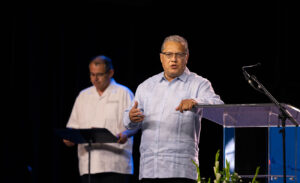
Ellis Orozco preached about the devotion and generosity that characterized the early church. As Orozco preached in English, Jesse Rincones, executive director of Convención Bautista Hispana de Texas, translated the sermon into Spanish. (Photo / Robbie Rogers)

Orozco, a longtime Texas Baptist pastor and now public theologian in residence at Stark College and Seminary and coach to pastors with Karooso Ministries, spoke about his own family of origin.

As Orozco preached in English, Jesse Rincones, executive director of Convención Bautista Hispana de Texas, translated the sermon into Spanish.

Orozco recalled his grandfather, who left Monterrey, Mexico, in 1919 and moved to Texas. His grandfather eventually built a home and raised nine children in a small house on five acres at the end of a caliche road south of Houston.

In time, the entire extended family—Orozco’s parents, his father’s brothers and sisters, and their wives and children—all built homes along that caliche road.

When two of his father’s brothers died, Orozco recalled how his dad provided for the two young widows and helped raise their children, eventually putting three girls through college.

When Orozco grew up and asked his father why he had sacrificed so much and given so much for children who were not his own, he replied: “They’re family. That’s what you do for family.”

Likewise, the early church lived as family—a household deeply devoted to the Scriptures, to fellowship, to remembering Jesus through the breaking of bread and to prayer.

Orozco again recalled his grandfather’s words to him: “Never forget who you are and where you came from. Never forget your people.”

The same holds true for the household of God, he asserted.

“We are forgetful creatures. We need to be reminded,” Orozco said. “Never forget who you are in Christ. Never forget who your family is in Christ.”

Demonstrating generosity

The household of God as seen in Acts 2 demonstrated generosity in four ways, he noted:

  • Sharing resources. Many who became followers of Christ were ostracized by their communities and disowned by their families, Orozco said.

“The church—their new family—was the only family they had left, the only community they had left,” he said.

The church provided for its members quite naturally, Orozco observed, noting the lesson he learned from his father.

“That’s what family does. We take care of each other,” he said.

  • Giving to those in need. The household of God willingly sold their goods to meet the real needs of others as prompted by the Holy Spirit, he noted.
  • Indiscriminate hospitality. The early Christians went to the temple court, where they knew people were gathered, and issued blanket invitations to fellowship meals in their own homes.
  • Sharing Jesus with the world. Jesus provided the greatest imaginable evangelistic strategy the night he washed his disciples’ feet, commanded them to do the same, and told them the world would know they were his followers by the love they showed to one another, Orozco said.

“When the world looks at your church, what do they see? Do they see a church with arms open wide, or a church with clenched fists, fighting each other and fighting the world?” he asked.

Serve the Savior, not fight culture wars

Rather than see people in the world as enemies who must be defeated in a culture war, Christ’s church is called to show the love of Jesus, he insisted.

“I’m not called by God to save our culture or to preserve some nostalgic view of the American dream. … I’m not called to fight some culture war. I’m called to serve the one who said to love one another, to love your enemies and to turn the other cheek,” Orozco said.

“All empires will fade away. All manmade institutions will die. But Jesus will still reign. The church will still live on.”

Christians are called to “do the hard thing” and take a courageous “leap of faith” into the kind of life Christ demonstrated, he asserted.

“In our polarized world, it’s difficult to choose love over hate, hospitality over discrimination, kindness over acrimony, and prayer over criticism. It’s hard,” he said.

It takes courage to “stand with the oppressed, the marginalized and the foreigner,” he acknowledged.

“But if you muster the courage to do it, you find yourself in good company.”


TBM helps church rebuild deteriorated home

SEAGOVILLE—After a lifetime of serving others, an elderly couple living in Seagoville had their well-worn home blessed by the service of a nearby church, their community and Texas Baptist Men volunteers.

Gary Carrier worked as a plumber and provided service to others earlier in his life, said John Hanson, project coordinator. Since then, Carrier has retired and suffers from moderate Alzheimer’s, which has caused difficulty in maintaining his own home.

Gary and Yvonne Carrier’s daughter, Tammy Norton, often sent contractors to assess the house’s condition and determine the cost of restoring it to decent shape.

However, most contractors offered services that would only partially repair issues or would give an estimate that exceeded what the couple could afford.

‘The Lord has been so faithful’

Norton voiced her frustrations to her in-laws, John and Cherlyn Hanson. With time, Norton said, “I surrendered it, and the Lord has been so faithful.”

The Hansons wanted to help the Carriers. They knew they needed to start with their church, Central Baptist in Crandall, which happens to be where David Wells, TBM state director of disaster relief, also is a member.

Hanson came to the church’s Great Commandment Team, and the group agreed to pray and work with him in pursuing the project, Wells said. Various church members donated siding, windows, flooring, paint and other materials and labor. TBM installed drywall.

“I saw God’s hands all over this as a lot of people became the hands and feet of Jesus, coming together to make the impossible possible,” Wells said.

When the project began, the house’s condition was almost unlivable. Pier and beam floors had completely worn away from termites.

“The decking completely rotted—so much that if someone walked on it, they could fall through,” said Curt Neal, director of TBM’s Collin County rebuild team.

Water damage had impacted drywall and wiring throughout the home, Hanson noted.

 “With time, the wiring could have caused a fire,” he said.

Additionally, windows throughout the house had no insulation, leaving the elderly couple feeling extreme weather conditions throughout the year. Ultimately, the house was in horrible condition and needed a miracle.

‘There’s nothing that God won’t help us do’

Although it was a huge challenge, Hanson said, “There’s nothing that God won’t help us do.”

Beginning May 15, about a dozen volunteers came to work on the house. Each volunteer gave up countless hours to serve the Carriers.

“Many volunteers have never served with TBM, yet their efforts made a significant difference,” said Rupert Robbins, associate director of disaster relief.

TBM volunteers hung and taped 75 drywall sheets around the house in five days. Church volunteers put in all-new floor beams.

Norton was impressed by how the team was “thinking about my parents’ needs and making the home handicap accessible for them. They have gone above and beyond.”

Volunteers built a laundry room, installed an easily accessible shower, installed new siding around the exterior, insulated windows and installed new electrical wiring throughout the house.

‘Display the love of Jesus’

Church members, friends and family covered all expenses needed to complete the rebuild for the Carriers, Neal said.

“Many people donated everything for this project, because this couple had no resources to complete it on their own,” Neal said. “The ultimate purpose of this project was to display the love of Jesus to such a deserving couple.”

The house will be like new in the coming weeks, and the Carriers will not have spent a penny. Norton said here parents “are overwhelmed and grateful beyond belief.”

Faith Dawood is a communications intern serving this summer with Texas Baptist Men. 


Wayland mission team ministers in rural Honduran villages

PLAINVIEW—Seven Wayland Baptist University students and two faculty members traveled to rural Honduras this summer, where they conducted door-to-door medical visits and participated in children’s ministry activities.

Luke Brockway provides medical services to a woman in a village in Honduras during Wayland Baptist University’s summer mission trip to the area. (WBU Photo)

Working closely with Dr. Jason Brockway, a physician from Kilgore, the mission team offered basic medical services to children and adults in small villages near Valle de Angeles, Honduras.

Adam Reinhart, dean of the Kenneth L. Mattox School of Mathematics and Sciences, and Donnie Brown, director of spiritual life at Wayland Baptist University led the team. Student team members were Jazmin Ortega, Bruna Moureira, Sidney Perez, Kali Garza, Luke Brockway, Dylan Dodd and Christopher Chadwick.

It marked the fifth time a Wayland medical mission team has traveled to Honduras in the last 10 years, Joseph Denton from Tree of Life International noted.

“Their dedication and contribution of work, love and encouragement has greatly blessed the people of Honduras, us personally, and our ministry,” Denton said.

The door-to-door medical visits took place in rural villages where Tree of Life International’s long-term mission team operates. The Wayland students collaborated with Denton and Brockway, while conducting the medical visits.

“This immersive experience allowed the students to gain a deeper understanding of the medical and spiritual culture within rural Honduran villages,” Reinhart said.

Wayland students have ministered to more than 500 children and adults in Honduran villages, Reinhart explained. During these visits, students dedicate significant time to praying for the individuals they encounter, while also providing much-needed medication and antiparasitic treatment.

In addition to the medical visits, the Wayland team assisted with children’s ministry in the villages. At each location, they helped children participate in a fun, Bible-based program in which they served meals, played games and provided practical assistance in various ways.


Italy pastor pitches in when he can with disaster relief

Joseph Barrett took time away from his pastoral duties recently to lend a hand when the Ellis County disaster relief chainsaw team responded after a storm toppled trees across a broad swath north of Corsicana.

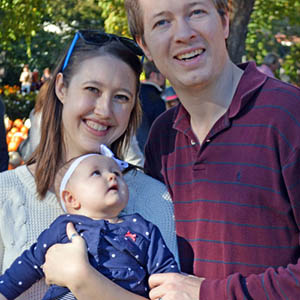
Pastor Joseph Barrett is pictured with his wife Natalie and daughter Tessa. (Courtesy Photo)

Barrett is pastor of Central Baptist Church in Italy and became a trained Texas Baptist Men disaster relief volunteer last year.

“I don’t get to volunteer that much because I’m a full-time pastor, but I happened to be able to take some time” at the end of the week, he said.

He mentioned two reasons for being a TBM disaster relief volunteer: “It’s a chance to do something different and in a different environment. … [and] getting your boots on the ground is enlivening to your church body.”

Several members of Central Baptist are TBM volunteers. Barrett has encouraged involvement in ministry through TBM, and “I push it every time there’s a training around,” he said.

TBM and its regional partners plan multiple training events around the state each year, many in the spring. Disaster relief training opportunities are listed on the TBM Events page.

David Hardage, a longtime Baptist pastor and retired executive director of the Baptist General Convention of Texas, promotes church engagement through TBM.

“When a pastor leads the way in church ministry, whatever that ministry is, the congregation tends to give more credibility to the ministry, as well as making positive decisions to be involved themselves,” he said.

Barrett said he likes setting an example of service, but he added, “I wouldn’t want to represent it like I did something special.”

Other volunteers, many retired, had worked in Corsicana the entire week before the pastor arrived.

And his thoughts were with his congregation.

“Getting buy-in from other members is easy to accomplish if you’re buying in yourself,” he said.


UMHB students of yesteryear had to follow curious rules

When in Louisiana, don’t even think about sending anyone a surprise pizza, or you may face a hefty $500 fine. And, next time you’re in Denver, avoid driving a black car on a Sunday.

Even though laws like these two are outdat­ed and no longer enforced, some bizarre laws remain on the books. Many were in place more than a century ago when they may—or may not—have made more sense.

During the early years of the University of Mary Hardin-Baylor, the school also had its fair share of unusual rules.

Some rules from the early 1900s may seem like common sense now, like “Do not pull flowers” and “Do not throw trash out of windows.”

But many rules that guided student behavior during this time came from Elli Moore Townsend, who oversaw the first work-study program for women in Texas called the Cottage Home System. According to museum records, six of the first 12 girls in the program were orphans, and all came from abject poverty.

“They were deserving girls, but they were very, very poor and had no means to go to college,” said Beth Norvell, associate director of museum and alumni engagement.

She speculates some rules perhaps were drafted specifically for the orphaned girls, because they hadn’t been exposed to common formalities of the day.

Mrs. Townsend’s Household Directory from the early 1920s laid every­thing out for them:

  • Each girl must bathe at least twice a week in summer and once a week in the winter.
  • No candy making, except on the first Monday.
  • Do not walk on the floor without your shoes from Oct. 1 until April 21.
  • You can read but three novels a year, unless required in your schoolwork.
  • With the permission of their parents, girls may spend the Christmas holidays at home. One other trip home is allowed those whose round-trip ticket does not exceed $300.

During these early years, the dining hall had some strict rules around proper etiquette—along with many other guidelines—ladies were expected to follow. Students stood behind their chairs while prayers were said.

At each meal, the head of the table appoint­ed a “table critic” whose duty was to see that proper etiquette was observed.

Table rules included:

  • Do not crumble bread into the soup.
  • Do not chew when passing food.
  • Do not sop from the plates.
  • Do not use the knife to carry food to the mouth.
  • Always talk on pleasant subjects at the table, but do not talk or laugh too loudly.
  • You are not excused from the supper table until after the bell rings.

Even though Mrs. Townsend was a stickler for the rules, students appreciated and respected her, even calling her their “Shepherdess.”

“The Cottage Girls definitely had a bond with her, and I think they knew she was giving them an oppor­tunity to get an education they wouldn’t have gotten otherwise,” Norvell said.

She points out Mrs. Townsend had a nurturing and motherly side to her and provided spiritual guidance to the stu­dents.

“They viewed those rules as much as an education as the education itself, because the rules taught them how to operate within a lifestyle that they had never been accustomed to,” she noted.

Mrs. Townsend always wanted her girls to feel at home and reminded them the dormitories were “home and not a boarding house.”

House­hold rules included:

  • Never use a chaffing dish in your room after 9:30 on Saturday evenings and after 8:00 Sunday morning.
  • Do not sleep between blankets but between sheets.
  • Never sweep dirt from rooms into halls.
  • Never do other people’s laundry.
  • Upon the discovery of a fire … slip on kimono and slippers and hasten to assigned exit.
  • Never run, whistle, call or laugh loudly in the halls; or call from one floor to another, or from one building to another, or out of the window to those on the ground, except from the first floor.

Keeping the Sabbath was not optional. The house chairman—now known as a resident assistant—had the uncomfortable job of making sure every student went to church, even if it meant pulling her from hiding places in closets and under the bed.

Students also were expected to know and follow specific correspondence rules about how, when and to whom they could write.

Rules governing correspondence:

  • You must write your home people at least once a month.
  • You can correspond with but one young man. Only in some special cases can you write to a young man oftener than once a month.
  • All letters must be written with pen and ink.
  • Do not open your mail in the dining room.
  • No letter-writing during study hall or study hours.
  • No mail is to be sent off until it has passed through the girl’s hands who tends to the mail. Except it be sent by Mrs. Townsend.

From the rules and regulations she has come across, Norvell said she sees a strong desire to protect not only the college’s reputation as a place where “daughters would be safe,” but also to protect the girl’s reputation.

“I feel like a lot of their value was wrapped up in how well-behaved they were,” she said. “The letters parents were writing to the college back then were very specific with instructions like ‘Don’t let my child ride with boys in the car’ or ‘Don’t let my daughter hang out with this person.’”

Strict curfews imposed

By today’s standards, the rules from around 100 years ago may now be considered unusually strict, especially when it came to leaving campus, hanging out with boys and meeting curfew.

“Students will not be permitted to go with boys on the blacklist.” And “every girl must be in by 10:10 on Saturday night.”

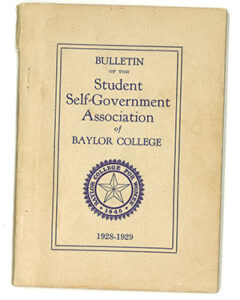
According to the 1928-29 Student Self-Govern­ment Association handbook, first-year students could go into Belton with permission two times each week in groups of two, but only on Monday morning or during the afternoons. Special permission to go shop­ping in Temple with a chaperone could be secured from the hostess.
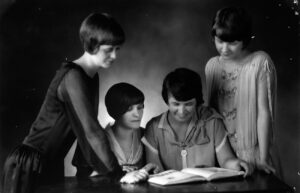
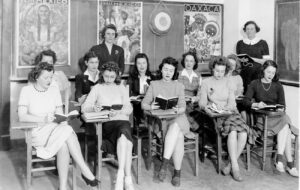
Freshmen were also allowed three visits from young men friends three times a month in the college parlors, provided they had direct written permission from a parent or guardian. Permission to “go riding with friends” was granted at the discretion of the hostess, but only if they were “properly chaper­oned.”

Upper-class students unquestionably had the most freedom and could “go walking, shopping or visiting any time,” but only if it didn’t interfere with schoolwork and they were back by 10:30 p.m.

They also had the special privilege of walking to the post office on Sunday afternoons and playing “popular music in the Senior room at any time except on Sunday.”

Dreaded ‘call downs’ in chapel

For less severe offenses, students who broke the rules could receive demerits or even “call downs,” where names of the misbehaving pupils were read aloud during chapel services.

“Shame is a great motivator,” Norvell said with a chuckle, pointing out that a “call down” was probably today’s equivalent of outing a friend via a social media blast.

“It had to be super embarrassing,” she said. “I don’t think it promoted sisterly affection when you have these girls who are not only spying but tattling. I feel like that would have isolated some people, and it gave the students a lot of control. I think at that time, may­be, the mindset was a little different. They viewed it in a more protective way.”

For more serious offenses or if trouble with a student intensified, parents received detailed letters of their daughters’ mischief.

In a letter dated Nov. 25, 1919, Opal’s parents learned she got caught “riding with some boys in a car,” which was cause for a trial and fines. The letter informed Opal’s parents she “had to appear in court as a witness against them, and I hope that she has learned a lesson that will stay with her through life.”

And when students were deemed uncontrolla­ble, like Anna Bell in July 1919, they were sent back home. In a letter to her parents, the school apologeti­cally reported Anna Bell was “defiantly disobeying our rules and regulations.”

In the 1920s, Mary Hardin-Baylor President John Hardy required written permission from home before a girl could bob her hair.

The writer continued that she was “a bright girl, and I have tried my best to help her overcome the desire to do wrong. … I sincerely hope that you can place Anna Bell somewhere where she will have a greater desire to do right than she has here.”

In 1922, the school president, John Hardy, requested no more girls “bob their hair without written permission from home.” Uniforms were part of the students’ attire in the early years.

“Ladies were required to dress in stark, unadorned clothes to promote unity within the student body,” Norvell said. There were even rules about how much jewelry one could wear and an etiquette class on how makeup should be applied.

The Bobby Sock Rebellion

But perhaps one of the most disliked rules was the one that led to a confrontation in front of Hardy Hall—the notorious “Bobby Sock Rebellion.”

Thanks to the “Bobby Sock Rebellion” of 1937, hosiery was no longer required attire for class.

Almost a century ago, students were required to wear silk stock­ings, and socks were prohibited except during physical education classes. Their hosiery constantly snagged on the wooden classroom chairs, which proved to be a costly snafu.

After protesting, the administration finally allowed students to wear socks to class the following semester in the fall of 1938, but they still were required to wear hosiery when going into downtown Belton.

“It’s one of my favorite stories because they were rebellious,” Norvell said. “It wasn’t practical anymore, and the girls wanted practicality, and the administration just wasn’t catching up.”

As the decades passed, the school saw other rules evolve, like in the 1970s when trousers became fashionable for women. Until then, women were required to wear skirts and dresses, except in physical education class. When the campus went co-ed in 1971, the rules in the student handbook changed again to accommodate more men on campus.

Readers in 2023 may find themselves chuckling or even scoffing at some of these outlandish early edicts. However amusing they may be, it’s worth considering a word of advice from the 1928-29 Student Self-Government Association hand­book: “DON’T FORGET—That the person who finds rules unreasonable is regarded as the one who usually needs restrictions.”

This article originally appeared in UMHB Life Magazine and is republished with permission. 


Volunteers help North Texas family recover from house fire

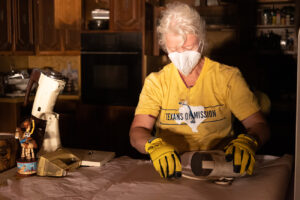
Mark Korenek sat in a chair in the middle of his burned-out Grand Prairie home looking a little overwhelmed. Soot-covered Texas Baptist Men volunteers swirled around him, some with wheelbarrows, moving charred personal items from the fire that burned his home in January.

TBM volunteers showed the love of Christ by removing debris—and recovering treasured personal items—from a burned-out home in Grand Prairie. (TBM Photo)

The sound of a revving skid steer moving everything from sheetrock to clothing into a massive 40-yard trash container threatened to drown him out as he recalled the tragedy that burned the home he shares with his wife, Karen, and sent him to the hospital for almost two months.

“It was Jan. 12,” he recalled. “I got up and got my wife off to work at First Baptist Church Dallas and went back to bed for an hour. At 6:30, the smoke alarm sounded. The fire started far away from me but traveled through the attic.

“When I woke up, I could see nothing because of the smoke. I grabbed my cell phone, ran to the hall and saw nothing but flames.”

His call was recorded by 911 at 6:32 a.m.

 “I told them, ‘I’m going to be in the back yard, I have five dogs and no one else is in the house,’” said Korenek. “I crawled down the hall and went to the backyard. I fainted going through the back door. I felt myself fainting and rolled on my back. I knew when the firemen arrived, but I never really came out of it.”

Three of his dogs made it out with him. Two died in the home, overcome by smoke. While not injured by the flames, Korenek spent months recovering from the effects of smoke inhalation.

“The firemen hit me with a shot,” he explained. “The chemicals in our house produced cyanide. The shot was used to draw the cyanide out of my body. They took me to Parkland (Hospital), and Parkland put me in a medical coma for four weeks. Their job was cleaning my lungs. My kidneys shut down. My pancreas shut down.

“I am told by the nurses I coded (ceased heartbeat) five times,” he said. “It was awful for my wife, Karen. She’d be holding my hand, and I’d code, and they’d kick her out.”

When Korenek woke from his coma, he said his medical team “reminded me I was in the fire, and then they began the trauma of dialysis and put me on insulin because my pancreas had shut down.” He  was intubated four weeks to clean his lungs.

Still sitting in his chair, Korenek grinned as he said: “I’m happy to say I lost 72 pounds, … the wrong way. They got me up the next day and started me walking. I was there until late February. I think I witnessed to every nurse there with the message, ‘God saved me.’”

Speech therapy and psychiatric tests followed to see if the smoke inhalation had affected his brain. He began rehabilitation, and his latest round of tests indicate no permanent damage.

‘We knew we’d need an army’

Mark Korenek of Grand Prairie, whose home burned in January, appreciated the recovery ministry of TBM volunteers Curt and Ann Neal and the teams they coordinated. (TBM Photo)

As he wrapped up his story, TBM volunteers continued to swarm around him, busily moving the remains of the home to the trash dumpsters.

By the end of the week, 45 volunteers helped reduce the house down to its studs to prepare the family for the next step of recovery.

Sabrina Pinales, TBM ministry advancement coordinator, called the week “a two-team effort. We have several trained disaster relief volunteers on site, and we also have day volunteers who have a desire to serve.”

TBM volunteer Curt Neal, the on-site coordinator, called the week-long project “unique.”

“We solicited anyone and everyone who would help. We knew we’d need an army, because the house was full of things,” Neal said. “This couple are collectors, which made the cleanout task more difficult.”

Since Mark and Karen Korenek are collectors, TBM volunteers gave special attention to recovering and storing items found in their burned-out home. (TBM Photo)

By the end of the week, the TBM team removed five 40-yard and five 30-yard trash containers of material and possessions from the home.

Neal’s wife Ann served as a coordinator at the site, as well as trailer manager and chaplain to the volunteers and homeowners. She said the project embodies TBM’s desire to bring “help, hope and healing.”

“When we first come in, we’re help, but after even a few minutes, you quickly see the hope. When you get to this point in a clean out, survivors are seeing things get back on track,” she said.

“We’ve seen (Mark) break down and cry, and (Karen) has broken down and cried several times today. I told them, ‘We’re cleaning out your house, but we’re here for you, to love on you, and do whatever you need.’”

Volunteer Jan Rahmandar echoed the sentiment.

“I came out to show God’s love. I can only do one day, but God said, ‘Go do what you can do.’ I’m pulling nails because it helps the homeowner get back on his feet,” Rahmandar said.

“It’s a job that’s overwhelming for the family,” volunteer Steve Glover agreed. “We’re helping get them organized so insurance can come in.

“TBM is a family, and what a great witness it is to this family to know we’re doing it and asking nothing in return.”


Neighbors help each other after tornado hits Matador

Members of First Baptist Church in Matador were gathered for their regularly scheduled mid-week prayer meeting June 21 when the worship service suddenly was disrupted.

Pastor Eddy Helms of First Baptist Church in Matador

“Everybody’s phones starting going off” with weather alerts, Pastor Eddy Helms said. “So, we left early and went home.”

At 8 p.m., an EF-3 tornado hit the western part of Matador, claiming four lives and injuring 15 people. Wind gusts between 145 mph and 165 mph destroyed 29 buildings and damaged at least 34 other homes and businesses in the town of 600.

“Praise God it wasn’t further east, where it’s a more heavily populated area,” Helms said.

Neither the 90-year-old First Baptist Church building nor the parsonage sustained any damage. Within 45 minutes after the tornado hit, Helms posted on the church’s Facebook page: “I can open the church for shelter if needed.”

A member of First Baptist Church who owns an Airbnb property offered the use of that house at no cost to a Matador resident who was left homeless after the tornado.

Among the church’s members, three households—one couple and two single individuals—sustained serious damage, Helms said. A young woman with disabilities lost her home.

“She will need a lot of help,” Helms said. But he quickly added the church received a significant donation three days after the tornado specifically to assist her.

Volunteers from neighboring town help

Meanwhile, 30 miles away, Paducah barely felt the effects of the tornado that devastated their neighboring community to the west.

“All we got was a little bit of a breeze and about 12 raindrops,” said Kyle Roach, pastor of First Baptist Church in Paducah.

Wind gusts between 145 mph and 165 mph destroyed 29 buildings and damaged at least 34 other homes and businesses in Matador, a town of 600. (Photo courtesy of Les Griffin)

The day after the tornado hit, Roach and several members of his church went to Matador to offer assistance.

“Kyle was on my front porch at 7:30 on Thursday morning,” Helms said.

Roach and his church members set up a grill on the front lawn at First Baptist Church in Matador to offer free meals to anyone who needed food. The volunteers from Paducah first prepared breakfast burritos and later grilled hamburgers.

During the first 24 hours after the tornado, Roach served as the point of contact for Texas Baptist Men and community ministry, enabling Helms to ensure the well-being of his congregation.

“Eddy drove around town and went by to check on every member of his church,” said Les Griffin, director of missions for Caprock Plains Baptist Association.

‘Angry’ storm left trail of destruction

At 8 p.m. on June 21, an EF-3 tornado hit the western part of Matador, claiming four lives and injuring 15 people. (Photo / Kyle Roach)

After Helms was able to care for his church members, he joined Roach and Griffin in driving around Matador to survey the damage.

“The storm didn’t cover of a lot of ground, but it was really angry,” Roach said.

They also visited with residents affected by the tornado.

“We just let people share their stories,” Roach said. “A lot of them were pretty well still in shock.”

He recalled meeting one Matador resident who ended up with a motorcycle pushed against the back of his garage after the tornado.

“And he didn’t own a motorcycle,” Roach said, noting he and others later located the motorcycle’s owner, who lived a half-mile away.

Another family discovered a car engine on their property.

“They didn’t know where the rest of the car was,” he said.

First responders on the scene

Search and rescue teams worked in Matador, looking for survivors and recovering fatalities. (Photo courtesy of Les Griffin)

Several members of First Baptist Church in Paducah who are part of the volunteer fire department also served as first responders in Matador, including participating in the search for casualties.

“They’re doing all right, but I’m sure they’ll be affected by what they saw,” Roach said. “Since they’re members of our church, I’ll keep tabs on them. They’re doing OK. They are where they probably need to be right now in terms of processing it.”

As the three ministers drove through the community, Roach was on the phone, coordinating volunteers and relaying information to Texas Baptist Men.

Griffin noted he was “totally amazed” by how quickly TBM responded to the Matador disaster, providing a generator at First Baptist Church the day after the tornado so the church building could be made available as a cooling station.

Fortunately, electricity was restored to the town by Thursday evening, and the generator was needed only briefly. TBM also dispatched a shower and laundry unit to Matador, but it was not needed once utilities were restored.

TBM also provided a box unit crew who distributed storage boxes to help residents affected by the storm collect recovered belongings.

‘God is good all the time’

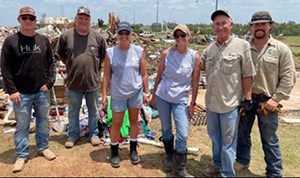
Volunteers from First Baptist Church in Quitaque served in Matador. Pictured are (left to right) Pastor Chris Tucker with Shad Schlueter, Christy Yates, Jamie Plumlee and Greg Ramsey, along with another volunteer who joined to help. (Photo courtesy of Caprock Plains Baptist Association)

Griffin noted a group from First Baptist Church in Quitaque brought a skid-steer to Matador and volunteers to help clear debris.

“They were very kind and helpful to separate the rubble from important personal belongings,” Griffin said. “All of our groups were sensitive to personal objects of others and seeking permission to clear things away. The Christ-like spirit of FBC Quitaque was appreciated by the family.”

On Sunday, June 25, members of First Baptist Church gathered to pray, sing and testify that “God is good all the time,” Helms said.

Griffin, who participated in the worship service, noted two commonplace greetings took on new meaning as the congregation gathered.

“When people said, ‘Glad to see you,’ they really meant it. And they asked each other, ‘How are you doing?’ But then they waited for a response. They really wanted to know how other people were doing,” he said.

Pastor Eddy Helms and his wife Joburta of First Baptist Church in Matador are pictured with Director of Missions Les Griffin and his wife Betty. (Caprock Plains Baptist Association Photo)

When Griffin briefly spoke during the service, he mentioned First Baptist Church in Muleshoe delivered two generators to Matador, including one that went to a member of First Baptist in Matador. He said a woman in the congregation immediately raised her hand and said, “That was me!”

Later in the worship service, that woman told the congregation: “It is a joy to be here, and I praise God for what he has done. I was in a closet talking to the Lord [when the tornado hit] but remained very calm. … I am thankful for my safety through the tornado, and I thank you for the electric generator.”

Helms delivered a brief sermon on “the hope of the Lord,” based on Ezekiel 37—the Old Testament prophet’s vision of a valley of dry bones restored to life by the breath of God.

‘Overflow’ of donations and volunteers

The next day, a report sent to TBM disaster relief volunteers stated: “TBM has completed all assigned work, and all volunteers and units have returned home. There was an overflow of skid-steers and volunteers from the surrounding communities, leaving the community able to take care of all needs.”

The “overflow” of donations and volunteer assistance was not limited to heavy equipment and those who operate it. Roach and his volunteers from Paducah were prepared to cook meals for an extended time, but they soon discovered other groups also offered free food at multiple locations.

“There were probably more places to go eat in Matador than there ever had been,” he said.

First Baptist Church in Matador served as a distribution center for several days after the tornado, providing donated clothing, water, toiletries and cleaning supplies to anyone who needed them.

“There was enough water donated to fill a swimming pool,” Griffin said.

About 200 cases of water filled the basement of Matador’s First Baptist Church building. Helms noted another community not far away needed water, and he hoped some of the bottled water at his church might benefit those people.

First Baptist planned to donate most of the surplus clothing to a crisis pregnancy center and a community ministry in Plainview, he added.

“We’ve just been blown away by the response of people from everywhere coming to help,” Helms said.

Griffin acknowledged he felt overwhelmed when he first learned about the tornado in Matador, and he said he hopes no other community in his area ever has a similar experience.

“But if it were to happen, I don’t think I will be as forlorn as I was last Wednesday night,” he said. “I’ve seen a reminder that God is good, and God’s people are good.”


Katie McCoy addresses female gender dysphoria

DALLAS (BP)—It’s not about pink dresses, blue button-downs, 18-wheelers or Barbies. For theologian Katie McCoy, dispelling gender dysphoria rests on Scripture undiluted by cultural stereotypes society assigns.

Neither is Scriptural truth in conflict with the science of gender dysphoria, McCoy said upon the release of her latest book intended to guide mothers and ministers in addressing the rapid onslaught of gender dysphoria among females.

“The theology of humanity, and the evidence that we’re seeing about all of gender dysphoria, its source, its treatment and its affects, they are in harmony,” McCoy said. “In other words, what secular sociologists, psychologists, endocrinologists, sexologists are all describing from their own perspectives of expertise, harmonizes with the truth that we find in Scripture of how God created humanity.”

Some of the scientific evidence is difficult to find, McCoy said, as it is typically not reported in mainstream media, or is dispelled to protect “politically prescribed narratives.”

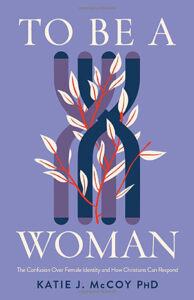
“But when all of the facts are known, the world of nature and the laws of nature confirm the laws of God,” McCoy said upon the release of To Be a Woman: The Confusion Over Female Identity and How Christians Can Respond.
McCoy, director of women’s ministry at the Baptist General Convention of Texas, gives guidance amid an onslaught of gender dysphoria and the denial of God’s created bilateral gender.

Rapid-Onset Gender Dysphoria, as termed by Brown University physician-scientist Lisa Littman, overwhelmingly affects biological females. Gender dysphoria was rare decades ago. It was more prevalent in boys, typically presenting itself between ages 2 and 4.

Long-simmering ideas boiling over

But in the last decade, McCoy’s research shows, it has skyrocketed. In 2007, the United States had only one gender clinic for adolescents. By 2021 there were at least 50.

“Gender confusion is not only just growing,” McCoy said. “It’s erupting, and by a landslide, it’s girls who seem to be most affected by the explosion.”

McCoy likens it to a crockpot of soup.

“The way we arrived at this moment is a little bit like throwing a lot of ingredients into a big pot to make a big soup. And into this soup are ideas about what it means to be human, to be happy, to be fulfilled, our relationship to society, and then even our relationship to our own bodies,” McCoy said.

“And these ideas have been allowed to simmer for decades, and we are just now seeing them come to fruition.”

McCoy wrote the book, she said, to assert that “female identity is socially guided, philosophically formed, relationally confirmed, biologically grounded and theologically bestowed.”

Address with Scripture and with love

Gender dysphoria should be addressed with Scripture and with love, two variables which are not in conflict. The problem should be addressed with an admission of societal sins and an acknowledgement of who God is.

“Jesus said the truth sets us free, and what a confession is, is to acknowledge with God what he says about who we are, what we believe and what we’ve done,” she said.

“We are presenting a truth that does not belong to us, because it doesn’t originate with us. We are messengers. We are ambassadors. And we’re not trying to make the world, somehow, exclusively, socially different. This is about protecting the image bearers of God from the self-inflicted harm that comes from denying their creator.”

She describes gender dysphoria not as a sin, but as a symptom of an underlying problem, trauma or a sense of not fitting into a societal peg.

“It can stem from things that are wrong, but the feeling of gender dysphoria is a feeling. It is something that is indicating an inner issue that is out of alignment,” she said. “And for so many girls and young women who have gender dysphoria … when they get to the root of it and fix that, so many times the gender dysphoria dissipates or resolves.”

To get to the truth of what it means to be a woman, McCoy dispels cultural stereotypes of gender that society has used for generations.

“We need to separate that which comes from the Bible and that which comes from culture,” McCoy said.

A biblical woman “will be a woman who evidences courage and boldness, but she does it according to her femaleness. And that will express itself in a different way, or present itself in a different way, than a man,” she said.

“This is where the cohesive union between our biological selves and our gender selves comes into play, because we don’t have to systematize these behaviors. Rather, if you have a woman who is trying to follow God faithfully in all of her life and relationships, she’s going to express that in her marriage relationship, in her ministry in the church, in her relationship to her children, in her priorities,” McCoy said, acknowledging that statements of faith are more detailed.

“In other words, if we allow simply how God created women to be and allow the Holy Spirit to guide them in their lives and relationships according to his word, I believe we’re going to see the true meaning of biblical womanhood.”


BGCT Family Gathering celebrates ‘Household of God’

McALLEN—The Baptist General Convention of Texas will gather for the 138th Annual Meeting on July 16-18 at the McAllen Convention Center.

Every five years, the BGCT annual meeting is a Family Gathering, held in conjunction with the Hispanic Baptist Convention, the African American Fellowship, and other ethnic and cultural partners.

The theme, from Ephesians 2:19, is coming together as the “Household of God” (or in Español, “La Familia de Dios”) and was chosen to reflect that unity.

 “At the Family Gathering, we will join our hearts together to celebrate our unity and diversity by sharing Christ—the good news of salvation available to all people—and showing love to God and others,” said Craig Christina, associate and acting executive director of Texas Baptists.

“Though there are many Christian denominations and nondenominational groups, there is no one exactly like Texas Baptists. Why not come to McAllen and help us celebrate and protect our cherished faith and unity that makes us one in him?”

Featured speakers include Greg Ammons, senior pastor of First Baptist Church in Garland; William Dwight McKissic, senior pastor of Cornerstone Baptist Church in Arlington; Ellis Orozco, coach to pastors for Kārooso Ministries and retired pastor of First Baptist Church of Richardson; and Thong Lun, senior pastor of Greater Houston Burmese Christian Fellowship.

Worship will be led by Ray Sanchez, pastor of worship and administration at First Baptist Church of Weslaco; the worship team from Calvary Baptist Church in McAllen; the Singing Men of Texas; Roy and Niya Cotton; and El Trio de Hoy.

During the business sessions, messengers will elect officers and vote on the 2024 proposed budget and on nominations for affiliated boards and ministries.

The committee on the annual meeting has chosen not to include resolutions in the convention’s business at the 2023 Family Gathering.

Julio Guarneri, president of Texas Baptists and lead pastor of Calvary McAllen said the decision was made in order to prioritize a focus on unity and worship among Texas Baptists.

“Because of the nature of the Family Gathering, this year our committee on the annual meeting has decided not to include resolutions in our business sessions,” Guarneri said. “Our focus will be on what unifies us both spiritually and missionally.”

Although no rallies will be held this year, several workshops and mission opportunities will be available. Attendees are encouraged to visit exhibit halls throughout the Family Gathering to learn more about Texas Baptists’ resources and partnering ministries and institutions. Several meals and receptions will be hosted by Texas Baptists’ ministries and partners.

 “The Texas Baptist Family Gathering this July will be an exciting time of celebration,” Guarneri said. “As we rally around the theme ‘Household of God’ based on Ephesians 2:19, we will rejoice in our unity in diversity.

“As our at-large family joins with the Hispanic Convention, the African American Fellowship, the Chinese Fellowship, the Vietnamese Fellowship and others, we will enjoy a rich time of worship, fellowship, inspiration and necessary business.”


UMHB professor answers God’s call to Estonia

Like many people around the world, Brenda and Dave Morton huddled around their TV last year, watching tensions escalate between Russia and Ukraine.

As the unrest grew and the Russian invasion of Ukraine neared, they answered countless calls from concerned family and friends.

“You’re not still going, are you?” they asked incredulously of their impending trip to Estonia, which borders Russia.

“We both just felt like God was telling us to go,” said Brenda Morton, an associate professor in the College of Education at the University of Mary Hardin-Baylor. “The State Department wasn’t telling us it was unsafe to go. There was no reason not to go.”

The Mortons headed to the airport Feb. 27, 2022, just three days after the invasion that killed thousands and instigated a mass exodus of refugees to nearby countries. Missile attacks continued as they waited at their gate to take off. Putting their faith in God, the couple left their doubts behind and boarded the plane to Estonia.

When they landed, American Embassy officials were there to meet them. Embassy personnel provided an emer­gency phone number for Marine Post One at the U.S. Embassy and an emergency evacuation plan to get out of the country fast—just in case.

Brenda Morton’s faith still was un­wavering. There was a reason God put her in Estonia as a Fulbright Specialist at that specific time. She just didn’t realize how big of a purpose God had in mind.

Training teachers to teach about trauma

Morton changed her clothes at Tallinn Airport and went straight to Tallinn University, where she walked into a classroom full of somber Estonians. A heaviness hung in the air.

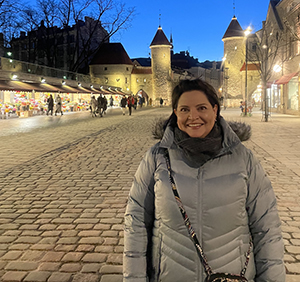
Brenda Morton enjoys her first evening in Old Town Tallinn. (UMHB Photo)

For more than 50 years, until 1991, Estonia suffered under Soviet occupation, and Russia’s invasion of Ukraine conjured memories Estonians tried hard to forget.

“They see themselves in the story of the Ukrainian people, because it was also their story—their shared story,” Morton explained. “So, the fact that I’m in a country dealing with a lot of historical trauma made it a unique time to be there.”

For four and a half weeks, Morton’s job was to pro­vide educational tools and train educators and students to teach others about trauma. It was easy to see the irony in her situation, but Morton looks back now and knows it was no coincidence she was there to teach trauma.

Because of funding, the pandemic and other reasons, her trip to Estonia had been canceled or re­scheduled at least three times. Still, every twist and turn in her journey led her to that exact time and place to help traumatized Estonians when they needed it most.

“God had a plan for all of this,” said Morton, who has taught classes online for Tallinn University since 2019. “There was never a time we felt like we were in danger or unsafe. If anything, we felt like God postponed this trip on three separate occasions, and he put us in this country three days after the war began. There’s a reason we’re here.”

Fell in love with Estonia

The Mortons’ first encounter with Estonia was during a vacation trip to Finland in 2015. On a whim, they decided to take a ferry to visit Estonia for four days and fell in love with the country.

When Brenda Morton walked into her classroom last year, her heart went out to her students as she saw the tension and fear on their faces.

“I had a student that started to cry, which is culturally unheard of,” she said. “Students were asking permission to have their phones out, because they wanted to be able to contact relatives if the sirens went off and we needed to take shelter. I even had a student who asked to bring her baby to class the next day, because she didn’t want to be more than seven minutes away from her child. You could feel the anxiety and stress in the country was just palpable.”

God prepared Morton

Morton didn’t just decide on a whim to go through trauma training.

“I thought I did, but there’s no way. I see that God prepared me to come to this place at this time to do this particular work,” she said.

God began preparing her more than a decade earlier when she was finishing her last year as a high school teacher.

“I had a foster child in one of my English courses. I didn’t know anything about foster care, and the more I got to know these kids and their backstories, I felt like God was asking us to become foster parents,” she said.

The Mortons set out to learn more. They went through the foster training and filled out all the forms.

“God’s got a sense of humor,” Brenda Morton recalled with a chuckle. “We asked to foster one child, a girl, and we wanted her to be younger than my youngest child. God sent us a sibling group of four.”

What she learned during her experience as a foster parent became the basis for her dissertation on foster care.

“No one is talking about trauma when it comes to these foster kids,” she discovered. “I started asking questions, and nobody knew the answers. I realized that these are kids hidden in plain sight.”

Eager to learn more, she enrolled in a postdoctoral cer­tification program in trauma and started working with the Oregon Department of Human Services doing advocacy around foster care.

The story of God’s preparation continues

Two years before coming to UMHB, Morton worked as a professor at George Fox University in Oregon. She was named a Fulbright Scholar to Estonia and spent seven months at the University of Tartu.

While there, a friend at the U.S. Embassy encouraged her to apply to come back again and continue her work as a Fulbright Specialist, which is how she ended up in Estonia last February to teach trauma-informed practices.

But her story didn’t end there.

After her trip as a Fulbright Scholar to Estonia, the couple began looking to move to Texas, where their oldest daughter had moved. As Morton began exploring opportunities, she was also working on a research project that connected her to Aida Ramos, who had worked as an associate professor in the College of Humanities and Sciences at UMHB. That’s when Morton learned about UMHB and an open teaching position in the Col­lege of Education.

“When I interviewed, I thought, ‘Wow, this is an amaz­ing group of people.’ At the time, I was interviewing at several other institutions and didn’t feel the same about them. When I came to the UMHB campus, I walked away feeling like there’s something different here,” she said.

After joining UMHB two years ago, she received a re­search grant that allowed her to interview 55 foster care students enrolled in a Texas college or university. The research is the basis for another book she is writing about children in the system and their experiences getting into college. She plans to use the book in her trauma class at UMHB as part of the educational advocacy program.

“There are a lot of barriers to them being successful, and all of that is trauma-based,” she said.

Since she began working with Estonians, Morton has helped train more than 300 Estonian teachers on trauma.

She also recently began a new project with a friend at the University of Tartu, creating a video series on trau­ma-informed practices, and will be offering a trauma class at UMHB next fall and spring. Most recently at UMHB, she wrote the curriculum for the first study-abroad trip to Estonia and is preparing to take her first group of students in May 2024.

“We will use the University of Tartu as our home base, and I’ll take them to see what a com­munity church looks and feels like, which is very different than anything experienced here,” she said.

When Morton reflects on the path God put her on to help Estonians through one of their most difficult times, she feels overwhelmed by God’s blessing.

“It was a blessing to be able to do something to be helpful—a great feeling like I was able to do something to help both the Estonian people and the Ukrainians in a country that was dealing with so much,” she said. “All of it was just a blessing.”

This story is republished by permission from UMHB Life Magazine.