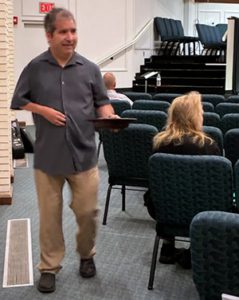
David Barton to advise Texas State Board of Education
David Barton, a conservative Christian activist who considers the separation of church and state a myth, will serve as an “expert content adviser” to the Texas State Board of Education when it develops new state standards for teaching social studies.

Barton is founding president of WallBuilders, an Aledo-based organization devoted to teaching what it calls “the true story of America and our Biblical foundation,” according to the group’s website.
Two members of the board—Julie Pickren of Pearland and Brandon Hall of Aledo—announced Barton as their choice to serve in the advisory role. Barton, a former vice chair of the Republican Party of Texas, served in a similar role in 2010 when the board revised social studies state standards.
“I am excited for the State of Texas to retain the expertise of someone I believe to be the foremost American historian of our day,” Hall posted on Facebook. He pointed to Barton’s appointment as the fulfillment of a campaign promise he made.
Barton holds an undergraduate degree in religious education from Oral Roberts University. While WallBuilders describes him as an “expert in historical and constitutional issues,” Barton holds no formal educational credentials in either history or constitutional law.
Book withdrawn by publisher
In the press release announcing Barton’s appointment, Pickren and Hall referred to him as “a recognized author of numerous works on American history and a highly sought after speaker and lecturer.”
In 2012, Christian publisher Thomas Nelson withdrew one of Barton’s books, The Jefferson Lies: Exposing the Myths You’ve Always Believed About Thomas Jefferson, because the publisher had “lost confidence” in the book’s historical details.
WND Books, a publishing house related to the far-right media outlet formerly known as WorldNetDaily, released a revised version of the book in 2016.
Pickren and Hall said they look forward to working with Barton and other advisers “to craft standards that will equip the next generation of students to become well-educated, proud Texans and patriotic Americans.”
‘Propensity to misquote, misinterpret or manufacture quotations’
Baptist historian Mike Williams acknowledged Barton “deserves some credit for trying to answer progressive secularists” who have downplayed the role of faith in U.S. history and who “lampooned evangelicals as redneck fundamentalists from the backwoods of the Deep South.”
“Unfortunately, he ignores the truth about Christianity and religion in colonial America: Religious faith was far more diverse in its origins than just the Puritans and those he incorrectly identifies as evangelicals among the founders,” said Williams, a recently retired professor of history.
“He forgets or never learned something I stress to students from freshman history to graduate courses—context, context, context. His propensity to misquote, misinterpret or manufacture quotations causes most of what he writes to be ignored by legitimate evangelical historians, political scientists and theologians.
“Such inaccuracies hurt historians who are clearly Christian from being respected in broader academic circles and makes them work harder to prove their ideas are valid. His writings seem to confirm to non-Christians that Christians are all lying hypocrites who ‘can’t handle the truth.’”
If the State Board of Education considers Barton an expert adviser, Williams suggested the board also include legitimate historians and political scientists “as a counterweight to what might be considered ‘fake history.’”
Promoting a ‘false narrative’

Amanda Tyler, executive director of the Baptist Joint Committee for Religious Liberty, also critiqued Barton for promoting a “false narrative” about U.S. history.
“For decades, David Barton has consistently pushed the false narrative that America was founded as a Christian nation, legally and historically. It is deeply concerning that he will be advising the State Board of Education on social studies standards in Texas,” Tyler said.
“The ‘Christian nation’ mythology is easily rebutted by reference to constitutional text and history. We should be preparing Texas students to live in an increasingly pluralistic country by teaching them accurate history, not a cherry-picked, false narrative that furthers theocratic interests.”
John Litzler, public policy director for Texas Baptists’ Christian Life Commission, also noted “serious concerns” raised about Barton’s “version of the historical record of the United States and the veracity of several of his claims.”
Separation of church and state ‘neither a myth nor a modern invention’
Texas Baptists particularly should be concerned about Barton’s statements denying the separation of church and state, Litzler said.

“Separation of church and state is neither a myth nor a modern invention. Baptist ministers like John Leland and Isaac Backus were instrumental in ensuring both the establishment and free exercise clauses of the First Amendment were included in our nation’s Bill of Rights,” Litzler said.
He noted Thomas Jefferson wrote his famous words about a “wall of separation between church and state” in direct response to the Danbury Baptist Association in Connecticut, whose religious liberties were being infringed upon by the government-established church in their state.
“From our earliest days, Baptists have been pioneers in including separation as a key element of religious freedom in our articles of faith. Every version of the Baptist Faith and Message contains the simple statement that, ‘Church and state should be separate.’ This belief is a hallmark of the Baptist faith,” Litzler said.
He echoed Williams’ call for the State Board of Education to listen to other content advisers who might “provide a differing view from Barton’s on this issue to bring balance to the process and help give voice to the millions of Baptists in Texas as the SBOE develops their new social studies agenda.”
“We thank the SBOE for their diligent and important work, while also urging them to seek input from Baptists and others on key issues of religious liberty and the history of the American church,” Litzler said.
‘Truth is unkillable’
Truth—including a true account of American history and the separation of church and state—is strong enough to stand on its own merits without embellishment, Williams asserted.
“Unvarnished truth about U.S. history, including religious history and Christianity, and vital ideas on religious liberty and separation of church and state, can stand on their own. They do not need to be propped up by rewriting history to fit with current political agendas,” he said.
Williams quoted Anabaptist Reformation theologian Baltasar Hubmaier, who often signed his theological treatises, “Truth is unkillable.”
“When American history is taught, it should be the ‘whole truth and nothing but the truth,’” Williams said, “not a fictionalized enhanced version of it that makes heroes from history into 21st century Bartonites. The truth sometimes hurts, but it must be told.”