Churches benefit from the gifts of people with disabilities

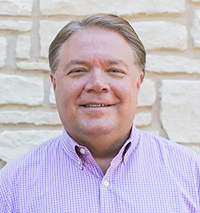
Erik Carter believes the church needs the gifts people with disabilities bring to the body of Christ as much as those individuals need the church.

Carter directs the Baylor Center for Developmental Disabilities and leads Baylor University’s new interdisciplinary Disability, Faith and Flourishing Initiative within the School of Education.

Erik Carter

“It’s my passion to help churches welcome and embrace persons with disabilities,” he said.

For Carter, that desire comes from personal experience. Growing up, he had no contact with any people with developmental disabilities.

“They were a hidden part of our community,” he said.

However, the summer after his freshman year in college, he worked at a camp for youth. To his surprise, he was assigned to work in programs for young adults with developmental and intellectual disabilities.

“I stumbled into relationships with people who had Down syndrome,” he said, noting they unconditionally embraced him as a friend.

The young people with developmental disabilities were Christians. At the time, Carter was not.

However, he was touched by their love for Jesus, their joyful approach to living, their accepting attitudes, and their firm conviction God accepted them just as they were.

“They shared their testimonies in a way I had never heard before,” he said. “That’s how I became a Christian.”

‘A matter of reciprocity’

As director of the new Baylor Disability, Faith and Flourishing Initiative, Carter hopes to influence the way churches view ministry with people who have disabilities.

“It’s not just about trying to open up churches to make them more hospitable and accessible to persons with disabilities because of their needs. It’s also about opening minds of church people who need to encounter people who have disabilities. These are individuals with gifts that we need,” he said.

“It’s a matter of reciprocity. It’s not a charity thing. It’s a faithfulness thing.”

In a society that values speed, people with disabilities can teach others the value of slowing down, he noted. In a culture that emphasizes independence, people with disabilities can help others learn the importance of interdependence, he added.

“People do come to Christ through the witness of people with disabilities. And I would love for it to be an unremarkable story,” Carter said.

Help churches become accessible and inviting

After teaching at Vanderbilt University, where he was co-director of the Vanderbilt Kennedy Center for Excellence in Developmental Disabilities, Carter joined the Baylor university faculty in January. He felt drawn to the university because of Baylor’s commitment to being “a preeminent Christian research university.”

Carter believes Baylor is uniquely positioned to become “the first of its kind hub” for research, theological reflection, ministry training and resource development to help congregations become accessible and inviting faith communities where people with disabilities can flourish.

“Most churches want to do it well, but they don’t know how,” he said.

The initiative Carter leads not only will examine empirical research that already exists, but also will do further research and seek to discover ministry models that work in churches of varied sizes and settings.

Based on research so far, Carter observed larger churches tend to respond to people with disabilities by creating programs geared toward them and hiring staff to carry out those programs. Programs may include specialized classes for individuals with disabilities, along with support groups and respite care for families.

“In smaller churches, it’s more a matter of coming alongside particular individuals and their families,” he said. “It’s dealing with one person at a time and one family at a time.”

Regardless of church size, ministry to people with disabilities demands time and intentionality, he noted. The initiative will seek to help churches identify barriers that may keep people with disabilities from participating fully in worship, discipleship, service and fellowship.

“Barriers to their participation can be architectural, and they can be attitudinal,” Carter said. “Churches may inadvertently exclude people.”

The Baylor initiative defines “disabilities” broadly enough not only to include people on the autistic spectrum or with Down syndrome, but also individuals who experience disabilities that accompany aging, such as memory loss, impaired mobility and loss of hearing and vision.

Seen in the broadest sense, 70 million Americans—1 out of 5 people in the United States—have disabilities. One student in 7 receives special education services in school. One child in 36 is on the autistic spectrum.

Think about disability from God’s perspective

One area of potential collaboration may be with Baylor’s Truett Theological Seminary, as the initiative seeks to help churches consider disabilities from a theological perspective.

“We want to enter into conversations with those who are thinking theologically about it,” Carter said. “How do we think about disability from God’s perspective?”

The initiative will include a training component for churches and make resources available to congregations, he noted.

In January, the Baylor Center for Developmental Disabilities will host a five-part training series focused on helping churches become more accessible, welcoming and supportive communities for people with disabilities and their families.

Designed for pastors, ministry leaders and other interested church members, sessions will focus on practical ways churches of all sizes can plan worship, religious education, fellowship activities, outreach and support that make possible ministry with and by people with disabilities. Both in-person and online options will be available. Dates and times will be announced online here.

As churches find ways to remove barriers and include people with disabilities in their congregations, they benefit from the gifts those individuals bring, Carter insisted.

“People with disabilities have different life experiences and perspectives to offer,” he said. “Even those who are unable to communicate can help us expand our imaginations, teaching us how to pray without speaking and worship without singing.

“As churches widen the welcome, we become more creative and imaginative. … We want to support churches in the journey.”


Wayland professor initiates drive to assist Lahaina school

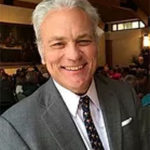
PLAINVIEW—When Libby Cleveland, longtime math professor at Wayland Baptist University in Plainview, saw news coverage of the Lahaina fire in Maui, her heart was broken for students left without classrooms more than 3,400 miles away.

So, she asked administrators at Wayland, which has an external campus in Hawaii, to provide a way to help students displaced by the fires on the island of Maui.

“What I saw was such devastation. There was nothing left. I was concerned for the children—the students,” said Cleveland, who has been teaching math for 62 years, including 30 years at Wayland.

“Schools offer a stable place for students. They lost their schools, and the students need to get back into school. I wanted to help.”

Wayland’s external center in Hawaii has multiple teaching locations, but none of those are located on Maui. However, many of the students and professors were affected by the fires in which 97 people died and 31 are still missing more than a month later.

The Maui fires, which burned 27 days, spread across more than 2,100 acres on the island. The fires have been deemed the deadliest in the United States in more than a century.

“The wildfires of Lahaina deeply hurt our souls,” said Henrique Regina, executive director and dean of the Hawaii campus. “They are our friends and families. They are our community. It hit very close to home.”

“Our guidance to our employees was to be engaged with the healing and rebuilding of Lahaina as they see fit. We decided to have faith and trust God for his wisdom and guidance leading us through his perfect timing.”

What Regina and other students, facility and staff at the Hawaii campus didn’t know was that God was already working in the heart of an 87-year-old math professor on the other side of the Pacific Ocean.

Cleveland gave initial donation

Cleveland offered to donate the first $500 to get a relief fund started at Wayland. She envisioned other members of the university family joining her in donating to help students on Maui.

At Cleveland’s request, administrators in Plainview and Hawaii began exploring how Wayland’s home campus in Plainview could help without being just another relief collection point.

“What I wanted Wayland to do was to help a school with students,” Cleveland said.

That wouldn’t be easy immediately following the disaster. However, Regina eventually connected with representatives of Doris Todd Christian Academy, which operates two campuses on Maui.

After receiving authorization to collect donations for the school through Wayland’s Student Emergency Fund, a webpage was created for online giving.

Once the fund was established, Cleveland became the first donor, giving the $500 she promised.

“We can help these children,” she said. “Some may not have anything. That’s why I said I’d be the first to give.”

Once the fund has grown significantly, Regina plans to present the money personally to Doris Todd Christian Academy.


Governor seeks clergy support for school vouchers

Gov. Greg Abbott publicly confirmed he plans to call a special session on school vouchers in October, and he called on ministers to voice support for “school choice” from the pulpit during the session.

A Sept.19 press release from the governor’s office announced Abbott’s call for churches to participate in “School Choice Sunday” on Oct. 15, which he first issued in a “town hall”-style teleconference with clergy.

 “I believe that every parent can do a better job of raising their children if they are given the power to choose the school that is best for their child. If they are given that power, that child will go down a pathway to better educational success, personal success, and relationship success,” Abbott stated.

“Collectively, we can make Texas even better when we all go to work to make sure we get across the finish line this urgent need to provide parents the ability to choose the school that’s best for their child.”

The news release quotes Robert Jeffress, pastor of First Baptist Church in Dallas, as lending support.

“I am a product of the Texas public school system, but it’s time for a choice,” Jeffress stated. “We are going to do everything we can at First Baptist Dallas to support Governor Abbott and his courageous call for school choice.”

‘Commandeer the church for political ends’

John Litzler

John Litzler, public policy director for Texas Baptists’ Christian Life Commission, noted messengers to the 2022 Baptist General Convention of Texas annual meeting approved a resolution affirming the historic Baptist commitments to religious liberty and the separation of church and state.

The resolution states Texas Baptists “will not seek to use government to coerce the worship of Christ” and “will not support any attempt by government to commandeer the church for political ends or any attempt by government to favor one religion over another.”

“Texas Baptists have a strong history of resisting attempts by the government to co-opt religion for political purposes,” Litzler said. “The Christian Life Commission encourages all Texas Baptist churches to continue to focus on the gospel and worship of Christ alone any and every Sunday morning.”

Pastors for Texas Children criticized both the governor’s call for a special session and his call for “pastors to use God’s pulpit to push his private school voucher program.”

Charles Foster Johnson

“The people of Texas know an eternal truth that seems to escape Gov. Abbott, that all genuine faith is voluntary and cannot properly be endorsed or supported by the authority of the state,” said Charles Foster Johnson, executive director of Pastors for Texas Children. “The use of public tax dollars to subsidize religious instruction is a sin against God.”

Pastors for Texas Children noted it is “very intentional in its message to keep politics out of our pulpits,” and individual ministers participate in the organization “outside formal times of religious gatherings.”

In the Texas House of Representatives, a coalition of rural Republicans and urban Democrats consistently has rejected any form of school vouchers. Abbott indicated if the House refuses to pass a bill to use public funds to provide tuition assistance for private schools, he will continue calling special sessions until they capitulate.

“This crass bullying is particularly odious,” Johnson said. “The truth of the matter is that the House of Representatives of the state of Texas opposes private school vouchers, as they have for over two decades. That will not change, no matter how many special legislative sessions the governor calls.”

Litzler urged the governor and lawmakers to focus on fully funding public education in Texas.

“Ensuring adequate and equitable funding for public education in Texas remains a public policy priority for the Christian Life Commission. We were disappointed that, despite a historic surplus in funds, legislation to increase student funding and raise the pay of educators did not pass during the regular session,” he said.

“We are advocating that Gov. Abbott’s call for a third special session of the Texas legislature be broad enough to allow legislators another opportunity to increase public school funding. The scope of the special session should not be limited to bills which would divert public funds to private institutions.

“All Texas children are constitutionally entitled to a fully-funded public education system. A properly funded public education system ensures that even the most vulnerable children in Texas have as much opportunity for a bright future as their peers.”


Baylor settles lawsuit with sexual abuse survivors

Baylor University settled a federal lawsuit with 15 women who asserted they were sexually assaulted on or near the campus.

The lawsuit, initially filed in June 2016 by three plaintiffs and later joined by 12 others, accused Baylor of a “deliberately indifferent response” to accusations of sexual assault and subsequent harassment. The suit alleged the university violated Title IX and the Clery Act, permitting “a campus condition rife with sexual assault.”

Terms of the lawsuit’s settlement were not disclosed.

“We are deeply sorry for anyone connected with the Baylor community who has been harmed by sexual violence,” a public statement from Baylor University said.

“While we can never erase the reprehensible acts of the past, we pray that this agreement will allow these 15 survivors to move forward in a supportive manner.”

The suit was one of several filed in 2015 and 2016 alleging Baylor failed to protect students who were sexually assaulted. The suits followed a scandal that rocked the athletic department and eventually led to the departure of then-President Ken Starr.

In fall 2015, Baylor University regents hired Pepper Hamilton, a Philadelphia law firm, to investigate the university’s response to reports of sexual violence.

After receiving an oral report from Pepper Hamilton in May 2016, regents subsequently removed Starr as president, fired Head Football Coach Art Briles and sanctioned Athletic Director Ian McCaw, who later resigned.

Pepper Hamilton offered 105 recommendations to the university regarding Title IX compliance and a proper response to sexual abuse allegations. In May 2017, regents announced the “foundational implementation” of all the recommendations.


Obituary: Wilbert H. Long

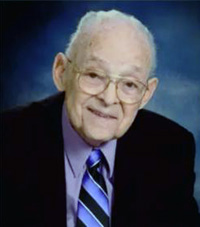
Wilbert Henry Long of San Antonio, longtime Texas Baptist pastor, died Sept. 6. He was 93. He was born in Chatom, Ala., on Oct. 15, 1929, to Henry and Marvelle Long. After he graduated from Wayland Baptist College, he served two years in the U.S. Army. He earned his master’s degree from Southwestern Baptist Theological Seminary while serving churches in Denton. He held pastorates in Dallas and Groesbeck before being called to Northeast Baptist Church in San Antonio in 1964. He served there 30 years, retiring in 1994. When he retired, he joined the staff of San Antonio Baptist Association, where he served in many capacities. He also was senior adult camp director for Alto Frio Baptist Encampment. He was a trustee of the Baptist Memorial System nine years and served on the Baptist General Convention of Texas Executive Board. He helped build churches in Alaska and San Antonio, and he participated in evangelistic crusades in Australia, Korea, Japan, Brazil and Canada. During his final years at Waterford Senior Living, he began a Bible study and a hymn sing for the residents. In 2000, he was chosen to receive the Winfred Moore Award for Lifetime Achievement in Ministry from Baylor University. He was preceded in death by his wife of 60 years Patricia Ann Colwell Long and by his sister Phyllis June Francies. He is survived by son Mark A. Long, daughter Leigh Ann Whisler and her husband Chris, daughter Laura L. Roach and her husband John, 10 grandchildren and 10 great-grandchildren.


Guarneri elegido como director del BGCT

Guarneri Elegido como Director del BGCT

La Cámara Ejecutiva de la Convención General Bautista de Texas en su reunión del 18 y 19 de septiembre en Dallaseligió a Julio Guarneri, pastor de la Iglesia Bautista Calvary en McAllen, como director ejecutivo.

Guarneri, quien fue elegido para un segundo mandato como presidente de BGCT en la Reunión Familiar de los Bautistas de Texas en Julio, es el primer individuo hispano en servir como director ejecutivo de BGCT.

A diferencia del precedente establecido, la junta delibero una sesión ejecutiva a puerta cerrada de una hora de duración para un turno de preguntas y respuestas con Guarneri.

Después de regresar a la sesión abierta, la junta votó por papeleta la elección de Guarneri. Recibió 55 votos a favor y 12 en contra.

A la luz de la elección de Guarneri como director ejecutivo y su renuncia como presidente del BGCT, el directorio aprobó una resolución afirmando la sucesión de oficiales de la BGCT de acuerdo a la Constitución de la BGCT.

El Primer vicepresidente Ronny Marriott, pastor de la Primera Iglesia Bautista en Burleson, es declarado presidente de la BGCT, y la Segunda Vicepresidenta Debbie Potter, ministra para niños de la Iglesia Bautista Trinity en San Antonio, es declarada a ser primer vicio presidenta.

Wendell Wright de Iglesia Park Cities en Dallas, silla del comité de búsqueda, se dirigió a la junta la noche antes de la elección de Guarneri como director ejecutivo, elogiándolo como “un hombre de humildad y paz”.

“Su capacidad a escuchar pensativamente, y todavía dirigir decisivamente con visión y convicción, servirá a los bautistas de Texas inmediatamente y en el futuro en esta cultura que cambia rápidamente”, dijo Wright.

En comentarios hacia la junta, Guarneri habló del llamando de Dios en su vida y la influencia de los bautistas de Texas en su ministerio.

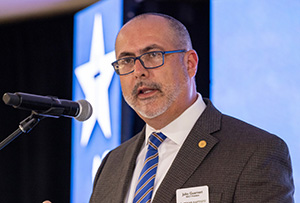
Julio Guarneri es el recién elegido director ejecutivo de la Convención General Bautista de Texas. (Foto BGCT)

“He buscado servir a las iglesias donde Dios me ha llamado, llevándolas a ser iglesias de la Gran Comisión y a ser iglesias misionales”, dijo Guarneri.

“Al estar frente a ustedes, quiero decir que soy un producto de BGCT. Mi llamado al ministerio fue en un evento de BGCT. Fui asesorado por el personal de BGCT. Me animaron en mi educación doctoral en una escuela de BGCT.Mi llamar y El enfoque del BGCT en la Gran Comisión y el Gran Mandamiento son uno en lo mismo”.

Julio Guarneri es el recién elegido director ejecutivo de la Convención General Bautista de Texas.

Guarneri agradeció a Texas Baptists por su restante enfoque en la misión que Dios ha dado.

“Como dije en la reunión familiar en McAllen a principios de este año, estoy muy agradecido que BGCT es no una convención impulsada por problemas pero a impulsada por una misión, afirmó”, dijo. “Es por eso que estoy tan entusiasmado con la oportunidad de desempeñar este cargo. Somos una gran y diversa familia de todo Texas … todos unidos para el objetivo de proclamando Cristo”.

Él admitió “excelente desafíos adelante” para Texas Baptists.

“Hay quienes quisieran sembrar división. Hay quienes quisieran que tuviéramos una carpa más pequeña”, dijo Guarneri.

“Al mismo tiempo, tenemos un estado en crecimiento con una población en crecimiento. No existe una mayoría étnica en nuestro estado, aunque los hispanos son el grupo étnico más grande. El mundo ha llegado a Texas.

“Nuestras iglesias están haciendo un gran trabajo. Nuestras instituciones están haciendo un gran trabajo. Nuestro personal de BGCT está haciendo un gran trabajo. Pero las necesidades son mayores”.

Cumplir la Gran Comisión exige más que seguir como de costumbre, enfatizó. Los bautistas de Texas no pueden hacerlo solos, pero pueden desempeñar un papel estratégico en asociación con otros.

“Nuestra agenda debería ser la agenda de Jesús”, dijo, citando los comentarios de Jesús en la sinagoga de Nazaret registrados en Lucas 4:18-19.

“Nuestra agenda debe ser proclamar las Buenas Nuevas a todas las personas de nuestro estado: ser un pueblo del reino, ser un pueblo de Jesús”.

Guarneri ha servido en la Iglesia Bautista Calvary en McAllen, una congregación multicultural en el Valle del Río Grande, desde 2010. Anteriormente, fue pastor de la Iglesia Bautista Getsemani en Fort Worth.

También sirvió en el personal de la Segunda Iglesia Bautista en Corpus Christi, fue fundador pastor de la Misión Bautista Shalom en Corpus Christi, y fue pastor de la Primera Iglesia Bautista en Taft.

Él nació en México y fue graduado de la preparatoria en el sur Texas y obtuvo una licenciatura de la Universidad Texas A&I en Kingsville. También tiene una Maestría en Educación Religiosa del Seminario Teológico Bautista Southwestern y un Ph.D. en estudios de liderazgo con concentración en ministerio de la Universidad Bautista de Dallas.

Guarneri ha presidido la junta directiva de Buckner International y ha formado parte de otros comités y juntas denominacionales.

Él y su esposa Mónica tienen cuatro hijos Josh, Rachel, Mia y Stevan y dos nietos: Daniel y Antares.

Junta aprueba 2024 presupuesto

Además de elegir a Guarneri como director ejecutivo, la junta también aprobó un presupuesto total de Texas de $35,294,994 para 2024, ligeramente por debajo del presupuesto de $35.46 millones para 2023.

Mientras que los mensajeros a la reunión anual de BGCT normalmente aprueban el presupuesto, la Junta Ejecutiva está autorizada a aprobar el presupuesto en los años en que la reunión anual se lleva a cabo como parte de la ReuniónFamiliar de los Bautistas de Texas en el verano.

El presupuesto total incluye un presupuesto neto de los Bautistas de Texas de $33.79 millones que depende de $27.117 millones en donaciones del Programa Cooperativo de Texas de las iglesias y un monto anticipado de $6.675 millones en ingresos por inversiones. También proyecta alrededor de $1.5 millones en ingresos adicionales por tarifas de conferencias y tarifas de stand, ventas de productos y otras fuentes.

Los ingresos no designados de las iglesias afiliadas seguirán dividiéndose en un 79 por ciento para la BGCT y un 21 por ciento para causas mundiales.

Se anticipan $1.1 millones en iniciativas y colaboraciones de misiones en todo el mundo y serán asignadas en lamisma manera como el año anterior: $340,000 para misiones de movilización, $200,000 para River Ministry yMisiones en México, $100,000 para Colaboraciones en Texas, $55,000 para la Alianza Mundial Bautista, $5,000 para la Fraternidad Bautista de América del Norte, $50,000 para intercultural internacional iniciativas, $200,000 paraMisiones Go Now, $100,000 para iniciativas de GC2, $20,000 para el Grupo de Trabajo de Educación Hispana y $30,000 para la capellanía.

La junta votó a favor de contratar a la firma Batts, Morrison, Wales y Lee para realizar la auditoría financiera.

Otro Ejecutivo Junta negocio

Por recomendación del Comité de Relaciones Institucionales, la junta autorizó a Valley Baptist Missions Education Center a aumentar su endeudamiento más allá del límite de 20 por ciento de total neto activo auditado.

Por recomendación del Comité de Nominaciones para Juntas Directivas de Afiliadas ministerios, la junta aprobó a Elizabeth Dixon de First Baptist Church en Universal City a la junta directiva de la Baptist Health Foundation de San Antonio.

La junta aprobó una recomendación para revisar la constitución de Singing Men of Texas y Singing Women of Texas para reestructurar su junta asesora, junto con una revisión de la poliza de igualdad de oportunidades de empleo de BGCT para estipular que la convención puede discriminar por motivos de religión.

Rellenos vacantes

En otros asuntos, la junta cubrió múltiples vacantes en consejos y comisiones:

  • Eric Anthony Brown de la New Jerusalem Baptist Church en Greenville al Affinity Ministries Council.
  • Malcom Barrington de Fallbrook Baptist Church en Houston, David Kirk de First Baptist Church en San Antonio, David Edmonds de South Tulsa Baptist Church en Tulsa, Okla., y Kristen Curtis Heritage Baptist Church en Farmville, Va., al Consejo de Respaldo de Capellanía.
  • Abigail Rojas de la Iglesia Bautista Azle Avenue en Fort Worth, Brandon Skaggs de First Baptist Church en Belton, Raymond Sánchez de First Baptist Church en Weslaco y Ryan Buck de Immanuel Baptist Church en San Angelo a la Comisión de Vida Cristiana.
  • Olga Harris de First Baptist Church en Pharr, Rebecca Retta de First Baptist Church en Temple, Gilma Juarez de First Baptist Church en Kaufman, Sergio Ramos de Getsemaní Baptist Church en Fort Worth, Jordan Villanueva de First Baptist Church en Blanket y Nathan Escamilla de la Iglesia Cristiana El Buen Pastor en Fort Worth al Consejo de Iniciativa de Educación Hispana.
  • Daniel Whitehurst de First Baptist Church en Longview al Consejo de Auditoría Institucional.
  • Jackie Faughn de First McKinney Baptist Church en McKinney, Norberto Palmitano de Shiloh Terrace Baptist Church en Dallas, Rand Jenkins de Bethlehem Baptist Church en Mansfield y Wendell Wright de Park Cities Baptist Church en Dallas, al Consejo Coordinador de Compromiso Misional.
  • Nancy Jackson de First Baptist Church en Woodway, Chad Mason de First Baptist Church en Boerne, Chad Bertrand de South Park Baptist Church en Alvin, Bryan Pinson de First Baptist Church en Midland y Edgardo Martínez deFirst Baptist Church en El Paso, al Consejo de Financiamiento de Misiones.
  • Wes Brown de Cowboy Church del condado de Collin en Princeton, Werth Mayes de Cowboy Church del condado de Erath en Stephenville y Jay Johnson de San Angelo Cowboy Church, al Western Heritage council.
  • Ann Bradshaw de Tallowood Baptist Church en Houston, Ken Box de First Baptist Church en Waxahachie, Don Allen de Sugar Creek Baptist Church en Sugar Land, Grady Tyroch de First Baptist Church en Temple, JamesWestbrook y Roberto Power de First Baptist Church en Richardson, Sam Jones de First Baptist Church en Arlingtony Merritt Johnston de First Baptist Church en Brenham, al Consejo de la Fundación de Misiones Bautistas de Texas.
  • Stephanie Beazley de Second Baptist Church en Corpus Christi, Jeff Smith de Park Cities Baptist Church enDallas y Betty Booth de First Baptist Church en Tyler, al Consejo Bautista de Historia y Distintivos.
  • Jason Atchley de Hunters Glen Baptist Church en Plano y Karen Bullock de la Lake Side Baptist Church en Granbury al Consejo de Educación Teológica.


Guarneri elected as BGCT executive director

The Baptist General Convention of Texas Executive Board at its Sept. 18-19 meeting in Dallas elected Julio Guarneri, pastor of Calvary Baptist Church in McAllen, as executive director.

Guarneri, who was elected to a second term as BGCT president at Texas Baptists’ Family Gathering in July, is the first Hispanic individual to serve as BGCT executive director.

In a departure from established precedent, the board went into an hourlong closed-door executive session for a question-and-answer time with Guarneri.

After returning to open session, the board voted by ballot on Guarneri’s election. He received 55 votes in favor and 12 opposed.

In light of Guarneri’s election as executive director and resignation as BGCT president, the board approved a resolution affirming the succession of convention officers according to the BGCT Constitution.

First Vice President Ronny Marriott, pastor of First Baptist Church in Burleson, is declared president of the BGCT, and Second Vice President Debbie Potter, minister to children at Trinity Baptist Church in San Antonio, is declared to be first vice president.

Wendell Wright of Park Cities Baptist Church in Dallas, chair of the search committee, addressed the board the evening before Guarneri’s election as executive director, praising him as “a man of humility and peace.”

“His ability to listen thoughtfully, yet lead decisively with vision and conviction, will serve Texas Baptists immediately and in the future in this rapidly changing culture,” Wright said.

In remarks to the board, Guarneri talked about God’s calling on his life and Texas Baptists’ influence on his ministry.

“I have sought to serve the churches where God has called me, leading them to be Great Commission churches and to be missional churches,” Guarneri said.

“As I stand before you, I want to say I am a product of the BGCT. My call to ministry was at a BGCT event. I was mentored by BGCT staff. I was encouraged in my doctoral education at a BGCT school. My call and the focus of the BGCT on the Great Commission and the Great Commandment are one in the same.”

Julio Guarneri is the newly elected executive director of the Baptist General Convention of Texas. (BGCT Photo)

Guarneri thanked Texas Baptists for remaining focused on the mission God has given.

“As I said at the Family Gathering back in McAllen earlier this year, I am so thankful the BGCT is not an issue-driven convention but a mission-driven convention,” he said. “That’s why I am so excited about the opportunity to serve in this role. We are a great, diverse family from all over Texas … all united for the purpose of proclaiming Christ.”

He acknowledged “great challenges ahead” for Texas Baptists.

“There are those who would like to sow division. There are those who would like us to have a smaller tent,” Guarneri said.

“At the same time, we have a growing state with a growing population. There is no ethnic majority in our state, although Hispanics are the largest ethnic group. The world has come to Texas.

“Our churches are doing great work. Our institutions are doing great work. Our BGCT staff is doing great work. But the needs are greater.”

Fulfilling the Great Commission demands more than “business as usual,” he stressed. Texas Baptists cannot do it alone, but they can play a strategic role in partnership with others.

“Our agenda ought to be Jesus’ agenda,” he said, quoting from Jesus’ remarks at the synagogue in Nazareth as recorded in Luke 4:18-19.

“Our agenda should be to proclaim the good news to all people in our state—to be a kingdom people, to be a Jesus people.”

Guarneri has served Calvary Baptist Church in McAllen—a multicultural congregation in the Rio Grande Valley—since 2010. Previously, he was pastor of Iglesia Bautista Getsemani in Fort Worth.

He also served on staff at Segunda Iglesia Bautista in Corpus Christi, was founding pastor of Shalom Baptist Mission in Corpus Christi, and was pastor of Primera Iglesia Bautista in Taft.

He was born in Mexico and graduated from high school in South Texas and earned an undergraduate degree from Texas A&I University in Kingsville. He also holds a Master of Arts in Religious Education degree from Southwestern Baptist Theological Seminary and a Ph.D. in leadership studies with a ministry concentration from Dallas Baptist University.

Guarneri has chaired the board of Buckner International and served on other denominational committees and boards.

He and his wife Monica have four children—Josh, Rachel, Mia and Stevan—and two grandchildren—Daniel and Antares.

Board approves 2024 budget

In addition to electing Guarneri as executive director, the board also approved a $35,294,994 total Texas budget for 2024, down slightly from the $35.46 million budget for 2023.

While messengers to the BGCT annual meeting normally approve the budget, the Executive Board is authorized to approve the budget on years when the annual meeting is held as part of Texas Baptists’ Family Gathering in the summer.

The total budget includes a $33.79 million net Texas Baptist budget that depends on $27.117 million in Texas Cooperative Program giving from churches and an anticipated $6.675 million in investment income. It also projects about $1.5 million in additional revenue from conference and booth fees, product sales and other sources.

Undesignated receipts from affiliated churches will continue to be divided 79 percent for the BGCT and 21 percent for worldwide causes.

An anticipated $1.1 million in worldwide missions initiatives and partnerships will be allocated in the same manner as the previous year: $340,000 for missions mobilization, $200,000 for River Ministry and Mexico missions, $100,000 for Texas Partnerships, $55,000 for the Baptist World Alliance, $5,000 for the North American Baptist Fellowship, $50,000 for intercultural international initiatives, $200,000 for Go Now Missions, $100,000 for GC2 initiatives, $20,000 for the Hispanic Education Task Force and $30,000 for chaplaincy.

The board voted to enlist the Batts, Morrison, Wales and Lee firm to conduct the financial audit.

Other Executive Board business

At the recommendation of the Institutional Relations Committee, the board authorized Valley Baptist Missions Education Center to increase its indebtedness beyond the threshold of 20 percent of total audited net assets.

At the recommendation of the Committee on Nominations for Boards of Affiliated Ministries, the board approved Elizabeth Dixon from First Baptist Church in Universal City to the Baptist Health Foundation of San Antonio board of trustees.

The board approved a recommendation to revise the constitution for Singing Men of Texas and Singing Women of Texas to restructure their advisory board, along with a revision to the BGCT equal employment opportunity policy to stipulate the convention can discriminate on the basis of religion.

Filling vacancies

In other business, the board filled multiple vacancies on councils and commissions:

  • Eric Anthony Brown from New Jerusalem Baptist Church in Greenville to the Affinity Ministries Council.
  • Malcom Barrington from Fallbrook Baptist Church in Houston, David Kirk from First Baptist Church in San Antonio, David Edmonds from South Tulsa Baptist Church in Tulsa, Okla., and Kristen Curtis from Heritage Baptist Church in Farmville, Va., to the Chaplaincy Endorsement Council.
  • Abigail Rojas from Azle Avenue Baptist Church in Fort Worth, Brandon Skaggs from First Baptist Church in Belton, Raymond Sanchez from First Baptist Church in Weslaco and Ryan Buck from Immanuel Baptist Church in San Angelo to the Christian Life Commission.
  • Olga Harris from First Baptist Church in Pharr, Rebecca Retta from First Baptist Church in Temple, Gilma Juarez from First Baptist Church in Kaufman, Sergio Ramos from Getsemani Baptist Church in Fort Worth, Jordan Villanueva from First Baptist Church in Blanket and Nathan Escamilla from El Buen Pastor Christian Church in Fort Worth to the Hispanic Education Initiative Council.
  • Daniel Whitehurst from First Baptist Church in Longview to the Institution Audits Council.
  • Jackie Faughn from First McKinney Baptist Church in McKinney, Norberto Palmitano from Shiloh Terrace Baptist Church in Dallas, Rand Jenkins from Bethlehem Baptist Church in Mansfield and Wendell Wright from Park Cities Baptist Church in Dallas to the Missional Engagement Coordinating Council.
  • Nancy Jackson from First Baptist Church in Woodway, Chad Mason from First Baptist Church in Boerne, Chad Bertrand from South Park Baptist Church in Alvin, Bryan Pinson from First Baptist Church in Midland and Edgardo Martinez from First Baptist Church in El Paso to the Missions Funding Council.
  • Wes Brown from the Cowboy Church of Collin County in Princeton, Werth Mayes from the Cowboy Church of Erath County in Stephenville and Jay Johnson from the San Angelo Cowboy Church to the Western Heritage Council.
  • Ann Bradshaw from Tallowood Baptist Church in Houston, Ken Box from First Baptist Church in Waxahachie, Don Allen from Sugar Creek Baptist Church in Sugar Land, Grady Tyroch from First Baptist Church in Temple, James Westbrook and Robert Power from First Baptist Church in Richardson, Sam Jones from First Baptist Church in Arlington and Merritt Johnston from First Baptist Church in Brenham to the Texas Baptist Missions Foundation Council.
  • Stephanie Beazley from Second Baptist Church in Corpus Christi, Jeff Smith from Park Cities Baptist Church in Dallas and Betty Booth from First Baptist Church in Tyler to the Baptist History and Distinctives Council.
  • Jason Atchley from Hunters Glen Baptist Church in Plano and Karen Bullock from Lake Side Baptist Church in Granbury to the Theological Education Council.


Obituary: Gil A. Stricklin

Gil A. Stricklin, founder of Marketplace Ministries and former military chaplain, died Sept. 10 at his home in Dallas. He was 88. Gilford Arthur Stricklin was born Sept. 11, 1934, in Sadler to Lessie Caroline Watson and Gilford Lane Stricklin. He accepted Christ as his Lord and Savior at age 12. At Baylor University, he was president of the freshman class, was a yell leader and served in the ROTC. He met Ann March in the fall semester in 1954, and they dated throughout their years at Baylor. They married May 23, 1958, in Waco. He graduated from Baylor with a business degree and a commission in the U.S. Air Force. As a commissioned officer, he was stationed at Donaldson Air Force Base in South Carolina. After three years on active duty in the Air Force, including a tour to Antarctica, the family moved back to Fort Worth where he attended Texas Christian University, receiving a degree in journalism while working for the Fort Worth Press and the Fort Worth Star-Telegram. He also earned a degree from Southwestern Baptist Theological Seminary. In 1965, he was invited to join the Billy Graham Evangelistic Association to serve in preparation for the upcoming World Congress on Evangelism and as a special assistant to Graham. For the following six years, he traveled the world, setting up press conferences for the evangelist and working with the media. In 1970, the family moved to Dallas when he went to work for the Baptist General Convention of Texas, where he pioneered the Super Summer Youth Evangelism program, which continues today. At the same time he was serving his 15 years with the BGCT, he also went to flight school and achieved both his instrument and multi-engine rating pilot licenses. He transitioned from the Air Force to the U.S. Army, serving as a chaplain during Operation Desert Storm and Desert Shield. He graduated from the U.S. Army Command and General Staff College in 1973. In 1983, he graduated from the U.S. Army War College, as only the seventh chaplain to do so. Three years later, he graduated from the National Defense University in Washington, D.C. During his active-duty military service, he officiated nearly 100 funerals at Arlington National Cemetery. In 1994, he retired from the U.S. Army as a colonel after serving his country 37 years—15 years in the Air Force and 22 years in the Army. In 1983, he founded Marketplace Ministries, which offers chaplain care to business employees. The organization now serves more than 1,000 companies with 1.2 million employees being helped. Stricklin was a member and deacon at First Baptist Church in Dallas more than five decades. He was a Distinguished Alumnus at Baylor University, where he was a devoted fan of all sports. He was preceded in death by three brothers, Don, Jerry and Jimmy Stricklin. He is survived by his wife of 65 years, Ann March Stricklin; sons Art and his wife Belinda of Dallas and Cliff and his wife Christy of Denver, Colo.; four grandchildren; and a brother, Charles Stricklin of Newport, Calif. Services will be at 2 p.m. Sept. 19 at First Baptist Church in downtown Dallas. In lieu of flowers, donations may be made to Marketplace Chaplains—Founder’s Endowment, 2001 West Plano Pkwy, Ste 3200, Plano TX 75075.


Sexual addiction a threat to the church, therapist asserts

Given the secrecy and shame surrounding pornography usage, researchers offer widely divergent statistics about its prevalence in the church. But few question the reality of the problem—both in the pews and in the pulpits.

“I don’t know of a bigger threat to the church today,” said Jimmy Myers, a licensed professional counselor and Christian certified sex addiction therapist. “And we are too pious to talk about it.”

In particular, clergy who struggle with pornography or other compulsive sexual behavior are reluctant to discuss it because they fear losing their jobs if they acknowledge a problem in their own lives, Myers said in an interview.

Adina Silvestri, a licensed professional counselor and researcher, agrees. In an online article published by the American Counseling Association, she wrote: “Within the Church, clergy who are sex addicts live with the shame, fear, and guilt involved with their compulsive sexual behaviors, while acting as a moral compass for their congregations. It is a lonely journey.”

The fifth edition of the Diagnostic and Statistical Manual of Mental Disorders—the standard reference source produced by the American Psychiatric Association—does not include sexual addiction.

However, Myers noted, the World Health Organization includes compulsive sexual behavior as a mental health disorder in the latest edition of its International Statistical Classification of Diseases.

Failure to address the problem

Jimmy Myers

Ministers who dare to talk about compulsive sexual behavior as an addiction from which people can recover with the proper therapy—not just a bad habit they can overcome with will power—risk being perceived as “soft on sin” by some church members, Myers said.

“We have to change the way we address this,” he said.

Myers served 20 years in church staff positions at Baptist churches before he founded The Timothy Center, an Austin-based Christian counseling center. He sees the use of pornography as destructive in itself and as a first step that can lead to other compulsive sexual behavior.

“Pornography is the marijuana of sexual addiction,” Myers said. “It is the gateway drug to other behaviors.”

Like drug users who crave increasingly stronger drugs, the arousal template for pornography users continues to escalate, requiring more frequent viewing, more hardcore content and other sexual behaviors to get the same results, he explained.

In an article produced for the Utah State University’s couple and family relationships extension service, Naomi Brower wrote: “Some of the common damaging effects of pornography for users can include addiction, isolation, increased aggression, distorted beliefs and perceptions about relationships about sexuality, negative feelings about themselves, and neglecting other areas of their lives.”

Mark Legg, a former associate editor at the Denison Forum, agrees about the devastating impact of pornography.

“Pornography carves canals of addiction in our brains, sends a torrent of shame into our hearts, digs up sedentary sin, and wreaks havoc on our relationships,” Legg wrote in an online article.

The “canals of addiction” Legg describes are neural pathways created by “consistent frequent exposure over long duration,” Myers explained.

Compulsive sexual behavior may be rooted in childhood abuse or severe family dysfunction, and patients often also are diagnosed with anxiety and depression.

“The brain of a person with sexual addiction is physically different,” he said, adding it explains the condition but is “not an excuse for behavior.”

Create new pathways in the brain

Fortunately, the brain continues to change and adapt, retaining a certain degree of plasticity. Through proper therapy and treatment, neural networks in the brain can be restructured, creating new neural pathways, he explained.

“Rewiring” the brain’s neural pathways requires time and intensive therapy, he acknowledged.

Previously, The Timothy Center treated compulsive sexual behavior through an intensive outpatient program that demanded three hours of therapy three times a week for six weeks.

Recently, the center introduced a 15-hour weekend intensive program—the only one of its kind in Central Texas. During two days of rigorous therapy, participants learn about the root causes of sexual addiction, and they explore emotional regulation and relapse reduction.

The two-day format not only is less time-consuming than the previous intensive outpatient program, but also allows individuals from outside the Austin area an opportunity to “jump-start” therapy, which can be continued with a licensed counselor closer to their home.

Churches should encourage members and ministers to seek professional help if they are struggling with compulsive sexual behavior, Myers said.

That may mean offering a sabbatical to staff members who need therapy rather than immediately dismissing them if their sexual addiction is discovered or confessed.

Churches benefit from learning about the causes and treatment of compulsive sexual behavior, because it helps them differentiate between the person and the person’s behavior, he said.

“Everyone is broken. How can we judge somebody just because they are sinning in a different way than we are?” Myers asked.

“We need to respond with compassion. We need to hit that sweet spot that Jesus demonstrated—not condemning the person and not ignoring the sinful behavior.”


Baylor professor finds gospel truth in Baldwin’s writings

Baylor University’s Greg Garrett has nothing and everything in common with the late James Baldwin.

Garrett is a white, happily married English professor at a Baptist school who has lived much of his life in Oklahoma and Texas.

Baldwin was a Black, Harlem-born writer who wrestled with his sexuality and completed some of his most significant literary work as an American expatriate in France and Switzerland.

Garrett was raised Southern Baptist but wandered spiritually more than two decades until he found a home in the Episcopal church, where he is a canon theologian.

Baldwin followed in his father’s footsteps as a young preacher in a theologically conservative Black church, but he ultimately left organized religion far behind.

Nevertheless, Garrett has found—and continues to find—not only relevant cultural insights, but also theological depth in Baldwin’s essays, novels, short stories and plays.

‘America’s great prophet’

In fact, Garrett sees Baldwin as “America’s great prophet,” as he describes him in his new book, The Gospel According to James Baldwin.
“He has helped me understand things about my own life and about faith,” Garrett said in an interview. “He also helps us understand this current moment that we’re in.”

Garrett said he—and many others—can relate to leaving the inherited religious tradition of their childhood.

Although Baldwin never formally returned to the church, he continued to draw upon the language, symbols and metaphors of the Bible. Baldwin’s personal correspondence included requests for prayer and references to theological issues with which he struggled. At his memorial service at St. John the Divine Cathedral in New York City, mourners listened to a recording of Baldwin singing “Precious Lord, Take My Hand.”

Garrett said he believes Baldwin has much to say to those who do not claim any specific church affiliation, choosing to identify as “spiritual but not religious.”

“When I think about Baldwin and the church, there is a sense of sadness around it, because he didn’t get rescued in the same way that I did, but he never left his faith behind,” Garrett said.

“One of the big lessons Baldwin can give us is what it looks like and how can you pull together a life of the spirit if you don’t feel like you belong in the church in which you were raised.”

Baldwin “found a way forward” by creating his own gatherings of people with whom he felt a sense of belonging and common purpose, he said.

Gathering at ‘The Welcome Table’

In fact, Baldwin’s final unfinished play “The Welcome Table,” which draws its title from a Negro Spiritual, deals specifically with that issue, Garrett said.

“For Baldwin, it was all about, ‘Where is this place where we all can gather, diverse as we are? … Where can we find this place where we can all be fed, all be recognized, all be loved, all be understood?’”

Baldwin also often used the metaphor of the New Jerusalem to describe his vision of a better tomorrow.

“Someday we will reach this place where all the divisions between us no longer matter. Speaking as a Christian theologian, these are intensely theological understandings of who we are and where we come from. It feels very much like Baldwin leaning into the belief that these things are possible,” Garrett said.

Baldwin possessed both the courage and the gifts to bear honest witness—“to see and to say” what he experienced and also to cast a prophetic vision of what could be, he said.

“This is a person who was honest about what America was and is, but also believed in the possibility that we could do better and be better,” he said.

Called to be ‘a witness’

Although Baldwin rejected his early commitment to preaching Christian doctrine, he continued to speak of his “calling” to be a “witness,” Garrett observed, noting it is a “loaded term.” In New Testament Greek, the word for “witness” is the same as the word we transliterate as “martyr,” he said.

“The idea was these are people who believe so deeply in something that they gave themselves for it,” Garrett said. “I think it doesn’t have to be witness to the death. It also can be witness in life.

“Baldwin’s great gifts were of observation, description and storytelling. … What he was saying was, ‘I’m going to use every one of my gifts to be present and to describe what I see—and to point out the possibilities.’”

As a Christian, Garrett finds the gospel—the good news—in Baldwin’s writings about the “primacy of love,” even for oppressors.

He quoted Baldwin as saying as a child, he was taught in church to “love everybody,” and even if others did not believe it, “I did.”

Baldwin’s disenchantment with the institutional church focused largely on its unloving actions and its failure to live up to the example of Jesus, he noted.

“Diverse as we are, separated as we are, there is still hope in this possibility of love,” Garrett said.


Search committee names executive director nominee

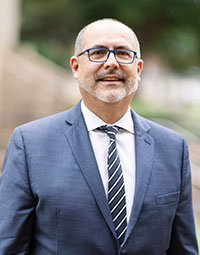
DALLAS—Texas Baptists’ executive director search committee announced Julio Guarneri, lead pastor of Calvary Baptist Church in McAllen, as its nominee for Baptist General Convention of Texas executive director.

The identity of the committee’s nominee was announced in an update posted to the executive director search committee webpage of Texas Baptists’ website on Sunday afternoon.

In a previous update, the committee announced it had selected a nominee but withheld the candidate’s name to allow him the opportunity to inform his congregation prior to the information becoming public. Guarneri informed his congregation of the nomination just prior to the committee’s announcement’s release.

In its announcement, the search committee praised Guarneri’s character, courageous leadership and calling.

Julio Guarneri

“We believe Dr. Julio Guarneri meets and exceeds the qualities listed in the search prospectus. His personal characteristics of humility, meekness and courageous leadership confirmed a sense of calling and affirmed the committee’s selection,” the committee stated.

 “We believe these qualities will further the cause of Christ in carrying out the mission and purpose of Texas Baptists in the days to come.”

Guarneri will be presented by the search committee to the BGCT Executive Board meeting Sept. 18. He is the first Hispanic nominee for the executive director position in the BGCT’s 137-year history.

“Dr. Guarneri is a respected Baptist statesman. He has a rich and longstanding history as a pastor, coupled with a proven capacity to lead our convention with sensitivity, conviction, humility, grace, and strength,” said Wendell Wright, chair of the search committee and director of church and denominational relations at Dallas Baptist University.

Guarneri has a long history of service in the convention, and he is currently carrying out his second term as president. Prior to being elected president, Guarneri served two terms as first vice president.

He is the current chair of Buckner International and also served as vice chair of the Buckner board, chair of Stark College and Seminary and on the BGCT Executive Board.

Guarneri has also served as a Baptist pastor about three decades. He has led Calvary Baptist Church since 2010, and he previously was senior pastor of Iglesia Bautista Getsemaní 17 years.

Additionally, he has served as the minister of education and youth at Segunda Iglesia Bautista in Corpus Christi, founding pastor of Shalom Baptist Mission in Corpus Christi and pastor of Primera Iglesia Bautista in Taft.

Guarneri completed his undergraduate degree from Texas A&M University in Kingsville. He also earned a Master of Arts in Religious Education degree from Southwestern Baptist Theological Seminary and a Ph.D. in leadership studies from Dallas Baptist University.

He and his wife, Monica, have four children and two grandchildren.

During his president’s remarks at the February board meeting, Guarneri called for seven weeks of prayer from Easter to Pentecost in anticipation of the 2023 Family Gathering in McAllen. He described the Family Gathering as a chance to practice Pentecost by joining in worship together and celebrating the diversity of Texas Baptists.

 “God sees you and invites you to his table,” Guarneri said. “The inclusion of every people, every nation and every language is the celebration of the great diversity God has created. Pentecost for us today is an invitation to practice that celebration.”

President Julio Guarneri, pastor of Calvary Baptist Church in McAllen, moderated the business sessions at the Baptist General Convention of Texas annual meeting. (BGCT Photo)

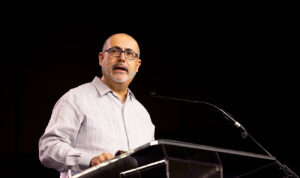
In his president’s remarks at the 2023 Family Gathering in McAllen, Guarneri celebrated the rich diversity of the BGCT and urged convention members to focus on unity in Christ.

 “We are one big family of men and women, children, youth and adults,” he said. “Anglo, Black, Hispanic, Asian. From remote places and from large cities. From small churches and from megachurches. And what binds us together is Christ. That’s who we are, familia Texas Baptists. We are the family of God, unified in diversity.”

In its announcement, the search committee noted its commitment to prayer dating back to its first gathering in August 2022.

 “With firm conviction, we believe God has directed our steps,” the committee stated.

 “After much prayer, dedication, hard work and perseverance, the committee is pleased and humbled to present its nominee to the Executive Board,” the announcement reads.

Since its creation, the executive director search committee has asked Texas Baptists to pray for discernment throughout the process.

 “We thank the entire Texas Baptists family for your continued prayers and support as we look forward with anticipation to the next step in this process. God is good, and we are grateful to him for his provision,” the committee said.

The committee initially was formed in July 2022 after David Hardage announced his retirement earlier that month.


Bobby Hall announces June 2024 retirement from Wayland

PLAINVIEW—After more than 40 years of service at Wayland Baptist University, including the past eight years as president, Bobby Hall has announced plans to retire effective June 30, 2024.

Hall’s decision was made earlier this year, and in accordance with Wayland’s presidential succession plan, he informed Wayland’s board of trustees of his plans privately in January. In April, he announced his plan to retire in a video message to the university’s faculty and staff. His public announcement comes as Wayland embarks upon an extensive search for the university’s next president.

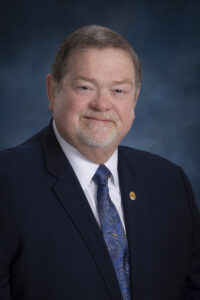
Bobby Hall

“An early influence in my life advised me to ‘find a great cause and lose your life in it.’ I was blessed to find that calling and do just that at Wayland for more than four decades,” Hall said. “Wayland’s greatest asset has always been its people. No matter their campus location, they are just outstanding, genuine, hardworking, Christian people, and it has been a privilege to serve alongside them.

“Wayland has been my life, and I will continue to pray for its people, its new leadership and its mission. I have no doubt that God will continue to use our university in mighty ways.”

Board Chair Mark Jones thanked Hall for more than 40 years of continuous service to the university.

“He has brought tenacity, innovation and leadership to the many roles he’s held across the organization, including his eight years as president of the university,” Jones said. “With his guidance, Wayland has successfully navigated the dynamically changing world of higher education, helping the university to prosper well into its second century.

“As president, Dr. Hall has made a tangible difference in the professional and spiritual lives of students across five different decades. We are grateful for his lifelong service to Wayland and wish he and his family the best in his retirement.”

Upgraded infrastructure, increased endowment

During his presidency, Hall implemented improved business practices, made development a primary focus and gave priority to infrastructure upgrades. Hall was instrumental in the redesign of Wayland’s approach to marketing, recruitment and admissions across all campuses.

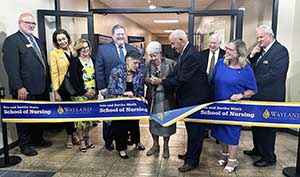
Wayland Baptist University marked the dedication and grand opening of the Ben and Bertha Mieth School of Nursing. (WBU Photo)

In securing a new location for the San Antonio campus, Hall led the university to secure the best return on the investment made in the original campus and secure a fair purchase price for the new property. That paved the way for a recent $2.5 million gift that made it possible for the Ben and Bertha Mieth School of Nursing to return to the San Antonio campus.

Infrastructure projects have included the restoration of the exterior of historic Gates Hall, the renovation of Harral Auditorium, construction of the Mabee Laboratory Science Building, completion of the Jimmy Dean Museum and creation of the Flying Queens Museum.

Under Hall’s leadership, Wayland’s endowment has grown by almost $28 million, from $84.3 million in 2016 to $112.2 million in 2023, and the university has embarked upon a comprehensive fundraising campaign with $11 million already raised. He has been involved directly in fundraising for this campaign.

Six of the university’s top seven fundraising years in the past 20 years have come during Hall’s presidency.

Hall led Wayland into a negotiated partnership with McAllister & Quinn to launch the university into securing federal grants. That effort has resulted in five grants totaling approximately $5 million.

Hall has encouraged the creation of new programs, including majors, minors and degrees. He has sought improved delivery methodologies with more online and hybrid opportunities.

He served as a peer evaluator for the Southern Association of Colleges and Schools Commission on Colleges. He has also chaired the International Association of Baptist Colleges and Universities and the Consortium for Global Education and is on the executive board of Independent Colleges and Universities of Texas.

Wayland has added new athletic programs during Hall’s administration and increased the number of student-athletes attending the university, while placing an emphasis on scholar athletes. He has served as a member of the NAIA Council of Presidents and chaired the Sooner Athletic Conference Council of Presidents.

Served Wayland since 1981 in varied roles

Hall served as Wayland’s executive vice president and provost prior to being named president. Since 1981, he has served in numerous capacities at Wayland, including assistant executive vice president, director of institutional research and effectiveness, director of graduate services, executive director of university relations, assistant to the president for institutional advancement, director of public relations, director of sports information, and director of career planning and placement.

Hall has served as a professor of business, receiving the Distinguished Faculty Service Award and Faculty University Service Award. He has written, spoken and served as a consultant on topics including higher education administration, institutional effectiveness, economic development and marketing.

Having founded Wayland’s office of institutional research and effectiveness, Hall designed, piloted and implemented a comprehensive strategic planning model for institutional effectiveness at the institutional, divisional and unit levels.

He has designed and conducted research dealing with teaching effectiveness; student outcome competencies, achievement, aptitude and satisfaction; alumni satisfaction and accomplishment; employee satisfaction; employee evaluation; academic and administrative effectiveness; relationships with external institutional constituencies; financial analysis; admissions criteria and prediction; and enrollment/retention.

Saying they have all been “exceptional partners in this journey,” Hall expressed his thanks to Wayland’s board of trustees, cabinet and staff members in the president’s office.

Hall also applauded his wife, Laurie, for her service to the university through the years, especially during his presidency.

“She has been a great asset in creating and growing Wayland’s relationships as First Lady, playing a large role in the development success we have had,” Hall said. “She continues to serve as president of the Sally Society, an organization that has raised more than $500,000 during the past 12 years.”

The chairman of Wayland’s board of trustees echoed the president’s praise for the Hall family.

“We thank his wife, Laurie Hall, for her tenure as Wayland’s First Lady, and their children, Alexis and Lucas,” Jones said.

The Halls opened their home to Wayland students and employees, as well as alumni and the community as they hosted more than 350 events there during his presidency. They were recognized last year with the Keeper of the Flame Award, one of Wayland’s most prestigious honors.

“Laurie and I have been blessed by our years of service to Wayland,” Hall said. “We will continue to work hard, and we will all pray hard for our trustees and search committee as they find the person God has prepared to come here.”