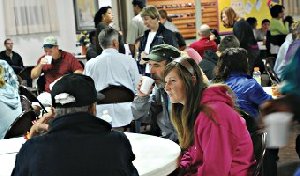
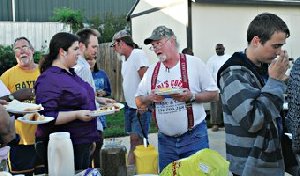
Camp introduces at-risk youth to a world of opportunity

BROADDUS—Telvin never had spent so much time away from city life.

For the 16-year-old Port Arthur resident, both home and the problems that consume him daily seemed erased from reality—if only for a moment.

At-risk youth from Southeast Texas enjoy getting away from the distractions—and negative influences—of home while enjoying activities such as a slip-and-slide at Opportunity Camp, a ministry of Golden Triangle Baptist Association.

Just minutes after his experience on a ropes course, Telvin wore a wide smile as he stood among pine trees during the three-day Opportunity Camp at Pineywoods Encampment in Broaddus.

“Out here you don’t have any bad influences. You don’t have anybody pressuring you,” Telvin said. “You don’t have any weed. You don’t have any beer. You don’t have any of that. You just have freedom and life.”

Opportunity Camp is a weeklong camp Golden Triangle Baptist Association has sponsored more than four decades for at-risk youth. This year’s camp drew 21 boys and 16 girls.

All but three of the boys were on juvenile probation, and almost all of the campers carried a similar story to Telvin’s, having never experienced much time apart from home and the distractions of the streets.

“It’s comforting because you don’t have to worry about a lot of things out here,” said Jannet, 13, of Bridge City. “It’s like a place you’ve always wanted to be, and you just want to stay.”

Along with outdoor activities such as canoeing, fishing, swimming and pickup basketball games, the campers took part in a Christian rap concert, worship services and devotionals.

Seven boys and five girls made professions of faith.

For 17-year-old Willie, that decision came in the waning hours that Tuesday—the final night of the boys’ camp. Willie, who lives in Beaumont, said he had never felt so free.

“It’s like something you see in a movie,” he said.

Getting to that point didn’t come without battles, and Willie’s counselor Mark Beard saw plenty of doubt before promise.

“Tuesday night when we got back to the room he was talking attitude, and I was fixing to just ignore him and let it go,” said Beard, 52 of Nederland. “But I said, ‘No,’ and pulled my chair over in front of him. We got to really talking, and he ended up getting saved.

“He was probably the most excited person I’ve ever had getting saved. He was out the next morning telling his friends he had gotten saved and what a load it was off his shoulders.”

That moment almost never came.

Just weeks before camp was scheduled to start, the Golden Triangle Baptist Association lacked the funds to offer the weeklong camp.

Dion Ainsworth, the association’s director of ministry evangelism, said at that point, having both a boys’ and girls’ camp was not possible financially. But a $5,000 grant from the Mary Hill Davis Offering for Texas Missions, along with other donations, made the camp a reality.
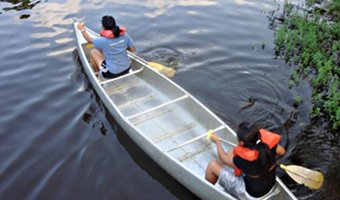
Girls from inner-city neighborhoods in the Beaumont/Orange/Port Arthur area enjoy outdoor activities like canoeing at Opportunity Camp, a ministry of Golden Triangle Baptist Association.

For the first time in the camp’s 45-year history, two former campers stepped into roles as camp counselors this year.

Vy Nguyen is one of those former campers. The 20-year-old Port Arthur resident began attending Opportunity Camp when she was 9, and she accepted Christ her first year at the camp.

Nguyen—who was brought up in a Buddhist home— had no other church outlet or escape from the confusions of life. She became a camp mainstay the next seven years.

She began volunteering as a camp helper in 2006 and was a group counselor for two girls this year.

“Opportunity Camp really got me in touch with God, and I feel like God used that to put people in my life,” Nguyen said. “If I hadn’t gone to Opportunity Camp, I would be so confused, and I don’t know that I’d be a Christian.”

Nguyen has seen both sides of the road, and she feels a connection with the campers.

“The girls that are there, I know where they’re coming from, and I feel like I can talk to them,” she said. “Opportunity Camp is not for everyone, but I feel like I can relate to it. I think it’s very unique, very effective and very personal, and every year I can feel God working. There is always spiritual warfare, but God is victorious every time.”

Tammy Huynh also made the transition from camper to counselor as she attended the camp as a 16 year old in 2007 following an invitation from Nguyen.

Huynh, who is now 18 and also lives in Port Arthur, was raised in a Buddhist family, but it didn’t take long before Christ entered the equation.

“I was just lost and felt like I had nothing to lose,” said Huynh, who made a profession of faith as a camper. “The people around me, counselors and helpers, gave me a positive vibe and I wanted to be like them.

“Camp is like fresh air to me. I love the environment, and I feel very good when I learn that someone has been saved. Volunteering is something I now love to do, and I can still see myself at this camp 10 years from now.”

Most of the camp’s counselors, in fact, have volunteered more than a decade.

Beard is among that group, having been a counselor the past 12 years, and he can’t remember a camp where one of his boys didn’t accept Christ.

“Seeing them accept Christ is the most exciting and most positive thing,” he said, “Also, you see them come in all mean and complaining with attitudes, and by the second day they’re playing and acting like kids.”

What drives Beard is the hope that each teen will see a better way in life—a new path to take.

Cameron, a 15-year-old Beaumont resident, was one of those teens this year. Far removed from his usual environment, Cameron spoke intensely of following the lessons the camp had taught him.

Just one day into a camp of first-time experiences and slightly more than 24 hours away from heading back home, Cameron was determined to cross the bridge from a life of dead ends to one with a new beginning.

“I’m going to change my surroundings, the people I’m around and focus on the prize,” he said. “You can’t keep on doing the same thing, because if you always do what you’ve always done, you’ll always get what you’ve always gotten. If I keep on doing what I’ve been doing I’m going to keep getting what I’ve already got—behind the walls.

“That’s not what I want. I’ve got big dreams and I’m not going to let anybody stop me.”


Jared Ainsworth is a journalism student a Lamar University in Beaumont and a longtime volunteer at Opportunity Camp.
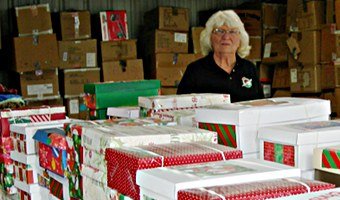


One woman’s enthusiasm for shoebox project becomes contagious

BAILEYVILLE—Nettie Hyde has it and has given it to everyone she knows. No, not H1N1 flu, but a fever for Operation Christmas Child.

Hyde first heard of Operation Christmas Child in 2003 and promptly packed her first shoebox for a child.

For Nettie Hyde, Operation Christmas Child is a year-round affair. Watch a video about her efforts here.

“After I packed it, I told my husband, ‘Let’s lay hands on this box and pray for the child that’s going to receive it,’” she recalled.

The next year, she and the Woman’s Missionary Union leader for her church, First Baptist Church in Rosebud, attended an Operation Christmas Child rally in Temple, and that was when her enthusiasm for the program became contagious.

“That day, I received my calling, and I hit the ground running. I haven’t stopped since,” Hyde said. “I can’t begin to say what it’s meant to me. I can’t describe how close my walk with God has grown with this.”

At her church in Rosebud, started rallying the troops. In 2004, members of First Baptist in Rosebud packed 121 boxes. The next year, with a whole year for Hyde to stir the masses and with Rosebud named a relay center, the town collected 1,073 boxes.

In 2006, Rosebud collected more boxes as a relay center than it has people—with a population of about 1,500 and 1,614 boxes gathered.

Last year, Hyde packed 501 boxes of the 2,098 collected herself.

This year, she has packed 1,006 boxes, but she has now stopped so she can work more on raising the $7,042 it will take to ship them.

“It’s amazing how God has blessed and is still blessing,” Hyde said.

For her, Operation Christmas Child is a year-round affair.

“I work on it some every day. I don’t feel like my day is complete if I don’t,” she said.

Her personal goal of 1,000 boxes for this year was something she kept to herself.

“I kept feeling like I was to do 1,000 boxes, but I wouldn’t tell anybody because it didn’t seem like reality,” she explained.

The task of raising the money for shipping is a big one, but she has found creative ways to do it. A man who owns a plant nursery in nearby Wilderville has either sold Hyde plants at a heavily discounted rate for her to resale or simply donated plants at no cost to her.

In addition to the plant sales, Hyde convinced her husband to construct a building she has dubbed Nettie’s Thrift Shop. The white building with red and green trim houses things people have given Hyde to sell. Some are handcrafted items such as paintings, and others are of a traditional garage sale variety, but 100 percent of the sales go to Operation Christmas Child.

Hyde also is quick to point out she has help finding the items to fill the boxes. Two women with a knack for finding bargains on small items for the boxes constantly are bringing her what they discover, she said.

All those boxes and the items to fill them have taken over the Hydes’ garage to the degree that no vehicle fits.

The task of wrapping all those boxes has not fallen on Hyde alone. First Baptist Church in Rosebud has Christmas wrapping days so that everyone can have a part in the ministry.

One woman has made hundreds of knit caps to include in the boxes. Others have made numerous bead necklaces and bracelets.

“It takes so many people helping in so many ways,” Hyde said. “I just want people to help in whatever way they feel led.”

The boxes not only have been life-changing for the children who receive them, but also for many of the people in Rosebud. For example, the mayor feels it to be his civic duty to help load the boxes into trucks every year.

But there have also been more eternal changes seen. A few years ago, a 16-year-old girl took two-dozen boxes home to wrap. Along with them was an Operation Christmas Child brochure that told how the boxes would be given to orphans around the world. The girl’s mother was a Muslim from Ghana, and she had seen first-hand the suffering of children in her homeland.

She was moved to help her daughter wrap the boxes. Before taking them back, the girl filled 20 of them, using money she collected at her birthday party in lieu of presents. Her mother filled the others.

That year, First Baptist, Rosebud, sold cookbooks to help finance the shipping of the boxes. On the back page of the cookbook, the girl told the story of her mother’s help and prayed for her mother to find Christ.

In March of this year, her mother accepted Jesus Christ as her Savior. And she has filled 200 boxes herself this year.

Passing on the Operation Christmas Child bug is just what Hyde wants.

“I’m 78, and I won’t be doing this forever. But I hope when I get to heaven that God will let me look down and see people packing shoeboxes, because it has been such a blessing to me,” she said.


Churches show love to poor children through shoebox gifts

TEMPLE—Glinda Harbison has been passionate about Operation Christmas Child since she first heard about it, and that passion has only grown stronger over the years.

Operation Christmas Child is a Samaritan’s Purse ministry that seeks to spread the love of Christ to impoverished children around world through a shoebox full of small gifts at Christmas. Participants are urged to pray over the boxes that the gift might communicate that God loves them.

Lanita Murray (left) and Maye Rea, both from Immanuel Baptist Church in Temple, pack boxes for Operation Christmas Child. (PHOTO/Courtesy of Immanuel Baptist Church of Temple)

Since its inception, 69 million boys and girls in more than 130 countries have had the gospel shared with them in this way, the vast majority of the children living in orphanages.

After hearing Franklin Graham speak about the nascent program at a meeting in Nashville in 1993, Harbison returned to Immanuel Baptist Church in Temple on a mission.

“I had never told one of our pastors, ‘We are going to do this.’ But I went into our prior pastor’s office and said: ‘We’re doing this. I’m not asking permission. We’re doing this,’” she recalled.

That first year, Immanuel’s congregation packed 35 boxes. “I was just beside myself,” said Harbison, who now serves as the church’s hospitality director.

Last year, people within the church brought 774 boxes to send to children around the world.

This is Immanuel’s second year to serve as a collection center for a number of Central Texas relay centers. The relay centers collect boxes from individuals and churches. Immanuel will take the 8,000 boxes it expects to receive from the surrounding churches and see that they are trucked to Denver for preparation for distribution to children around the world.

Most churches will observe Nov. 16-22 as their collection week. Many will bring their boxes to the collection center on Nov. 22, and the boxes will leave for the distribution center on Nov. 23.

“Some of our people are going to follow the boxes to Colorado and go to the distribution center to help out there,” Harbison added. “They’re simply going to finish what they’ve started.”

Volunteers will open the boxes and take out the $7 needed to pay for the shipping of each box. They also will give it a quick look to see if the contents dictate it go to a warm or colder climate. For example, if someone has knitted a wool cap to include, that box will be sent to a child in a cooler climate.

“The integrity of box is never compromised, because we’ve asked people to pray over the contents of that box,” Harbison explained.

Wayne McDonald will be among the volunteers who make the trek to Colorado.

OCC Logo “I’ve been involved with OCC since Immanuel Baptist Church first started doing it,” he said. “It’s a great thing to do. You spread the gospel and spread a little cheer for a little while—maybe longer than a little while.”

Spreading cheer while spreading the gospel was exactly what first attracted Harbison to Operation Christmas Child.

“I loved the idea of giving a gift to a child who has never received a gift,” she said.

She gained a new perspective about the program, however, on April 19, 1995. She was at a children’s conference and was next to a table of children’s workers from Oklahoma City when they learned of the bombing of the Murrah Federal Building.

“I made a commitment that day to myself that our church would continue to be involved with this ministry because we never knew—and we’ll never know—whose hands these boxes go into,” Harbison said.

It occurred to her that a child who might grow up to be a terrorist after being taught to hate Americans might question those teachings through a box filled with love.

“It may change a life for forever. It just hit me that day the importance of these boxes,” Harbison said.

Children who receive the boxes also are given the opportunity to make a profession of faith and then follow through with a 15-week discipleship course.

“It’s not just sending a shoebox,” Harbison explained. Professions of faith were recorded for 750,000 children last year through Operation Christmas Child.

Last year, a man at Immanuel was deeply moved by an Operation Christmas Child video about a Bosnian girl who contemplated stepping on a landmine to end her life, but a pair of tennis shoes in an Operation Christmas Child gave her the hope to keep living, Harbison recalled. Inspired by her story, the man provided 50 pairs of shoes last year. This year, he has given her money to buy 150 pairs of shoes.

“Once you become a part (of Operation Christmas Child), you realize how passionate people can become—not just about a simple shoebox, but the end results of that shoebox,” Harbison said.


Juarez violence points to continuing need for prayer by Texas Baptists

Unabated violence in the border city of Juarez underscores the continuing need for prayer by Texas Baptists, said a Tyler physician who is seeking to mobilize a statewide response.

Various news sources have reported the number of people killed in Ciudad Juarez this year by mid-September had topped 1,600—more than in all of 2008. Many of the homicides have been drive-by shootings and gangland-style killings associated with drug cartels.

And many of those deaths hit close to home for Baptists in Juarez, said Dick Hurst, a medical doctor from First Baptist Church in Tyler who is spearheading a statewide effort to link Texas Baptist congregations to sister churches in Juarez.

“I received an e-mail reporting that nine young people in three of our churches in Juarez were murdered recently,” he said.

Earlier this year, representatives from the Baptist General Convention of Texas, the Cooperative Baptist Fellowship, Buckner International, Baylor University and several churches met to explore ways Texas Baptists can respond to the needs of churches in Juarez.

The group agreed to seek Texas Baptist churches to enter a relationship with each of the 44 Baptist churches in Juarez. They also agreed to look for ways Texas Baptist schools could help the churches in Juarez with leadership development.

So far, between 30 and 40 Texas Baptist churches have agreed to become sister churches with congregations in Juarez, Hurst reported. Some large Sunday school classes also have expressed an interest in developing an ongoing relationship with a small Juarez church, he added.

Pastors in Juarez received an initial box of Texas Hope 2010 multimedia compact discs with gospel presentations and Scripture, made possible by the BGCT, he noted.

One pastor, who only received 30 CDs, noted it would not begin to be enough to distribute on the city’s streets, Hurst said. “So, his church established discipleship groups in homes. They are using the CDS in those groups as people work their way through them over 10 weeks,” he said.

For more information about the sister-church program with Baptists in Juarez, contact Hurst at crbhurst@hotmail.com .


Wayland pair make discovery in cancer research

PLAINVIEW—Early findings indicate a pair of Wayland Baptist University summer researchers may have isolated an herbal compound that appears to kill cancer cells.

Kassie Hughes laughs when she recalls the moment her professor, Gary Gray, visited them in the lab to see their final analysis results.

“He jumped for joy, that’s for sure,” said the senior chemistry major at Wayland Baptist University.

“It took them a while to realize what they had done,” Gray said. “You just don’t see something that appears to kill (cancer) cells like this.”

Student summer researchers Asenath Arauza (left) and Kassie Hughes look over results from the HPLC machine after it ran a test on a particular compound in their experiment. (PHOTOS/Wayland Baptist University)

Hughes, a Plainview native, and fellow student Asenath Arauza, a junior chemistry and molecular biology major, were participants in Wayland’s summer research program in chemistry, funded in large part by a grant from the Welch Foundation.

While they haven’t exactly discovered a cure for cancer, what Hughes and Arauza did over the summer months has quite a bit of value both in terms of scientific research and in their own education and edification, Gray noted.

The pair technically started their research in the spring 2009 term after learning in November they were chosen for the program. They spent the spring doing an extensive literature review once they chose a topic from the choices they were presented.

They chose to follow a path started by May 2009 graduate Joanne Jacob, who had experimented with 12 different herbs and their effect on tumor growth in mice. One in particular had significant results in Jacob’s research, and the two coeds decided to further check out Ashwagandha, commonly known as Indian Ginseng and used by many to treat depression, inflammation and neurological disorders.

Using a powdered form of the root, Hughes and Arauza first rinsed it to remove any lipids, then ran a 6-hour process known as a Soxhlet to liquify the extract into a more usable form. Gray likened the process to a drip coffee maker, where heated water—or in this case, methanol—runs through the extract and then back through repeatedly until it is complete.

Using thin-layer chromatography on glass plates, the team was able to separate the extract into various compounds. Through nearly 30 plates—a time-consuming process itself—the duo was able to identify one particular compound that was strong every time. They tested it on 4T1 breast cancer cells grown in Petri dishes to determine how it would affect the cells. The results were astonishing.

“This was really annihilating the breast cancer cells,” noted Arauza, pointing to a chart of the results that showed the cell growth was dramatically reduced compared to even the full extract. “This one was very potent. None of the others were even close.”

The next step was to characterize the isolated compound at Texas Tech University’s lab, utilizing their mass spectrometer, a machine the Wayland lab does not possess, to determine exactly what the size of the molecule is. A larger sample will be needed, however, to get a better reading and study using the Tech equipment.

The girls’ next plan is to repeat their entire research project to get a purer, larger sample and then run the cell culture test again before moving to the next stage, which is to inject the cancer cells in mice, then inject the compound and measure the results. They are excited about the next step, as is their faculty mentor.

“This raises all kinds of interesting questions since this appears to be different than the compounds that are already known,” Gray said. “If this turns out to be a unique plant steroid that just grows naturally and has this effect, this should be pursued. They’ve been eating this root for centuries, so we know it’s not a poison.”


Texas Baptist Men sending relief team to the Philippines

DALLAS—Texas Baptist Men will deploy 10 men to the Philippines Oct. 7 to spend 10 days helping with relief work and teaching local people how to clean up the area in the aftermath of the flooding and landslides that took place in the last week.

Within the last week, the Philippines were hit by typhoons Ketsana and Parma, causing water to rise more than 20 feet in some areas. At one point, 80 percent of Manila sat underwater.

The National Disaster Coordinating Council reports Ketsana caused 246 deaths in the Philippines, as well as 72 in Vietnam and nine in Cambodia. More than 2 million people have been affected by the storm.

“Our mission is to equip and train local people in how to do the cleanup work,” said Dick Talley, Texas Baptist Men director of disaster relief.

The group includes team leader Ernie Rice of Stockdale, Bill Gresso of Garland, Stan Knight of Dallas, Harold Patterson of Scoggins, Russell Schieck of Lubbock, Mike Tello of Elsa, Larry Vawter of Altair, Leo Vega of Odessa, Rey Villanueva of Kenedy and Rand Jenkins of Mansfield.

The Texas Baptist team will join with Baptist Global Response, Kentucky Baptist Men, Oklahoma Baptist Men and the Southern Baptist Convention of Texas to carry out various clean-up activities within the next two weeks.

“Imagine standing in two or three inches of muck and having to dig it out, remove furniture, remove personal belongings, decide what to save and what to throw out and then rinse off and sanitize what is left,” Talley said. “It is quite emotional for those who are going through it.”

The men hope to bring physical, emotional and spiritual help and restoration to the flood victims who are sitting in such a vulnerable state, Talley said.
Texas Baptist Men disaster relief efforts are made possible through donations given to Texas Baptist Men and the Texas Baptist Missions Foundation at the Baptist General Convention of Texas.

To support the Philippine relief efforts through Texas Baptist Men, visit http://www.texasbaptistmen.org/ and click on the donations tab or mail a check marked for disaster response to Texas Baptist Men at 5351 Catron, Dallas, TX 75227.

To give to the efforts through the Texas Baptist Missions Foundation, visit www.bgct.org/give and click on Disaster Response or send a check marked for disaster relief to the Texas Baptist Mission Foundation at 333 N. Washington, Dallas, TX 75246-1798.

For more information about relief work in the Philippines, contact Joe Detterman, volunteer disaster relief director, at (214) 632-8861.


Houston pastor to be nominated for BGCT 2nd vice president

HOUSTON—John Ogletree, founding pastor of First Metropolitan Baptist Church in Houston and former chairman of the Baptist General Convention of Texas Executive Board, will allow his nomination for BGCT second vice president.

Bob Fowler, a Houston attorney who succeeded Ogletree as Executive Board chairman, will make the nomination during the BGCT annual meeting in Houston, Nov. 16-17.

John Ogletree

“John doesn’t have any agenda other than helping to advance the kingdom of God and the cause of Texas Baptists,” Fowler said.

Ogletree, past-president of the Texas Baptist African-American Fellowship and former moderator of Union Baptist Association, has demonstrated through service he is “a man for all Texas Baptists,” Fowler said.

“I would describe him as a comfortable leader who is reflective and affirming of those he seeks to lead,” he continued.

Ogletree’s civic involvement serving on the CyFair Independent School District board and the experience he gained during the more than two decades he was a practicing attorney further demonstrate the breadth of his leadership abilities, Fowler added.

“I want to be part of the continuing effort by the BGCT to relate to all its churches,” Ogletree said. “I believe my background will help me to speak effectively to that diversity.”

He expressed his desire to work as “part of the team” as the BGCT faces “the challenges before us,” pointing specifically to financial constraints caused by the nationwide economic downturn.

Ogletree praised BGCT Executive Director Randel Everett for the Texas Hope 2010 vision that “has rallied us and given us a target.” The threefold emphasis on praying, caring for the hungry and sharing the gospel with every Texan by Easter 2010 is “something churches in every corner of our state can embrace,” he said.

Ogletree was born in Dallas and earned his undergraduate degree at the University of Texas at Arlington before obtaining his doctor of jurisprudence degree from South Texas College of Law in Houston.

He was called into the gospel ministry in 1982 and three years later was ordained at Antioch Missionary Baptist Church of Houston, where he served as minister of Christian development. In 1986, he became founding pastor of First Metropolitan Baptist Church in northwest Houston.

He has been involved with Mission Houston and was instrumental in forming the Redemption Community Development Corporation.

He and his wife, Evelyn, have three sons, Johnny, Joseph and Jordan; one daughter, Lambreni; and six grandchildren.


Christians embrace holistic ministry to make impact on poverty

WACO—Rather than responding to the needs of poor people by simply offering short-term relief, sponsors of the No Need Among You Conference challenged participants to move toward a biblical approach of holistic ministry with the poor. 

Jimmy Dorrell, executive director of Mission Waco, celebrates with Darlene, a woman whom the ministry serves, as she holds up a coin she received at an Alcoholics Anonymous meeting earlier that day. Darlene received the coin because she has remained sober 95 days.

The three-day conference at Baylor University focused on helping churches and individuals become aware of and engaged in holistic community ministry that helps and empowers people caught in poverty, suffering from mental illness and victimized by human trafficking.

“The Lord comes not only to save us for a relationship with him. He also is concerned with our whole person,” said Gerald Davis, community development director at the Baptist General Convention of Texas.

“He’s concerned about us entirely—concerned about our health, how we love one another, where we live and how we are making a difference for his name’s sake. All of that is wrapped up into being saved and being in a right relationship with God.”

The conference provided an opportunity for people to examine what it means to be marginalized and look at other issues related to poverty within a biblical context—issues that often aren’t discussed in a local body of believers, said Jimmy Dorrell, executive director of Mission Waco and pastor of Church Under the Bridge.

Participants pray at the conference.

“It’s about being prophetic in a culture that is losing its way without giving up your faith, but at the same time loving people,” Dorrell said.

“We consider ourselves biblical and trying to bring together the whole gospel again. This kind of conference is so fresh and encouraging for the evangelical community that they are learning again that you can’t just throw tracts in people’s faces and preach at them. Real love is always going to mean doing what the Good Samaritan did. The whole gospel is loving people in their need.”

Until the early 1900s, the American church had a social consciousness and a holistic approach to ministry, Dorrell said. The Great Reversal occurred when conservative and liberal churches became polarized over their response to the Social Gospel. Social justice became associated with the liberal church in a way that essentially scared the conservative church into underplaying ministry and strongly emphasizing evangelism in reaction. 

“The gospel has always been holistic. Evangelism and social action go together,” Dorrell said. “When you move more into a kingdom-of-God theology, you learn that God not only cares about us individually, but he also cares about the systems that he put in place so the children do get education and people don’t go hungry. Then, we realize those are tainted with sin, and we can fight for social justice. That isn’t liberal thinking, but it’s basic Christian stuff.”

Kathy Flowers (right), a member of Antioch Community Church in Waco, prays with a woman who attended the Friday morning homeless breakfast organized by Mission Waco.

To bring lasting change, the church needs to approach the poor on a holistic level, dealing with their problems, struggles and injustice that occurs on the physical, mental and spiritual levels, Dorrell said.

Keynote speaker Ray Rivera, director of Latino Pastoral Action Center in the Bronx, believes holistic ministry cannot begin until a church or individual receives a transcendent vision from God that will bring people out of their captivity.

“You have to see beyond the reality,” Rivera said. “A transcendent vision is one that transcends space and time and points us to the kingdom of God. It speaks a word that’s relevant to the situation and is impacting.”

Holistic ministry must have prophetic integrity and be incarnational, just as Jesus was when he came to earth, Rivera added. This allows the church to be part of a community so Christ can touch and transform people through them.  

“From a prophetic perspective, there are things that we can’t compromise on even when it’s not popular,” he said. “Sometimes as Chris-tians, we can’t bow, no matter what the institutional church or culture says.”

Breakfast at the No Need Among You conference.

For Matthew Stanford, professor and graduate program director of psychology at Baylor University and author of Grace for the Afflicted, the conference provided a way to encourage the church to address mental illness and pastors to realize the position of influence and ministry they hold. 

“Psychologists have known for 50 years that someone with a mental disorder is more likely to go to a pastor or clergy than a doctor,” Stanford said. “Part of this is accessibility. If you cannot afford the help you need, you will go to the highest-trained person around, and that is usually a pastor.

“Religious social support has been shown to help an individual recover quickly and effectively. When they have a system of family and friends to help them during the process, they recover more quickly and effectively.”

Once a church or individual has moved toward holistic ministry, the approach and mindset must be examined if it is to be put into place successfully, said Scott Talley, community minister at Crestview Church of Christ in Waco.

Often, people attempt to help the poor with a middle-class approach and expect them to respond positively and effectively, even though they know little about the hidden rules of middle-class society, Talley said.

To bring lasting change, the church needs to approach the poor on a holistic level, speakers said.

“Those of us in the middle class attempt to help, but we do it in our middle-class method,” Talley said during a presentation of the Ruby Payne’s Bridges Out of Poverty training.

“We can’t talk to people in poverty with this mindset. We need to understand each other enough to know what motivates people. It’s not about embracing the differences, but understanding them so that we can help.”

The training identifies hidden societal rules and key ideas about money, time, possessions and power among those in wealth, middle class and poverty. Once these are learned, ministry volunteers can approach those in poverty in a way that will help and motivate them to choose to better their situation.

“Hidden rules aren’t a matter of identity but choice,” he said. “We try to tell people in poverty how to fix their problems without even inviting them to take part and share what they think needs to happen. Knowledge of the hidden rules leads to access, and access leads to power” to change.

As churches and individuals begin to embody this holistic gospel theology, results will look different, Rivera said. It can be a long journey, he said, but Christians should be encouraged in knowing that God is faithful as people are obedient. 

“Holistic ministry isn’t a call to success but to faithfulness, because you don’t define success by the world’s standards,” he said.

To immediately put teachings from the conference into practice, some participants served at a homeless breakfast, and others attended a cookout at My Brother’s Keeper, a shelter run by Mission Waco.

Twelve students from the Baptist University of the Americas also attended Poverty Simulation, a weekend where participants become homeless to understand the issues driving poverty as they gain a first-hand glimpse of what it is like to be poor.


Hospital serves up gospel tray liners along with food

BEAUMONT—Baptist Hospital of Southeast Texas is serving hope to people who eat in its facilities.

As part of its participation in Texas Hope 2010, the hospital is using 15,000 tray liners that encourage Christians to pray for people around them, care for those in need and share the gospel—the three pillars of the Baptist General Convention of Texas initiative aimed at sharing the hope of Christ with every Texan by Easter 2010.

David Cross, director of the hospital’s chaplaincy department, said he hopes the liners not only inspire Christians, but also catch the eye of nonbelievers, creating avenues through which the gospel can be shared or lowering barriers so others can share the hope of Christ.

“This is a way to emphasize the concepts of praying, caring and sharing,” he said. “We intend for it to heighten the curiosity of patients or family members who might be standing there feeding a patient so when they are exposed to other materials such as a CD passed out in their neighborhood, a light bulb might go on that we are loving them by serving them.”

For more information about the Texas Hope 2010 initiative, visit www.texashope2010.com .


Church called pastor 60 years ago; he never heard God say, ‘Move’

PRAIRIE HILL—Some people search their entire lives for their purpose, but Fred Sain found his as a 20-year-old junior at Baylor University.

Called as pastor on Aug. 14, 1949, he has been the shepherd of the congregation of Prairie Hill Baptist Church 60 years. And that suits him just fine.

“In times gone by, I’ve had opportunities to leave—not many in recent years, but in the earlier years. But each time, I’ve felt this was the place the Lord wanted me, and I’ve stayed here because of that,” Sain said.

{youtube}NqIo9-7CeQQ&hl=en&fs=1&rel=0{/youtube}
Fred Sain has served 60 years as pastor of Prairie Hill Baptist Church, northeast of Waco.

God’s direction to stay was not through any great sign, he said, but rather through grace-filled encouragement.

“He makes you content in your service, and he motivates your service in this place. And he gives you love for the people that live here. I’ve sought to have a pastor’s heart, and I certainly have found that here,” he said.

“This church is like a family to me. When we have a death of one of our members, it’s like a member of the family.”

And over the course of his six decades as pastor, he has ministered to more than 500 people at their deaths, but he also has presided at a similar number of weddings.

By Church Clerk Carol Webb’s count, he has preached about 8,000 sermons and conducted 52 revivals. He also went to Russia in 1991 and 1992, preaching in Moscow, St. Petersburg, Kiev and Norsgard.

In 1994, the church paid for Sain and his wife, Sally, to tour the Holy Land, and Sain preached a sermon at the Sea of Galilee.

All of that is not what has made Webb love her pastor for the more than half century she has been a member of Prairie Hill.

“In 2001, I had a very serious surgery and almost died. I was home and ready to give up and die. He was down on his knees and saying, ‘Carol, you’re stronger than that,’ she recalled.

"This church is like a family to me"

“Somebody like that, who will be with you when you’re at your lowest and help you back up, he’s so special. Every time we need him, he’s right there. He’s 80 years old, but he’s right there.”

While Sain’s pastoral skills are loved, Webb said he also is a talented preacher.

“He’s such a wonderful pastor. He explains things to you. He’s such a wonderful teacher, you can’t help but learn,” she said.

The population of Prairie Hill—a Limestone County community northeast of Waco—has dwindled to the point where the Baptist church is the only congregation still meeting, so people of other denominations also come to hear Sain preach, Webb said.

The population decrease has had its impact on the church, Sain admits.

“When I came here, there was a farmer and his family on every 80 acres,” he recalled. He said one wealthy person came to town and bought 44,000 acres, so there are far fewer families living in the area.

When Sain came to Prairie Hill 60 years ago, about 100 people generally filled the pews. Now it’s about 35, with only about 15 attending Sunday school.

Still, he’s very pleased with his congregation’s faithfulness. The church’s Mary Hill Davis Offering for Texas Missions goal was $3,000, and he felt certain they would meet that. Also, 58 percent of the church budget goes to the Cooperative Program.

Many visitors were on hand for his anniversary celebration, but it was not a retirement party. He doesn’t feel any release from the call he received six decades ago.

“It’s just like the same way you go home. I don’t think I could ever feel comfortable attending another church and listen to another preacher,” he said with a chuckle.

“My life has been this place, and it’s been his purpose. It’s been a good life. If I could go back and look over it, I believe I’d do it all again.

“I feel like the Apostle Paul. His life was not one any of us could emulate, but when he finished, he said his mission was accomplished. That’s how I feel about mine. This is the mission the Lord gave me, and I’ve tried to be faithful to it.”


Port Arthur church shares transformational hope

PORT ARTHUR—In the 35 years since Procter Baptist Church was planted, people have come and gone. The neighborhood has changed. But the gospel continues to change lives.

In recent years, the community around the church has changed ethnically and socio-economically. Apartment complexes have sprung up. Children grew up and left, as did their parents. Now, a new generation of young people is moving into the area.

The changes have been challenging to the congregation, which saw attendance drop significantly over several years as a result of a variety of factors. The church kept fighting to share the hope of Christ with the people living near it.

Whether it’s been refugees from Hurricane Katrina, new residents in the apartment complexes or families in homes, the congregation is seeking to spread the gospel first by meeting people’s needs and building relationships.

Members of the church have given out free blankets, food, clothes and flu shots in an effort to connect with people in the community.

“There are a thousand ways to get to meet people,” Pastor Rick Erwin said. “If you offer them something, they will come.”

The congregation is seeing God’s kingdom expand as a result of his working through their efforts, Erwin said. The church has baptized 28 people in the past few months. Sunday school attendance has increased from about 110 people a week to roughly 150.

“We’ve had whole families that we’ve baptized,” Erwin said. “We had two professions of faith yesterday.”

The church hopes the growth is only the beginning. As part of its participation in Texas Hope 2010—an initiative to share the gospel with every person in Texas by Easter 2010—the congregation is trying to share the hope of Christ with the nearly 7,000 who live within one mile of its facilities by next Easter.

The church hopes to pass out 3,000 bags filled with information about the congregation and gospel tracts to the community.

“Most of all, it’s building personal relationships,” Erwin said. “It’s meeting your neighbors, getting to know them.”

Through those relationships, Erwin prays that people will be connected to the transformational message of Christ.

“This is our goal’—that we will see our sanctuary filled twice Easter Sunday morning—not with just people visiting once, but with people we’ve met, we’ve gotten to know and we’ve built a relationship with,” he said.


BGCT forms Center for Effective Leadership

DALLAS—The Baptist General Convention of Texas has formed the Center for Effective Leadership to provide resources for pastors and other congregational leaders to develop leadership skills and practices. 

The center will help Texas Baptists develop leadership skills that will help congregations thrive, making an impact on their communities and the world, BGCT Executive Director Randel Everett said.

“The key to church and institutional health is the right kind of leadership. The Cen-ter for Effective Leadership was created to allow us to deal with this essential principle in pragmatic ways that provide tools and evaluations for our Texas Baptist leaders,” he said.

The center aims to help Texas Baptists increase their leadership abilities by pointing them to resources that are strong theologically as well as practically useful. Sometimes that will entail pointing individuals to existing resources.  Other times, the center will create resources by bringing Texas Baptists together who are passionate about a particular leadership issue, Center Director Ron Herring said.

By bringing Texas Baptists together, the center can create contextually accurate resources that provide the theological foundation for leadership, as well as practical leadership skills that will work in Texas Baptist churches.

“We want to assist churches and church leaders right where they are,” Herring said. “The resources we point people to and the resources we will create will help people better develop their leadership skills.”

The center is beginning its work by seeking feedback from Texas Baptists about where they find their leadership resources and what they would like to see created.

Listening is often the first step in effective church leadership, said Emily Prevost, the center’s associate director. It seems to be a logical point for starting the center’s ministry as well.

“If you walk in saying you have all the answers, you’re going to fail,” she said.

“In order to create significant solutions for leadership issues across the state, we need to make sure we’re addressing issues that actually exist. From that point, we can begin to bring people together to tackle the problems that Texas Baptists believe are most critical.”

In creating the center, Bivocational Specialist Cecil Deadman and Pastorless Church Consultant Karl Fickling were moved to the BGCT Christian Education/ Discipleship Center. Bill Claiborne, who primarily worked with Texas.E-quip.net, became a congregational strategist. The position held by Julie Sadler will be eliminated Oct. 31 as part of this strategic change.

The center’s budget will consist of limited BGCT cooperative funds and is intended to become self-supporting within a few years.