DeSOTO—Texas Baptist Men chainsaw teams came to the aid of a disabled homeowner in DeSoto after an insurance company told the homeowner he had to remove all limbs over his roof by the end of November or his insurance would be canceled.
“There were probably eight red oak trees around the house,” said Dan Sell, coordinator of Ellis County’s TBM disaster relief team. “After 50 some years, the limbs were high above the roof line, but an aerial view almost hid the roof.
“We are a new chainsaw unit,” Sell continued. “We have the ability to do ground work, but we needed a manlift and climbers. So, I contacted Wendell Romans with Collin County asking for their manlift,”
Romans, who is also statewide TBM chainsaw coordinator, “not only said ‘yes,’ but also volunteered to personally help with the lift,” Sell said. “Of course, I said ‘yes’ and ‘thank you.’“
Sell then contacted David Meyers, state coordinator for climbers, and he put out an email request for climbers. Three volunteers responded within 12 hours.
A small group from Ellis County started the work Nov. 24, Sell said. Then a large group worked Nov. 27 for “a good 8 hours,” and a smaller crew wrapped up things Nov. 28—in time to save the homeowner’s insurance.
Mission accomplished in three workdays, Sell said. The team presented a Bible to the homeowner, his son and daughter. They also shared the good news with two neighbors.
“So much thanks to the many hands and feet of our Lord Jesus Christ,” Sell said.
And, in a note, he added a prayer request: “We still have a need for our own manlift, keep praying!”
“The bottom line is, it was a real TBM team effort. That’s the real story,” Sell said.
Pastor puts beard on the line for Peru mission project
December 11, 2023
HEMPSTEAD—What began as a joke made in front of a rural Texas congregation ended with a gift of more than $26,000 contributed to enable Texas Baptist Men and their ministry partners to drill new water wells in Peru.
Tim Smith presents the weekly announcements during worship services at First Baptist Church in Hempstead, northwest of Houston.
One Sunday in October, he told the congregation Pastor John Brandt might shave off his beard if the church gave a certain amount of money for this year’s annual statewide Royal Ambassadors mission project—drilling water wells in Peru.
Good-hearted pressure began to build on the pastor to set an amount.
Pastor John Brandt agreed to shave off his beard if First Baptist Church raised at least $20,000 for a mission project in Peru. The church gave $26,000—more than enough to drill two water wells. (Courtesy Photo)
Brandt said he decided to play along by setting a price for the shaving of his beard—one he thought would be too high to reach. The price for his shave was $20,000.
The church had never known their pastor without a beard. Brandt started as worship pastor in 2015 and became pastor in 2017. His children had not seen him without a beard for nine years.
Smith said he checked with Brandt’s wife, Amanda, about the challenge, as well.
“She was good natured about it, too,” Smith said.
Children in the church started raising money for the mission project associated with the annual RA Campout and Missions Mania event, which was Nov. 10-12 this year.
All the church’s children participated
First Baptist in Hempstead has both an RA chapter and a Girls in Action group, so all children involved in missions programs at the church were involved in the fund-raising project, Brandt said.
The children began the fundraising effort by using empty water bottles to collect coins, Smith said. Then they brought bottles to the Wednesday night and Sunday morning services so adults could contribute.
The total slowly climbed in the hundreds.
“By the end, we had about 10 bottles sitting there, some completely full,” Smith said. “One couple came in with rolls of pennies.”
Barber Adam Gessner (right) helped Pastor John Brandt fulfill his pledge to shave his beard if his church gave at least $20,000 to a mission project. (Courtesy Photo)
But still people gave, and Smith, the chair of deacons, and others kept the rising total under wraps.
As the RA boys were “getting in the van to go to Missions Mania,” a church member “pulled up and wanted to make sure his gift got in” on time, Smith said.
They did not announce the total of more than $26,000 until the Sunday after returning from Missions Mania.
“We came back and announced the total,” Smith said. “John had a surprised look on his face. … You never thought it was going to be as big as it was, but then it was.”
Brandt went to his barber Nov. 28 and said goodbye to all of his facial hair except a mustache.
“I noticed as soon as they finished shaving that my face was colder,” the pastor said. “Now I’m shocked every time I look in the mirror.”
Smith said the church “just thought this would be a fun thing to do. It became sort of a running joke for about a month. … We had a lot of great people step up.”
The beard cutting made the effort fun for the congregation, but the pastor said it really wasn’t about facial hair.
“Everybody in our church knows about water wells in Peru now,” Brandt said.
Stressing the importance of Christian mission
First Baptist in Hempstead emphasizes awareness about the importance of Christian mission, the pastor said. He used the singular “mission” to stress that all Christians are to be on mission.
“We’ve continued to press into RAs and GAs, to emphasize the importance of raising our children to be on mission. … We are constantly pushing mission with our kids.”
The congregation is now getting its first look at their pastor without a beard, but it’s not a new look for Brandt. Before arriving in Hempstead, he served 11 years in the U.S. Army Honor Guard.
“Every Monday we got a fresh haircut, … no mustaches.” He was “clean shaven all the time.”
But Brandt grew up in a house with a dad who had a beard. So, he grew his own beard after leaving the Army.
The beard-cutting promoted awareness about the needs in Peru and pointed toward a specific way to address it through TBM. The $26,000 will cover more than the cost of drilling two wells.
There is still some debate in the church as to whether the mustache was exempted from the shave. Smith laughed and said they are reviewing business meeting minutes to see if the pastor has fully complied.
There is already talk of an additional $5,000 bounty on the mustache, Smith said.
The pastor is not sure of the timing, but he said the beard will return.
As for the church, Brandt said, being on mission is still the key.
“Now we’re looking for what we’re going to do next,” he said. “Who knows?”
Mission Arlington clinic benefits from Texas Rangers gift
December 11, 2023
Even before the Texas Rangers clinched a World Series championship, the team and its charitable foundation scored a huge victory for children and families in need as far as Tillie Burgin, founding executive director of Mission Arlington, was concerned.
The Texas Rangers and Major League Baseball selected Mission Arlington as a World Series Legacy Gift recipient. The Legacy Gift program is an MLB initiative to support worthy causes in communities that host its premiere events each season—the mid-summer All-Star Game and the World Series fall classic.
Mission Arlington will apply the gift toward the expansion of its medical clinic, which offers health care at no cost to more than 12,000 patients each year.
“We don’t turn people away. It’s a place of refuge and love that the Lord has put together,” said Burgin, who founded Mission Arlington in 1986.
Mission Arlington will apply the World Series Legacy Gift toward the expansion of its medical clinic, which offers health care at no cost to more than 12,000 patients each year. (Photo / Ken Camp)
Mission Arlington plans to add seven examining rooms and a triage room to its clinic. One pediatric examining room will be decorated in Texas Rangers team colors and markings.
“People line up for the clinic at 3:00 or 4:00 in the morning, Monday through Friday,” said Clark Burgin, operations manager at Mission Arlington and Tillie Burgin’s grandson.
The number of patients served by the clinic grew 11 percent from 2021 to 2022, and it increased another 17 percent in the past year, with a 75 percent rise in pediatric cases, he noted.
‘One life at a time’
The numbers served by Mission Arlington’s clinic and its multiple other ministries—as well as its outreach Bible studies and mission congregations at 360 apartments and other locations throughout Arlington, Grand Prairie and Fort Worth—are impressive. But Tillie Burgin prefers to focus on individuals, not statistics.
“It’s one life at a time, ministering to the people God brings us who allow us to get involved in their lives,” she said. “People with no hope find Christ here.”
The Texas Rangers are longtime supporters of Mission Arlington, providing toys for children at Christmas, volunteers to deliver meals at Thanksgiving and funds to meet urgent needs in times of distress.
“They are about more than just baseball. They are people who really care about other people and this community,” said Jim Burgin, communications director at Mission Arlington and Tillie Burgin’s son.
A significant number of Christians work with the Rangers organization, Tillie Burgin added. “So, we speak the same language.”
At this point, Mission Arlington doesn’t yet know the exact amount of the World Series Legacy gift or precisely how much it will increase the clinic’s capacity to serve patients. But Tillie Burgin is trusting in God’s provision.
“It will be exactly as God planned it to be, so there’s no need for speculation,” she said. “I’m sure people will fill those rooms, and we’ll need more as God continues to allow us to be his hands and feet.
“We want them to know when they come to this place, they’ve been in his presence.”
Leadership program focuses on head, heart, hands, habits
December 11, 2023
PLAINVIEW—When Dee Ann Curry was looking for the right way to honor the memory of her husband Eddy at his alma mater, Wayland Baptist University, she knew certain aspects to include—leadership and mentorship.
“There are four parts that Eddy and I both liked in ministry: lead with head, heart, hands and habits,” she said. “The heart is because the Lord wants you completely. It’s an all-in thing, the emotional desire the Holy Spirit puts there. You are called to lead, not driven.”
When she learned the university was seeking to develop a new leadership program for students, it seemed a perfect partnership of her heart and Wayland’s vision. With her donation, the Curry Pioneer Leaders program was born in summer 2023.
Dean of Students Shawn Thomas formed a staff team to plan the program, keeping both Curry’s wishes and the university’s strategic plan in mind.
Eight students are participating in the program in its inaugural year. The diverse group includes students from across the academic spectrum, some athletes and an international student. Each is paired with an alumni mentor from his or her field for some organic leadership mentoring. In the spring term, the team will organize and implement the university’s Community Service Day in Plainview.
Participants in the inaugural Curry Pioneers Leaders retreat at Bonita Park Camp and Conference Center near Ruidoso, N.M. scale a wall during a leadership activity. (Wayland Baptist University Photo)
The initial cohort began the program by traveling to Bonita Park Camp and Conference Center near Ruidoso, N.M., for a three-day retreat that included a challenge course, ropes course, campfire gatherings and other times to reflect on learning. At the retreat, students were introduced to many key leadership concepts through teaching and experiential learning.
Student participants received goody bags with a T-shirt and journal to keep program notes, as well as Habitudes by Tim Elmore, a set of the curriculum on which the teaching is based. The books cover principles of leadership from self-leadership to leading teams, each based on an image that makes it more memorable. Participants said the retreat time had an impact on them.
“Learning about leadership and how effective the different skills can be will have a huge impact on my life, as I began to feel like a new person within the first devotional we had. When getting different leadership positions, I feel as if we never stop to think about how to be a leader,” said JoNiesha Kennedy, a junior from Louisiana and member of Wayland’s wrestling team.
“Having other adults outside of your home taking time out to discuss and teach about this thing called leadership is incredible. It warms my heart to know that there are more adults that care for us and genuinely want us to be great leaders within the world. The retreat meant a lot to me.”
Cooper Trolinger, president of the Student Government Association, also noted the importance of the training.
“I am so thankful for this program. I got to spend time with students that I normally wouldn’t come into much contact with. During this weekend, we had serious moments of learning, but also, we had a ton of fun and laughed a lot. This program helped me grow my established leadership abilities, and in turn I can use them in my role as Student Government president to continue to help make this place better for all students,” said Trolinger, a senior from Pampa.
“I am so grateful to the Curry family for making this program available to us at Wayland, and I’m excited to see what this program grows into.”
Leadership based on ‘caring about individuals’
Dee Ann Curry is pictured with her late husband Eddy.
The Curry family has deep Wayland connections. Eddy Curry’s father and two brothers attended the university, as did all three of their wives. Eddy and Dee Ann Curry’s daughter, Kamber, is a Wayland graduate, and their granddaughter, K’Dee Bailey, is a junior at the university now.
Eddy and Dee Ann Curry met at a freshman talent show and married while students. She studied education and served as a public school teacher for 30 years. She then taught speech at various colleges, retiring from McMurry University.
She is most excited the leadership program at Wayland includes so many things important to her husband, who died of a heart attack in 2019. A 1975 Wayland graduate, Eddy Curry served in church education ministry his entire career, cherishing his role of helping others grow in their relationship with Christ.
“Eddy didn’t like to be in front of people but loved to do one-on-one ministry and lead one-on-one,” she said. “I can’t tell you how many daily texts he’d send to encourage people. He built personal connections and relationships. He stayed in contact with people we were doing life with.
“It’s caring about individuals. You can’t do that with everybody, but you can do it with your actions and example.”
Curry said her husband kept regular contact with about 20 men from Wayland whom he poured his life into, noting he loved mentoring other ministers and students. He was a great servant leader who sent others out to serve, as well. She believes he would be proud of Wayland’s Curry Pioneer Leaders program.
“I love the fact that they are learning with a balanced style of leadership. Servant is mentioned way more than leader in the Bible,” she said. “Being Christ-centered is so hard, but leading with integrity is a good way to honor God. Leadership is a process of influence, and your habits have to reflect that to be a good leader.”
Marchelle Bowden, a junior on Wayland’s Flying Queens basketball team, identified those as key takeaways for her from the retreat.
“Leadership and servant leadership are different. You can be an outstanding leader, but if God isn’t glorified, the kingdom will not grow,” said the junior from Michigan. paraphrasing Romans 8. “As we become empty of self and dependent on God, the Holy Spirit will use us.”
Texas in the minority in regard to capital punishment
December 11, 2023
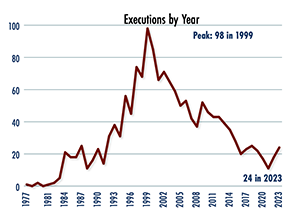
Texas was one of only five states that carried out executions this year and one of only seven that imposed new death sentences, the Death Penalty Information Center reported.
Florida, Alabama, Missouri and Oklahoma joined Texas as the only states conducting executions this year, the center reported. The eight executions carried out in Texas and the six in Florida accounted for more than half of the 24 conducted in the United States in 2023. Nine of the inmates executed this year were people of color, “The Death Penalty in 2023: Year End Report” revealed.
Arizona, California, Louisiana and North Carolina joined Texas, Florida and Alabama as the only states this year that sentenced convicted individuals to death.
Mentally ill inmates executed
The center reported 79 percent of the inmates executed in 2023 had serious mental illness, brain injury, developmental brain damage, intellectual disability or had experienced chronic serious childhood trauma, neglect or abuse.
Texas executed three inmates in 2023—Jedidiah Murphy, Arthur Brown and Gary Green—who presented evidence of mental illness or intellectual disability.
Another Texas inmate—Scott Panetti—was slated for execution in spite of a diagnosis of schizophrenia and history of mental illness. However, the U.S. District Court of the Western District of Texas ruled Sept. 28 the state could not execute him.
William Keith Speers, inmate coordinator of the faith-based program on Texas Death Row, was scheduled for execution Oct. 26, but the Texas Court of Appeals granted a last-minute stay of execution. In his application to the appeals court, Speers asserted his previous legal counsel failed to present to the jury evidence of his long history of trauma due to childhood abuse and neglect.
John Litzler
John Litzler, public policy director for Texas Baptists’ Christian Life Commission, said the execution of prisoners with mental illness or serious impairment conflicts with the CLC’s commitment to a “culture of life.”
“We are grieved by the statistics in the Death Penalty Information Center’s annual report and, in particular, the data about high rate of execution for individuals with an intellectual disability or suffering from mental illness,” he said.
“While we support victims of heinous crimes and their right to justice, those with certain intellectual disabilities and mental illnesses often lack the mental ability to understand the consequences or sometimes even the wrongness of their actions. In those instances, a true commitment to both justice and a culture of life dictates more appropriately measured consequences.
“During the legislative session the Christian Life Commission supported two separate bills aimed at prohibiting capital punishment for those with intellectual disability and those suffering from schizophrenia or schizoaffective disorder. Each bill passed the House of Representatives, but failed to pass in the Senate. The annual report motivates the CLC to continue its efforts to promote a culture of life in the State of Texas.”
Lawmakers in Arizona and Arkansas also considered legislation to exempt inmates with severe mental illness from the death penalty, but the bills failed.
Texas has the third-largest Death Row population in the country with 192 inmates, behind California at 665 and Florida at 313, the center’s end-of-year report noted.
Texas an ‘outlier’ in terms of executions
Stephen Reeves, executive director of Fellowship Southwest, voiced strong concern about what the end-of-year report revealed.
Stephen Reeves
“Texas continues to be a sad outlier in the business of killing prisoners. The latest report shows once again that we reserve capital punishment almost exclusively for the poor, the mentally ill, the abused and the unlucky,” Reeves said.
“It is well past time that Texans of good conscience, and especially Christians, demand an end to this unjust and barbaric practice.”
The Death Penalty Information Center’s year-end report supported Reeves’ characterization of Texas as an “outlier” in terms of capital punishment.
From a Death Penalty Information Center report.
The report noted 2023 was the ninth consecutive year when fewer than 30 inmates in the United States were executed and fewer than 50 received a death sentence, as of Dec. 1. Nationally, the number of executions peaked in 1999 when 98 inmates were put to death.
This year marked the first time more Americans (50 percent) told Gallup pollsters they believe the death penalty is administered unfairly than say it is conducted fairly (47 percent).
Three new exonerations of Death Row inmates—John Huffington in Maryland, Jesse Johnson in Oregon and Glynn Simmons in Oklahoma—occurred in 2023. Together, the three men served more than 140 years in prison before their convictions were overturned.
Inmates executed in 2023 spent an average of 23 years in prison—the longest average time since the death penalty was reinstated in 1976, the center reported. Their average age at the time of execution was 54.
“The data show that most Americans no longer believe the death penalty can be imposed fairly,” said Robin M. Maher, executive director of the Death Penalty Information Center.
“That important change can also be seen in the unprecedented show of support for death-sentenced prisoners from conservative lawmakers and elected officials this year, some of whom now oppose use of the death penalty in their state.”
From a Death Penalty Information Center report.
Twenty-nine states either have abolished the death penalty or have paused executions by executive action. Arizona and Pennsylvania both paused executions through executive actions in 2023.
Guarneri begins service as BGCT executive director
December 11, 2023
GARLAND—Julio Guarneri began his time of service as executive director of the Baptist General Convention of Texas with a Nov. 30 luncheon for BGCT staff hosted by First Baptist Church in Garland.
“It takes a special person. … It takes a person of conviction to say this is who we are, and this is what God’s calling us to be and do,” Christina said.
“You have a humble spirit. You are full of grace and love and compassion, but you also are clear about who you are, and we love that about you.”
Guarneri, addressing convention staff for the first time as executive director, expressed gratitude on behalf of him and his wife Monica.
Julio Guarneri addresses the Baptist General Convention staff on his first day on the job as executive director. (Texas Baptists Photo)
“We are just honored and elated at the opportunity to serve the Lord in this way,” he said. “We have felt your love. … You have expressed your support for me in this new role, and I really am grateful for that.”
Reflecting on the luncheon program led by First Baptist Garland’s minister of music and worship, Mark Hill, and music and worship associate, Clay Mobley, Guarneri pointed to the significance of the gospel message.
“In the midst of the laughter and food we are reminded it’s all about Jesus, right? It’s about knowing Jesus, it’s about worshiping Jesus and it’s about proclaiming him. That’s what we’re about. I am excited to be a part of this team,” he said.
Guarneri, who has spoken previously of his Texas Baptist roots, shared with ministry staff that he considers himself a product of Texas Baptists.
He responded to the call to ministry at Congreso, was discipled and shaped by the Baptist Student Ministry in Corpus Christi, was a recipient of Mary Hill Davis scholarship funds, studied at Dallas Baptist University, and was encouraged, inspired and mentored by various BGCT staff throughout his ministry.
“It’s been so exciting to watch you. All of you are doing just incredible things for the kingdom of God,” Guarneri said. “I am honored to pray with you, to dream with you and then to work together for the sake of the kingdom, for the sake of the king.”
Christina thanked staff for their support as he served as acting executive director beginning Jan. 1 until Guarneri’s start, calling the opportunity “one of the great joys” in his life.
Christina called on Oza Jones, director of African American Ministry, and David Miranda, director of Ministers Development and Missional Network, to pray over Guarneri and his wife as staff gathered around the couple.
Guarneri is scheduled to meet with Lubbock-area pastors at a luncheon on Dec. 15, with other similar gatherings to follow at other locations around the state.
Dorrells and Stricklin among Baylor alumni honorees
December 11, 2023
Janet and Jimmy Dorrell, co-founders of Mission Waco/Mission World, are the recipients of Baylor University’s Pro Ecclesia Medal of Service—one of five 2024 Baylor Alumni Awards announced Nov. 30.
“Baylor alumni serve in unique ways through their professions and in their communities. The 2024 Baylor Alumni Award honorees stand as examples of how our mission, to educate men and women for worldwide leadership and service, is lived out among our alumni every day,” Baylor President Linda Livingstone said.
“As a Christian research university committed to providing a transformational education rooted in faith, Baylor continues to invest in the lives of our students, helping them find and follow their callings. It is our honor to showcase this remarkable group of Baylor Alumni Award recipients and to tell their stories of impact and contributions to Baylor and society.”
A celebration honoring the award recipients will be held on the Baylor campus Feb. 23.
The Pro Ecclesia Medal of Service is awarded to individuals whose broad contributions to Christian ministry are considered to have made an immeasurable impact.
More than four decades ago, Jimmy and Janet Dorrell sensed God’s calling to “incarnational ministry” among the poor. So, they moved to a blighted neighborhood in North Waco known for its prostitution, crack houses and deep poverty.
The Dorrells began seeking to make a difference by building a basketball court next to their house and inviting youth from the area to play there. Relationships with the children and teenagers led to friendships with their parents.
As the Dorrells listened to what their neighbors taught them about the community, one transformational ministry after another took shape under the umbrella of what became Mission Waco.
Jimmy Dorrell, now president emeritus of Mission Waco/Mission World, serves as pastor of Church Under the Bridge, a congregation that includes unhoused people who meet for worship beneath the I-35 overpass. He is on the adjunct faculty of Baylor’s Truett Theological Seminary.
Janet Dorrell is director of Mission World, a ministry that serves families in Haiti, Mexico, South Asia and Colombia. Through Mission World, she helps to empower women and provide for children through tutoring programs, computer and sewing classes, and microcredit initiatives. She also seeks to connect hospitals and universities with community service efforts among the marginalized.
Gil Stricklin honored posthumously
Baylor named Gil Stricklin, founder of Marketplace Ministries/Marketplace Chaplains, as the posthumous recipient of the Distinguished Achievement Award.
Gil Stricklin
After graduating from Baylor and serving as an officer in the U.S. Air Force, Stricklin worked with the Billy Graham Evangelistic Association as a special assistant to Graham.
He served 15 years on the Baptist General Convention of Texas staff, where he pioneered the Super Summer Youth Evangelism program.
In 1983, he founded Marketplace Ministries, which offers chaplain care to business employees. The organization now serves more than 1,000 companies with 1.2 million employees being helped.
Stricklin also served as a U.S. Army chaplain during Operation Desert Storm and Desert Shield. He retired from the U.S. Army as a colonel after 37 years of military service—15 years in the Air Force and 22 years in the Army.
Baylor also will recognize:
David Wills of Waco, co-founder of Generous Giving and TrustBridge Global Foundation and president emeritus of the National Christian Foundation, as Alumnus of the Year.
Jessica Beachum of Phoenix, Ariz., co-founder of the Beachum Charitable Fund and co-curator of the Jessica and Kelvin Beachum Collection, as Young Alumna of the Year.
Gabrielle “Gabe” Madison, president of Bonton Farms in Dallas, a nonprofit farm that serves a former food desert in South Dallas, as recipient of the Pro Texana Medal of Service.
Based in part on information provided by Lori Fogleman with Baylor University Media and Public Relations.
Texas Supreme Court hears arguments in abortion case
December 11, 2023
The Texas Supreme Court heard oral arguments Nov. 28 in a case challenging the state’s ban on abortions except when a pregnant woman’s life is at risk.
The lawsuit claims pregnant women in Texas “have been denied necessary and potentially life-saving obstetrical care because medical professionals throughout the state fear liability under Texas’ abortion bans.”
The Center for Reproductive Rights filed the suit March 6, asking the state to clarify the scope of the “medical emergency” exceptions in its abortion ban.
In August, a Travis County judge granted the plaintiffs request for a temporary injunction that exempted pregnant women with life-threatening pregnancies—or lethal fetal diagnoses—from the state’s abortion ban. The Texas attorney general’s office appealed that ruling to the Texas Supreme Court.
“Protecting the health of mothers and babies is of paramount importance to the people of Texas, a moral principle enshrined in the law which states that an abortion may be performed under limited circumstances, such as in the event of ‘a life-threatening physical condition aggravated by, caused by, or arising from a pregnancy’ that places the pregnant woman ‘at risk of death or poses a serious risk of substantial impairment of a major bodily function unless the abortion is performed or induced,’” the attorney general’s office said in a public statement issued at the time of the appeal.
The Center for Reproductive Rights originally filed the suit on behalf of Amanda Zurawski and six other women who said they were denied medically necessary abortions and two obstetrician-gynecologists. Another 13 women later joined the lawsuit.
“Abortion bans are hindering or delaying necessary obstetrical care. And, contrary to their stated purpose of furthering life, the bans are exposing pregnant people to risks of death, injury, and illness, including loss of fertility—making it less likely that every family who wants to bring children into the world will be able to do so and survive the experience,” the lawsuit stated.
Attorneys offer opposing arguments
Appearing before the Texas Supreme Court for about one hour, Beth Lusmann with the attorney general’s office presented arguments on behalf of the state, and Molly Duane with the Center for Reproductive Rights presented arguments for the plaintiffs.
Lusmann asserted the question of whether exemptions to the state’s abortion ban are clear is a matter for the Texas Legislature—not the courts—to address. However, she did not fault lawmakers for the way the law was drafted, saying they “set the bar high.”
“What the legislature has done is choose to value unborn life and prohibit abortion in all circumstances unless that life is going to conflict with the life of the mother,” she said.
Lusmann also asserted the plaintiffs lacked standing to sue the state, saying they instead should have pressed any legal claims against their physicians.
“Some of these women seem to have fallen within the exemption, but their doctors still said ‘no’” to an abortion, she said. “That’s not the fault of the law. That’s a decision of the doctor.”
When asked if the abortion ban put physicians in peril, she replied, “I don’t think it does, if they are allowed to use reasonable medical judgment, which is presumably a judgment they use when treating a patient in any given circumstance.”
Arguing on behalf of the plaintiffs, Duane said the abortion ban subjects physicians to “the most extreme penalties imaginable—life in prison and the loss of their medical license.”
“While there is technically a medical exception to the bans, no one knows what it means, and the state won’t tell us,” she added.
Duane objected to the state’s assertion that the women who brought the lawsuit lack standing because they do not face an “impending” circumstance. Instead, the state insisted, they are seeking an advisory opinion regarding “a hypothetical or contingent claim” on behalf of other women.
Duane asserted the lead plaintiff Zurawski became septic “while waiting to become sick enough to receive an abortion.” Zurawski subsequently had to undergo multiple operations to reconstruct her uterus, and the ordeal left her with compromised fertility, she added.
“We’re not talking about hypothetical harms,” Duane said. “These are real patients, many of whom are sitting in the courtroom today.”
Evangelicals seek to change the immigration narrative
December 11, 2023
Evangelicals agree all people—including immigrants—should be treated with respect and mercy, but they hold divergent views on how that translates into public policy, an official with the National Association of Evangelicals said.
“The reason we have people lining up at the border is that we don’t have a functional legal system that admits a reasonable number of immigrants both for work and for family,” Galen Carey, vice president of government relations with the National Association of Evangelicals, told participants at the Evangelical Convening on Immigration. The Evangelical Immigration Table sponsored the Nov. 17 event in Houston.
Carey participated in a panel along with Phillip Connor, senior demographer at FWD.us, an advocacy group focused on immigration and criminal justice reform; Hannah Daniel, policy manager with the Southern Baptist Convention’s Ethics and Religious Liberty Commission; and Kathryn Freeman, Texas advocacy strategist for World Relief Texas. Eric Black, editor and publisher of the Baptist Standard, moderated the discussion.
Expand public officials’ ‘field of vision’
Kathryn Freeman
Freeman, former public policy director for Texas Baptists’ Christian Life Commission, encouraged Christians to help elected officials expand their “field of vision” in regard to what their evangelical constituents really believe about immigration.
“I think there’s a narrative of who the voters are that gets stuck in their head and in their imagination, and so, they think they’re in step with their constituents,” she said.
She pointed to a Lifeway Research study showing significantly larger percentages of Americans who are “evangelical by belief,” as opposed to “self-identified evangelicals,” support immigration policies that promote family unity and provide immigrants a pathway to citizenship.
Daniel noted messengers to the Southern Baptist Convention 2023 annual meeting in New Orleans approved a resolution urging government leaders to “provide robust avenues for asylum claimants” and to “create legal pathways for permanent status for immigrants who are in our communities by no fault of their own, prioritizing the unity of families.” The resolution condemned “any form of nativism, mistreatment or exploitation” as “inconsistent with the gospel.”
Several panelists encouraged evangelicals to encourage lawmakers to support the bipartisan Dignity Act of 2023, HR 3599.
The Dignity Act seeks to strengthen border security, while also providing undocumented individuals—particularly DACA recipients and Temporary Protected Status holders—a path to pursue legal status.
Michael DeBruhl, a retired Border Patrol official who now directs the Casa del Sagrado Corazon shelter in El Paso, noted the border security system was created to process Mexican nationals entering the United States illegally, and it was “woefully unprepared” for a massive influx of refugees and asylum seekers from other countries.
Mexican nationals who entered the United States without documentation and who were apprehended by Border Patrol 20 years ago largely went unseen by the general public, he noted. Today, those who are seeking refugee status, asylum or humanitarian parole are in the public eye.
“Now we see that population. They are visible to us,” he said.
DeBruhl participated in a panel along with Julie Mirlicourtois, executive producer of the Maybe God podcast and ACROSS, a documentary film series about asylum seekers; and Yonathan Moya, founding executive director of Border Perspectives.
“Nations from all over the world are coming to the southern border” of the United States, Moya said.
Texas House defeats school vouchers again
December 11, 2023
Rural Republicans in the Texas House of Representatives joined Democrats in defeating a plan to use tax dollars to support private education, including religious schools.
In the fourth special session of the Texas Legislature this year, the House voted 84-63 to approve an amendment by Rep. John Raney, R-College Station, that stripped educational savings accounts—essentially school vouchers—from HB1. The $7 billion omnibus education bill included funding for public schools and more money for teachers.
House members debated the amendment about three hours before voting—once again—to reject any effort to divert public funds to private schools. The Texas House repeatedly has rejected school voucher-type programs for more than two decades.
Religious liberty concerns voiced
John Litzler
“It was encouraging to hear, on more than one occasion, that legislators shared the concerns of many about how a proposed education savings account might affect religious liberty and what may happen if the state government began to involve itself in the affairs of private religious schools,” said John Litzler, public policy director for Texas Baptists’ Christian Life Commission.
A bipartisan coalition that included 21 Republicans along with all the House Democrats voted to strip the education savings accounts from the bill, in spite of seven months of lobbying by Gov. Greg Abbott to pass legislation granting parents “school choice.”
“I will continue advancing school choice in the Texas Legislature and at the ballot box, and will maintain the fight for parent empowerment until all parents can choose the best education path for their child. I am in it to win it,” Abbott posted on X, the social media platform formerly known as Twitter.
‘Morally centered bipartisan coalition’
Charles Foster Johnson, executive director of Pastors for Texas Children, particularly praised the Republicans in the House who stood against vouchers, even after the governor pledged to support the primary opponents of any representatives who opposed the education savings accounts proposal.
Charles Foster Johnson
“A strong, clear, morally centered bipartisan coalition of urban Democrats and rural Republicans once again saved Texas public education by staving off a voucher program—as they have done so many times before,” Johnson said. “But, the heroes are our Republican friends in the House who are paying a heavy political price for their courageous stand for our children.”
Johnson also commended several Texas Baptist pastors who “made critical calls at a strategic time” to encourage their representatives to stand firm in their opposition to vouchers.
Texas lawmakers still have the opportunity to provide much-needed funds for public education, Litzler observed.
“The fourth special session is not over. It continues through Dec. 7. There is still time for our elected officials to pass legislation that would increase school funding, provide retention bonuses for teachers, revise the A-F rating and STAAR accountability system, and create a school security grant that would fund security officers on campus, security cameras, fencing and more,” he said.
“The Texas Baptists Christian Life Commission will continue to advocate for the Texas legislature to fully fund public education in our state throughout the remainder of the special session.”
TBM sees open door for the gospel in Uganda
December 11, 2023
Texas Baptist Men leaders know from experience God sometimes opens doors of opportunity. In Uganda, they believe God has blown the door clear off its hinges as he seeks to transform thousands of lives through TBM Water Impact.
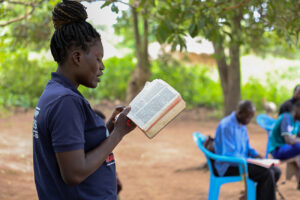
Already this year, TBM has drilled more than 30 wells in northern Uganda, each with a Bible study connected to it. More than 500 people have made professions of faith in Christ and been baptized as Ugandans share the gospel with their friends and neighbors. (TBM Photo / John Hall)
The TBM water ministry is seeking to provide more than 33,000 people in three districts of Northern Uganda with access to clean water. That means drilling and installing wells that serve 200 people within every 1.5 kilometers of their homes by the end of 2025.
But the effort involves more than water. Through a community-led approach, TBM is starting more Bible studies and drilling sustainable water wells faster than ever before.
Already this year, TBM has drilled more than 30 wells, each with a Bible study connected to it. More than 500 people have made professions of faith in Christ and been baptized as Ugandans share the gospel with their friends and neighbors.
TBM Water Impact Director Mitch Chapman has spent at least two weeks a month in Uganda since July guiding the effort. He has preached in Bible studies, prayed with people in villages and celebrated baptisms during church services. God is working in a powerful way.
“This is a door God has opened wider than any other I’ve ever seen in more than 20 years of ministry,” Chapman said. “God is meeting physical needs, radically changing lives spiritually and transforming entire communities. It’s incredible. I’m honored God has chosen TBM as his instrument to use at this time.”
Water as an ‘access route for the gospel’
Sam Ojok, who leads the effort in Uganda, emphasized TBM uses water as “an access route for the gospel.”
Sam Ojok, who leads the effort in Uganda, emphasized TBM uses water as “an access route for the gospel.” (TBM Photo / John Hall)
“Water is just the beginning. I see people come to Christ. But not just come to Christ, but get baptized. And they commit to a weekly Bible study. This is transforming the community and making Christ known,” Ojok said.
The ministry addresses a significant need in remote Ugandan villages, where stomach illnesses are common if not constant. In many cases, the diseases are fatal, particularly among young children.
“I’ve seen many, many children die of common, preventable diseases,” Ojok said. “This week alone, our program was interrupted by three different deaths. This can be prevented. Our programs can prevent it. I don’t want any more children to die. If we can do something to reduce these incidents, that is what we need to do.
“This is our opportunity for real impact—if we’re really concerned and we really want to help people.”
Impact requires significant investments of time into each village. The effort begins with starting a Bible study, which brings the community together. Members study the Scripture and are transformed by it. The Bible study becomes the backbone of the village and the catalyst for improving life for everyone.
After a TBM representative arrives in a village and identifies a “person of peace” who has the respect of his or her neighbors, together they start a Bible study. (TBM Photo / John Hall)
After months of Bible study, TBM helps the community learn basic hygiene. As a result, latrines are constructed in villages where open defecation had been practiced, and hand-washing stations are set up in front of all homes.
Then, TBM drills a well supported by the entire community. Residents donate money for ongoing maintenance of the well, allowing it to serve for generations into the future.
Each community project starts when a Ugandan TBM representative arrives. He identifies a “person of peace” in the village, who typically is a respected area resident with some influence. Together, they start a Bible study that unites the community and shares the gospel.
Three months later, with an established Bible study, TBM shares basic hygiene principles. The village also forms a water committee to build infrastructure for supporting a water well by building latrines and hand-washing stations at homes.
‘Transformed by the gospel’
Six months from the beginning, TBM drills a water well. At the dedication, a Ugandan leader shares the gospel with the community.
About 18 months later, TBM leaders walk alongside village leaders to ensure the well is working properly and train a maintenance technician for every 10 wells.
TBM also introduces microfinance into a village, which creates a small local group similar to a savings and loan. With this tool, the community can help its residents start businesses.
“The goal is that in five years the TBM well will be effectively providing needed drinking water, and the village is united,” Chapman said. “We will pray and work toward the goal of economic development being in full swing.
“We envision multiple neighboring villages seeing the changes and working to get their own wells and Bible studies. The region, we are confident, will be transformed by the gospel.”
Texas has second-highest food insecurity in the nation
December 11, 2023
Food insecurity increased significantly in the United States last year, and Texas has the second-highest rate of food insecurity in the nation, a recent report from the U.S. Department of Agriculture revealed.
Food insecurity refers to the inability of households to acquire adequate food, at times, for one or more household members. The prevalence of food insecurity in the state presents both challenges and opportunities for Texas Baptists as they seek to minister to human needs in Christ’s name.
“While the overall economic outlook in Texas may look strong, low-income residents have experienced a huge dose of hardship,” said Jeremy Everett, founding executive director of the Baylor Collaborative on Hunger and Poverty.
The report revealed 15.5 percent of Texas households reported a lack of consistent access to affordable and healthy food between 2020 and 2022, making Texas second only to Arkansas in terms of food insecurity.
Along with Louisiana, Mississippi, Oklahoma and South Carolina, Texas and Arkansas are the six states where the prevalence of food insecurity was higher than the national average.
Everett attributed the rising food insecurity in Texas primarily to two factors: a significant number of workers receiving no more than the minimum wage of $7.25 an hour and a worker shortage in state agencies, creating delays in processing applications for SNAP—the Supplemental Nutrition Assistance Program—in a timely manner.
At the same time, Texas has experienced rising costs of food and fuel along with the rest of the nation, he added.
“Low-income Americans spend a higher percentage of their income on the necessities—food, transportation and shelter. When rent is up, food prices are up and transportation costs are up, it has a huge impact,” Everett said.
Food insecurity higher in homes with children
The report from the USDA Economic Research Service showed 17 million U.S. households experienced food insecurity at some point during 2022, compared to 13.5 million households the previous year. Food insecurity affected 12.8 percent of households in the country last year.
The food insecurity rates last year were significantly higher for households with children (17.3 percent), households with children under age 6 (16.7 percent), and households with children headed by a single female (33.1 percent) or a single male (21.2 percent).
Children in 3.3 million homes—8.8 percent of U.S. households with children—were food insecure at some point in 2022.
“The 2022 Household Food Security in the United States report is a sobering reminder that, while the vast majority of Americans are able to affordably feed themselves and their families, too many of our neighbors struggle to put healthy food on the table,” Secretary of Agriculture Tom Vilsack said.
“These numbers are more than statistics. They paint a picture of just how many Americans faced the heartbreaking challenge last year of struggling to meet a basic need for themselves and their children. And the survey responses should be a wake-up call to those wanting to further roll back our anti-poverty and anti-hunger programs.”
Everett pointed out one factor affecting food insecurity in 2022 was the termination of several COVID-era relief programs from which low-income Americans particularly benefitted.
Lessons from the pandemic
“We learned a lot during the pandemic about ways to have an impact on hunger and poverty,” he said. “For instance, the child tax credit has a significant impact on reducing the child poverty rate.”
Another pandemic-related factor that affected food insecurity in Texas specifically was the inability of congregate summer feeding programs to continue, he noted. For several years prior to COVID, churches and other community service providers built a network that significantly increased the number of children who received meals during the summer.
“The pandemic blew that infrastructure up,” Everett said.
However, the Meals-to-You program—first piloted in 30 East Texas and West Texas counties through a partnership led by the Texas Hunger Initiative in 2019—became the national Emergency Meals-to-You program, delivering food boxes to households in rural areas.
The Consolidated Appropriations Act of 2023 made noncongregate and summer meal delivery a permanent option for children, and it allowed for summer electronic benefit transfer options beginning next summer.
One of the most effective ways to fight food insecurity is to maximize SNAP benefits, Everett observed.
“We know SNAP is an economic driver for communities. It accounts for 1 out of 10 jobs in local grocery stores,” he said.
Everett noted every dollar in SNAP benefits helps generate $1.50 in economic activity. When Texas fails to access available SNAP dollars, it results in a loss for the state’s food and agricultural sector, he added.
Reducing food insecurity is a complex issue greater than the ability of any one entity to solve, Everett said, but coalitions of nonprofit organizations, social service agencies and businesses can help build hunger-free communities.
“We like to see churches at the epicenter of these coalitions,” Everett said. “It’s a way for us to carry out our biblical mandate to feed the hungry.”






 Three new exonerations of Death Row inmates—John Huffington in Maryland, Jesse Johnson in Oregon and Glynn Simmons in Oklahoma—occurred in 2023. Together, the three men served more than 140 years in prison before their convictions were overturned.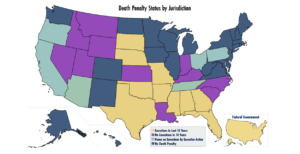





 Food insecurity refers to the inability of households to acquire adequate food, at times, for one or more household members. The prevalence of food insecurity in the state presents both challenges and opportunities for Texas Baptists as they seek to minister to human needs in Christ’s name.
 The food insecurity rates last year were significantly higher for households with children (17.3 percent), households with children under age 6 (16.7 percent), and households with children headed by a single female (33.1 percent) or a single male (21.2 percent).