Buckner seeks adoptive family for special-needs baby

DALLAS—Buckner Adoption and Maternity Services places dozens of children into loving families each year through domestic open adoption. But this year, one special child needs a family more than ever.

Buckner is seeking an adoptive family for a seven-month-old boy was born with spina bifida, a developmental birth defect where a child’s spinal cord protrudes through the vertebrae and fills with fluid.

A seven-month-old boy was born with spina bifida, a developmental birth defect where a child’s spinal cord protrudes through the vertebrae and fills with fluid. Doctors performed surgery shortly after his birth and were successful in repairing the rupture, but it has caused a number of medical difficulties for this playful and happy baby, said Leah Gilliam, Buckner adoption counselor.

“He is paralyzed from the knees down and will probably always need assistance to walk,” she said.

Gilliam said the child’s 16-year-old mother and 17-year-old father made a decision to place their son for adoption before he was born. “They’re teenagers, and they knew they couldn’t provide the family he needed,” she said.

Doctors performed surgery shortly after his birth and were successful in repairing the rupture, but it has caused a number of medical difficulties for him, and he will require special care.

But when he was born with special needs and there weren’t any available adoptive families, they decided to take him home and try parenting, Gilliam explained.

“Within a few months they realized they were unable to provide for him the way they had hoped. We’ve been spreading the word around the state through our other foster care and adoption offices to try and find an adoptive family, but we haven’t been successful,” she said.

Buckner would like to place the boy into an adoptive family in the Dallas/Fort Worth area to support an open relationship, but his birth grandmother and primary caregiver for the past seven months said a family who is willing to love and nurture him is the most important thing.

“He deserves a family who can give him more than we’re able to,” she said.

Buckner is looking for a family who is willing to maintain an open relationship with the boy’s birth parents and capable of helping him with his special needs.

For more information about this child or the adoption process, contact Buckner Adoption and Maternity Services at (214) 319-3426.


Texas Tidbits

Baylor named a “Best Buy” by college guide. A best-selling college guide for college-bound students and their parents has named Baylor University a “Best Buy” for the fifth consecutive year. Baylor is one of only 45 public and private colleges and universities in the United States, Canada and Great Britain—and the only Texas Big 12 institution—to earn the designation from The Fiske Guide to Colleges. Baylor was designated a “Best Buy” based on ratings of the quality of the university’s academic programs and campus experience in relation to the cost of attendance.

Chaplaincy program offered at DBU. Dallas Baptist University added a chaplaincy ministry concentration to its Master of Arts in Christian Ministry degree program. The concentration is designed to address all of the basic theological and biblical requirements for chaplaincy endorsement and provide chaplaincy-specific courses in order to further prepare students for specialized chaplaincy ministry. When chaplaincy candidates complete the program, they will be equipped to serve in a variety of ministry areas, including institutional, marketplace and military settings. Jim Lemons, program director of the Master of Arts in Christian Ministry, in consultation with Bobby Smith, director of chaplaincy relations with the Baptist General Convention of Texas, worked to develop the 72-hour program. Tom Vann, a retired army chaplain colonel, will join the Gary Cook Graduate School of Leadership faculty at DBU to help coordinate the program, as well as teach several of the new chaplaincy courses. For more information, e-mail jiml@dbu.edu or call (214) 333-5375.

Christian books desired for prisons. Christian Library International is collecting donated Christian literature and Bibles for prisons, jails and juvenile detention centers. The ministry distributes about 100,000 books annually to 1,000 criminal justice centers nationally, and it supports 76 Texas facilities. For more information, visit www.cli-nc.org or the CLI blog at http://cli-nc.blogspot.com/.

Multicultural Mesquite church receives grant. The Crossing Baptist Church in Mesquite has received a grant from the Calvin Institute of Christian Worship in Grand Rapids, Mich., to study multicultural and intergenerational worship and develop an ensemble that will support the growing cultural diversity of its congregation. The grant also includes plans for the team to offer a seminar on multicultural, intergenerational worship to interested churches in the Dallas/Fort Worth area. The institute’s Worship Renewal Grants program is supported by the Indianapolis-based Lilly Endowment.


On the Move

Javier Alamanza to Flatonia Church in Flatonia as student minister.

Brian Arnold to Hillcrest Church in Cedar Hill as associate minister of music and worship from Central Church in Italy, where he was music minister.

Jeremy Beggs to Central Church in Italy as youth minister.

Danny Craig to Providence Church in Hamilton as pastor.

Jeff Donnell to Lakeside Church in Dallas as pastor from First Church in Andrews, where he was pastor.

Emmett Duty to Osage Church in Oglesby as pastor.

Curt Hamlin to First Church in Dumas as minister of music and education

Rich Havard to Wilshire Church in Dallas as summer youth intern.

Joe Lopez to First Church in Castroville as youth minister.

Meredith Morris to Wilshire Church in Dallas as summer music ministry intern.

Wade Smith has resigned as pastor of Trinity Church in Pleasanton.

James Sturgeon to Adamsville Church in Adamsville as youth minister.

Trey Vigil to Wilshire Church in Dallas as summer preschool and children’s ministry intern.

Tim Watson, former pastor of First Church in Longview, is available for supply preaching. He can be contacted at (903) 261-1929 or timwatson@letu.edu.


Around the State

East Texas Baptist University will be a host site for the Global Leadership Summit 2010 Aug. 5-6. The summit, which originates from Willow Creek Community Church in South Barrington, Ill., will be beamed live via satellite to more than 170 locations in North America, including ETBU’s Ornelas Spiritual Life Center. Speakers include Jack Welch, former CEO of General Electric; Tony Dungy, former NFL Super Bowl-winning head coach; Bill Hybels, founding pastor of Willow Creek Community Church; and T.D. Jakes, pastor of The Potter’s House in Dallas. For more information, call (903) 923-2130.

Howard Payne University has selected four students from its Douglas MacArthur Academy of Freedom as recipients of the Hatton W. Sumners Foundation Scholarship. Recipients are Kathryn Burns, a political science and communication major from Austin; Adam Hardy, a political science major from Corpus Christi; Kaitlyn Kelm, a biology major from Lindale; and Chandler Raine, a pre-law/political science major from Mesquite. The scholarship provides $5,500 per semester for two years. In addition, the foundation provides lectures and seminars that students attend throughout their two years as Sumners scholars.

Baptist Child & Family Services recently held its annual “independence day” conference for foster and at-risk youth in Kerrville and the surrounding areas. The yearly event aims to help young adults learn how to build the skills and confidence they need to lead successful lives. Motivational youth speaker Ryan Kohnen was the keynote speaker. Workshops were held throughout the day focusing on time management, job skills, abstinence/sexual ethics and life coaching.

The University of Mary Hardin-Baylor received a $25,000 donation from CEFCO Convenience Stores as an addition to the C.E. Fikes Endowed Scholarship, established in 2006. The addition elevates the scholarship to the level of a Presidential Endowed Scholar-ship at the university.

Baptist University of the Américas has named Moises Rodriguez as the first full-time director of the school’s Baptist Bible Institute. The institute includes about 50 centers that offer diploma and certificate-level training in ministry. Rodriguez previously was pastor of Primera Baptist Church in Fort Worth and director of the North Texas Church Planting Institute and Leadership Development Center.

Anniversaries

John Coleman, 30th, as minister of music and education at First Church in Pleasanton, June 13.

Immanuel Church in San Angelo, 100th, July 10. James Mitchell is pastor.

First Church in Richmond, 125th, July 18. John Lockhart is pastor.

Friendship Church in Weatherford, 100th, July 25. A lunch and afternoon activities will follow the 10 a.m. service. Todd Houston is pastor.

• Clifton Eaton, 15th, as pastor of Harmony Missionary Church in Sherman.

Valley Baptist Medical Center in Harlingen, 85th. The medical center will mark the occasion with a reception June 30 from 4 to 7 p.m. in the east tower lobby. A photo retrospective will highlight the medical center’s history of commitment to providing high-quality health care for the Rio Grande Valley.

Retiring

Matias Rodriguez, as pastor of Calvary Church in Kerrville, after exactly 47 years of ministry. He preached both his first and last sermons on July 4. His father was pastor of the church from 1921 until 1961, and his grandfather founded the church.

Dave Blanton, as minister of music at First Church in Mathis, after 11 years of service, July 4. He previously was minister of music at First Church in Beeville 33 years.

Glen Godsey, as associate director of missions for Caprock Plains Area, where he served 16 years, effective Aug. 31. The entirety of his service on the associational staff came after age 70. A reception will be held in his honor Aug. 29 from 2 p.m. to 4 p.m. at College Heights Church in Plainview. After his ordination at First Church in Plainview in 1949, his ministry has been directed toward Hispanics. He was pastor of Mexican Mission in Plainview, Mision la Trinidad in Olton and Primera Iglesia Mexicana in Plainview. He also served on the associational staffs of Tierra Blanca Association, Big Bend Association and Permian Basin Association prior to joining Caprock Plains.

Deaths

W.C. Carpenter Jr., 95, June 5 in Lewiston, Idaho. He was a graduate of Wayland University, Baylor University and South-western Seminary. He was pastor of churches in Texas, New Mexico and Idaho during his 60 years of ministry. He was on the Southwestern board of trustees from 1973 until 1983 and was named a distinguished alumnus by the seminary in 1988. He was preceded in death by his wife of 48 years, Fannie, in 1989. He is survived by his second wife, Norma; daughters, Pat Mac-Dowell, Mollie Bedwell, Mary Panther, Martha Kenyon and Carla Martin; stepson, Vance Nebling; stepdaughter, Kelly Hornsby; sister, Clara Fae Rogers; brother, Max; 13 grandchildren; and 22 great-grandchildren.

B.L. Davis, 91, July 2 in Waco. A World War II veteran, he was awarded the Purple Heart, two Bronze Stars; and one Oak Leaf Cluster for his service in combat. He surrendered to preach in 1951 at Summit Church in Amarillo. He was pastor of Brooksmithe Church in Brook-smithe, Rocky Creek Church in Brownwood, East Cisco Church in Cisco, First Church in Seagraves, First Church in Hereford, and San Jacinto Church in Amarillo. He was director of missions for Amarillo Association from 1975 through 1986. He also helped break ground for High Plains Baptist Hospital and served on its board for nine years. He was preceded in death by his daughter, Dixie Lee Davis, and his wife of 62 years, Ellan. He is survived by his daughter, Dian Taylor, son, Mike; sister, Mary Frances Ward; six grandchildren; and 17 great-grandchildren.

Events

The Liberdade Church Alliance Choir from Sao Paulo, Brazil, will appear in concert at several Texas churches. The 70 singers and 25 musicians will perform at 7 p.m. July 19 at First Church in Garland; 7 p.m. July 20 at Wilshire Church in Dallas; 7 p.m. July 21 at Birchman Church in Fort Worth; 7:30 p.m. July 22 at The Gospel Space in Austin; 7 p.m. July 23 at Primera Iglesia Mexicana in San Antonio; 10:30 a.m. July 25 at Trinity Church in San Antonio; and 7 p.m. July 25 at Tallowood Church in Houston.

Licensed

• Daniel Camp, to the ministry at South Garland Church in Garland, July 11.

Ordained

• Jason Wright, to the ministry at Hamby Church in Abilene.

• Ray Byrd, as a deacon at First Church in Lytle.

Revival

• First Church, Melvin; Aug. 1-4; evangelist, Robert Barge; music, Jeff Gore; pastor, Garry Bivins.


Pastors more like webslinger than Man of Steel

HOUSTON—Pastors are more like Spider-Man than Superman, Kevin Cosby told participants at the 2010 African American Fellowship Conference July 13 in Houston.

Cosby, pastor of St. Stephen Baptist Church in Louisville, Ky., preached from the 14th chapter of Acts. The New Testament passage describes how the Apostle Paul healed a crippled man, and a crowd of pagans treated him as if he and his fellow apostle Barnabas were gods. Paul protested, telling them, “We, too, are only men, human like you.”

Kevin Cosby

“Every preacher ought to profess the Pauline confession,” Cosby said. “It identifies who the pastor is: We are men who have struggles—the same struggles as you, … the same frailties as you, … the same human condition as you.

“Paul says, ‘Don’t venerate us. We are the channel of the miracle, not the source of the miracle.”

Pastors and laypeople alike ought to understand that distinction, which also describes pastors, he noted.

“If the pastor were a … comic book superhero, he would not be Superman. He’s more like Spider-Man,” Cosby insisted.

“Superman is from another planet, Krypton. Like Spider-Man, the pastor is from here. Superman is alien and has supernatural power. Spider-Man is human, but he acquired power.

“Superman is Clark Kent, who only acts quiet and shy. But Spider-Man is Peter Parker, who actually is shy.”

Similarly, Superman is emotionally detached and remote, because he is alien. But Spider-Man “has all kinds of issues,” such as anger and insecurity, because he is human and endures human feelings, he said. Bullets bounce off Superman, but Spider-Man can be injured and feels pain like everyone else.

So, pastors are much more like the human Spider-Man than the superhuman alien Superman, Cosby stressed.

“It is very important that pastors not forget what Paul said: ‘We are men.’ Just like deacons, just like trustees, just like men in the choir.”

Just like Spider-Man, the pastor is flawed, Cosby acknowledged.

“He might go around acting super, but that’s an illusion. He’s flawed,” he said. “But in spite of being flawed, he’s got to do some supernatural things.”

For example, the pastor must be diligent, he said, explaining: “That means work hard. There might be some lazy pastors around, but I don’t know how a good pastor can be lazy.”

To illustrate, he asked laypeople in the audience to consider how much time is required to craft a sermon.

“The pastor has to deal with the recurring Sabbath,” he said. “That’s like having a major term paper hanging over your head every week. It was easier being a prophet in the Old Testament than a local church pastor. Prophets only spoke when they were inspired. But a pastor has to speak, even when he’s not inspired.”

Pastors also must deal with diversification, Cosby reported, noting that, in addition to preaching, pastors must handle all the trivia of ministry.

“Jonah got swallowed by a whale. But a pastor gets nibbled to death by minnows,” he said. “A pastor has to shake as many hands as a politician, memorize as many names as a high school principal, administer like a college president, raise money like a banker and be a conflict mediator like a diplomat.”

The pastorate additionally requires discipline, he suggested.

“There is no other profession in which the messenger and the message are inseparable,” he said. “You can be a good mechanic but not a good man, and people still will let you fix their car. The mailman can have affairs with 10 women on his route, but you don’t care as long as he delivers the mail on time.

“But a preacher, he can’t even get angry, mad or frustrated, or else the people will say, ‘He’s supposed to be a preacher.’”

Cosby told a story about a pastor who built a deck in his backyard, and a little neighbor boy came over and watched for hours and hours.

The preacher asked him: “Son, why are you here? Would you like to learn how to be a carpenter?”

“No,” the boy replied. “I want to find out what a preacher says when he hits his hand with a hammer.”

“Can I be honest?” Cosby asked the audience to howls of laughter. “He says the same ‘damn’ thing you say. … Because he’s Spider-Man and not Superman.”

Pastors should admit they’re merely human not only because they’re flawed, but also because the church is fickle, he said. In the Scripture text, other religious leaders turned the once-adoring crowd against Paul and Barnabas.

Cosby described similar circumstances today, such as those who preach a compelling health-and-wealth gospel, or visiting preachers who are more eloquent but not substantive.

“Another preacher will come to town, and they’ll turn on you,” he warned of churches.

But although pastors are flawed and congregations are fickle, God alone is faithful, Crosby promised.

He compared the pastor’s ultimate job to the way, night after night for years, late-night television sidekick Ed McMahon introduced “Tonight Show” host Johnny Carson. McMahon stood offstage, behind a curtain, and announced, “Heeeere’s Johnny!”

“All the preacher does is stand behind the curtain and say, ‘Heeeere’s Jesus!” Crosby said. “He raised the lame man—‘Heeeere’s Jesus!’ He woke me up this morning—‘Heeeere’s Jesus!’ He made a way out of no way—‘Heeeere’s Jesus!’ He put food on my table—‘Heeeere’s Jesus!’”



Harvest Baptist Association building a total loss after fire

DECATUR—An overnight fire July 11 destroyed Harvest Baptist Association’s mission center.

“It was a total loss,” Director of Missions Gerry Lewis said. Firefighters indicated it appeared to be an electrical fire that originated around a laminating machine. Insurance adjusters had not estimated the financial loss as of early July 13.

Items salvaged from his ministry assistant’s desk—current files, petty cash and a few miscellaneous materials—were able to be carried from the building in one rubber tub, Lewis noted.

Harvest Baptist Association’s mission center burned July 11. (PHOTO/David Bowman/BGCT Congregational Strategist)

“We had done an online back-up of the financial records, so theoretically we should be able to access them, but that hasn’t been tested yet,” he said.

From his office, Lewis only was able to retrieve two drawers filled with old sermon files.

He lost antique furniture that had been in his family for generations, a century-old set of sermons by Charles Spurgeon, a collection of old Bibles that had belonged to his wife’s family and a New Testament that had belonged his great-grandfather, a circuit-riding Presbyterian preacher. Nevertheless, he sought to keep the loss in perspective.

“It’s just stuff. Some of it was irreplaceable, and emotionally it’s a struggle. But it’s still just stuff,” Lewis said. “It doesn’t diminish what God has done here, and I’m excited to see what good he will bring out of this.”

First Baptist Church in Bridgeport has offered the association temporary office space until long-term interim space can be acquired. Later, the association will decide whether to rebuild on its current property or make other arrangements, Lewis noted.

The association staff hopes to be able to transfer its office phone numbers in the near future. In the meantime, Lewis can be reached by cell phone at (817) 291-9047 or e-mail at gerry@harvestba.com.


Plano pastor to be BGCT first VP nominee

RICHARDSON—Jerry Carlisle, pastor of First Baptist Church in Plano , will be a candidate for first vice president of the Baptist General Convention of Texas this fall.

Gary Singleton, pastor of The Heights Baptist Church in Richardson, announced he will nominate Carlisle for the vice presidency when the BGCT holds its annual meeting Nov. 8-9 in McAllen.

Jerry Carlisle

Carlisle and Singleton have served neighboring churches since Carlisle joined the Plano congregation in 2002, and Singleton has liked what he’s seen.

“I’ve been impressed by Jerry’s faithfulness and integrity—the way he’s represented God in our community,” Singleton said. “I’m also impressed by his involvement in leadership roles around the state and beyond.”

He cited a litany of Carlisle’s responsibilities—moderator of Collin Baptist Association, member of the BGCT Executive Board and chair of its institutional relations committee, incoming chair of the Baptist World Alliance personnel committee, vice president of Mission to Unreached Peoples, trustee of Baylor Regional Medical Center at Plano and a trustee of Dallas Baptist University.

“That’s very impressive,” Singleton noted.

“I’ve seen Jerry’s involvement,” he added. “His sense of responsibility for the kingdom of God is bigger than his own church. He has a heart for the whole state.

“And his strength is leadership. He’s done a great job wherever he’s been.”

Carlisle noted he prefers to serve “behind the scenes, rather than be the face on the platform,” but he agreed to allow his nomination to support BGCT Executive Director Randel Everett’s Acts 1:8 emphasis on local, regional, national and global missions outreach.

“My only reason is to help our convention focus on missions and fulfill the Great Commission,” Carlisle said.

In particular, he wants churches to understand they can “leverage” missions efforts thorough collaborative ventures, cooperative giving and support for the institutional ministries affiliated with the BGCT.

“I would like to see us celebrate what God is doing through our institutions, missions and ministries,” he said.

Under Carlisle’s leadership, First Baptist Church in Plano has helped launch Hispanic, Anglo and western-heritage congregations, and it has been host to Korean and Chin congregations. The church shares its campus with Mission to Unreached Peoples, Plano Children’s Medical Clinic, Chin Baptist Church and Texas Baptist Church Weekday Education Association.

First Baptist Church is engaged in strategic partnerships for community development, meeting human needs, evangelism and church planting in five states in Mexico—Jalisco, Zacatecas, Oaxaca, Tabasco and Chiapas—and in short-term mission projects in the Rio Grande Valley.

Prior to his service at First Baptist Church in Plano, he served five years as pastor at First Baptist Church in Temple and seven years at Valley Ranch Baptist Church in Coppell. Previously, he served seven years on staff at Tallowood Baptist Church in Houston and five years at Plymouth Park Baptist Church in Irving.

Carlisle earned his undergraduate degree at Southwest Baptist College in Bolivar, Mo., and Master of Divinity and Doctor of Ministry degrees from Southwestern Baptist Theological Seminary.

He and his wife, Dedi, have been married 29 years on July 18. They have three children—Elyse, who teaches in Highland Park; Collin, a junior at Dallas Baptist University; and Caleb, a junior at Plano East Senior High School.


Experiencing God transformed TBM over last two decades

DALLAS—Principles in a book published 20 years ago revolutionized Texas Baptist Men, transforming it from a missions program for men and boys in Texas Baptist churches to a broad-based ministry with global outreach.

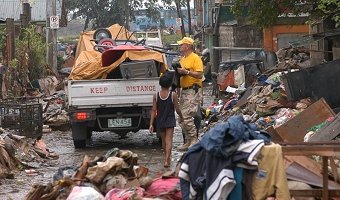
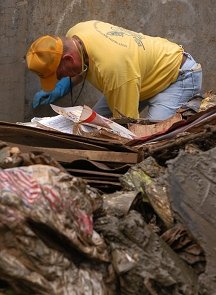
Last fall, Texas Baptist Men disaster relief team leader Ernie Rice of Stockdale (center, blue shirt) and Bill Gresso of Garland (left) worked alongside other volunteers unloading supplies in the Philippines, where the government estimated 6 million people were affected by typhoons Ketsana and Parma. (PHOTOS/Rand Jenkins/BGCT)

In 1990, the Southern Baptist Sunday School Board published an interactive workbook by Henry Blackaby and Claude King titled Experiencing God: Knowing and Doing the Will of God.

“Before, were program-driven. But when Experiencing God came in and we began responding to God’s invitations, our ministries began to expand right and left,” TBM Executive Director Leo Smith said. “It shaped us and made up what we are today.”

Blackaby had just become director of missions for a Baptist association in Vancouver, British Columbia, when TBM leaders first heard about him. Before joining the associational staff, he reportedly had been pastor of a church there that was dying when he arrived but experienced revival and birthed multiple mission congregations after he led members to “join God where he is at work.”

Since Blackaby’s experience dovetailed with the TBM emphasis on lay renewal, the mission organization invited him to speak at the 1987 TBM Convention in Fort Worth.

There, he presented in an early form the basic elements of what he later called “the seven realities” of Experiencing God:

• God is always at work around us.

• God pursues a continuing love relationship with us that is real and personal.

• God invites us to join him in his work.

• God speaks by the Holy Spirit through the Bible, prayer, circumstances and the church to reveal himself, his purposes and his ways.

• God’s invitation for us to work with him always leads to a crisis of belief that requires faith and action.

• We must make major adjustments in our lives to join God in what he is doing.

• We come to know God by experience as we obey him and he accomplishes his work through us.

When TBM began applying those principles, the missions organization changed dramatically, said Bob Dixon, who led TBM nearly three decades as executive director.

Texas Baptist Men Disaster Relief volunteers responded to “an invitation to join in the activity of God” by relieving human suffering in the Philippines last fall after typhoons Ketsana and Parma hit. (PHOTOS/Rand Jenkins/BGCT)

“When we began looking at where God was working and responding to his invitations, we didn’t have to drum up things to do,” Dixon said. “The Father kept giving us assignments. And when we were faithful, he would give us another one.”

When a cholera epidemic hit Peru, TBM worked with Texas Baptist hospitals to provide more than $4 million in financial help and medical supplies, with the first round of emergency aid delivered to the country by military transport planes.

After the Pentagon discovered the capability of TBM to respond to disaster, a representative from the Office of Humanitarian Assistance in the U.S. Department of Defense called to ask, “How are you Baptists at getting blankets together?”

He explained Kurdish refugees from Iraq had fled to the mountains of western Turkey and eastern Iran, and by some estimates, 1,000 a day were dying of exposure. Through a Texas Baptist River Ministry contact, Dixon learned about a manufacturer who could provide blankets at cost. He had in stock enough blankets to fill four 18-wheelers, and TBM could have the 14,400 blankets for $48,000.

Soon after Dixon assembled his staff to pray about the matter, a $4,800 check arrived in the mail with a notation: “For wherever God wills today.” It was signed by a deacon at a church where Dixon recently had led an Experiencing God weekend. Dixon was convinced if God could provide 10 percent of the needed funds immediately, he would supply the rest, and TBM committed to the project.

TBM has multiple global ministry opportunities since it began applying the principles of Experiencing God 20 years ago, leads of the mission organization insist. (PHOTOS/Rand Jenkins/BGCT)

TBM not only ended up providing blankets, but also worked with mission partners to provide medical teams and field kitchens in areas normally closed to Americans. Churches that worked with TBM also began ministries to Kurds who resettled in the United States.

That international experience led to future global initiatives as TBM responded to “invitations to join God in his activity”—lay renewal in South Africa, famine relief and agricultural development in North Korea, refugee relief in Africa, building projects in the Middle East, disaster relief training for Christians in Cuba and water purification projects in more than 50 countries.

Stateside, TBM also applied the principles of Experiencing God to its varied ministries such as volunteer construction projects, church renewal and restorative justice ministry.

Restorative Justice Ministry took on new life because of Experiencing God,” said Don Gibson, TBM church renewal consultant. The workbook became the key curriculum for Inmate Discipleship Fellowship, a related program that grew out of TBM and focused on ongoing discipleship efforts behind bars.

Ten years ago, application of the “seven realities of Experiencing God” also led to the birth of Victim Relief Ministries, an interdenominational organization that grew out of TBM’s restorative justice ministry initiatives, Gibson noted.

TBM moved from lay renewal weekends to weekends designed to introduce churches to an overview of the Experiencing God principles. Pastor Jim Shamburger credits one of those weekends with sparking a transformation at First Baptist Church in Victoria.

“Experiencing God revolutionized my church. We had been doing church with an emphasis on buildings, budgets and long-range planning—not asking God where he was inviting us to go,” Shamburger said.

In recent years, the church has begun new ministries in its community and beyond as God has opened doors, he noted.

“Our approach to sharing the gospel has become more about taking it to people where they are rather than trying to bring them to us,” he said.

TBM also has sent teams outside Texas to lead Experiencing God weekends in churches. Last September, TBM volunteers worked with leaders of Central Baptist Association to lead simultaneous Experiencing God weekends in five churches in South Central Wisconsin.

“I had never been around revival or spiritual awakening before,” said Mark Millman, associational director of missions. “God did it. It wasn’t anything that could be manufactured or manipulated.”

The event proved so life-changing for participants, one congregation in suburban Madison even changed its name, from Prairie Springs Baptist Church to Transformation Church, Millman said.

TBM leaders insist as the organization looks to the future, whatever ministries it may develop will grow out of a keen awareness of the principles of Experiencing God—a love relationship with God, sensitivity to his activity and obedience to his invitation.

“God is still inviting us to join him,” Smith said. “We’re always going to operate this way. It’s who we are now.”

Henry Blackaby and Claude King, authors of Experiencing God: Knowing and Doing the Will of God, will be keynote speakers at Texas Baptist Men’s annual Cedars spiritual awakening conference, Aug. 27-29 at Lakeview Conference Center near Waxahachie.

For more information about the conference, visit www.texasbaptistmen.org or call (214) 828-5353.

TBM is collecting testimonies from pastors about the impact Experiencing God has made on their churches. E-mail brief testimonies to don.gibson@texasbaptistmen.org.


Barefoot School full of happy souls, thanks to new computer lab

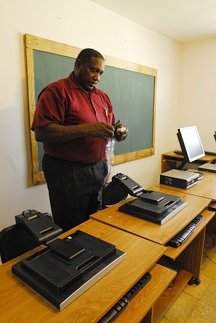
PORT-AU-PRINCE, Haiti—Haitian students whispered excitedly as a small group of foreigners parked in the school driveway and unloaded a stack of black crates that never should have made it into the country.

Gerald Davis, director of community development for the Baptist General Convention of Texas, delivers computer equipment to the TLC Barefoot School in Port-au-Prince, Haiti. (PHOTOS/Lauren Hollon)

It marked an exciting moment for a special school.

Gerald Davis, director of community development for the Baptist General Convention of Texas, was a man on a mission as he pushed a cart piled high with boxes of computer equipment into DFW International Airport.

Standing at the check-in counter with seven crates and a bag of equipment, Davis learned Haiti had declared an embargo allowing each traveler to bring no more than two pieces of checked luggage into the country. An employee reluctantly agreed to check the boxes as far as Fort Lauderdale.

In Florida, Davis claimed his extra luggage and spoke with a manager. In a move Davis attributed to the work of God, the manager decided to ignore Haiti’s embargo and checked the bags through to Port-au-Prince. Davis had no problems picking up all eight pieces of baggage when he arrived in Haiti.

At TLC Barefoot School the next day, summer students sat absorbed in their books while Davis wired the small lab, dripping sweat in the sweltering tropical heat.

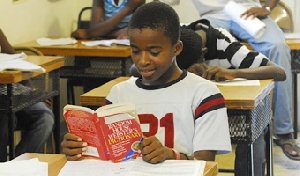
Students at the TLC Barefoot School in Port-au-Prince, Haiti, work on classroom assignments. (PHOTOS/Lauren Hollon)

Before dismissing them, the teacher gave his students permission to go upstairs and see the progress of their new lab. The well-mannered, neatly-dressed little group walked quietly upstairs and filed into the room, grinning when they saw the monitors and thanking the Texas Baptist team.

“I’m so proud of these computers,” said Missael Morisseau, a seventh grade student. “I was really waiting for something like that to be in TLC.”

TLC serves impoverished neighborhood children whose parents can’t afford to feed them, much less pay for their education. Tom and Linda Counts, an American missionary couple, founded it in the mid-1990s, and it began as a feeding ministry operating out of their guesthouse.

“A lot of kids would come around and ask for food, and they would give them food, and they were barefoot, you know, no clothes, and that’s why we called it Barefoot School,” said Nickson Desrosiers, the school’s principal. “And they decided, ‘Feeding them is not enough; they need an education.’ But they didn’t know where the money was going to come from. I think it’s just by faith they started, and God has chosen people from all over to sponsor us.”

Nickson Desrosiers, principal of the TLC Barefoot School in Port-au-Prince, Haiti, tests the newly installed computer equipment provided by Texas Baptists. (PHOTOS/Lauren Hollon)

Today, the school can accommodate between 90 and 100 students from pre-kindergarten to eighth grade. They accept 12 new students each year and provide students with breakfast and lunch every day.

All subjects except for French are taught in English, using an American self-paced curriculum.

“They speak better English than many of my teachers because they started when they were five years old,” Desrosiers said. “Every year when I have missionaries come for clinic, they call me and tell me, ‘We need two good translators.’ They know they will find the best translators from TLC. I could send them from fifth grade, sixth grade, whatever grade I choose them to go and help.”

After eighth grade, students take a national exam and enter the Haitian school Desrosiers attended as a student. Students who never dreamed they would have an education receive one of the best in the city.

“Every year we send them; they’re always the top students,” Desrosiers said. “And then when they go to the Haitian school, the director of the Haitian school would call me and say, ‘I need to talk to you.’ So when I go there and I sit in his office talking to him he said: ‘These students are the best. You sent me three last year, they were the best, and three this year, they’re still the best.’ TLC students are very smart and our teachers are doing a wonderful job.”

{youtube}wPLdSbCe6XY{/youtube}
TLC Barefoot School in Haiti.

TLC students already have an edge in English. Computer classes will open up even more opportunities.

“A few Haitian schools have computer labs, not most,” Desrosiers said. “You would find one computer in the director’s office you know, not very many… It’s a wonderful blessing.”

TLC is funded by sponsors throughout the United States, Desrosiers said. It costs about $525 to send a student to school for one year.

Sadrac Brusma, age 16, just graduated from TLC in May and will attend Nouveau College Concordia in the fall. His best subject is math, he said, and he wants to become a mechanical engineer to help solve the water problems in Haiti.

Unlike many his age who grew up in the streets scrounging for food or money, Brusma’s earliest childhood memories are marked by learning the alphabet and going on field trips to the ocean. None of it would have been possible without the generosity of sponsors.

“Without the sponsor, there’s no education, there’s no TLC, there’s no food, nothing, because these people are the ones that send the money,” Desrosiers said. “I think without the sponsors we couldn’t go anywhere. (Students) would be in the streets begging, like many (children) are doing.”

To learn more about the school and how to help, visit www.tlcbarefootschool.com.


Baptists still helping Haitians

GRAND-GOÂVE, Haiti—Michael Akinboro emanates gentleness. Toddlers sit quietly while he checks their breathing. Babies obediently swallow bitter cough syrup. Not one child who comes for diagnosis fusses or cries.

The skeleton of Siloé Baptist Church bears silent testimony to the devastation an earthquake caused in Haiti. The words ‘a demolir’—to demolish—are spray-painted across its façade. (PHOTO/ Lauren Hollon)

As he works, a bare bulb overhead lights the tiny free clinic, and an old oscillating fan in the corner coaxes warm, moist air throughout the room. The thermometer mounted in the shade of the doorframe reads 100 degrees. Shelves piled with bottles of medicine, vitamins and antiseptics line the walls.

Outside, a concrete mixer rumbles as Haitian men pour in gravel and cement mix. They have worked for months to rebuild the Siloé Baptist School, located 40 miles southwest of Port-au-Prince, which a January earthquake shook to rubble. Workers have finished two classrooms with three to go, while students meet outside beneath a canopy of plastic tarps hung from tree branches. When it rains, the school closes.

Behind the school stands the skeleton of Siloé Baptist Church, the congregation affiliated with the school and clinic. Its roof and doors are gone, walls cracked, the organ a jumble of broken wood and wires and the words ‘a demolir’—to demolish—spray-painted across the façade. Members meet in the evening under the classrooms’ tarps, singing harmonies that are mournful and joyful at the same time.

Haitian students study outside as workers try to reconstruct their school in Grand-Goâve, about 40 miles southwest of Port-au-Prince, which an earthquake destroyed. (PHOTO/ Lauren Hollon)

This church, school and clinic complex in Grand-Goâve represents one small area where the Cooperative Baptist Fellowship and Texas Baptists are partnering to help rebuild Haiti.

Akinboro is a Nigerian-born registered nurse from African Evangelical Baptist Church in Grand Prairie. After six long days of triple-digit heat and a constant stream of patients, he felt exhausted but happy.

“We have been treating an average of about 40 to 60, but the last few days it has gone to about 100 to 120 patients a day,” Akinboro said.

Most cases he saw were different infections, including eye, urinary tract, skin and upper respiratory infections—“especially for the children,” he said.

“The cause of the infections, I think, mainly is likely to be the type of water that they take,” Akinboro said. “Also, maybe due to the high humidity, we are having upper respiratory tract infections. Scabies, of course, would be waterborne problems. So, it’s really some hygienic problems stemming from inadequate water supply.”

Malnutrition presents another problem. The clinic offers not only multivitamins and power bars, but also education about health, hygiene and nutrition.

Michael Akinboro, a Nigerian-born registered nurse from African Evangelical Baptist Church in Grand Prairie, examines patients at a clinic in Grand-Goâve. (PHOTO/ Lauren Hollon)

“I’ve had to actually sit four mothers down and talk to them about nutrition,” Akinboro said. “And one of them actually confessed to me that she only feeds her 3-month-old child twice a day. I really had to talk to her. But I asked if she has the money to buy the food, and she did say she has access to it. I did ask her to come back after one month so that we can follow up with that child.”

Since the initial health response to the earthquake has passed, the clinic is moving to a preventative health care model rather than a curative one, said Tim Brendle, the disaster response coordinator for CBF’s work in Haiti.

“We desperately need people who can come and help people with eye problems, dental problems, general practitioners, heart specialists, almost any specialty,” Brendle said. “If we know in advance that you want to come, we will welcome you here and use you to good effect.”

Just beyond the clinic door, the concrete and rebar walls of the new school take shape. Siloé Baptist operates two schools—one in the morning and one in the afternoon. Morning students wear school uniforms, but 70 of the 351 children can’t afford to pay tuition. In the afternoon school, 160 children who can afford neither uniforms nor tuition attend class under the tarps.

Students at Siloé Baptist School meet outdoors beneath a plastic tarp since an earthquake destroyed their school building. Texas Baptists and the Cooperative Baptist Fellowship are helping the school—and the related church and clinic—rebuild. (PHOTO/ Lauren Hollon)

Administrator Pascal Ybsens Clanck said the school has had difficulties paying its teachers because of the earthquake and a lack of tuition money from families. Sometimes, he has to turn away students due to lack of funds.

“When we save some money to pay the teacher, then we call (him) on the phone and tell him, ‘Come to school.’ The kids who don’t have school just wait at home because they don’t have money,” Clanck said.

Siloé Baptist Church helps the school financially when it can, but it’s not enough. It costs about $135 to pay for a child’s uniform, school supplies and yearly tuition, Clanck said.

“People in the U.S. can help by sending money to help some students to pay for uniforms, to pay for books, for whatever, and to help to pay those teachers so that we can continue to give this education for the community,” Clanck said.

Clanck was encouraged to see progress made on the school’s new building.

“The school was completely flat by the earthquake, so now we find some help to know how we can continue to rebuild those classes,” he said. “We have CBF that’s helping us to back up that.”

When CBF arrived in Grand-Goâve, the local church’s crisis committee already was working to clear away rubble.

“I really cannot say enough good about how well the Haitians have participated in the rebuilding of this school,” Brendle said. “During the first two months that we worked here, they worked absolutely as volunteers right alongside our volunteers with no compensation whatsoever. Once we got to the point where we needed to move more quickly we did start to hire local workers, but even those were working at a reduced rate so that there was still the aspect of volunteerism.”

Children receive health care, and their mothers learn the importance of hygiene and nutrition, at a clinic in Grand-Goâve. (PHOTO/ Lauren Hollon)

Texas Baptists are sending teams throughout the summer and fall to help finish the school and serve in the clinic, as well as build new homes for church members who lost their houses.

Scotty Smith, associate pastor of Cowboy Fellowship in Pleasanton, joined a CBF mission team from California and had a chance to build relationships and minister to the Haitian workers.

“They could (rebuild without American workers helping), but then that doesn’t build the relationship with them,” Smith said. “There’s no connection, and if there’s no connection, in the long run you really don’t care. You have to learn to be able to care about the people you’re trying to help. … When you connect, it’s definitely worth it. Definitely.”

“I want to encourage a lot of those who have never gotten their passport before, who financially believe that they could never do anything like this, that if God calls them to do something, there’s nothing that will stand in their way.”

For more information on Texas Baptist mission trips to Haiti, contact Marla Bearden at (888) 244-9400. To support Texas Baptist disaster response efforts, visit www.texasbaptists.org/give or send a check designated “disaster response” to Texas Baptist Missions Foundation at 333 N. Washington Ave., Dallas 75246.


Half a year after an earthquake, Haiti has a long way to go

PORT-AU-PRINCE, Haiti – Haiti is a country of conspicuous contrasts – a landscape both monochrome and vivid, and a people standing solidly, yet shaken to pieces.

The people of Haiti continue the slow, laborious process of removing rubble from an earthquake that shook the island in January. (PHOTO/Lauren Hollon)

Six months after an earthquake rocked Port-au-Prince, the city remains a mess. Every fifth building has collapsed into a broken mountain of rubble. Twisted, tangled rebar pokes out in all directions from great hills of dust and concrete.

“If I look at the big picture, I don’t see a whole lot of progress,” said Tim Brendle, the Cooperative Baptist Fellowship’s disaster response coordinator for Haiti. “If you drive from Port-au-Prince, it’s 40 miles of destruction.”

Despite aid efforts, the removal of rubble moves at a snail’s pace. Most cleanup proceeds by hand.

“Progress in cleanup is very slow, but ongoing,” wrote Robert Shehane, Texas Baptists’ liaison for mission projects in Haiti, in an e-mail. The U.S. Agency for International Development is doing very much of it, he reported.

A recent mission team coordinated by Texas Baptists observed three or four pieces of heavy machinery working on rubble removal.

“Some heavy equipment is seen in use, but for the most part I notice Haitian men and women in yellow USAID shirts with shovels,” Shehane wrote. “I have heard that the cleanup will be years in the doing.”

The conditions of the city’s roads and sanitation are deplorable, observers noted. Crater-sized potholes make side streets almost impossible to traverse without four-wheel drive.

Official estimates put unemployment in Haiti at 90 percent, but that doesn’t mean Haitians aren’t trying to make a living. People line the sidewalks of the capital, selling everything from shoeshines to carrots in the shade of crumbling buildings. (PHOTO/Lauren Hollon)

At any moment in the dirty roadside streams, one finds plastic bottles, smashed cardboard boxes, old shoes, food wrappers and faded scraps of fabric. Every space is a city dump; trash collects in the road, on the sidewalks, outside businesses and in rivers. Heaps of trash are blown, thrown and mingled into a nondescript gray mess in the gutters.

But it’s also apparent from Port-au-Prince’s landscape that Haitians love color. The contrast is like Dorothy’s Kansas and the wizard’s Oz. Anything not coated in ash-colored dust has been painted and repainted with a flamboyant display of color spanning the entire spectrum. Walls are splashed with vivid advertisements, and storefronts feature rainbow lists of the goods and services offered.

Public transportation is even more wildly decorated. Tap-taps—pickup trucks with bench seats in the bed—and buses are painted with complex technicolor patterns.

Vendors, too, offer a colorful sight. Official estimates put unemployment in Haiti at 90 percent, but that doesn’t mean Haitians aren’t trying to make a living. People line the sidewalks of the capital, selling everything from shoeshines to carrots in the shade of crumbling buildings.

Away from the busiest part of town, tent communities are brimming. The lucky find themselves in fields of tents set up in neatly spaced rows by international aid organizations.

Others cobble together shelters using whatever they find—sticks, tarps, blankets, towels, corrugated metal salvaged from homes—building their precarious shelters one after the other next to the road, behind a bus stop and even on a 6-foot-wide median.

Nearly six months after an earthquake rocked Haiti, the island still bears the scars of the disaster. (PHOTO/Lauren Hollon)

“As you come through Port-au-Prince, one of the tent cities actually used to be a playground,” said Scotty Smith, associate pastor of Cowboy Fellowship in Pleasanton and a volunteer in the rebuilding effort. “You can see the tarps draped over the slides and the play equipment and stuff, and people are living in those tent cities.”

The rain, sun and wind have taken their toll on the shelters. Edges of the plastic tarps hang in tatters. Many have begun leaking during storms.

“One interesting thing about the homes is that people have a phobia now. They don’t want to live under concrete roofs anymore,” Shehane said.

In addition to Haitians’ concerns about the safety and durability of new houses, new home building is made difficult by issues related to funding, land ownership and government restrictions.

“It’s always difficult to work through the bureaucracy here, and that’s true in many, many countries,” Brendle said. “First of all, because we have competing interests. We have the international aid community that wants to come in and have everything just flow in without any tariffs, without any bureaucracy, and that worked for a while after the disaster. But one of the major sources of income for this government is its tariffs from imports.”

Rice farmers in Haiti spend their days bent over in the hot sun, ankle- and wrist-deep in the paddies’ gray mud. (PHOTO/Lauren Hollon)

Rural areas are as poor and depressed as the capital. Rice farmers spend their days bent over in the hot sun, ankle- and wrist-deep in the paddies’ gray mud. Many children wear torn, faded, stretched and dirty clothes. Clean water is scarce. Children and adults bathe nude in brown roadside streams swimming with bacteria and parasites. Medical care is equally hard to come by.

Outside Port-au-Prince, the country offers breathtaking scenery. To the right of the road going northwest out of the capital lush, gently sloping mountains disappear into the mist. To the left, a tranquil ocean as clear and warm as bathwater stretches along the coast. Observers note it’s easy to see opportunities for a tourist economy— if Haiti could overcome the recent devastation.

“If you’re asking how long it will take Haiti to rebuild, I would say decades,” Brendle said. “And who will do that? Basically the Haitians must do it. The best thing we can do right now is facilitate in the early stages and help them find methods they can replicate so they are able to continue to build on what we do initially.”

To support Texas Baptists’ disaster response effort, visit www.texasbaptists.org/give or send a check designated “disaster response” to Texas Baptist Missions Foundation, 333 N. Washington Ave, Dallas 75246.


Texas Baptist Men build home, faith in Chile

NIPAS, Chile—Volunteers from Texas Baptist Men traveled by truck through foggy mountains for hours to reach Nipas, a small town almost 300 miles south of Santiago. There, they worked more than two weeks to help a local pastor get back on his feet.

Nipas is one of many Chilean towns suffering from destruction caused by the February earthquake. Ricky Null, pastor of Travel Center Family Ministry, a truck stop mission of First Baptist Church in Terrell, and his team of four recently returned from a 17-day trip where they worked to rebuild one of 10 parsonages in the area that were destroyed.

Null’s team worked on the home of Pastor Eliseo Avila. When the team arrived, Avila was living in one of the four Baptist churches he serves as pastor.

The weather was perfect for pouring the concrete foundation and framing the house. They were also able to install plumbing, electrical wiring, insulation and a roof.

Texas Baptist Men volunteers build a home for a pastor in Nipas, Chile. (PHOTOS/Courtesy of Ricky Null)

Null and his team bought the necessary tools once they arrived in Chile, including a circular saw, a drill, a combination miter box and saw, an air compressor, a nail gun and other equipment. The team brought filtration systems from the United States to distribute to people without clean water.

“We didn’t get to purchase as much as we wanted, but God stepped in and we got everything we needed,” Null said.

In the end, it was a blessing that they couldn’t afford to purchase multiples of each tool. When they finished loading the truck with what they had, it was completely full.

One part of their mission was teaching locals to use the tools. Several Chileans helped with the building effort, including pastors, a deacon and two young men who hitched a ride from their hometown 150 miles away.

“They learned all of (construction), from the foundation up,” Null said. “We took time to teach them every part of it.”

Pastor Raul Ruiz was left in charge as the overseer and master builder of the project when Texas Baptist Men left.  Null said Ruiz was impressed by how much the younger men learned in such a short time. He wanted to keep them on his building team for as long as they were willing to stay.

Building God’s kingdom was the other order of business for the team. They had the opportunity to witness to many Chileans during their stay.

Texas Baptist Men team also brought filtration systems from the United States to distribute to people without clean water.

“When I go on a trip like that, I don’t go sightseeing,” Null said. “I don’t go shopping for my wife, children, or grandchildren, because I focus on the mission at hand. We worked, went to church and ministered to the people about Jesus, to anyone who was available in the restaurants, on the way to church or at the job site.”

The construction site provided good opportunities for witnessing to people in the town, where most homes are 10-feet by 10-feet with one bedroom.

“Ours had two bedrooms, a bathroom, kitchen, living room, dining room and porch,” volunteer Roy Campos of Terrell said. “I heard from some people walking by the street that the house would have taken seven to nine months to build, whereas we did it in 13 days. We were able to tell them that God was responsible; it was God doing the work.”

Campos told Pastor Avila he would have liked to have more time in Chile to visit people in the community. Pastor Avila had a 30-minute radio slot each week on the local station and offered it to Campos.

“I got a chance to pray for the whole city of Nipas,” Campos said.

The radio station manager, Sergio, requested more recorded sermons and prayers to air on his station.

“I don’t believe the pastor had really talked to him about accepting Christ,” Campos said. “We talked to him about salvation and we didn’t have enough time with him, but at least it got to the point where the seed was planted.”

The team was blessed to see their host couple develop a personal relationship with Jesus.

“I could tell our landlady needed God just by looking at her,” Campos said.

During their time in the house, the team’s joy and peace was a testimony to God’s presence in their lives.

“Mario and Elena accepted Christ as their savior on June 8 at 8:50 a.m., five minutes before we left her place to start heading back to Texas,” Null said. “She told me that when we met her the first time, she felt that God sent us there.”

“We gave Elena the plan of salvation and she said, ‘I’ve been waiting on that.’ This woman was in her mid-60s but to see her face transform into Christ’s likeness, I could tell that she belonged to God.”

Null and his team left encouraged. The parsonage was near completion and the Chileans they worked alongside had the newly acquired tools and knowledge to finish the job.

“God has blessed me once again in allowing me to be a part of his work,” Null said.

To support Texas Baptist Men's ministry in Chile, visit www.texasbaptistmen.org or send checks designated “disaster relief” to 5351 Catron, Dallas, 75227.