Around the State

The University of Mary Hardin-Baylor College of Visual and Performing Arts, Department of Art and the Musick Alumni Center and Museum have joined to present “People and Places in UMHB History,” an exhibition featuring historical paintings and photographs on display in Arla Ray Tyson Art Gallery in the Townsend Memorial Library through Aug. 13. The display includes portraits of people who have provided leadership, encouragement and financial resources to establish and develop the campus, and who have contributed to the welfare of their communities. Open Monday through Friday from 8 a.m. to 5 p.m. and Saturday from 10 a.m. to 2 p.m., the gallery is located on the second floor of the library. Admission is free. For additional information, call (254) 296-4678.

Dillon International will present a free adoption information meeting from 6 p.m. to 7:30 p.m. July 22 at the Buckner Children’s Home Campus in Dallas. An overview of adoption from China, Korea, Haiti, India, Hong Kong and Nepal, plus new opportunities in Ghana, will be presented. A domestic adoption program for Texas families and adoption programs in Russia, Ethiopia and Honduras also will be discussed. For information or a reservation to attend the meeting, please call (214) 319-3426.

Green Acres Church in Tyler recently celebrated the opening of its new Crosswalk Conference Center. The 75,000-square-foot facility is designed to host conferences, banquets, concerts and other activities. The largest room is capable of hosting 2,000 people in conference-style seating or 1,400 at tables.

Paisano Baptist Encampment will hold its 90th consecutive general encampment beginning the evening of July 25 and continuing through noon lunch on July 30. Morning worship begins at 11 a.m. daily with the evening service at 8 pm. Supper is served in the dining shed at 6 p.m. Everyone is welcome. In celebration of the 90th anniversary, a few long-time Paisano attendees will share memories during the evening services. Mariwyn Blythe Maloney, Mary Barton Robinson, Ruth Collins Wilkerson and Ed Wittner will recall their years at Paisano. Wednesday evening will feature an old-fashioned campfire, with testimonials, devotionals and singing. Preaching will be Duane Brooks and Hulitt Gloer. Tommy Brisco will lead the Bible study. Jim Cleaveland will lead the music. Between services, activities are available that exercise the body and spirit. Nursery, preschool, children’s day camp and youth programs occupy the mornings while adults have their own experiences. Paisano Baptist Encampment is located in Paisano Pass, between Alpine and Marfa, in far West Texas. For more information, please visit the website at www.paisanoencampment.org.

Baptist Child & Family Services has opened a transition center in San Antonio to facilitate youth transitioning into life on their own. The center not only will include foster youth, but also young adults returning to their communities from out-of-home placements such as the Texas Youth Commission. Services included at the center are life-skills training, job placement, conflict mitigation courses, parenting classes, college and vocational school tuition vouchers, mentoring, a computer lab and others.

Howard Payne University honored several faculty and staff at its annual awards luncheon. Julie Welker, professor of communication, was the recipient of the Outstanding Faculty Member Award, and Randy Weehunt, director of administrative computing, was presented the Outstanding Staff Member Award. Excellence in teaching awards were presented to Athena Bean, assistant professor of psychology and university counselor; Lance Beaumont, assistant professor of music; Derek Smith, assistant professor of physical science; and Rusty Wheelington, assistant professor of Christian studies. Eydie Henderson, administrative assistant for the School of Christian Studies, and Debbie Childs, facilities coordinator, were recipients of excellence in service awards.

Gil Stricklin, founder, chairman and CEO of Marketplace Ministries, was named a finalist for the Ernst & Young Entrepreneur of the Year Award in the Southwest-Area North. Marketplace Ministries is the nation’s leading provider of workplace chaplaincy services to employees in the corporate workplace.

Nancy Kucinski has been named dean of graduate studies at Hardin-Simmons University. She has been at HSU since 2001, serving as a professor of management and director of all the school’s master’s level business programs.

“Saint John the Baptist in the Wilderness,” a painting by 17th century artist Anthony Van Dyck, now hangs in the Belin Chapel of Houston Baptist University. The painting is a gift from William and Sharon Morris.

A group to support the East Texas Baptist University’s Mayme Jarrett Library has been formed. The Mary K. Armstrong Society is named for a longtime librarian of the school. A membership drive will be held in the fall.

Anniversaries

Adamsville Church in Adamsville, 135th, July 5. The church will celebrate the milestone July 25 with a meal following the morning service. Kelly Wolverton is pastor.

Aiken Church in Lockney, 100th, July 11. A meal will follow the morning service. Dennis Butler is pastor.

Calvary Church in Friona, 50th, July 11. Rick Burton is pastor.

Fermin Flores, 50th, in ministry. He is pastor of El Buen Pastor in San Antonio.

First Church in Ore City, 90th, Aug. 1. Several former pastors and music ministers are expected to attend, including Paul Saylors and Randel Trull, who are expected to speak. Exhibits of the church’s history will be on display. A meal will follow the morning service. Rob Casey is pastor.

Deaths

Gene Kimler, 82, May 23. He made a profession of faith in Christ at age 10 during a family devotional time in Mexico. When his family moved to Pasadena, he, his parents and two sisters were all baptized at Memorial Church there. He served in Douglas MacArthur’s General Headquar-ters staff during World War II and the occupation of Japan. During his time off, he taught English and Bible at a Christian school in Tokyo. After he returned to college, Japanese students would write to him and ask “When are you coming back to tell us more about Jesus?” God used these pleas to call him to missionary service. After graduating from Baylor University, he pastored Spanish-speaking missions in Fort Worth, Ranger and Cisco, and also was pastor of Calvary Church in Breckenridge. He and his wife, Eva Nell, were commissioned as missionaries to Venezuela in 1958 by the Southern Baptist Foreign Mission Board. They started more than 20 churches and missions during their 40 years of service. When the returned to Texas in 1999, the started a Spanish-speaking church in Forney and later worked with a mission in Crandall. He is survived by his wife of 55 years, Eva Nell; sons, David and Nathan; daughters, Mary Johnson and Elizabeth Leininger; and 13 grandchildren.

Lillian Beard, 101, June 10 in Kingwood. An orphan, she was given at age 3 months to a couple who could not speak or hear, so her first language was sign language. She used that skill to start the deaf ministry at First Church in Houston and lay the groundwork for Woodhaven Deaf Church in Houston. She became the First Church’s first deaf interpreter in 1924 at age 15, signing for her parents and a few other deaf members. More deaf people soon came and a Sunday school class and deaf ministry was launched. That ministry became Woodhaven Deaf Church, which serves the deaf community, families with deaf individuals and their friends. Beard helped start the Southern Baptist and Texas Baptist conferences for the deaf, and she was the primary sign language interpreter for the 1952 Billy Graham evangelistic crusade in Houston. She also went around the world on mission trips, and as a result, there are deaf Southern Baptist missionaries in Thailand, South America and Central Europe.

Events

Members of Cornerstone Church in Dallas and a Victim Relief Ministries team from South Garland Church in Garland were among the volunteers who helped distribute food and other supplies to more than 3,000 low-income South Dallas residents June 18. Feed the Children provided the supplies, and Operation Care-Dallas provided the distribution venue and security at Fair Park in Dallas. Pastor Chris Simmons of Cornerstone Church noted many of the volunteers from his church who participated in the food distribution had been recipients of similar ministries in the past and wanted to repay the kindness they had been shown.


On the Move

Lucas Biggs to First Church in Canadian as youth minister from Myrtle Springs Church in Hooks, where he was minister of education and youth.

Jason Bowen to Cross Pointe Church in Texarkana as pastor.

• Jennifer Browder to Wilshire Church in Dallas as summer preschool and children’s ministry intern.

Michael Churchill to First Church in Avery as pastor.

Kristen Eddleman to First Church in Denton as summer children ministry intern.

Drew Hall to First Church in Denton as summer children’s ministry intern.

Taylor Harbert to Wilshire Church in Dallas as summer preschool and children’s ministry intern.

Evan Henson to First Church in Richardson as youth ministry intern.

Richard McCroskey to First Church in Sulphur Springs as summer youth ministry intern.

Kylie Singleton to First Church in Sulphur Springs as summer children’s ministry intern.

Ryan Thompson to First Church in Sulphur Springs as summer youth ministry intern.

Cooper Welch to First Church in Sulphur Springs as summer children’s ministry intern.


MercyMe encourages listeners to share gospel by loving others well

GREENVILLE—For the Texas-based band MercyMe, "The Generous Mr. Lovewell" is more than just the title of their latest CD. It’s a call to action and a reminder of the need to share the gospel by loving others well.

MercyMe

The Generous Mr. Lovewell album debuted at No. 3 on the Billboard Top 200 SoundScan chart during its first week of sales and claimed the No. 1 spot on the overall Contemporary Christian SoundScan chart.

To tie in with the theme of their sixth studio album, the band created a series of YouTube videos, along with a website, Facebook and Twitter accounts to promote Mr. Lovewell, a fictional character who extends kindness to others and is holding a heart-shaped balloon on their album cover.

They have also partnered with radio stations for a nationwide “Lovewell Campaign.” In this campaign, listeners were asked to nominate a family or individual who needed a little extra short-term help. The chosen recipients received $500 from the band to assist with needs such as mortgage, health bills, car or groceries.

As band members have traveled across the country and performed concerts, they have been sharing Christ’s love with others while serving food and washing dishes at rescue missions.

{youtube}VjPW3PsQD1M{/youtube}

“We need to let people know why Christians are called to make a difference,” said lead singer Bart Millard, who grew up in Greenville, where his grandfather, Lloyd Lindsey, served as pastor of Ardis Heights Baptist Church throughout the 1960s and early 1970s.

“Our prayer is that this concept would mobilize the body of Christ to encourage people in word and deed.

“For some of us, the idea of loving others well means that we need to put hands and feet on our ideology and rhetoric. For others, it means that we need to continue in doing well, but not to stop there. If we really believe that we have this hope in Christ and then stop short and not be the hands and feet of Jesus, it seems almost offensive.”

The band has been inundated with e-mails from people who are finding ways to share Christ’s love through displaying random acts of kindness across the country.

“It’s incredibly humbling to see the love well idea take flight,” Millard said.

“There are so many people out there living for Christ and truly sharing his love in the lives of others. I am in awe and incredibly thankful for the opportunity to witness it all.”

Band members came up with the “love well” theme and desired to make a greater impact for the kingdom after returning from a mission trip to a poverty-stricken province in the Dominican Republic, where they sponsor children through Com-passion International.

“We always heard ‘you come back different’ from a trip like that, and sure enough, it turned our world upside down,” Millard said. 

“We came back disgusted with ourselves and what we had considered important in life. It was time to relate this message to our audience and to churches. We wanted to figure out how we might do something about improving the way we love each other, at home or halfway around the globe.

“Our desire is that the love well theme and songs will lead people to have a relationship with Christ. It doesn’t have to be about major sacrifices. Just let your life become such that people will know what you stand for.”

Drummer Robby Shaffer agreed. “The whole idea behind this theme is to call the church to action,” he said. “To apply what Scripture says, basically putting action with our faith and using these acts of kindness to lead people to the cross. If we don’t share the key to eternal life with others, it’s the most selfish way to live. We need to make sure that we’re not just loving others, but we’re loving others well by sharing the gospel.”   


Convencion celebrates God’s faithfulness

Officers of the Hispanic Baptist Convention of Texas are (left to right) Rafael Muñoz of San Antonio, secretary; Daniel “Tiny” Domínguez of Lubbock, third vice president; Jesse Rincones of Lubbock, first vice president; Manuel Ríos of San Antonio, second vice president; Bea Mesquías of Harlingen, president of Hispanic Woman’s Missionary Union of Texas; Brenda Rincones of Lubbock, president of Ministers’ Wives Conference; Baldemar Borrego of Wichita Falls, president of Ministers’ Conference; and Victor Rodríguez of San Antonio, president; along with Rolando Rodríguez, director of Hispanic ministries for the Baptist General Convention of Texas. (PHOTO/BGCT/John Hall)

SAN ANTONIO—Participants at the Hispanic Baptist Convention annual meeting remembered how God has been faithful in working through Convencion for a century, celebrated how he continues to use it today and anticipated how he will use it in the future.

Volunteers (left to right) Jackie Ramirez from Primera Iglesia Bautista in Boerne and Gabriela Martinez and Cecilia Martinez, both from Iglesia Bautista Emmanuel in Boerne, spend an afternoon sorting canned goods at the San Antonio Food Bank during the Hispanic Baptist Convention of Texas. About 60 young people prepared 2,000 bags of food for needy people during the afternoon mission project. (PHOTO/Ken Camp)

The body that began in 1910 with a gathering of members from 24 Hispanic congregations drew a crowd of about 3,000—including about 800 youth—June 27-29 during its centennial annual meeting. The Convencion now has about 1,200 affiliated congregations across the state.

In business matters, messengers elected officers and approved a new unification agreement with the Baptist General Convention of Texas.

President Victor Rodriguez, pastor of South San Filadelfia Baptist Church, is in the middle of his two-year term. Jesse Rincones, pastor of Alliance Baptist Church in Lubbock, was elected first vice president. Manuel Rios, pastor of Iglesia Bautista Monte Calvario in San Antonio, was elected second vice president. Daniel “Tiny” Dominguez, pastor of Community Heights Baptist Church in Lubbock, was elected third vice president. Rafael Munoz, member of South San Filadelfia Baptist Church in San Antonio, was elected secretary.

Hispanic Baptist Convention messengers overwhelmingly approved a new unification agreement with the BGCT. The unification agreement outlines the cooperative relationship between the two conventions. Under the restated agreement, the president of the Hispanic convention will become a voting member of the BGCT Executive Board. 

In the annual convention message, Luis Gabriel César Isunza, pastor of Primera Iglesia Bautista de Ciudad Satélite, Mexico, told the Hispanic Baptist Convention of Texas that God gives people visions and dreams of the future. (PHOTOS/BGCT/John Hall)

In the annual convention message, Luis Gabriel César Isunza, pastor of Primera Iglesia Bautista de Ciudad Satélite, Mexico, said God gives people visions and dreams of what the future can be like. When people follow God’s calling—no matter how long or arduous the journey may be—great things can be accomplished.

“He puts a dream, a vision, a determination” in individual hearts, he said. “Then that vision captures a man.”

In his president’s address, Rodriguez reminded people how God has worked through the convention in the past 100 years. Although there were struggles at times, God has used Hispanic Texas Baptists to reach people throughout the state, in Mexico and around the globe, he said.

Rodriguez praised the generations of Hispanic Baptist leaders who committed themselves to expanding God’s kingdom. Calling them “heroes” and “missionaries,” Rodriguez said Hispanic Baptist work continues to grow because of the dedication of these men and women.

The Hispanic Baptist Convention of Texas honored educator and historian Josue Grijalva for his years of service to Hispanic Texas Baptists.

As Texas’ Hispanic population continues to grow, the Hispanic Baptist Convention’s importance increases as well, he said. Because they have common cultural connections, Hispanic Baptists are strategically positioned to share the gospel with other Hispanics in Texas.

“Remember Jesus was the rock,” Rodriguez said. “He is the rock. He will continue to be the rock for our convention. In the future, we will continue to be around because he is our rock.”

Dominguez of Lubbock, said he is amazed at the progress Hispanic Baptists have made. In the span of 100 years, Hispanics have gone from a group that many churches did not want attending their services to a population churches are striving to reach.

In the process, he observed, Hispanic Baptist churches have grown from being the target of short -term missions efforts to being mission forces themselves.

“We have gone from being the missionary project to being the missionary,” he said.

Dallas Baptist University President Gary Cook (center) and Frank Palos (left), director of Hispanic evangelism with the Baptist General Convention of Texas, enjoy mariachi music at a reception sponsored by DBU. (PHOTO/BGCT/John Hall)

Despite the progress, San Antonio Baptist Association Hispanic Church Planting & Health Consultant Roland Lopez believes much work remains for Hispanic churches.

“We cannot live on the successes of yesterday,” he preached. “Many of our churches have a lot of fellowship locally. This is good, but not so good because they haven’t baptized a single person the whole year.

“People from other congregations come from out of town to join our church. This is great, but not so great because few people are being reached by the gospel of Jesus Christ. Is it that we don’t believe in the power of Jesus Christ?”

Just prior to the start of the convention’s annual meeting, San Antonio-area Hispanic Baptist churches aimed to baptize 100 people, one for each year of the convention’s existence.

They surpassed that goal, baptizing 111 people on June 26.

Through cooperation, Rodriguez sees God calling Hispanic Baptists to such great outreach efforts.

“If we work together in Jesus’ name, we can work great things,” he said.


Convencion president to be nominated for BGCT presidency

SAN ANTONIO—Minutes after Hispanic Baptist Convention of Texas President Victor Rodriguez adjourned the Convencion’s centennial meeting, Ellis Orozco announced his intention to nominate Rodriguez for president of the Baptist General Convention of Texas at the Nov. 8-9 annual meeting in McAllen.

“I know Victor Rodriguez to be one of those rare leaders who can relate to people of all ages, backgrounds and heritages,” said Orozco, pastor of First Baptist Church in Richardson.

With gavel in hand, Victor Rodriguez presided at the centennial gathering of the Hispanic Baptist Convention of Texas. Rodriguez, who is beginning the second year of his two-year term as Convencion president, will be nominated for Baptist General Convention of Texas president in November. (PHOTO/BGCT)

The Hispanic Baptist Convention of Texas elected Rodriguez to a two-year term as president last year. He is a second-generation Convencion president, following in the footsteps of his father, Manuel.

Rodriguez has served 12 years as pastor of South San Filadelfia Baptist Church in San Antonio, which Orozco described as “a multigenerational church in one of the most ethnically diverse cities in Texas.”

“Victor Rodriguez is just the kind of leader I want to follow,” he continued. “I am proud to call him my brother in Christ, my colleague and my friend.”

Orozco cited three primary reasons for nominating Rodriguez:

• Passion for evangelism. “He is a personal soul-winner whom God has used to build a church of personal soul-winners,” he said. South San Filadelfia Baptist Church has baptized an average 120 new Christians each of the last seven years, Orozco noted.

• Community impact. “The church he leads has been a shining example of a Christian body that is able to move outside its four walls to make an impressive impact on its community,” he said. He cited the food pantry, medical clinic, Head Start program, computer learning center, English-as-a-Second-Language classes and T-ball league sponsored by South San Filadelfia as ways the congregation reaches its community.

• Concern for the poor. Rodriguez “has a heart for the poor, the underprivileged and the underserved,” Orozco said. “Every day of the week, Victor Rodriguez and the church he leads does something to help the poor. That’s the kind of leader I want for Texas Baptists.”

Rodriguez applauded the way BGCT Executive Director Randel Everett has challenged Texas Baptists to share the gospel, and he hopes to continue that emphasis if elected BGCT president.

“I believe we need to get back to evangelism,” he said. “It’s a different Texas that we face today. But the solution is still Jesus.”

Noting the spirit of celebration and unity that characterized the Conven-cion’s centennial meeting, Rodriguez expressed his desire to “take it to the next level” and see all Texas Baptists united around shared values reflected in a commitment to evangelism, missions, church starting and community ministry.

In addition to his service as president of the Hispanic Baptist Convention of Texas, Rodriguez has served on a variety of committees with the BGCT and San Antonio Baptist Association.

Rodriguez, a native of Odessa, is a graduate of Hardin-Simmons University and is working on a master’s degree from Wayland Baptist University.

He and his wife, Olga, have three sons—Victor, Fernando and Manuel.


TBM activated in preparation for arrival of gulf storm

DALLAS—Texas Baptist Men’s state disaster relief feeding unit will leave the organization’s headquarters June 29 and head toward South Texas where it will be ready to provide as many as 20,000 meals a day to 22 shelters in the wake of Tropical Storm Alex.

The storm, which is rotating in the Gulf of Mexico and could be upgraded to hurricane status, is forecast to make landfall along the Rio Grande Valley and northern Mexico coast on Thursday morning.

The storm sustained 60 mph winds and forecasters say it could strengthen. Officials fear possible flooding from the storm.

“Texas Baptist Men is prepared to respond to tropical storm Alex in any form or shape it may take,” said Gary Smith, TBM’s volunteer disaster relief coordinator.

To support TBM’s ministry, visit www.texasbaptistmen.org or send a check designated “disaster relief” to 5351 Catron, Dallas 75227.


Hawk Nelson challenges teens to ‘live life loud’

GARLAND—At their concerts, the Christian rock band Hawk Nelson encourages teenagers to “live life loud.”  For this band, it means more than just making a bunch of noise. 

No caption submitted

“The phrase seems to encompass the overall theme for the band,” bass player Daniel Biro said.  “One of the messages that we share with teenagers is that they are never too young to start making a difference in this world. Treating others with kindness and being faithful in the little things are ways to impact people for Christ. We always want to encourage students to be different from the rest of the world and to live a life that makes a bold stand for Christ.”

In addition to Biro, the band is made up of lead singer Jason Dunn, guitarist Jonathan Steingard and drummer Justin Benner.

The band will perform at the Baptist General Convention of Texas’ Youth Evangelism Conference in Garland June 25. The following day, they will be at Celebrate Freedom at Southfork Ranch, an event sponsored by Dallas Christian radio station KLTY-FM.  This summer, they will perform at Six Flags in Arlington and Rock the Desert in Midland.

Wherever Hawk Nelson performs, their goal is to provide students and young adults a life-changing encounter with God.

“We like to write songs that relate to situations we’ve experienced,” Biro said.  “A couple of our songs are about difficult situations, such as my parents’ divorce when I was a teenager.  There was definitely a period of my life where I didn’t want to forgive my mom.  With maturity, God showed me that I had to forgive her.  By sharing difficult experiences through songs, we hope to minister to others who are also dealing with tough times.”

While touring, the band members also takes time out of their schedule to visit sick children and their families at Ronald McDonald Houses.

In an effort to encourage young people to reach out and make a difference in the lives of other people, band members often share information about a variety of missions organizations at their concerts.

Hawk Nelson is committed to raising awareness for the Hands and Feet Orphanage in Haiti, started by Mark Stuart of Audio Adrenaline. By partnering with TOMS Shoes, for every pair of shoes sold on the band’s website, a pair of shoes is donated to a child in Haiti.

{youtube}aMFRV-so2mg{/youtube}

They have also teamed with the Mocha Club, an online community of people who give up the cost of two mochas each month ($7) to help fund relief and development projects in Africa. The donations from their recent tour led to sponsorships for about 200 children and provided medical treatments for more than 100 children infected with HIV.

“We’ve really felt compelled to do more than just have an entertaining concert,” Biro said. “We want to use our platform to make a difference in this world. As Christians, we’re called to be the hands and feet of Jesus and to help widows and orphans in need.” 

More than having a passion for music, the group has a calling to touch lives, Biro added.

“There is nothing more fulfilling than impacting lives for Christ,” Biro said. “We always encourage teenagers to find something they are passionate about, whether it’s drawing, writing, cooking or sports, and to use those talents for God’s glory. I think that God can take that little spark of willingness and a desire to be used for his glory and do amazing things.”


Nonprofit administration a new niche for Baylor School of Social Work

WACO—Early summer marked a quiet transition in the offices of the Waco Foundation as one social worker left and another one was hired. But they were administrative workers, not clinical social workers, and they signal the emergence of a niche specialty for the Baylor School of Social Work.

One Baylor School of Social Work alum passed the torch to another when Tihara Vargas (right) moved out of her position as the Waco Foundation’s director of special projects to make way for Melissa Hardage, who became coordinator of outreach and communication. (PHOTO/Vicki Kabat)

Tihara Vargas, who earned the dual Master of Social Work/Master of Divinity degree from the School of Social Work and Truett Theological Seminary in 2008, moved out of her position as the foundation’s director of special projects to make way for Melissa Hardage, a 2010 Baylor School of Social Work graduate, who became coordinator of outreach and communication.

Vargas, who is leaving Waco to be closer to her family, was Hardage’s field supervisor during Hardage’s recent internship at the foundation.

Vargas, Hardage and Hannah Kuhl, who interned this spring at the Freeman Center, have taken their passion for improving organizations’ systems and merged it with their social work skills to carve out a niche for themselves in the School’s Community Practice concentration. And local community leaders clearly like what they see.

Dan Worley, executive director of the Freeman Center, an addiction rehabilitation facility, was so impressed with Kuhl that he created a new position in his agency for her, which she begins this summer. Kuhl helped prepare a request for proposal to the Department of State Health Services requesting $14.5 million over five years to help the nonprofit agency treat substance abuse disorder.

“I’ve never had anyone who could grasp the concepts and handle the details and critical thinking a task like this requires,” Worley said. “I can’t tell you how much help she has been to me.”

Ashley Allison, executive director of the Waco Foundation, a nonprofit community foundation trust that allocates funding to other nonprofits throughout Waco and McLennan County, reconfigured Vargas’s position to create the new one for Hardage. Allison imagines building an even stronger bond between nonprofits and the School of Social Work. It is a connection she calls a “pipeline to building a healthy nonprofit leadership pool” of graduates.

Hannah Kuhl interned this spring at the Freeman Center, an addiction rehabilitation facility in Waco. Kuhl helped prepare a request for proposal to the Department of State Health Services requesting $14.5 million over five years to help the nonprofit agency treat substance abuse disorder. This summer, she begins a new position at the center. (BAYLOR PHOTO)

“I do think it makes sense for us to work very closely together,” Allison said. “If you take a macro-oriented (Master of Social Work degree) graduate and immerse them in the nuts and bolts of running a nonprofit effectively and efficiently, that can directly impact the quality of our nonprofit community.”

The difference is the unique blend of social work skills with business knowledge. “Social workers are very good at seeing the holistic picture and how everything affects something else,” said Kuhl. “We’re aware of the clients and their needs. We have those interpersonal skills. I really see the need in nonprofit management and administration for the social work viewpoint.”

Curtis Mooney, president and chief executive officer of DePelchin Children’s Center in Houston, agrees, suggesting the social worker in this role can advocate for the clients’ interests. Human service organizations today are businesses with specific missions and “tremendous accountability,” he said. The graduate social work degree “provides the basis of focusing on the mission of the organization,” while the business degree “provides the knowledge and skills of running a business, which is demanded today.”

“Strictly from a business view it is so easy to lose sight of the mission of the organization,” said Mooney, a former member of the School of Social Work’s board of advocates, a volunteer advisory group. “That mission may require putting together a myriad of funding streams to serve a population that is not necessarily seen as worthy of investment from a bottom-line perspective.”

The desirability of combining these skill sets in a degree program is not lost on Diana Garland, dean of the School of Social Work. As a result of the initiative of Dennis Myers, former associate dean for graduate studies, the school is in conversation with Baylor’s Hankamer School of Business about developing a dual degree. The faculty at both schools are reviewing curriculum for the proposed graduate dual degree.

“I’m am so excited about the opportunity to prepare social workers who can combine social work and business knowledge and skills to provide leadership to human service organizations,” Garland said.  “For years, I have heard organizations asking social work schools to consider such a program, and I’m pleased that we are moving forward with the help and encouragement of our colleagues in the business school.”

Helping nonprofits engage in best practices such as capacity building and networking will have a ripple effect throughout one’s community, Hardage said. “By strengthening nonprofits, you’re able to strengthen communities because you are better able to meet the needs of their clients.”

Even if a social worker begins as a clinician, at some point in his or her career, Hardage said the social worker will need these business skills. “Basic accounting, internal controls, nonprofit fraud—it’s important for social workers to know all that.”

Vargas brought that mindset to her work during the past two years, and now the Waco Foundation offers a capacity building collaborative; a series of workshops for nonprofit leadership; a free review process for grant proposals being prepared by nonprofits; and its leader circles networking initiative. The monthly workshops focus on different topics such as budgeting, diversifying financial streams, human resource issues, internal controls, accounting practices, nonprofit fraud and succession planning.

“Foundations want measurable outcomes, not just anecdotes,” Vargas said. “They’ll award the funds to those who can show they’re making measurable impact. You have to be able to express your mission beyond good intentions.”

Nonprofits play a huge role in the nation and in its economy, Hardage said. “Because you are impacting so many people through the programs you devise, there is a great responsibility to be as effective as possible.”


Organic church effectiveness comes from relationships

SAN ANTONIO—Ben Hanna’s churches don’t have pews, hymnals, pulpits or stained glass. There are no choirs or sanctuaries, either. But Hanna is seeing lives changed as people meet Christ without the structure of an institutional church.

Parishioners walk into a living room filled with children, teenagers and parents and settle into a comfortable sofa. There is a sense of connection and relationship as easy conversation flows throughout the room. The service begins with singing while the worship leader strums his guitar from a seat on the hearth. The congregation separates into groups so fathers can talk through the day’s Scripture passage with their families. Everyone comes together again for further discussion facilitated by one church member. The church moves to the dining room to share a meal together before heading next door to help a neighbor whose home flooded a few days ago.

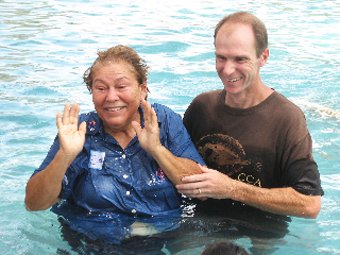
Organic church starter Ben Hanna prepares to baptize Elena. A member of one of Hanna’s sponsor churches spearheaded the effort to rebuild and refurnish Elena’s home after it burned.

Hanna’s home church is just one incarnation of the organic church—a movement gaining popularity throughout the United States. In the last year in Texas, 189 new organic churches have been started. There have also been at least 2,892 professions of faith, and that number is growing all the time.

“An organic church is a group of Christ followers who lives out the life of a church in elemental ways, usually on site somewhere in a home, a park or another convenient place,” said Lindsay Cofield, director of multihousing and organic churches for the Baptist General Convention of Texas.

“Organic just means there’s nothing added from the outside that’s not natural to the little group that is meeting as a church. The church in a Hispanic mobile home park would not have an organ. The church in a trendy, upscale condo area would not have a band. There are fewer church cultural carryovers.”

Hanna insists many of his neighbors would never enter a traditional church.

“Some people we meet will never step into an established church, but either they will come to our home or we’ll go to theirs,” he said.

Hanna first was exposed to organic churches in Eastern Europe when he served as a missionary for the Southern Baptist Convention International Mission Board . He later worked four years in Houston as a congregational strategist and a church planter for the BGCT.

Hanna’s family attended institutional churches off and on while living in Houston, but it always came back to having church at home. The New Testament book of Acts, Hanna said, kept bringing him back to the organic church.

He and his family moved to San Antonio when an opportunity came to focus on organic church ministry full time.

“One of the main reasons we came here [to San Antonio] was because the director of missions at the San Antonio Baptist Association , Dr. Charles Price, had a vision even bigger than ours and a challenging vision to see all of San Antonio come to Christ,” Hanna said. “He’s started a team of urban church planters, including myself and two others.”

Hanna said the fundamentals of starting an organic church are praying and finding people of peace—Christians or non-Christians in whose lives God is working. Next, church-starters love people in practical ways, opening the Bible with people in their own homes and follow through by building relationships. Due to the nature of the organic church, people don’t usually stumble into a worship service.

“You’ve got to actively go to where people are,” Hanna said. “If we’re not going, we’re not growing.”

When people see churches are making an effort to meet them where they are, they are more receptive to the message, he said. Hanna has witnessed amazing examples of God’s work through his San Antonio ministry.

“In the fall of 2008, we were praying and prayer walking in a downtown area about 10 minutes from the Alamo,” Hanna said. “I met the manager of a restaurant and asked how I could pray for them. One of the workers there told me his girlfriend was dying from cancer, so we said we would pray for her.”

Once they learned of the woman’s need, Hanna and members of CrossBridge Community Church , one of several churches that sponsor Hanna’s ministry, were able to show Christ’s love in action.

“We helped to raise money for her medical bills, visited her in the hospital and brought them food several times,” Hanna said. “Then, we helped to pay for her funeral when she died. Later, when I went back to the restaurant, someone said, ‘Did you know that our cook’s mom’s house burned down?’ They came and told me because they saw that we had helped before.”

Hanna drove to the home of Elena, the cook’s mother, to check things out. He found her outside, barefoot and pajama-clad in January. A member of one of Hanna’s sponsor churches—the vice president for construction at a homebuilding company—spearheaded the effort to rebuild and refurnish Elena’s home by the summer of 2009.

“She started crying when she saw all the things people were doing for her,” Hanna said. “’Why are you doing this?’ she asked. So we were able to tell her about love and forgiveness of Christ and she prayed and gave her life to the Lord. She was baptized last summer.”

After that, a new house church began meeting in Elena’s home.

Hanna has seen three house churches started in San Antonio since his family moved there almost two years ago. Hanna’s newest house church started in the Kennedy Arms Apartments on Monday after Easter this year.

“It’s the Lord who’s doing it,” Hanna said. “He’s in the deep end of the pool. He’s calling us to join him, but he’s there. It’s more of an adventure than obligation or duty. The biggest blessing is just to join him.”


Buckner center to combat child abandonment in Guatemala

SAN JOSE PINULA, Guatemala—Buckner recently opened a community transformation center to serve people in one of Guatemala’s most impoverished communities, San Jose Pinula.

Children make up more than half of the population in Guatemala, and about half of those children—3.7 million girls and boys—live in poverty. (PHOTOS/Buckner International)

“We did a socioeconomic study and found that there was great need,” said Liliana Arcely Pineda, Buckner social worker at the center. “We found illiteracy, poor health and malnutrition among children. That’s why we chose this place.”

The community transformation center will offer English classes, literacy classes, computer classes and a medical clinic in collaboration with several community partners. Licensed social workers also will provide personalized case management for families, all with the goal of keeping families together and preventing children from being abused, neglected and abandoned.

“There is an orphanage close by, and we want to transform the community so that we can stop filling it with children,” said Roberto Tejada, Buckner director of community transformation centers in Guatemala. “By doing our part, we will keep families together by equipping them with the tools they need to be self-sufficient and capable of providing for their children.”

Buckner’s community transformation center in San Jose Pinula, Guatemala, will offer English classes, literacy classes, computer classes and a medical clinic in collaboration with several community partners. Licensed social workers also will provide personalized case management for families, all with the goal of keeping families together and preventing children from being abused, neglected and abandoned. (PHOTOS/Buckner International)

UNICEF reports children compose more than half of Guatemala’s population. About 50 percent of them—3.7 million girls and boys—live in poverty. About 23 percent of children are part of the labor force, a cycle which prevents children from receiving an education and provides little hope for their future.

“We hope that in five or 10 years, there will be a difference in these people’s quality of life,” Tejada said. “We’d like to see young people grow up educated, working in the community and preserving their families.”

Jose Mario Lutin Solares Consejal, who spoke on behalf of Mayor Victor Reyes Pur at the center’s ribbon-cutting ceremony, described the center as “part of what our citizens have always dreamed of. Today we recognize this group of people as being sent here by God. Let us educate children and young people so that we won’t have to correct the adults.” The mayor’s office provides 30 percent of the building’s rent.

Buckner operates similar programs for communities in Guatemala, Ethiopia and Mexico. For more information, visit www.buckner.org or call (214) 758-8050.


Music videos allow North Texas church to touch the world

BURLESON – When Jarod O’Flaherty saw the 2008 movie Fireproof and learned a Baptist church in Georgia produced it, he left inspired to do something similar with his Burleson church.

“I tried to see what I could do to try and put something together, like they did with Fireproof,” O’Flaherty said. “A big concern obviously is funds. To do something like that is very expensive. So, I thought we could do a music video.”

{youtube}3COr3zsWq1o{/youtube}

He and his church, Retta Baptist in Burleson, created two music videos—“The Resist Project” and “Run to You”—and posted them on networking sites like Facebook and YouTube. O’Flaherty’s church has embraced this ministry as a response to the rise of technology-driven culture.

“There are a lot of people out there on Facebook that will sit and watch a video or a link that some of their friends send out to them, but they won’t step into a church in 2010,” said O’Flaherty, director of both music videos.

Not only do these videos reach those who may not be open to attending church, but they also are cost-efficient ministry tools.

“We felt like we may not have the time or money to go on a mission trip across the world, but we can put out a video that people all over the world can see,” said Shane Clements, lead singer of the Shane Clements Band.

The first video “The Resist Project” features a teenage girl whose spirit is broken by worldly troubles. The girl finally turns to God with her time of need.

{youtube}vquMnlkE-U4{/youtube}

“In ‘Resist,’ the message and all the characters are primarily teenagers. I work specifically with the youth ministry at our church so it originated there,” O’Flaherty said, “That was the target audience for the first video.”

After seeing the success of the first video, O’Flaherty and the Shane Clements Band began to put the next project, “Run to You,” in action. The video for “Run to You” features a more varied age range of actors portraying people who are facing situations where they must run to God.

“You saw a dad who lost his job, a grandmother who lost a grandson. We were really trying to direct it more toward everyone,” said Samantha Craig, a member of the production crew for the videos. “That was Jarod’s whole idea for the second one, to reach out to a bunch of people instead of one specific group.”

After seeing the success of their original songs, The Shane Clements Band has plans for the future.

“We’re definitely going to move forward, if that’s what God has in store for us. We wouldn’t be a band with out having ‘The Resist Project,’” Clements said. “We have and always will consider ourselves a ministry. … We want to continue to move forward. We’re in the process of writing songs and doing normal band things.”

O’Flaherty, despite not having specific plans for additional videos, believes God will encourage them to create more.

“I’m pretty sure something will come up, and God will lead us to do more of this. And hopefully each time, it gets a little more professional, and we know how to do our part of it better,” O’Flaherty said.

Even if there are no future projects, Clements feels these videos served their purpose.

“To us, if one person or two were to be saved or start asking questions to somebody that then led them to get saved, it was completely worth it.”


Baylor brings education, care to Dallas area hard hit by diabetes

DALLAS – Baylor Health Care System in partnership with the city of Dallas opened a wellness center dedicated to diabetes care and education June 7 in an area where residents are three times more likely to die of diabetes-related complications than in the rest of the city.

“Diabetes is epidemic, and if you look at this population, they’re even more at risk. So, the inspiration was really to put our investment in the people that needed it the most,” said Donna Rice, president of the Diabetes Health and Wellness Institute at Juanita J. Craft Recreation Center.

Education specialist Misty Jones (left) provides information about diabetes prevention and treatment to patient Terry Dotson at the Diabetes Health and Wellness Institute at Juanita J. Craft Recreation Center, a new entity Baylor Health Care System has launched in partnership with the city of Dallas. (PHOTO/Jessica Acklen)

The institute is focused not only on the prevention of diabetes, but also personalized education of how to deal with the disease.

“Nobody wants to know about diabetes; they want to know about their diabetes. The care really needs to be personalized,” Rice said. “I think that’s going to be our approach and why we’re different.”

The institute provides both a clinic to treat and classes to teach its patients. Complete with a gym, tennis courts, softball courts, a workout room and a full kitchen to instruct learners on healthy dieting, the institute seeks to change the personal habits of its patients.

“If they’re used to eating fried chicken four times a week, we look at the oil they’re using. So they can still fry it, but they may go from Crisco to olive oil,” Rice said. “The goal of each class is to give information, but also to work on that individual.”

The institute also has the ability to broadcast classes throughout the community and outside events, including church services, back to viewers in the recreation center.

“We’re training a person in each church to be one of our staff ‘peer.’ The part that they play is really supporting this individual in their role and looking for ways to bring their messages into their community,” Rice said. “I think the church is really key in changing the behavior here.”

Dallas’ part in the construction of the institute is important in lowering the high numbers of diabetes in the area.

{youtube}b8uCEBPt_Sc{/youtube}
The Diabetes Health and Wellness Institute at Juanita J. Craft Recreation Center in Dallas is dedicated to diabetes care and education. (Baylor Health Care Video)

“Where do you ever see a city and a health system come together? Health systems play a role but we need the community involved and this is a great way to get the community involved in a disease that’s epidemic in this country,” Rice said. “It’s a way for [Dallas] to take a stand.”

Rice also expressed a desire for the recreational center, which already existed in the community prior to institute’s move, to be a “haven” for families.

“Why build something new [when you have] this paradise within the city? It’s kind of like a gem, and I don’t think anybody knows it here,” Rice said. “I think it will be the place to go for the community. There’s something for everybody here, and that’s really neat.”

The recreational center also reflects the community’s culture. Local artists’ work and framed pictures drawn by children in local schools adorned the walls.

As faith-based health care system, Rice feels that Baylor’s role in the community is important and eventually will lead to improving community’s conditions.

“I think Baylor has been very, very generous. I just see the great work they have done,” Rice said. “I think they saw this as an opportunity to really impact an impoverished area. It’s not only the level of healthcare, but its economic development. I think Baylor being an anchor here may draw opportunity for other investors, grocery stores, or pharmacy chains or whatever, to come into the community.”

Rice hopes the success of this center will lead to a new way of combating diabetes in the future.

“I think they want to see how this model works, but I think this is the future model, and we will be seeing models like this throughout the U.S.,” Rice said.