Around the State

Houston Baptist University’s Dunham Bible Museum will host a premeire showing of KJV: The Making of the King James Bible in the Dunham Theater Sept. 2 at 7 p.m. Participants will see the history of the Bible translation, meet the documentary’s producer and enter a drawing to win an original 1611 Bible leaf. To reserve a seat, call (281) 649-3222.

{youtube}V-KPPXnz1Hg{/youtube}
Clip from KJV: The Making of the King James Bible

East Texas Baptist University has commissioned historian Bill O’Neal to write a history of the university. The completed work is scheduled to be available for the university’s 2012 centennial celebration.

Anniversaries

Pablo Salcedo, 10th, as pastor of Primera Iglesia Hispana in Sherman, Aug. 13.

Billy Neal, fifth, as pastor of First Church in Bells, Aug. 14.

Victory Church in Marshall, 40th, Aug. 15. Former member David Holder, who now is pastor of First Church in Sulphur, La., was the guest preacher, and David Barnett led the music. Ron Segers is pastor.

Bethel Church in Ingleside, 25th, Aug. 29. James Anaya is pastor.

Harold Mundine, fifth, as music minister at First Church in Sinton.

Harris Avenue Church in San Angelo, 70th, Sept. 4-5. An ice cream fellowship will be held Saturday from 6 p.m. to 8:30 p.m. Sunday will begin with a time of doughnuts and coffee from 9:30 a.m. until 10:15 a.m. Former pastors Milton Tyler, Terry Gayle, Travis Monday and Earl Dunn will take part in the morning worship service. Former music minister David Henderson also will participate. A meal will follow the morning worship service. The last event of the day will be the opening of the cornerstone. Randy Bush is pastor.

Retiring

Albert Martinez and his family enjoyed an afternoon of swimming at South Texas Childrens Home Ministries, where Martinez lived as a child. The Martinez family joined more than 450 other STCHM students and staff, past and present, during STCHM’s Homecoming celebration this summer. STCHM alums from every decade since the home was founded in 1952 attended, travelling from all over the United States and as far away as France. Participants spent the afternoon sharing stories, looking through old photo albums and yearbooks, strolling the campus, and swimming. Many alumni also spent time searching for the paver with their name inscribed on it, along with the year they came to live at STCHM, on the walkway outside Piper Children’s Center. South Texas Children’s Home Ministries holds a reunion every five years, and this year’s reunion was the largest.

Andy Walker, as pastor of Searsville Church in Valley Mills, July 18. He served the church 10 years after it reopened following a period of inactivity.

Deaths

Harold Parnell, 84, July 20 in Fort Worth. He not only was a pastor, but also served several churches as minister of music and education. He served at Burchill, Calvary and Rehoboth churches in Tarrant County, Gardendale Church in Corpus Christi, First Church in Lake Jackson and First Church in West Columbia. He also was the founding pastor of a Pennsylvania church. He is survived by his wife of 64 years, Wynelle; daughter, Linda Nixon; and sons, Michael and David.

Frances Guajardo, 72, in Mineral, Aug. 5. She served as a pastor’s wife and was involved in home missions with the Southern Baptist Convention 34 years. She was employed 12 years with Lifeway Christian Resources (formerly known as the Baptist Sunday School Board) and was an editor of Sunday school materials for Spanish-speaking children. She was a consultant with Texas Partnerships for the Baptist General Convention of Texas. She was preceded in death by her brothers, Isaac Romero and Zaragosa Romero. She is survived by her husband of 51 years, Alcides; daughters, Orpha Garcia, Ruth Brewer and Naomi Galvan; sisters, Mary Burgos, Pauline Gonzales, Anita Loa and Esther Watson; brothers, Macario Romero, Ricardo Romero, Cata-rino Romero Jr. and Ramiro Romero; 17 grandchildren; and three great-grandchildren.

James Bond, 80, Aug. 6 in Frisco. A graduate of Howard Payne University and Southwest-ern Seminary, his pastorates included First Church in Algoa, Old First Orange Church in Orange, First Church in Nava-sota, Trinity Church in Amarillo and First Church in Athens. After 17 years in Athens, he retired and became involved in the intentional interim program of the Baptist General Convention of Texas. Congregations he served in that capacity include First Church in Rockport, Allen Heights Church in Allen, Waddill Street Church in McKinney, North Fort Worth Church in Fort Worth and First Church in Mineral Wells. He is survived by his wife of 52 years, Marion; daughters, Sue Christo-pher and Linn Cobb; sons, Jim and John; and nine grandchildren.

Events

Northside Church in Corsicana broke ground Aug. 1 on a $8.4 million expansion project. The project will provide new facilities as well as improving some existing structures. Rick Lamb is pastor.

A state historical plaque will be dedicated at Primera Church in Bastrop Sept. 11. The ceremony will begin at 9:30 a.m. Lunch will follow. For more information, call (512) 321-1351. Harold Welch is pastor.

Ordained

Nathan Smith to the ministry at Lakeview Church in Waco.

Bob Whitener as a deacon at First Church in Seguin.


Band bridges generation gap with a unique mix of musical styles

NASHVILLE, Tenn.—With their mix of Southern Gospel, country, bluegrass, traditional hymns and contemporary worship songs, Jason Baird and Justin Rivers—better known as the Dove Award-winning duo Austins Bridge—seek to bridge generations and connect people to Christ.

“When we first talked about starting a band, we wanted to create music for all ages to enjoy,” Baird said. “From our experiences growing up in church, there seemed to be a gap between older and younger generations regarding the style of music. In Titus, it talks about how the older and younger generations need to be linked together because there’s so much wisdom that can be gained. So, we wanted to make sure that our concerts offered something for everyone.”

Jason Baird (left) and Justin Rivers make up the Dove Award-winning duo known as Austins Bridge.

Growing up, Baird attended Friendship Baptist Church in Austin. Later, he majored in music at the University of Mary Hardin-Baylor in Belton before transferring to Belmont University in Nashville, Tenn.

“During my junior year of high school, I felt like God was calling me to some sort of ministry,” Baird said. “However, itinerant music ministry seemed like such a far-fetched dream. It’s not something that you just go out and apply for. Where we are today shows how God was working in our lives by providing these opportunities.”

Rivers, the son of a pastor, grew up in Alabama and started playing music at an early age—piano, drums, bass, acoustic and electric guitars, banjo, mandolin and fiddle.

“Whenever one of the church musicians didn’t show up, I would fill in, which provided valuable learning experiences for me,” Rivers said. “Throughout high school, I traveled with some local bands around my hometown and moved to Nashville after my freshman year of college. 

“Later on, I ended up in Austin for a while. Through a bizarre serious of events, I was talking to a friend one day and told him about a desire that God had really placed on my heart to create music that would lead people of all ages to Christ. My friend knew Jason and told me to give him a call. Next thing you know, Jason and I were sharing ministry ideas. We both really felt like God was directing and opening doors, which would allow us to impact his kingdom.”

As they began performing at local churches and ministry events, it didn’t take long before word began to spread about their family-friendly concerts, and they became inundated with requests to perform at larger gatherings and festivals.

Four years later, they continue to maintain a busy schedule with events around the country.

“Any venue that God opens up, we want to be able to play there because we want to reach as many people as possible for Christ,” Rivers said. “There are so many people who are desperately needing to hear about the hope and salvation that only a relationship with Jesus can provide. Wherever we perform, we don’t compromise or water down the message at all.”

{youtube}3eBSlRutrQQ{/youtube}
Austins Bridge performs live.

The duo recently released their second album, Times Like These, produced by Jay DeMarcus, the bass player for the country music group Rascal Flatts. Through toe-tapping and heart-stirring songs, Austins Bridge desires to point listeners to Christ as their source of joy, comfort and strength.

“We want our music to be a magnet that attracts people to Christ,” Baird said. “So often, people come up to us at our concerts and share about the trials that they are going through. Many are so overwhelmed and feel like God isn’t listening to their prayers.  That belief is probably more prevalent today than it has been in years past, because of things people are dealing with in our country. 

“Whether it’s financial or relational, people have some kind of burden that they’re carrying, and we know that Satan is attacking people during their weakest moments. By sharing our own life experiences and telling how Christ has carried us through difficult times in our lives, we really want to encourage people to not give up and to place their trust in him. While we may not understand God’s plans, he will never leave us.”

Rivers agreed, adding: “It’s easy to stand on stage and say that God is faithful and can bring you through your trials. But until you’ve actually been tested and tried with those very words and come out on the other side, that’s when you know that God is faithful and able to do exceedingly above more than you could ask or think.”


BGCT eliminates 13 staff positions, reduces some to part-time

DALLAS—Six Baptist General Convention of Texas Executive Board employees are losing their jobs, seven unfilled posts are being eliminated and a dozen positions are being reduced from full-time to part-time due to the state convention’s current financial situation and the 2011 forecast.

Savings resulting from the staff cuts total $1,044,000 in salary and benefits for 2011, said Jill Larsen, BGCT treasurer and chief financial officer. The layoffs and cutbacks bring the total BGCT Executive Board staff—full-time and part-time—to two-thirds the number employed four years ago.

Effective dates of job termination or reduction vary, Larsen noted.

The six occupied posts being eliminated are the director of institutional relations and his administrative assistant, a resource specialist and order processing specialist in information management, the administrative assistant to the director of information technology and an accounts payable technician.

Nine congregational strategists around the state were moved from full-time to part-time status, as were the ministry assistant for intercultural ministries, ministry assistant for associational missions and camp specialist/disaster response field coordinator.

In addition, seven vacant positions are being eliminated—a ministry assistant in the Missions Foundation, a Baptist Student Ministry director, the director of community and restorative justice, the director of program planning for the Texas Baptist Offering for World Hunger and three part-time Baptist Student Ministry interns.

“As we finish out this year and plan for next year, your leadership team has spent many hours looking at various options to determine our direction both strategically and financially. Unfortunately, any of the options considered required that we reduce our expenses. This requires the elimination of some positions,” BGCT Executive Director Randel Everett said in an e-mail to staff.

In correspondence to directors of the BGCT Executive Board, Everett elaborated: “The staffing reduction decisions have been made with a consideration of both the current year financial situation and the forecast for 2011. Each manager who faces a reduction of staff in their area has made the proposal about the reduction. We continue to work with these managers to mitigate the impact on ministry of the affected areas. Further, we have discussed with each person who faces the reduction or elimination of their position.”

In an interview, Everett emphasized budget considerations and income projections made the cuts necessary, and none were based on job performance.

As of July 31, Texas Cooperative Program receipts totaled $19,825,159—88.61 percent of budget and 90.14 percent of year-to-date 2009 receipts.

In addition to staff cutbacks, BGCT administration also is implementing other cost-saving measures, Everett noted. For example, the Texas Baptist Historical Collection and Archives—which have been housed in rented office space—are being moved to the Baptist Building when the current lease expires.

The BGCT Executive Board’s finance subcommittee meets Aug. 24 to discuss the 2011 budget. The subcommittee will meet again Sept. 27 to finalize its recommendation to the administration support committee that same day and to the full board the following day. Messengers to the BGCT annual meeting in McAllen, Nov. 8-10, will vote on the budget the board recommends.

The latest round of layoffs and cutbacks continues a trend dating back seven years.

In 2003, the BGCT eliminated 20 staff positions—laying off 13 people and eliminating seven vacant posts—but some positions were added later in an organizational restructuring.

In a major round of layoffs four years later, 29 staff positions were eliminated. Staff reductions continued incrementally since then, primarily by not filling vacant positions.

In 2006, the BGCT employed 406 staff, with 315 in full-time positions. After the latest cuts take effect, staff will number 268, with 213 full-time positions.


Houston VBS teaches Haitian orphans, ‘Jesus loves you’

HOUSTON—As a group of kindergarteners sat coloring, one small boy began to sing “Jesus loves me.” Soon, all the children in the Vacation Bible School class joined in.

The coloring pages included a note reading “Jesus loves you” in Creole—the common language of Haiti. It’s a personalized message the Houston children are including in kits of school supplies that will be sent to orphans in Haiti.

Westbury Baptist Church in Houston used its Vacation Bible School this year to partner with Baptist Global Response, the Southern Baptist international relief and development organization, in a project to raise funds and assemble about 100 school-supply kits—sandwich bags containing pencils, erasers and crayons.

Among Haitian children affected by the earthquake, school supplies are badly needed—as is the good news that Jesus loves them. (PHOTO/Baptist Global Response)

The children wanted to include something personal in the kits and decided to include the decorated “Jesus loves you” notes. At first, they only had the French translation of the phrase, until one of the VBS workers mentioned he had family members who spoke Creole.

As the children colored the notes and sang “Jesus loves me,” it “was a moment I’ll never forget,” said Beverly McDaniel, a church member who has helped with VBS for the past three years.

The idea for a project focused on Haiti came about as Hope McNeil, children’s minister at Westbury Baptist Church, decided to do a mission project for VBS through Baptist Global Response.

The church had been involved with the relief agency over the past year, collecting money for Haiti relief and putting together three in-home care kits that contain supplies caregivers use to provide comfort for terminally ill patients.

McNeil believed the in-home care kits, with all their specific components, would be too difficult for the children to gather. So, she asked Baptist Global Response personnel in Haiti what would be most helpful. They suggested school supply kits, and the VBS team knew that was the answer for their children.

Each day at VBS, the children attended a worship rally and then rotated through crafts, recreation, snack time, Bible study and either a music or missions group. As the children in the missions group put together the school supply kits, they learned about Haiti and the January earthquake that ravaged the capital, Port-au-Prince. The children also viewed photos Baptist Global Response personnel sent from a recent visit to Haiti.

“The entire project certainly touched the hearts of those involved,” McDaniel said. The children “were mesmerized by the scenes they saw. Each day as we reviewed countries we had ‘visited’ as a part of our mission stories, they always mentioned Haiti. … Our Haiti project was the highlight of our missions rotation.”


Tour opens students’ eyes to hunger needs in Texas

When five students signed up for a road trip across Texas, they had no idea they’d be beheading roosters on a Waco farm or standing in as last-minute chefs for an absent kitchen crew before a crowd of hungry people.

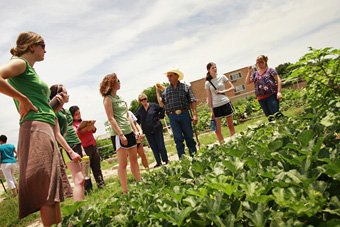
At a community garden in San Angelo, Bob Knox, director of Rust Street Ministries, tells the Texas at the Table team about the garden. While people of the community have plots in the garden, the residents of the nearby Retirement Village take pride in keeping the garden maintained. Also, 50 percent of everything harvested in the garden goes to Rust Street Ministries, which provides food, clothes, house goods, furniture and other assistance to the poor. (PHOTOS/Courtesy of Chelsea Jenkins)

The young women had their share of adventures on the three-week journey, during which they learned about hunger, nutrition, agriculture, public policy and what Texans around the state are doing to help those in need.

Jeremy Everett, director of the Texas Hunger Initiative, and Brenda Sanders, student missions consultant at GoNow Missions, conceived the idea for the Texas at the Table tour. Everett participated in a similar trip 10 years ago when he was in seminary.

“This time around, we realized a lot of kids have heard about hunger in Haiti or Africa, but not domestically. This was a chance to educate them about what’s going on in the state,” he said.

Mallory Homeyer, lead organizer at the Texas Hunger Initiative, planned the trip with stops in Waco, Lubbock, San Angelo, San Antonio, McAllen and Austin.

Students learned about the reasons so many lack access to healthy foods. Financial concerns, transportation issues, improper equipment for food storage and cooking or a simple lack of knowledge about a healthy diet all play a role.

“During the summers, parents will give a lot of kids a dollar or two for lunch,” Everett said. “And they walk to the convenience store and get a candy bar and a Coke, because it’s all they can afford. It makes their hunger pains go away, but they’re incredibly malnourished.”

That explains how hunger and childhood obesity can go hand in hand, something Texas Tech senior Emily Moore said she never understood until she took this trip.

“Even if there is food available, it’s not even worth eating because it’s hurting you even more than it’s providing you nutrients,” Moore said.

Poor families who can get to the grocery store often don’t fare much better. They’re forced to buy cheap, processed foods full of unhealthy ingredients like high fructose corn syrup.

Emily Moore (left), a senior at Texas Tech University, and Brittany Rupp, a sophomore at the University of Texas at Arlington, prepare to serve lunch at Wesley Daily Bread Soup Kitchen at Wesley United Methodist Church in San Angelo. The team prepared and served lunch to more than 100 people during lunch that day.  (PHOTOS/Courtesy of Chelsea Jenkins)

“From growing up in a Walmart generation, I would say I have been completely surprised about how the food that we eat is so unhealthy,” said Chelsea Jenkins, a graduate student at Texas A&M University-Commerce. “And yet, they’re selling it to us each and every day.”

Brittany Rupp, a sophomore at the University of Texas at Arlington, echoed the sentiment.

“I thought that eating a fruit from the store was really healthy,” Rupp said. “I’ve learned a lot more about eating in season for what’s growing in season. And now I’m more interested in buying locally, because not only is the food fresher, but it also helps people in my own community who are trying to make a living by growing things there.”

At the World Hunger Relief Farm in Waco, students learned about alternatives to store-bought, genetically modified and processed food, and they experienced a few days living like farmhands. They set up fencing, harvested crops, collected eggs and cooked meals from scratch.

“I can honestly say that I never expected life on the farm to be this intense,” wrote Howard Payne University junior Dani Clark on the trip blog.

“The explanation for dinner was simple—‘You have everything you need here on the farm, so get to collecting and cooking.’ Easier said than done. Collecting the veggies was easy, and even catching the fast rooster was easy enough. Killing and skinning was a totally different story.”

A guest of Wesley Daily Bread Soup Kitchen in San Angelo enjoys his meal. (PHOTOS/Courtesy of Chelsea Jenkins)

They learned about eating fresh food and buying locally through urban gardening, community gardens and farmers’ markets.

“Because of the declining economy and rising food prices, more and more people are taking to growing their own food in their backyards,” said Bethel Erickson, a trip leader and member of the Heart of Texas urban gardening coalition. “And as we go around the state, we’re seeing more food pantries and churches getting in on that activity.”

For anyone interested in learning to grow their own food, Erickson recommends hitting the local library and then going out and digging in.

“Of course, you’ll have your successes and your failures, but I think the best way to learn is by actually just getting your hands dirty,” she said.

More and more farmers markets now accept the Lone Star Card, a Texas governmental food assistance program, which is good news for low-income families who often are forced to sacrifice nutrition for thrift. Community gardens are also a great resource for families in need.

In addition to nutrition, the group learned about different feeding programs, from soup kitchens and food pantries to the Summer Food Service Program for children who qualify for free or reduced-price lunches during the school year.

The Texas Department of Agriculture and the United States Department of Agriculture fund the Summer Food Assistance Program. Local sponsors, such as school districts or food banks, prepare and package meals and deliver them to local feeding sites, like churches, neighborhood parks or schools, for distribution to hungry children.

Moore noted these programs can’t function without volunteers—if no one shows up to help, people will go hungry.

“I always thought: ‘Oh, our church volunteers once a month at the soup kitchen. That’s when I’m going to go do it,’” Moore said. “But they need people—they have to have people every day, or it won’t work.”

The students realized how necessary volunteers are while visiting a San Angelo soup kitchen. In the middle of their tour, when the scheduled cooking team called and said they couldn’t make it.

“Panic spread across most of our faces since we had no idea what we were supposed to do, and none of us had never cooked food for a group of the size we were about to feed,” Clark wrote on the trip blog.

Two hours later, the group served up enchiladas, meat and potatoes, spinach, rolls and spaghetti.

“As the people filed in, we saw young, good-looking people, older folks shuffling in, families with little children and people from all different backgrounds, and not one of them was denied a meal,” Clark wrote. “All of the meals were hot, and every plate was served piled high.”

All the girls talked about their excitement to go home, spread the word and apply what they learned to their lives.

“I think trying to start locally, and trying to help the people at least in your own community—that can make a big difference,” Rupp said.

To read more about Texas at the Table, check out the trip blog at www.texasatthetable.blogspot.com.


Texans ford the fjords on Sweden mission trip

Vikings welcomed cowboys to their home turf recently—but not for a gridiron challenge.

At a cowhorse clinic in Sweden, trainer Ralph Hull teaches Josephine Aberg riding and horse-handling techniques. (PHOTOS/Courtesy of Maureen Hull)

A five-person team from Cowboy Church of Mineral Wells and Cowboy Gatherin’ in Bunger, a small community south of Graham, participated in a nine-day mission trip to Sweden, where they rode, roped and wrangled, all in the name of God’s kingdom.

This trip has been several years in the making for Ralph Hull, a horse trainer who has sold horses to people throughout Europe.

“My clients in Sweden come occasionally to stay with me,” he said. “Every time they come, my wife Maureen and I take them to cowboy church with us.”

Hull’s Swedish clients had asked him many times to visit and teach a cowhorse clinic. He always turned them down until one client suggested he lead a cowboy church service at a major horse show sponsored by the Swedish Reined Cowhorse Association .

“When she said that, I got more excited,” Hull said. “I’ve been asked for several years to come, but I always had shows or horses to take care of and didn’t want to take the time to go. But since I saw the opportunity to spread the gospel along with training horses, I saw the Lord was opening a door. Going to teach about horses didn’t really enthuse me; going to share the gospel did.”

Pastor Jamey Burrus Cowboy Gatherin’ in Bunger plays cowboy gospel music while Victor Tollemark of Sweden looks on during a barbecue by the sea. (PHOTOS/Courtesy of Maureen Hull)

Studies show that while almost eight in 10 Swedes are members of the Church of Sweden, only one in 10 thinks religion is important in daily life.

“The biggest need right now is just knowledge,” said Maureen Hull, secretary of Cowboy Church. “They don’t know anything about God. You can’t ask them, ‘Are you saved?’ because they don’t know what that means.

Church dues are collected by the government along with taxes whether people attend services or not, Hull said, giving many Swedes the impression the state church only cares about their money.

The Texas team set out to shatter these impressions and connect with an unreached demographic—members of the Swedish horse culture.

Texas Baptists helped fund the trip in part through a grant from the Mary Hill Davis Offering for Texas Missions , said Steve Seaberry, director of Texas partnerships for the Baptist General Convention of Texas. The team also received private donations and held two fundraising events. Their contacts in Sweden provided room and board.

On the first part of the trip, Hull taught a reined cowhorse clinic with 11 participants in Halmstad, about five-and-a-half hours southwest of Stockholm. In the second part, members of the team competed, preached and evangelized at the annual horse show at High Chaparral, an Old West-themed park in Hillerstorp, about four hours southwest of Stockholm.

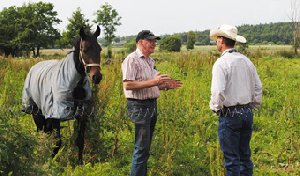
Ralph Hull (right) and a Swedish rancher discuss horses and cattle. (PHOTOS/Courtesy of Maureen Hull)

High Chaparral features an Indian expo, a Mexican village, gift shops, a museum, train rides and other themed attractions.

“It’s nothing you’ve ever seen,” Maureen Hull said. “Everything is authentic. It’s all memorabilia and nostalgia items from our country’s history. The train that goes around—they actually shoveled coal in it. You can smell the coal burning.”

High Chaparral’s western village has a 15th century Swedish church where the team held cowboy church services each afternoon.

“We got a lot more opportunities to preach and spread the gospel than we anticipated,” said Jamey Burrus, pastor of Cowboy Gatherin’. “We were only actually scheduled for one service. After we went there and preached to them and I did one of my rope sermons, they kept talking about it and asking for more.”

Most of the work was accomplished through one-on-one evangelism. Burrus said he felt encouraged by what he saw God doing in the lives of the friends they made.

“They really want Bibles—that’s one of the biggest things,” Burrus said. “We met a guy named Ulf Noren who writes a horse magazine over there. We gave him a Cowboy New Testament, and he was so excited about it. He sat and read it and looked at it a long time. Just sat and read it and insisted that we get him more to pass out to people in Sweden.”

Members of Texas cowboy churches enjoy time with new friends on a trip to Sweden. They are (back row, left to right) Gary Tull, pastor of Cowboy Church of Mineral Wells; Jamey Burrus, pastor of Cowboy Gatherin’ Church in Bunger; Delise Burrus; Ralph Hull, Lay Pastor of Cowboy Church of Mineral Wells, Maureen Hull; Katarina Nielson; Staffan Nielson; Bjorn Karlsson; (front row) Maria Westgaard holding Juni Westgaard; Rolf Westgaard; Marianna Karlsson; and Peter Westgaard. (PHOTOS/Courtesy of Maureen Hull)

Burrus and Ralph Hull spent time throughout the week speaking with a Swede named Rolf, one of the Hulls’ customers.

“He had been with us through our whole trip,” Hull said. “He’d been at all the services and heard us talk to people. He said, ‘The idea sounds very interesting, but I’m not ready yet.’ I told him: ‘Whenever the Lord says it’s time, it’s time. Be ready and don’t turn away when he does.’ And we just gave it time. On that last day he wanted to talk to Jamey and me alone, so we were able to visit with him. And through that, he knew that the Lord wanted him to turn his life over to him, and he did.”

The change in Rolf was immediate, Burrus said.

“You could tell by the way he talked that he really found peace in the Lord,” Burrus said. “Several people came up to me later and said they could really tell and that his life was completely different.”

Maureen Hull and Delise Burrus had many opportunities to tell Swedes about the gospel in casual conversations while sitting in the stands watching their husbands compete.

“I think there are people whose lives we touched and we’re not really aware of it right now,” Maureen Hull said.

Ralph Hull said God used the group’s unique talents to draw people into conversation. They had more opportunities to share the gospel than they expected.

“The Lord worked in amazing ways while we were there,” Hull said. “Jamey is a fabulous roper. He did well in roping there and really got people’s attention. Through that, people would come up and talk to him who normally wouldn’t. The abilities God gave us caused people to want to come to us. God was pulling them toward us.”

Reporters from various equine magazines interviewed Hull after the horse he showed won reserve champion of the show. He talked freely about his faith in interviews and said his testimony, at least in part, would be shared in print throughout the Swedish cowboy culture.

Burrus said the trip was not a one-time thing. The relationships the team built continue to grow as they stay in e-mail contact, and the show’s organizers have already insisted that the team come back in the future.

“It was a very, very moving experience for me,” Burrus said. “I personally just run out of words trying to explain it.”

To learn more about the Sweden mission trip and watch Burrus’ roping sermons, visit the trip blog at ourridetosweden.wordpress.com .


Ministry offers a place of stability for people left adrift

FORT WORTH—Anchorless, Danny Evans was drifting. He coasted into a debilitating drug addiction that cost him jobs, his home and ultimately time in jail. Upon his release, he wandered the streets not knowing where he would find his next meal, a safe place to sleep or a solitary member of society who cared about.

Drugs may have driven him to the streets, but trying to survive there killed his will to live.

“It’s like you don’t have any dreams anymore,” Evans said of living on the street. “Society has just sucked you in and taken everything from you. You don’t dream. You don’t set goals. You don’t have … ambition anymore. It’s just about trying to make it day-by-day on the street.”

A Union Gospel Mission resident studies the Alpha Course, a 15-lesson discussion series teaching the basic tenets of Christianity,

Having lost everything, Evans found himself at the front door of Union Gospel Mission , a Texas Baptist Offering for World Hunger-supported ministry that serves roughly 75 percent of the city’s homeless through a variety of aid programs.

In a humbling experience, Evans shared his story with case workers at the mission—the drugs, the incarceration, the streets, his decreasing desire for life—all of it. Because of his willingness to be honest and commit to turning his life around, he found an open door to a new life.

“They’re breathing life into you here,” he said. “They’re letting you know there is hope, there is life out there if you want it. Go out there and apply yourself and take the next step. There is a chance for you to make it, no matter what you’ve been through in your past.”

He became one of the mission’s 325 residents, each of whom are attempting to get on their feet after falling flat for one reason or another. Through the mission’s connections, he entered a narcotics anonymous program and accepted a part-time job on the premises. Workers and fellow residents have pushed him to examine his life and make needed changes. They encourage him, but they also keep him accountable. Evans enrolled in Tarrant County Community College and will begin taking classes this fall—one of several small goals he’s set for himself as he seeks to turn his life around.

“It’s changed my life,” he said. “Without this mission, I don’t know where I’d be. Being out on the street is a tough thing for someone who’s never been there before. It’s stressful. And it can break you if you’re not strong-minded.”

But the change in Evans is more than quitting drugs and going back to school. His outlook has drastically changed, he said. He credits that to a new relationship with Christ.

Sitting in the mission’s daily chapel service, Evans heard a minister preach on Psalm 40: “I wait patiently for the Lord; he turned to me and heard my cry. He lifted me out of the slimy pit, out of the mud and mire; he set my feet on a rock and gave me a firm place to stand.”

The man couldn’t have been talking about Evans more if he’d called him by name. God placed Evans at the mission, he said. There, he found God and embraced a relationship with him, forever altering the way he viewed life.

“This was my rock,” Evans said. “I was just out there. When I got here, my life began to get stable. I began looking at life a different way.”

{youtube}YPXCeqjtjag{/youtube}
Union Gospel Mission in Fort Worth offers hope for the lost and homeless.

Evans admits he still has many steps before him until his life is how he would like. He still isn’t exactly sure how he’ll get there. But when times get tough, Evans knows he has two places where he can turn—the loving people at Union Gospel Mission and a God who cared enough about him to send him there.

“Religion and spirituality was something that really didn’t faze me,” he said. “But since coming here, it’s changed a lot. I’ve got a relationship with God now. I can talk to him when I can’t talk to no one else. Life isn’t great to the point where I want it to be, but it’s better.”

In 2009, Union Gospel Mission served about 247,000 meals. Leaders expect that number to increase 20 percent in 2010. For more information about the diverse ministries that are supported by the Texas Baptist Offering for World Hunger, visit www.texasbaptists.org/worldhunger, where people can also find promotion materials such as videos that can be used during services. To give online to the offering, visit www.texasbaptists.org/give


On the Move

Doug Beck to First Church in Dorchester as pastor.

Lamar Black to Keene Church in Keene as pastor.

Paul Boyer to First Church in Refugio as assistant summer youth worker.

Branson Boykin to Union Church in Sulphur Springs as pastor.

Elias Garcia to First Church in Plainview as minister to students.

Scott Higginbotham to Lexington Church in Corpus Christi as pastor.

Scott Jones to First Church in Refugio as music director.

T.J. Lewis to Village Meadows Church in Sierra Vista, Ariz., as youth minister from Cana Church in Burleson.

David Miller to Calvary Church in Burleson as pastor.

Ben Moore to Hillside Christian Center in Amarillo as contemporary worship leader from First Church in Wichita Falls.

Charles Morris to Ida Church in Sherman as pastor.

Tony Nickel to First Church in Graham as pastor.

Bob Rutherford has resigned as pastor of Belmont Church in Denison.

Trent Sellers to First Church in Burleson as interim children’s minister.

Jeff Steele to First Church in Refugio as summer youth worker.

Paul Stripling has completed an interim pastorate at Hillcrest Church in Bryan.

Lauren Turner to First Church in Edna as summer youth intern.

Matthew Vandagriff to Willow Meadows Church in Houston as pastor.

David Warren to First Church in Seymour as pastor from Elmcrest Church in Abilene.

Wallace Watkins to Central Church in Marshall as pastor.

Les Williams to First Church in Grandview as minister of youth.

Laney Wootten to First Church in Lubbock as worship minister.

Craig Yates to Hillcrest Church in Bryan as pastor.


Around the State

Moises Rodriguez has been named the first full-time director of Baptist University of the Américas’ Baptist Bible Institute. The Baptist Bible Institute has approximately 50 centers offering diploma and certificate training in theology and ministry. The majority of the centers are along both sides of the Rio Grande River, but others are located throughout Texas and the southeastern United States. Rodriguez has been pastor of Primera Iglesia in Fort Worth and director of the North Texas Church Planting Institute and Leadership Development Center for the past decade. BUA expects to increase the number of centers and students. The Baptist General Convention of Texas is providing substantial matching funding to support the institute’s expansion over the next three years.

The steel for the East Texas Baptist University Ornelas Student Center has been erected. The 31,528-square-foot student center is scheduled to be completed by Dec. 31. (Photo by Jason Cowart/ETBU)

Sparkey Beckham, who has served as a member and past chairman of the board at Baylor University Medical Center in Dallas for more than four decades, has been named recipient of the Texas Healthcare Trustees’ highest honor, the Founders’ Award, for 2010. Established in 1972, the award is presented to trustees who have provided leadership and contributed significantly to the health care field. With his background and expertise in land and property development, Beckham contributed to the expansion of Baylor University Medical Center’s Dallas campus to the 26-hospital system it is today. He was active in the planning and building of A. Webb Roberts Hospital in the early 1980s, and served as chairman of the long-range planning council that developed specialty facilities and hospitals throughout the system. He also has been a steady and passionate advocate for medical education throughout his tenure on the board. He is a deacon at Park Cities Church in Dallas.

The University of Mary Hardin-Baylor awarded degrees to 88 students during a summer commencement ceremony. Sixty-eight students received bachelor’s degrees, 19 were awarded master’s degrees, and one student earned a doctoral degree.

This summer, Baptist Child & Famiy Services’ staple West Side coffee house, Guadalupe Street Coffee, is offer ing a free lunch and an afternoon snack daily to youth ages 1 to 18. The Summer Food Service Program is sponsored by the U.S. Department of Agriculture and coordinated locally by the Texas Hunger Initiative and San Antonio Food Bank. Meal distribution sites are located in areas where more than 50 percent of children are eligible for free or reduced-price meals under the National School Lunch Program. In 2008, more than 12.6 million meals were served to Texas children through the program. This is the first year Guadalupe Street Coffee is serving as a meal site. Free lunches at Guadalupe Street Coffee will be served brown bag-style, consisting of a sandwich, piece of fruit or vegetable, and milk or juice, in addition to a healthy afternoon snack. The free lunch program is open to all children, regardless of income or home neighborhood.

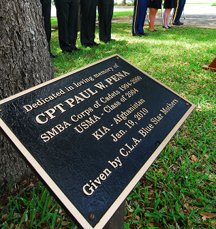
San Marcos Baptist Academy dedicated a tree to Paul Pena, a 2000 graduate of the academy. Pena, a U.S. Army captain was killed in action in Afghanistan earlier this year.

East Texas Baptist University’s Mayme Jarrett Library has acquired some of the works of journalist H.L. Mencken. The works were donated from the private collection of Joseph Goulden of Washington D.C. Goulden grew up in Marshall and is a former reporter for the Marshall News Messenger, Dallas Morn-ing News and Philadelphia Inquirer. The Mencken collection will be available for research in the library.

Howard Payne University has named Paul Dunne vice president for development. Other administrative promotions in-clude William Tew, to provost and chief academic officer; Brenda Pena, to senior vice president for finance and administration; Brad Johnson, to senior vice president for institutional ad-vancement; Brent Marsh, to vice president for student life and dean of students; and Stan Pena, to assistant vice president for facilities and planning.

Anniversaries

Paula DeBaugh, fifth, as children’s minister at First Church in Midlothian, July 3.

Joel Odom, 10th, as pastor of Oak Hills Church in Floresville, July 11.

New Hope Church in Mansfield, 125th, July 18. Michael Postell is pastor.

Alamo Heights Church in Port Lavaca, 50th, Sept. 9-12. On Thursday at 6:30 p.m., the Singing Men of South Texas will present a concert featuring Roger Helton. A fish fry and fellowship time will be held from 5 p.m to 9 p.m. Former pastors and staff are expected to attend. Two sessions of music and fellowship will be held Saturday. The first session will run from 10 a.m. until 2 p.m. and will include a noon meal of finger foods. The evening session will be from 5 p.m to 9 p.m. and include a catered meal. A meal also will follow the Sunday morning service. Former pastors expected to attend include Casey Dubose, Markus Goehlke, Miles Miers and Bynum Akins. Other former staff expected include Russ Clark, Adele Hamelwright, Roger Helton and Danny Dawdy. Timothy Smith is pastor.

Deaths

Don Harris, 78, July 7 in Fort Worth. A music minister and pastor, he was active in the police department’s Code Blue program as well as the Clergy and Police Alliance. He is survived by his wife of 59 years, Nell; son, Rick; daughter, Sheila; two granddaughters; and four great-granddaughters.

Beatrice Moody, 89, July 13 in Fort Worth. A retired registered nurse, she was a volunteer at Huguley Memorial Medical Center 22 years. A member of First Church in Everman, she was a Sunday school teacher. She also was active in the Tarrant Association disaster relief team for many years and the association’s Woman’s Missionary Union. She was preceded in death by her husband, Luther, and daughter, Wanda Whaley. She is survived by her sons, Leland, Bill, Dale and Bob; three grandsons; six great-grandchildren; and two great-great-grandchildren.

Event

First Church in Dripping Springs will hold a dedication service for its new facility Sept. 12. The church burned in 2007 and broke ground to build the new worship center last year. Craig Curry is pastor.

Revival

First Church, Cheek; Aug. 8-11; evangelists, Robbie and Lacy Hargrave; pastor, Travis Darsey.


Plainview church, family part of miracle for Kenyan

PLAINVIEW—Running always has been a way of life for Edward Taragon, since his earliest days in Kenya. Taragon knew if he were fast enough, he could run for an American college, earn a degree and make possible a better life for his family, who make their living growing potatoes and maize.

Edward Taragon competes in the 5000-meter run at the NAIA Indoor National Championships, held in Johnson City, Tenn. (PHOTO/Wayland Baptist University)

But circumstances last year nearly sidelined Taragon from running track, at least at the collegiate level. But with help from a Plainview couple and their church, he’s been able to take it all in stride—literally.

It’s been a few years since Edward first set foot on United States soil, coming first to California to run track for a college there. During a routine physical there, doctors found a hole in Taragon’s heart, but no one instructed him to quit running.

“I thought I was 100 percent healthy,” Taragon said. “I ran regularly and usually felt fine.”

After a semester, though, the coach sent Taragon to Texas to run for Coach Brian Whitlock at Wayland Baptist University in January 2009. He’d begun training for the indoor track season, which was soon to begin when Wayland sent him for a physical. The news wasn’t good.

Doctors confirmed he did, indeed, have a hole in his heart, and if he continued to train at the same level, it might cause permanent damage.

For Taragon’s safety, Whitlock could not let him run and risk further heart damage or even death. And since his education was tied to his track scholarship, he had to find a way to pay the difference if he wanted to stay on at the university. The news was devastating to Taragon.

That’s when Wayland and Debbie Richardson stepped in.

“He called us just crying, saying they were going to send him home,” said Debbie. “So we came to get him and find out what happened.”

The Richardsons had known Edward only a few months. They met him when he began attending Colonial Baptist Church in Plainview with track teammate Bradley Sell and ended up in their college Sunday school class. Drawn to Taragon’s faithfulness and sweet spirit, the Richardsons bonded instantly with him, and he soon became part of their extended family.

“Everything is just so new to him. It has humbled us and our whole family,” Wayland Richardson said, noting his grown children and grandchildren even welcomed Taragon as an adopted brother of sorts. “We believe God brought him here to us because of the route he came to get here. Our mission field came to us.”

Edward Taragon (center) opens a shirt given to him by the Richardsons during a family Christmas at their Plainview home. (PHOTO/Wayland Baptist University)

Taragon and a few other Kenyan runners who came to Wayland became regular guests at the Richardson home and even accompanied them on short out-of-town trips. They enjoyed providing him with new experiences. Debbie Richardson cooked regularly for the students, and she let the young men cook traditional Kenyan meals for their family, involving them in holidays and family reunions.

When she received that tearful phone call from Taragon about the heart defect and the lost of a scholarship, she sprung into action. The family spoke to their church and raised the money to keep him in school for the semester, and they set out to discover what could be done for him medically.

They learned surgery was an option, and doctors said repairs typically were very successful. But as an international student, Taragon had no insurance to cover the expensive procedures. The hospital agreed to do the surgery if he could at least come up with the down payment; then payments could be made until the balance was paid.

When he called home to let his parents know of the situation, Taragon said they were befuddled by the $26,000 price tag on the surgery.

“They didn’t know what to do about it,” he said. “But their second reaction was to give everything to God, because they couldn’t do anything about it. They were so thankful about how people have treated me here, and they know I’m safe.”

Meanwhile, his “American parents” were putting feet to their own faith on his behalf.

“We sent e-mails asking for prayer, and we knew God would provide,” Debbie Richardson said. “We put some money in of our own, then challenged the church and the community to match the money for Edward’s surgery. We shared his story with everyone we knew, and a lot of people gave.”

Colonial Baptist Church rallied to his cause. Even the Richardsons’ grandchildren opted to save their allowances for four months and donated to Taragon’s medical fund. Soon, the down payment was raised and the two-hour, arthroscopic surgery was scheduled. A pre-op session with the pediatric cardiologist found the situation even more miraculous. “The cardiologist said it was a common pediatric problem but was usually repaired while a child was a few months old,” Debbie recalled. “He said Edward shouldn’t be alive, and he sure shouldn’t be running cross-country and breaking records.”

The Richardsons documented much of the visit, the surgery and recovery to send home to Taragon’s family, and they kept an unbroken prayer chain going for the months leading up to and after the procedure.

Kenyan track runners Hildon Boen (left) and Edward Taragon (right) and his “adopted” American parents, Wayland and Debbie Richardson, pose for a photo at Amarillo’s Cadillac Ranch while on a visit. The Richardsons have enjoyed introducing the Kenyans to the American and West Texas culture. (PHOTO/Wayland Baptist University)

Taragon admits he had plenty of anxiety himself. He worried that the surgery would have to be done open-heart, which might end his running career permanently and, by extension, his chance at an American education. He’d already settled on a major in mathematics with plans to pursue a career in structural engineering he can use to improve his home country. But peace soon prevailed.

“Prayer really helped me. At home, my source was God, and I came all the way here, so I knew he’d help me,” Taragon said. “The church helped give me the courage also by telling me everything was going to be OK.”

The Richardsons delivered Edward to the hospital in Lubbock for the procedure. If all went well, the doctor said he’d be out of surgery in two hours. Ninety minutes later, the doctor emerged with good news.

“He said it could not have gone more perfectly,” Debbie Richardson said.

Taragon’s family—his parents in Kenya, and his adopted family in Plainview and his church family—were elated at the success of the procedure and the prognosis of the doctor that with some recovery time, he would likely be running again.

Getting back to full speed would take a while for him, though, even with his otherwise healthy state. For the first few months, he had to take it easy. Then in November, the doctor cleared Taragon to begin jogging no more than 20 minutes at a time. The Richardsons bought him a bicycle to get some exercise without the great exertion of running and work his way back to full strength.

In December, the doctor released him to run competitively again, noting that his EKGs were normal and by all accounts, the surgery had been successful. Taragon immediately began training, hoping to secure a spot back on the Wayland track team and prove to the coaches he truly was an asset.

In his first race, Jan. 23 at Texas Tech, he placed first in the 5,000-meter run with a time of 15:14.72, qualifying him for the national meet. Then on Feb. 6 at the next meet, he placed second, beating his own time by four seconds. He placed No. 17 at the nationals preliminary race for the 5000-meter.

With more time to train, Taragon qualified for the outdoor nationals meet as well, in the 5,000-meter run as well as the 10,000 and the 3,000. He planned to stay with the 5,000-meter race for the outdoor meet, which began May 27 and wrapped up just three days before his 25th birthday.

However, Taragon ran the 3,000-meter steeplechase event—one he never ran before the conference championships a month ago—and won the preliminary heat, advancing to the finals.

While Taragon was getting back to normal on his running schedule and training for the Wayland track team, the Richardsons continued faithfully making payments to the hospital for his surgical procedure. Then one day, Taragon arrived at their house with an odd letter from a collection agency, and the couple set out to investigate the situation.

“I called … to check on the account, and they could not find the records right off, so she said she’d have to look into it,” Debbie Richardson recalled. “I called back the next day and the lady had dug everything up and said that someone had paid the entire hospital bill, about $20,000. I just burst out crying.”

The hospital couldn’t tell them who the anonymous benefactor had been, but save for the anesthesiologist bill, the majority of the surgery has been paid. Debbie said she kept the news to herself for a few days but finally couldn’t stand it.

“We told … (Taragon) at church, and he couldn’t believe it,” Wayland Richardson said.

Taragon offered thanks to God for friends whose names he knew and those who remained unknown to him.

“I just couldn’t believe the love of people, especially for someone like me that didn’t know anyone here,” he said.

Colonial Baptist Church and the Plainview community helped with Taragon’s tuition. He hopes to qualify for a new track scholarship at Wayland, finish his education and return to Kenya to make a difference for others, paying forward the kindness he’s found here in America.

While Taragon definitely has been blessed by his association with Colonial Baptist Church, the Richardsons and his Wayland experience, the couple will be the first to say they’re the ones most enriched.

“We just love the young man. He makes my heart happy and my eyes water,” Wayland Richardson said. “It’s just too much God. He’s orchestrated all this.”

Debbie Richardson, whom Taragon calls “Mum,” concurs.

“I truly know without a doubt that he was placed here for us to help. In the process, he has blessed us so much,” she said. “Our lives will never be the same again, that’s for sure.”


DBU tennis teams share gospel in England

DALLAS—The Dallas Baptist University Men and Women’s Patriot tennis teams taught tennis lessons, volunteered in church-sponsored ministries and shared their faith during an international mission trip to the Tees Valley of northern England.

The Champions for Christ trip was the fourth trip in DBU’s Global Sports Mission Initiative, created to allow DBU student-athletes the opportunity to experience other cultures by living and serving abroad. In recent years, DBU has sent teams to Guatemala, Peru and South Korea on athletic-related mission trips.

The Patriot tennis players were divided into three groups, each assigned to a different church in the Tees Valley. The DBU student-athletes stayed in homes of church members where they had the opportunity to experience the English culture.

Dallas Baptist University tennis coach Jennifer Curran (2nd from left) and students (left to right) Lexi Yeado, a sophomore from Elk River, Minn.; Hannah Innes, a sophomore from Melbourne, Australia; and Richard Abel, a junior from Corsicana; lead a classroom activity in England. (PHOTO/ Courtesy DBU)

“Many of the student-athletes shared how they were humbled, challenged, encouraged and changed. They were stretched and forced out of their comfort zones as they faced opportunities to verbally share their faith, to pray out loud in a group and to give of themselves sacrificially. Several students had very real conversations with youth and adults about what it means to be saved, who Jesus is and how they can have a relationship with him,” said Christy Gandy, DBU assistant director of spiritual life.

“Some were burdened for the lost, convicted of their selfishness and moved to someday return to the people of England. It was a week of planting seeds. We were all challenged to return to America with a goal of being intentional in the way we live our lives and to seek out those who need the hope of Christ.”

Each day, the student-athletes worked with the local churches in their ministries and volunteered in schools, teaching tennis lessons and talking about their Christian faith.

They also spent time building relationships with the youth groups at each church. Those efforts included taking part in a community-wide all-night youth outreach and sharing their testimonies with children, youth and adults, as well as seeking to support and encourage the churches and community leaders.

Tennis clinics offered the teams many opportunities to share their athletic knowledge and prowess and—most importantly—their testimonies of God’s grace and love.

“Traveling to England to spread the word and news of Jesus was an honor and an eye-opening experience for all of us. Many of the youth (in England) have never been to church and have no idea who Jesus is and what he can do for each of their lives,” said Cathy Ray, DBU senior woman’s administrator.

Aside from their ministry efforts, the Patriots enjoyed Sunday morning worship various churches. One church met on the beach of the North Sea for a baptism service.

“What an amazing experience my teammates and I had to travel across the world and spread the word of God to others. Between teaching tennis in the schools, hanging out at the park and working with the youth in the church, I feel like the people of the Tees Valley were not the only ones who learned something. It was each of us,” senior Bronson Vaughan said.

Head Tennis Coach Jennifer Curran called the experience “an incredible opportunity” for the student-athletes.

“We had the chance to go into the public schools and present the story of the Good Samaritan. We would sing songs about being kind to your neighbor and loving God with all your heart, mind, soul and strength. With this simple story, we were able to discuss God’s love and tell them that he cares for each of them,” she said. “In our attempt to be a blessing to them, they blessed all of us so much. No one came home the same person.”


Columbaria bring members of church family home for final rest

DALLAS—Churches became disconnected from death in the last century, but some congregations are seeking to correct that problem.

Historically, cemeteries often were adjacent to the church, and the end of life was just as apparent as the living of it. But in the 20th century, particularly as people moved from rural areas to the cities and suburbs, cemeteries became far-removed from church grounds.

Pastor George Mason (center) leads the dedication service for the columbarium at Wilshire Baptist Church in Dallas.

In recent years, some congregations have sought to recapture the sense of the church as the final resting place of its members’ remains. But because land is expensive and in short supply, churches are turning to columbaria—places to inurn the remains of those who have died and had their bodies cremated. Niches are sold to hold urns containing the ashes.

The need seems to be increasing. According to the state Funeral Service Commission, Texas had more than 50,000 cremations in 2009, up from 38,000 only two years before.

Wilshire Baptist Church in Dallas dedicated its columbarium June 13. At the dedication, three urns of three members were placed in the resting places, including two Texas Baptist statesmen—Ed Laux, who served many years with the Baptist General Convention of Texas, and Phil Strickland, who was head of the Texas Christian Life Commission.

Wilshire is not the only Texas Baptist church with a columbarium. Woodland Baptist Church in San Antonio and Riverbend Church in Austin have inurnment facilities that pre-date Wilshire’s.

Most columbaria have distinctive features, unique to a specific congregation. Wilshire’s columbarium is a garden space that includes a water fountain, terrazzo path, landscaping and a prayer labyrinth. The circular labyrinth is an ancient tool for Christian prayer by which individuals walk the serpentine path as they pray.

Nearly 300 niches for inurnment are included in Wilshire’s columbarium, as well as a separate wall of remembrance where the names of those buried elsewhere may be inscribed.

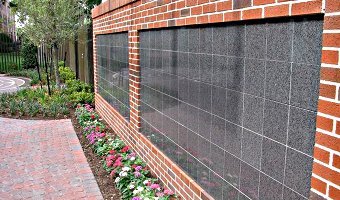
In addition to niches for the inurnment of the remains of church members, the columbarium at Wilshire Baptist Church in Dallas also features a wall of remembrance, where members who are interred elsewhere can be memorialized.

A large disc at the entrance to the columbarium bears an engraved quotation from Psalm 90: “Lord, you have been our dwelling place in all generations. … So teach us to number our days, that we may gain a heart of wisdom.”

At the dedication service, Pastor George Mason explained that the church is a natural place to help people think about both life and death. By walking among the remembrances of those who have gone before, believers today may be inspired to right living.

The price for a half-niche in Wilshire’s columbarium is $1,500, and a whole niche for two urns can be secured for $3,000—significantly less than the fees for traditional burials, Associate Pastor Mark Wingfield noted.

The columbarium at Woodland Baptist Church contains 60 niches and is situated near a place where children play and where foot traffic is somewhat heavy, said Mary Lynn Lewis, the head of the church’s columbarium ministry team.

Initially, she said, some people were afraid they would not want to walk by the columbarium, but in the two years since its dedication, that fear has faded.

“It’s been well accepted. Some people now walk by and say, ‘There’s our future home or our future apartment.’ And that’s the goal of this ministry for us—bringing our loved ones back to the church where they belong,” she said.

Niches in Woodland’s columbarium initially sold for $1,000, but that has price has increased to $1,500. More than half of the niches already either are filled or reserved, and the church soon will consider expanding the columbarium’s size. It was designed with expansion in mind.

The columbarium at Wilshire Baptist Church in Dallas includes a prayer labyrinth—an ancient tool for Christian prayer by which individuals walk the serpentine path as they pray.

Lewis, a hospital chaplain, noted she is glad to work on the team, because she has seen the need to deal well with the end of life.

Alan Wright, a hospice chaplain at Baylor Medical Center and a Wilshire member, reflected on the message of the columbarium in a recent blog posting.

“I am more proud than ever about being a member of Wilshire knowing that people within our church made the decision to include such a space,” he wrote.

“The church in general, especially the Baptist wing of it, needs more columbaria. I hope we’ve started a trend. We non-Catholics like our churches pristine, void of such reminders.

“I can confidently say from my experience as a chaplain in a hospital, the church has done a disservice to its people by too often choosing what is spiritually palpable over what we so need help spiritually digesting—that we are temporary. Facing this alone can be quite frightening. Together, however, this knowledge makes us stronger and more committed.”