Exegesis, narrative both necessary in preaching, Gregory says

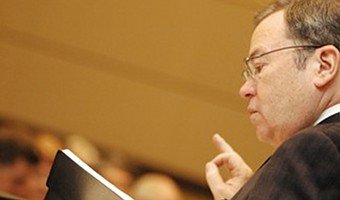
MCALLEN –As a part of a BGCT annual meeting workshop designed to help churches proclaim the words of Jesus Christ found in Acts 1:8, Joel Gregory, professor of preaching at Truett Seminary in Waco, demonstrated two ways in which this verse can be preached – the deductive method and the narrative method.

Gregory began with the deductive method. At the heart of any good sermon, he explained, is its ability to point to the large idea of the passage.

Joel Gregory

“How many times have you listened to the sermon and asked, ‘What is this about?’” he asked. “What you are looking for is a sense of unity.”

According to Gregory, the deductive method is the simplest way to make sure that unity is maintained. It is also the easiest way to ensure that the intended meaning of the author comes through in the sermon.

“We need to be about leading meaning out of the text instead of leading meaning into the text,” Gregory stated.

Therefore, good exegesis of the text is always necessary regardless of the method one chooses to deliver the sermon.

“If I bring any meaning and impose it on the text, then it is just that, an imposition,” he said.

While the deductive method of preaching is the easiest way to preserve the meaning and unity of the text, it has its weaknesses. First, the text of Scripture does not always come in neat packages that fit well within a three-point outline. Second, extreme deductive preaching tends to “bleed the story dry of its narrative.” Instead of capturing the excitement of a story, it whittles it down to succinct and sometimes boring points.

Third, deductive preaching is not people’s normal method of communicating with each other. According to Gregory, “We live in stories. You have your story. I have my story. We do not talk to each other in propositions; we talk in stories.”

The narrative method, therefore, best captures typical conversation and is sometimes a preferred means of hearing by congregations. Gregory listed out the various ways in which this narrative form can take shape. Some prefer to simple run the story of the text and “just tell it like it happened.”

Another method is the initial narrative, beginning with the biblical narrative and then going into the contemporary story. The postponed narrative flips this and begins with the story from today and then goes on to the story in Scripture.

A fourth approach, the intermittent narrative, interchanges two narratives, biblical and contemporary throughout the sermon. While each approach lends its benefits, Gregory demonstrated that through an intermittent narrative approach to Scripture, often the preacher can blend the best of the deductive and the best of the narrative.

Perhaps the biggest weakness of the narrative approach, Gregory suggested, is its reliance on the congregation to discover the main points themselves without having it told to them. In the narrative method, “I don’t really want you to know whether I said it or you thought it,” Gregory stated.

In this case, the sermon becomes provocative, but the unity of the sermon may be lost. “Some people have understood the narrative as a story—a text and that’s that,” Gregory admitted.

For himself, Gregory claimed to rely more on a deductive approach than narrative, but he suggested that each should study their congregations and determine what works best for them. For some it will be a sermon through a series of propositions, for others a story.


Texas Tidbits

Association affirms six-day creation. Messengers to the Sabine Valley Baptist Association annual meeting at First Baptist Church in Newton adopted a resolution affirming “belief in the biblical account of creation, emphasizing the biblically established fact that Jehovah Elohim created everything out of nothing in six 24-hour days; that he created the first man, Adam, out of dirt, and then created the first woman, Eve, out of man; and that death did not enter any part of creation until Adam and Eve sinned.” The resolution particularly took exception to a passage by “one of our supposedly conservative professors” at Southwestern Baptist Theological Seminary in The End of Christianity saying nature presents “strong evidence against” young-earth creation. It quotes in part a passage that states: “… once God breathes the breath of life into (man and woman), we may assume that the first humans experienced an amnesia of their former animal life.” The author of the book, William Dembski, is a philosophy professor at Southwestern Seminary and a senior fellow at the Discovery Institute’s Center for Science and Culture in Seattle, and he is a leading proponent of Intelligent Design.

Texas Bar Exam no hurdle for Baylor Law School students. For the 14th time since 2001, Baylor Law School students claimed the top pass rate on the Texas State Bar Exam with 94.64 percent success rate, the highest pass rate for students from the nine Texas law schools. Of the 112 Baylor students who took the three-day exam in July, 106 passed on their first try. The overall state pass rate was 86.37 percent, with 1,470 successful candidates out of 1,702 who took the exam for the first time.

Texas Baptist Missions Foundation presents awards. At an awards luncheon held in conjunction with the Baptist General Convention of Texas annual meeting, the Texas Baptist Missions Foundation honored three Christian leaders for their work in spreading the gospel in the Rio Grande Valley. Othal Brand Jr. of McAllen received the Adventurer Award for leadership in missions. Brand, a member of the executive council of Rio Grande Valley Baptist Association and supporter of the University of Texas-Pan American Baptist Student Ministries, serves as chairman of the board at the Valley Baptist Missions and Education Center. Jerry Johnson, who served more than 40 years as director of missions for Rio Grande Valley Baptist Association, received the Innovator Award for creativity in missions. Through his 10-week “Boot Camp,” he trained hundreds of student summer missionaries, many of whom would go on to full-time Christian service. Isaac Torres received the Pioneer Award for service in missions. For more than 40 years, he has taught countless evangelism seminars in English and Spanish, as well as working with River Ministry, Texas Baptist Men, Partnership Missions and Mission Service Corps.


On the Move

Ben Morris to Living Proof Church in Grandview as minister of music.

Brandon Watson to Greenbrier Church in Alvarado as minister of youth.


Around the State

Contemporary Christian artist duo Shane & Shane will perform at Howard Payne University Nov. 30 as a part of their “Glory in the Highest” Christmas tour. The concert is open to the public and will begin at 7 p.m. Tickets are $10. For more information, call (325) 649-8009.

High school seniors and college transfer students are invited to attend Shadow Day at East Texas Baptist University Dec. 2-3. The campus visit allows prospective students to spend the night in the dorm, socialize with students and visit with professors at breakfast and by attending classes. A $15 nonrefundable fee reserves registration for the event. For more information, call (800) 804-3828.

Registration is under way for the “May by the Bay” adult retreat May 9-12 at Texas Baptist Encampment in Palacios. Russell Dilday will be the camp preacher. In addition to the Bible study, prayer, singing and fellowship, a Western-themed banquet will be held. To request registration information, call (361) 972-2717. In order to request the limited motel accomodations, registration must be postmarked by Jan. 7. Other housing includes RV slots and dormitory-style rooms.

• The Baylor University Graduate School, in cooperation with the Baptist General Convention of Texas, has launched the Texas Baptist Universities (TBU) Scholars program, an initiative designed to recruit top graduate student applicants from Texas Baptist universities for Baylor’s Ph.D. programs. Kim Bodenhamer, Hardin-Simmons University; Jessi Hampton, East Texas Baptist University; and Chelsea Ruiz, University of Mary Hardin-Baylor, are the inaugural participants. The TBU Scholars program was created to increase the number of Baptist-educated doctoral students staying in Texas Baptist universities; connect Texas Baptist universities by partnering in graduate education; retain bright doctoral students in Texas Baptist universities as students and, subsequently, as faculty; increase loyalty and involvement of Ph.D. graduates with the BGCT and Texas Baptist universities; and stem the "dying of the light" by providing a continued education for bright students in a Baptist university committed to its religious identity.

Hardin-Simmons University will offer two new undergraduate degree programs next fall—public administration and nonprofit management.

Anniversaries

West End Church in Beaumont, 50th, Dec. 12. Frank Page, president of the Southern Baptist Convention Executive Committee, will be the featured speaker. A meal will follow the morning service. Jim Salles is pastor.

Death

Bootsie Griffin, 84, Sept. 23 in Kilgore. She and her husband, James, were appointed as missionaries in 1975 by the Home Mission Board. She worked as a preschool specialist in Mississippi, Louisiana, Arkansas, Kansas and Texas. In 1987, they moved to Kilgore, where they were active members of First Church. They continued their mission work as Mission Service Corps volunteers and assisting bivocational ministers. She was preceded in death by her husband; son, James; granddaughter, Rhonda Griffin; sister, Dean Faircloth; and brother, Warren Faircloth. She is survived by daughter, Judy Perkins; three grandchildren; and three great-grandchildren.

Events

Dorcas Wills Memorial Church in Trinity will hold a mission banquet and auction Nov. 20. Twenty-one missionaries who have served or are serving around the globe will be in attendance. Tickets for the banquet and auction are $15. A table for eight people can be secured for a tax deductable donation of $250 or more. Auction items include antique furniture, a football signed by Roger Staubach and many other items. The church is seeking to earn $44,000 from this event—the cost of keeping a missionary in foreign service for a year. Missionaries also will speak in Sunday school classes the next morning. For reservations and tickets, call (936) 594-3822. Jason Burden is pastor.

Dove Award nominee Miss Pattycake will be at The Heights Church in Richardson Dec. 2 for a “Happy Birthday Jesus” party featuring the The Heights Joyland and Child Development Center preschool children’s choirs. The one-hour concert will begin at 6:30 p.m. Admis-sion is one unwrapped toy ($20 value) or a $20 donation per family, benefitting the Three Trees Christmas benevolence ministry.


Americans will miss Awakening unless they acknowledge God as king

MCALLEN—According to reports from around the world, people are coming to faith in Christ at an amazing rate. For Jim Denison, this is proof that the Fifth Great Awakening is underway, but America could miss it.

Denison, theologian-in-residence at the Baptist General Convention of Texas and president of the Center for Informed Faith, believes the world is becoming more and more Christian on a daily basis.

Jim Denison

Jim Denison

Estimates peg the growth at 82,000 believers per day, which Denison said is the largest number in 20 centuries.  He noted movements in Australia and in Central and South America, where Pentecostal/charismatic movements are springing up regularly, as more proof. Cuba has seen 1 million new Christians over the past 10 years, and God is working among Muslims in great ways, particularly through dreams and visions of Jesus, he said.

While the movements are different in some aspects, one thing is constant in the swell of enthusiasm for the gospel, Denison noted—It’s not happening in the United States.

“God is on the march. The Holy Spirit is on the move. We’re in what I believe is the Fifth Great Awakening in the world, but we’re not seeing it here,” said Denison, addressing a workshop session held during the Baptist General Convention of Texas annual meeting in McAllen. The workshop addressed key elements of the great awakening occurring around the world and Denison’s view on how it came to be.

Denison believes the Fifth Great Awakening can be traced to South Korea in 1958, when the great devastation to the nation moved a pastor named Cho to start a church in a home. From that first gathering of seven, the church now has 1.2 million members, the largest evangelical church in history. South Korea now boasts five of the 10 largest churches in the world and sends more missionaries out than the United States. Denison noted a tailor in his Dallas neighborhood moved to the States to open her business and minister to customers through prayer, Bible verse cards and evangelism.

However, that awakening is not taking place in Western Europe and the United States. In Great Britain, for instance, four times as many Muslims go to mosque on Friday as Christians go to church on Sunday, Denison reported.

Only 23 percent of Americans are in church on Sundays, and the fastest growing religious demographic is the one that claims “no religion,” he said. The shift, he said, comes from the way Americans live.

“We live compartmentalized lives, with our spiritual life separate from our secular life. It’s like transactional religion; you do your part and God does his part,” he said. “Biblical Christianity is all in, 24/7.”

With the demographic shift in Texas, Denison said, churches have a unique opportunity to respond to a culture that embraces family, faith and connectedness if they will just do it. And while the spiritual state of America may look bleak, Denison said there is a solution.

“We most need to make God our king, not our hobby,” he said. “He is our king to the degree that your obeying his will. Wherever he is king, the awakening is happening.”

Kingship occurs when people first make Jesus their Lord and Savior, then admit that they need his power to accomplish anything, Denison said. When people submit to the Holy Spirit’s leading on a daily basis and keep in conversation with God, he truly is king of their lives, and they are able to live out the words of Acts 1:8, the theme verse for the convention.

“You will only make God your king when you realize you need a king,” Denison said. “We will never experience the Fifth Great Awakening in America until we pray, turn from our wicked ways and seek His face. When we do these things, we will … see the same things happening in South Korea, China, Africa and the rest of the world.”


Christians in 21st century can offer world a theology of hope

McALLEN—At least three things set apart as distinctive the theology of hope Christians in the 21st century can offer the world—a crucified Christ, a cross-bearing church and a radical love-ethic, said Ellis Orozco, pastor of First Baptist Church in Richardson.

Orozco led a Bible study at the Baptist General Convention of Texas annual meeting exploring the theological foundation for the Acts 1:8 call to bear witness of Christ locally, regionally and to farthest reaches of the globe.

Ellis Orozco

Ellis Orozco

Orozco noted the context for the Acts 1:8 mandate, pointing to Jesus’ original audience as “a society that knew nothing but domination by a foreign power,” the Roman Empire. In the rigidly stratified social structure of his day, Jesus worked primarily among the peasantry and the outcast handicapped and unclean whom the ruling elite considered expendable, he noted.

“Jesus’ whole life was given over to ministry to the poorest of the poor,” Orozco said.

While Judaism in the first century was far from unified in many respects, its varied strains held two things in common, he noted—a strong spirit of nationalism and messianic expectation, understood in terms of liberation from Roman oppression.

Rapid expansion of the gospel in the first century was made possible by the Roman Empire’s unified language, common philosophy and culture,  the Pax Romana that guaranteed law and order, and a system of highways created to expedite Roman commerce.

“God prepared the way centuries before Jesus for the proliferation of the gospel of hope,” Orozco said.

Similarly, 21st century globalization has created an environment for spreading the Christian message of hope, he added. English—particularly as translated through computer translation systems—provides a common language, and the Enlightenment philosophy that helped shape American democracy and free-market capitalism have spread around the world.

Unfortunately, Orozco noted, some aspects of the worst aspects of the American dream—selfish consumption and rampant materialism—also have been exported globally. “We’re exporting gluttony instead of Christ,” he said.

Instead of spreading a “health and wealth heresy” or a “sanitized Christianity,” Orozco said, Christians in America have the opportunity to offer a real gospel centered on a crucified Savior and lived out by a cross-bearing church.

That will occur when Christians take seriously Christ’s radical love-ethic, as expressed in the command to love enemies, he said.

“That radical love-ethic is not optional. It’s a required course,” Orozco said.

When Christians demonstrate genuine love, it draws people to Christ he said.

“Jesus gave us the greatest evangelistic strategy imaginable—love each other.”


Rodriguez steps down, Rincones picks up reins as Convencion president

MCALLEN—A day after being elected president of the Baptist General Convention of Texas, Victor Rodriguez relinquished his role as president of the Hispanic Baptist Convention of Texas.

Rodriguez, the first person to be elected president of both conventions the same year, said he wanted to make the move quickly so the Hispanic Baptist Convention will know they have a president who is fully committed to leading the body.

Rodriguez will continue supporting the convention and working with it, he said, but Jesse Rincones, pastor of Alliance Church in Lubbock and first vice president of the Hispanic convention, will become president.

Victor Rodriguez

Victor Rodriguez

“I think Jesse Rincones, for him to take the leadership will be a blessing for the convention,” Rodriguez said.

Rincones praised Rodriguez’s leadership through the Hispanic convention’s recent 100th anniversary and looks forward to continue building the organization’s ministry.

“I’d like to thank Brother Victor for his service and his leadership through the centennial celebration of Convencion,” Rincones said. “He set a higher bar for the next 100 years.”

Rodriguez, pastor of South San Filadelfia Baptist Church in San Antonio, believes contemporary Texas Baptists are living through historic time as they come together across ethnic lines. The future is bright for the Hispanic Baptist Convention and the BGCT, he insisted.

“This is the uniting and coming together as a whole family,” he said.

Rodriguez is the second Hispanic elected BGCT president. Albert Reyes, president of Buckner International, was the first Hispanic BGCT president.


Lowrie calls on Texas Baptists to pray and go to reach the state for Christ

McALLEN—In the face of poverty and hunger, as well as changing state demographics, Texas Baptists might be inclined to shrink in fear from the task at hand. But Baptist General Convention of Texas President David Lowrie urged messengers to Texas Baptists’ annual meeting to remain strong and courageous as they follow Jesus’ strategy to reach a hurting state.

Using the passage in Luke 10 in which Jesus sends out workers into the fields, Lowrie encouraged Baptists not to miss the key elements of the work in the harvest, specifically that while Jesus asked the workers to pray for additional help, he also urged them to go.

David Lowrie

David Lowrie, BGCT president

“Jesus gives us a practical expression of the strategy he might use to change our state and the world. The Lord appointed 72 others and sent them two by two ahead of him to every town and place where he was about to go,” said Lowrie, pastor of First Baptist Church in El Paso.

“People question the whole concept of cooperation, but from the very earliest days of the movement of Jesus, he taught cooperation. If anyone could have done it by himself, it would have been Jesus. But he intentionally appointed them and gave them a task.”

The key element was being sent, Lowrie said, a concept many churches have lost as they follow the “If you build it, they will come” concept from the baseball film Field of Dreams.

“I would dare you to find in the strategy of Jesus one that says ‘sit and wait.’ We have to take the hope to them, so Jesus sent them out,” he noted. “Are we sitting there waiting for the world to come to us, or are we going to take Jesus at his word and be sent?”

Those Jesus sent were not the saviors but the advance team, those sent to share the message that the kingdom of God was at hand, Lowrie said.

Christians serve the same purpose. But when Jesus shows up in a community, lives are changed. Jesus also shared a clear vision in the Luke 10 passage, Lowrie said.

“When the harvest comes in, it’s a time of action. There’s an urgency about it,” he said. “Some would see Texas through dark eyes, saying this is difficult time and place to be. But it could be that Texas is as ripe as it’s ever been for spiritual awakening.”

Those difficult times include a high childhood hunger rate—Texas is the top state in the U.S. in that category—and a No. 1 ranking in adults working at minimum wage. Contrasted with the No. 1 state in which to run a business and the No. 1 state in wind power, Texas also has the lowest rate of high school graduation.

But Moses’ admonition to Joshua to “be strong and courageous for the Lord God is with you wherever you go” can be good advice for Texans as they face the daunting task of reaching one of the nation’s most populous states, Lowrie said. The key, he said, is for churches to cooperate, trust God fully and overcome obvious threats to both issues.

“We cannot let kingdom cooperation die on our watch. I don’t care what we call it; we have to keep doing it. We have to keep working together and stretching ourselves,” Lowrie said, noting that relational and financial issues threaten that cooperation often. “We have to lead with trust in the Lord and with each other. We have to lay aside preconceived notions about people and realize we have the same passions. It’s the enemy who draws these lines.

“The economy has been bad, and it’s often hard (for churches) to make ends meet. When money gets tight, (we are tempted to ask) do we keep the money at home to keep the lights on or continue to give to the convention to ministries. But what we do as a church teaches our people what we believe about God.”

Churches are tempted to forego support for convention entities and mission-sending agencies to fund their own hands-on ministry work, but he encouraged them to consider those two as not mutually exclusive.  Instead, churches should be involved in both efforts and trust God to provide and bless as they obey his commands to go.

Jesus “asks them to ask for more workers, but then go. Don’t wait for the reinforcements to come, just go and trust me,” he said. “Are we going to try and strategize or come to the place where we say, ‘We’re gonna go’ and say, ‘We believe you’re going to meet our needs.’ Let’s put our faith in Jesus and trust him. Could it be that Jesus is saying to all of us to be strong and courageous, because the Lord your God goes before you into the land?”


Executive director urges Texas Baptists to spread hope

McALLEN—Baptist General Convention of Texas Executive Director Randel Everett put a face on the convention’s new Hope 1:8 initiative in his address during the annual meeting in McAllen, encouraging churches to change their thinking in order to reach a changing state.

Everett introduced Keron Jackson, who described how he had been without family and homeless, eventually ending up in East Texas, living in his car. A friend told him about Panola Junior College, but he had little interest in school. Once he learned the school had a cafeteria, his interest grew.

Randel Everett

Randel Everett

Then he found a couple of friends—one who let him move into his home until the dorms opened and the other who gave him a job mowing lawns and invited him to attend Central Baptist Church in Carthage.

“I had blamed God for everything in my life, for losing my parents, for being abused. I did not want to have anything to do with God,” he said.
“I was adopted by Sunday school class 23 as a ‘project,’ and I went from having no family to having these 20 sets of people caring about me. These people began to make up the face of Jesus for me.”

Once Jackson began attending the church and reading the Bible, he said, he realized salvation in Christ was key, and his life was changed.

“The problems we face are not bigger than the God we serve. Even when I hated God, he still had a plan for my life,” he said.

Jackson’s situation was not as rare as it may seem, Everett said.

“Not all of us have been like Keron and have been homeless, not all of us have lost their family; not all of us have had a friend murdered,” he said. “But all of us had to be rescued by the power of the Holy Spirit. All of us live hopeless, destructive lives unless God rescues us through the hope of Christ. It’s through God’s church that this word of hope is going to be announced.”

Through the most recent BGCT emphasis, Texas Hope 2010, Texas Baptists succeeded in spreading the gospel to many in the state, but much work remains, he said. Everett introduced the Hope 1:8 emphasis, based on the passage in Acts 1:8: “And you will receive power when the Holy Spirit comes on you, and you will be my witnesses in Jerusalem, in Judea, in Samaria and to the ends of the earth.”

Every believer and congregation has to determine what his or her “Judea” and “Samaria” is, whether a geographic area or affinity groups, Everett said. Texas Baptist churches should consider the makeup of Texas now compared to what it is projected to look like in 2018.

Looking at the Acts 1:8 imperative and the prospects of a more secular Texas in 2018  will shape what the state’s Baptist churches and institutions look like to a large degree as they attempt to respond, Everett said.

Massive population growth and demographic shifts lead to the logical conclusion that more churches are needed, but Everett said the cost involved in building facilities and other resources is simply out of reach. Instead, he suggested, looking at new mission models.

“Our state is increasingly becoming more secular and isolated and ignorant of the hope that is within all of us,” Everett said, noting that the church plants would have to multiply four-fold just to keep up with population growth from 10 years ago.

“Are there other models where one building might house multiple congregations, worshipping in multiple languages and multiple styles? Could our institutions be housing churches? Who are we training that can be leaders and pastors? If we’re going to reach Texans for Christ, we’re going to need a new paradigm.”

Part of that paradigm shift needs to include a close examination of where churches are spending their dollars, Everett said, given the struggle currently felt to support the Baptist missionaries around the world. Partnering with Baptists around the world, mission-sending agencies and international seminaries that are training local believers is another area Everett encouraged churches to consider. But individuals also must accept responsibility.

“It will take us all to realize that we’re all called to missions,” he said. “What if you trained your workforce to be missionaries for Christ so that as they are scattered around the world doing your work, they also go to share the hope of Christ? What if when you shipped our materials, you included a place for medical supplies to the world in need?

“It wasn’t preachers that were scattered around the world in Acts 1:8. It was everyday people who went out wherever they were sharing about Christ. Churches are talking about how hard it is in an evil world and tragic economic times and how difficult it is to live for Jesus in a pagan world. But we need to stand strong. … It will take all of us.”


God works in middle of change, McAllen pastor tells rally

MCALLEN – On the eve of the first Baptist General Convention of Texas annual meeting in the Rio Grande Valley, Texas Baptists gathered to worship, celebrating where God has moved in the past and looking toward the future.

Preaching during the rally, Julio Guarneri told participants the world is changing. Change of any sort makes people uncomfortable, and individuals struggle with how to respond to what is going on around them.

Praise was part of the Hispanic and African-American rally that preceded the BGCT annual meeting in McAllen.

Guarneri, pastor of Calvary Baptist Church in McAllen reminded Texas Baptists that God is moving in the midst of change. God is changing hearts and lives, revolutionizing families and communities, he said.

"He is a God of new things,” Guarneri said. “He specializes in that.”

Change is constant, and so is God’s activity in the middle of it, Guarneri said. Both have existed throughout human history, he noted. God showed himself in dramatic ways—using a burning bush, delivering the Israelites from bondage in Egypt and revealing himself most fully through the life and actions of Christ.

And 100 years ago, Guarneri said, God brought together a small group of Hispanic Texas Baptists to form the Hispanic Baptist Convention of Texas to cooperate in missions and ministry. Decades later, the Hispanic Baptist convention signed a unification agreement with the Baptist General Convention of Texas. This year, both conventions reworked that agreement.

God “is the God that led (Hispanic Texas Baptists) to plant churches, to organize their work,” he said. “That led to us.”

Guarneri pondered what God is doing in the midst of change now. Missiologists have noted Christianity is booming in the Southern Hemisphere, where Christian groups are expanding by leaps and bounds. More than 400 South American groups sent more than 10,000 missionaries around the globe last year.

“This is a new world,” Guarneri said. “God is doing a new thing.”

Hispanic Texas Baptists can learn from Latinos in the Southern Hemisphere, Guarneri said. God is calling his people to share the gospel. Texas Baptists may find new ways of doing that from South American Latinos.

To learn from what God is doing in the Southern Hemisphere, Hispanic Texas Baptists first must be willing to open their hearts to God’s work and calling. That action can change the way people think and act, seeking to share the hope of Christ.

“If we expect God to do new things, it must start in our hearts,” he said.


TBM celebrates God’s activity in Rio Grande Valley

MCALLEN—Texas Baptist Men gathered at Calvary Baptist Church to celebrate the activity of God—work being done around the world in Christ’s name.

The group particularly focused on missions and ministry in the Rio Grande Valley, as McAllen played host to the Baptist General Convention of Texas annual meeting.

Leo Smith

Texas Baptist Men Executive Director Leo Smith reports on missions progress to the TBM rally in McAllen. (PHOTO/Eric Guel)

TBM President Al Wise of Woods Chapel Baptist Church in Arlington spoke about the purpose of the rally, noting the passages from Christ,” First Corinthians about the body of Christ.

“We are one; we’re not several,” Wise said. “When we gather here today, there’s no distinction. We have different backgrounds, and some of us speak different languages, but we have one common thing. We are part of the body of Christ.”

The program featured reports from individuals involved in TBM ministries around the Valley, including Joacim Ramos, who leads TBM efforts for Rio Grande Valley Baptist Association that encompasses four counties. Ramos noted monthly meetings have included about 100 men gathering for fellowship, discipleship and encouragement. Men’s lives are being changed, he reported.

“We know that whatever we do is not going to be in vain,” Ramos said.

Mike Tello, regional TBM director and a member of First Baptist Church in Weslaco, spoke about the Royal Ambassadors work in the region. The first camp for boys in the Valley was held four years ago, fulfilling a longtime dream for Tello, and more than 50 came to faith in Christ. This year’s camp drew hundreds who participated in skills classes, praise and worship, Bible study and missions testimonies.

Tello also noted the annual men’s retreat in Menard, which 320 men and boys attended for training in leadership for Royal Ambassadors. He encouraged the growth of this area.

“The door to Texas Baptist Men is through Royal Ambassadors,” he said. “We need men who will take the bull by the horns, be available and be willing to be trained.”

Domingo Quintanilla of Mission spoke about international missions experiences, particularly a longtime partnership he has enjoyed in Peru, serving as a translator for medical missions teams that treat residents of the mountain regions. He has been to the country eight times in the past decade and has seen hundreds make decisions for Christ. He has also traveled to Mexico on missions endeavors many times since 1984.

The rally also featured a brief testimony from Leo Endel, executive director of the Minnesota-Wisconsin Association, who brought thanks for TBM’s continued work in their region. TBM teams have led church renewal weekends in Wisconsin for the past two years, with many congregations experiencing growth and revival.

“These events have jumpstarted the enthusiasm in our churches,” he said. “They’re beginning to see God work in amazing ways. You played a part in helping them see God’s work in their midst.”

Mickey Lenamon, resource development director for TBM, closed out the program by encouraging participation in “Count Me in for 2010,” an emphasis aimed at involving 5,000 families to partner with TBM.

Currently at about 80 percent to its goal, Texas Baptist Men is seeking help in three areas—prayer for volunteers and staff; participation in one of 18 ministries; and partnership financially in terms of monthly support for the ministry.


Texas Baptists reject call to allow non-Baptists on HBU board

MCALLEN—Messengers to opening business session of the Baptist General Convention of Texas annual meeting rejected a proposal that would have allowed Houston Baptist University to elect non-Baptist trustees, and they approved — with two amendments from the floor — a massive overhaul of Texas Baptists’ annual meeting.

Messengers on Nov. 8 turned aside a BGCT Executive Board recommendation that the state convention revise its agreement with Houston Baptist University, allowing HBU to elect a minority of non-Baptist Christian trustees.

HBU Vote

Messengers on Nov. 8 turned aside a BGCT Executive Board recommendation that the state convention revise its agreement with Houston Baptist University.

HBU has related to the convention by special agreement since 2001. That agreement allows HBU to elect 75 percent of its own trustees, with the BGCT electing the remaining 25 percent. All trustees HBU elects must be Baptist but not necessarily from BGCT-affiliated churches.

The revised agreement would have allowed up to one third of the trustees elected by the university — one-fourth of the total board — to be non-Baptist Christians.

Ed Seay, chair of the trustee board and pastor of First Baptist Church in Magnolia, noted HBU is the only evangelical university in the Houston—soon to be the nation’s third-largest city. Seay emphasized the diverse population of Houston and the need to reach out to evangelical Christians in the city by providing them a minority voice on the school’s governing board.

Clyde Glazener, pastor of Gambrell Street Baptist Church in Fort Worth and a BGCT past president, expressed concern that denominations historically have lost institutions after they allowed similar moves.

“They never take the step without eventually losing” the school, he said. “It’s like a flat roof. It’s not a question of if it’s going to leak. It’s a question of when.”

Bob Fowler, a messenger from South Main Baptist Church in Houston and a past chair of the BGCT Executive Board, characterized the recommended change as “well-reasoned and appropriate.”

He emphasized the need for HBU to be able to relate effectively to other evangelical Christians, and he expressed appreciation for the way the school’s trustees came to the BGCT “with no demands, only a request” that non-Baptists be allowed a presence on the board.

But another past chair of the Executive Board, John Petty, pastor of Trinity Baptist Church in Kerrville, expressed his concern that allowing non-Baptists to serve on Baptist institutional boards is a “slippery slope” toward a diminished commitment to Baptist identity.

Pointing to the size of Union Baptist Association — larger than some state Baptist conventions — he said he found it hard to believe HBU could not find enough well-informed, engaged Baptists to serve on its board.

Seay insisted the university remains committed to its Baptist identity. The motion will “in no way diffuse our Baptist identity or direction,” he said.

But Andy Pittman, pastor of First Baptist Church in Lufkin, voiced concern that having non-Baptists on the board would “allow non-Baptists to set the agenda … hurting the future of Texas Baptists.”

Stacy Conner, pastor of First Baptist Church in Muleshoe, asked whether the revised agreement would allow non-Baptists to serve as officers on the trustee board.

Seay said the agreement included no restriction prohibiting it, but he deemed it unlikely.

However, Conner said, if non-Baptists eventually could rise to a position of leadership as officers on the board, their influence no longer could be considered a minority presence.

In other business, messengers approved an extreme makeover of the BGCT annual meeting focus and format — but not quite as extreme as a study committee recommended.

Kyle Henderson, pastor of First Baptist Church in Athens, chaired the committee appointed to study ways to increase participation at the annual event. He compared the annual meeting to a Thanksgiving family dinner that fewer and fewer people were participating in each year.

“Look around. There are a lot of empty seats around the family table,” he said, noting only 8.5 of the churches eligible to send messengers to the annual meeting attended the McAllen gathering. At mid-afternoon on the opening day, only 754 messengers had registered, along with 775 visitors.

The study committee recommended two measurable goals focused on the number of churches participating in the annual meeting rather than the number of people in attendance—double the percentage of participating churches by 2013 and involve every Texas Baptist church at least once every five years.

Key recommendations included:

• Showcase one area of ministry each year. Focus on a different theme annually, rotating between five key areas—evangelism/missions, education/discipleship, advocacy/care, Baptist identity and Baptist community. Every fifth year, schedule “The Gathering”—a three-day summer event that would bring together Texas Baptist ethnic groups and interest groups. The committee also recommended a multi-site event in 2017 using video simulcast technology, involving as many Texas Baptist institutions as possible.

• Plan beyond the current year. Coordinate and plan the annual meeting starting 18 months in advance of the event to secure speakers, gather resources, facilitate institutional cooperation and build momentum.

• Adopt a planning matrix with a clear purpose statement and values. The committee expressed its belief the purpose of the annual meeting should be “mobilizing, encouraging, informing and uniting Texas Baptists to accomplish the Great Commission.”

Several of the value statements — lengthen the meeting to three days, include a service project and schedule plenty of time for fellowship —sparked little discussion.

However, messengers rejected two proposals included in the list of values, turning aside proposals to limit business discussion to targeted breakout sessions and eliminating resolutions.

Steve Wells, pastor of South Main Baptist Church in Houston, characterized the recommendation about moving business discussions to breakout sessions and having votes without discussion in general sessions as “a bad plan,” and he made a motion amending the committee’s recommendations by removing that proposal. After extended discussion, the amendment passed.

Ken Coffee, a messenger from First Baptist Church in San Antonio, also made a motion amending the committee’s recommendation by removing the proposal that would have done away with resolutions.

Coffee noted resolutions provide a way for the BGCT to go on record regarding important issues — a tool that proves helpful when critics accuse the convention of not taking a stand on those matters.

He also voiced concern some would characterize elimination of resolutions as “one more way to keep people from voicing opinions.” After discussion, the amendment passed.

With those two issues out of the way, the committee’s proposal passed overwhelmingly.

In other business, messengers:

• Elected Victor Rodriguez, pastor of South San Filadelfia in San Antonio as president; Jerry Carlisle, pastor of First Baptist Church in Plano, as first vice president; and Sylvia DeLoach, veteran missions leader and member of First Baptist Church in Richardson, as second vice president.

• Approved a revised unification agreement with the Hispanic Baptist Convention of Texas.

• Granted recognized status to the Vietnamese Baptist Fellowship.

• Approved recommendations from a committee on border violence. They included a day of prayer and other prayer initiatives, retreats for Mexican pastors and spouses to offer them encouragement, and a partnership with the group No Mas Violencia that sponsors programs for schools, churches, civic officials and law enforcement.

John Hall of Texas Baptist Communications contributed to this article.