Around the State

East Texas Baptist University will hold Tiger Day, a free preview event, March 5. Participants will tour the campus, meet faculty and current students, receive admissions and financial aid information, and visit academic departments. Lunch is provided. For more information or to register, call (800) 804-3828.

A free lunch and program honoring retired Baptist ministers, missionaries, church and denominational workers, and seminary professors, as well as their spouses, will be held at Dallas Baptist University March 18 at 10 a.m. A worship program will begin the day, with Darold Morgan, Bill Pinson, Charles Wade and Presnall Wood participating. A complimentary lunch will follow. After the luncheon, affinity groups of retirees will have time to fellowship. Hosts for these reunions will be Wayne Allen, Jan Daehnert, Hubert Martin, Joe Mosley, Alva Parks, Herb Pedersen and Bernie Spooner. For more information, call (214) 333-5130.

• The Texas Port Ministry will hold a fund-raising banquet March 25 at River Place in Freeport. Tables of eight are available for $200. Individual tickets are $30. The Texas Port Ministry shares the gospel with seamen from around the world when they dock in Texas. For more information, call (979) 233-5641.

Marcus Wood, women’s soccer coach at Hardin-Simmons University, was named Division III coach of the year by the National Soccer Coaches Associa-tion of America. Wood led the Cowgirls to the NCAA Division III title with a 24-0-1 record.

• The Baylor Alumni Association has named five Baylor University graduates as recipients of the Distinguished Alumni Award. Gerald Cobb, Timothy Hale, Michael Johnson, Patricia Mathes and David Rubenstein received their awards at the 2011 Hall of Fame banquet Jan. 21. The association also presented awards in nine other categories: Families of Baylor Award—the Abney Family, which includes five generations of alumni and students; Herbert H. Reynolds Outstanding Young Alumni Award—Brian Clark, Kristen Cox, Chase Palmer and Sophia Young; Price Daniel Distin-guished Public Service Award—Marvin Watson; George W. Truett Distinguished Church Service Award—Marv Knox and Randall O’Brien; Abner V. McCall Humanitarian Award—Calvin McKaig; Abner V. McCall Religious Liberty Award—Derek Davis; Herbert H. Reynolds Retired Faculty and Administrat-ors Awards—Carolyn Backus, Norman Gilchrest, Stanley Campbell and Tom Newsom; W.R. White Meritorious Service Award—Carroll Dawson, Calvin Smith, and Bob and Anna Smith Wright; and Alumni Legacies Scholarship recipients—John Dickson Jr., Samuel Davidson, Chase Fickling, Allison Jones, Bill Kroll, Kathryn Morrill and Rachel Wells.

Whit Goodwin has been appointed director of student life at Houston Baptist University. He had been director of the scholars’ program at Samford University.

Anniversaries

Ken Wells, 30th, as pastor of Northview Church in Lewisville, Feb. 13.

Lowell Addy, 15th, as minister of business administration at First Church in Wichita Falls, Feb. 25.

Jerry Davis, 15th, as pastor of First Church in Collinsville, March 15.

First Church in Waxahachie, 150th, March 17. A number of activities are planned throughout the month. On March 6, former pastor Bill Austin will preach in the morning worship service, followed by a barbecue lunch. Cost is $5, and reservations are required. Team Impact will present assemblies in schools March 9-13, and revival services will be held at the church each evening at 6 p.m. Ana Rodriguez, Miss Texas, will speak in the morning worship service March 20. That afternoon, a granite water sculpture by Jesus Moroles will be dedicated. Carol Farrar will be the musical guest March 27, and State Representative Jim Pitts will deliver a state proclamation. David Hardage is interim pastor.

Retiring

Jim Curtis, after five years as minister of music at Crossway Church in Abilene, Dec. 31. He is available for supply work at (325) 676-9222.

Tom Boggus, after 24 years as music minister at Calvary Church in Bryan, Jan. 30.

Death

Bill Agee, 80, Jan. 24 in Waco. After his two initial pastorates in Arkansas, he was pastor at First Church in Whitehouse, Pine Springs Church in Tyler, Meadow Brook Church in Rockdale, Emmanuel Church in Waco, First Church in Bremond, First Church in Hearne and Calvary Church in Tyler. After retirement, he served numerous churches in Central Texas as interim pastor over a period of 14 years. He was a member of Columbus Avenue Church in Waco. He served on Baylor University’s board of trustees and also on the board of Hillcrest Baptist Hospital in Waco. He is survived by his wife of 59 years, Pat; son, William Jr.; daughters, Gaylen Tenberg and Carolyn Chamness; nine children; and nine great-grandchildren.

Event

Shiloh will present a concert at First Church in Granbury Feb. 27 at 5 p.m.

Licensed

Mark Camarillo to the ministry at First Church in Pleasanton.

Revival

International Church, Abilene; Feb. 17-20; evangelists, Daiqing Yuan, Yutaka Takarada, Ernest Dagohoy and Jerry Clower; pastor, Myung Kyo Lee.


Children at Heart president announces retirement date

ROUND ROCK—Jerry Bradley, president of Children at Heart Ministries, has announced his retirement effective Dec. 31, capping a 40-year career in Baptist child care.

Bradley, who came to Round Rock in 1990 to become executive director of the Texas Baptist Children’s Home, today heads a ministry that also includes Gracewood in Houston, Miracle Farm in Brenham and STARRY in Round Rock.

Jerry Bradley

“Over half of my career has been spent serving in our ministries,” he said in a statement to employees. “Those have been wonderful years, and it is now time for a leader with new vision and greater vigor.”

The Children at Heart Ministries board of trustees will appoint a search committee to find a successor. Succession planning has been under way for several years.

Bradley began at Texas Baptist Children’s Home on June 1, 1990, moving from a position as director of child care for Oklahoma Baptists. He previously worked at institutional ministries in Kentucky and Florida.

A graduate of Oklahoma Baptist University with a degree in social work, he also holds master’s degrees in religious education from Southern Baptist Theological Seminary and in social work from Florida State University. He is an ordained minister.

In 1990, the entity that would become Children at Heart Ministries included Texas Baptist Children’s Home and Miracle Farm, with assets of just over $9 million, an endowment of about $6.7 million, an annual budget of $2 million and about 2,400 clients.

Today, with a $10 million budget, assets of more than $100 million and an endowment of nearly $80 million, the ministries serve more than 6,000 children, mothers and families each year.

New ministries added under Bradley’s leadership included Gracewood’s ministry to single mothers and children in Houston and STARRY, which provides an emergency shelter and foster care in Williamson County and counseling in Round Rock, Waco and Temple. In addition, existing programs, such as family care at Texas Baptist Children’s Home for single mothers and their children, expanded greatly.

He also oversaw a restructuring in 2006 in which all four ministries became part of the family of Children at Heart Ministries.

“Critical decisions led to the creation of new corporations and the structure of a family of ministries that exist to honor God and build a better world by serving children and strengthening families,” he said.

“It has not always been easy, but it has been done with a sense of stewardship and forward thinking. It leaves a structure that can continue to grow and meet the needs of Texas families.”

Bradley determined the time had come for new leadership at Children at Heart Ministries.

“All organizations have a life cycle, and the only way to keep them viable is through vitality and vision under God’s direction. I have come to the point in life when I know that it is time for new leadership to be at the helm of this great ministry,” he said.

“My successor will find a dedicated staff, supportive trustees, beneficial resources, new challenges and a firm foundation upon which to build a new administration.”


Leaders offer helpful tips for mission trips along the border

Leaders of mission work along the Texas-Mexico border shared several helpful hints for volunteers who feel called to share the hope of Christ in the region through mission trips

Work on the Texas side of the border. Although drug cartel violence has not ravaged the entire Mexico side of the border, organizations continue urging mission teams to work along the Texas side of the border where the physical and spiritual needs remain great, and the region is safe.

Partner with trusted organizations. There are a multitude of churches and ministry organizations along the Texas border. Choosing an organization that is known and trusted like those supported by Texas Baptists’ Cooperative Program giving—Texas Baptists River Ministry, Buckner International and Valley Baptist Missions Education Center—helps church groups know they will be well taken care of and put in a position where they can have a long-lasting impact for God’s kingdom.

Listen to local leaders and organizers and do as they say. Local residents and ministries know the area better than visitors coming into it. While the Texas border remains safe, it is always important to remain in areas organized have already scouted. It not only does it keep teams safe, but also enables them to work together better and accomplish the task at hand.

Consider staying at a Christian retreat center. There are several retreat centers along the Texas border designed to host mission teams. Many of them—like Valley Baptist Missions Education Center—can help connect mission teams with projects, provide three full meals each day to each trip participant and allow space for teams to debrief at the end of the day—all at prices drastically lower than what it would cost to stay at a hotel and eat at restaurants. And the money spent at these retreat centers is invested back into ministry and mission efforts.

Expect God to work before a trip, during the trip and after it. Missions leaders believe people along the border are more open to the gospel than they typically are because of the violence on the other side of the border. Organizers encourage team members to prepare themselves through prayer and studying the Bible before the trip, during the trip and long after the trip finishes. God will change the lives of people mission volunteers encounter along the border, mission leaders said. Lives of volunteers also may be changed.


Church-starting opportunities great along the Rio Grande

LAREDO—When Mario Garcia surveys Laredo, he sees opportunities to help people living in destitute conditions, to provide a word of encouragement and most importantly to share the gospel with more than 185,000 area residents who attend no church.

As a River Ministry coordinator for Texas Baptists, Garcia seeks to respond to those opportunities. Fewer than two dozen Baptist churches serve an area of about 500,000 people. Although there are other evangelical churches in Laredo, the region’s spiritual needs remain drastically underserved, he noted.

“The need is so, so great,” Garcia said. “Just hearing 185,000 people go to no church, that’s unbelievable.”

Laredo’s situation is typical of Texas border towns, where the number of evangelical congregations cannot keep pace with the exploding population. Noe Trevino, Baptist General Convention of Texas church starter in the Rio Grande Valley, said Laredo and Brownsville each need at least 20 new congregations. Del Rio and Eagle Pass each need at least five more congregations. El Paso also needs a significant number of new churches.

Where congregations are being started along the border, they are growing, Trevino noted. Many of the 16 church starts facilitated by the BGCT in the past few years have ingrained themselves in their communities, building relationships, providing benevolence ministries and sharing the gospel.

“The church is thriving in colonias,” Trevino said. “Folks are really eager to come out and listen to the gospel and help one another. Many times, you’ll find these folks don’t go outside their colonia. They help those within the colonia. They’re practicing Acts 2, selling what they have to help their brethren.”

Garcia and Trevino face two primary obstacles head-on as they seek to connect congregations and associations to start churches—lack of churches willing to sponsor church starts and lack of church starters.

In Laredo, the association has two training groups that equip laypeople to become church starters, creating a force of indigenous, prepared people who feel called to start churches.

Working with the BGCT Missions Mobilization Team, Garcia equips people to start house churches. These house church starting efforts are unfunded and have proven effective in reaching people in the region, Garcia said. Laypeople are trained to start home Bible studies that can are meant to develop into churches.

To encourage churches to sponsor new congregations along the border, Texas Baptists have tapped into technology to allow churches in other parts of the state to help launch congregations. Through Web video conferencing and regular visits, churches and local associations can provide the required accountability of the convention’s church-starting process.

“If a church in Dallas or Houston or San Antonio wants to partner to start a church along the border, we can enter into that conversation,” said Paul Atkinson, who leads Texas Baptist’ church-starting efforts. “We’re looking for sponsor churches from all across the state.”

For more information about getting involved in starting a church or ministering along the border, call Texas Baptists at (888) 244-9400.


Border mission trips decline significantly in some areas

BROWNSVILLE—Violence between drug cartels in Mexican border towns has drastically cut into the number of mission trips in the area. And in some cases, it has led church groups—even those who have served in the area for years—to cancel trips to sites on the Texas side of the border as well.

Children participate in a home-based Kids Club sponsored by Laredo Border in Action. (PHOTOS/Courtesy of Mario Garcia)

The Baptist General Convention of Texas strongly is encouraging groups who want to serve along the Texas-Mexico border to minister on the Texas side of the Rio Grande, said Daniel Rangel, director of Texas Baptists’ River Ministry.

A few teams have chosen to serve in Mexico, and the BGCT n requires those who want to minister there to spend their evenings on the Texas side of the border if they want the convention’s assistance in facilitating the groups’ efforts, Rangel.

Despite the encouragement to serve in Texas, some areas in South Texas have seen a significant drop in the number of mission teams serving, and the overall number of mission teams through River Ministry has decreased since the Mexico border violence broke out.

In the past, River Ministry facilitated 50 El Paso mission teams in a typical year. Last year, it helped seven teams there. The number of trips working through the Rio Grande Valley Baptist Association has been cut in half to 25. However, in the past three years, the number of mission teams serving in Laredo through River Ministry has grown from zero to 40.

A family of seven lived in a shelter made from an old water tank until they moved into a new home, thanks in large part to the ministry of Laredo Border in Action. (PHOTOS/Courtesy of Mario Garcia)

As a result of the border violence, a number of Mexico-based ministry agencies have partnered with Buckner International, increasing the number of mission groups Buckner expects to facilitate in 2011, said Jorge Zapata, director of Buckner International’s colonias program.

Congregations are choosing not minister along the border as a result of the reports of violence in Mexico border towns, Rangel said. Although River Ministry, Buckner and Valley Baptist Missions Education Center have facilitated mission trips throughout the Texas side of the border without incident, some church members and leaders are hesitant to undertake mission work there.

Some churches try to put together teams, but find people aren’t willing to go to the border because of safety concerns, ministry leaders said. Some churches plan to do mission trips to the border, but volunteers to go on the trips never materialize.

Volunteers from Wainwright (Okla.) Baptist Church set up for a sports camp in the Laredo area. (PHOTOS/Courtesy of Mario Garcia)

“I think everybody has great intentions,” said Jamie Campbell, facilities manager at Valley Baptist Missions Education Center. “Their heart says we have served in the Valley or served along the border before, and they want to go again. They say let’s go ahead and plan like we’ve always done before. I think what’s happening is the mission teams aren’t stepping up.”

Many border mission teams traditionally have been made up of youth, and parents do not want to take a chance sending their children to the border. Texas border ministry leaders said they understand church members’ concerns, but they quickly note the Texas side of the border is at least as safe as any large Texas city—and probably more so. Texas Baptist ministries particularly are careful about the situations in which they place volunteers, attempting to place people where they can minister safely.

“As a parent, I understand the concern about sending your child down,” Campbell said. “What they have to realize is none of us would put your children in a situation where there is any danger. We simply wouldn’t do that. It wouldn’t be responsible.”

Churches that choose not to serve along the Texas-Mexico border are missing a significant opportunity to share the gospel, Rangel said. People on both sides of the border are searching for answers and looking for peace, he stressed.

“People are open to the gospel more so than other times,’ Rangel said. “It’s during crises that people are open to the gospel. Now is the time for evangelistic outreach. People are searching for security and comfort, and that is Jesus.”

Zapata agreed, noting the opportunities to building God’s kingdom along the border are vast and diverse, including chances for congregations to build homes, feed the hungry, conduct Vacation Bible Schools, hold backyard Bible clubs and perform medical and dental clinics. In some cases, churches serving in Texas can minister to people from Mexico.

“There are a lot of people who need Christ,” he said. “There are a lot of people who fled the Mexico side and are living with family on this side of the border. The need is great.”

For more information about mission opportunities along the Texas-Mexico border, call Rangel at (888) 244-9400. 


Church arsonists receive additional life sentences

ATHENS, Texas (ABP) — Two men already sentenced to life in prison for setting five east Texas churches on fire in 2010 pleaded guilty to more arsons Feb. 8.

Jason Bourque and Daniel McAllister were sentenced to life in prison for three church fires in Henderson County, Texas. Their plea agreements allow them to serve their sentences concurrently with previous life sentences imposed for five church arsons in neighboring Smith County Jan. 10.

The men, suspected of setting fire to 10 East Texas churches between Jan. 1 and Feb. 8 last year, still face charges for two church fires in Van Zandt County. They are scheduled to appear in court there Feb. 11 and are expected to enter similar pleas.

Bourque, 22, and McAllister, 20, were arrested Feb. 21 after a multi-force investigation involving state, local and federal officials.

No one was hurt in the fires. Their motive for the crimes is unknown.

Previous story:

Church arsonists get maximum penalty


Buckner Romania to be self-sustaining organization

TARGU MURES, Romania —Twelve years after it established a nongovernmental organization in Romania to help that country’s overburdened orphanage system, Buckner International announced it is withdrawing financial support from Fundatia Buckner Romania and setting it on a course of self-sustainability.

Phyllis Carrier, a long-term volunteer with Buckner, holds a baby in Tarneveni, Romania. The Carriers were among the volunteers who helped establish the Buckner Child Development Center in Tarneveni, Romania to help gypsy children. (PHOTO/Courtesy of Phyllis Carrier)

Buckner International President Albert L. Reyes said the transition is part of Buckner’s long-term plan for establishing self-sustainability among its international nongovernmental organizations as time, resources and support allow.

Buckner began work in Romania in 1996 after Romanian officials sought Buckner’s child care and social services expertise to help overcome mounting problems in the country’s orphanages. Buckner established Fundatia Buckner—Buckner Found-ation Romania—in 1998 and began offering mission teams to conduct evangelistic camps in orphanages in the Targu Mures region.

Phil Brinkmeyer, Buckner regional director for Guatemala, Honduras and Russia, said Buckner has provided a variety of ministries over its 12-year tenure in Romania. “We began initially by providing humanitarian aid directly to the remnants of a communist orphanage system—one that was, in essence, providing first aid to those in need but was putting a band-aid on a broken system.”

About 90 to 95 percent of children in Romania’s child welfare system are gypsy children, according to Buckner vice president Randy Daniels. The work of Buckner Romania has included education programs, foster care, humanitarian aid, and mission trips since 1996. (PHOTO/Russ Dilday/Buckner International)

Since 1998, Buckner has offered large-scale humanitarian aid, orphanage renovations and emergency relief to Romanian orphanages, developed a relationship with Child Protective Services in Targu Mures for emergency relief and aid coordination, a transitional living home for children who have aged out of care, sent hundreds of volunteers to minister to children and, along with CPS, initiated a domestic program to encourage Romanians to report child abuse.

Also, Buckner instituted an evangelistic follow-up program using Romanian staff to provide weekly visits to orphans, a “grandmother” program to provide infants with basic nurturing and a foster care program along with Pathway to Joy Ministry in Oradea.

Since 2000, Buckner’s Shoes for Orphan Souls drive has shipped almost 84,000 pairs of shoes to children in Romania

But Buckner’s contributions went beyond programs and aid, said Randy Daniels, Buckner vice president for global initiatives, and eventually led to changes in the country’s orphanage and social services systems, long regarded as among the poorest-performing in the world.

Phil Brinkmeyer, regional director for Buckner in Russia, Guatemala and Honduras, poses with children on the opening day of the new Buckner Child Development Center in Tarneveni in 2007. (PHOTO/Buckner)

Through its NGO, Buckner “modeled foster care at Pathway to Joy in Oradea and we helped Romania in its transition from an orphanage-based child care system to a foster care-based system by helping Romanian officials acknowledge the value of foster care,” Daniels said.

While Buckner has set its Romanian NGO on a course of self-sustainability, it won’t be alone, Brinkmeyer said.

Buckner will continue to share its expertise in social services, and the NGO will receive support from another U.S.-based nonprofit partner—Another Child Foundation, created by Tim Oloffson, a former Buckner missions volunteer, he explained.

For more information about Another Child Foundation, go to www.anotherchild.org.


Wayland students promote economic development in Kenya

KENYA – A year ago, sophomore Leigh Castillo didn’t know much about business— and certainly not about starting up a new business from scratch. Today, she’s president of Wayland Baptist University’s Students in Free Enterprise team that recently returned from Kenya, where they helped train small-business owners.

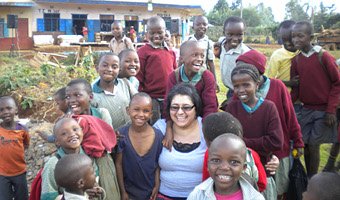
Students in Free Enterprise President Leigh Castillo (center), a sophomore English education major at Wayland Baptist University, is surrounded by happy Kenyan children during an evening crusade in Kiandu, outside Nyeri.

Castillo, a single mother who aspires to teach English in secondary schools, finds it all pretty overwhelming. But with the experiences she has received at Wayland—including the opportunity to travel to three continents in one year—she is convinced God is blessing her plans to pursue her educational goals.

Castillo considers the three-week trip to Kenya a chance to pass on those blessings and share important information with nationals who are seeking to sustain their families through small-business ventures.

Kelly Warren, associate professor of management at Wayland, traveled to Kenya last summer. While he was there, he met a Kenyan who wanted his countrymen to learn about business practices and sustainability—a task Warren believed the Student in Free Enterprise team could fufill. Since the university already had planned a January trip to Kenya through the Wayland Mission Center, it seemed a natural fit.

“We had to work quickly to get our fundraising together for the trip,” Castillo noted, adding Warren first approached the group at the start of the fall term. “Since we already knew each other, it didn’t take us long to work out how we’d work together, so that helped.”

The group first spent a few days at Wayland’s Kenya campus at Brackenhurst near Limuru, for orientation. Gilbert Werema, a Kenyan national and associate professor of marketing at Wayland, told the students what would benefit the businesspeople the most, and he also provided important cultural background information.

“We worked with church and community leaders there and taught basic business principles such as communication, choosing a microenterprise, planning and finances, marketing and recordkeeping,” said Castillo, noting that each team member handled a different aspect of the presentation.

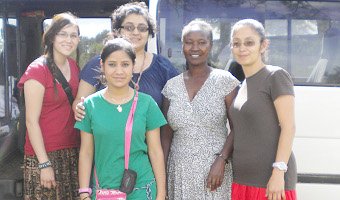
Wayland Students in Free Enterprise team members (left to right) Estella Rodriguez, Leigh Castillo, Maria Carrillo and Hopie DeLeon meet with Sarai, a Kenyan woman who hosted the group in her home outside Eldoret during a recent trip to present business seminars.

“The people there don’t have any formal business training. They just decide to grow something or create something. But they don’t know anything about recordkeeping or talking to suppliers or other considerations that would help them sustain themselves. Marketing was a big thing for them.”

The team then spent three days each in Nyeri and Eldoret before traveling to the larger city of Mumbasa for two days. The Nyeri seminars drew the largest crowd, with about 100 attending. Castillo said that area had a lot of agricultural businesses represented, as did Eldoret, and Mumbasa featured more retail businesses and landlords. About 50 people attended the seminar in Eldoret and another 25 in Mumbasa.

In addition to helping with the business seminars, Warren joined several Texas pastors in providing leadership training for area churches and held some pastors’ meetings. The Texas team also led an evangelistic crusade in the cities in the evenings.

On the third day, the business owners had a chance to question the student group and help with business plans. The seminar groups were divided by trade for the business plan segment since they shared many aspects.

The American students found the Kenyans quite receptive to the information shared, although Castillo admitted they were apprehensive about how helpful they would be and how the Kenyans would regard young students with business information.

“They really grasped a lot of the concepts we shared and understood what they needed to do to be sustainable,” she said. “On our last week as we were leaving, one of the tour guides shared that the people in Nyeri had another meeting to talk more about the information we left with them.”

Castillo noted that the needs of business owners in each Kenyan city varied, but they were able to address those needs in the short time they had there. In Nyeri, they needed unique marketable ideas so they didn’t have too much competition.

In Eldoret, business leaders needed help preventing overproduction that led to a lack of supply and demand.

And in Mumbasa, owners were troubled by credit issues with fellow businesses.

Even though the Wayland student group was not participating in a traditional mission trip, Castillo said, she believes the team was able to minister through practical advice that ultimately will build the economy in Kenya.

“My pastor talks about how the Lord wants to empower you to prosper, and if we were able to sow that seed into their lives and help empower them, that was good,” she said. “The Lord has given us all an idea and something to manage, and he wants us to manage it correctly so he can increase us more, whether with health, with more business or more friends. A lot of times we tied in the Bible with the concepts we were presenting as well.”

The Wayland students also organized a Students in Free Enterprise chapter in Brackenhurst, recruiting about 20 members. Those students started brainstorming ideas for projects they can do to better their own communities. One idea was a clean-up day to combat the trend of trash around the city; another involved literacy training to combat the high illiteracy rate in Kenya.

Castillo is encouraged by the efforts on all ends, especially as a big proponent of education. She joined the Students in Free Enterprise team last spring after being encouraged to bring her communications and presentation skills from her role on the Wayland Ethics Match team. She enjoyed the wide range of projects and was encouraged that she didn’t have to be a business major to join the group. Advisers told her the team likes to open itself to majors from other disciplines because they all bring unique talents and experiences to the group.

Castillo, an English education major, was grateful for the chance to visit Kenya, especially after being able to attend a mission trip and study trip to Ecuador last summer with the School of Education. She believes these overseas experiences will benefit her greatly as a future educator. Eventually she would like to pursue a master’s degree and a doctorate in English and wants to teach at the college level.

Seeing the determination, hard work and perseverance of the Kenyan business owners was encouraging to Castillo, who is a full-time student, part-time worker in the WBU business office and mother to Bella Jace Moreno, 9.

Castillo noted a Kenyan woman named Sarai, who was a self-taught entrepreneur, provided much encouragement and a good example for the students while hosting them in her home near Eldoret.


Researcher finds civil rights songs on flip side of gospel records

WACO—A surprisingly large number of lesser known “B” sides on vintage records of gospel songs championed civil rights, suggesting Christian artists were interested in bettering the here and now as well as proclaiming hope for the hereafter—even though doing so might have been risky for them, according to a Baylor University researcher.

Robert Darden, an associate professor of journalism at Baylor and a former gospel editor for Billboard magazine, has discovered the flip side of many class gospel records included civil rights songs. (PHOTO/Robert Rogers/Baylor University)

The recent discovery “tells us that the gospel community was much more involved in the civil rights movement than we previously thought—outside of Mahalia Jackson and Dorothy Love Coates, who we knew were very involved,” said Robert Darden, an associate professor of journalism at Baylor and a former gospel editor for Billboard magazine.

In 2005, Darden began a search-and-rescue mission for gospel music on old 78s, 45s and LPs and in various taped formats to be preserved digitally and cataloged at Baylor. Darden—author of People Get Ready! A New History of Black Gospel Music—was concerned that while contemporary gospel was thriving, early gospel by lesser-known artists during the 1940s to the 1970s, the “Golden Age of Gospel Music,” might be lost forever. He now oversees Baylor’s Black Gospel Music Restoration Project.

“The reason we haven’t known about the ‘B’ sides before is that more than third of what we’ve received is not in the lone book that tries to catalog all gospel music,” Darden said. “When we’ve known about a song, it is almost always the hit or ‘A’ side.”

The songs related to civil rights may have escaped notice because few scholars are studying gospel music’s impact on that issue, as well as the fact many of the artists are lesser known or even unknown, other than by a small circle of friends, family members and church members, he said.

The spirited “Where is Freedom?” by The Friendly Four begins with a rousing appeal: “Here’s a freedom song for all you freedom fighters out there everywhere. And when you sing, remember the wonderful ones who lost their dedicated lives for this precious purpose and won’t be allowed to see it through. Now sing—Sing, every one of you!”

{youtube}IX5BN9iMrmQ{/youtube}

The lyrics speak of civil rights marches and demonstrations in Atlanta, Tennessee, Birmingham and Chicago, of violence and snapping police dogs, of integration and equal rights.

The All-Star Gospel Singers recorded “I Believe Martin Luther King Made It Home.” And the somber “Tribute to Dr. Martin Luther King” by Franklin Fondel speaks of the civil rights leader whose “voice was his weapon that opened barred doors. … He’s free now forever, like all men should be, regardless of color, religion or creed.”

One of the well-known individuals who sang of civil rights was Della Reese, a gospel singer before she became a pop singer and star of TV’s “Touched by an Angel.” She sang “Simple Song of Freedom.”

–For more information about the project, visit www.baylor.edu/lib/gospel.


Executive director search committee begins work

DALLAS—The Baptist General Convention of Texas executive director search committee met for the first time Jan. 24.

Members prayed for God to guide them to the person he is calling to lead the convention's executive board staff, began outlining the values that will guide the search and brainstormed ways to seek input from the diverse Texas Baptist family.

Ron Lyles, the committee’s chairman and pastor of South Main Baptist Church in Pasadena, reported he was pleased with the first meeting. The committee is encouraging Texas Baptists to pray for the search process, particularly in worship services Feb. 27.

“We had an excellent first meeting as we were reminded of our task within the context of God’s empowerment and purpose,” he said.

“We began to build a trustful relationship with each other and prayed for each other. We are unified in our desire to seek God’s direction and are committed to doing that in a confident but humble manner. We are determined not to feel anxious or hurried in our deliberation and decision, but we will be diligent in our work.”

The committee also elected David Lowrie, pastor of First Baptist Church in El Paso, as its vice chairman.


Former drug smuggler discovers hope and new life in Christ

DEL RIO—Cold water swirls around Julio Gonzales’ legs as he stands in the baptistry. He laughs quickly, nervously—and who can blame him? It isn’t everyday a person stands at the intersection of two disparate lives—the one he seeks to leave behind and the new one he feels God calling him to live.

He prays he will find the freedom that has eluded him for 16 years.

Bearing the unmistakable marks of a hard life, former drug smuggler Julio Gonzales talks to young people during a seminar at First Baptist Church in Del Rio, urging them to avoid the kind of bad choices he made that led to time in prison. (PHOTO/John Hall/BGCT)

Gonzales, 32, has spent the last half of his life in and out of the criminal system, including four stints in prison on charges that include conspiracy to murder and smuggling drugs. He carries the outer scars—a plethora of tattoos on his arms, back, chest, face and head—and inner burdens of a hard life.

He is four months from being off parole and out of the criminal justice system for the first time since he was a teenager. He credits his progress to the support of several people, including Jeff Johnson, pastor of First Baptist Church, and Moises Reyes, the church’s missions pastor, who reached out to him with a caring spirit and the hope of Christ. Through a relationship with God, Gonzales sees an opportunity to change his life and be a better father to his 9-year-old daughter.

“It’s a new start, doing something different,” he said in an interview before he was baptized during the Texas Baptist River Ministry Conference at First Baptist Church Jan. 28. “God’s going to pull me and my family through.”

He knows starting anew won’t be easy. He’s reminded of it nearly every day. Federal authorities have given him permission to live across the border from Del Rio in Acuña, so he can care for his wife and daughter. Life there is harder than any other he’s experienced, he said—a significant statement from a man who was stabbed seven times.

Gonzales hasn’t found steady employment since he was released from prison 19 months ago, and has supported his family by picking up occasional day jobs. The water to his home was turned off a couple of weeks ago because he couldn’t pay for it. He recently received the electric bill and cannot afford to pay it. His family is “lucky” to have balogna and milk in his refrigerator, he said.

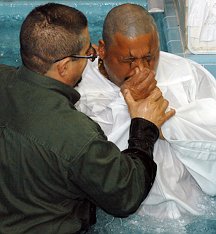
Julio Gonzales, an ex-convict and former drug smuggler, is baptized at First Baptist Church in Del Rio by missions pastor Moises Reyes. (PHOTO/John Hall/BGCT)

Gonzales faces constant temptation to turn back to his old lifestyle to earn money. He recognizes opportunities to make quick money smuggling drugs, but he knows that’s not the lifestyle God is calling him to lead. God will provide for his family, Gonzales said, not drugs or other criminal activities.

“The money’s good, but you don’t live in peace,” he said. “There’s no peace. Now I’m happy with myself.”

Andrea Huffman, First Baptist Church’s community minister, is working with Gonzales to help him put his skills to use in micro-enterprise to provide self-sustaining income. 

Overcoming temptation marks just one aspect of Gonzales’ new faith. In many ways, he’s like so many other new Christians who struggle to discover what having a relationship with God means in daily life.

“I still have a lot to work on. I ain’t no angel,” said Gonzales, who has the phrase “forgive me for my crazy life” tattooed above his eyebrows and on his collarbone.

Johnson helps encourage Gonzales in his relationship with God, calling him twice a week to see how he is doing and how the church can help.

“Julio coming to know Christ is a classic example of planting, watering, and God giving the increase,” Johnson said. “From the prison ministry, mission partnerships, advocacy/care, prayer walking to personal evangelism—all God used. We are happy to be part of God’s plan for Julio.”

Despite the temptation that surrounds him, Gonzales believes he’s going to make it—to get off probation and be a better father. He can’t make up for years lost in prison, but can do the best he can to be the man God is calling him to be, he noted. He’s not sure where that will lead, but he hopes God will call him to help young people avoid the pitfalls in which he fell. He’s already trying to help the young men who live around him.

“I know I’m going to make it,” he said. “It’s tough, but I’m going to make it.”


Wayland graduate forms bonds in the Balkans

PLAINVIEW—Melanie Vasquez faced a big dilemma in December.

She was set to leave the Balkans and return home to Hobbs, N.M., and Plainview, where she attended Wayland Baptist University. She graduated in May 2010 and continued helping with student ministry in nearby Tulia.

Melanie Vasquez (right) spends time with her friend, Marita, who helps with the English classes and also helps Vasquez brush up on her foreign languages in the process.

Her plan all along was to stay six months, then return to the States. But something wasn’t right. She had unfinished business to do, even though her funding to stay overseas was not guaranteed.

Questions loomed: Should she pack her belongings into storage, come home and hope to return for them later? Or should she leave everything in place and trust that she’d be coming back after a holiday visit with relatives and friends?

Vasquez chose the latter, trusting God to work the details out for her to return to the nation that quickly is becoming her second home.

“I just feel like it’s not over for me here,” she said. “About the third month here, I knew there was so much more to do and what that might mean. I began thinking, ‘How can I leave the people that have become my family and not let them have the opportunity to know me better?’ I just knew I had to come back until it was finished.”

Once she returns, Vasquez will help run a community center and teaching English there. She also hopes to start a master’s degree through Wayland’s Virtual Campus, focusing on education and English as a Second Language.

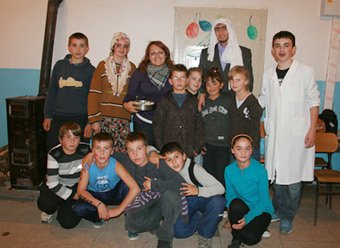
Wayland graduate Melanie Vasquez of Hobbs, N.M., (back row, third from left) joins a group of Balkan children at a Halloween party held at a community center where she works.

Her work in the Balkans has not been much different than when she first visited several years earlier while on a Wayland-sponsored trip. The focus always has been on building relationships, sharing cultures and providing help and hope for the people there.

“I’ve always known that God loves all people, but not everyone has the chance to know and understand his call for them,” said Vasquez. “When an opportunity came my way, I took it.”

That first opportunity was to Mexico. Then, she visited the Balkans the next summer. Her world was transformed, and she knew where she wanted to go the next time a trip was scheduled. In fact, she was so sure of the seeds being planted there that she opted to spend not only her summer there, but also the following fall semester of 2009.

“I fell in love with the people there and just felt like there was a need there for English education, a need for hope and for the people to see something different and know something different,” she said. “The people need to see that it’s a bigger world.”

After returning to Wayland, she completed her last semester of college and headed back to the Balkans just a few weeks after earning her degree. Her intent was to stay another six months, then return to the High Plains to work and do community development.

A group of Balkan women knitted these bags to provide additional income for their families with help from Melanie Vasquez and an outside organization she hopes will market the handcrafts in America and around the world.

But something told her things weren’t finished, and she plans to head back in February to pick up where she left off. First Baptist Church in Tulia has funded her effort in full, having helped significantly for the last trip, and she’s using her home visit to make some connections that will help an effort she began in the European nation before she left.

In an effort to provide economic development and enrichment for the women, Vasquez started a group that knit various products including doilies and handbags, using brightly colored yarns and knitted floral decorations as well.

Since most women in the Balkans do not work outside the home, many families rely on the husband’s salary alone to survive and it often means financial hardships. By using a skill they already possess—Vasquez said most of the women know how to knit quite well and often create things for themselves—she hoped to find connections with vendors who could sell those handcrafts internationally and provide additional income for the families.

 “Other people like Americans don’t normally do these things. They’d rather buy them instead, and to know they are handmade from these ladies on the other side of the world is great,” Vasquez said. “We are hoping that we can show the women that they do have a skill that can help provide for their families.

“This also helps with their self-esteem as they see the team effort and how it will help them all. I tell them that God loves all people, and he expects us to help each other out. No one is above anyone else in the group.”

While the effort has taken time to get under way, Vasquez is confident that a vendor will emerge to help the women sell their wares.

“The challenge is to help them sustain that help for themselves over the long term. If we’re going to make a difference, we want to make one that lasts,” she said. “I’m a problem solver, but I’m learning that I can’t solve everything, and that’s been hard.”

The work, the classes and the other tasks she’s been called upon to do have all opened doors for Vasquez to do her favorite thing—get to know people and a culture so different than her own.

“I’ve made some really good friends and had some great conversations about religion and my own culture. I’ve been able to share my culture and my religion in lots of different ways,” she said. “I’ve always been a people person and get along with everybody. It felt much the same there. They’re just people like me, and I’m interested in knowing about them too. I connect with the people and enjoy just sitting and having coffee with people.”

Through the community center’s programs—which include a coffee house, open-microphone nights, English classes and community development resources for families—Vasquez said the doors are open wide to meeting even more people and forming relationships.

“It’s weird. … It’s like home now. My home is here, but it is there, too. I cannot even fathom not being there and doing what I’m doing,” she said. “It’s always been hard to come back, because America is so different than most cultures. America is such a rich country compared to others, and other countries follow us.”