Texas Baptists make views known to lawmakers about payday lending

AUSTIN—Some Texas Baptists continued their legislative fight against what they call the “predatory” lending practices of payday and auto-title lenders, testifying before the state Senate Committee on Business and Commerce.

Texas Baptists testified how the practices of payday and auto-title lenders adversely are affecting their communities.

Texas payday lenders operate in a loophole in state legislation that enables them to charge interest as high as 500 percent on loans, said Suzii Paynter, director of the Texas Baptist Christian Life Commission.

That creates a situation where people take out loans in desperation and never can repay them. If legislators would close the loophole, payday and auto-title lenders would be forced to operate under the same rules as all lenders in the state.

“Payday products have created a perpetual product,” Paynter testified before the Senate committee. “And I want to make a point about this. We’ve really focused on the need and how that first need is really important. The person gets the $200 or $500 that they need. It’s not that moment that’s the problem. It’s the problem the product creates—the perpetual pattern of debt. It’s just simple math. In these loans, you can take out a $4,000 car loan. You can pay $1,200 a month and never pay off the loan.”

When people and families are caught in the downward spiral of payday loans, they suffer, Paynter noted. When Texas families are hurt, Texas business also is hurt. Financially struggling families cannot support local businesses, stunting the economy.

“When a family is affected by this, it does affect the business of Texas,” she said.

Frederick Haynes III, senior pastor of Friendship West Baptist Church in Dallas and representative of a four-church coalition against predatory lending, said in the past several years, about 20 payday lenders have cropped up within a five-mile area near the coalition churches.

A widowed grandmother in the area turned to one of the payday lenders for a $300 loan she used to purchase medicine. The total cost of repaying the loan was $700. A college student took out a $200 to $300 loan to buy textbooks. Total cost of repayment was $600.

“We have had complaints from members of our churches and members of our community.” Haynes said.

Chad Chaddick, pastor of Northeast Baptist Church in San Antonio, said a member of his church had a similar experience. A single income family supporting six children and an elderly mother-in-law was in danger of losing its home. When the family turned to the church for help the first time, the congregation provided financial assistance. The second time the church was asked for help, it began looking at the family’s financial situation.

The church discovered the family had taken out a $700 payday loan. The terms of the loan indicated the family was to pay $200 every two weeks, which was crippling the family financially. After nine payments, the family had not reduced the principle of the loan at all.

Northeast Baptist Church helped pull the family out of their predicament, and with education, they now are living within their means.

Several legislators, including Sen. Wendy Davis, D-Fort Worth, former House Speaker Tom Craddick, R-Midland, and Rep. Eddie Rodriguez, D-Austin, have filed bills that would close the loophole that allows payday lenders to charge higher interest than other loan entities.

For more information about this issue and how to inform legislators how payday lending affects Texas, call (512) 473-2288.


On the Move

Larry Dodd to First Church in Nash as interim music minister.

Mark Lambert to Circle J Cowboy Church in Texarkana as youth minister.

Michael Ryer to First Church in Commerce as minister of education and music.

Tommy Turner to First Church in Paris as pastor from Eagle Heights Church in Harrison, Ark.


Around the State

The 90th Annual Panhandle-Plains Pastors’ and Laymen’s Conference will be held at Wayland Baptist University Feb. 28-March 1. The theme is “Great is Thy Faithfulness.” Monday morning’s featured speakers include Micheal Summers, Claude Cone and Ken McClung. The afternoon session will feature Beverly Sutton Miller, Gene Hawkins, Howard Batson and Wayne Shuffield. The evening session will feature Rick Shaw, Joel Gregory, Melanie Vasquez and Paul Armes. The Hispanic conference that evening will hear Miguel Contreras, Carlos Hinojos and Ernesto Rodriquez. Tuesday morning’s featured speakers are Joel Gregory, Cherry Peach, Suzy Wall, David Garland and Bryan Houser. A golf fellowship that afternoon at the Plainview Country Club and a dinner that evening will conclude the activities. For more information, call (806) 291-1165.

Texas adoptive families will tour Russia, China, Vietnam, South Korea and Ethiopia without leaving the walls of Tallowood Baptist Church in Houston March 5 at a Heritage Day celebration hosted by Dillon International and Buckner International. Families will experience entertainment from around the globe, including performances by the Ethiopian Christian Fellowship Church choir, the Ari Rang Korean Folk Dance Group, and magic tricks and illusions from Texas Magician “Cardini” Carter Blackburn. Tickets to attend the event—which will be from noon to 4 p.m.—are $10 per adult and $5 per child, with a maximum cost of $30 per family. For registration or information, call (713) 278-9213, ext. 2228. Randy Pullin and daughter Hannah enjoy celebrating her Vietnamese heritage at the 2010 Heritage Day gathering.

Howard Payne University’s fourth annual Currie-Strickland Distinguished Lectures in Christian Ethics will be held Tuesday, March 15, from 1:30 p.m. to 4:30 p.m. Featured speakers are Doug Ezell, George Mason and Ira Peak Jr. Ezell, retired minister and counselor from Iowa, La., will address “Five Ethical Themes in the New Testament.” Mason, senior pastor of Wilshire Baptist Church in Dallas, will speak on “Preaching on Ethics in the Local Church.” Peak, retired pastor and adjunct professor of religion and philosophy at the University of Indianapolis, will discuss “Five Ethical Themes in the Old Testament.” Admission is free, but reservations are required. For reservations, call (325) 649-8009.

Dillon International will present a free adoption information meeting at 6 p.m. March 21 at the Buckner Children’s Home campus in Dallas. A representative will give an overview of adoption from China, Korea, Haiti, India, Japan and Hong Kong, plus new opportunities in Ghana. A domestic adoption program for Texas families and adoption programs in Russia, Ethiopia and Honduras, available through an affiliation with Buckner, also will be discussed. For information or a reservation, call (214) 319-3426.

Clayton Roberts, organist at Zion Lutheran Church in Houston, will be the featured organist at an April 1 organ recital at Houston Baptist University. The 30-minute recital will begin at noon.

Charles and Mary Alice Wise of Gatesville were presented the Baylor University Founders Medallion during the annual Founders Day ceremony. They have established several endowed scholarships and also contributed toward the construction of the Mayborn Museum Complex, the McLane Student Life Center and George Truett Theological Seminary.

Chris Holloway has been named Baptist Student Ministry director at Dallas Baptist University. A 2009 DBU graduate, he was a resident director for one of the school’s dorms.

Hardin-Simmons University has named its outstanding young alumni for 2011. Terri Hendrix, an award-winning musician, recently released her 14th album. She was a cowriter on a Grammy-winning instrumental on the Dixie Chicks’ 2002 album, “Home.” Todd Gentzel, a 1995 graduate, is chief strategist a Yaffe Deutser, a Houston-based management consulting firm that specializes in the integration and alignment in strategy, culture and communication. Leighton Flowers, a 1997 graduate, is the youth evangelism director for the Baptist General Convention of Texas.

Anniversaries

James Cheatham, fifth, as pastor of Carmel Church in Lindale, Feb. 1.

David Dykes, 20th, as pastor of Green Acres Church in Tyler, March 3.

Ray Davis, fifth, as pastor of First Church in Whitehouse, March 5.

Deaths

School children visit “Canstruction Belton,” displayed at The University of Mary Hardin-Baylor. Seven community teams created structures made entirely of canned goods. The event brought in 18,000 cans of food, and more than $10,000 was raised through a dinner, silent auction and public donations. The funds will benefit the local food pantry.

Bobby Rine, 83, Jan. 16 in Lubbock. A graduate of Wayland Baptist University and Southwestern Baptist Theological Seminary, he was pastor of 23 Texas and New Mexico churches during his 63 years of ministry. He was a member of First Church in Idalou. He was preceded in death by his brother, Donnie. He is survived by his wife of 62 years, Wanda; son, David; daughters, Wana Hunt and Kathy Barton; brothers, Jackie and James; sister, Joyce Mitchell; 12 grandchildren; and seven great-grandchildren.

Miguel Mojica Jr., 90, Feb. 6 in Dripping Springs. A graduate of Howard Payne University and Southwestern Seminary, he served in ministry 45 years. He was a pastor of several Texas churches, and he was widely known for his mission work among Anglos and Spanish-speaking people in Texas, New Mexico and Mexico. He was director of missions for New Mexico. He later returned to Texas and helped start more than 100 churches along the Texas-Mexico border between Laredo and Brownsville. He retired in 2000, but he continued to lead mission and health trips to Central America and Mexico. After retiring to Dripping Springs, he was known as the “Bread Man,” driving his van to area ranches and homes to hand out bread and other food to people in need. He was preceded in death by his wife of 54 years, Betty. He is survived by his sons, Mike and Tommy; daughter, Becky Mojica; brothers, Joel and Homer; sisters, Carolyn Villarreal, Chene Hernandez, Martha Grijalva and Rachel Nino; seven grandchildren and three great-grandchildren.

Andy Pettitte, making his first appearance after retiring as a New York Yankees pitcher, reads from Scripture at the Heights Church in Richardson Feb. 6. In detailing his decision not to return this season, Pettitte quoted Jeremiah 29:11. “God has plans for our lives and it’s a good plan,” he said. “I know I have a purpose in my life, and that’s to serve God no matter what. But for the first time in a very long time, my purpose wasn’t to get ready for a baseball season.” During his 20-year Major League career, he accumulated 2,251 strikeouts, had 240 wins, earned five World Series rings and never had a losing season.

John Herndon, 81, Feb. 8 in Houston. He and his wife, Roblyn, funded the Waco Hall auditorium organ at Baylor University. A physician, he was a member of Friends of Truett Seminary, Strecker Museum Friends and Strecker Museum Associates, he also served on Baylor’s development council from 1997 to 2004 and was involved with the Bear Foundation from 2003 to 2004. He is survived by his wife; daughter, Sally Lombardo; son, John III; sister, Katherine Westmoreland; and five grandchildren.

John Petty, 42, Feb. 9 in Kerrville. A graduate of Baylor University, Southwestern Seminary and Truett Seminary, he was youth minister at First Church in White Settlement, and pastor at Baptist Temple Church in Uvalde and Trinity Church in Kerrville, where he served at the time of his death. He served as chairman of the Executive Board of the Baptist General Convention of Texas and was active in the Emerging Leaders Network of the Baptist World Alliance. He was preceded in death by his father, Jerry, and brother, Alan. He is survived by his wife, Kelly; mother, Marcia; son, Davis; daughter, Mara; sisters, Rosemary Cunningham and Gay Rhoades.

Russell Fudge, 100, Feb. 15 in Brownwood. He was the first director and creator of the academic curricula of the Douglas MacArthur Academy of Freedom at Howard Payne University. Fudge was a U.S. Army officer who retired as full colonel of infantry in 1962. During World War II, he saw action in the Pacific Theatre, eventually becoming chief of staff and military governor of the island of Anguar in the Palau Group. He was the senior army officer to negotiate the Japanese surrender of the Bonin Islands. He was a member of the first staff of the post-war secretary of defense and twice was assigned to the Army general staff in the Pentagon. At the age of 85, he retired for the second time as emeritus professor of political science from Howard Payne, where he held the Carr P. Collins Jr. chair of international politics. He received the Freedom Medal in 1965 from the Douglas MacArthur Academy of Freedom, and in 1986, he received Howard Payne’s Medal of Service. He was preceded in death by his daughters Wilma and Ruth and wife of 41 years, Betty. He is survived by a son, John; daughters Ann Fudge and Jane Masters; three grandchildren and two great-grandchildren.

Event

The women’s ministry of First Church in Center will hold its 15th annual Joy Seekers Conference March 25-26. Natalie Nichols will be the featured speaker. Musical guests will be Grateful Heart, Jessica Hopkins, Sherry Crawford, Joann Smith and the Border Sisters. Before March 15, the cost is $20. A light breakfast and lunch on Saturday are included. At the door, the price is $25. Registration begins at 6 p.m. Friday.

Ordained

Jarryn Dickenson to the ministry at First Church in Crockett.

Brady Sharp to the ministry at First Church in Wichita Falls.

Revival

Calvary Church of Nogales Prairie, Apple Springs; March 13-19; evangelist, Nathan Davis; music, Nathan Alsbrooks; pastor, James Whittlesey.


Institutional relations dominate BGCT Executive Board meeting

DALLAS—Relationships to Baptist institutions—including one university that opened its governing board to include non-Baptists, another university that is increasing its capital debt by $40 million and a financially troubled health care system whose hospitals have entered a joint venture with a for-profit hospital—dominated discussion at the Baptist General Convention of Texas Executive Board’s Feb. 21-22 meeting.

Responding to questions about Baylor University at the Baptist General Convention of Texas Executive Board meeting are (left to right) Houston attorney Bob Fowler, representing the board’s Institutional Relations Committee; Dary Stone of Dallas, chair of the Baylor University board of regents; Debbie Ferrier of Houston, chair of the BGCT Executive Board; and Gary Elliston of Dallas, a BGCT-elected Baylor regent. (PHOTO/John Hall/BGCT)

Baylor University regents recently voted to amend the university’s bylaws, allowing non-Baptist Christians to comprise up to 25 percent of the school’s governing board.

In response, the BGCT Executive Board affirmed the Baptist state convention’s historic relationship with Baylor University and authorized the board’s chair to appoint a task force to meet with representatives of the university’s regents to discuss the future of that relationship.

“The goal for these discussions would be a better understanding of Baylor’s vision for the future and a harmonious relationship” between the university and the BGCT, the motion said. The task force will report back to the board at its May 23-24 meeting.

Baylor President Ken Starr and three regents—Chairman Dary Stone of Dallas, Gary Elliston of Dallas and Ramiro Peña of Waco—made a presentation and responded to questions from the Executive Board’s Institutional Relations Committee regarding the action. The three regents—along with Linda Brian of Amarillo, who is both a Baylor regent and a director of the BGCT Executive Board—also spoke to the full board.

The regents insisted they value Baylor’s close relationship to the BGCT.

“We are a Texas Baptist institution, we have been throughout our history, and we always will be so,” said Elliston, a BGCT-elected regent.

Regents chose to make available to non-Baptist Christians up to one-fourth of its board seats so alumni and other supporters of the school would not feel like “second-class citizens, but could aspire to involvement at the highest level of university governance,” Stone said.

“Only 31 percent of our freshman class claim the Baptist label,” he added, noting the percentage of Baptist students has been declining about 2 percent a year and likely will drop to 20 percent within this decade.

Jeff Johnson, pastor of First Baptist Church in Del Rio, raises questions about how effectively Baylor University regents communicated to Baptist General Convention of Texas leaders their intention to open some chairs on the board of regents to non-Baptist Christians. (PHOTO/John Hall/BGCT)

While the change allows non-Baptists a minority presence on the board, regents “built a firewall to ensure we always will be a Baptist institution going forward,” Stone said.

Any future change in the percentage of non-Baptists on the board will require the approval of 75 percent of the board’s Baptist regents; either the chair or vice chair of the board must be Baptist; a Baptist officer must preside over any vote related to a change in Baptist board representation; and only Baptists on the board will vote on matters concerning the university’s Truett Theological Seminary, the regents explained.

Jeff Johnson, an Executive Board director from Del Rio, expressed concern about a perceived “communication breakdown” between Baylor and BGCT leaders.

He and some others also questioned the timing of the regents’ action, particularly after messengers to the BGCT annual meeting in November soundly rejected a similar proposal—an Executive Board recommendation that Houston Baptist University be allowed to elect some non-Baptist trustees.

“It was a difficult situation,” Elliston acknowledged. “No one at Baylor meant any disrespect toward Texas Baptists, and it was not meant as a slight to this group (the Executive Board) in any way.”

Regents had spent at least four years discussing the possibility of opening board membership to some non-Baptists, he noted.

“According to our relationship agreement with the BGCT, the board of regents was within its legal rights to take the action we did, and we did so because of our fiduciary responsibility to act in the best interests of Baylor,” Elliston said.

Messenger action regarding Houston Baptist University at the 2010 annual meeting in McAllen complicated matters, he acknowledged.

If Baylor regents had asked the BGCT board to endorse its plan to open some seats to non-Baptists, “we would have put you squarely in the position of being asked to do what the convention said not to do,” he said. And if the board had rejected what a majority of regents believed was in the school’s best interests, Baylor’s regents would have been in a position of acting in open defiance of the Executive Board.

“If we offended you, we apologize. … From our perspective, if it was the right thing to do, it was the right thing to do now,” Elliston said.

Ed Jackson of Garland, originator of the motion the Executive Board approved, explained his rationale after the meeting. Allowing a task force to deal with the matter rather than taking immediate action in a board meeting “will let emotions subside so that we can deal with the substance of this discussion,” he said. At the same time, it leaves the door open for the board to act in May if it chooses to do so after the matter has been discussed thoroughly.

“This motion notifies Texas Baptists that we have not ignored the action of the Baylor board of regents. It affirms the past, yet it looks forward. It promotes communication and discussion between two autonomous organizations with the goal of harmony and understanding, giving us a hope of a better relationship,” he said.

After the board approved the motion regarding Baylor, Bruce Webb of The Woodlands introduced a resolution expressing appreciation to the Houston Baptist University trustees for the consideration they showed to the Executive Board. The resolution carried overwhelmingly.

In other action, the Executive Board approved a request from the University of Mary Hardin-Baylor’s trustees to increase indebtedness beyond the prescribed limit of 20 percent of total audited net assets.

UMHB trustees approved a campus master plan that involves a $100 million building program over the next three to seven years. However, the trustees’ action was made contingent on Executive Board permission to increase its indebtedness up to 64 percent of net assets.

UMHB President Randy O’Rear explained to the Institutional Relations Committee the building program includes a $20 million building for the school’s College of Nursing and a $25 million student union building, as well as an on-campus football stadium, a performing arts building, a visual arts center, field house expansion and relocation of the physical plant operations building.

Bob Fowler of Houston, who served on the Executive Board’s debt-review task force and presided over the Institutional Relations Committee meeting, noted UMHB’s “history of responsible handling of its finances.” The task force and committee recommended UMHB be granted a waiver of the 20 percent ceiling on indebtedness but also issued a six-part recommendation the Executive Board endorsed:

• Preserve existing cash reserves to provide an ultimate source of repayment of a portion of the debt incurred.

• Secure a commitment of pledges to a major capital campaign in an appropriate and substantial amount before any portion of the new debt is used to fund capital projects.

• Keep in mind fulfillment of capital campaign pledges often negatively impacts general annual giving, and carefully monitor that impact.

• Make the stability and reasonable growth of the student population “a sharp and defined focus of administration effort … especially during the debt incurring and early servicing years.”

• Do not, under any circumstances, use any part of the authorized borrowed funds— directly or indirectly—for the university’s operating expenses, including debt service.

• Provide the boards’ Institutional Relations Committee annual reports on the financing and implementation of the campus master plan.

The Executive Board also heard a report regarding Valley Baptist Health System . James Eastham, president of the health system, told the Institutional Relations Committee the system’s hospital in Harlingen sustained significant damage and service interruption due to Hurricane Dolly in 2008.

Since the health system serves a rapidly growing but economically disadvantaged area where more than 41 percent of the population is uninsured, it could not maintain the cash balance its lenders require. Valley Baptist Health System owes about $190 million, mostly in tax-exempt bonds that could be called in 18 months, and its bank required the system to develop a recapitalization plan.

Consequently, representatives of Valley Baptist Health System signed a letter of intent for its operational units to enter into a joint venture with the for-profit Vanguard Health.

Since the BGCT relates to the health care system’s holding company, not its operating units, the matter did not affect BGCT-related governance and or require Executive Board action.

The Executive Board voted to extend its guarantee of a loan for Baptist University of the Americas. The BGCT previously had pledged investments as collateral for a $2.5 million bank loan to BUA. Since that original loan matured, the board voted to extend it to May 31. In the meantime, BUA will continue to negotiate the loan’s refinancing. Any further obligation by the BGCT after May 31 will have to be considered by the Executive Board.

In other business, the board voted to fill several vacancies created since the annual meeting: Ronny Marriott, pastor of First Baptist Church in Corpus Christi, to the Theological Education Council; Sally Eaves from First Baptist Church in Plainview to the Wayland Baptist University board of trustees; Don Ringler of Taylors Valley Baptist Church in Temple, to the University of Mary Hardin-Baylor board of trustees; Kathy Hillman from Columbus Avenue Baptist Church in Waco to the Committee on Nominations for Executive Board Directors; Jim Nelson from First Baptist Church in Austin to the Committee on Nominations for Boards of Affiliated Ministries; and Jeff Humphrey, minister of education at First Baptist Church in Allen, and Greg Wallace, pastor of Woodridge Baptist Church in Kingwood, to the Executive Board.

Editor's Note: As originally posted, two names were omitted in the last paragraph. The article has been corrected to provide full information. Also, the church affiliation of one individual in the last paragraph was corrected.


Piece of Hardin-Simmons history uncovered on eBay

ABILENE—When an artifact from Hardin-Simmons University’s history showed up on the popular Internet selling site eBay, Abilene High School history teacher Jay Moore suspected there would be some keen interest in the rather quirky piece.

Alice Specht, dean of university libraries at Hardin-Simmons University, displays an artifact from the university’s history that Jay Moore, a history teacher at Abilene High School, discovered on eBay. (PHOTO/Hardin-Simmons University)

Moore, a local history buff and the creator of the DVD series History in Plain Sight, searches for Abilene memorabilia on the Internet routinely and usually finds only postcards of Abilene buildings, some of which no longer exist. But this time, he found a lasting testimonial to early 20th century college spirit and comradery.

Moore found for sale a bronze plaque commemorating something named the “Cowden Hall Yell.” Even though the plaque does not mention Hardin-Simmons by name, Moore knew Cowden Hall had been a dormitory on campus.

“When I saw that plaque, I knew Alice Specht was the person to alert,” Moore said. “I didn’t want to buy it myself, but I knew she would be interested.”

Moore’s hunch was right. Specht, dean of university libraries at Hardin-Simmons, logged onto eBay and tried to retrieve the historical piece for less than the asking price. “It was for sale for $250, so I typed in $50, which was rejected immediately by the system, ” she said.

Undaunted, Specht decided instead of bidding on the plaque to ask the owner if she could have it at no charge.

“I explained that it belonged to the university and was a piece of our history,” she said. “The seller agreed that it should go home to Abilene. So, he sent it back priority mail in exchange for only a letter thanking him for the donation.”

S.V. Kastell, Jr. of Hollywood, S.C., told Specht he found the plaque at an estate sale in South Carolina. The seller from whom he purchased it had found the plaque in Connecticut, also at an estate sale. How the plaque found its way to Connecticut remains an unsolved mystery.

According to the wording on the plaque, it honored the memory of a student who was a member of an unofficial school-spirit yelling quartet.

Cowden Hall was built in 1908 and burned in 1922. The sons of the late Billie Cowden gave $5,000 toward the building of the men's dorm.

An account of the Cowden Hall Yell, and other student escapades from the early years, is referenced in a book by Rupert Richardson, former HSU president and Texas historian. The quartet was made up of H.J. “Hoss” Blackwell, Ray C. “Gus” Billips, R.H. (Amos) Johnson and Morgan “Hans” Copeland, whom the plaque memorializes.

Investigation by the Hardin-Simmons registrar’s office revealed Copeland, who graduated from Lorraine High School, took classes at HSU from 1914 to 1919. He died on May 18, 1931, at age 33.

But campus history buffs wonder where the plaque originally was displayed on campus. Cowden Hall burned to the ground on May 14, 1922, and the bronze could not have been cast until after Copeland’s death in 1931. One theory suggests the plaque hung in Ferguson Hall, the structure closest to the location of Cowden.

Now that the plaque is back at Hardin-Simmons, Specht plans to display it in the Legacy Room, part of the Rupert Richardson Research Center for the Southwest, located on the second floor of the Richardson Library.


Dolls enable Christians inside, outside of prison to join in missions

WHARTON—Handmade dolls provided a means for Baptist women in South Texas and incarcerated women in Central Texas to share the gospel and bring joy to children in Mexico and a low-income Hispanic neighborhood in West Dallas.

Displaying the witnessing dolls made by volunteers at two Baptist churches in Wharton and by female offenders at a correctional facility near Gatesville are (left to right) Paulette Kirkpatrick from First Baptist Church in Wharton; Carole Ross, a home missionary and founding president of Cross Prison Ministries; and Christina McCracken, an attorney and volunteer who works with El Calvario Bautista in West Dallas. (PHOTOS/Courtesy of A.C. Shelton)

The project began when women at First Baptist Church in Wharton saw an article in Missions Mosaic, a Woman’s Missionary Union publication, about a church-based group that made witnessing dolls, Paulette Kirkpatrick from First Baptist explained.

Every doll wears a necklace with six colored beads, each representing a spiritual truth. A card printed in English and Spanish attached to every doll uses the colored beads to explain the Christian plan of salvation.

The dolls have two sides—each featuring a face representing a person’s spiritual condition. On one side, eyes are closed, symbolizing spiritual blindness. On the other, eyes are wide open—representative of spiritual insight.

Since Colorado Baptist Association supports home missionary Carole Ross and her Cross Prison Ministries, the women at First Baptist in Wharton saw an opportunity to link with female offenders to make the dolls.

More than two dozen women from First Baptist and College Heights Baptist churches in Wharton cut out fabric and assembled the dolls.

“Jerry Joines sewed most of the dolls—probably about 500 of the 600 we made,” Kirkpatrick noted.

Next, Cross Prison Ministries provided the incomplete dolls to offenders in the special projects section of the Mountain View Unit near Gatesville—a maximum-security facility for women— who stuffed them, attached hair to them and gave them unique facial expressions.

Joining in a time of dedication and celebration marking the completion of witnessing dolls that will be distributed to children in Mexico and a Hispanic neighborhood in Dallas are (left to right) Mack Mathis, pastor of First Baptist Church in Wharton; Jerry Joines, chief seamstress for the doll-making project; Carole Ross, founding president of Cross Prison Ministries; and Paulette Kirkpatrick, a volunteer missions coordinator from First Baptist in Wharton. (PHOTOS/Courtesy of A.C. Shelton)

“You could see the personality of the offenders in the faces of each of the dolls,” Ross said. “When you look at the freckles, the tears, the teeth, they are distinctive. The Lord’s hand was on them.”

First Baptist in Wharton will send many of the dolls—along with about 1,500 Christmas stockings stuffed with toys and a simple gospel presentation—to Edweina Peroni of Christ the King Baptist Church in Mission for distribution to children in Mexico.

The church presented the rest of the dolls to Christina McCracken, a Dallas attorney who volunteers with El Calvario Bautista in west Dallas. “We plan use them in Vacation Bible School this summer,” McCracken said.

During a presentation service at First Baptist Church in Wharton, the dolls lined the front of the sanctuary. Ross saw particular meaning as she looked at the dolls surrounding the Lord’s Supper table.

“We’re committed to healing the broken body of Christ—believers behind bars who are separated from believers in the free world,” she said. “Through these dolls, the church behind bars got to be part of missions, even though its members are incarcerated.”


Baptist disaster relief pioneer reflects on lessons learned

John LaNoue began helping Texas Baptists meet human needs more than 40 year ago, and a list of firsts marks some of the highlights of his service.

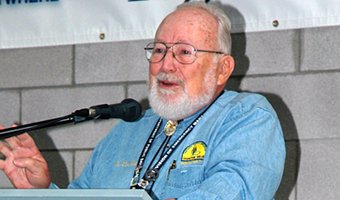
John LaNoue recounts examples of the “activity of God” in Texas Baptist Men disaster relief ministries during the dedication of a new disaster relief complex at the TBM mission equipping center in east Dallas. (File Photos)

He was builder of the first mobile clinic along the Rio Grande. Designer of the first Baptist disaster relief mobile unit. Leader of one of the first American Christian teams to enter Iran since the Islamic Revolution. Member of one of the first groups from the United States in more than four decades to spend extended time in North Korea.

As far back as the late 1980s, friends told him he should write a book about his experiences. He retired from the Texas Baptist Men staff in 1999, fully intending to write. But he didn’t publish Walking with God in Broken Places until a few months ago.

“I hadn’t learned the lessons yet,” he said. “I could report on what happened and who did what. But God wouldn’t give me freedom to write it until I learned the lessons.”

Indeed, the book carries the subtitle, “…and lessons I’ve learned along the way.” In 535 pages, LaNoue explicitly cited more than 40 lessons he believes God taught him, and readers probably could draw an equal number of conclusions by reading between the lines.

John LaNoue built the first Baptist disaster relief mobile unit for Texas Baptists in 1972. Today, Texas Baptist Men operates a fleet of disaster response vehicles, and Southern Baptist Disaster Relief has grown to become the third-largest disaster response group in the United States.

“I tried to show how God uses ordinary people in extraordinary ways to accomplish the evidently impossible,” he said.

LaNoue grew up poor in Beaumont. His father was a hard-drinking boilermaker who left his family when his son was 4 years old. LaNoue’s life changed at age 16 when two laymen led him to faith in Christ.

Construction of the first mobile medical unit Texas Baptists used along the Rio Grande grew out of an insight LaNoue gained while preparing to teach a Bible class at Kilgore College, where he served as Baptist Student Union director. As he read John 14:12-15, he was struck by Jesus’ statement that his followers would continue the works he did and do even greater works.

As he began to consider what Jesus did in his ministry, he realized everything fit into two categories. “He met human need where he found it, and he introduced people to God,” LaNoue concluded.

With those two guideposts before him, he began planning for a student medical/dental mission trip to the Rio Grande. After visiting and praying with his personal physician, Kerfoot Walker of Tyler, LaNoue realized the most effective way to meet needs and share the gospel in multiple remote villages in a short time—bring an examining room on wheels to where the people lived.

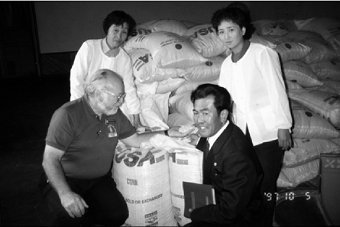
John LaNoue spent three months in North Korea in 1997 as part of a small team of nongovernmental organization representatives who monitored the distribution of food provided by humanitarian organizations in the United States.

Early experiences working in an automotive repair shop, body shop, machine shops and a foundry served him well when he converted an old school bus into a mobile medical unit.

“God is definitely the great economist. He never wastes anything, not even youthful experiences,” LaNoue observed.

Those skills came in handy again just a few years later when he designed the first Baptist disaster relief mobile unit. Texas Baptists first became involved in disaster relief after Hurricane Beulah hit South Texas in 1967. Three years later, when Hurricane Celia struck, Texas Baptist Men took the lead in coordinating the disaster response, and on-the-job experience demonstrated the need for a mobile field kitchen.

Working around-the-clock 36 hours, LaNoue drew up the plans for a trailer that could house the field kitchen, a communications center, bunks for a crew and essential disaster response equipment.

With funds provided through the Mary Hill Davis Offering for Texas Missions, LaNoue and a crew of volunteers built the disaster relief mobile unit in the rear driveway of his home in Mesquite.

LaNoue helps distribute food in North Korea in 1997.

Just as the unit neared completion, the Guadalupe River in South Central Texas flooded, causing more than $17 million in property damage and drowning 17 people. LaNoue drove the mobile unit to Seguin and set up disaster relief operations on the courthouse square where he, his 9-year-old son and a few other TBM workers field-tested the unit.

“Sometimes obedience to the Father makes you look a lot better than you really are,” he reflected.

In the years that followed, LaNoue traveled with the mobile disaster relief unit to missions in Honduras and Mexico, as well as throughout Texas and around the United States. And he led disaster relief teams to dangerous places where few Americans have been welcomed—particularly Iran and North Korea.

“In Iran, we were able to see the effectiveness of an unspoken witness given through love and generosity,” he said, recalling the close supervision the Baptist disaster relief crews received from Muslim officials as they served Kurdish refugees in the Dolanov Valley.

LaNoue remembered the report a military official gave to a Mullah: “These men are not like the Americans we have heard about. They do not drink or smoke. I have watched them for three weeks, and they have not bothered any of the women. They sing in the night, and they love each other.”

In response, the Mullah anointed LaNoue’s hands with rose oil and prayed for Allah to bless the Baptist workers.

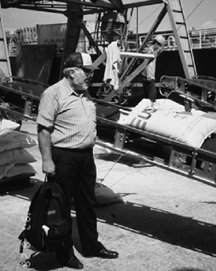
In 1997, LaNoue spent three months in North Korea as part of a five-person team of nongovernmental organization representatives who monitored the distribution of food provided by humanitarian organizations in the United States.

“In the lonesome hours of the night, God was teaching me to find comfort and companionship with him,” he said.

Working in disaster relief across denominational lines and in various cultures taught LaNoue lessons he believes he might never have grasped if not forced out of his Baptist comfort zone.

“The notion that people have to do things my way, sound like me and look like me—the Lord blew that out the window,” he said. “I’ve learned never to look down on other people’s walk with God. I have to respect other people’s experience with God and trust it to be valid and authentic, even though it’s not like mine.

“God is at work everywhere. I’ve grown outside my Baptist experience.”

In his own walk with God through broken places populated by hurting people, LaNoue noted he has seen miracles he never would have encountered had he not been placed in positions where God was his only resource.

“I can only do what God enables me to do,” LaNoue said. “Probably the most important lesson I’ve learned is that God is absolutely God. He can do anything he want to do with people who are willing to join him in what he wants to do.”


Walking with God in Broken Places is available from Amazon.com. For a personalized autographed copy, send $20 plus $5 for shipping and handling to John LaNoue, P.O. Box 396, Frost, TX 76641.


Texas-based sports movie retells story of the Prodigal Son

DALLAS—Writer/producer/director Andrew Stevens found the inspiration for his latest film during a Sunday morning church service.

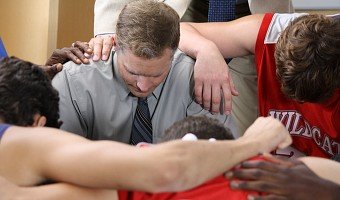
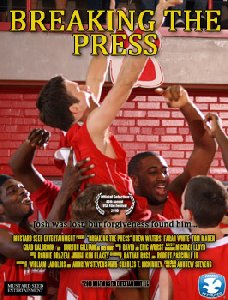
Breaking the Press offers a modern retelling of the parable of the Prodigal Son, set in the context of Texas high school basketball. (PHOTO/Courtesy of Mustard Seed Entertainment LLC)

The pastor was delivering a sermon on Jesus’ parable of the Prodigal Son when he veered into his experiences as a coach. Stevens quickly arrived at the idea of retelling the parable within the world of Texas high school basketball. The sports setting became an ideal backdrop for a modern take on the parable, which he refers to as “a story of universal love and…unconditional forgiveness.”

Stevens’ Sunday morning daydream developed into Breaking the Press. He began discussing the project with a longtime friend, Dallas financial manager Charles McKinney. Stevens was presenting ideas for financing the project when McKinney interjected with a surprising offer; Stevens recalls, “Charlie basically said, ‘I’m in for half. Are you in?’ ”

With McKinney on board as executive producer, the project moved quickly. Principal photography was completed in 15 days. Production remained in the Dallas area, using local churches and high schools gyms as set locations.

Drew Waters of NBC’s Friday Night Lights plays Coach Joe Conaghey in Breaking the Press, a modern retelling of the parable of the Prodigal Son, set in the context of Texas high school basketball. (PHOTO/Courtesy of Mustard Seed Entertainment LLC)

Stevens built his cast with some of the region’s best-known actors. Drew Waters of NBC’s Friday Night Lights and Farah White of Bandslam play Joe and Laura Conaghey. Tom Maden and Chad Halbrook portray their teenage sons, and Richard Dillard, from HBO’s Temple Grandin, rounds out the lead cast as Coach Tex Summer. The large ensemble cast includes Juli Erickson, Bryan Massey, and Burton Gilliam.

Many cast members commented on how refreshing it was to be involved on such a project. “There’s a lot of films out there, and a lot of them don’t make the world a better place,” Farah White said. “It is nice to put something out there that is positive.”

Breaking the Press centers on the struggles of the fictional Conaghey family. Joe Conaghey’s high school basketball team hasn’t come through with a winning season, which throws the young coach’s job into jeopardy. His problems are worsened by the fierce on- and off-court rivalry between his two sons—hard-working older son Matt and gifted but arrogant younger son Josh.

Drew Waters (center) of NBC’s Friday Night Lights plays Coach Joe Conaghey in Breaking the Press, a modern retelling of the parable of the Prodigal Son, set in the context of Texas high school basketball. (PHOTO/Courtesy of Mustard Seed Entertainment LLC)

When Josh is offered a spot on the team at a prestigious Dallas high school, Joe and his kind-hearted wife, Laura, reluctantly give their permission. Josh quickly falls in with a fast, image-driven crowd, not realizing that his newfound popularity—and his position on the team—is both fragile and costly. Veteran coach Tex Summer, who arrives in town to assist Joe and his struggling team, narrates the story.

The film’s creative team had no intention of slacking when it came to the sports aspect of the story. “My number one thing was that the basketball had to look real,” said McKinney, who choreographed all the on-court sequences. Rolando Blackman, Popeye Jones, and Dallas Mavericks general manager Donnie Nelson all have cameos in the film.

McKinney offered Breaking the Press the chance to partner with the Heroes Foundation, a charitable organization that allows at-risk children in Dallas to become involved in athletics. McKinney co-founded the charity with long-time friends Mark Cuban and Mike Modano. Six years after its establishment, the Heroes Foundation has grown into one of the most prominent inner-city sports programs in the nation. Almost all the young athletes who appear in the film are Heroes’ players, many of whom are being recruited by top-ranking college programs.

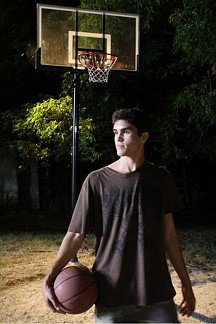
Tom Maden plays Josh Conaghey—the Prodigal Son in a modern-day retelling of Jesus’s parable, Breaking the Press. (PHOTO/Courtesy of Mustard Seed Entertainment LLC)

Faith-based films are known for conveying a positive message, but the genre also has a reputation for being didactic and presenting a too-good-to-be-true vision of the Christian life. Stevens, however, wanted his characters to be as realistic as the on-court action.

The story “could have been hokey, but it wasn’t,” actor Richard Dillard said. The film does not glaze over the Conaghey family’s failures and imperfections: Joe briefly swears at his team in a moment of anger; Josh needles his older brother over the idea of sexual purity.

When Drew Waters spoke with several viewers after an advance screening, he recalled, “Everybody said the same thing: Thank you very much for not throwing the religious part in our faces.”

For all its focus on sports, Breaking the Press is, at heart, a story of forgiveness that stays true to the parable that inspired it. Actors Tom Maden and Chad Halbrook, who play brothers onscreen, are both the sons of ordained ministers and were already very familiar with the biblical parable. Halbrook relates on a personal level, having grown up playing basketball on select teams around Dallas.

“People get caught up in themselves—especially in high school. It’s very easy for young, talented players to get so wrapped up in themselves that they forget everyone around them,” he said.

Maden, in his role as the Prodigal Son, believes the message of forgiveness makes the film universal. “The Prodigal Son is one of the most well-known (parables) because everybody screws up,” he said, “It relates to everyone.”

Breaking the Press is due out on DVD from Fox in the fourth quarter of 2011. For more information, e-mail info@astevensent.com.


Gospel writers harmonize; they don’t sing the melody of Jesus in unison

WACO—Reading Scripture well is like listening to a chorus, the dean of Duke Divinity School explained during the 2011 Winter Pastors’ School at Baylor University’s Truett Theological Seminary.

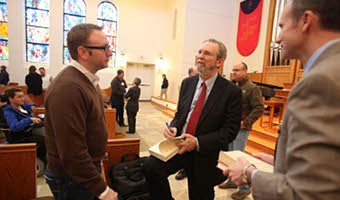
Richard Hays, dean of Duke Divinity School, autographs books and visits with students and faculty at Truett Seminary between sessions of the 2011 Winter Pastors’ School. (PHOTOS/Matthew Minard, Baylor Marketing & Communications)

Hearers appreciate music best when they listen for and distinguish between the parts as well as take in the whole, said Richard Hays, the George Washington Ivey professor of New Testament at Duke.

Nearly 200 people attended the event, presented by the Kyle Lake Center for Effective Preaching at Truett. Hays’ theme was “Reading Scripture Alongside the Gospel Writers.”

The first three books of the New Testament—Matthew, Mark and Luke—are called the Synoptic Gospels. They include many of the same stories, often in the same sequence and sometimes with nearly exactly the same wording, scholars note.

But a close examination shows very different approaches, each of which enriches the reader’s understanding, he added.

Mark begins by “plunging roughly to the point of Jesus’ baptism,” Hays said. But Matthew anchors his account in Jesus’ genealogy, stretching back 42 generations to Abraham instead of “bursting out of nowhere” as Mark does.

Matthew’s approach is “hardly an electrifying way to begin the narrative, but it ensures the continuation between Israel’s story and the one Matthew is about to tell,” he said.

Debbie Rarick, a doctor of ministry student at Baylor University’s Truett Theological Seminary, listens during the seminary’s Winter Pastors’ School. (PHOTOS/Matthew Minard, Baylor Marketing & Communications)

While Mark’s introduction to Jesus is straightforward—recounting the way John the Baptist heralded Jesus’ arrival—his Gospel also demonstrates “a reticence about the shocking claims he is making about Jesus,” Hays said. Mark rarely points explicitly to Old Testament Scripture references to the Messiah. And the Gospel ends with the women fleeing the tomb in fear, rather than the longer, bolder accounts of the Resurrection, which are described in the other Gospels.

Matthew, meanwhile, is “far more overt in many passages, providing explicit explanation of things only hinted about” in Mark, he said.

“Matthew erects a large highway sign to make it clear that Jesus is the fulfillment of Scripture,” Hays said. Matthew cites myriad allusions and quotations from Old Testament law and prophecies to frame his text in “an authoritative voice.”

The message is “beginning the world anew,” Hays said. “Jesus is both the son of David, the anointed king, and the son of Abraham.

“Matthew uses a lens of mercy for interpreting the Torah. Mercy is not in opposition to the law, but what the law is all about. Jesus’ Sermon the on Mount is one of incredible moral rigor, but the theme of mercy occurs over and over again.”

Matthew reconfigures the Torah, “inviting us to become characters in the re-shaping, to become disciples,” he noted.

In the third Gospel—Luke—the story of Jesus is “deeply counter-cultural,” referring to the Old Testament not so much as a collection of predictions but as a collection of promises.

Richard Hays, dean of Duke Divinity School, focused on the Gospels as he addressed the 2011 Winter Pastors’ School. (PHOTOS/Matthew Minard, Baylor Marketing & Communications)

Jesus is portrayed as an agent of liberation, a Spirit-anointed servant who will bring grace to outsiders, Hays said. His followers in the church will be a counterculture within Judaism and within the Roman Empire—in effect turning the world upside down.

Unlike Matthew, “Luke almost never says, ‘By the way, let me explain to you that this is a quote’” from the Old Testament, Hays observed. “He puts the word in the mouths of the characters. It’s like actors on the stage with sepia images on the screen behind them that correlate.”

Luke emphasizes re-shaping Israel, not as a coercive power by a violent Messiah, but rather a nonviolent one.

“Israel is not to be saved by some new Moses, but God himself will appear on the scene—someone far greater than what John the Baptist was looking for,” Hays said.

The Gospel of John, which is not part of the Synoptics, parallels but stands apart from the other three Gospels, he added.

John can be compared to “the soaring descant or the deep bass notes” of a chorus, Hays said. “It adds flavor and texture to the tight harmony of the Synoptic Gospels.”

John begins his Gospel with the same metaphor the Old Testament writer of Genesis used to begin the Bible, he noted. Just as Genesis reports how God spoke creation into being, John calls Jesus the “Word” through whom “all things were made.”

John further parallels Hebrew Scripture by presenting Jesus as a substitute for the Jewish Temple, Hays said.

“Jesus’ body is the place where God dwells, where atonement takes place, and where God and humanity are reconciled,” he said, explaining how the spiritual destination the Jews sought in the Temple is reached in Jesus. “The Temple always was a sign, a configuration pointing toward Jesus.”

Throughout John, Jesus is seen as the fulfillment of Old Testament feasts, events and prophesy, Hays reported. “John understands the Old Testament as a matrix of symbols, all pointing toward Jesus … the truth and glory of God embodied in Jesus.”

Jesus himself encouraged his listeners to read the Scripture with new eyes, Hays said. “The Old Testament teaches you to read the New Testament, and the New Testament teaches you to read the old.”

The purpose of The Kyle Lake Center for Effective Preaching at Baylor’s Truett Seminary is to prepare seminarians for preaching and to provide continuing education for pastors and other ministers. The center’s namesake, a 1997 Truett Seminary graduate, died while he was pastor of University Baptist Church in Waco. His parents, David and Shirley Lake, helped establish the Center so their son’s influence would be felt for generations.


–With additional reporting by Baptist Standard Editor Marv Knox.


Baylor’s Baptist Center designed to preserve, celebrate heritage

WACO—The Baptist Studies Center for Research at Baylor University, approved by the Baylor board of regents at their February meeting, will preserve the 400-year global heritage of Baptists through a virtual depository of important Baptist documents, photographs, books and other collections.

The center, which will include hundreds of thousands of items already housed throughout Baylor’s campus, will be established through the department of religion in Baylor’s College of Arts and Sciences. It will continue the Baptist story as part of the university’s mission, said Bill Bellinger, chairman of the religion department.

bagbys

The new center will include historical documents about pioneer missionaries William Buck Bagby and Anne Luther Bagby.

“We think Baylor is the logical place for this center,” he said. “We’ll have a new layer of accessibility for researchers.”

Besides making materials about Baptist heritage available for visiting scholars, who in return will provide a lecture series, the center will support research projects for Baylor faculty and encourage students to learn about Baptist identity. Materials also will be accessible for laity.

Baylor and other institutions hold a treasure trove of Baptist materials, and the center will work with libraries throughout in the country and abroad to create an ongoing virtual collection. Work on digitizing materials already has begun at Baylor.

“We’re getting a better handle on resources we already have on hand,” Bellinger said. “We’re happy for the materials to stay where they are, but what we hope for is virtual access. We hope a lot of these things can become available online, and we have not limited ourselves to what’s on the Baylor campus, because there are other excellent resources elsewhere.”

Significant documents, books, photographs, letters and recordings are housed at Baylor in several locations, including the Institute for Oral History, the J.M. Dawson Institute of Church-State Studies , Baylor University Central Libraries, George W. Truett Theological Seminary , Armstrong Browning Library and the Texas Collection.

The Baptist Studies Center for Research will:

• Serve as a resource for visiting scholars, who also will lecture at Baylor.

• Provide access to materials for those researching the Baptist tradition, regardless whether they are able to travel to actual collection sites.

• Support such faculty research projects as “Early English Baptist Texts” and The Baptists’ Bible project, with Baylor University Press to be a publishing partner with connections to the Baptist World Alliance. The ongoing Bible project is a commentary on Baptist interpretations of Scripture from the 17th century to the present and shows ways Baptists have used the Bible in confessions, sermons and other documents.

• Sponsor an essay contest for students on Baptist identity and encourage student travel and study.

• Support entities which contribute to such journals as Baptist History and Heritage and Perspectives in Religious Studies. Among the organizations are the Baptist History and Heritage Society , the National Association of Baptist Professors of Religion and the Association of Ministry Guidance professionals.

• Provide an emphasis in Baptist studies for the Ph.D. program in religion. Baylor is the only Baptist university that offers a doctor of philosophy program in religion, Bellinger said. The program rose significantly in the recent National Research Council rankings, making major strides in several areas, including faculty productivity.

While some other Baptist universities house collections, “They’ve often been specifically tied to church relations or undergraduate curriculum,” Bellinger said. “There really hasn’t been something comprehensive and tied to research.

“We have resources with our digitizing that not everybody has, and we can work together,” he said.

Among those resources is a scanner capable of turning pages and simultaneously shooting fronts and backs of pages at a rate of 2,400 pages per hour.

Using that scanner, the digitization of more than 43,000 pages of Southern Baptist Convention annuals — dating back to 1845 — has begun, with students, supervised by electronic library staff, assisting.

Many of the annuals contain printed sermons and speeches illustrating Baptist doctrine, Bellinger said.

Another scanner is capable of scanning images up to 5 feet wide, 8 feet long and 12 inches deep. Baylor is the only university in Texas that has such a scanner, and it has been used to scan large portraits –including paintings and photographs — of Baylor presidents, said Eric Ames , digital collections consultant with University Electronic Libraries.

Since April 2009, faculty members of Baylor’s department of religion have traveled with Kathy Hillman, director of special collections for central libraries at Baylor, to libraries in the United States and England to view materials and discuss the possibility of sharing materials.

William Pitts, professor of religion at Baylor, visited Angus Library at Oxford University in England, which has a national library and archive for Baptist and non-conformist history and heritage; and Doug Weaver — associate professor of religion at Baylor, undergraduate program director and coordinator of the research in Baptist studies — traveled to the Southern Baptist Historical Library and Archives in Nashville, Tenn.

Bellinger traveled to the American Baptist Samuel Colgate Historical Library and Archives in Atlanta. It houses tens of thousands of artifacts of Baptist history, some from its roots amid Germans and the Dutch, and records of the modern missionary movement, African-American church associations, women's work and the social gospel movement.

“Other libraries graciously received us and have shown much interest in the goals of our center,” Weaver said. “We look forward to the possibility of developing increased cooperation with Baptist libraries in the U.S. and abroad.”

Among materials in Baylor’s collections are:

• More than 100,000 photos, documents and correspondences of Baylor’s presidents.

• The personal archives of Joan Riffey Sutton, retired musical missionary and 1951 Baylor graduate. She and her husband, Boyd Sutton, were missionaries in Brazil from 1959 to 1993 and helped organize and translate hymnody for Portuguese-speaking congregations.

• Eyewitness recordings of denominational leaders, pastors, missionaries and laity, including interviews with Baptists representing the Baptist General Convention of Texas, Mexican Baptist Convention (today’s Hispanic Baptist Convention), Cooperative Baptist Fellowship, North American Baptist Conference, the Southern Baptist Convention, the Baptist World Alliance and the American Baptist Convention. Among topics are Baptists and race relations, women in ministry, rural churches and the fundamentalist movements of the early and late 20th century.

• Recorded interviews of histories of Baptist institutions, including Baylor University, University of Mary Hardin-Baylor, Wayland Baptist University, South Texas Children’s Home, Mexican Bible Institute, Southern Baptist Theological Seminary, Southwestern Baptist Theological Seminary, Woman’s Missionary Union and the Baptist Student Union.

• Photographs, letters, diaries and other memorabilia of William Buck Bagby and Anne Luther Bagby, pioneer Baptist missionaries, and their family. The Bagbys served in Brazil from 1882 to 1939. They had nine children, five of whom lived to maturity and became missionaries in South America.  Anne Bagby was the daughter of John Luther, president of Baylor Female College.

Thelma Cooper, a granddaughter of the Bagbys and retired assistant professor of piano at Baylor, and her husband, Bill Cooper, retired professor of philosophy at Baylor, are excited about the center’s potential. They regularly visit and contribute to The Texas Collection housed in Baylor’s Carroll Library, recently donating photograph albums.

“It’s putting your life out there for the public to see your weaknesses and successes as well, but it seems right that these things should be in a place where people can have access to them,” Thelma Cooper said.

“It’s not just about the Bagbys and Luthers but about trying to attract other collections.”

Another individual enthusiastic about the center is Alan Lefever, director of the Texas Baptist Historical Collection , the official depository of the Baptist General Convention of Texas. Lefever also chairs a committee of the Association of Librarians and Archivists at Baptist Institutions, which is seeking to launch a digital Baptist library.

“If the digital library gets off the ground, it will provide another avenue for the Baptist Studies Center for Research to have access to,” said Lefever, an adjunct professor at Baylor’s Truett Theological Seminary.

People interested in the Baptist story eventually will have greater access to research material online.

“Most people assume that digital collections decrease on-site use, but the opposite is actually true,” Hillman said. “Usually if they see things online, they want to come see the real thing. It actually increases interest. The wave of the future is knowing where the materials are and making them available to scholars around the world.”

Weaver said the center “will be unique if we can get it birthed here."

“We want to affirm that we are completely a part of the larger Christian tradition, but we want to participate and celebrate our Baptist tradition,” he said. “It’s not ‘either/or.’ It’s ‘both/and.’ Our story is worth celebrating and learning.”


Baylor regents vote to allow non-Baptists on board (Updated)

Editors Note: The story has been updated to include a quote from Truett Theological Seminary Dean David Garland after the 30th paragraph. 

DALLAS—The governing body of Baylor University , the world’s largest Baptist academic institution, now may include Christians who are not Baptists.

Baylor’s board of regents voted Feb. 11 to amend the university’s bylaws, allowing members who are active in Christian—but not Baptist—churches to comprise up to 25 percent of the board.

Baylor UniversityThe bylaws require 75 percent of the board to be Baptists, and the Baptist General Convention of Texas will continue to elect 25 percent of the overall board.

In steps Baylor leaders described as maintaining the Waco university’s ties to the Baptist denomination, the regents also voted to create the Baptist Studies Center for Research and to increase the amount of financial aid available to children of Baptist ministers and missionaries.

Baptist identity

Despite the change, Baylor will maintain its strong Baptist identity, regent Chairman Dary Stone of Dallas pledged.

“We have been for 166 years … and always will be a Baptist university,” Stone said. He cited creation of the Baptist center and increases in scholarships for Baptist ministers’ and missionaries’ children as examples of Baylor’s faithfulness to Baptists.

But expanding regent qualifications to include non-Baptist Christians reflects Baylor’s large non-Baptist constituency, he added.

“Changing our governance is in great part an accommodation to obvious demographic changes in church labels and affiliation,” he said. For example, the composition of the freshman class is slightly less than one-third Baptist, and the majority of the overall student body is non-Baptist.

“But we think the vast majority (of students) are very baptistic,” even though many of their families attend churches that do not bear the Baptist name, he noted. Many non-Baptist students’ families formerly attended Baptist churches, he acknowledged.

“First and foremost, our commitment is to the lordship of Jesus Christ,” Stone said. “But the ‘Baptist’ label alone disqualifies many Baylor families” from representation on the regent board. “We’re responsible to reach out and reclaim many people … and many former Baptists.”

Although some future non-Baptist regents may not have studied at Baylor, he predicted the vast majority of them will be chosen from among Baylor alumni.

“It could be in Baylor’s interest in some way, way future date, that someone who is an outstanding Christian leader elsewhere and who could advance Baylor’s mission would be chosen. But now, basically, we’re looking at people who went to Baylor, who chose it because of its Christian mission … but are, for whatever reason, not Baptists now.”

Seeking input?

Baylor is in the process of developing a new strategic vision. Consequently, administrators are holding listening sessions with constituents throughout Texas and across the nation.

Some opponents of non-Baptist regents have questioned why the regents did not place this issue on the agenda for the listening sessions and defer a decision until after that process is completed.

“This conversation at the board level has been going on for several years,” Stone said. “We didn’t wake up to this yesterday. This is something we have been wrestling with for a long, long time.

“We have gleaned a very deep body of opinion, some of which is negative, but the vast, vast majority is enthusiastic about broadening the tent.”

BGCT executive staff response

BGCT executive staff leaders learned Feb. 9 the regents planned to consider changing the requirement that the university’s entire governing board be Baptists.

“While we had heard throughout the fall that this was a possible consideration, this was the first official word we received,” said Steve Vernon, associate executive director of the BGCT Executive Board.

“Based on the vote concerning a similar situation with Houston Baptist University taken at the annual meeting in McAllen, I wrote by e-mail to the Baylor board of regents to express our opposition to the move. The vote did not go as I believe Texas Baptists would desire.”

Messengers at the annual meeting turned aside a BGCT Executive Board recommendation that the state convention revise its agreement with Houston Baptist University, allowing HBU to elect a minority of non-Baptist Christian trustees.

The special agreement between HBU and the BGCT allows HBU to elect 75 percent of its own trustees, with the BGCT electing the remaining 25 percent. All trustees HBU elects must be Baptist but not necessarily from BGCT-affiliated churches. The revised agreement rejected in McAllen would have allowed up to one third of the trustees elected by the university — one-fourth of the total board — to be non-Baptist Christians.

The Baylor regents’ action “does not change the percentage of Baylor regents the BGCT elects,” Vernon added. “Baylor is still a valued member of the Texas Baptist family.”

Baylor receives about $1.5 million a year in direct institutional support through the BGCT Cooperative Program, he reported. Including funds for ministerial student scholarships, the BGCT budget provides about $2.8 million annually to Baylor. From 2000 to 2009, the BGCT provided more than $26 million to the university.

A special agreement between the BGCT and Baylor — negotiated after Baylor’s governing board unilaterally changed its charter in 1990 — stipulated that all the university’s regents will be Baptist, but it also stated that requirement could be changed by a two-thirds majority of the regents without BGCT approval.

According to Baylor’s articles of incorporation, the BGCT recognizes the school as “an independent, nonprofit, nonmember corporation under the laws of the State of Texas with full legal right, power and authority to amend or rescind its articles of incorporation or bylaws without approval or consent of the BGCT or any other party.”

Creating 'safeguards'

But when the regents changed the requirement that all members of the board be Baptists, they put in place a couple of provisions university leaders described as “safeguards” to protect key aspects of Baylor’s Baptist identity. One of those safeguards reflects the “religious qualifications of regents.”

Any future change in the percentage of non-Baptists on the board will require the approval of 75 percent of the board’s Baptist regents, explained regent David Harper of Dallas, who drafted the bylaw amendment.

The new requirement parallels ongoing policies for “vetting the spiritual qualifications of all of our candidates,” Harper said. The regent-nomination process requires a letter of affirmation from each candidate’s pastor, as well as a statement of personal Christian testimony and a faith commitment, he noted.

Another safeguard applies exclusive voting rights to Baptist regents for issues related to Baylor’s George W. Truett Theological Seminary.

“It would be very unusual for the board to get involved in that kind of vote,” Harper said, noting regents leave operational issues to university and seminary administrators, but adding the provision is designed to guarantee the seminary’s Baptist identity.

“Truett Seminary is unique,” he noted. “Its clear Baptist mission is completely intact.”

David Garland, dean of Truett Theological Seminary, emphasized the importance of safeguarding distinctive Baptist influence at the seminary.

“George W. Truett Theological Seminary was founded by Baptists and funded by Baptists to train ministers who will serve in Baptist churches and agencies to help fulfill the Great Commission,” Garland said. 

“The faculty members are all Baptists, members of BGCT churches, educated at some point in Baptist institutions, committed to Baptist principles, and dedicated to training ministers in a Baptist context. We expect to retain our Baptist heritage as decisions by the board of regents related to the seminary will be made only by those members who are Baptist.”

A similar Baptists-only voting right does not apply to the university’s religion department, Harper said.

Technically, carving out special treatment of an academic department within the overall university—such as the religion department’s standing within the College of Arts and Sciences—would be difficult, Stone added.

Truett Seminary, however, stands as a solitary academic unit, he said, calling it, “the caretaker of theology and doctrine.”

Former BGCT presidents react

Baylor University’s communications office provided statements of support for the regents’ action from two former BGCT presidents — both related to Buckner International, a BGCT-affiliated ministry that allows non-Baptists a minority presence on its board of directors.

“In the complex world of today, we’re seeing increased cooperation beyond denominations and denominational labels. For Baylor to broaden its board of regents and include like-minded Christians is a natural step into the 21st century,” said Ken Hall, chief executive officer of Buckner International .

“Having other Christians on our board of trustees at Buckner International for the past few years has proved both enlightening and enabling for us as we’ve seen tremendous growth in our ministries. We’ve been encouraged to find fellow Christians who cherish our historic Baptists principles and practices.”

Albert Reyes, president of Buckner International, likewise praised the regents’ decision.

“Baylor’s efforts to reach out to fellow Christians, who would add value to its governing structure and influence, positions Baylor as a leading citizen in the global village and a bright light in the Redeemer’s kingdom,” Reyes said.

“We have similar governance in place at Buckner International and have found that while our heart and soul remains theologically Baptist, having like-minded Christians on our board has given us a much broader view of ministry. It has also opened a window to extend the reach of Buckner and strengthened the overall composition of our board of trustees.”

Baptist Studies Center

The Baptist Studies Center for Research will be a vital addition, not only to Baylor, but also to the Baptist denomination, Baylor President Ken Starr predicted.

“The center sits beautifully at the heart and soul of what Baylor is as the largest Baptist university in the world,” Starr said. “This is an idea that has been discussed over a two-year period and came to fruition today. …

“Baylor is the one place in the world where there should be a comprehensive center for Baptist studies. This augurs well for the vibrancy of Baptist studies, and Baylor is at the forefront of leadership.”

PK & MK scholarships

The scholarships available to children of Baptist ministers and missionaries are expected to increase by 300 percent, to total more than $500,000 annually. Financial awards will be tailored to the needs of each family, Starr said.

“We’re being very intentional about responding to the needs of Baptist pastors’ and missionaries’ families,” he noted. The amount each student receives “will all depend upon the specific student and family. Just because of the response of the regents to this felt need—which is quite palpable—there will be much more scholarship aid available to these families.”

With additional reporting by Managing Editor Ken Camp


Pottsboro church wonders, ‘What will God do next?’

POTTSBORO—Excitement grips the congregation at Georgetown Baptist Church in Pottsboro—not only because a huge debt has been paid, but also due to expectation of God’s next blessing.

When Pastor Bobby Hancock came to lead the congregation three years ago, the church owed $900,000 on a recreation building built in 2004.

Dennis Hulsey (center), a deacon at Georgetown Baptist Church in Pottsboro, holds up the note on a building the church burned after retiring the debt. Looking on are (left to right) Marshall Cathey, finance committee chair; Diana Williams, president of Landmark Bank; Pastor Bobby Hancock; trustee Jeff Jeffers; deacon David Tidwell, chairman of the original Together We Build campaign; and trustees Claude Henderson and Lawrence Kennon. (PHOTO/Courtesy of Georgetown Baptist Church in Pottsboro)

“We’re just a small church in a small community. We knew we wanted to shed that debt as quickly as possibly, but we were limited in our resources,” Hancock said.

Still, through the sacrificial giving of many in the congregation, the debt had been pared to $450,000 by last October.

Then a family in the community presented a challenge to the church—a matching gift of up to $230,000 with a Dec. 31 deadline. The church only had two months to raise the funds required to secure the match.

“A lot of people were skeptical, and I’m sorry to say, I was one of them,” Hancock acknowledged.

Rather than being paralyzed by the size of the task, the congregation moved into action. Three young couples who didn’t have a lot of disposable income but had some items they weren’t using anymore held a garage sale that raised more than $2,000.

One member sold a motorcycle and another a four-wheeler to raise money for the effort. After prayer, one couple gave 10 percent of the goal.

About 90 percent of the church gave something—a statistic Hancock finds most satisfying.

And while a bit of doubt might have scratched at Hancock, he also knew God was capable. He carries in his Bible a Baptist Standard clipping about a church’s almost-inconceivable one-day harvest offering.

“It reminds me that if God did it somewhere else, he can do it here,” Hancock said.

By the deadline, the church family’s gifts and few outside contributions totaled $240,000. With the matching gift, the church found itself debt-free.

Throughout the fund-raising effort, budget giving never lagged, Hancock noted.

“The big thing it did for us is give us an excitement to say: ‘What’s next? What’s God want to do next?’” he said.

Members created a display at church to commemorate the ef-fort.

They don’t want what God did there to be forgotten by this generation—or the next.