Texan helps Chileans process post-quake trauma

PUERTO MONTT, Chile—In February 2010, a 8.8-magnitude earthquake shook Chile. While immediate physical needs draw concern following such a disaster, emotional needs sometimes are overlooked. But International Mission Board missionary Dick Price didn’t miss them.

A Chilean Baptist volunteer shares Scriptures with a family of earthquake victims in a rural community near Talca, Chile. This family earlier had received food aid from Chilean Baptist volunteers from Talca’s Iglesia Bautista El Sembrador (Baptist Church of the Sower). (IMB PHOTO/Wilson Hunter)

After serving 20 years as a U.S. Air Force psychologist and more than 10 years as a missionary to Chile, Price—who was born in Lubbock but considers San Antonio his hometown—was uniquely qualified to counsel Chileans following the quake. In the six months afterward, Price made 14 trips to Chile’s most damaged areas to deliver educational and preventative presentations about processing stress after traumatic events.

“These two-hour interactive talks stressed the importance of talking about our experiences, our thoughts, our feelings and the impact in our lives of emotionally traumatic events,” said Price, a Baylor University alumnus. “In every talk, a clear statement was made about God’s promise in Romans 8:38-39 that nothing, not even death, can separate us from his love in Christ Jesus.”

The training reached about 3,000 people, including 37 medical professionals and nearly 500 military, police and investigations personnel. It also provided small-group debriefing sessions for 1,000 people.

“It was a God-ordained opportunity to meet an identified emotional need while having an opportunity to share the Gospel,” Price said.


Pastor sees healthy lifestyle as act of worship

MARSHALL—First Baptist Church of Kenova, West Va., is changing its community for the better after the congregation received challenging news from the pulpit concerning obesity.

Pastor Steve Willis of First Baptist Church in Kenova, West Va., speaks to East Texas Baptist University students on the sin of gluttony during a recent chapel service. He told how his church helped facilitate change in its community, leading resident to live a healthier lifestyle. (PHOTO/Jason John Cowart/ETBU)

Before he approached the sensitive subject in a sermon, Pastor Steve Willis sought the counsel of his church’s elders.

“The elders told me I could preach on anything but gluttony,” Willis told students during a recent chapel service on the East Texas Baptist University campus. “They were afraid someone would get offended if I called them ‘fat’ from the pulpit.” 

After two months prayerful consideration, the elders encouraged their pastor to proceed. Then in 2008, prior to the Sunday when Willis had planned to preach on gluttony, the Center for Disease Control released a report that named the Huntington area—including Kenova—as the most obese and unhealthiest city in America. Willis saw the report as an affirmation by God he was on the correct path.

“Why can we talk about all matters of sin in the church, but we don’t talk about the sin of not taking care of the temples that God has given us?” asked Willis of the chapel audience. 

He encouraged his listeners to consider exercise and eating healthy as an act of worship.

“It matters what Christians do to their bodies, our bodies belong to God,” he said.

Willis told the ETBU crowd obesity is mostly self-induced because of Americans’ diet. “Everyone is eating too many processed foods and not enough good fresh food. If food can stay on the shelf for a year and still be edible, it is not good for you,” he said.

The message Willis preached on gluttony at First Baptist of Kenova caught the attention of British celebrity chef, Jamie Oliver. The church was featured last year on Oliver’s reality show, Food Revolution, which promotes good health and proper nutrition. 

Pastor Steve Willis of First Baptist Church of Kenova, West Virginia visits with a small group after speaking in chapel at East Texas Baptist University. The topic for the day was gluttony, and he encouraged the listeners to understand that how we treat our bodies is an act of worship to God. (PHOTO/Jason John Cowart/ETBU)

First Baptist in Kenova has led its community to promote awareness about the benefits of good nutrition and exercise. A community fitness walk is scheduled each weekday in the church’s family life center.

The church recently opened an exercise center for residents to use free of charge, and the kitchen in the church’s new facility is used to prepare healthy meals, as well as providing instructions for cooking healthy meals. 

“As we got into this as a church, I told my wife, ‘I know a little about exercise but nothing about nutrition.’ We had members exercising and losing weight, but we still were not addressing the issue of the food that we eat. I was praying: ‘Lord, the problem is what we eat. I need help with how to cook healthy.’ The next thing I know, I am getting a phone call from Jamie Oliver, who knows how to cook healthy, wanting to partner with us,” Willis said. “When Jamie called, I knew the Lord was in what we’re doing.”

Fellowship dinners at the church have changed. Today, the mashed potatoes and gravy still are on the menu, but healthy options like salads and fruits are readily available. Fresh food is cooked, as well. Snacks prepared for preschoolers during Sunday school now consist of fresh cut fruits—not cookies and Kool-aid.

“Our largest problem in the United States is that we eat too much. As a church, how many resources are we losing due to our inability to control our eating and exercise habits?” said Willis. 

“How many hours do pastors spend with people who cannot invest in the kingdom of God because they are physically unable as a result of how they have treated their bodies for 30 years? How much do Christians spend on medical care due to self inflicted diseases?”

Willis believes his message on gluttony is being heard because he presents the truth with grace. “When I have one-on-one conversation with dads, I tell them in love, ‘Do you want to pray with your grandchildren when they graduate from high school?’ That hits home with parents about changing their eating habits.” 

Since appearing on Jamie Oliver’s Food Revolution, doors have opened for Willis to share his message on other national television shows like Good Morning America, Nightline and the Larry King Show. 

“The greatest thing to me throughout this whole process is God has taken something that even our fallen culture understands is a problem. The world knows this is an issue, and they want the church to speak out on these issues of justice. I have been able to share the good news about Christ and how the Bible is relevant today to hundreds of people who would never step into a church,” Willis said.

David Rice, pastor of Crossroads Baptist Church of Marshall, attended the ETBU chapel service, and he identified with the struggle Willis must have faced before determining to preach about gluttony.

“It is really tough to preach on gluttony when you look out and see those people in your congregation that you love who struggle with discipline and indulgences,” Rice said.

Will Walker, chair of the kinesiology and exercise science program at ETBU, applauded Willis for addressing the subject.

“It is good to have somebody here on our campus put this subject in a Christian focus to help our students understand it from a biblical view,” Walker. “What Pastor Willis said … reaffirms what we are doing, because we have changed many of our activity classes from a strictly recreational time to a deeper focus on personal fitness.”


HSU freshman drowns in canoeing accident on Dallas-area lake

SUNNYVALE—An 18-year-old Hardin-Simmons University freshman who was considering a call to ministry drowned in a spring break canoeing accident on Lake Ray Hubbard, east of Dallas.

Kiefer Holman, from Mimosa Lane Baptist Church in Mesquite, was on the lake March 12 with two other teenagers when high winds capsized their canoe, throwing all three into the water. The other two swam to safety, but Holman was unable to make it to shore in the stiff winds.

{youtube}ZUpwdK9aHeU{/youtube}
Omer Hancock was Kiefer Holman's academic advisor at HSU.

Divers began searching for Holman soon after his disappearance. They recovered his body March 16.

Caleb Steed, dorm director at Hardin-Simmons’ Nix Residence Hall, recalled Holman as “a great student … a very godly and respectful student.”

“He was always eager to talk about his faith and was the kind of student who was loved by anyone who had a class or a conversation with him," Steed said.

Holman, a graduate of Mesquite Poteet High School, played soccer at Hardin-Simmons.

“He was doing some preaching at some of the smaller churches and told me he was feeling a calling to study ministry,” HSU Head Soccer Coach Dan Heger said. “He was sort of in transition about trying to decide if he wanted to major in Bible and go to seminary.”

Omer Hancock, professor of church ministry and director of in-service training in Hardin-Simmons’ Logsdon School of Theology, served as Holman’s advisor and had been his teacher in an Old Testament class.

“He was a very likeable, outgoing and energetic person—a very friendly young man,” Hancock recalled.

He noted Holman had preached recently at Second Baptist Church in Abilene, and Hancock was scheduled to review evaluations of that sermon with him soon after spring break.

Janlyn Thaxton of Hardin-Simmons University contributed to this report.


Sanctity of life bigger than one issue, Gushee tells UMHB

BELTON—Sanctity of human life transcends politics and reaches far beyond one or two hot-button issues, Christian ethicist David Gushee told students and faculty at the University of Mary Hardin-Baylor.

“Sanctity of life is the biblical conviction that all human beings are to be perceived as sacred, as persons of equal and immeasurable worth and of inviolable dignity,” said Gushee, distinguished university professor of Christian ethics at Mercer University.

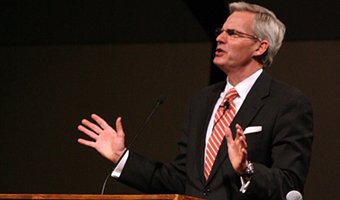
Christian ethicist David Gushee addresses sanctity of human life as a multi-faceted issue during a lecture series at the University of Mary Hardin-Baylor. (PHOTO/Jennifer Jones/UMHB)

“This includes human beings at any and every stage of life, from womb to tomb; in any and every state of consciousness; of any and every race, color, and ethnicity; of every level of intelligence; whatever their religion, language, nationality, or gender; of every type of character and behavior, physical ability or disability, potential, class and social status; and whether they are friends, strangers, or enemies to us. Everyone. No exceptions.”

Early Christian writings reflect a strong commitment to recognizing the sanctity of all people, said Gushee, speaking in a lecture series sponsored by the UMHB Center for Baptist Studies and the university’s honors program.

“Christians once changed the world through their Christ-drenched love for the abandoned of the world—lepers, slave, prostitutes, beggars, abandoned infants, and those condemned to die,” he said.

Today, many people associate sanctity of life only with discussions of abortion or capital punishment, but its implications actually are more far-reaching than those issues, Gushee emphasized.

“The sanctity of life is not a slogan,” he said. “It cannot be confined to a single issue, and it is not owned by any political party. The sanctity of life is God’s will for the world he has made.

“Honoring that sanctity is our comprehensive moral obligation as Christians. If God has decided that each and every life is sacred, then God’s people have no choice but to do the same.”


Texas Baptists commit $25,000 to Japanese relief effort

DALLAS – Texas Baptists have committed $25,000 to the Japanese Baptist Convention to help with the response effort in the wake of the March 11 earthquake and subsequent tsunami that devastated parts of the country.

Chris Liebrum, who leads Texas Baptist disaster response, said the funds will help Japanese Baptist leaders respond to immediate needs following the disaster. The funds will provide a way for Japanese Baptists to respond quickly and cost-effectively to the needs the see immediately. The Japanese convention is hoping to raise $100,000 to assist with the response effort.

Disaster casualties are still mounting, with latest media reports indicating nearly 1,900 people are dead and at least 3,000 people are missing. It’s estimated 450,000 people are living in shelters. Parts of the country do not have electricity or water. One nuclear power plant remains unstable.

“These funds are just the beginning of aid Texas Baptists hopes to provide to our brothers and sisters in Japan,” Liebrum said. “We are in regular contact with our partners working in the area, including Baptist World Aid, the Japanese Baptist Convention, Southern Baptist Convention International Mission Board and Cooperative Baptist Fellowship. As advanced teams do their work, they will identify needs and service opportunities that Texas Baptists will seek to meet as effectively and efficiently as possible.”

Texas Baptist Men stands ready to serve with two volunteers who are ready to travel to Japan to help serve as point people for Texas response efforts. Texas Baptist Men has committed $5,000 to help the Japanese Baptist Convention with its relief effort as well.

Yutaka Takarada, pastor of Japanese Baptist Church of North Texas in Dallas and member of the convention’s Executive Board, is communicating with Japanese Baptist leaders daily.

“Texas Baptists are truly blessed to have Yutaka Takarada,” Liebrum said. “His relationships with Japanese Baptists, his insight into Japanese culture and willingness to serve the convention already have proved invaluable in this process. We are grateful to him and for him.”

Mission opportunities will arise in the coming weeks and months, Liebrum said. As those opportunities become available, they will be posted at www.texasbaptists.org/disaster.


‘Love your neighbor’ more than a slogan, Garland tells Wayland event

PLAINVIEW—In the Parable of the Good Samaritan, Jesus gave the perfect example of what it means to love outcasts, recognizing all people as “fellow travelers” on life’s journey, New Testament scholar David Garland told a gathering at Wayland Baptist University.

Garland, dean of Baylor University’s Truett Theological Seminary in Waco, offered his insights on the parable from Luke’s Gospel during a banquet to open the annual Willson Lecture Series at Wayland.

“The magic of parables is that they give us a glimpse of the transcendent from the lens of the ordinary,” he said.


David Garland

While the conversation between Jesus and the expert in Jewish law might have looked like a casual exchange about eternal life and neighborly behavior, Garland said, the parable sheds light on the cultural biases of the day and the question of character.

The legal expert’s question—“What must I do to inherit eternal life?”—was meant to put Jesus to the test, but Jesus turned it around by asking how the law is written. Citing Deuteronomy, the lawyer noted commands to love God and love one’s neighbor as oneself. But wishing to test Jesus more, he asked, “Who is my neighbor?”

He raised the question not out of a desire to serve but out of a desire to build additional boundaries and limits on the law that he must follow, Garland observed. But Jesus expanded the boundaries.

While the priest and the Levite in the parable passed the beaten and robbed man on the other side of the road and refused to help, the Samaritan took pity and helped the injured man, providing resources to ensure the man’s recovery and comfort.

“Samaritans understand themselves to be under the same Mosaic law as the Israelites. He had no way of knowing who the man was or what he was,” Garland said. At the end of the parable, “Jesus requires the answer of ‘Who is my neighbor’ from the perspective of the man in need, which is a twist Jesus often invokes in his parables in Luke.”

The question then becomes whether a Jew in need would allow help from a Samaritan, for whom the Jews had little respect.

Theological conclusions from the parable include the pointlessness of the lawyer’s question to Jesus, since one cannot do anything to receive an inheritance, Garland said. “He is either an heir or he isn’t.”

The lawyer’s questions also reflect a misconception about what eternal life is, seeming to miss the point of the relationship with God that begins in this life, he noted.

Christians must see all humankind as their neighbors, as Jesus often modeled, Garland noted.

“This story really leads people to realize the ‘kin-dom’ of God that includes all fellow travelers on this journey,” he said. “Love your neighbor is not a slogan or a proverb. It is a divine command.”


Panhandle-Plains Conference celebrates God’s faithfulness

PLAINVIEW—With a nod to its humble beginnings and rich heritage, speakers at the 90th annual Panhandle-Plains Pastors’ and Laymen’s Conference at Wayland Baptist University said the continuous thread has been God’s faithfulness.

Howard Batson, pastor of First Baptist Church in Amarillo, preaches a sermon for the Pastors’ and Laymen’s Conference at Wayland Baptist University.

Gene Hawkins of Lubbock, a retired director of missions, listed preachers who had occupied the pulpit during the conference’s history, likening them to the “Hall of Faith” in the New Testament book of Hebrews, chapter 11.

“You don’t accomplish 90 years without there being a great demonstration of faith,” Hawkins said, noting such longtime pastors as W.A. Criswell from First Baptist Church in Dallas and Winfred Moore from First Baptist Church in Amarillo, as well as Doug Carver, U.S. Army chief of chaplains.

Although leaders are considering changes in the conference to involve more people from across the region, Hawkins said, it remains important to keep the spirit of the founders and maintain a lifestyle of faith.

“If it’s a relay race, then we have the responsibility to take the baton and carry it for the rest of our lives to the world around us, a world lost in sin,” Hawkins said. “We can be faithful in fulfilling the purpose of God today.”

Howard Batson, pastor of First Baptist Church in Amarillo, preached from 1 Kings 17, relating how God was faithful to the prophet Elijah both in mountaintop and valley experiences, occurring back to back.

“God is faithful on Mount Carmel and on Mount Horab,” Batson noted.

On Mount Carmel, Elijah set up two altars, challenging Baal worshippers to create a larger fire. While the people danced and chanted around the altar, nothing happened. Elijah then took water and doused the altar of God three times. Fire consumed the entire altar.


Richard Miller, pastor of Happy Union Baptist Church in Plainview, presents the solo during a choral anthem.

“We see the faithfulness of God in our victories, but is God still faithful in those quieter, still times?” Batson asked. “Sometimes our darkest days come after our brightest days.”

To illustrate that point, Batson described how Elijah ran for his life and hid in a cave at Mount Horeb, wondering where God was during that dark time. But God provided by giving him grace, rest, food and a chance to talk out his frustrations.

Christians can get discouraged after mountaintop experiences and experience low times in church work, Batson said. Often, people overestimate their problems and simply have to wait on God to speak and encourage them.

“Sometimes we prophets of God focus too much on ourselves,” Batson said. “Sometimes we come off a Mount Carmel experience into a Mount Horeb time. But at a time you do not know, God will be faithful to you there as well. The God of Mount Carmel is the God of Mount Horeb.”

The session also featured music from the Happy Union Baptist Church choir and a dramatic presentation by David Howle, associate professor of religion, portraying university founder James H. Wayland, a pioneer physician.

In character as Wayland, Howle closed his presentation by pulling an old compass from his pocket, noting how the device had kept him on course for years while covering the countryside to visit patients. Likewise, he noted, the Pastors’ and Laymen’s Conference had provided direction and leadership from God through ordinary individuals for 90 years.

“God has been leading all along, and he’ll lead us into the future,” he said.


Tuition Equalization Grant cuts have big impact on Texas Baptist schools

Proposed cuts in the Texas Tuition Equalization Grant program could have a major impact on Texas Baptist universities and many of their students, administrators at several schools noted.

The state-funded Tuition Equalization Grant—a need-based financial-aid program designed to help offset some tuition costs of Texas students who attend private universities—could face cuts of up to 41 percent as Texas lawmakers struggle with the state budget.

Of the $101.8 million in TEG funds allocated for 2011, more than $29 million benefits students in universities related to the Baptist General Convention of Texas, according to the Texas Higher Education Coordinating Board.

By far, the largest Texas Baptist recipient of TEG aid for students is Baylor University, drawing $12.3 million this year. As a point of comparison, the Baptist General Convention of Texas provides about $2.8 million to Baylor annually.

More than one-fourth of the undergraduates at Baylor University receive TEG assistance, said Tommye Lou Davis, Baylor vice president for constituent engagement. They include a significant number of first-generation college students and ethnic minorities, she added.

Cuts to the program would undercut Baylor’s efforts to increase ethnic and socio-economic diversity among its student body, Davis noted.

At $1.35 million this year, Howard Payne University receives the smallest amount of any BGCT-related schools, but that aid has a huge impact on a student population where more than 40 percent receive TEG assistance, said Brad Johnson, senior vice president for institutional advancement at the Brownwood school.

“These are tough times down there (in Austin), but I hope the legislators will realize what a bargain this program is for the state,” Johnson said. “The amount per student in the program is less than half what would be appropriated if that student were to transfer to a state institution.”

The average Tuition Equalization Grant in fiscal year 2009 was slightly more than 45 percent the estimated taxpayer contribution for each fulltime student in a state university, according to the Independent College and Universities of Texas website.

“In fiscal year 2009, if TEG recipients had enrolled at state universities, Texas taxpayers would have paid more than $232 million, or more than twice the appropriation for TEG,” the website states.

About 450 students a year at East Texas Baptist University—more than one-third of the total student population—benefit from the TEG program, which provides about $1.5 million in funding, said Tommy Young, the school’s director of financial aid.

“It would be a real disadvantage to students if the grants were cut,” Young said.

This academic year, Dallas Baptist University received more than $3.86 million in TEG funds for 1,150 students out of a total population of 2,949 fulltime students, said Lee Ferguson, the school’s director of financial aid.

At the University of Mary Hardin-Baylor, 1,032 students currently receive the grants, and another 1,025 qualified but did not receive the grant this year due to limited funds, said Ron Brown, director of financial aid at the Belton school. The program provided $3.9 million for UMHB students this year.

“The average household income for our students who receive TEG assistance is $43,715. This is not a rich man’s grant,” Brown said.


HPU to fight hunger through Empty Bowls project

BROWNWOOD—Howard Payne University students, faculty and staff members joined together to paint bowls for the upcoming Empty Bowls event sponsored by Good Samaritan Ministries. Ann Smith, chair of HPU’s art department, hosted the bowl-painting activity and provided instruction for volunteers.

Katie Curry, part-time youth ministry graduate program assistant, and Howard Payne University senior Molly Gore paint bowls for the Empty Bowls project on March 31. (Photo by Hannah Pippen/Howard Payne University)

Empty Bowls will be held March 31, 11 a.m. to 7 p.m., at the Brownwood Depot. Soup donated from area restaurants will be served in the hand-painted bowls. A silent auction also will be held throughout the day along with live music.

The cost is $10 per person. Ninety percent of the proceeds will go for local needs, while 10 percent will go to help address international hunger needs through Heifer International.

“Community involvement is so important to the effectiveness of this event because, not only does it raise money to provide food for the hungry people in our community, it brings awareness that we are living among those people. Awareness can lead people to act, and we’re hoping that Empty Bowls will encourage our community by showing that we can do something to help,” said Katie Curry, part-time youth ministry graduate program assistant at HPU, who is assisting in the planning of Empty Bowls.

This is the second Empty Bowls event to be held in Brownwood. Empty Bowls is a grassroots project of The Imagine/Render Group, a nonprofit organization dedicated to positive and lasting social change through the arts, education and projects that build community.


Three Hispanic evangelism conferences draw 3,400 participants

SAN ANTONIO—Evangelist Herman Rios urged people to give their lives to Christ. And that’s what they did at a Hispanic Evangelism Conference at South San Filadelfia Baptist Church in San Antonio.

Evangelist Herman Rios talks to participants at the Hispanic Evangelism Conference in San Antonio during the commitment time of the service. (PHOTO/John Hall/Texas Baptist Communications)

Event organizers recorded more than 250 decisions for Christ—including 147 professions of faith and 11 who felt called to vocational ministry—during Texas Baptists’ three Hispanic Evangelism Conferences, one each in Houston, El Paso and San Antonio during February.

“God’s still at work,” said Johnnie Musquiz, pastor of Primera Iglesia Bautista in Houston. “It’s a thrill for a church to see.”

The Hispanic Evangelism Conference, sponsored by the Baptist General Convention of Texas, has expanded in recent years from a single event in Houston. Organizers added a second conference in San Antonio three years ago. This year marked the first Hispanic Evangelism Conference in El Paso.

“There’s inspiration and training brought to their backyard,” said Hispanic Evangelism Director Frank Palos. “Economic constraints have made it difficult for people to get out of where they are. So, we’re coming to them, bringing much-needed evangelism training.”

Despite having to cancel one day of the Houston event due to bad weather, about 3,400 people attended the three events. Conference participants also gave $3,145 to missions through local ministries and the Texas Baptist Cooperative Program.

BGCT President Victor Rodriguez, pastor of South San Filadelfia Baptist Church, noted the conference in San Antonio reminded him of one- and two-week-long church revivals that took place when he was a child. Volunteers from South San Filadelfia Baptist Church, San Antonio Baptist Association and the BGCT eagerly prepared, excited to see how God would work. Volunteers were prepared to begin follow up with those who made spiritual decisions.

“Evangelism is still alive and well. That’s the core. That’s what’s going to move our churches, our convention,” he said.


CrossBridge sees itself as a lighthouse in darkness

CORPUS CHRISTI—At sundown, a ragtag group of Christians gathers in a small apartment in one of Corpus Christi’s roughest neighborhoods.

During one of CrossBridge Fellowship’s home team meetings, Adam Reyna and other church members pray.

They include a couple who met in a drug deal that didn’t work out, a security consultant who for reasons he can’t completely explain cares for this part of town that many people are trying to forget exists, a recovering alcoholic who is now a television clown and a pastor of a church no one believed would work.

Around a small table, they study the Bible, cry a little and laugh a lot in a meeting that feels more like a family reunion than an official gathering. And there’s always room for someone new. This night, the apartment door remains open, light piercing the surrounding darkness and inviting people to join them.

This group comprises one of the “home teams”—an off-campus small-group Bible study—for CrossBridge Fellowship. Second Baptist Church of Corpus Christi sponsors the church-start, with the help of gifts through the Baptist General Convention of Texas Cooperative Program and the Mary Hill Davis Offering for Texas Missions .

The church is anchored in a region of Corpus Christi that places roughly 1,600 calls to the police each month, member Jimmy Rodriguez said. Nationally, one in every 164 people is a victim of a violent crime such as murder, rape or armed robbery. Here, it’s one in every 32 people.

J.J. Pena flips through his new Bible from CrossBridge Fellowship in Corpus Christi. Pena and his family are involved in the church’s after-school program.

A memorial rests on a fence a short walk from the church, marking the place a young gang member lost his life while many people in the community looked on. Tennis shoes hang from a nearby power line, denoting a place where drugs are sold. Even the church hasn’t been immune from crime. The first week the church met, more than $15,000 in music equipment was stolen.

Many families here are broken, said Pastor Mario Quezada, who recalls people telling him he was stupid for attempting to start a church in the area. Some teens live alone because their parents are incarcerated. Some residents are addicted to drugs, alcohol or both. Financial pressures squeeze residents tightly. Gangs recruit children as young as 8 years old.

“This isn’t a good neighborhood in the least,” home team leader Hector Pena confessed. “To me … that’s how I see it. It’s a lighthouse. People are out to sea. This (church) is calling them home.”

CrossBridge gives people a choice—lives of drugs, dependency and struggles or the embrace of people who care about others, members said. Many have struggled with dependency in the past and face a variety of hardships now, meaning they welcome others without judgment. The congregation provides a refuge for wayward pilgrims.

“In this neighborhood, if you don’t have family, you go find family out there—either in the gangs or at CrossBridge Fellowship. I’m so glad we’re here,” said Crystal Womack, who met her husband, Lawrence, when he was selling drugs on the street.

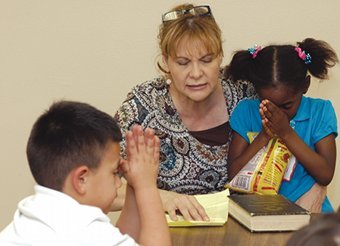
Shirley Graham, a volunteer from CrossBridge Fellowship’s sponsor church, Second Baptist Church in Corpus Christi, prays with children during the after-school program.

In an effort to engage all people in the neighborhood, the church attempts to eliminate barriers between it and the community. The church partners with the food bank to distribute food twice a month to as many as 200 people. It has partnered with its sponsor congregation, Second Baptist Church, to hand out about 300 backpacks full of school supplies to area children. It has provided shoes for more than 30 children.

Each week, the church conducts an after-school program that draws dozens of children from the apartments across the street from the congregation. Students eagerly hop off the school bus and into the arms of Quezada, Pena and other volunteers, including some from Second Baptist Church, which is committed to helping CrossBridge beyond finances.

Students enjoy a snack provided by the Woman’s Missionary Union of Second Baptist Church, participate in a Bible study and play on the community “park”—the church playground.

God is working through the ministry to provide beacons of light in the community. About 80 people attend worship services at the church each week. And Quezada added, “People get baptized nearly every month.”

This night, as the group was wrapping up, a woman walked through the open door. She saw the light and hoped it was a church meeting.

She had wrestled with drugs and alcohol and recently suffered a relapse. Struggling, she hoped to find someone who would pray for her.

She discovered a group of people who understood exactly where she was, because they’d been there, too. They visited with her for a short while, then circled around her and prayed for her. Afterward, a few of the women in the home team pulled her to the side and began visiting with her more.

“Home teams are really a big blessing,” said Adam Reyna, a recovering alcoholic. “The last home team, we talked about ‘Jesus with skin on.’ This is a church with walls down.”


Texas Tidbits

Buckner collaboration aids single-parent families. Buckner International has teamed up with Star of Hope Mission to provide a transitional program for single-parent families in Houston, focusing particularly on homeless families. Buckner Family Place of Houston residents will be enrolled in academic or vocational programs, receive housing and child-care assistance, and have access to counseling and case-management services.

ETBU has new address. East Texas Baptist University has a new street address, but the campus has not relocated. The Marshall City Commission recently approved a resolution changing Barney Carter Street to Tiger Drive, making One Tiger Drive the new physical address for ETBU.

HBU nursing school receives gift. Houston Baptist University’s School of Nursing and Allied Health received a $300,000 lead gift from Bruce and Mary Ann Belin that will enable the school to move forward with plans to modernize and enhance its nursing program and facilities. Once complete, the Mary Ann Belin Nursing and Allied Health Simulation Lab will allow the HBU School of Nursing to accommodate additional students by doubling both classroom capacity and lab space. The proposed expansion also will make room for new equipment, including a fully simulative training environment featuring a nursing station, computer desks, sinks, beds and an IV simulator.

Grant aids BCFS youth program. Baptist Child & Family Services will launch a three-year education and job-training program for drop-outs in the Kerrville area, thanks to a more than $881,000 grant from the U.S. Department of Labor. Youth eligible for services are Kerr County residents, ages 16 to 24, who dropped out of school, are transitioning out of the Texas foster care or juvenile justice systems, or who are from low-income homes. Students will spend half their day in school and the other half working on construction projects through Habitat for Humanity, building homes for low-income families. 

Utley commentaries available online. Bible commentaries and study aids written by Bob Utley, retired professor of religion at East Texas Baptist University, are now available in an open access collection at http://site.ebrary.com/lib/etbu. Created by the university’s librarians, the new site includes materials in English and Russian, with additional languages to be added in the upcoming weeks.

Senior saint summit set at UMHB. Pastor Andy Davis from First Baptist Church in Belton will preach and Pastor Ronnie Hood from Canyon Creek Baptist Church in Temple will lead the Bible study at the Senior Adult Summit, May 16-19 at the University of Mary Hardin-Baylor in Belton. “A Blast from the Past” is the summit theme. The Central Texas Master Singers and the choir and orchestra from First Baptist Church in Belton will perform concerts during the event for adults age 55 and older. The choir from Crestview Baptist Church in Georgetown also will participate. For more information, contact wmuske@umhb.edu.