Texas Baptists Committed leaders stress desire to support the BGCT
Some Texas Baptists have asked why an organization birthed in denominational controversy continues to exist when any battles for control of the state convention ended years ago. Michael Bell, chairman of Texas Baptists Committed, raises a different question.
“If we are walking along the same path, why are there two state conventions in Texas relating to the Southern Baptist Convention?” he asked.
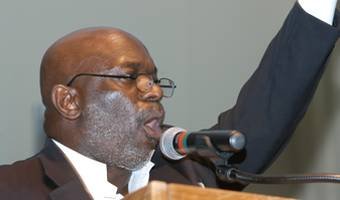
Michael Bell
|
The reason, he insisted, is that while the two paths represented by the state conventions run parallel at some points, they diverge widely at others.
The Baptist General Convention of Texas remains committed to the historic Baptist principles of local church autonomy and the priesthood of believers, said Bell, pastor of Greater Saint Stephen First Baptist Church in Fort Worth.
The vast majority of BGCT-affiliated churches choose to relate to the SBC. Others affiliate with the Cooperative Baptist Fellowship or relate to other national or international groups. “That’s their choice. That’s their business,” Bell said.
The competing Southern Baptists of Texas Convention, on the other hand, cites two criteria as the basis for fellowship—doctrinal adherence to the 2000 Baptist Faith & Message confessional statement and missiological commitment to working with the national Southern Baptist Convention by giving through the Cooperative Program unified budget.
From Bell’s perspective, it means a requirement “that churches should walk in lockstep.”
As long as a second state convention in Texas competes with the BGCT for the allegiance of churches, Texas Baptist Committed has an important role to fulfill, he said.
“We want to be promoters and supporters of the BGCT rather than detractors and disparagers,” Bell said. “We know the convention faces challenges, but we don’t see the glass as half empty. We see it as half full. In fact, we are looking for a bigger glass.”

Ken Coffee
|
Ken Coffee, who retired from the BGCT Executive Board staff as associate executive director of the State Missions Commission and served previously as an associational director of missions, likewise sees both challenges and opportunities for the BGCT. He writes about both in his blog, “Strong Coffee.” But he sees Texas Baptists Committed as a major part of the problem in Texas Baptist life, not its solution.
“It seems to me that if there was a collective mistake by the convention as a whole, it was standing by to allow members of Texas Baptists Committed to get such a stranglehold on the affairs of the body,” he wrote in his blog.
“The convention should have stood up and screamed, ‘Enough!' years ago, when it became obvious that this body-within-the-body had garnered for itself too much power over the processes of the convention. We must never again allow such a thing to happen.” In an interview, Coffee explained he never felt the BGCT needed Texas Baptists Committed. While he counts many of the people involved in Texas Baptists Committed as friends, he said, he never agreed with having political organizations within state convention life.
“We are better off pulling together than pulling apart,” he said, emphasizing his belief Texas Baptists Committed played a role in “driving a wedge between people in the convention.” “
As long as Texas Baptists Committed exists, there also exists enmity between brothers. To my way of thinking, such is not needed in the BGCT. It’s not healthy,” he said.
Furthermore, Coffee added, Texas Baptists Committed effectively did at the state level “what fundamentalists in the Southern Baptist Convention did” nationally—rallied messengers to vote at the convention’s annual meeting, successfully got their candidates elected and influenced the process for nominating committee members, trustees and directors of boards.
“TBC became what they hated,” he asserted. “I don’t believe fundamentalism is limited to the right wing.”
Bell disputed that characterization. Texas Baptists Committed has no desire to be “a meddling influence” in the state convention, he insisted.
“We want to walk with the convention, not—as some have said—arrogantly imposing our will on the convention. That is the stuff of fantasy,” he said.
The organization ceased endorsing candidates for BGCT office several years ago, and even when it did, Texas Baptists Committed did not control decisions made by convention officers, Bell maintained.
“No one from TBM picked up the phone and told those intelligent and qualified people, ‘This is what you need to do,’” he said.
Twenty year ago, Texas Baptists Committed focused on encouraging like-minded Baptists around the state to attend BGCT annual meetings and vote on critical issues. But today, key decisions affecting the BGCT typically are made in local churches—most often when pastors move from one congregation to another. Changes in denominational alignment often follow changes in pastoral leadership.
“We want to provide information to pastorless churches so they can make better-informed choices as far as leadership is concerned,” Bell said. “We come only if we are invited. We just want to be a resource.”
Since Texas Baptists Committed began distributing a weekly electronic newsletter in May, the group has received requests for information from churches without pastors, said Bill Jones, associate executive director for the organization.
“We’ve also been encouraged by the number of responses we’ve had from people who said: ‘We’re glad you’re back. We were afraid you wouldn’t be around any more. You’re still needed,’” he said.
Still, he acknowledged the organization no longer has the high-profile presence it once enjoyed in Texas Baptist life. At the high point of its influence, Texas Baptists Committed mobilized thousands of messengers from churches around the state to attend BGCT annual meetings and elect a series of officers endorsed by the group—including the state convention’s first Hispanic, African-American and female presidents.
The organization’s database includes the names of more than 20,000 people who at one time were involved with the group. Distribution of the e-mail newsletter is limited to about 1,500, Jones said.
The organization lacks an executive director. Its office in San Angelo closed. And financially, Bell said, “We are like
most nonprofit organizations, and we all face the same struggles in this economy.”
However, after a hiatus, Texas Baptists Committed plans to resume holding a breakfast event in conjunction with the BGCT annual meeting in Amarillo and staff a booth in the convention exhibit hall, he said. Details for the breakfast event still are pending.

Phil Lineberger
|
The BGCT needs advocates—particularly among the young generation of church leaders—and Texas Baptists Committed can help fulfill that role, said Phil Lineberger, vice chairman of the organization.
Some churches view denominational organizations as irrelevant entities “relegated to the past,” but Texas Baptists Committed can help young leaders understand the good work done through the BGCT and its related institutions, said Lineberger, pastor of Sugar Land Baptist Church, near Houston.
Many young pastors have a passionate desire to make an impact on their communities and the world, he noted. Veteran pastors can help them recognize the value in working cooperatively through the BGCT, rather than working in isolation.
“We want to be a support to the BGCT and encourage people to stay involved,” he said. “We want to be a resource to Texas Baptist churches.”