Texas Tidbits

ETBU expands relationship with Chinese college. Officials from East Texas Baptist University and Guandong Teachers College of Foreign Language and Arts of Guangzhou, China, recently signed agreements that will continue and expand a 20-year relationship between the two schools. The agreement allows professors and students from both schools to exchange campuses for a semester or longer. Li Qusheng, party secretary of the Guandong Teachers College and chief executive official of the school system, signed the agreement along with ETBU President Dub Oliver.

Orosco to address TBC Event. Ellis Orosco, pastor of First Baptist Church in Richardson, will speak at the Texas Baptists Committed breakfast, scheduled in conjunction with the Baptist General Convention of Texas annual meeting in Amarillo. The breakfast will be at 6:30 a.m. Oct. 25 in the Amarillo Civic Center and will conclude by 8 a.m., in time for participants to join in "Igniting Hope in the Community" ministry and service projects.

BCFS receives healthcare grant for colonias. The Texas Health and Human Services Commission awarded Baptist Child & Family Services a $150,000 grant to increase access to and improve the quality of health and medical care for more than 1,400 families living in Webb and Zapata County colonias. The grant is for one year with the possibility of extension. The BCFS health initiative will improve access to immunizations, vision and hearing screenings, dental health, and disease management programs, and it will include educational programs in nutrition and health. The initiative expands BCFS community-based programs that provide mobile community-based medical care and case management services to colonia residents.

South Texas School, HSU provide undergraduate classes. The South Texas School of Christian Studies in Corpus Christi is offering classes leading to a bachelor's degree through a partnership with Hardin-Simmons University. Through Hardin-Simmons, the South Texas School of Christian Studies offers three undergraduate degree programs—a bachelor of arts in religion, a bachelor of arts in biblical studies and a bachelor of behavioral science in ministry. Hardin-Simmons University's Logsdon Seminary already offered graduate-level theological classes through the school.

Baylor prof receives NEH grant. Sarah-Jane Murray, associate professor in the Great Texts program in the Honors College at Baylor University and resident scholar at Baylor's Institute for Studies of Religion, has received a $210,000 grant from the National Endowment for the Humanities to translate the Ovide moralisé from Old French into English. An anonymous Franciscan friar composed the Ovide moralisé—14th century French interpretation of an epic poem by the Roman writer Ovid—to guide Christian readers on a redemptive quest.


On the Move

John Jay Alvaro to Wilshire Church in Dallas as a pastoral resident.

Colby Benavides has resigned as youth minister at First Church in Mathis.

Bob Billups to First Church in Midland as senior associate pastor from First Church in Denton.

Adam Brock to First Church in Clyde as minister of youth.

Jon Burton has resigned as youth minister at Calvary Church in Abilene.

Ryan Busby to First Church in Baird as minister of youth.

Adan Cancino has resigned as pastor of Iglesia La Esperanza in George West.

Ron Earley to First Church in Portland as pastor from First Church in Kingsville.

Matt Edwards to Faith Community Church in Paradise as pastor from First Church in Seminole.

Morris Kamire to Bethel Church in Rockport as pastor.

Todd Nivens to First Church in Grapeland as pastor.

Kristin Pool to Calvary Church in Tyler as children's ministry coordinator.

Annette Thornburg to Wilshire Church in Dallas a pastoral resident.

David Tull to Pleasant Valley Church in Jonesboro as pastor.

Milton Tyler has completed an interim pastorate at First Church in Sonora and has begun a new interim pastorate at Immanuel Church in San Angelo.

Phil Wheeler to Amazing Grace Church in Seguin as music minister.

Susan Womack to First Church in Waco as intentional interim minister to children.

Jerry Young to Mount Vernon Church in Kennard as pastor.


Around the State

Hardin-Simmons University will host the 2011 Southwest Conference on Christianity and Literature Sept. 29-Oct. 1. The conference is an enrichment opportunity for scholars who teach in fields that connect religion and literature, especially English, theology and philosophy.

The Cici's Pizza Barefoot Run, benefiting Shoes for Orphan Souls, will be held at 8 a.m. Oct. 8 at Andy Brown Park East in Coppell. The 5K and 1-mile fun run is open to children and adults, and shoes are considered "optional," said Rachel Garton, director of Shoes for Orphan Souls. "Barefoot running has become a popular trend, but it's something the kids we serve around the world face every day. They run barefoot because they have to, not by choice. We hope that by hosting a barefoot run we can help raise awareness of the need for shoes and have fun, as well." Prizes and medals will be awarded to the winners who run the race barefoot or with shoes. Special games and activities, like the Shoe-put Toss, also will be offered for children or adults who participate. All proceeds from the race will benefit children in Africa who need shoes. To sign up for the race, visit www.shoesfororphansouls.org/barefootrun.

Dallas Baptist University will hold a preview day for prospective students Oct. 10. The day allows students who are out of school for Columbus Day to visit DBU and experience university life. Included will be a tour of the campus, visits with faculty and administrators, and an opportunity to receive information about admissions, financial aid and campus life. Visitors also will have an opportunity to attend a chapel service and eat in the cafeteria. The event is free for the student and up to two guests. For more information, call (214) 333-5360.

"Blue & Gold Forever—A Legacy that Lasts" is the theme for East Texas Baptist University's homecoming activities Oct. 14-16. For a complete schedule of activities, go to www.etbu.edu.

Bill Ellis, president of Howard Payne University, has been elected to the board of the International Association of Baptist Colleges and Universities.

Anniversaries

Mike Simmons, 20th, as pastor of Hillcrest Church in Cedar Hill, Sept. 8.

Field Street Church in Cleburne, 100th, Oct. 1-2. The Saturday dinner begins at 6 p.m. and includes music and remembrances in the Family Life Center. A centennial worship service also will be held at 10:30 a.m. on Sunday. Former pastor Douglas Laird plans to attend. Reservations for Saturday's dinner can be made at (817) 645-4376. John Hall is pastor.

Frio River Association, 50th, Oct. 15. First Church in Devine will host the annual meeting and anniversary celebration from 11 a.m. to 4 p.m. Former director of missions James Watson will preach the annual meeting sermon. A barbecue lunch will be provided. A children's fun zone will include inflatables. Missionaries to South Central Asia, Craig and Terry Keller, also will speak. Jimmy Smith is director of missions.

Calvary Church in Lufkin, 100th, Oct. 15-16. Saturday activities begins at 2 p.m. with individual and group singing. An anniversary choir rehearsal begins at 3:30 p.m. At 4:15 p.m., a fellowship of family fun with a bounce house and other outside games will be held. Sunday's activities begin at 9:30 a.m. with a joint adult Sunday school in the sanctuary. Former pastor Lewis Abbott will speak in the morning service, and former minister of music David Campbell will lead worship. A meal will follow the morning service. Randy Brown is pastor.

Palo Duro Church near Wildorado, 110th, Oct. 23. A meal will follow the morning worship service. An anniversary celebration and reception will begin at 2 p.m. Ron Muller is pastor.

Travis Avenue Church in Fort Worth, 100th, November 5. The celebration will be held at the Omni Hotel and begins with a coffee reception at 10:30 a.m. and continues with the luncheon and program at 11 a.m. Tickets are $25, which includes valet parking at the hotel or free bus transportation from the church (with reservation). Childcare also is available by reservation. Tickets may be reserved by calling the church office at (817) 924-4266 before Oct. 19. Michael Dean is pastor.

Deaths

Delfina Garza, 67, Aug. 7 in Rockport. Her husband, Pablo, was pastor of Bethel Church in Rockport until his death. She is survived by her sons, Pablo Jr., Joe and Mark; daughters, Graciela Romero, Christina Garza, Priscilda Garza and Thelma Hinojosa; brothers, Amado and Arnoldo Rios; sisters, Ida Moreno, Rosie Garza and Thelma DeLeon; 15 grandchildren; and 18 great-grandchildren.

Fred DeVaney, 91, Aug. 28 in San Angelo. A graduate of Baylor University and South-western Seminary, he was pastor of McClanahan Church in Marlin, Blue Ridge Church in Reagan, and a church in Troy. He also served several Central Texas churches as interim pastor. He was a member of First Church in San Angelo at the time of his death. He was preceded in death by his brother, Jack. He is survived by his wife of 65 years, Lola.

Tim Martin, 43, Sept. 13 in Honey Grove. An avid motorcycle rider, he hit a bull that had wandered into the roadway in the early morning hours. He had served as minister of music and youth at First Church in Bogata the last three years. He was preceded in death by his father, Ronnie. He is survived by his wife of six years, Shawna; mother, Barbara Martin; brother, Marty; and grandmother, Margie Martin.

Doyle Lumpkin, 89, Sept. 17 in San Angelo. A graduate of Southwestern Seminary, he was a pastor in Texas, Arkansas and Oklahoma. His Air Force career spanned 28 years in active duty, the Air Force Reserves and Air National Guard. As Air Force chaplain, he retired as a major. He also served as a hospital chaplain in Oklahoma and Arkansas. He retired in 1985 from the missions department of the Arkansas Baptist State Convention. After retirement, he and his wife spent 23 months in Germany as volunteers with the Foreign Mission Board. He moved to San Angelo in 1990 and was a member of First Church in San Angelo. He was preceded in death by his wife of 62 years, Marie. He is survived by his sons, David, Daniel and James; daughters, Elizabeth Murphy and Nancy Kane; 10 grandchildren; and 13 great-grandchildren.

Ordained

Robert Hatfield to the ministry at First Church in George West.

• Steve Callaway, John Cox, Mike McFarland, Daniel Thiebaud and Jeff Timmons as deacons at First Church in Dublin, Sept. 18.

Bill Barnett as a deacon at First Church in Smithfield.

James Peregory and Kevin Graham as deacons at Cibolo Valley Church in Cibolo.

Revival

First Church, Odem; Oct. 16-19; evangelist, Mike Keahbone; music, Jim and Rhonda Willeford; pastor, Willis Moore.


For some, success means going back to rough neighborhoods

WACO—Alexie Torres-Flemming grew up in the South Bronx projects surrounded by difficulty. About half the residents there were impoverished, and 30 percent of men were unemployed.

By her own description, people would have described her as “at-risk” of becoming pregnant as a teen, of dropping out and of any number of problems.

People who saw promise in Torres-Flemming as a smart and hard-working girl told her if she wanted to succeed, she needed to escape her surroundings.

Kathy Dudley

Kathy Dudley

“The measure of my success would be how … far away from community and my family I could get,” she said.

By that gauge, Torres-Flemming succeeded. She graduated from college and got a prestigious job in public relations. She travelled. She lived in Manhattan. She made it—to a place where she wasn’t happy. She was still at-risk, she said.

“I was at-risk of losing myself, losing my soul,” she said.

Looking for purpose and satisfaction, Torres-Flemming found herself in her old neighborhood. She walked into her old church, where she found a small group of members starting a community action group. There were seven crack houses near the church. Drug trafficking took place at a nearby gas station.

The church had had enough. Members were organizing a march to “pray the devil out” of the houses and gas station. Torres-Flemming jumped right in. Soon after, she joined several hundred people in prayer walking the area.

For Torres-Flemming, that was just the beginning. Drug dealers exacted their revenge on the church shortly after, burning its buildings to the ground. The church announced it was organizing another prayer march. The pastor received daily death threats, and he resorted to wearing a bulletproof vest. Church members also were threatened.

Still, roughly 1,200 people marched two weeks later, including Torres-Flemming and her father. This was her home. She would continue ministering in it, starting Youth Ministries for Peace and Justice, an outreach to area young people.

Now she delivers a message she wishes she could have heard: Each person is God’s child, not a statistic waiting to happen.

“Every day I had to look into young people’s eyes and say: ‘You are God’s beloved. You are not to be pitied. You are to be loved. You are to be fought for,’” she said during the No Need Among You Conference, a Christian community development training event in Waco.

Christ calls his followers to make a difference in communities where people are hurting and struggling, Torres-Flemming said.

“We must go with a fire in our hearts as if we were walking into that dark crack house and our baby was in there,” she said.

Experience with difficult circumstances can draw people to make a difference, such as Torres-Flemming and Kathy Dudley, another featured speaker at the conference.

Dudley is the 12th daughter of sharecroppers. Her dad was smart but illiterate and for a time was an alcoholic. An encounter with Christ ended his dependence on alcohol. From that moment, Dudley set out to minister to the poor.

Dudley and her husband began taking in people in need. The effort developed into a nonprofit organization where people would open up their houses and allow homeless people to live with them. Since then, she has started three more nonprofit ministry organizations, each seeking to help the impoverished in the Dallas-Fort Worth area.

“If ever there was a time we need transformational leaders, it is now,” she said.

Dudley moved into an impoverished area so she could better serve. Community development starts with spending extensive amounts of “porch time” visiting with the community a person seeks to help, she said.

Through relationships, community developers can discover neighborhood needs, and community members can participate in obtaining solutions to problems.

“Many of us want to ride in on our white horse and ride out with all the accolades,” she said. “It doesn’t work that way. In fact, if we ride in like that, we will probably do more harm.”

Many Christians are responding to the cries of the poor, Dudley said. Churches are attempting to reach into pockets of poverty and work with people to alleviate struggles.

“I believe the church is the dominant vehicle God wants to use to change the world,” she said.

“I think we’re doing pretty good. I may be different in that than some people. But we have a long way to go.”


Poverty in the suburbs looks different that urban models

WACO—When poverty moves to the suburbs, it looks different than urban poverty and requires different ministry strategies, the cofounders of Mission Cy-Fair in northwest Houston told a Christian community development conference.

Elliott Scott, pastor of Lifepath Church, and Susan Nichols, executive director of Mission Cy-Fair, led a workshop on poverty in the suburbs as part of the No Need Among You conference in Waco.

Mission Cy-air

Training for volunteers at The Bridge, a ministry of Mission Cy-Fair in Houston.

Nichols worked 18 years in urban ministry before she moved to Cy-Fair, a mostly unincorporated area in northwest Houston where 750,000 people live, and 50 percent of the students in the school district qualify for free or reduced lunches.

She noted key differences between urban and suburban poverty:

• Expectations. Urban poverty is expected; suburban poverty is unexpected. “In the inner-city, perception is reality. In the suburbs, perception is disbelief,” she said. People expect a certain amount of poverty and homelessness in urban areas, but affluent suburban-dwellers may be shocked to learn large pockets of poverty exist just a few miles from where they live.

• IMBY vs. NIMBY. Urban poverty is “in my back yard by definition,” Nichols noted. On the other hand, many suburban-dwellers mistakenly believe poverty and its attendant problems are “not in my back yard.” Signs of poverty that appear clearly visible in blighted urban areas may exist just beneath the surface in suburbia.

• Distance. In urban areas, poverty exists in concentrated areas, but in the suburbs, it is spread out. That makes suburban poverty more difficult to target.

• Transportation. The urban poor often can access services through public transportation if someone provides them with the fare required. In the suburbs, public transportation typically is limited or nonexistent.

• Services.
Longstanding nonprofit organizations and ministries serve urban areas. Many suburban areas lack these nonprofit agencies, and if they are unincorporated areas, they also lack municipal services.

• Diversity.
Urban areas are known for their cultural diversity. Young suburban-dwellers typically know about their community’s cultural diversity, but older residents may still think of their areas as almost exclusively Anglo. For instance, the Cy-Fair schools were 90 percent Anglo in the mid-1970s. Today, they are 28 percent Anglo, and there are 97 languages and dialects spoken in students’ homes, but older residents may not understand that.

• Homelessness. In contrast to the clearly visible chronically homeless who live on the streets and in the shelters of urban areas, the suburbs have an invisible transitionally homeless population who move frequently.

• Old vs. new. Poor people in cities generally live in run-down, dilapidated buildings. The homes of suburban poor typically are less than 30 years old, and they may not immediately appear to be in disrepair. However, some lack utilities, and many soon will begin to show the effects of deferred maintenance.

• Multihousing.
In the inner-cities, multihousing typically means tenements or government projects. In the suburbs, multihousing means multiple families—or at least multiple generations of extended families—living together in single-family dwellings.

As communities change socio-economically, churches typically respond in one of three ways, Elliott observed. They may try to ignore the change, they may relocate to an area away from perceived problems, or they may try to engage the community.

Lifepath Church chose the latter option by meeting in a school in the area of greatest need, he noted. The church also is seeking to partner with the school and other groups in the community to raise awareness, equip volunteers and mobilize workers.


Christians need to embrace transformational gospel

WACO—God calls his people not only to seek the salvation of individuals for eternity, but also to bring about societal transformation in the present world, Bob Roberts told a Christian community development conference.

Bob Roberts

Bob Roberts

“God expects his kingdom to come here and now,” Roberts, founding senior pastor of NorthWood Church in Keller, told the No Need Among You Conference in Waco.

The New Testament book of Colossians teaches God intended Christ’s sacrificial death “to reconcile to himself all things, whether things on earth or things in heaven,” Roberts emphasized. The gospel of the kingdom involves obedient Christ-followers engaging in all the domains of society with a goal of reconciling them to God.

For missional transformation to occur, Christians must:

• Move from a gospel of salvation to a gospel of the kingdom.
Individual salvation marks the starting point, not the end goal. Christians want other people to come to faith in Christ, but a focus only on individual salvation can lead to tribal and consumeristic attitudes toward faith, he asserted. In contrast, he said, “The gospel of the kingdom is very fluid and about transformation.”

• Move from the grid of the church to the grid of society.
Rather than focusing on performance at the Sunday event, the church should emphasize equipping disciples for service the other six days each week, he stressed.

“It’s a focus on the disciple and the society, not the preacher and the church,” he said. “It’s the church scattered, not just the church gathered.”

• Move from the concept of vocational ministry to the released church.
A missional church helps members view their workplace as their place of ministry.

“We must loose them and let them go—release the whole body of Christ,” Roberts said. The challenge to “learn, grow and go” proves inadequate because Christians may never feel they have learned enough and grown enough to go out and serve. Instead, the command should be “hear and obey,” he said.

• Move from isolated tribal faith to integrated city engagement. This represents a continuing challenge because it pushes churches outside what is comfortable and familiar.

“We know how to make the gospel relevant to suburban America, but we do not have a clue how to do it in a multiethnic, multifaith global world.”

No Need Among You conference sponsors included Mission Waco, the Baylor University School of Social Work’s Center for Family and Community Ministries, the Baptist General Convention of Texas, Buckner International, Baptist University of the Américas and Waco Regional Baptist Association.


Economic & policy factors make life tough for Texas children

WACO—Children are not doing well in Texas—at least, many are not, Frances Deviney told the No Need Among You conference in Waco.

Deviney, director of the Texas Kids Count program at the Center for Public Policy Priorities in Austin, painted a statistical picture of the plight of children in Texas.  But, “it’s not about the numbers; it’s about the people behind the numbers,” she said.

children in poverty

Texas once again ranks in the bottom third of states in children’s well-being, according to a study by Center for Public Policy Priorities in Austin.

Speaking to Christian community ministry leaders, Deviney said, “The work you guys are doing is critical, but you can’t do it alone.” She works with public policy responses to issues related to children. “We have to have additional solutions to support you so that you do not get overrun.”

Texas Kids Count is part of a broad national effort funded by the Annie E. Casey Foundation. It has sought to collect data about the actual situation of children so lawmakers and others will not have to rely simply on anecdotal information in making decisions. And that situation is greatly affected by the economic situation.

Deviney reported:

• In the United States, 2.4 million kids have become poor since 2000. Of those, one of every six lives in Texas. “We have a much greater share of the poor,” Deviney said. When a household falls into poverty, children are exposed to increased parental distress, inadequate childcare, poor nutrition and negative health outcomes.

• Nine percent of Texas children (607,000) had at least one unemployed parent in 2010, up from five percent (303,000) in 2007. The number has doubled, and unemployment means lost income and lost health insurance.

• Texas added nearly 281,000 jobs from 2007 to 2010, but the Texas working-age population grew by 22.5 percent, twice the national rate. The result has been higher unemployment even with the increase in the number of jobs.

Frances Deviney

Frances Deviney

• Texas is tied with Mississippi for the highest percentage of low-wage jobs in the country. “The majority of people living in poverty are working full time,” Deviney said.

• Housing costs hit the poor hard. Low-income homeowners spend an average of 53 percent of their income on housing, compared to six percent among higher income families. And among renters, low-income households spend 71 percent on housing compared to two percent by higher income households. This is a “huge divide,” she said.

• Texas had the highest rate of uninsured children in the nation for 11 straight years, through 2008. They gave up that top ranking one year, then gained it back in 2010, Deviney said.

• Education is not good for Texas kids either. Texas is fifth-lowest in per pupil expenditures in 2011, and this year’s legislature cut funding more. Texas also is in the bottom quarter of states for reading proficiency, which is the skill which makes other learning possible.

• Texas has a regressive tax policy because of its heavy dependence on sales taxes. Consequently, the lowest income households pay the highest percentage of state and local taxes. Households below $29,233 annual income paid 13.7 percent of their income toward taxes, while households with income above $126,460 paid 3.6 percent of their income.
Deviney’s Center for Public Policy Priorities follows a two-generation strategy for addressing the problems related to Texas children and seeks to put families on a “path to economic success,” she said.

Families can be strengthened on the policy side by strengthening two federal programs—Earned Income Tax Credits and Supplemental Nutrition Assistance Program (Food Stamps), Deviney said. Also, health care needs to be more affordable and accessible, since medical expenses are the number one reason for bankruptcies.

The poor need to be encouraged to increase savings and be made aware of “tax time savings tools,” she said. And finally, they need protection from the predatory practices of payday lenders.

“Help children to reach their full potential,” Deviney said, by supporting responsible parenthood, increasing prenatal care for mothers-to-be, ensuring children are developmentally ready for school and promoting reading proficiency by the end of the third grade.

“We know that success can occur,” she said. “We just have to … consider what our priorities are.” Bringing jobs to Texas is critical, but low-paying jobs are not a long-term solution. Texas needs to “create a space for families to succeed,” she insisted.

The No Need Among You” conference each year attracts leaders of Christian ministries from around the state. It is sponsored by nine organizations, including the Baptist General Convention of Texas, the Baylor University School of Social Work, Buckner International, Baptist University of the Américas and Waco Regional Baptist Association.


Dorrell: Four characteristics of Christian community development

WACO—Four distinctive attributes should characterize Christian community development, Mission Waco Executive Director Jimmy Dorrell told the No Need Among You conference in Waco.

• Compassion.
Christians should not treat the needs of poor people as a Thanksgiving or Christmas project to be adopted, Dorrell insisted.

Jimmy Dorrell (right), founder of Mission Waco and pastor of Church Under the Bridge, stands next to Kenneth Kucker (left), who prepares to lead the congregation in a prayer. Kucker was one of the first members of Church Under the Bridge when it began in 1992. (PHOTO/Grace Gaddy) 

“In America, we have reduced concern for the poor to end-of-the-year guilt-relief projects,” he said. Instead, Christian should enter the pain of the poor—even relocating to live among hurting people for the long term.

• Empowerment. “Use the people with the problem to address the problem,” he said. “See the potential among the poor.”

To recognize how poor people can deal with their own problems, the Christian community developer must take the time to develop relationships and learn who the natural leaders are in the community. “It means hanging out long before the program is created,” he said.

• Courage. Living among the poor means taking some risks, and dangers are magnified for parents with children, he acknowledged.

However, Dorrell noted, because his children grew up in a racially, culturally and socio-economically diverse neighborhood, they had advantages children attending high-ranking racially homogenous schools lack.

“My kids have no problem living and working among people who are different from them,” he said.

• Enjoyment. Relax and take delight in the surprises that ministry among the poor offers, Dorrell suggested.

He described the creativity and spontaneity—and the stark honesty—of the Church Under the Bridge, the multicultural congregation he leads under the Interstate 35 overpass.

“I would never go back to the world I came from,” he said. “I could never go back to boring, middle-class white church.”


Texas Baptists minister to needs caused by Texas wildfires

BASTROP (ABP) — Dan Franklin couldn’t even smell the scent of smoke Friday that entailed the destruction of about 1,500 homes, the burning of about 34,000 acres and the loss of two lives. The volunteer chaplain with the Texas Baptist chaplaincy office nevertheless witnessed the personal toll of the Texas fires in Bastrop County north of Austin.

Texas Baptist men feed firefighters in Bastrop. (TBM photo)

“One lost his house,” he said of a man he met at a small camp where members of the Texas Baptist Men Disaster Relief organization fed firefighters. “He is talking pretty well, but I know it’s hard. He needed to talk a lot. It’s a horrible situation.”

Franklin said firefighters struggle with hard decisions such as deciding which house to save when there is time to save only one.

Senior Pastor Richard Shahan of Calvary Baptist Church in Bastrop lost his home, as did several others in his church. He and his family are staying with a member of his congregation until they can move to an apartment provided by his insurance company.

When he received word of the fire, Shahan was told he had half an hour before the fire took his home. His attitude has been one of acceptance and turning to God. So have those of church members he has spoken to who had even less time to escape.

“Okay, we're like Job,” Shahan said. “The Lord giveth, and the Lord taketh away. Blessed be the name of the Lord.”

The fire was 60 percent contained by Monday [Sept. 12], although other fires continued to burn throughout Texas.

In the week leading up to Saturday [Sept. 10], the Texas Forest Service responded to 179 fires that have burned 170,686 acres.


Authorities say wildfires roaring across Texas are coming slowly under control. (TBM photo)

A fire in Cass County in East Texas burned about 40,500 acres and destroyed 28 homes. It is 80 percent contained. The Riley Road Fire northwest of Houston burned about 19,000 acres, is 75 percent contained and has destroyed at least 59 homes.

An extreme drought situation in Texas has set the state aflame. Out of 254 Texas counties, 250 have reported burn bans, but anything from a welder’s slag to a spark from a chain striking the road have been known to cause fires, Texas Forest Service representatives have said.

Those dry conditions and high winds made the Bastrop Complex Fire explode to more than 1,000 acres within a few hours, Pastor Raymond Edge of First Baptist Church in Bastrop said.

“In the afternoon, around 3 p.m., a member called and said, ‘Because of the fire I need to get out.’” Edge said. “I said, ‘What fire?’ We didn’t know about it downtown.… Some got out with what they had on — it was that quick.”

Within the next few days, it would be the central topic for the thousands displaced. People would meet each other in the area grocery stores and hug and cry together in the aisles, Edge said.

“It has touched the entire community,” Edge said.

With the fire more under control, cleanup may be next for the area, Dick Talley, disaster relief director for Texas Baptist Men, said.

Talley said the focus of the fire is now on hotspots in the interior. Neighborhoods in Bastrop are slowly opening back up. He said only about 260 people were in area shelters as of Sept. 9.

“You’ve got a lot of people who are in shock right now,” Talley said. “The biggest thing is to pray for the victims and the workers. Most are volunteer firefighters. They’re all tired and worn out.”

For now Talley said the best way people can help — along with prayer — is monetary donations. It is difficult to tell what will be needed at any given moment, he explained, and many of the supplies that people traditionally donate can be a burden on families who have no place to store them.

Edge said First Baptist Church in Bastrop has about three warehouses full of clothing. Area churches including First Baptist Church in Austin are holding special offerings to bring relief.

Edge said his church plans to use land for a planned expansion of the church as a staging area for chainsaw gangs to help clear away debris.

“It has been quite a disaster for us,” Edge said.


Matthew Waller is county government reporter for the San Angelo Standard Times. This article was written as a free-lance assignment for Associated Baptist Press.


Hardin-Simmons student shot, in critical condition

ABILENE–Hardin-Simmons University student Jacob Allen is in critical condition at Hendrick Medical Center after he was shot in the head and the leg Sept. 7 while working at the Mesquite Square Apartments in Abilene.

Allen, a senior business major from Brownwood, and another HSU student, Josh Steed, a junior business major from San Angelo, were on duty at the front desk just after 5 p.m. Wednesday when, according to police, a 70-year-old man, a resident of the apartment complex, began firing shots at the two students.

Jacob was shot once in the head and once in the leg. Steed struck the assailant with a chair, then retrieved the gun, hid it behind the office and called 9-11 for police and medical help.

As word of the incident spread, HSU students, faculty and staff gathered at the hospital in support of the two victims.

Kelly Pigott, HSU chaplain and associate professor of church history, said, "Jacob is well loved. Many students and friends were at the hospital last night to support him and Josh and their families. We are praying for them."

"We should remember to pray for the man who wielded the gun, also," he said. "There is something going on there that needs healing. We are just hoping that overall healing takes place."

During a 9/11 memorial service Thursday in Logsdon Chapel, HSU Provost Tommy Brisco asked those gathered to remember the victims of 9/11 and to also lift up Allen and his family in prayer.

Police are calling Steed a hero for his actions in subduing the gunman.


Even before classes begin, Texas Baptist students serve

Incoming freshmen at Texas Baptist universities were active in making a difference in their new found communities, even before they began classes.

Approximately 80 Howard Payne University students joined in communitywide efforts to clean up Lake Brownwood. They removed five tons of garbage from the lake that day.

More than 150 East Texas Baptist University students spent their last Saturday of the summer serving others in the Marshall community. ETBU students divided into 16 groups and performed a variety of service projects, both near campus and throughout the city of Marshall.

New students participated in S.M.A.S.H. (Students Making a Second Home) activities in order to be introduced to ETBU.

Blair Prevost, director of student activities, said: "Community service is an important tradition and part of college life at ETBU. Individual students, student organizations and various sports teams all intentionally incorporate this significant part of the Christian life into what they do. As such, we want to make sure we introduce the idea of service and community involvement to all our new students from the beginning of their time at ETBU."

While learning the culture and traditions of Dallas Baptist University during the school's Student Welcome and Trans-ition Week, students experienced servant leadership firsthand.

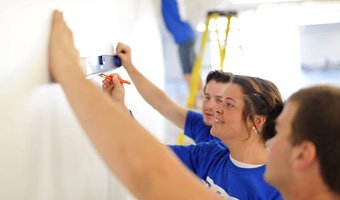
More than 150 new students volunteered to help with community service projects. Dallas Baptist University's Nikki Hixson was part of a team that served on a painting crew at Habitat for Humanity Dallas during the school's SWAT week.

More than 600 students participated in service projects at 19 local ministries and organizations across the DFW Metroplex.

The student projects ranged from stocking shelves in local food pantries and landscaping to playing with children and visiting with residents in a nursing home.

Approximately 80 Howard Payne University students joined with community organizations to work on four projects—the Corinne T. Smith Animal Center, Lake Brownwood, the Brownwood Area Community Garden and a historic home being renovated for use by the Heart of Texas Christian Women's Job Corps.

Thirty-five HPU students served the Christian Women's Job Corps by aiding in renovations to a two-story, historic home on Center Avenue.

East Texas Baptist University freshman Lauren Fedor of Canton painted a piece of playground equipment at William B. Travis Elementary School in Marshall.

"The students got us off to a good start," said Bettie Evans, director of the organization. "Several of the students were asking if they could come back and help some more, so we are looking forward to working with them in the future."

Incoming Baylor University freshmen did their project during orientation in July.

They partnered with the Texas Hunger Initiative and the Food Planning Task Force of McLennan County to canvass Waco neighborhoods to increase awareness and participation in the Summer Food Service Program to ensure all children had access to healthy and nutritious meals during their summer break from school.

Many children have little to eat when school is out.


Grieving parents learn lessons about trust from tragedy

LUBBOCK—In the Lubbock-Cooper school district, seniors teach a seminar on a topic of their choosing. Kelsey Vines' turn came Sept. 2, 2008.

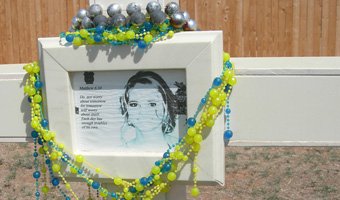
Thom Vines appreciates the memorial garden dedicated to the memory of his daughter, Kelsey, created by her twin sister, Kayla, and members of her graduating class. (PHOTO/George Henson)

"You can lead the class on anything you want to, and she led the class on Matthew 6:34—which I don't think is a coincidence," said her father, Thom Vines. "It says, 'Don't worry about tomorrow, for tomorrow will take care of itself.'"

A few hours later, Kelsey was killed. She was driving home from school when the steering controls on a 48,000-pound dump truck broke and hit the car she was driving.

Kayla, her twin sister, was sitting next to her, but her physical injuries were limited to an ankle and a few scrapes and bruises.

The days that followed were traumatic for all the members of the Vines family, as well as for Kelsey's boyfriend, John Michael Vestal.

Her father turned to Scripture to heal his broken heart and bruised faith.

"As much as anything in the past years and months, it's Proverbs 3:5 that I keep coming back to. We don't know why this happened. We certainly don't like that it happened. But we don't lean on our own understanding. We trust God," Vines said.

That deep-seated trust led Vines and Vestal to write a book, Tragedy and Trust: Can You Still Trust God After Losing a Child?

Vines describes Vestal as "without a doubt the single best human being I've ever met—a deep, deep abiding faith and rock solid."

While he is glad his daughter chose to spend her last 11 months of life in a relationship with such an exemplary young man, Vestal's character also is the source of some pain.

"Kelsey was already a Christian, but we watched her faith flower with him. And what they lost together, could have had together, that's part of the pain," he admitted.

Vestal's spiritual maturity beyond his years served as a steadying influence for Vines after his daughter's death. "After the accident, as much as anybody, he became my spiritual teacher," he said.

Vines wrestled with the question: "Why do you trust God?"

"I thought long and hard about this, and then I suddenly realized the answer was right there in front of me all the time. The reason we trust him is because he loves us," Vines said.

"Why does he love us? Because he created us, and we are his children. Just as I love my children, he loves us on an infinite scale.

"So, I can accept it. I don't understand why this happened —how this was part of his will. But I know he loves us, and therefore, for some reason I do not understand, this is the way it had to be."

Even so, Vines acknowledged he still misses his 18-year-old daughter, even after three years have passed.

"To be sure, there's still human grief. The first thing we think of each morning when we wake up is Kelsey. The last thing we think of at night is Kelsey. Every day I have one or two of what I call 'Kelsey moments.'

"Despite all that, we love our Lord, and that's what keeps us going. And I remind myself every day that I will see her again," he said. "We will always have grief. On this side of the grave, it will never be over, but what awaits us beyond is wonderful.

"The last three years have been the most horrible and most wonderful time of my life.

"The horrible is easily apparent—we lost our child, which for a parent is as bad as it gets. But the growth and the coming to the Lord and the joy we've found in that has been wonderful."

Becky Vines finds solace in knowing her daughter is in the arms of her Heavenly Father. She recalls stories that remind her of her daughter's faith.

One story is of a young man Kelsey offered a Bible to at the end of her junior year in high school.

He refused, but on the second day of school following the summer break, he asked Kelsey if he could still have the Bible.

Days later, he was at the visitation at the funeral home asking her family if they wanted it returned.

"I told him to wear it out," her father said.

Kelsey's parents agreed healing has been a process.

"I know where she is, and that gives me peace. I say, 'I know where you are, and I know you're safe and that I just can't call you on the phone.' And that's the way I have to handle it," her mother said.

For her father, a couple of dates mark his healing. The first is July 22, 2009.

"The accident site had always been the place where Kelsey died. … On July 22, it just popped into my mind, 'That's where Kelsey went to heaven.' Not where she died, but where she went to heaven.

"It took me 10 months, but that was a real turning point—when I was able to look at the place not as a negative, but a positive. I go by that spot nearly every day, and it's still painful, but it's also a place of hope," he said.

The second marker was last fall when he made contact with the driver and the owner of the dump truck to let them know of his forgiveness of them.

Vestal, now 22 and a teacher and coach in the Lubbock-Cooper school district, said the book allowed him to track the spiritual journey and see God's hand in his life.

"It's been cool to see how far God has taken us. It's three years later, and we're still here. God has a plan for our lives, and the plan God had for our lives did not stop. It continues on. The plan God had for our lives did not change at all," he said.

Just as all their lives have continued, her mother said, Kelsey lives on as well.

"People still send her Facebook messages: 'I got baptized today because of you.' Kids go on mission trips and tell her story, so she's still giving testimony for the Lord."

Figuring out why is not something Vines worries about anymore.

"We don't know, but we trust—that's the core of the book, the core of our experience," he said.

The book is available on Amazon.com as a paperback and an e-book.