Prophetic communities speak from societal margins, Orozco says

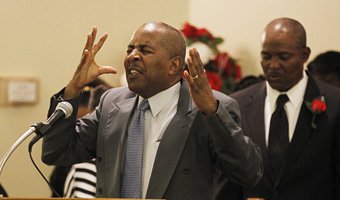
AMARILLO—The church as prophetic community—not the voice of the isolated prophet—holds the greatest potential for bringing God’s message of justice to a rapidly changing world, Ellis Orozco told a Texas Baptist gathering.

The work of building churches as prophetic communities may be the most critical task facing the 21st century church, Orozco, pastor of First Baptist Church in Richardson, told the Texas Baptists Committed breakfast. The self-described mainstream Baptist group met in conjunction with the Baptist General Convention of Texas annual meeting in Amarillo.

“For American Christianity, the Old Testament image of the lonely prophet thundering his message from the mountaintop has been formative. I’m not sure it’s accurate, but it is certainly popular,” he said.

Some American preachers like to see themselves in that role, fancying the romantic image of the persecuted prophet in isolation—“a Lone Ranger without even Tonto to comfort him,” Orozco said. But the typical preacher who views himself in those terms rarely fits the profile.

“The sins he rails against are carefully chosen, so as to offend mostly those outside his congregation. And his hand-picked pulpit belongs to a congregation that applauds, if not demands, that type of preaching,” he said.

“In short, he rarely risks anything with his preaching. And in the end, his sermons are more self-serving than sacrificial.”

While churches still need preachers who provide thoughtful reflection on contemporary issues, Orozco insisted, “the work of the pastor and church leadership in the 21st century is not so much to thunder prophetic utterances as it is to build prophetic community.”

Prophetic communities operate from the margins, not the power centers of society, he insisted.

“The church cannot serve a sociopolitical ideology and Christ at the same time,” Orozco said. At a time when the political left and right both wrestle for positions at the center of power, Christians should not succumb to that desire.

The prophetic preacher should strive to build the kind of prophetic community that can tell the difference between the voice of culture and the voice of God, he said.

“This is why the prophetic community becomes imperative in the new millennium, because it is the community—the church, not the preacher—who can be a prophetic force, speaking and acting from the margins in a shrinking and dynamically changing world,” he said.

Jesus built prophetic community among his followers and gave them a model prayer that demonstrates his radical ethic—a prayer filled with petitions “for God to show up in the world to make that which is wrong right,” Orozco said.

“Jesus’ prayer is a radical and dangerous prayer—a prayer that calls for the world to be turned upside-down by a new and thoroughly prophetic ethic,” he said. “In the early church, it was repeated with fear and trembling. It is a prayer that fuels the prophetic community.”

The American church has been pushed to the margins of society by powerful forces—and that is where it does its best work, Orozco insisted.

“There is much turbulence and violence and despair at the power centers of our world,” he said. “And I believe that the church stands ready at the margins to be a prophetic community speaking and doing God’s justice in the world. Everything depends on it.”


BGCT approves renegotiated agreement with Baylor University

AMARILLO—Messengers to the Baptist General Convention of Texas annual meeting approved a renegotiated agreement with Baylor University, replacing a 20-year old agreement that sets the terms for the relationship between the university and the state convention.

The renegotiated agreement—approved with only a smattering of dissenting votes at the Oct. 24 meeting— gives Baylor greater influence in determining the composition of its governing board.

Texas BaptistsFor 20 years, the BGCT has related to Baylor through a special agreement the convention and university reached after Baylor changed its charter. That agreement included the stipulation, “All members of the board of directors shall be Baptists.”

However, the 1991 agreement also stated, “The BGCT recognizes that Baylor is an independent, nonprofit, nonmember corporation under the laws of the State of Texas with the full legal right, power and authority to amend or rescind its articles of incorporation or bylaws without approval or consent of the BGCT or any other party.”

In February, Baylor opened membership on its board of regents to non-Baptist Christians. In response, the BGCT Executive Board in May directed Associate Executive Director Steve Vernon to invite Baylor University President Ken Starr to develop a process for renegotiating the relationship agreement.

A six-member committee—with Roger Hall, Ed Jackson and Bill Brian representing the BGCT and Buddy Jones, David Harper and Ramiro Peña representing Baylor—negotiated the revised agreement.

Brian, an attorney and member of First Baptist Church in Amarillo, pointed to the preamble of the new agreement that placed a renegotiated agreement within the context of a desire on the part of both Baylor and the BGCT to “continue and enhance their longstanding and mutually beneficial relationship.”

Jackson, a retired engineer from First Baptist Church in Garland, acknowledged the negotiating process as “not a Pollyanna assignment” but had its share of “low points and rough spots.” However, he presented the final outcome as a positive way to move forward.

Roger Hall, retired BGCT treasurer from First Baptist Church in Midlothian, emphasized the negotiating team’s desire to simply and streamline the agreement and provide a framework to “foster future cooperation.”

Since 1991, Baylor University has elected 75 percent of its board of regents, and messengers to the BGCT annual meeting have elected 25 percent.

Under the revised agreement, the school’s BGCT-elected regents will be nominated by a five-member committee composed of two people designated by the convention, the president of Baylor or a person the president designates, the chair of the Baylor regents or a person the chair designates and one additional member designated by the regent chair, with the stipulation that individual must be a member of a BGCT-affiliated church.

Previously, the five-member group that nominates BGCT-elected Baylor regents consisted of four people named by the BGCT Committee on Nominations for Boards of Affiliated Ministries and either the chair of the Baylor regents or a person he designates.

After originating with the five-person committee, the nominees for regents will go to the Committee on Nominations for Board of Affiliated Ministries and then on to the state convention annual meeting for consideration.

The revised agreement also states Baylor has the right to confirm —“or not to confirm with good cause”—regents elected by the BGCT as set forth in the university’s governing documents.

“Because the BGCT’s authority is a delegation of authority from Baylor and because of issues related to Baylor’s accreditation, the BGCT agrees that it will consider Baylor’s best interests as the only criterion in the selection of Baylor … (regents), subject to a requirement that the individual person elected shall be a member of a BGCT church,” the agreement states.

Les Hollon, pastor of Trinity Baptist Church in San Antonio, asked what necessitated the change from a four-to-one BGCT/Baylor ratio in the group from which regent nominees originates to a three-to-two Baylor/BGCT ratio, with the Baylor regents retaining the right to reject an elected regent.

In terms of the change in composition of the nominating group, Brian explained, “Baylor wanted more input into nomination” of regents at that early stage.

Both he and Jackson pointed out a BGCT-elected regent could be rejected only for substantive cause. Jackson also noted that while Baylor will have an advantage in step one of the process, the second and third steps—the Committee on Nominations for Board of Affiliated Ministries and the state convention annual meeting—are 100 percent BGCT.

David Lowrie, pastor of First Baptist Church in El Paso and past president of the BGCT, spoke in favor of the renegotiated relationship agreement. He compared it to a couple who renew vows after many years of marriage.

Just as changes in those renewed vows reflect how the husband and wife have changed since their wedding, the renegotiated agreement with Baylor acknowledges that both the university and the state convention have changed in the last two decades, Lowrie said.


Meeting needs, sharing gospel focus at Hispanic rally

AMARILLO—Hispanic Texas Baptists reported on God's faithfulness and looked ahead to new initiatives in evangelism, missions and ministry during a rally on the eve of the Baptist General Convention of Texas annual meeting.

Teo Cisneros, vice president for development at Baptist University of the Americas, preaches at a rally preceding the BGCT annual meeting in Amarillo.

Jesse Rincones, president of the Hispanic Baptist Convention of Texas, noted the Hispanic Baptist Convention of Texas approved a new agreement with the BGCT in 2010.

"One of the fruits of that agreement is that now our convention can have its own initiatives for funding and resources for its programs and collaborations that it wants to do," he said.

Rincones announced 2012 would focus on missions with the convention's collaboration with Shoes for Orphan Souls, a ministry of Buckner International. Hispanic Texas Baptists hope to collect 2,012 pairs of new shoes for the ministry at Convención next June in San Antonio.

A new collaboration with Frontera Solutions will provide a telephone medicine program for Hispanic pastors and families around the state, many of whom don't have health insurance, Rincones announced.

The program gives participants unlimited access to doctors via telephone who can make diagnoses and call in prescriptions for families. Through this program, families also receive discounts on prescriptions.

Hispanic Texas Baptists need to look at ways to bless the spiritually lost, not seek blessings for themselves, Teo Cisneros, vice president for development at Baptist University of the Americas, said in the rally sermon from the first chapter of the New Testament book of Acts.

"Statistics show that baptisms are at their lowest point in 20 years," he continued, "And in Texas, the second most populated state with 26 million people, 50 percent are lost. The gospel hasn't changed. It still has power. The blood of Christ hasn't changed. It hasn't lost its power to save. My question to you tonight is, 'What can we do?'"

Too many Christians aren't asking the right questions, he said, comparing churches with the disciples who asked Jesus when he would restore the kingdom of Israel or argued over who would sit on his right hand side.

"What we should be asking is, 'How can we bless the lost? How can we reach the lost?' not 'How can I be blessed?'" he said.

Churches also often don't seek the right power, Cisneros insisted, stressing the importance of seeking the Holy Spirit.

"If you don't look for divine power, the power of the Holy Spirit, you won't be effective in reaching the lost," he said.

Finally, he said, churches aren't looking in the right direction.

"Because of our limited view, sometimes we ignore certain groups of people," he said. "But Jesus says to make disciples of every nation. The Greek word for every nation is 'ethnos,' meaning all people or all ethnicities."


Work of the Holy Spirit emphasized at African-American Rally

AMARILLO—The Holy Spirit moves throughout the world, changing hearts and transforming lives. And the Spirit carries out God's purpose while working through his people, Larry Rhea told the African-American Fellowship Rally prior to the Baptist General Convention of Texas annual meeting.  

Rhea, interim pastor of Saint John Baptist Church in Amarillo, reminded listeners of the promise Jesus gave in Acts 1:8 that his people would receive power when the Holy Spirit came upon them.

Gregory Pride, pastor of Joshua Tabernacle Baptist Church in Amarillo, preached at the African-American Fellowship Rally in Amarillo. (PHOTO/Robbie Rogers)

"And you will be my witnesses," Rhea read from the passage—"to the ends of the earth."

The Holy Spirit moves as his people are obedient and walk in faith. Faith, Rhea noted, is demonstrated through action.

That faith rests in Jesus Christ, whose shed blood on the cross made evident God's will—to redeem the souls of humankind.

"He poured out his love in compassion, breaking the hearts of sinful men," Rhea said. 

As hearts are changed, they become ripe for the work of the Spirit—regeneration, sanctification, consecration and new life in Christ. This is the story of all of the redeemed, he said.

"Holy Ghost power is about changing individuals," Rhea said. "Jesus is anxious to save, and his desire is to fill the redeemed with his power."

This power comes upon every believer, working through them to then reach out to others. In this way, the work of the Spirit is viral, Rhea said.

"We can go all over the world with power," he said. "We are to change the world one life at a time."

Christians must hold fast to a hope—a desire to see the lost saved and for God to receive the glory.

"We are clothed with power when we love the glory of God and long for his presence, to press forward with compassion for the lost and hurting people," Rhea said.

This concept ties in with Texas Baptists' commitment to Hope 1:8, an initiative underscoring the Acts 1:8 mandate encouraging believers to live out their faith through missions and outreach. 

 Michael Evans, president of the fellowship, affirmed Rhea's message and reminded listeners of the importance of collaboration. 

"Together we can save souls. We can positively impact the lives of all Texas Baptists," he said. "We are serving with a group of pastors and lay men and women who share the same hope, the same dream. And we will see that happen."


Texas Tidbits

TBM volunteers describe the activity of God. God has honored Texas Baptist Men volunteers in recent months by using them to bring people to Christ, speakers reported at a TBM Rally held at Second Baptist Church in Amarillo on the eve of the Baptist General Convention of Texas annual meeting. Ralph Rogers, a member of Paramount Baptist Church in Amarillo, said the church's disaster relief teams have served in a number of places, including Amarillo, Possum Kingdom, Bastrop, Tuscaloosa, Ala., and Minot, S.D. More than 4,000 homes were affected by flooding in Minot, and Paramount mud-out teams served for 30 days there, assessing damage, cleaning homes, praying with victims and sharing the gospel where possible.

HSU holds line on tuition. Hardin-Simmons University trustees voted to keep tuition for new incoming full-time or part-time students at the current $715 per semester hour rate. The action represents a double-freeze, HSU Vice President for Enrollment and Marketing Management Shane Davidson noted. "No. 1, tuition will not go up for freshmen and transfers, and No. 2, students can lock in the rate as long as they remain full-time students," he said. Since the fall 1993 semester, HSU students have been able to lock in their freshman tuition rate until they graduate and may continue at the same rate even in master's-level classes. Some current students studying for their master's degrees still are paying the $535 per semester hour tuition rate they paid in 2007, Davidson noted.

Elshtain joins Baylor institute. Jean Bethke Elshtain, recent recipient of the Democracy Service Medal from the National Endowment for Democracy, has joined the Baylor University faculty as visiting distinguished professor of religion and public life at Baylor's Institute for Studies of Religion. Elshtain—a prolific author—also serves as the Laura Spelman Rockefeller professor of social and political ethics at the University of Chicago Divinity School. Elshtain is a past recipient of the Goodnow Award, the highest honor bestowed by the American Political Science Association for distinguished service to the profession. She has served on the board of the National Humanities Center and on the President's Council of Bioethics. Currently, she is a member of the Council of the National Endowment for the Humanities and the Scholars Council of the Library of Congress. At Baylor, Elshtain will conduct and produce new scholarship about the intersection of religion and public life, working alongside faculty as well as undergraduate and graduate students from political science, philosophy and the Honors College.


Around the State

Dallas Baptist University will hold homecoming festivities Nov. 14-19. Events begin Monday with an alumni dinner for the College of Education. On Thursday, the master of arts in counseling program will hold its alumni dinner, and the Mr. Big Chief competition will be held in the Burg Center at 8 p.m. At 4 p.m. Friday, a pep rally and parade will be held, followed at 6 p.m. by the alumni homecoming banquet. David Fletcher, professor of religion at DBU 41 years, will be named an honorary alumnus. Ronald Jones, mayor of Garland, will be named a distinguished alumnus. At 8 p.m., the Homecoming Extravaganza will kick off, with songs and performances from DBU alumni. A variety of activities are planned for Saturday, including reunion luncheons at 1 p.m. and a 4:30 p.m. tailgate party. At 7 p.m., the Patriot basketball team will play LeTourneau University in the Burg Center. For more information, call (214) 333-5628.

Lorin Vega, a student at Amarillo College, receives a hamburger from Texas Baptist volunteers during a cookout sponsored by the school's Baptist Student Ministry. Volunteers served about 450 students. (PHOTO/Eric Guel)

Abilene Association will honor several people and a church at its annual meeting, Nov. 1 at First Church in Abilene. Evelyn Dorsett, a member of First Church in Abilene, will be named the layperson of the year for her service through the association's social ministries. First Church in Tuscola will be honored as the church of the year; Charles Maciel, who recently retired as pastor of Ambler Church in Abilene after 27 years of service there and 44 years in bivocational ministry, will be named pastor of the year; and Marsha Langford, who served Belmont Church in Abilene more than 23 years before beginning a recent role as ministry assistant at the Abilene-Callahan Baptist Area Resource Center, will be named staff person of the year. The afternoon session begins at 4 p.m., and a meal will be served at 5:30 p.m. The evening session begins at 6:30 p.m. Richard Darden, pastor of Shining Star Fellowship in Abilene, will preach the annual sermon. Truman Turk is director of missions.

Hardin-Simmons University presented several awards during homecoming activities. Billie Martin was the recipient of the John J. Keeter Jr. Alumni Service Award. The Distinguished Alumni award was presented to Elizabeth Abernethy, Charles Douglas and Robert Moates. Athletic Hall of Fame inductees included Jimmie Keeling, football coach; George Hine Jr., sports information director; Kirk Rogers, football; and Gary Marable, tennis player and coach.

East Texas Baptist University has added several faculty members including Bernadette Bruster, English; Kristen Bugos, music; Katie Edwards, kinesiology and associate athletic director; Ellen Fineout-Overholt, nursing and dean of professional studies; William Griffith, chemistry; Judy Hogberg, education; Gerald Nissley, psychology; Elizabeth Ponder, manager of instruction and information services; Scott Ray, dean of school of business; Laci Wallace, kinesiology; and Connie Wyszynski, nursing.

Howard Payne University has announced a new scholarship for students entering the master of education in instructional leadership program. At its highest level, the scholarship would cut tuition almost in half. The program is for students who wish to become certified principals in Texas. Instrution for the 36-hour, non-thesis degree is delivered entirely online, and residency at the university is not required. It can be completed in as little as 22 months. For more information, call (325) 649-8205.

Anniversaries

Jack Burton, 60th in ministry, Oct. 21. A reception was held in his honor at Woodlawn Church in Austin, where he was pastor 23 years prior to his retirement in 1997. Since retirement, he has served four churches as intentional interim pastor, and currently is pastor of SkyView Church in Austin. A graduate of Southwestern Seminary, he has been pastor of churches in Kansas, New Mexico and Texas.

Deaths

Boyd O'Neal, 86, Sept. 24 in McKinney. He served almost 40 years as a Southern Baptist missionary in Brazil and eight years on staff at the International Mission Board headquarters in Richmond, Va. Born in Novice, he was the youngest of 13 children. While a student at Howard Payne College, he worked two full-time jobs and hitchhiked every Sunday to Silver Valley, where he was pastor. He and his wife, Irma, were appointed by the Foreign Mission Board to Brazil in 1949. During his time there, the state where he worked went from having 12 struggling churches to 52 thriving ones. He also directed the construction of a Baptist camp there and then served as camp director 32 years. After retiring from foreign service in 1988, he served as director of volunteers for the IMB. He retired in 1996 and moved to McKinney, where he was a member of First Church. He was preceded in death by seven brothers, five sisters and a great-grandson. He is survived by his wife of 66 years; daughters, Melba Hogue, Betty Brown and Becky Gore; son, James; seven grandchildren; and five great-grandchildren.

Homer Wright, 99, Sept. 28 in Texarkana. A retired pastor and former volunteer prison chaplain, he was a member of First Church in Red Lick. He was preceded in death by his wife, Evelyn. He is survived by his son, Kenneth; daughter, Joyce Stone; five grandchildren; three great-grandchildren; and one great-great-grandchild.

W.J. "Doc" Isbell, 89, Oct. 4 in Bessemer, Ala. After working 17 years as a veterinarian, he became Baptist Brotherhood secretary for the Alabama Baptist Convention. During 13 years there, he developed the Royal Ambassadors Boys Camp at Shocco Springs. In 1968, he joined the Southern Baptist Convention's Brotherhood department as director of the men's division. In 1977, he accepted a position with Texas Baptist Men, where he was instrumental in building a hospitality house for prisoners' families to use during visits to Huntsville. He later became executive secretary of the men's department of the Baptist World Alliance and visited world Baptist men's work and wrote a Baptist Men's manual for all churches throughout the alliance. He is survived by his wife, Nell; son, Jay; daughter, Cissy Isbell; brother, Roy; sister, Lee Wood; two grandsons; and three great-grandchildren.

Kim Hall, Oct. 21 in Hot Springs, Ark. He was pastor of Hunters Glen Church in Plano almost 22 years. During his 35 years of ministry, he also served churches in Louisiana and Mississippi. He served on the Executive Board of the Baptist General Convention of Texas and on its mission funding committee. He served in numerous positions with Collin Association. He was a chaplain for the Plano police and fire departments. He was the founder of Advance International, which partners with New Orleans Seminary and the International Mission Board to provide theological education to Christian leaders in remote areas of the world. He is survived by his wife, Martha; sons, Hunter and Daniel; sisters, Lydia Willis and Myrna Tarver; brothers, David and Joey; and two grandchildren.

Revivals

First Church, Devers; Nov. 6-10; evangelist, Herman Cramer; music, Sam Craig; pastor, Harry McDaniel.

First Church, Normangee; Nov. 13-16; evangelist, Mike Satterfield; music, Richard Mabry; pastor, Bob Shirley.

Event

Wylie Church in Abilene recognized Oscar Fanning as pastor emeritus, Oct. 2. He served the church as pastor more than 20 years.


On the Move

Tommy Brisco to Lawn Church in Lawn as interim pastor.

David Eaton has resigned as minister of music at Second Church in Corpus Christi.

Charles Maciel has retired as pastor of Ambler Church in Abilene for health reasons after serving the church 27 years.


Relationships — cooperative but changing

Loyalty to universities, love for children's homes and appreciation for Baptist hospitals and senior-care facilities runs deep among Texas Baptists.

Institutions matter in Texas Baptist life. But how the Baptist General Convention of Texas relates to schools and caregiving ministries has changed and continues to change.

At the BGCT annual meeting in Amarillo, messengers will vote on a renegotiated relationship agreement with Baylor University. They also will consider a bud-get that increases financial support for some institutions while cutting funds for others—particularly Baylor, which stands to lose about $900,000 in 2012.

The BGCT views institutions either as affiliated or related. Messengers to the state convention annual meeting elect at least 75 percent of the governing boards of what the BGCT recognizes as affiliated institutions. Related institutions, on the other hand, have contractual agreements with the BGCT that allow those schools or caregiving ministries greater control over the selection of their boards. The proposed budget makes a distinction in funding levels between affiliated and related educational institutions.

All in the family?

Historian Alan Lefever uses the analogy of a healthy parent-child relationship to describe the historical relationship between the BGCT and institutions. Parents provide full support for children when they are young, but once children become adults, their relationship to parents focuses less on financial support and more on family ties.

"When the institutions began, they depended heavily on Texas Baptists to survive. As they have grown and matured, the need for that kind of support has lessened. But like a parent and a grown child, Texas Baptists still want to be a part of the lives of institutions," said Lefever, director of the Texas Baptist Historical Collection.

Likewise, most institutions see the value in their Baptist history and heritage, and they want to maintain a connection to Texas Baptists—but not be controlled by "parents" who may be reluctant to acknowledge the need for independence, he added.

"The influence and history that connects Texas Baptists and the institutions is more than just money—it's more than a percentage of the budget," he said.

Lanny Hall, president of Hardin-Simmons University, believes most institutions have been "loyal children who follow the rules of the relationship." But he takes issue with siblings whom he believes have failed to honor family rules—in particular, institutions that have appealed directly to churches rather than accepting the cooperative giving approach the BGCT follows.

"While we are grateful for those churches which include HSU and Logsdon Seminary in their budget, we are not making pulpit appeals for special offerings or actively seeking funds from individual churches instead of the cooperative giving approach," Hall said. "HSU has long been the beneficiary of cooperation, and we would hope that the cooperative approach will continue and lead to greater resources for Christian education in the future.

"In my opinion, the BGCT has been overly tolerant of institutions which have openly violated the rules of our relationship. This has left the loyal institutions a bit confused as to what the relationship really means. I am grateful for members of the Executive Board who have been advocates for the institutions and who have called for consistency in applying the rules of our relationship with Texas Baptists."

Jerry Bradley, longtime president of Children at Heart Ministries, chooses a different family analogy to describe the relationship between the state convention and institutions.

"I see it as a cooperative relationship much like a marriage, where both parties need the other. Each brings different components/aspects to the relationship that enhances the whole. This is a dynamic relationship that demands communication and cooperation based on trust," Bradley said.

Rene Maciel, president of Baptist University of the Américas, sees the relationship as comparable to "la familia"—a central facet of Hispanic life and culture.

"La familia is extended family, where everyone helps everyone," Maciel explained. "We get help, and as we help our students, they go on to positions of spiritual leadership in Texas Baptist churches and in their communities and careers. Families disagree sometimes. Family members differ on how to spend limited resources. But you're always family. We're always family."

Paul Armes, president of Wayland Baptist University, and Albert Reyes, president of Buckner International, prefer a different way of describing the relationship—in terms of the kingdom of God. Armes calls the relationship between the state convention and institutions "a kingdom partnership," and Reyes speaks of "collaboration and cooperation for kingdom purposes."

Cooperation or competition?

Some institutions consider financial support provided through the Texas Baptist Cooperative Program essential to their operations.

"Is there a category higher than absolutely vital?" Maciel asked, describing how much Baptist University of the Américas depends on the funding. "Maybe we are a relic of the glory days of the Cooperative Program, but the CP makes it possible for a small school with very limited resources to dare to dream we can make a difference in Texas and the world in the Hispanic mission field."

Likewise, Children at Heart Ministries considers Cooperative Program support "critical to our operations," Bradley said.

"It is not only the funding, but he assurance of a continued relationship," he said. "It would take a lot of endowment to produce what CP provides, and the CP can go directly into the budget. I would dread the day that we had to go directly to churches, because that would validate that CP is dead and buried. Also, smaller ministries could not compete with larger ones who have large development and communication budgets."

But some institutions—notably Buckner International—have pressed the BGCT to expand the definition of cooperation and allow institutions to approach churches directly to request financial support. Cooperative Program funds provide less than 1 percent of the overall Buckner budget, Reyes said.

"Our history shows that Buckner raised more funds before it was part of the Cooperative Program, and, consequently, Cooperative Program support has diminished over the years. There is no question in my mind that direct appeals to Texas Baptist churches would be more favorable to the overall work of Buckner than the current CP method," Reyes said.

"This method of direct appeal may not be easy to manage from a pastoral perspective, but most churches appoint denominational relations committees that already manage denominational relationships and ministry partners."

Wayland Baptist University probably would benefit from direct appeals to churches, Armes said, but he opposes any retreat from the cooperative approach.

"I think Wayland would fare very well if we were to undertake a more direct approach to churches. However, I am opposed to such a change for several reasons," Armes said.

"First, I believe that practice would not only perpetuate the financial resources disparity between the larger and the smaller institutions of the family; it would widen the gap significantly. Who can muster more staff members to stand in pulpits across the state and ask for support? Surely the largest and most resourced institutions.

"Additionally, why would we want to ask our pastors to be gatekeepers for institutional appeals? Which pastor would want their members to be solicited by a dozen or more institutions, each of which has a compelling case statement as well as a worthy ministry? Institutional morale would suffer significantly, I fear."

Reyes remains unconvinced. "I have heard the arguments against a new approach to the Cooperative Program: Pastors will be overwhelmed, smaller institutions will suffer, and the list goes on. These objections are shortsighted and do not speak to our collective ability to create and innovate new and equitable patterns of stewardship in the distribution of resources," he said.

"I do believe that we need some type of hybrid approach to place the locus of control for institutional ministry support into the hands of congregational and pastoral leadership, balanced with inclusion of a denominational expression of stewardship, as well."

Texas Baptist identity

Without exception, institutions that relate to the BGCT affirm the importance of their Texas Baptist identity and heritage. But some institutions have felt a need to include non-Texas Baptists on their governing boards and to reach beyond geographic and denominational boundaries.

"Because of our position as the only Christian Hispanic university in the country, we feel it is part of our missional responsibility to help Baptists in other states train leaders for their Hispanic populations, too," Maciel said regarding BUA. "So, we have one trustee from Arkansas, one from Alabama and one from Louisiana—to provide counsel and resources to help us in that task.

"But we want Texas Baptist-elected trustees to have voting control of our board. And all the rest of the trustees we are allowed to nominate are active in local Texas Baptist congregations."

Some institutions point to the importance of inclusion in a time marked by diminished denominational loyalty.

institutions childcare"All denominations are faced with the transition into a post-denominational era," said Kevin Dinnin, president of Baptist Child & Family Services. "Data predicts an acceleration of the lack of denominational loyalty. The goal for our institution is to hold on to the vital guiding principles of our Baptist heritage as the denomination as a whole continues to deteriorate."

But other institutions emphasize the importance of continuing cooperation within Texas Baptist life.

"Texas Baptist churches have encouraged us, prayed for us, sent their students to us and have supported us financially. Texas Baptists and Hardin-Simmons have partnered throughout HSU's 120-year history. We thank God for Texas Baptists," Hall said.

Others may choose a different course, but Hall insisted his institution planned to follow an old West Texas proverb: "You dance with them what brung you."


Amarillo couple fills house with foster, adoptive children

AMARILLO—It's not that Tim and December Barcroft wouldn't love to go to Washington, D.C. They would have been among 150 others nationally to be honored at a gala as part of the Angels in Adoption awards through the Congressional Coalition on Adoption Institute on Oct. 5.

It's just, they couldn't go.

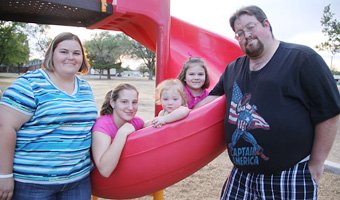
Tim and December Barcroft finalized the adoption of their daughters Genie, 14, Kelsey, 2, and Heavenly, 6, on Sept. 29. The Buckner foster family received a national award from the Congressional Coalition on Adoption. (?Photo by Russ Dilday/Buckner International)

Barcroft has a route to run delivering tortillas around the area for J&T Distributing. Mrs. Barcroft, who not surprisingl, was born in December, can't afford to miss class at West Texas A&M University, where she's studying to be a teacher. Then, there are the girls—Genie, Heavenly and Kelsey. What to do about them?

"It's probably best we not go," Barcroft said. "We'd like to, but just can't. It's disappointing, but money was also an issue as well."

The Barcrofts are a common couple doing an extraordinarily uncommon thing. That's what foster parents are. They're like so many on the outside, but inside they have an extra dose of love, unselfishness and sacrifice.

Life was peaceful and routine the first five years of their marriage. Maybe too peaceful.

"We were tired of our quiet house," Mrs. Barcroft said.

They talked of being foster parents for three years. Finally, they enrolled in the foster parents program through Buckner International, training that is intense and rigorous.

They had a heart for children, had none of their own, and were eager to have some extra noise in their home.

"Foster parents have to be patient, flexible, giving and obviously loving," said Scott Collins, vice president of communications for Buckner.

"I think for Tim and December, it was also part of a spiritual calling," he said.

In March 2009, they became foster parents of two boys, Aaron, 6, and Jason, 9. They were in their home until they returned to their mother the day after Christmas 2009.

"We still pick them up and take them to church every Sunday," Barcroft said. "They may not live with us, but they're still part of our family."

It's now a crowded drive to New Life Foursquare Church.

A little more than a month after the two brothers left, the Barcrofts received two sisters, Genie and Heavenly, from the Panhandle Assessment Center.

Soon after, their infant sister, Kelsey, was taken from another foster home to join her sisters.

"It's been mind-altering, a house full of girls," Barcroft said. "I mean, sharing one bathroom, come on. There's not a moment's peace with that. It's been rough, but we love them to death, absolutely love them to death."

Imagine this challenge: A teenager, one in kindergarten, and one who now is 2 years old. Those are some different needs and priorities with no time for parents to grow into the challenge.

"Kelsey can entertain herself. She's independent, but very loving," Barcroft said.

"Heavenly had some severe behavioral issues in the beginning, but she's come a long way. Genie is Genie. She's attached and then detached. She has her moments as I'm sure all 14-year-olds do."

But few have had the baggage the two oldest had been saddled with. What was missing in their lives, as it is with virtually all foster children, is stability, a parental role model who will be there for them.

"We've provided them and showed them there are people out there who do love them for who they are," December Barcroft said.

The Barcrofts didn't get to go to the nation's capital, but they did get to go to 108th District Court in Potter County the day following the Washington event. There, before Judge Doug Woodburn, the Barcrofts legally adopted the three girls. No doubt which event meant more.

"Going to Washington would have been pretty cool," Barcroft said. "But the real honor is having these kids for a lifetime."

But the Barcrofts hope this isn't the final chapter.

They would like to add more foster children and their own biological children one day.

"God's not done with us yet," Barcroft said. "But we're going to need a bigger home."

–Jon Mark Beilue is a columnist for the Amarillo Globe-News.


Baptist General Convention of Texas celebrates 125 years of ministry

AMARILLO—When messengers gather for the Baptist General Convention of Texas annual meeting, they will be carrying out a tradition of making decisions to advance God's kingdom just as their predecessors have done for 125 years.

During an annual meeting birthday party of sorts, Texas Baptist messengers will celebrate 125 years of the convention sharing the hope of Christ throughout Texas and around the globe.

Born in 1886 when five state conventions united, the BGCT's ability to minister in large ways has always relied on affiliated churches' willingness to partner for the sake of God's kingdom, said Alan Lefever, director of the Texas Baptist Historical Collection.

Lefever, who noted that even the name "Baptist General Convention of Texas" brings together the names of the two largest pre-existing Texas Baptist conventions, said God has brought Texas Baptists together in a spirit of cooperation to share the hope of Christ.

As a result, they have started hospitals, colleges and children's homes, he noted. Churches have reached out to people in need in the name of Christ, providing food, clothes and encouragement.

"I think the biggest thing we should be celebrating is what we have accomplished by cooperating," Lefever said.

Called by God, Baptists throughout the state have had a significant impact in Texas and beyond, Lefever noted.

George W. Truett, former pastor of First Baptist Church in Dallas, emphasized the importance of religious liberty and separation of church and state. William and Anne Bagby of Waco founded the first Baptist church in Brazil. Countless people have been influenced through Texas Baptist schools and human-care institutions. The convention launched the Youth Evangelism Conference, Super Summer and See You at the Pole.

"When you talk about the BGCT, the people within the convention have reached out to touch the world," Lefever said.

The calling of the convention doesn't end at 125 years, Lefever is quick to point out. God continues calling Texas Baptists to serve him. Looking backward should be done only for the benefit of learning as the convention moves forward in ministry.

"Celebrating an anniversary is a great opportunity to look at the accomplishments of the past," he said. "At the same time, if we miss the opportunity to reflect on current challenges, we make past accomplishments irrelevant."


Youth ministers urged to see Christ as source of strength

ARLINGTON—Ministers and lay leaders will face challenges and hardships when they try to reach out to young people, veteran youth ministry leaders said. Expect trials, setbacks and difficulties, they told participants at Youth Ministry Conclave.

In response, those who work with youth must cling to the Source who can guide them through obstacles to continue shining hope into young people's lives—Christ, said David Nasser, lead pastor of Christ City Church in Birmingham, Ala.

Christ calls his followers to a lifestyle that embodies God's character of "100 percent grace" and "100 percent truth," Nasser said. To do so requires Christians to have discernment about which battles to fight and which discussions to engage. Some are not worth the time or effort. Others, Nasser argued, must be fought passionately as Christ would.

God can use anyone, in spite of their limitations, lifelong stutterer and veteran minister Neal Jeffrey told Youth Ministry Conclave participants.

"Fight for your marriage," he said during the Texas Baptist event. "Fight for your ministry. Fight for your students. Fight. Fight. Fight."

Some Christians have an incomplete image of Jesus by focusing only on biblical passages where Christ taught his followers to "turn the other cheek," Nasser said. Christ also turned over the tables in the temple and drove out the moneychangers, he noted.

"God is a warrior who never ran," Nasser said.

An encounter with that God of grace and truth is life-changing, said Neal Jeffrey, associate pastor of pastoral and preaching ministries at Prestonwood Baptist Church in Plano. God is sufficient for all the issues and obstacles a person comes across.

"Everyone who was touched by Jesus in the New Testament was changed," Jeffrey said. "You can't be the same man, you can't be the same woman after being touched by Jesus."

Jeffrey believes his life story is a testimony to Christ's power. A life-long stutterer, Jeffrey felt called to preach but resisted it, feeling he never could speak publicly.

He even stuttered during silent prayer, he joked.

The low point came when he was asked to introduce himself to a church during a mission trip. He opened his mouth and nothing came out. After a bit, the mission trip leader introduced Jeffrey.

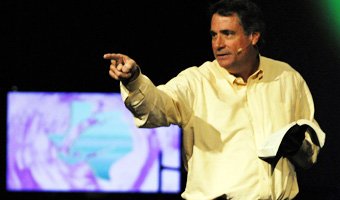
Christian leaders need discernment to know which battles are worth fighting, David Nasser, pastor of Christ City Church in Birmingham, Ala., told participants at Youth Ministry Conclave.

Jeffrey still struggles with his stuttering, but God has honored his willingness to follow his call upon Jeffrey's life, he testified. As a result of God working through him, people have come to know and embrace Christ.

God "can do anything with any man, any woman who will say yes to him," he said.

Ben Stuart, executive director of Breakaway Ministries in College Station, affirmed life for a Christian must stem from a relationship with Christ. He rediscovered this truth recently as he was forced to lie on his stomach day and night for a month following a back injury. Lying there, he found himself watching movie after movie to pass the time. Eventually he found himself watching a subpar movie at 2 a.m. and realized he was just trying to distract himself from his situation.

He turned off the movie and began praying honestly to God, sharing how he felt. On the floor, he connected with God again.

"I met with God on my living room floor," Stuart said. "I'll tell you today, I love him more than I've ever loved him before."

Youth ministers can be confronted by the challenge of busy schedules and attempting to have the best youth programs, Stuart noted. They get so carried away with the varied techniques they can use and building the largest programs that they lose sight of what's most important—connecting with God.

"When you get into youth ministry, everything is flying at you, and it's easy to lose that one thing," Stuart said.


Newly married couples showered with shoes to benefit orphans

Two Texas Baptist brides who love Buckner International's Shoes for Orphan Souls ministry almost as much as they love their new husbands turned summer nuptials into an opportunity for guests to be part of something bigger.

Rebecca and Ron Pyle married late in life. "When we were planning the wedding, we decided we didn't need more stuff. We wanted to encourage generosity to a charity, and we chose Buckner. So, we decided to ask our guests to participate in a Shoes for Orphan Souls wedding shoe drive."

Amy Duncan-Stier, 25, served as a volunteer with Buckner in Guatemala after she graduated from Baylor University in 2008. Her father, John Duncan, is pastor at First Baptist Church in Georgetown .

"We did a shoe trip while I was there," she said. "And when I saw the need and saw what shoes meant to the kids, it just touched my heart. It's just amazing how those children would line up for shoes. … Since I got back from Guatemala, I've always wanted to do a shoe drive."

After she and Scott Stier got engaged, they talked about trading in a traditional gift registry for a request for shoes.

Initially, she wondered what people would think of having a shoe drive instead of traditional wedding gifts. She realized her wedding was a one-time event, and she and her husband would use the gifts they received for the rest of their married lives.

"In the end, my husband, Scott, and I wanted to start our lives out service-oriented, because that's what marriage is," she said. "It's about coming together and serving others and Christ for the rest of your life."

Duncan-Stier said she and her husband were blessed beyond what they could have imagined, receiving all the things they needed to set up their home in several bridal showers held in her honor.

Amy and Scott Stier tied the knot with new shoes surrounding them. *(PHOTO/Allison Notgrass/Focal Point Photographics)

The shoe drive wedding reception also was a bigger blessing and a bigger hit with the guests than Duncan-Stier and her husband expected. Everyone loved having the opportunity to participate in ministry through a wedding gift.

"Little old ladies would come up to me in the weeks before the wedding and say, 'I've got my shoes for the wedding!' But it was shoes to give to the orphans, not to wear with their dress," Duncan-Stier said.

The couple collected more than 150 pairs of shoes at their reception, and several guests made donations to Shoes for Orphan Souls in their honor.

Rebecca Morton Pyle started planning her first wedding at 56.

"I had a great first half of my life," she said. "It was never a life-or-death, 'I have to get married' situation. But I wanted a different second half of my life, so I intentionally sought out God's choice."

She found her husband, Ron Pyle, through an online dating website. She committed to spend six months using the website, and when she first set up her profile, he had just decided to take a break from using the site. They nearly missed finding each other completely; he didn't log on again until her six months were almost up.

The Lubbock couple, who attend Second Baptist Church, dated more than a year before they married in June.

"I went to Oaxaca last November on my first Shoes for Orphan Souls mission trip, and it just captured my heart," she said.  "When we were planning the wedding, we decided we didn't need more stuff.

"We wanted to encourage generosity to a charity, and we chose Buckner. So, we decided to ask our guests to participate in a Shoes for Orphan Souls wedding shoe drive."

They kept their wedding small and married in Lewisville, near his family. About 60 guests attended, and 123 pairs of shoes were collected.

Scott Collins, vice president of communications for Buckner and a longtime friend of the bride, attended the wedding and spoke about the mission of Shoes for Orphan Souls at the reception.

"It was a traditional wedding in every way, except the reception," Collins said. "It was a thrill to walk into the reception area at the wedding and see tables piled high with shoes. That Rebecca and Ron would give up wedding gifts in favor of gifts for orphan children says so much about them and their love for children."

He picked up a zebra-striped pair of shoes from the collection table and told Mrs. Pyle he would deliver them to a child in Kenya in July.

"When he sent me a picture of the girl who got that pair of shoes, I got goose bumps," she said. "It was an immediate gratification to see that photo and to be reminded that these are real people the shoes go to."

"Because of this, other people have heard about Shoes for Orphan Souls from our guests telling the story to other people. I think that's so cool, because it's not about me and Ron. It's about the kids who need shoes and how we can help."