Toy ministry shows Christ’s love to families in need

DENTON—Families in Denton served by Elves Shelves and Blessing Tree know the source of the toys their children enjoy—not Santa's workshop, but the love of Christ demonstrated by members of First Baptist Church.

Brad Cockrell, associate pastor at First Baptist Church in Denton, shows bicycles his church will give to needy children through its Elves Shelves ministry. (PHOTOS/George Henson)

The Christmas outreach project began as a ministry to those within the church, Pastor Jeff Williams said.

"This all began when our children's minister at the time, Christy Butler, had the idea of ministering to some of the families of the church who were having a difficult time," Williams said.

Eight families received gifts for their children that year, and the scope was small enough that the presents all fit in a 10-foot by 10-foot closet.

Before long, someone mentioned the number of people in the community who could be helped by a similar gift of love. So, the next year, about 300 families received assistance.

Last year, 1,200 children received presents, and this year, they numbered 1,800.

Brenda Eckel, who coordinates the effort now, said registration starts before Thanksgiving, and the church suggests ideas about what types of presents to bring.

"The first Sunday in November, we may ask everyone to bring presents for boys and girls ages 9 to 12. The next week, it may be girls 13 to 16, and we go on like that until the last Sunday, when we ask for whatever we seem to be running short of," Eckels explained.

Judy VanDuyne volunteers with the Elves Shelves ministry at First Baptist Church in Denton. (PHOTOS/George Henson)

Brenda Eckel serves as coordinator of the Elves Shelves ministry at First Baptist Church in Denton. (PHOTO/George Henson)

The ministry has become a passion for many in the congregation, Associate Pastor Brad Cockrell said, and they give cash throughout the year. This year, members donated about $25,000 for the ministry.

That money enables shoppers on the Elves Shelves ministry team to shop all year and buy toys when bargains are found, he noted.

In addition to the toys, Eckel said, each family also receives a Bible and hears the Christmas story.

This year, First Baptist Church is partnering with a Hispanic church in a follow-up effort.

"About 95 percent of the families we serve are Hispanic, and we just were not seeing them come back. But since most are Hispanic, all our registration materials and other information is in Spanish and English. One of the questions on the registration form this year is, 'Would you like someone to visit your home?' I have been amazed at the number who have checked 'yes,'" Eckel said.

"An outreach team from the Hispanic church is going to make a personal visit to their homes and in their native language. I'm really excited about that," she said.

In addition to the registration forms, families also provide proof each child listed in the home actually lives their, and other checks are made to verify need, such as enrollment in the school free-lunch program.

Jane Naugher, volunteer coordinator for the Elves Shelves team, said it would be hard to quantify the number of volunteers who participate to make the program a success, because so many people help throughout the year. About 350 helped this year, beginning with the setup in the gym on Wednesday preceding the event and ending when the last family left on Saturday after receiving their gifts.

Volunteers included 25 who gathered for a mass bicycle assembly team. By working together, Williams noted, the group assembled more than 100 bikes in about an hour.

This year, the families also received pictures of the children with Santa.

"If you go to the mall, it costs $30 to $40. The families have really appreciated that opportunity to have a photo," Eckel said.

Patsy Caldwell removes old ribbons and replaces them with new as part of the decorations for the Elves Shelves ministry at First Baptist Church in Denton. (PHOTOS/George Henson)

While the Elves Shelves ministry began as an effort to help families within the church, the number of families from within the congregation had lessened even though the need was greater.

This year, First Baptist tried a different approach for ministering to the church families in need. No one other that Cockrell saw their registration forms, and they could even register online if they desired. Their children's desires for toys then were placed on a tree in the foyer, and individuals took care of those needs and wants.

Increased anonymity has doubled the number of families participating, Cockrell noted. It also has become one of the favorite means of ministry for the congregation.

Once Cockrell receives the gifts for the family, individual appointments are set for them to pick up the gifts.

"The Blessing Tree has been great," Eckel said. "We called it the Blessing Tree because we get an opportunity to bless these families, but we also get the blessing as we give," she said.

In addition, the church provides each family from the congregation a $25 gift card to help pay for the groceries for the holiday.

Both ministries are an example of a congregation living out what it means to show Christ's love rather than just giving it lip service, Williams said.

"I am so proud of our people and of what they've done," he said. "It started as a staff idea, but our people have taken it over. We talk about the need to love God and love people, share Christ and make disciples. That's exactly what they're doing, and I couldn't be prouder."


South Texas family living a dream, building a future, thanks to WMU

PENITAS—Thanks to the caring spirit of Woman's Missionary Union volunteers from Texas and Illinois, the family of Juan Perez and Juany De La Rosa saw their lives change drastically in the span of one week.

Volunteer builders from Texas and Illinois take a moment to take in the view. (PHOTO/John Hall/BGCT)

Nail by nail, wire by wire and pipe by pipe, the 17-woman group constructed a new future where the family of six could live happy and healthy.

The new three-bedroom wood house in the lower Rio Grande Valley will provide a dramatically different living situation than the one-room dilapidated recreational vehicle whose deteriorating walls are threatening the health of their baby son. As the women built the family's new home, the baby came down with pneumonia and was hospitalized.

The new home should alleviate the health concerns for a family that has been involved in Buckner International's area outreach for several months.

Sandra Wisdom-Martin, executive director-treasurer of Woman's Missionary Union of Texas, prays the WMU volunteers helped the family take a significant step toward a better life.

"I think we gave the children a safe environment to grow up in," Wisdom-Martin said. "We gave the family encouragement that someone out there cares about them. I think we gave them a picture of what a Christian looks like."

Susan Tollison, a member of First Baptist Church in Bogota, said the construction effort represented an opportunity to put her faith into action. Buckner leaders already are sharing the hope of Christ with the family. The actions of the WMU volunteers provide support to the ongoing words expressed by Buckner staff members.

"I think so many times as Christians we need to do more than tell them to pray and read the Bible and how to get saved," she said. "We need to help people in their everyday lives."

The home is a dream come true for the De La Rosas, and it is for many of the Texas women who built it as well. Many of them admitted to feeling ill-equipped for the mission effort, but they found a group of veteran homebuilding Illinois women willing to help them.

Susan Tollison, member of First Baptist Church in Bogota, paints boards for a new home for a South Texas family. (PHOTO/John Hall/BGCT)

"I've always wanted to build a home, and I've never done it," Tollison said.

"I'm learning so much. This group from Illinois has taken us under their wing."

WMU of Illinois has built 11 homes for free. Wisdom-Martin, who led the Illinois WMU before coming to Texas, encouraged a team from Illinois to participate in the Penitas build with Texas WMU, hoping the team members would encourage first-time builders.

Judy Taylor, a member of Dorrisville Baptist Church in Harrisburg, Ill., participated in the trip despite having a broken arm. Although she couldn't help with some projects such as shingling the roof, she did help organize the building plans, painted and did other work.

The experience proved to be a teaching moment for Taylor. Every person has limitations—physical and emotional—but if he or she is willing to follow God's calling, he will use them for his glory, she concluded

"There's a plan for you," she said. "Whether you have one bad arm or two bad arms, there is a place for you."

By working together, the women were able to make more progress than they expected. Starting with a foundation, the team had the housed framed at the end of the first day. They began working on the roof the next day. They started installation of interior drywall and insulation on day three.

"After the first day, I was in awe of how much had been accomplished," said Marsha Whitrock, member of First Baptist Church in Raymondville who led the effort to run plumbing throughout the house. "And every day, I'm more amazed."

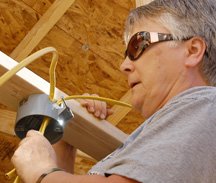
Jeanie Slusser runs electricity for the new home. (PHOTO/John Hall/BGCT)

Wisdom-Martin was pleased to see the women take on the challenge of building a home for a family in need. The trip provided a different service opportunity than those women typically experience.

 "I like to challenge WMU members to move beyond their comfort zones to share Christ," she said. "This is definitely beyond the norm for what you'd expect for women. But I knew if the women would experience it just once, it would transform God's call on their lives."

Gabriel Flores, Buckner mission group coordinator, praised the efforts of the women, particularly their hard work, efficiency, effectiveness and camaraderie. Their willingness to serve for a week is part of a larger effort that will transform the De La Rosas' lives.

 "It's not just a three-bedroom house. It's much more."


Around the State

The University of Mary Hardin-Baylor Christian Studies Forum will host a lecture by Leroy Kemp on "Insights from Genesis 1-3" at noon Jan. 12 in the Shelton Theater of the Mabee Student Center. The presentation is free, and participants are encouraged to bring their own lunch.

Howard Payne University will begin offering a master's degree in business administration in January. The degree can be completed in as few as 12 months, with all courses offered at night and on weekends. For more information, call (325) 649-8704.

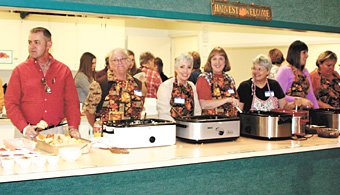
Volunteers from several Houston-area Baptist churches helped serve a Thanksgiving meal at Montrose Street Reach, a ministry in the Montrose area of Houston that seeks to minister to teens living on the street as well as older homeless adults.

Joan Davis has been named director of counseling services at Dallas Baptist University. She also will work as an assistant professor of psychology and counseling. She has been a member of the DBU staff since 1993, serving as director of the academic advising.

Jeremy Taylor has been named associate executive director of statewide transition services by Baptist Child & Family Services. He will oversee five youth transition centers that help young people transition from foster care.

Crystal Lopez won East Texas Baptist University's Bennett Speech Contest. The contest, held annually, invites senior students to inspire audiences through public speaking to live on a higher plane or endorse a policy or course of action. Lopez won a $100 cash prize.

Marsha Rutland, associate professor of physical therapy at Hardin-Simmons University, has been named the William R. Gould Outstanding Physical Therapy Educator by the Texas Physical Therapy Association.

Deaths

Ardelle Clemons, 93, Nov. 26 in San Antonio. She was a founding board member of Associated Baptist Press. A Southwestern Theological Semi-nary graduate, she worked as a Baptist student minister at Rice University, Baylor Medical School and Texas Tech Univer-sity. She was married to Hardy Clemons, former pastor of First Church in Georgetown and Second Church in Lubbock, executive pastor of Trinity Church in San Antonio and a past moderator of the Cooperative Baptist Fellowship. She was ABP's longest-serving board member when she left the board after 14 years of service in 2004. The ABP directors established an endowment fund in honor of her and her husband in 2008. She is survived by her husband of 57 years; daughter, Kay Watt; two grandchildren; and one great-grandchild.

Licensed

First Church in Hamilton joined forces with other local churches to host a communitywide Thanksgiving dinner. Pastor Luke Killian said it was not a church project, but a community event. Twenty-nine people from seven churches organized the event attended by more than 300 people.

Drey Clark, Kent Carroll, Ryan Claxton, Josh Heavin, Blake Herrington, Landon Miller, Trey Permenter, Hayden Walsh and Lance Williams to the ministry at Paramount Church in Amarillo.

Ordained

Ricky Roman, to the ministry at El Buen Pastor in Beeville.

Alejandro Donjuan, to the ministry at Iglesia La Nueva Jerusalen in Clifton.

Ben West, to the ministry at First Church in Tuscola.

Anniversary

Dellview Church in San Antonio, 60th, Jan. 15. A meal will follow the morning service. Phil Risley is pastor.

Retired

• Paul McBride, as pastor of Friendship Church in The Colony, after 27 years of service.


HBU student athletes pack boxes, bring joy to troops

HOUSTON—Houston Baptist University student-athletes recently helped make Christmas a little brighter for members of the United States Armed Forces for the third consecutive year through Operation Interdependence.

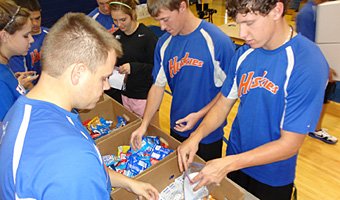
Houston Baptist University student-athletes assemble care packages for troops, working through Operation Interdependence. (HBU PHOTO)

While the HBU baseball team has spearheaded the effort the past two years, members of the men's basketball, softball and volleyball teams joined in the effort this year. The Huskies packed 101 boxes full of snacks, supplies and personal notes in a little over two hours, and those packages will reach 5,050 soldiers serving abroad.

"Being away from their families and loved ones is always tough, especially during this time of year—the Christmas season—so we just hope we can bring a smile to their faces," HBU head baseball Coach Jared Moon said. "We just want to show our appreciation for all they sacrifice for our freedom, and it's the very least we can do to let them they are not forgotten."

Moon reminded the baseball team many of the soldiers are the same ages as the student-athletes, and said his message hit home with the team when a commander presented him an American flag that flew over Bagram Air Base to mark a soldier's death. The framed flag hangs on the wall in Moon's office.

"We are not just trying to win baseball games here," Moon said. "We are trying to affect lives, whether it be the soldiers or our team. Not only do we want our guys to be good students and players; we also want them to be leaders in the community."


System helps ministries manage outpouring of holiday help

DALLAS—Churches and community service providers know volunteer recruitment can prove challenging much of the time. Too often, needs outpace personnel. But then there's the holiday season, when ministries face a completely different challenge.

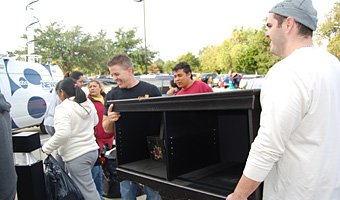
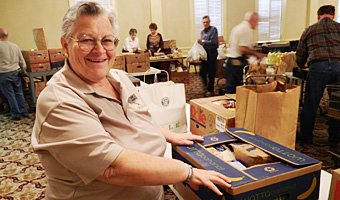
More than 1,000 volunteers served about 3,000 nonpaying customers at the Garage Giveaway, sponsored by 3e McKinney. The small organization was able to coordinate the logistics of enlisting and managing the volunteers using the Meet the Need computer system. (PHOTOS/Courtesy of Christ Fellowship in McKinney)

Cornerstone Baptist Church offers multiple ministries to the inner-city area near the Fair Park area of Dallas. For example, the church makes a shower facility available and gives free toiletries to the homeless every Thursday and Saturday, and it provides a clothes closet for neighbors in need on those same days. Cornerstone Baptist also serves seven meals a week to homeless people—about 6,000 meals each month.

On the church's website, each of those ministries notes a need for volunteers. But in bold print and all capital letters, the website also posts another notice: "No more volunteers for Christmas Eve dinner. … Our spots for volunteering during Christmas Eve are full."

The church learned its lesson the hard way with regard to limiting the number of volunteers during the season when they are easy to enlist.

"We would have been overwhelmed at Thanksgiving" if the church had posted an open invitation for volunteers to help serve meals to people in need, said Pastor Chris Simmons.

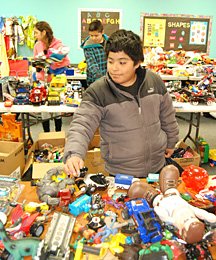
Children select toys at a Garage Giveaway sponsored by 3e McKinney. The event involved more than 1,000 volunteers, but 3e McKinney was able to coordinate it using the Meet the Need computer system.

"We had more than 1,000 volunteers a couple of years ago, and we couldn't handle it. We only wanted 115 this year serving on site."

So, instead of a general invitation, Cornerstone Baptist worked through a couple of its ministry partners—Park Cities Baptist Church in Dallas and Lake Pointe Church in Rockwall—to request a specific number of volunteers for the Thanksgiving event.

In recent months, both churches have implemented the Meet the Need computer-based management system to link volunteers to needs. The software runs through each church's website, and an account management and reporting system enables the church to track needs and responses.

"Having more volunteers that a ministry needs can be overwhelming for a ministry and create a bad experience for volunteers," noted Jim Morgan, founder and executive director of Meet the Need. The computer management system his nonprofit organization developed eliminates the potential for that happening.

"For instance, suppose Cornerstone had a need for 30 volunteers. All of the spots were filled expect one, and two people saw that opening at the same time—one on the Lake Pointe site and the other on the Park Cities site. If one person logged on to volunteer even a millisecond ahead other the other, the posting would disappear, and nobody else could sign up. A ministry cannot oversubscribe volunteers through the system."

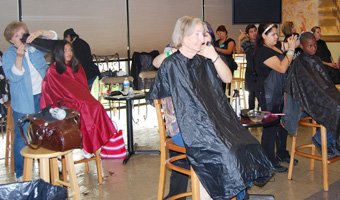
In addition to a free store, volunteers at the Garage Giveaway also provided no-cost services such as haircuts.

Managing the flow of volunteers can be just as important—if not more important—than enlisting them, agreed Jana Jackson, director of family and community ministries for Dallas Baptist Association. This summer, the association adopted Meet the Need as the behind-the-scenes operating system for its CityServe online community ministry platform.

So far, most of the largest churches in the association have implemented Meet the Need, Jackson said, and she expects smaller churches to adopt it as they discover its benefits. Annual cost is $100 for a church that averages 500 or fewer in attendance, and larger churches are billed on a sliding scale.

"We feel like it's really starting to pick up as churches become more familiar with it," she said.

Instead of the time-consuming and labor-intensive chores of making phone calls, sending e-mails and personally assigning volunteers to specific tasks, the computer system frees church staff members and workers at service-providers to focus on ministry instead of logistical coordination, Morgan noted.

This girl found a teddy bear at the Garage Giveaway sponsored by 3e McKinney.

For a ministry with a small staff, that's an answer to prayer, Larry Robinson testified. Robinson serves as the executive director—and only fulltime employee—of 3e (engage, equip, empower) McKinney, a consortium of churches, social-service providers, businesses and individual volunteers devoted to serving the poor in east McKinney.

A couple of weeks before Thanksgiving, the four-year-old organization coordinated a Garage Giveaway—essentially a no-cost garage sale—that involved about 1,000 volunteers from 14 churches who served 3,000 low-income people. Guests shopped for items ranging from electronics and toys to vacuum cleaners and furniture at Christ Fellowship in McKinney.

Another Garage Giveaway will be held in the spring at First Baptist Church in McKinney, Robinson noted.

In addition to that major event, 3e also coordinates an ongoing adopt-a-school program involving volunteers from 11 churches who serve as mentors and help teachers at nine at-risk schools.

A half dozen McKinney churches already have implemented the Meet the Need computer system, and 3e McKinney uses it to link volunteers and resources to needs, Robinson said.

"We run a lean operation," he said. "Meet the Need is what we needed to be more efficient in our work of collaboration and coordination."


San Antonio church provides Bountiful Blessings to families in need

SAN ANTONIO—The demise of a national ministry to the poor sparked the creation of a church-based ministry that already has grown beyond its organizers' expectations—just in time to ease the burden of low-income families during the holidays.

Ruth Cawthon notes that by buying staple items from the San Antonio Food Bank, the Bountiful Blessings ministry at Trinity Baptist Church can provide a large box of food to a family for $7.50. (PHOTO/Ken Camp)

In September, Angel Food ministries ceased operations, leaving thousands of client families around the country without access to affordable food. But Trinity Baptist Church in San Antonio decided to launch its own Bountiful Blessings ministry to meet that need locally.

Since Trinity Baptist had been participating with Angel Food, donated funds already were available to purchase food for distribution to needy families, noted Ruth Cawthon, a leader of Bountiful Blessings.

By buying staple items from the San Antonio Food Bank, Trinity Baptist can provide a large box of food to a family for $7.50, she noted.

Sixteen boxes are designated for alumni and outpatients at Alpha Home, a nonprofit treatment center for chemically dependent women Trinity Baptist founded more than 45 years ago, Cawthon explained. Another seven boxes go to students at Baptist University of the Américas who are in need.

In November, church members sponsored an additional 12 needy families to receive food boxes.

Families also can select a number of food items that change from month to month, depending on what the food bank has to offer. One recent Saturday, options included dinner rolls, chips and spaghetti sauce, as well as fresh produce and other items.

"The Lord has given us a passion for this program," Cawthon said. "We didn't know what we were going to do when we found out we'd no longer be able to participate through Angel Food. But now we're able to serve more families than ever before."


Amarillo family mobilizes volunteers to bring joy to the forgotten

AMARILLO—In 1997, Nancy Haning and her daughter Ashley were in a home delivering Christmas presents for underprivileged children when they noticed something that changed their lives.

There was another person in the room—an elderly man who provided care for the children. They realized he needed to be cared for just as much as the children did—but they had nothing to give him.

Nancy Haning (left), who started A Time to Share with her family, delivers a Christmas present to Antoinette Williams. (PHOTO/Kaitlin Warrington/BGCT)

The Hanings—including father Jerry—set out to provide Christmas presents for the elderly as well as the physically challenged throughout Amarillo. It's their way of caring for the "forgotten and overlooked" older people in their community and show them people still care about them.

The Haning family, members of First Baptist Church in Amarillo, researched the needs of the elderly, particularly shut-ins, and launched A Time to Share, a nonprofit organization that mobilizes volunteers to collect, wrap and deliver Christmas presents to the aged each year.

"The people who are living in their homes are lonely," Nancy Haning said. "They love for our volunteers to come, give them a hug, a few gifts. We've had people say before, 'Actually the visit from the nice family means as much as the nice gifts.'"

The family made its first delivery in 1999, and harnessing the efforts of 70 volunteers, A Time to Share ministered to 151 people that year. Since then, the ministry has continued to grow, now partnering with eight agencies and ministering to more than 1,100 people during Christmas and Easter.

Many of the volunteers are members of First Baptist Church, but others are friends, Girl Scouts and others in the community. A Time to Share leaders never know how many people will volunteer through the organization. They simply trust God to provide the people and donations God would like to see. Jerry Haning admits it's a business plan that would drive bankers crazy, but it works perfectly every year.

"Somehow, that just works out," he said. "Just the right number of people."

People who receive gifts are thankful for people having thought of them, Nancy Haning said. They're excited by the opportunity to visit with someone who is willing to take time to come see them.

The elderly often ask those who deliver the presents to sit next to them while opening the gifts. Others choose to save the gifts and open it Christmas day. Upon one delivery, a man said the A Time to Share presents were the first Christmas gifts he'd had in eight years. Another woman indicated A Time to Share provided her first Christmas presents in 12 years.

"They get as excited as the little kids," Nancy Haning said. "They may not jump up and down. They may not show it outwardly. But they have such great hearts of appreciation."

A Time to Share volunteers many times are as excited to deliver the gifts as people are to receive them. Their enthusiasm is stoked further by their involvement. They recruit their friends to help with the effort. They share the need to participate in the ministry.

One volunteer noticed when he delivered presents that a house had no heat. That year, he and his family members decided to forego purchasing gifts for each other in order to go back to that house and help the resident get heat for the winter.

"This is especially dear to my heart because it helps the elderly in Amarillo," said Corky Holland, who volunteers at A Time to Share with his family.

"It's folks that are not able to get out and have Christmas themselves. To me, it's a great opportunity to share with those who have given of their lives to many others, friends and family they've had and now are no longer able to do that."

Nancy Haning said the key to the ministry is caring for others as God would like. Every person wants to feel like someone else cares about him, she noted. A Time to Share fills that desire.

"All of us deserve to celebrate Lord Jesus' birthday and his death and resurrection, regardless of what choices we've made or what's gone down with our families," she said. "We're all important to him. Thus we must all be important to each other."


This month, Texas Baptists are discussing ministry to the elderly and shut-ins during Christmas. To join the discussion, visit www.texasbaptists.org/fellowshiphall.

Compiled from reporting by Rex Campbell, Dennis Parrish and Kaitlin Warrington.


Baylor professor fighting dismissal charge

WACO, Texas (ABP) – A Baylor University professor is fighting dismissal charges that supporters say are aimed at silencing a dissident voice in America’s Jewish community.

According to published reports, Marc Ellis, university professor of Jewish studies and director of Baylor’s Center for Jewish Studies, said during a Nov. 21 speech to the American Academy of Religion he has become a victim of “selectively enforced” policies regarding practices that are routinely overlooked.

Ellis, an expert in Holocaust studies and liberation theology, said former Baylor presidents defended his outspoken opposition to U.S. and Israeli policy toward Palestinians. He claimed current Baylor president and former Bill Clinton prosecutor Kenneth Starr was personally involved in efforts to fire him, a charge denied by Baylor spokesperson Lori Fogleman.

Neither side is discussing details of the charges. Ellis has hired a lawyer to fight dismissal of a tenured professor. Several high-profile individuals have come to his aid. Princeton scholar Cornel West, feminist theologian Rosemary Ruether and Archbishop Desmond Tutu co-sponsored an online petition on his behalf to “stop persecution” of a dissident voice.

Fogleman told the Waco Tribune-Herald that the charges against Ellis have nothing to do with his exercise of academic freedom, but due to privacy rules she could not go into details without the professor’s permission.

Ellis’ attorney, Roger Sanders, questioned whether timing of formal charges filed Nov. 18, just three days before Ellis was to be honored by the 10,000-member American Academy of Religion, the world’s largest association of scholars in the field of religious studies, was intended to embarrass the professor. Fogleman said the dates were coincidental and that the charges came after a period of due process.

Ellis told the academy that his duties were curtailed after the investigation began. He said all of his classes for the fall semester were canceled unilaterally and he was stymied in efforts to bring West, an acknowledged scholar and frequent commentator on political talk shows, to campus.

Ruether, visiting professor at the Pacific School of Religion at Claremont Graduate University, told the Waco newspaper that Baylor wants to get rid of Ellis because his views on Israel are too controversial. She said she believes Ellis is willing to accept severance, because the environment is unfriendly and he is near retirement age, and she wondered why Baylor didn’t negotiate instead of risk notoriety by firing hm.


–Bob Allen is managing editor of Associated Baptist Press.


HSU Global Awareness Week highlights Fair Trade

ABILENE—Fair trade offers consumers in the United States the opportunity to help people in developing countries earn reasonable wages for the work they do, students at Hardin-Simmons University learned during Global Awareness Week, sponsored by the school's Baptist Student Ministries.

Anne Olson, public policy specialist with the Texas Baptist Christian Life Commission, illustrated the need for consumer awareness during a chapel service at the university. She asked any members of the standing audience to sit if they did not own a purse or backpack. Nobody sat down.

"Sit if you don't know the brand of your backpack or purse," she said. A few faculty and staff members sat, but most of the students remained standing.

"Sit if you do not know the country where your item was made." A smattering more sat.

She continued with the last question: "Do you know how much the person was paid who made your backpack?" Everyone sat down.

Olson, coordinator of Good News Goods for the CLC, told students how fair trade helps put food on family tables, fight AIDS, and provide healthcare and clean drinking water to people living in poverty.

Anne Olson, public policy specialist with the Texas Baptist Christian Life Commission challenged students to play a role in combatting human trafficking.

Good News Goods uses an Internet site to market products made by artisans in impoverished parts of the globe, many of them former victims of human trafficking. Proceeds raised from the sale of the merchandise goes to help the craftsmen, with a portion also going to help fund international development projects.

"Global poverty, hunger, human trafficking, and AIDS are a reality for millions around the globe each day," said James Stone, director of church relations for HSU. "Hardin-Simmons and Logsdon Seminary are fortunate to be able to host Good News Goods in a manner which provides all of our campus community an opportunity to engage these who suffer—both by understanding their plight and recognizing our mandate to act on their behalf."

Olsen told students they can play a role in combatting human trafficking, which affects some 27 million people in the United States and around the world. "It is a part of being a Christian to take these injustices to heart. We should be concerned of how our brothers and sisters in Christ are treated around the world," she said.

"Fair trade is a new movement that exists to remedy child labor, people working in slavery, and unsafe working conditions. Fair trade allows people to have a market for their goods."

Good News Goods provides information on its website about the lives of the artisans who make the products sold on the Internet.

"Unique Batik is a group of women in Guatemala who now have dignified employment. Without the income they get from Good News Goods and Unique Batik, they wouldn't have any income," Olson said.

"Samina is an 18-year-old soccer ball stitcher in Pakistan who now has health care and was able to receive the thyroid operation she needed. This is the first year for workers there to have health insurance."

Putting more faces to products she added: "In Ghana and on the Ivory Coast, Divine Chocolate is the world's first farmer-owned chocolate company—a co-operative and innovative new business that fights slavery and violence. You see, we can use our spending to fix problems rather than create them. Purchases of Good News Goods have brought dignity, stability, and hope to people across the globe. Just one purchase from every Texas Baptist this year could help a million families be lifted out of poverty for one whole year."

Hardin-Simmons is the first Baptist General Convention of Texas-affiliated university to engage with Good News Goods campuswide, Olson noted. During Global Awareness Week, Good New Goods set up a marketplace in Moody Center where students could see the products before they order them off of the Internet site.


Logsdon guest lecturer presents prophecy as art and art as prophecy

ABILENE—Timeless poetry, prophecy and art intersect in the visions of the Old Testament prophet Jeremiah, guest lecturer Ellen Davis of Duke University Divinity School told students at Hardin-Simmons University's Logsdon School of Theology.

"Jeremiah is one of the greatest Hebrew poets of all time," said Davis, featured speaker during the George Knight Lecture Series at Hardin-Simmons University. Her presentation focused on "art as prophecy and prophecy as art."

Ellen Davis of Duke University Divinity School.

"Prophecy is about seeing our current situation in divine perspective," she noted, comparing what she calls the prophetic poetry of Jeremiah to modern-day laments. "I believe Jeremiah is a prophet whose time has come again."

Jeremiah ministered during and following the last decades of the kingdom of Judah. He prophesied the fall of Jerusalem and witnessed the destruction of the First Temple and the city about 586 B.C.

Davis used artwork to illustrate the abiding relevance of Jeremiah's prophecy, particularly focusing on the "dance of death" motif in the work of artists such as Fritz Eichenberg.

Showing a slide of Eichenberg's 20th-century wood carving, "The Lamentations of Jeremiah" she asked, "Is this Jerusalem, or is this Germany during World War II?"

Jeremiah's poems of condemnation and lament speak to God as no one else in the Bible dared, Davis said, explaining that the book blends condemnation and grief and both divine and human voices.

"There have been prophetic thinkers in every generation," she said. "And surely no other generation needs this more than our own."

Davis is the Amos Ragan Kearns distinguished professor of Bible and practical theology at Duke University Divinity School in Durham, N.C. She is the author of eight books and many articles.


Teenager develops new attitude, new skills at Miracle Farm

BRENHAM—When Alex Hamilton met 16-year-old Dalton in August 2010, he saw a troubled young man with potential who needed special attention.

At the time, Hamilton served as campus life supervisor at Texas Baptist Children's Home in Round Rock.

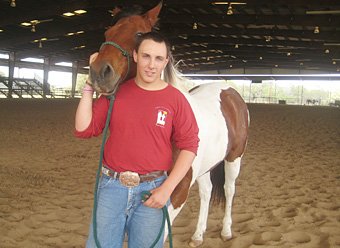
Dalton, a resident student at Miracle Farm, developed a special bond with Butkus, a horse that—like the teenager—didn't want to be told what to do but benefited from loving guidance.

"Dalton was never a bad kid, but the public school system had failed him. He was struggling with his school work and getting his ADHD under control," said Hamilton. "Dalton's relationship with his house parents was not going great either, and he was still having behavioral issues."

Shortly after Hamilton transitioned to Miracle Farm as its executive director, another young man from Texas Baptist Children's Home whose brother was a resident at the farm told Dalton about it. Miracle Farm, a part of Children at Heart Ministries like Texas Baptist Children's Home, offers residential care, a public charter school, vocational training and other services that help boys and their families experience new direction and restoration.

Dalton decided Miracle Farm might be a better fit for him, and he began pursuing the move.

When he arrived at Miracle Farm in late April, Dalton still was struggling with his schoolwork and was on several medications to treat his ADHD. He continued having challenges in school, and near the end of June, he announced he wanted to drop out.

Dalton was given one week to see what life would be like as a high school dropout. A neighbor of Miracle Farm put him to work doing physical labor for two days.

Dalton thought the work was boring, so he was then assigned to work with James Paben, who provides farrier services for Miracle Farm's horses. Paben assigned Dalton the job of pulling weeds in cattle pens.

"We referred to it as the 'James Paben dropout program,'" Paben said. "After three or four days of hard labor, Dalton promptly decided he wanted to go back to school."

"At first I thought Mr. James was just being mean to me to try and get me to go back to school, but then I realized this was the kind of job available for someone without an education," Dalton said.

Upon his return to the classroom, Paben's wife, Caty, the campus director for Premier High School's Miracle Farm campus and Dalton's teacher, made some modifications to his school program that allowed him the opportunity to thrive academically.

In addition to the change of pace in the classroom, Dalton credits two other factors for his success—his relationship with his house parent, David Jones, and his relationship with Butkus, a horse recently donated to Miracle Farm.

"David and Dalton have a special bond, because David understands Dalton. They're very similar," Hamilton said. "David has been instrumental in helping Dalton, because he struggled with similar issues growing up."

Jones took Dalton under his wing and taught him how to take used ropes and craft head stalls and lead ropes for horses, which Dalton has had the opportunity to sell.

"Dalton is one of the most naturally gifted rope workers I've ever seen," Jones said. "He is truly phenomenal with his hands."

Dalton's horse, Butkus, has also been instrumental in his change. Dalton volunteered to ride and train Butkus, who quickly earned a reputation for being a little bit feisty with some of the other boys.

"When Butkus arrived at the farm, he was a bit spoiled and did not want to be told what to do. Using a training method developed by master horseman Chris Cox, Dalton has been able to help Butkus understand that if he cooperates, life can be more fun," Hamilton said.

Dalton noted he and the horse understand each other.

"I can relate to Butkus, because people are telling me what to do all the time," he said. "Now he actually lets me pull on his reigns and lead him."

"Watching these boys with their horses is like when hard heads meet hard heads. These boys are a lot like their horses. Neither wants to do anything and they both need to learn a lesson," said Paben, who also volunteers with the farm's horse program.

"As the boys start to get better, so do their horses. There are boys who return to the farm long after they've left just to talk to their horses."

Dalton hopes to leave the farm and return home to Lexington to complete his senior year of high school.

"There are just a lot of people there that said I could never do anything without my medication, and I'd love to prove them wrong," said Dalton. "Plus, I'd like to share my story in order to motivate change in others."

Now that Dalton is back on track with the help of the Miracle Farm staff, his teachers, volunteers such as Paben and, of course, Butkus, he also aspires to become either a mechanic or rope worker after he completes his education.

"Dalton represents the typical kid we serve here at Miracle Farm," Hamilton said. "Just when you think a boy is ready to walk away, he steps up to the plate and becomes a man. Young men like Dalton are why we do what we do."


Caring for Wounded Warriors

CAMP LEJEUNE, N.C.—Sitting around the kitchen table, the Riverses are a picture of the quintessential American family. Over a freshly prepared meal, they share stories of the day's events. The room is filled with the warmth of smiles, laughter and genuine compassion for each other.

Chaplain Ray Rivers leads a Bible study for Marines at Camp Lejeune, N.C. When Rivers returned from tours of duty in Afghanistan and Iraq, he and his family found the transition stressful.

But it wasn't that long ago one significant piece of this portrait—the family's patriarch, Ray Rivers—was absent, as he served tours of duty in Afghanistan and Iraq as a Baptist General Convention of Texas-endorsed chaplain. His deployment in 2008 and 2009 forced the family to adjust. When he returned from duty, the Rivers family needed to adjust again. A father was back. A husband had returned. Deployment was stressful, but reconfiguring roles within the family after Rivers returned also proved to be a trying time.

"It's stressful when they get home," said his wife, Paula. "He came home and said to me, 'What happened to my wife?' Because I changed. I had to. I was forced to change. I was forced to become more self-confident, more bold, more militant, more whatever just to make things work."

Challenges of military families

The Rivers family faced and overcame challenges typical of a military family looking at, dealing with or readjusting in the wake of a deployment, according to a recent Pew Research Center survey that marked the 10th anniversary of the war in Afghanistan. The wars in Afghanistan and Iraq make up the longest period of sustained military engagement in U.S. history, and the nation has carried out these campaigns entirely with a voluntary force, leaving 0.5 percent of the nation's population to shoulder the brunt of the effort.

Chaplain Ray Rivers and his wife, Paula, enjoy having their entire family reunited since Rivers returned from deployment in Afghanistan and Iraq. But they also found they had to reconfigure family roles and make adjustments.

The theater of war is only the beginning of where post-Sept. 11, 2001, veterans sense issues, according to the report. More than four in 10 said adjustment to civilian life has been difficult, up from the 25 percent of pre-Sept. 11 veterans.

Thirty-seven percent of post-Sept. 11 veterans reported suffering post-traumatic stress. That number escalates to 49 percent when dealing with veterans who served in a combat zone.

Nearly half of married post-Sept. 11 veterans reported their deployments had a negative impact on their relationship with their spouse. Thirty-four percent of veterans from pre-Sept. 11 said the same thing.

Dealing with emotional scars

Brad Riza, BGCT associate director of chaplaincy relations and a Vietnam veteran who has dealt with his own post-traumatic stress issues for about 40 years, said improvements in medicine have helped soldiers on the battlefield but left more veterans to work through the scars of war. Modern medicine saves the lives of people who would have died in combat during previous wars. However, with more wounded soldiers living, there are more people trying to make sense of what they experienced.

"Because the care is better, they get treated better and survive," Riza said. "Because of that, we're dealing with more emotional scars."

Military personnel often are haunted by the images they saw, a sense of leaving friends and fellow soldiers behind as well as wondering why their lives were spared, Riza said. Military personnel are taught never to leave a fellow soldier behind. Yet some of them struggle with the reality that they did.

Platform of support

First Baptist Church in San Antonio provides meals periodically for military personnel and their families through the Fisher Houses and the Warrior and Family Center at San Antonio Military Medical Center. (PHOTOS/Courtesy of First Baptist Church in San Antonio)

The military offers a variety of options to help active personnel deal with their wartime experiences, Riza said. The military branches do an excellent job of attempting to help soldiers who are struggling, he said. Beyond the official channels, military personnel have a "band of brothers" around them that have gone through similar experiences in the form of their unit.

"You have a platform of support," Riza said. "The military does a good job with that."

After military personnel have finished their service, they can go to a Veteran's Administration hospital for help, but there may not be one close to where the veteran lives. While the hospitals' reputations are improving, some veterans will choose not to go there, believing their doctors and local hospitals provide better care, Riza said.

The combination of these factors leaves some veterans without a viable avenue through which they can find help for their post-traumatic stress issues, including flashbacks, flashes of anger, feelings of regret and lack of closure, Riza noted.

A wounded veteran arrives at a meal for military personnel and their families, provided by First Baptist Church in San Antonio.

Emotional and psychological issues are compounded when combined with the current economy, said BGCT-endorsed Chaplain Mike Mackrell, who serves in the U.S. National Guard in Austin. Many service people are struggling to find work after serving their nation.

"The transition of going from one, two, three deployments and coming back to have your employer keep your job or find another job is tough," Mackrell said.

Churches struggle to minister

This gap in places where soldiers and veterans can find solace would seem like a natural place where churches could minister, Riza noted. But doing so is difficult. Many veterans struggle to find a path through which they can express what they're going through and often can't find that avenue in churches.

Where are veterans supposed to turn when they are reliving experiences of significant injuries or watching close friends die? Where can they discuss performing duties such as picking up and identifying body parts after an improvised explosive device is detonated? Civilians don't understand those experiences and lack the necessary counseling skills to have those conversations, Riza said.

"They can't talk about that with their pastor," Riza said. "They can't talk about that with their Sunday school class."

Approaches to ministry

Churches realize the need for ministering to military personnel and their families and have tried different approaches to serving. Many congregations recognize veterans during services near July 4, Memorial Day and Veterans' Day. A significant number post pictures of church members and relatives of church members who are serving in combat. Churches thank veterans for their service and pray during worship for those who are deployed.

Other churches are less formal about the way they seek to minister to military families. They rely on the church body to reach out to military members and their families as they would any other person in the community. Sunday school classes, Woman's Missionary Union of Texas groups and others within the congregation routinely pray for specific needs.

Making an impact

To make a more direct impact, churches can contact their local bases, armories or chaplains, Mackrell said. The military holds Christmas celebrations and donation drives to gather personal items for specific soldiers. Chaplains often can provide specific points of need churches can fill. Recently, Mackrell connected a church with a soldier who returned from deployment only to see his Bastrop-area home had burned. The church provided supplies for the soldier and his wife.

"Churches could increase their attendance just by reaching out to soldiers," Mackrell said. "When they come back, half of them are asking serious questions."

First Baptist Church in San Antonio provides meals periodically for military personnel and their families through the Fisher Houses, located at military medical centers to provide a free place for military families to stay while their loved ones receive care, and the Warrior and Family Center at San Antonio Military Medical Center.

The meals are a way for First Baptist Church to show servicemen and women that the congregation cares about them, said Charlotte Anderson, who coordinates the effort and also volunteers to help the chaplain at Brooke Army Medical Center. People are in the houses for short periods of time at crucial moments, and the meals give families one less task they have to worry about.

Church members prepare and serve the meals. They often have an opportunity to visit with some of the people who come to eat as well. People share about injuries suffered by their sons. Mothers have spoken about a son's losing battle with cancer.

In serving military members and their families as well as working the chaplain, Anderson seeks to help however she can. When First Baptist Church members discover ways they can help military personnel, they are eager to get involved. One ministry opportunity often leads to another.

"We just kind of keep our eyes and ears open and try to meet needs," Anderson said.

A message of hope

First Baptist Church in Glen Rose took a different approach to serving military personnel—starting a support group for veterans led by veterans within the congregation. The church attempted to create a safe environment where veterans could talk about issues they were going through. The gatherings were held on Wednesday nights. After trying for a while, the congregation stopped holding the classes due to lack of attendance.

No matter how congregations approach ministry to veterans, Riza believes it's vital. People such as veterans who have seen some of the darker aspects of life need to hear a word of encouragement and have the opportunity to ground their lives in the love of Christ, he said. Without Christ, their post-war struggles are much more difficult to survive.

"Church can give a message of hope," Riza said. "That's the one piece of advice I would give."