Former BGCT State Missions Commission leader Semple dies

James Semple, retired director of the Texas Baptist State Missions Commission, died July 22 at age 80 after a battle with esophageal cancer.

For 12 years, Semple led the commission that included the evangelism, missions, church services and Sunday school divisions of the Baptist General Convention of Texas. During his tenure, Texas Baptists set new records in the number of churches started and people baptized. He retired from the convention staff in 2001.

From 2004 to 2007, Semple served the Baptist Convention of New Mexico, including 10 months as acting executive director and an extended time as interim director of evangelism ministries.

Before joining the BGCT staff, Semple served 25 years as pastor of First Baptist Church in Paris, during which the church had 25 consecutive years of increases in giving through the Texas Baptist Cooperative Program. Semple also previously served churches in Plano, Fort Worth, Mineral Wells and rural Wise County, as well as Ocala, Fla.

BGCT Executive Director Emeritus Bill Pinson characterized serving alongside Semple as one of the joys of his life. He praised Semple’s dedication to Christ, commitment to sharing the gospel and service to the Baptist denomination.

“Dr. Semple was a brilliant scholar and a zealous evangelist,” Pinson said. “His sermons and writing inspired and influenced a literal army of persons. His loving witness was used by the Lord to usher a host of persons in the Christian family. Heaven is more thoroughly populated because of the life and witness of James Semple.”

BGCT Executive Director David Hardage reflected on Semple’s impact for God’s kingdom.

“Dr. James Semple, to me, was the epitome of a Texas Baptist,” he said. “I am saddened to learn of his death but know that his life of ministry as a pastor and denominational servant will long be remembered.”

Semple is survived by his wife, Betty, six married children and 20 grandchildren.

Visitation is set for July 25, from 6 to 8 p.m. at Fry-Gibbs Funeral Home in Paris. The service is scheduled for 2 p.m. July 26 at First Baptist Church in Paris.


Texas Baptist Men volunteers head to New Mexico to help with ash-out efforts

About 20 Texas Baptist Men volunteers have been working to help families in New Mexico salvage what they could from their homes after savage fires roared through the mountains there.

The Texas teams joined Oklahoma, New Mexico and Southern Baptist Convention disaster relief teams. A shower unit from First Baptist Church in Amarillo also has been helping in various areas of the state.

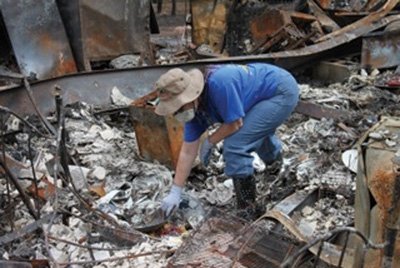
TBM volunteers help residents rummage through ash to reclaim what few things survived the fires in New Mexico.

The Texas teams arrived July 8 and expected to return home July 22.

Some of the families they helped were unaware of the fires until just before they reached homes. Because of that, they left with little more than the clothes they were wearing.

The Texas crews not only are removing ash and debris from burned-out homes, but also helping homeowners reclaim what possessions the flames spared.

One woman asked the team to help her look for five items she and her family held dear—wedding rings belonging to her and her husband, antique guns, jewelry and pottery angels.

She showed the team the areas where she thought the items might be located, and after many hours sifting through the ash and debris, all the items were located.

Some of the things were melted, but the rings were in good condition.

"The lady cried, and the team cried with her," Joe Henard, the Texas team coordinator, said.

On another occasion, the team noticed a woman who was distressed. Some of the women on the team talked with her and tried to discover what had her so upset, but they were unable to get her to calm down enough to tell the nature of her problem.

They dug up some of the flower bulbs from her flower bed for replanting, but that did not soothe her.

She finally began to tell them about the prize possession her brother had given her. As she was talking, a team member found something and dug it out of the debris, and it was just what she was looking for.

For the volunteers, the mission is much more about the people than their possessions.

The Paramount mud-out unit from the Panhan-dle of Texas doubles as an ash-out team. The team has made it a practice to give leather-bound Bibles to the families they help. The Bibles were provided by several Sunday school classes.

The team completed eight jobs in its first five days on site.

Four individuals associated with Texas Baptist Men also deployed to Colorado. While Colorado seemed to have enough volunteers in general, it was short of people skilled in working heavy machinery, so these four Texans filled that need, Texas Baptist Men Disaster Relief Director Terry Henderson reported.


Apartment ministry to internationals in Houston a ‘daily adventure’

HOUSTON—The voice wasn't audible—but the message was clear: Go preach God's word. Acting in obedience, Jim Morisey left behind his dream of writing Christian songs in Nashville and began to preach the gospel.

That was 40 years ago.

Jim Morisey ministers to 20 apartments in a one-square-mile area of southwest Houston that is home to about 10,000 people from around the world. He shares the gospel with Hindus, Muslims, Buddhists, Jehovah's Witnesses, Mormons and followers of Santeria. (PHOTOS/Josh Hayter)

At 65, Morisey still is preaching, and he shows no signs of slowing down. His passion to share the gospel with the spiritually lost and make disciples among people of all nations has only increased with time.

"We are commanded by Jesus to go and share Christ," Morisey said. "To me, it's an adventure." 

Ten years ago, the adventure took him to southwest Houston, where he continues to minister among 20 apartments in a one-square-mile area with about 10,000 people from around the world. Morisey works with Hindus, Muslims, Buddhists, Jehovah's Witnesses, Mormons and followers of Santeria. Supported by the Baptist General Convention of Texas, three churches and five families, he meets regularly with a network of 18 families, small churches and individuals for encouragement and training.

Texas Baptists help support Morisey's apartment ministry to internationals through their gifts to the Mary Hill Davis Offering for Texas Missions.

"As we are daily going about our way, we are to be making disciples or be sharing Christ with the lost and inviting them to follow Jesus Christ," Morisey said. "The Gospel of John teaches no one comes to the Father unless the Father draws him. Once the Holy Spirit revealed that to me, I realized in my heart that I could not change people or save them."

It took years of ministry experience for him to understand that truth, Morisey said. When he realized there was nothing he could do on his own, and God was the only one who could change hearts and draw people to Christ, it changed his perspective on evangelism, and much of the pressure of ministry went away.

"Ministry became a daily adventure. 'How will God lead me today?  Who will I run into and share Christ or pray for?'" Morisey said.  "I just trusted in the leadership of the Holy Spirit to accomplish what he put on my heart to do. If God puts an idea in my heart to do something, instead of being afraid with thoughts of 'How can I do this?' I begin to get excited that God's preparing some people's hearts to hear the gospel. I now go with the expectation of finding the people God is leading me to."

T4T developed when Asian-American missionary Ying Kai asking God to show him how he could reach the millions of spiritually lost people surrounding him in Asia. He believes God revealed to him how he could train a continually multiplying number of church-planter trainers.

A missionary once told Morisey God has his "persons of peace" and "houses of peace" where people will gather to hear about Jesus and where certain individuals will be the ones who really spread the gospel. 

"The Lord will lead you to them," Morisey said. "If you don't spend much time with the Lord, you will find the persons of peace, but it will be much harder because your spirit is not sensitive to his voice."

God led Morisey to a young Pakistani man whom he has mentored and trained over the Internet for seven years. Today, the man plants churches in Pakistan.

"He began training young men like Jesus trained his disciples," Morisey said. "And now he oversees a movement of over 7,000 people in over 100 gatherings in Pakistan."

Morisey sees himself as both teacher and pupil. Another Pakistani Christian is mentoring Morisey in a church-planting movement, Training for Trainers or "T4T."

"It's a combination of evangelism, discipleship, church planting and leadership training," Morisey explained.

T4T developed when Asian-American missionary Ying Kai asking God to show him how he could reach the millions of spiritually lost people surrounding him in Asia. He believes God revealed to him how he could train a continually multiplying number of church-planter trainers.

Based on 2 Timothy 2:2, where the Apostle Paul discipled Timothy and urged him to teach reliable men who will be qualified to teach others, Morisey said, T4T is a simple, duplicable biblical strategy that can be used to train any Christian to share his or her testimony and the gospel with others and then disciple and give leadership training to people in small groups. 

"It's a strategy of someone evangelizing and discipling a person with the command and vision that he do the same with another, and they do the same with another to at least four generations or more," Morisey said. "Churches could train their members and utilize discipleship groups meeting in homes and other places.

"The Great Commission commands us to go and share, to make disciples, baptize them and teach them to obey. Christ started with 12, and it grew to 70, 500, 3,000 and more."

Morisey challenges Christians to go back to the basics of the gospel in Acts. Evangelize, disciple and teach them to duplicate, he said. When people do that, the Holy Spirit will open the eyes of others to join in.

Morisey evangelizes because he understands where people without Christ stand before God. As he preaches the gospel, he has confidence God will save his people.

"I am deeply aware that people are dead in sin," he said. "God hates sin and must punish our sin.  If he punishes us, we go to hell.  But in his love, God sent Christ to be punished in our place for our sin on the cross. The blood he shed was his life being given for our sin."

Morisey is new to T4T, but he's already seeing results. A few people he has trained are beginning to share Christ with others. People are coming to Christ and immediately going out to share the gospel.

"The movement is just beginning. We have a long ways to go, but I am encouraged," Morisey said. "I receive a real joy, because I see the gospel being spread by others."


Discipleship not defined by technique, but by God working in a person’s life

Any number of methods can be employed to disciple youth, but leaders believe youth ministers can tell if their methods are working by evaluating whether their young people are following Christ and exhibiting the fruit of the Holy Spirit.

Churches employ a variety of techniques to successfully help students grow in their faith, noted David Adams, Texas Baptist discipleship specialist. Some congregations focus their efforts on Sunday school. Others concentrate on small groups. One-on-one models are used. Some churches use a combination of approaches.

Each method has strengths and weaknesses, Adams said. As a result, the same discipleship technique that helps one person grow tremendously may not be as effective for another individual. The focus must be on helping people know Jesus and as a result, put biblical principles into practice in their daily lives.

"I don't know that there is a 'best way' to do discipleship," Adams said. "People are different, and people learn differently. What works for me might not work for you."

Texas Baptist youth ministry specialist Jane Wilson said a disciple is a learner.

"That word should describe a believer all the days of his life," she said. "When applied to a teenager, 'learner' is a very broad term, for he has had fewer years in which to grow in his relationship with Christ."

Discipleship is ongoing, Adams said. Spiritual growth rarely is constant and continuous. According to James Fowler's stages of faith, one step is when an individual—often in young adulthood—reflects on the faith they learned from others and analyzes it independently. That stage can lead to a person taking ownership of what they believe, a move Adams believes is crucial.

"Discipleship is a process," said Randy Johnson, youth minister at First Baptist Church in Richardson.

Johnson has been youth minister at the Richardson church 27 years and understands students can look great one moment and then disappoint the next. Still he never ceases to be amazed at what young people can do, he said.

Johnson believes discipleship in-cludes an education process, in which students learn biblical concepts and disciplines of discipleship such as Bible study and prayer. It's also a practical process, where students learn by doing—putting into practice what they have learned.

No matter how one person disciples another, Adams indicated, a mature disciple of Christ will exhibit the fruit of the Spirit listed in Galatians 5—love, joy, peace, forbearance, kindness, goodness, faithfulness, gentleness and self control.

Wilson affirmed Scripture provides a way for youth ministers to evaluate their discipleship efforts. Beyond Galatians 5, there are other passages that describe what a growing follower of Christ is like.

"To assess progress in discipleship, a student minister may look for progress in two basic areas of a teenager's life—having the mind of Christ as expressed in Philippians 2:5-8 (servanthood, unselfishness, humility) and walking as Christ walked, as noted in 1 John 2:6," she said.

Those characteristics only reveal themselves as a result of a person embracing a relationship with Christ and allowing him to work in his or her life, Adams said. That requires patience and belief that God will move in the lives of individuals.

"As a parent or a Sunday school teacher or a church staff member, you've got to trust God more than methods from the beginning."


Southwestern Seminary offers look at Dead Sea Scroll fragments

FORT WORTH—Southwestern Baptist Theological Seminary opened its exhibition of the Dead Sea Scrolls July 2 in the MacGorman Performing Arts Center on its Fort Worth campus. The exhibition will continue through Jan. 13.

Shalom Paul, professor emeritus of Bible at Hebrew University in Jerusalem, delivers a lecture at the exhibit.

A series of educational lectures dealing with either the scrolls or archaelogy in general also is being held each Tuesday evening.

The first lecture, "The Dead Sea Scrolls and Their Significance for Understanding the Bible, Early Judaism and the Birth of Christianity," was given by Shalom Paul, professor emeritus of Bible at Hebrew University in Jerusalem.

He also is chairperson of the Dead Sea Scrolls Foundation.

He has opened all the exhibitions of the Dead Sea Scrolls in the United States, he said. He noted the other exhibitions were all at museums, and this is the first time the scrolls have been shown at a seminary.

The exhibition includes 21 fragments of original scrolls bearing texts from Genesis, Exodus, Leviticus, Deuteronomy, Psalms, Isaiah and Daniel. At least 12 of the fragments in the exhibit, including a rare large fragment from a Genesis scroll, never have been on public display.

A simulated Qumran dig site located behind the building where the exhibit is held allows visitors of all ages to experience the work of an archaeologist. Doctoral students teach visitors to take elevations, record measurements and tag artifacts.
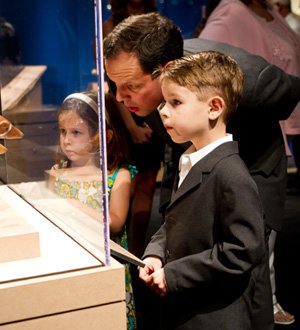
Dead Sea Scroll exhibit at Southwestern Seminary provides a learning opportunity for visitors of all ages. (Photo by Matt Miller/Southwestern Seminary)

A shepherd boy whose goat wondered away discovered the scrolls in 1947, Paul said. The goat wandered into a cave and the boy tossed in a rock to scare it out. Instead of hearing the expected sound of stone striking stone, he heard pottery breaking.

"This is what I call the Big Bang," Paul quipped.

Further inspection yielded the scrolls stored in seven amphoras, or large vases.

The scrolls were taken to an antiquities dealer in Bethlehem, but the script was so ancient, no one could read it. Only person in Israel at that time, a professor in Jerusalem, could read the script.

While the distance between Jerusalem and Bethlehem was not great, hostilities festered, and Jordanian troops prevented the professor from seeing the scrolls.

Finally, he examined the scrolls and bought three of the seven scrolls for $100. No one knows why he didn't buy the others, Paul said.

However, the professor's son saw an advertisement in the Wall Street Journal seven years later and realized it was for the other four scrolls. The price paid for the remaining four was $250,000.

The large Genesis fragment in the exhibition would be expected to fetch about $45 million if put up for auction today, Paul said.

After archaeologists and biblical scholars realized the antiquity and value of the scrolls, they began to scour the caves around Qumran for more.

"But the Bedouins beat us to almost every cave," Paul said. "How did we know? In every cave there was an empty pack of Marlboro cigarettes."

In all, 11 caves contained scrolls. They almost entirely were in fragments, having deteriorated over the years. Hundreds of thousands of scroll fragments comprise about 300 books, he said.

The exhibition includes 21 fragments of original scrolls bearing texts from Genesis, Exodus, Leviticus, Deuteronomy, Psalms, Isaiah and Daniel.

"When I say books, I mean portions of books. But if we have fragments, the whole book was once there," Paul explained.

While an Isaiah scroll measures 22 feet, and the Temple Scroll is 26 feet long, many of the fragments are only about an inch in size.

Paul said people attributed all sorts of reasons to why it took so long the publish the Dead Sea Scrolls, but the real reason was they were "not published because you had to be an expert at jigsaw puzzles to put these together."

After the Israeli war in 1967, many more scholars could work on the scrolls, and translation has gone much quicker since then, he explained. To date, 44 books using the source materials of the Dead Sea Scrolls have been published.

Ninety percent of the Dead Sea Scrolls are written in Hebrew, 7 percent in Aramaic and 3 percent are in Greek, Paul said. They range in date from 250 B.C. to A.D. 68.

He said fragments of every book of the Old Testament have been found except for the Book of Esther.

The great value of the scrolls is that prior to their discovery, the earliest manuscript of the Bible that had been found was one found in Syria dating to A.D. 975, he said.

"The Dead Sea Scrolls get us 1,000 years closer to the source materials," he explained. "It means the text is intact."

Not all the scrolls are biblical, however. Many have to do with everyday life in the community. One scroll de-crees that someone who wanted to join the community could only eat with others there after a year of living with them and doing the work and not causing any problems. If they continued to be in good standing after a second year, they also could drink with the others. After three years of good behavior, the goods the applicant brought and that had been held in escrow were put into the community treasury, and the person was a full member of the community.

Other scrolls describe how no one went to Jerusalem to make sacrifice because they believe the priests and the temple there to be heretical. The people of Qumran believed their sacrifice to be their prayers, in which they believed they joined their voices with the angels'.

Qumran seemed to function as a sort of library, and not all the scrolls found were written there, Paul said.

A copper scroll, the only one found of its kind, seems to be some sort of treasure map, Paul said. Some have speculated it to be a map to the temple treasury, but no treasure has been found.

Tickets for the exhibit and other information can be found at www.SeeTheScrolls.com.


Bling for the Souls event brings blessings

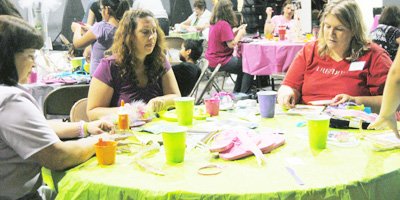
NEW CANEY—The opportunity to fellowship, show off their decorating skills and bless someone else drew more women than anyone could have guessed to the inaugural Bling for the Souls event held at Bethel Baptist Church in New Caney.

Bethel Baptist Church in New Caney was the site for the Children's Emergency Relief International's first Bling for Souls event. Women decorated shoes for themselves at others during the evening.

Bling for the Souls is a program to bless others as well as spread the word about Children's Emergency Relief International, said Gretchen Lange, CERI's director of development.

Bethel Baptist Church has sent teams to Moldova with CERI to provide orphans with boots to keep their feet dry and warm during winter.

That partnership made it a natural extension for the first Bling for the Souls event to be held at the Southeast Texas church, she said.

About 75 women of all ages attended the event. Most decorated flipflop sandals, but others chose to bling out athletic shoes and even picture frames.

The church, which has an average of less than 200 in attendance, was delighted at the number who came.

"We were thrilled at how well-attended it was," said Julie Davis, the pastor's wife and one of the organizers of the event. "One of our goals was for this to be an outreach event, and that is what happened. We not only had ladies from other churches in the area come, but some brought friends who don't have a church home."

The night started with finger foods, followed by a short description by Lange on the ministry of the children's relief organization, which is affiliated with Baptist Child & Family Services.

She also outlined the idea of the evening: Decorate two pairs of shoes identically—one to keep and one to give away.

"The idea was not to decorate shoes for donation to the children we provide for, but instead for them to wear their shoes and when someone says, 'What cute shoes,' they have a pair to give that person and also an opportunity to explain the mission we have with Childen's Emergency Relief International," Lange explained.

While donation to the children in orphanages was not the goal, several women did decide to do so. Those shoes will either be given to children in Mexico or auctioned off at the organization's annual benefit dinner.

One of the things Lange liked best about the event was its multigenerational nature. She said there were girls and women of all ages, often sitting at the same table.

"It was a beautiful thing to see them all together, having such a good time."

The Hispanic congregation across the street from Bethel sent a delegation of women. They likewise participated in Bethel's boot collection prior to its last trip to Moldova.

The New Caney church does not have an organized women's ministry to pull off events such as this.

"We periodically decide we want to do something, and whoever wants to help jumps in," Davis said.

After the decorating time, the women played Blingo.

"Really it was just Bingo, and we added an "L," Davis said with a chuckle.

A Bethel member who made a trip to Moldova described for the women her experiences and the reason she chose to make that investment of time and money.

The evening was capped by the testimony of a former orphan who told what a difference the donations of others had made in her life while a child.

The combination of missions and fellowship was perfect for Bethel Baptist Church, Davis said.

"Our church is very missions oriented. We get very excited about missions work and to get to work with CERI like this was exciting.

"Here was an event where we could partner with them, have fun and do something together. It was a real blessing and a reason for us to rejoice together," Davis said.

A second Bling event has been planned with a church in Nashville, Tenn., but after that, no more are on the calendar.

To partner with CERI?to host a Bling event, contact Lange at (281) 360-3702.


Abilene Baptists seek to renew, connect caring communities

ABILENE—One day last spring as Janet Mendenhall strolled her Abilene neighborhood handing out fliers, she met Daine Beasley working on a bus in a nearby churchyard. She couldn't have found a more receptive person for the message on her flier, inviting people to a neighborhood renewal meeting.

"That's been our mission through the years," Beasley said of his church. "Neighborhood improvement."

Doug and Janet Mendenhall, who live in a Friendship House sponsored by First Baptist Church in Abilene, invite their neighbors to their home every Thursday for a potluck meal. (PHOTO/Loretta Fulton)

And that also is the mission and purpose of Connecting Caring Communities, noted Mendenhall, community coordinator for the nonprofit organization that originated as a neighborhood improvement initiative at Hardin-Simmons University.

Although CCC serves the entire city and relies on various churches, organizations and foundations, it has been Baptist-driven from the beginning.

At the heart of CCC's initiative are Friendship Houses, which function like mini-community centers. Host families, such as Doug and Janet Mendenhall, live in the house and agree to open their home to the neighborhood for meals, after-school activities, meetings and other events.

Abilene is home to three Friendship Houses. They are sponsored—and funded—by Hardin-Simmons, First Baptist Church in Abilene and Hendrick Medical Center.

Connecting Caring Communities dates back about 12 years, when Lanny Hall was in his first term as president of Hardin-Simmons. He later left to become president of Howard Payne University in Brownwood and then returned to HSU as president.

Hall remembered a conversation during his first stint with Linda Carleton, who at the time was dean of students and associate vice president for student development at HSU.

Carleton had been studying a neighborhood renewal program in Shreveport and Bossier City, La., now called Community Renewal International. She envisioned Hardin-Simmons starting something similar in the neighborhoods surrounding the university campus.

"I knew she was on to something," Hall said.

Craig Turner took up the mantle when he became president in 2001 and made it part of his inaugural address. Turner, now president of Kentucky Wesleyan College, projected a vision for Hardin-Simmons that would make the surrounding community feel a part of the campus. He challenged students to start a Habitat for Humanity chapter and initiated a massive cleanup effort in the neighborhood that resulted in 42 tons of trash being hauled to the landfill.

Then he talked to Carleton about what was going on in her hometown of Shreveport. Turner was hooked.

"It was a wonderful collaboration," Turner said. "The stars aligned perfectly on that one."

A dozen years later, Connecting Caring Communities, with Carleton on its board of directors, is well into that "something" Hall picked up on in talking with Carleton.

"The Friendship House stands today as a symbol of Christian love and a service point for the neighborhood," Hall said. "Lives have been positively influenced."

Neighbors served by CCC initiatives concur. A popular event for host families is sponsoring occasional get-togethers. The Mendenhalls invite the neighbors to their home every Thursday for a potluck meal.

During a recent gathering, Daine and Cindy Beasely sat back after a chicken spaghetti lunch, looked around the houseful of diverse people, and smiled.

"It's all positive—what we've heard," Cindy Beasley said.

The Beasleys, like many families recruited by CCC, have a "We Care" sign in their yard. The sign tells others in the neighborhood the Beasleys are part of a network of caring neighbors.

Friendship Houses, We Care houses and Haven Houses, which offer assistance to people in need, are the building blocks of the community renewal Connecting Caring Communities envisions.

One reason for the positive reception is inclusion of other churches and a nearby school in the renewal effort. Janet Mendenhall has partnered with a United Methodist church, Second Baptist Church, where the Beasley's attend, and a new elementary school that will open in the fall.

"That multiplies my efforts," she said. "That's been a lot of fun."

With three Friendship Houses in place, Connecting Caring Communities is broadening its scope. The original Friendship House, sponsored by Hardin-Simmons, is called North Park for a former elementary school in the HSU area.

Originally, the Friendship House was an older home in the area, but now CCC has built a new home that serves as the cornerstone for North Park development. The former North Park school was razed, and CCC bought the vacant lot for development of a diverse housing subdivision.

Only one other house has been built to date, with nine lots still available for construction. A major focus of the development will be a park in the center. CCC wants to develop the park and then turn it over to the city.

Carleton noted CCC wants the city to take over ownership and maintenance of the park, which would be open to anyone in the city, so CCC can get back to what it does best.

"We want to focus solely on the relationship business," she said.

Apparently, Connecting Caring Communities, as envisioned by Carleton and other Hardin-Simmons leaders, is doing quite well in the relationship business.

In April, the host couple in the North Park Friendship House, Bart and Laura Herridge, held their seventh annual neighborhood party. More than 200 people spent the afternoon milling around the property, jumping on inflatable air castles, tossing baseballs, eating and visiting.

Before they began to eat, Bart Herridge offered a prayer that lies at the heart of the Connecting Caring Communities vision.

"We wish the spirit that's in this neighborhood were all over this city and all over the world," Herridge said.


Finding the right camp experience

Congregations need to consider what they are seeking to accomplish with their youth in order to pick a summer camp that meets their needs, according to Texas Baptist encampment leaders.

The marketplace features a variety of camp offerings for congregations, and each of them offers a slightly different emphasis, said Susan Ater, who is the liaison for Texas Baptists to the state's 29 Baptist encampments. Some are evangelism-driven. Others are discipleship-driven. Others focus on providing ways for youth groups to bond. Most try to blend each of these purposes, but their strengths shine through and can be seen by looking at a camp's schedule.

Small-group time is an important element of the camping experience for the youth of Wilshire Baptist Church in Dallas.

Extensive large-group times typically are focused on creating opportunities for youth to respond to a gospel invitation. Longer small-group times allow for follow-up on decisions as well as discipleship. Extended recreation periods foster strong team building that can bond a youth group together.

The best camp is the one that matches what a church is doing in its youth program.

"It would really depend on each individual church group and each individual youth minister," said Rhonda Roberts, executive director of Heart of Texas Baptist Camp and Conference Center in Brownwood.

Camps offer partners for churches, helping them reach their goals, Ater said. Choosing an appropriate summer camp requires youth leaders to understand their programs and the youth they serve. Ministers need to plan teaching and programming that leads up to a camp as well as efforts that reinforce the camp experience after the group returns.

Last year, more than 8,000 young people made recorded first-time professions of faith in Christ as Lord at Texas Baptist encampments that host a variety of camps throughout the year. Roughly 7,000 people rededicated themselves to God, and another 2,000 people felt called to vocational ministry. In all, 330,000 people attended a Texas Baptist camp last year.

"This is one of the greatest evangelistic tools that exists in our state," Ater said. "Look at the numbers: 7,000 to 8,000 salvations a year. That's pretty significant. Of course, we're talking about a partnership with the church that has prepared the youth and nurtured the youth. Then they come to camp, which provides an opportunity, during a focused week, to respond to the gospel."

The impact of camps goes beyond salvations, Ater noted. Youth who return year after year to summer camp are learning skills that help them grow in their faith, assume leadership roles and share the gospel with people around them.

"We tend to focus on the incredible numbers of salvation experiences that occur every summer at our camps," she said. "In addition to that, consider that Texas Baptist leaders of the future are being mentored and trained through these summer camp experiences. I love that."

When done well, camp is more than an event for a congregation, said Danny Dawdy, executive director of Highland Lakes Camp and Conference Center in Spicewood. Camp is a church cooperating with a Christian organization to help share the gospel with non-Christian youth and help Christian youth grow in their faith.

"We try to look at what the mission statement of the church is and try to help them accomplish that," Dawdy said.

Planned properly within a ministry context, lives and entire youth groups can be changed by camp experiences, Roberts noted. A secluded setting empowers a person to connect with God. One week of camp provides the same number of hours as an entire year of Sunday School.

"There's a power in camp that comes from getting away from your normal routine and coming to worship God," Roberts said. "God uses the unique environment of camp to change lives."


On the Move

Jim Benson to Edmund Boulevard Church in San Angelo as interim pastor.

Stacy Campbell to First Church in Smithville as youth minister.

Lewis Howard to First Church in Wichita Falls as pastor of education from First Church in Naples, Fla.

James Roberts has resigned as pastor of Clark Church in Gonzales.

John Wheat to Trinity Church in Kerrville as pastor from First Church in Kenedy.


Around the State

Baptist University of the Américas has expanded its Latina Leadership Institute outside Texas for the first time through an extension in Sophia, N.C. The institute is a certificate-granting program dedicated to the development and empowerment of Hispanic women.

Shady Grove Church in Greenville broke ground June 24 for a 7,000-square-foot sanctuary that will seat 250 people. The day of the groundbreaking, the church also burned the note on its family fellowship building. James Ralson is pastor.

East Texas Baptist University's Fred Hale School of Business has received a grant from the Council of Christian Colleges and Universities. The grant will aid the university in starting its Free Market Economic Institute.

Howard Payne University honored several faculty and staff at its annual personnel recognition luncheon. Nancy Jo Humfield, director and professor of theater, was named outstanding faculty member, and Debbie Childs, facilities coordinator, received the outstanding staff member award. Medallions recognizing excellence in teaching were received by Gary Gramling, director of the youth ministry graduate program and professor of Christian studies; Wendy Grooms, associate professor of mathematics; Carla Hawkins, assistant professor of modern languages; Lynn Humeniuk, director of the criminal justice program and associate professor of sociology; and Mandy Locker, assistant professor of criminal justice. Medallions for excellence in service were earned by Marcie Drew, controller; and Martha Fothergill, coordiator of records and reports for the registrar's office.

Hardin-Simmons University presented its Hemphill Graduate Honor Award to Erin James-Brown, teaching pastor at Crosspoint Church in Abilene. The award recognizes a student who excels in academic studies, possesses character and behavior consistent with the university's purpose and exhibits potential for significant contribution to their chosen field. It includes a plaque and cash award.

• Sylvia Artmann, Dallas Baptist University professor emeritus in education, has written a book titled Called to Teach: A Guidebook for the Journey. Her career in education spanned more than 50 years. She began teaching at DBU in 1983.

Anniversaries

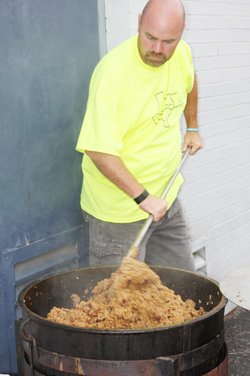
A group of students and adult leaders from Live Oak Church in Watson, La., worked with Montrose Street Reach, a ministry in the Montrose area of Houston that seeks to minister to teens living on the street as well as older homeless adults. Youth Pastor Johnny Morgan not only preached, he also cooked up a steaming pot of jambalaya. About 100 people were served, with most coming back for seconds.

Holly Brook Church in Hawkins, 25th, Aug. 25-26. An open house and fellowship time will be held Saturday from 3 p.m. to 5 p.m. in the Family Life Center. Light refreshments will be served. Paul Powell will be the guest preacher Sunday morning at 11 a.m. Danny Pickens, Smith Association director of missions, and Richard Faling of the church services department of the Baptist General Convention of Texas also will speak briefly. A lunch and anniversary program will follow the service. Guy McGraw is pastor.

Deaths

Billy Roberts, 81, June 7 in Coleman. During his tenure as pastor, he served White Chapel Church in Coleman, Dunn Memorial Church in McKinney; First Church in Fort Hancock, where he ministered 15 years; and North Coleman Church, where he was pastor 30 years. During most of his years as a pastor, he also was a schoolteacher. He is survived by his wife, Tommie; sons, Craig and Brian; stepson, Delbert Gault; sister, Dorothy Kennedy; brothers, Charles and Ralph; three grandchildren; and one great-granddaughter.

Bob Latham Jr., 83, June 15 in Sugar Land. A graduate of Howard Payne University and Southwestern Seminary, he was pastor of churches in Silver Valley, Morales, Dacus and Richards while a student. In 1957, he became the first pastor of Sharpstown Church in Houston. In 1980, he moved to an Indiana church, where he retired in 1993. He also served 10 years as a trustee of the Home Mission Board of the Southern Baptist Convention, was president of the Southern Baptist Convention of Indiana, and served on the Executive Board of the Baptist General Convention of Texas. He also served on the board of trustees for Howard Payne University and Memorial Baptist Hospital System in Houston, as well as serving in various capacities with Union Association. He is survived by his wife of almost 62 years, Becky; daughters, Susan Randel, Beth Runnels and Liane Latham; sons, Tim and Mark; six grandchildren; four great-grandchildren; three sisters; and one brother.

John Park Jr., 57, July 2 in San Antonio. He was associate pastor at Trinity Church in San Antonio, serving there in numerous capacities during his 33-year tenure. He is survived by his wife of 25 years, Darleen; children, John III, Dakota, Amber and Sawyer; brothers, David and James; and sister, Joyce Engle.

LeRoy Ford, 90, July 9 in Fort Worth. During World War II, he worked as a civilian trainer at the Pentagon, and he then served as a secretary for the U.S. bombing research team going to Hiroshima and Nagasaki, Japan. Following the war, he became a student at Southwestern Seminary. After serving several churches in Oklahoma and Texas, he became editor of adult and youth Training Union materials for the Baptist Sunday School Board. In 1966, he returned to Southwestern as professor of religious education. He retired in 1983. He is survived by his wife of 62 years, Jeanette; daughters, Judith Rex and Cynthia Meyer; son, Daniel; sister, Lucille Windham; and four grandchildren.

Ordained

Jared Watson as a deacon at First Church in Mertzon.


Nondenominational Christians, Muslims among top Texas religious adherents

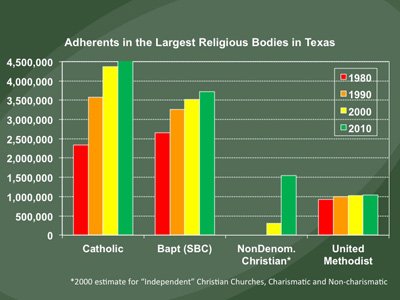
Southern Baptists continue to rank second only to Roman Catholics in terms of total adherents in Texas, but nondenominational churches have overtaken Methodists, according to Clay Price, information analyst with the Baptist General Convention of Texas.

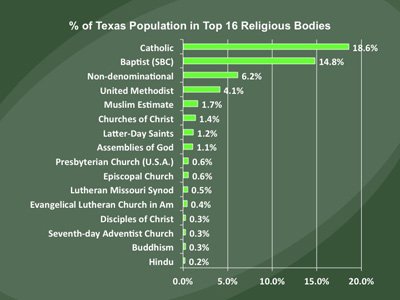
And while the precise number of Muslims in Texas may be debated, nobody can question their increasing presence in the state, Price said. The number of Texas mosques grew from 91 to 166 in 10 years, and Muslims may be the state's fifth-largest religious group.

Price analyzed data from the recently released 2010 U.S. Religion Census, conducted by the Association of Statisticians of American Religious Bodies. He presented an overview of his findings to the July 10 meeting of the BGCT Leadership Council.

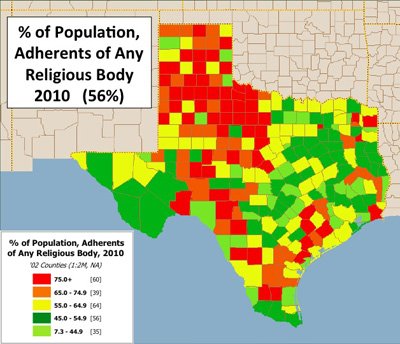
The U.S. Religion Census showed 152 religious bodies in Texas claim 56 percent of the state's population, with more than 13.9 million adherents in 27,848 congregations.

Nationally, 236 religious groups participated in the 2010 study—produced every 10 years to coincide with the U.S. Census. The survey found 49 percent of the United States population related to a religious group, with more than 150 million adherents in 344,894 congregations.

"The adherent figure is meant to be the most complete count of people affiliated with a congregation and the most comparable count people across participating groups," Price said. Adherents not only include members, but also children and people who attend but have not joined a place of worship.

For groups that count members but not adherents, the U.S. Religion Census estimates that number by computing what percentage a group's membership is of a county's adult population, applying that percentage to the county's child population and then adding the resulting figure to the group's reported membership, Price explained.

Southern Baptists in Texas grew by 5.8 percent, from 3.5 million to 3.7 million, while Catholics grew 7 percent, from 4.37 million to 4.67 million. The U.S. Religion Census counts as Southern Baptists any churches affiliated with either the Baptist General Convention of Texas or the Southern Baptists of Texas Convention.

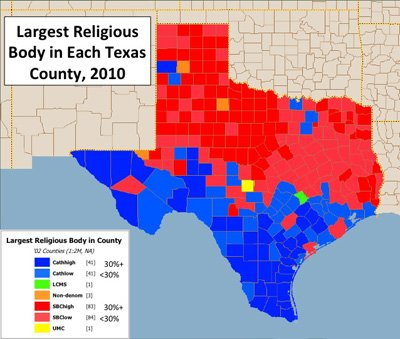
Baptists are the largest religious group in 167 Texas counties, and Catholics are largest in 82 counties. Predictably, Catholics dominate in the southern third of the state, where the Hispanic population is highest, but they also post a strong presence in parts of metropolitan North Texas—notably Dallas, Collin and Cooke counties.

Together, Catholics and Baptists account for one-third of the state's population—19 percent for Catholics and 15 percent for Baptists.

Although nondenominational Christian churches were not identified in that way in the 2000 survey, they emerged as the third-largest group in 2010 with more than 1.5 million adherents in 3,600 congregations.

Adherents in nondenominational churches are concentrated particularly along the highly populated Interstate 35 corridor and the Houston area, but they blanket the state, with adherents in 210 of the 254 Texas counties.

United Methodists posted a modest 1.3 percent increase, from 1.02 million in 2000 to 1.03 million in 2010.

The survey showed Muslims had a 267 percent increase, from about 115,000 in 2000 to 422,000 in 2010, but Price took issue with the methodology used to arrive at that estimate.

Researchers estimated 2,542 average participants per mosque in Texas, based on the average size of mosques that reported their number of adherents, he noted. Price determined that average was applied to 47 of the Texas mosques, including some in counties with a relatively small population.

"The U.S. average was 1,247, and if this number had been used, the total Texas Muslim count would have been reduced by at least 61,000. The total Texas Muslim estimate would have been 361,000, and Muslims still would have been the fifth-largest religious group in the state," Price said.

He insisted a more accurate number would have been based on the median rather than the average, bringing the number closer to 300,000. Still, he noted, mosques are located in 35 of the 254 Texas counties.

"The estimate as reported is high, but even when using alternate methods, Muslims would still have a significant presence in Texas."

The Evangelical Lutheran Church in America posted the most significant decline in the last 10 years, losing 43,372 adherents. Other groups sustaining deep declines were the Christian Church (Disciples of Christ), down 36,471; the Episcopal Church, down 29,471; Churches of Christ, down 26,135; and Presbyterian Church USA, down 25,269.

In contrast, the Mormons (Church of Jesus Christ of Latter-day Saints) posted a 91 percent increase in adherents, and Seventh-day Adventists showed a 60 percent increase.

About 11 million Texans are unclaimed by any religion. Of the 44 percent of Texans not connected to any religious body, the largest number are in the counties with the largest populations, Price noted.

"There are 35 Texas counties where 55 percent or more of the population have no connection to a religious body, and there are another 56 counties where the percentage is 45 to 55 percent," he said.

"Baptist outreach in the form of new churches, evangelism and ministry are needed everywhere, but these 91 counties with higher-than-average levels of unclaimed people demand our special attention."


Students study ancient manuscripts, thanks to vision of Hobby Lobby chief

WACO—Armed with a newly awarded master of divinity degree and with experience as an associate pastor under his belt, Paul DuPont turned wrestler during a recent week's visit to Baylor University—wrestling with Hebrew and Greek languages in ancient documents.

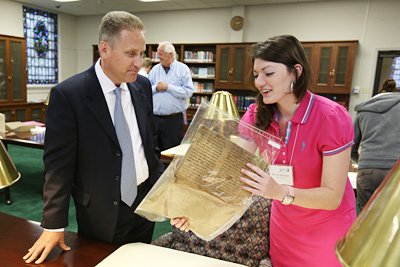
Rachel Butcher of Baylor University shows an ancient text to Steve Green, president of Hobby Lobby, during Logos at Baylor University, an international  summer institute in which leading scholars mentor undergraduates and graduates in hands-on research of rare manuscripts and artifacts. The items were made available for study by Green, who owns a large private collection of biblical artifacts. The institute is part of the Green Scholars Initiative, a program of the Institute for Studies of Religion at Baylor. (PHOTO/Matthew Minard/Baylor University)

DuPont was one of 31 international students chosen to attend the first-ever Logos Institute at Baylor University—a summer institute for university and seminary students eager to pore over papyrus and parchment texts, contemplate universal questions, worship, pray and learn to defend their Christian faith.

"I'm used to letters being typed all nicely by the computer," said DuPont, an aspiring doctoral student at the Charlotte, N.C., campus of Gordon-Conwell Theological Seminary. "I didn't realize how challenging it would be because of fading and missing pieces on the manuscript."

But he plunged into the task, joining other students doing hands-on research with scholar-mentors in textual studies, biblical studies, classics, Christian philosophy and apologetics.

The institute is the vision of Christian businessman Steve Green, president of Hobby Lobby, who loaned items from The Green Collection. In less than three years, he has amassed a priceless collection of more than 40,000 rare texts and artifacts, including clay tablets, scrolls and Scripture on papyrus and animal parchment.

The institute is part of the Green Scholars Initiative, a program of the Institute for Studies of Religion at Baylor expected eventually to include more than 100 universities. Green provided scholarships for students to travel to Baylor from the United States, the United Kingdom and Canada.

"You'll hear a lot of academics here—and then you'll hear me," Green told students and mentors at an evening session. "We're here because of our love of a book (the Bible), and we want to share the story with the world.

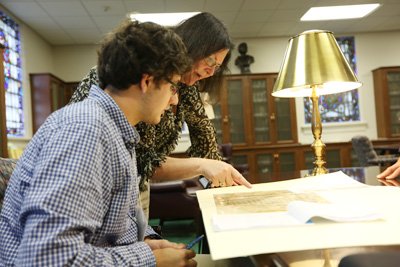
Andrew Camp of Wake Forest University examines rare document with Michelle Brown, professor of medieval manuscript studies at the University of London, during Logos at Baylor University. Logos is an international summer institute and is part of the Green Scholars Initiative, a program of the Institute for Studies of Religion at Baylor. (PHOTO/Matthew Minard/Baylor University)

"What we're focusing on is reliability. I'm not interested in scholars that are intentionally trying to discredit God's word; I'm also not interested in people who try to embellish God's word. … All we need to do is take the evidence that's there, present it without embellishment to the world, and say, 'Make your choice.'"

At one workshop, students donned plastic gloves before removing fragile Latin texts from protective covers.

"Read in Latin, make a transcript in Latin, use a computer program for a line or two so see if you can locate it and find a description of what we have," said David Lyle Jeffrey, distinguished professor of literature and the humanities in Baylor's Honors College and distinguished senior fellow and director of manuscript research in Scripture and tradition at Baylor's Institute for Studies of Religion.

"If people are moaning and groaning and get absolutely stuck, I'll help you, but I want you to rely on each other," he said. "I'll give you some things that have been identified, but there are some humdingers that haven't been. Are you game?"

They were.

"Having a community like this has been incredible," said Cambridge University sophomore Suzie Millar, a theology major, who worked with a group studying Genesis 32 in the Dead Sea Scrolls. "It's exciting to see the oldest versions of the Scriptures that we have."

Some manuscripts are significant because "they help to fill in the picture we have of the ancient world, including the world of the Bible," said Jeff Fish, associate professor of classics at Baylor. "With documentary papyri in particular, we get a look at the daily life and language of ordinary people. In effect, through private letters and other documents, we can eavesdrop on the ancients."

Scholars also mentored students editing some of the earliest fragments of the New Testament, with some dating to the second century, Fish said. Other discoveries are fragments of copies of some of St. Augustine's commentaries on John's Gospel and the Psalms, Jeffrey said.

Lori Baker, associate professor of anthropology at Baylor, told how radiocarbon dating and DNA analysis are used to date and analyze animal parchments and papyri.

"Dating the inks needs to be done to be sure the writing is as old as the parchment, too," she said. "In the seventh and ninth centuries, many were scrubbed and scoured to be used for new writing. … DNA from the parchment can tell us about the animals and, through them, the people who kept and bred these animals."

Ancient DNA is degraded and fragmented, making it difficult to analyze, she said. Despite the problems, "technology is changing the game."

A take-away message for young scholars came from Darin Davis, assistant professor of philosophy and director of the Institute for Faith and Learning at Baylor.

"We're called to connect the dots between ourselves and others in different fields and academic disciplines," he said. "Christians are not called to collaborate on interdisciplinary research because it is vogue, but because all truth is connected to God. The next generation of faithful scholars need to be seekers of wisdom who share it with God's people everywhere. It's not ours to stock up for ourselves."