Seek and find hope in the Lamb’s agenda

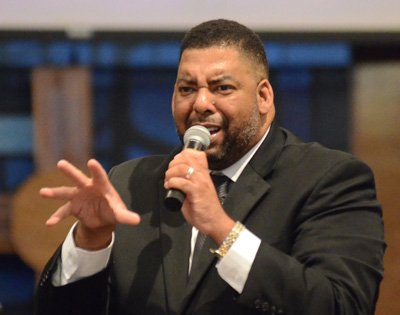
CORPUS CHRISTI—Samuel Rodriguez, pastor of New Season Christian Worship Center in Sacramento, Calif., urged Texas Baptists to find hope not in the agenda of donkeys or elephants but in the agenda of the Lamb of God, Jesus Christ.

The Lamb's church is at its core a Spirit-powered church, Rodriguez said at the Baptist General Convention of Texas annual meeting.
Samuel Rodriguez, pastor of New Season Christian Worship Center in Sacramento, Calif., urged Texas Baptists to seek and find hope in the agenda of the Lamb of God. (PHOTO/Robert Rogers/Baylor University)

Rodriguez recalled obstacles that stood in the way of God's people in the Bible—Egypt's pharaoh, Goliath the Philistine and Jezebel the pagan queen. The spirit of those challenges remains, he added.

"Yet I do have news for you this morning," Rodriguez said. "There is a Spirit more powerful than all of these spirits combined. The most powerful Spirit in America and on the planet today is still the Holy Spirit of almighty God."

Churches should hold up a counter-narrative to today's prevailing sense of loss, hopelessness and spiritual apathy by boldly proclaiming the Lamb's agenda, he insisted.

The agenda of the Lamb is complete freedom, he said.

"Why is there so much bondage in the world?" Rodriguez asked. "Because the enemy understands that the most powerful human on the planet is a person set free by the blood of the Lamb, Jesus Christ."

Free individuals boldly stood up to Pharaoh, Goliath, Jezebel and others in Scripture, he said. They broke the chains of tyranny. Ultimately, one free man took the sins of the world upon himself and declared, "He whom the Son sets free is free indeed," Rodriguez said.

The Lamb's agenda is the message of the cross, Rod-riguez continued, pointing out many American churches forget the essence of the cross.

"Simply stated, the cross is both vertical and horizontal. It is both redemption and relationship, holiness and humility, covenant and community, kingdom and society, righteousness and justice, salvation and transformation, ethos and pathos, John 3:16 and Matthew 25, Billy Graham and Martin Luther King Jr., prayer and activism."

The Lamb's agenda activates the worshipper, instilling confidence to proclaim the name of Jesus boldly, regardless of circumstances.

"There is power in the name of Jesus," he said. "That is the name that still sets captives free."

The Lamb's agenda activates a kingdom-culture perspective, he said. Pointing to what he views as a new and exciting Christian movement, Rodriguez said the coming spiritual awakening must be characterized as a multiethnic movement, using cultural expressions of every tribe and tongue. Instead of churches viewing the world according to their cultural context, they need to view it through the "compassionate lens of their kingdom citizenship," he said.

The Lamb's agenda produces overcoming, he concluded.

"According to some, we shouldn't even be here right now," Rodriguez said. Naming so many who predicted the end of Christianity, he looked at the assembled Texas Baptists and said, "Well, here we are in Corpus Christi, Texas, in 2012, and the church of Jesus is still alive and well."

"I encourage you to rise up and speak truth," he said. "Rise up with the Lamb's agenda, living out hope and healing in his name. And when that broken soul in Texas says no one can open the book of my deliverance, no one can heal me; when the world cries out for an answer, let this convention stand up and say: 'There is one who can do it. There is one who is worthy. Behold the Lamb!'"


Fund helps churches fulfill their mission

GONZALES—Churches in Gonzales Baptist Association invested in missions by contributing to each other's efforts.

The association agreed last year to move $50,000 from its general fund to a special missions fund and granted its missions committee discretion over how those funds are spent.

Michelle Malcik from First Baptist Church in Gonzales participates in face-painting and other activities at an outreach event. She was able to go on the mission trip thanks to the missions fund of Gonzales Baptist Association. (PHOTO/Courtesy of First Baptist Church in Gonzales)

For several years, the association helped churches in mission endeavors by purchasing Bibles, tracts, building materials and other items.

This year, the association began helping people with their own expenses for mission trips, as well.

"We try to tailor the amount given to each person's individual need," said Tommy Wilson, director of missions for South Central Baptist Area, which also includes Gambrell Association.

Since April, the association has expended $29,852, helping 51 people from six churches pursue mission opportunities in six countries—Haiti, Ethiopia, China, France, Germany and Vietnam.

Wilson views the money as an investment in God's kingdom and money well spent.

"I honestly feel God is going to bless a missions-minded church or a missions-giving church, and I've come to realize that God is going to bless a missions-minded and missions-giving association," he said.

The association has a track record of meeting needs of local churches, Wilson said.

"For instance, our cowboy church several years ago had gone through a summer without an air conditioner in a metal building. The pastor was saying that they needed to figure out how they were going to get air conditioning before the next summer. Well, someone made a motion, and we gave $10,000 just like that. No discussion, and we didn't bicker about it. That's just the atmosphere of our executive board meetings," he said.

Due directly to the mission expenditures, First Baptist Church in La Grange increased its gifts to the association, Pastor Jonathan Smith said.

"We doubled our giving to our association simply because we were able to see the direct workings of our tithes and offerings," he said.

First Baptist Church in La Grange has conducted baseball clinics as part of its mission work in Germany since 2008, and mission team members received associational subsidies. Some of the people who went this year probably would not have even considered it if the associational funds had not been available, Smith said.

The same could be said of the mission team from First Baptist Church in Gonzales, Pastor Chris Irving said. Eight of the 13 members of the team received funds from the association ranging from $200 to $700.

Two new German Christians—Isabella (left) and Penny—are grateful for the sports camps and other missions endeavors of First Baptist Church in LaGrange. (PHOTO/Courtesy of First Baptist Church in LaGrange)

"The way I would describe all this is that it's just a smaller picture of the Cooperative Program and what it was originally intended to be—a missions-sending force," Irving said.

The association's annual missions rally is one of the best-attended events of the year, Wilson noted.

"Even those little country churches who didn't have anybody go on a mission trip, they come and see what's going on. They realize that the amount they give every month is doing something, going for a good cause. They benefit from realizing they had a part in that," he said.

"When I get an opportunity to speak from the pulpit in those churches, I tell them about the things that are happening, and I tell them, 'The reason we're able to do this is because churches like yours give—it may be a little, but a little and a little make a lot.'"

Missions play an important part of what churches do locally as well, Irving believes.

"Once they go, they get a taste to see the Great Commission happen and live it out, and they come back with the same passion to do the same thing in their hometown," he said.

Smith sees it as even more encompassing.

"I believe very strongly that when the church is doing what the church is supposed to do, God will do what only God can do. When we focus on evangelism and discipleship—focus on the kingdom—he will take care of the church," he said.

"Having that philosophy, I knew one of the fastest ways to stimulate people to share their faith in their own hometown was to do so elsewhere."

During the four years the LaGrange church has traveled to Bunde, Germany, on mission trips, core membership has increased from 50 to about 250.

"Every time we go to do mission work, when we come back, families just show up. It's amazing. We know that from August to about this time of year, we're going to have great numbers of people visiting. I think it's directly related to mission work," Smith said.

The groundwork now is being laid for the congregation to expand its mission efforts to the Czech Republic and El Salvador—a direct result of the association's commitment to missions.

The association's contributions to his congregations mission efforts has raised the La Grange church's awareness of the association and its mission, Smith said.

"They've asked a lot of questions about the association and its work, and some have given extra gifts directly to the association. Our people are more aware of our association than they probably ever have been because of those gifts coming back to us. On top of that, our people now know people in Germany whose lives have been radically changed through those gifts," he said.

The associational missions funds gives small-membership churches a chance to be mobilized for missions, Irving added.

"You can be a Lone Ranger for missions, or you can cooperate together and get more accomplished and see almost every continent touched by a group of 24 churches—six different countries im-pacted with the gos-pel," he said.

"That's huge. The challenge is to come back home and see it also done right here."


On the Move

Trey Ainsworth has resigned as minister of students and senior adults at Calvary Church in Lufkin.

Timothy Askew to Mount Zion Church in Floydada as pastor.

J.R. Mosley to Metropolitan Church in Tyler as pastor.


Around the State

Raimundo Barreto, director of the division of freedom and justice for the Baptist World Alliance, was the keynote speaker for the T.B. Maston lecture series hosted by Dallas Baptist University. Barreto told participants that about 200 million Christians endure persecution.

East Texas Baptist University held its centennial gala Oct. 20. Guests enjoyed fellowship in the Quad with hors d'oeuvres and beverages prior to dinner. Almost 450 people attended the celebration.

More than 200 Howard Payne University students, faculty and staff raised in excess of $3,700 for breast cancer research through the Brenda Newbury Annual Walk for Breast Cancer Awareness. The event is named in honor of the wife of HPU chancellor and former president Don Newbury.

Stuart and Gina Solomon of McLean, Va., were named Baylor University's Parents of the Year during the annual parent and family weekend. They met during their first week as Baylor students as members of the Golden Wave Band. Their children—Melissa, Michelle and Jeffrey—all are Baylor students.

New faculty members at East Texas Baptist University include Jennifer Bashaw, assistant professor of religion; Joseph Brown, associate dean of the School of Education and professor of kinesiology; Sarah Bussard, assistant professor of theater; Amanda Chesshir, instructor of communication; Lawrence Clark, associate professor of English; Ken Fairweather, associate professor of marketing; Tom Haygood, associate professor of psychology; Robin McClaran, instructor of mathematics; Marila Palmer, assistant provost and assistant professor of education; Carol Rizer, assistant professor of nursing; and Dennis Robertson, professor of communication.

Anniversaries

First Church of Gresham in Tyler, 100th, Oct. 14. Roy Thoene is pastor.

Tyland Church in Tyler, 50th, Oct. 14. David Mahfood is pastor.

Bill Holmes, 10th, as pastor of First Church in Hawkins, Nov. 3.

First Church in Mineral Wells, 130th, Nov. 11. A lunch will follow the morning service. Nathan Buchanan is pastor.

Joe Martin, 40th, as pianist at Field Street Church in Cleburne, Nov. 11. He will perform a concert at 6 p.m., and a reception will follow.

Ordained

Daniel Camp, to the ministry at South Garland Church in Garland, Nov. 11. He is pastor at Shiloh Church in Crawford.

Revival

Belmore Church, San Angelo; Nov. 11-14; evangelist, Mickey Fugitt; music, Mike Anderson Family; pastor, Toby Irwin.


Quiet meeting as BGCT elects officers, approves flat budget

CORPUS CHRISTI—Messengers to the Baptist General Convention of Texas elected their top three officers by acclamation and approved a flat budget during remarkably quiet business sessions at Texas Baptists’ annual meeting.

New officers are President Jeff Johnson, pastor of First Baptist Church in Commerce; First Vice President Byron Stevenson, pastor of The Fort Bend Baptist Church in Sugar Land; and Second Vice President Kathy Hillman from Waco.

Johnson had served the past year as first vice president, and Stevenson served as second vice president. Hillman, director of special collections for the Baylor University libraries, is a past president of Woman’s Missionary Union of Texas.

Bernie Spooner, retired director of Sunday school/discipleship with the BGCT, was re-elected secretary of the corporation, and Doug Powell, minister of education at First Baptist Church in Garland, was elected registration secretary.

Convention messengers approved a flat budget for the third consecutive year. The 2013 BGCT budget depends on $33.85 million in Cooperative Program receipts from churches, along with $2.15 million in investment income and an additional $2 million from non-church donors for a $38 million net budget—the same as 2011 and 2012.

Counting revenue from the North American Mission Board, conference and booth fees, product sales and other miscellaneous sources, the BGCT anticipates $41,314,307 for 2013—down $28,224 from anticipated 2012 revenue.

In the approved budget, 79 percent of designated receipts are allocated to the BGCT and 21 percent to worldwide causes, with each church determining the recipient or recipients of its worldwide giving.

The budget anticipates $2.101 million for Texas worldwide missions initiatives and partnerships, up from $1.8 million in 2012.

The budget is divided 36.1 percent to education/discipleship, 19.5 percent to evangelism/missions, 16.8 percent to financial ministry support, 12.9 percent to advocacy/care, 9.9 percent to the associate executive director’s office and 4.8 percent to the executive director’s office/administration.

Messengers in Corpus Christi also approved two constitutional amendments without any discussion or questions from the floor.

One amendment grants the BGCT Executive Board authority to adopt the budget at its fall meeting in years when a summer annual meeting is held. The 2013 BGCT “family gathering” will be held July 14-17 in San Antonio in conjunction with the African-American Fellowship of Texas and the Hispanic Baptist Convention of Texas.

The other amendment grants voting privileges on the BGCT Executive Board to the presidents of BGCT-recognized fellowships, provided the presidents are members of BGCT-supportive churches.

For one of the few times in recent convention history, messengers introduced no motions from the floor during the miscellaneous business session.

Messengers approved a resolution encouraging “individual Texas Baptists to seek God’s guidance in making their election decisions” and to be informed voters. Other resolutions expressed appreciation to the hosts for the annual meeting and to the convention officers and staff.

Outgoing BGCT President Jerry Carlisle urged Texas Baptists to live out hope each day as a witness to the power of Christ.

“Will you stand in the place that God has put you to lift up the word of God, the hope that we have in Christ?” Carlisle asked in the presidential message to the convention. “Will you listen to his word? Do not be afraid. Do not be silent. Jesus says, ‘I am with you.’ That is how hope gets started. That’s how hope takes hold. That’s how hope takes over. That is hope lived out.”

The 2012 BGCT annual meeting drew 894 messengers and 476 registered visitors. The 2011 meeting in Amarillo attracted 983 messengers and 568 visitors.

Julio Guarneri, pastor of Calvary Baptist in McAllen, was selected to preach the annual sermon at the 2013 convention, July 14-17 in San Antonio, and Bob McCartney, pastor of First Baptist Church in Wichita Falls, was named alternate.

The 2014 BGCT annual meeting will be held Nov. 16-19 in Waco, and the 2015 annual meeting will be Nov. 8-11 in Frisco.


Kinnaman challenges churches to engage young spiritual exiles

CORPUS CHRISTI—The life of a 20-something isn't what it used to be.

Young adult lifestyles today differ starkly from 50 years ago, researcher and author David Kinnaman told the Baptist General Convention of Texas annual meeting.

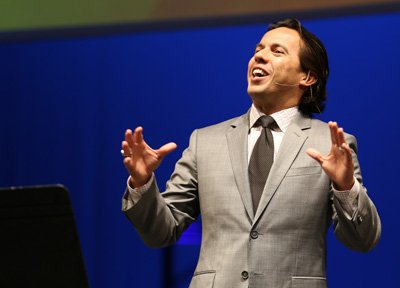
David Kinnaman, president of the Barna Group, challenged Texas Baptists to engage 20-something spiritual exiles. (PHOTO/Eric Guel/BGCT Newsroom)

Kinnaman, president of the Barna Group, cited the late "launch" of young adults into the world of independent living. Fifty years ago, 77 percent of women and 65 percent of men lived apart from their parents, completed their education and were self-supporting married parents with children by age 30. Today, only 46 percent of women and 31 percent of men fit that description.

Kinnaman also pointed to the increase in percentage of births to unwed mothers. In 1960, the number remained around 5 percent, but today 41 percent of children born do not have biological parents who are married to each other.

Added to these personal factors, the rapid change of technology also provides young people with a different reality. In 1960, people had the choice of a radio and three television stations; today, the number of media outlets seems unlimited, and youth can never seem to get enough.

"The typical teenager today uses more than 10 hours of media per day," Kinnaman stated. "How is it that our churches are going to disciple in that kind of world where we have maybe 40 minutes a week?"

Looking to Scripture as a guide for engaging the current generation, he said, "Friends, I believe that the best metaphor for the complexity of our digital culture is being exiles in Babylon."

The difference for churches today, Kinnaman suggested, is the difference between discipling in Jerusalem—the homogeneous society of 1960—and discipling in Babylon and a culture where anything goes.

With this paradigm in mind, the Old Testament prophet Daniel provides an example for a young generation of exiles raised in Babylon and its culture while retaining the essence of their faith. Because of the faithfulness of young exiles like Daniel, God used them to teach the community how to be faithful.

Kinnaman insisted churches must reach out in three ways to stay engaged with the young exiles and disciple them. First, they must be in genuine relationship with other believers, especially older believers. Second, they need to cultivate a clear sense of calling. Third, they need to have a clear sense that God continues to speak to his people through his word.

Keep the picture of Daniel in mind, Kinnaman urged, and seek ways to keep the younger generation engaged with the gospel, even if that engagement looks different than it did in the past.

"We need exiles to help us navigate the changing culture," Kinnaman stated. "They are going to challenge us, they are going to ask tough questions, they may not always agree with us, but we have to be willing to be present when they are asking us these tough things."


Texas Baptists called to live out hope, Carlisle insists

CORPUS CHRISTI—The ancient church in Corinth still has a message of hope for Christians, Baptist General Convention of Texas President Jerry Carlisle told Texas Baptists.

In his presidential message to the BGCT annual meeting, Carlisle described how a broken, battered and disheartened Apostle Paul arrived in a lost and hopeless Corinth ready to cease preaching.

Outgoing BGCT President Jerry Carlisle urged Texas Baptists to live out hope each day as a witness to the power of Christ in a world driven by pleasure and profit at any cost. (PHOTO/Robert Rogers/Baylor University)

Paul recently had left a cohort of new believers behind in Thessalonica and was worried about how they would fare. He had argued in Athens with the intellectuals, with little success. He had taken a beating in Philippi and been escorted out of Berea.

"He'd been run off and run off and run off, and if you're not careful, that kind of thing has a way of hurting your feelings," Carlisle said. "When he made his way to Corinth, he was spent. He'd been 'rode hard and put up wet,' in Texas terms. He was exhausted and frustrated and anxious and humiliated."

Hope eventually took root in Corinth, Carlisle said, but not because of anything Paul brought to the table.

"It was not a place that was open to the gospel," said Carlisle, pastor of First Baptist Church in Plano . "It was not a place that had great potential or energy or generosity." However, Corinth possessed a strategic location. The city was a swirl of cultures, languages and ethnicities. It was a major center of commerce and trade, brimming with merchants, bankers, soldiers, temple prostitutes, slaves and religious leaders.

"Toleration was the ultimate virtue," Carlisle said. "I don't know about you, but Corinth doesn't sound much different from my town. So how did hope come to Corinth? Luke tells us that God had been at work, that it was because of God that there was a foothold, that God himself had orchestrated opportunities for believers to collaborate and cooperate."

Out of the 250,000 residents of Corinth, Paul found Priscilla and Aquilla, fellow believers who had been expelled from Rome. When Paul came to town, broke and broken, they partnered with him and gave him work.

When Paul had started losing hope in Corinth, God spoke to him in a vision. God said, "Do not be afraid," at a time when Paul was terrified of violence. He said, "Do not be silent," at a time when Paul was ready to be quiet for a while. He said, "I am with you," at a time when Paul was feeling alone and lonely.

"We tend to think of these visions to Paul as some mystical and difficult one-time events," Carlisle said. "The Lord said, 'Do not be afraid.' Does that sound familiar? … The things God was revealing in Paul's vision were nothing new; this was the Scripture that Paul knew by heart—God's word revealed to Paul.

"See, the vision we need is in red and black on pages of white in this word from God that we call the Scriptures. The voice you and I need to hear is the spirit of Christ who lives in us, who empowers us to the degree that we allow him."

In the end, the hope of the gospel was transformative in the towns and cities where Paul had been rejected. Timothy and Silas met up with Paul in Corinth, bringing an offering from the church in Philippi. The hope of the gospel had taken root there and the Philippians' generosity gave Paul a chance to preach full time in Corinth. Timothy and Silas also brought news from the church in Thessalonica; hope had also taken hold there and was being lived out in the lives of the believers. Things were starting to turn around.

Carlisle encouraged his listeners, saying God intentionally placed Texas Baptists at a crossroad of competing worldviews. He urged the audience to live out hope each day as a witness to the power of Christ in a world driven by pleasure and profit at any cost.

"My question to you today is this: Will you stand in the place that God has put you to lift up the word of God, the hope that we have in Christ?" he said. "Will you listen to his word? Do not be afraid. Do not be silent. Jesus says, 'I am with you.' That is how hope gets started. That's how hope takes hold. That's how hope takes over. That is hope lived out. May it start with us. May it start right now."


Churches called to embrace their context, be true to their calling

CORPUS CHRISTI – God places his followers where he wants them and then calls them to minister there, Dennis Wiles, pastor of First Baptist Church in Arlington, said in the Baptist General Convention of Texas annual meeting sermon.

In the BGCT annual message, Dennis Wiles, pastor of First Baptist Church in Arlington, challenged Texas Baptists to embrace the context in which God has placed them and be true to their core calling. (PHOTO/Robert Roger/Baylor University)

In the first century, God anointed people to start the church of Antioch and turned that church into a missions force, Wiles said. Today, God calls Christians to engage the culture around them for the sake of the gospel, he insisted.

The context in which Texas Baptists live demands engagement, Wiles said. They are in the midst of overwhelming diversity like the church in Antioch, faced with growing secularism and religious plurality, he noted, adding 20,000 Muslims live in Arlington.

In this environment, Christians must find a way to share the hope of Christ.

"Instead of longing for a different day, we need to embrace our context," Wiles said.

Christians need to identify the calling God has placed on their lives and cling to that calling, Wiles said. Discovery of calling begins not by look at one's community but by looking inside and sensing what God is calling each believer to do, he said. God's work in a person's life must spill over into action.

"Our ministries, our missions are reflections of our core," he said.

God's calling can be challenging, Wiles noted. It may mean learning new skills or figuring out how to accomplish new tasks. That can be part of the process of holding to God's mission.

"We need to be on a pilgrimage of learning," he said.


BGCT elects officers, approves constitutional amendments

CORPUS CHRISTI—Messengers to the Baptist General Convention of Texas elected their top three officers by acclamation during a remarkably quiet opening business session of the group's annual meeting.

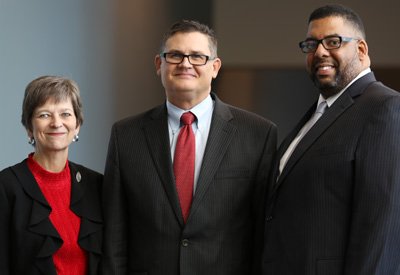
New BGCT officers are President Jeff Johnson, pastor of First Baptist Church in Commerce (center), First Vice President Byron Stevenson, pastor of The Fort Bend Baptist Church in Sugar Land, and Second Vice President Kathy Hillman from Waco.

New officers are President Jeff Johnson, pastor of First Baptist Church in Commerce, First Vice President Byron Stevenson, pastor of The Fort Bend Baptist Church in Sugar Land, and Second Vice President Kathy Hillman from Waco.

Johnson had served the past year as first vice president, and Stevenson served as second vice president. Hillman, director of special collections for the Baylor University libraries, is a past president of Woman's Missionary Union of Texas.

Messengers also approved two constitutional amendments without any discussion or questions from the floor.

One amendment grants the BGCT Executive Board authority to adopt the budget at its fall meeting in years when a summer annual meeting is held. The 2013 BGCT "family gathering" will be held July 14-17 in San Antonio in conjunction with the African-American Fellowship of Texas and the Hispanic Baptist Convention of Texas.

The other amendment grants voting privileges on the BGCT Executive Board to the presidents of BGCT-recognized fellowships, provided the presidents are members of BGCT-supportive churches.

For the first time in the memory of many long-time convention attenders, messengers introduced no motions from the floor during the miscellaneous business session.


Kenneth Hall named to Baylor development post

WACO – Kenneth L. Hall, President Emeritus of Buckner International, will join Baylor University as senior vice president for university development and strategic initiatives, effective Jan. 1, 2013.

Hall served as president and CEO of Buckner International from 1994-2010 and as CEO there from 2010 until his retirement in April 2012. He currently is a principal with Long View Equity Partners LLC.

Kenneth Hall is joining Baylor University as senior vice president for university development and strategic initiatives.

Since June, Hall has served as a BGCT appointee to the Baylor University Board of Regents, and as chair of the Development, Marketing and Communications Committee of the board. In 2009, Hall was appointed chair of the 10-member Presidential Search Advisory Committee that assisted with the successful selection in 2010 of Judge Ken Starr as Baylor's 14th president. Hall has also participated in a presidential task force to examine the advancement of the University's institutional interests and as a member of the Honors College Advisory Council.

Prior to his appointment to President Starr's Executive Council, Hall resigned his position on Baylor's Board of Regents. He will begin his new duties with the university on Jan. 1, 2013.

 During his 19-year tenure, Hall led Buckner to become one of the nation's showcase social service non-governmental organizations, annually serving more than 450,000 people through an array of diverse services for orphans, vulnerable children and families, and elder adults. Hall oversaw the expansion of Buckner to include more than $200 million in capital improvements in the past 15 years and the growth of the Buckner endowment to $200 million. Today, Buckner lists total assets nearing $400 million.

Along with the capital growth and improvements, Hall guided Buckner to expand its service offerings beyond the borders of Texas and the United States by launching the organization's international programs in 1996.

"I had a profound sense of calling to Buckner International, an organization I have loved and served for many years, and I would not have agreed to join Baylor in this new position unless I felt the same powerful call to serve," Hall said. "I am honored and humbled to have been offered the opportunity to serve Baylor as we stand at the threshold of a new period in the University's 167-year history. It will be a distinct privilege to work alongside President Starr, Executive Council colleagues and our dedicated development staff as we continue to move Baylor forward as a university with a steadfast dedication to academic excellence and Christian faith."

A Louisiana native, Hall earned a Bachelor of Science degree from the University of Texas at Tyler and Master of Divinity and Doctor of Ministry degrees from Southwestern Baptist Theological Seminary in Fort Worth. He also is an honorary alumnus of Baylor's George W. Truett Theological Seminary and received an honorary doctor of divinity degree from Dallas Baptist University.

Hall and his wife, Linda, have two grown children, Kevin and Kayce, and four grandchildren.


Baptist churches have women in ministry, panelists insist

CORPUS CHRISTI—Women minister in most Texas Baptist churches; they just don't always carry the job title, speakers noted in a panel discussion held in conjunction with the Baptist General Convention of Texas annual meeting.

"Titles are important, but we shouldn't get hung up on them. The important thing is being true to your calling," said Barbara Hessong, minister to children at Second Baptist Church in Corpus Christi.

Barbara Hessong, minister to children at Second Baptist Church in Corpus Christi, took part in a panel discussion held in conjunction with the BGCT annual meeting. (PHOTO/Eric Guel/BGCT Newsroom)

However, she felt "validated" in her calling when Second Baptist licensed her to the ministry. Second Baptist also called her "minister to children"—not "children's director" as another church had insisted she be designated, Hessong added.

"Whatever church situation you are in, whether you carry the title or not, you are a minister. It's not all about the title," she said. "But it sure helps."

Hessong participated in a panel discussion moderated by Meredith Stone, women in ministry specialist with the BGCT. Other panelists included Candy Smith, pastor of spiritual formation and ministry at First Baptist Church in Richardson; Taylor Sandlin, pastor of Southland Baptist Church in San Angelo; and Van Christian, pastor of First Baptist Church in Comanche.

Smith recalled the experience of a girl at her church who told her mother God was calling her to be a pastor.

"I love the fact that we have an environment in our church where young women can follow God's leadership and a girl can feel the freedom to tell her mom she feels God has called her to be a pastor—an environment where there are no restrictions on hearing the voice of God," she said.

Sandlin noted Southland Baptist Church dealt with the issue of women in ministry early in its history—long before his arrival—by seriously studying what the Bible said on the subject.

"The church walked through the Scripture together. We have women in ministry because the church studied the Scripture, not in spite of it," he said.

Christian likewise pointed to the biblical grounds for women serving as deacons and ministers, noting particularly the preaching ministry. The gospel message—"Christ is risen"—first was entrusted to a woman who was instructed to make that announcement to men, he emphasized. "That ought to end the discussion."

Beyond the theological justification for full participation by all God's people in ministry, Sandlin also noted practical reasons for allowing both men and women to serve as ministers and deacons, such as service in gender-specific settings.

First Baptist Church in Comanche does not have women deacons yet, but the church has initiated deacon-led ministry teams that often include more women than men, Christian reported.

"The first step is to get people to realize they already have women deacons. They just don't call them that," he said.


Trials show God’s strength, African-American Fellowship told

CORPUS CHRISTI—People discover the strength of God during their durations of distress, a featured speaker told the African-American Fellowship of Texas worship rally on the eve before the Baptist General Convention of Texas Annual Meeting.

Byron Stevenson

Byron Stevenson, pastor of The Fort Bend Church in Sugar Land, said Christian leaders encounter times of trial and testing. Holding to a proper perspective and strong faith in God is the key to believers making it through them, he emphasized.

Trials are opportunities for Christians to grow stronger and more reliant on God, Stevenson said. God is with his followers in the midst of their struggles.

"Your straining is your training," he preached.

Stevenson encouraged people going through tough times to pray to God and rely on him to carry them through. In 2008, Stevenson's father-in-law and father both died. Hurricane Ike later destroyed his house. It was a difficult time where he sometimes felt he didn't have the strength to stand and preach, but he was able to see God working.

"God showed up week after week when I stood behind the pulpit and preached while my heart broke," he said.

God is a deliverer, Stevenson said. He brought the Israelites out of Egypt. God sent his Son to die on a cross to deliver mankind from sin and into a relationship with him.

"When the storm is over," Stevenson said, "you can look back and say, 'I made it.'"