Texans on Mission rebuild home for tornado victim

Brooke Brandon still fearfully recalls the day—June 21, 2023—the tornado ripped through the West Texas town of Matador. Her town. Her home. The home her parents built in 1963, and she and her siblings inherited.

“All I did was scream and pray,” she said. “I had three cats and was screaming for the cats, and there was a dog out in the storage room. So, all I could think of was the animals, you know?”

She remembers hearing wind and the sound of glass breaking, but “I don’t remember anything else, really. It’s just really loud.”

The tornado touched down about nine miles away from the city and moved quickly over the Texas caprock into Matador, taking out businesses and homes.

She and her neighbors were directly in its path. The home of the couple who lived next door “was leveled,” she said. The wife didn’t survive, and the husband still suffers from injuries he sustained that day.

Tornado survivor Brooke Brandon and her uncle, Stan Martin, express appreciation for the volunteer labor and building supplies provided by Texans on Mission and Southcrest Baptist Church in Lubbock. (Texans on Mission Photo / Russ Dilday)

Sitting at her kitchen table, she is surrounded by the sounds of hammers, drills and sawing. Her kitchen floor is stripped to the baseboards, and the walls are unfinished sheetrock. Still, she’s grateful for the construction all around her, calling it one of many “blessings after blessings.”

The noises around her are being created by a dozen Texans on Mission Rebuild volunteers, a team from Southcrest Baptist Church in Lubbock. Bob Davis of Matador coordinated the project, and he is part of Texans on Mission Builders.

The volunteers worked for a week refurbishing the garage and storage room and placing cement board on the façade, adding to the work already provided by a similar team from Lawn Baptist Church.

‘A bunch of blessings after blessings’

“Well, all I can say is it’s been a bunch of blessings after blessings,” she said. Those blessings started when first responders and her uncle, Stan Martin, found her and the three cats and the dog, all alive, after the tornado. A support fund provided by neighbors helped, too, but the money soon ran out. leaving her with few options to rebuild her destroyed home.

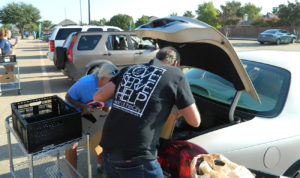
Larry Childers from Southcrest Baptist Church in Lubbock works on a rebuilding project for a Matador resident. (Texans on Mission Photo / Russ Dilday)

But then Rafa Muñoz of Texans on Mission called “out of the blue and says, ‘We’re fixing to come up there and do some stuff,’” she recalled.

That “stuff” was teams working under the Texans on Mission Rebuild banner showing up with materials and manpower to provide construction work.

She said the family was “running low on our money, the donation money we received, when all of a sudden, boom, it’s just happening. It’s been nothing but a miracle since then.

“Y’all just stepped in again and provided,” she continued.

“You can just see God working—the blessings that are here, that didn’t have to be here, but God has provided.”

The response has given her an “overwhelming feeling,” she explained.

Gary Beaty, team leader from Southcrest Baptist Church in Lubbock, works on a tornado-damaged home in Matador. (Texans on Mission Photo / Russ Dilday)

“Not overwhelming in a bad way, but of knowing a joy and happiness to know that,” she explained. “Because I feel like it’s a different situation for me. As far as I know, I’m the only person out of Matador that’s been able to get this type of help.

“It’s the flooding of people coming in and just working in the heat and whatever it is, and having the best attitudes about it as well,” she said about the Texans on Mission teams. “And it’s been fun being able to get to know them, too.”

Stan Martin also has helped the teams with the construction. He says the Southcrest team “is mainly doing the sheetrock and the OSB board in the garage and in the storage room.”

“We didn’t really tell everybody in the world, but we were running out of money and … couldn’t afford to buy any materials anymore,” he said.

“With everything that’s happened, we don’t need to be reminded there’s a God. … But if you’re sitting there wondering, you know, because everyone has these kinds of thoughts, if you just want to give up, or you say, ‘I’m tired of feeling this way,’ God always just comes back and says, ‘Here I am again.’”

Davis, project leader in Matador, said he felt compelled to step in because “there wasn’t any insurance on the house or anything, and they had limited funds to try to get this back where Brooke could live into it.”

Brad Barnes, a member of Southcrest Baptist Church in Lubbock, works on a Texans on Mission rebuilding project in Matador. (Texans on Mission Photo / Russ Dilday)

“I was glad to be a part of it, since I live here anyway,” he said.

Davis said the teams have “come in here and done things that there’s no way this family could have gotten done without them, and they think they’ve had the blessing out of this.

“We told them: ‘You may have, but we’re the ones that really get the blessing—the team members that do the work.’”

Southcrest team lead Gary Beaty, associate pastor of missions for the congregation, agreed.

“We’re trying to finish this project up, so Brooke can get a little bit of comfort and peace and get back to some semblance of normalcy,” he said.

“I’m not sure what her options would have been, but she’d definitely have been looking for another place to live, and I’m not sure what would have been available here for her.

“I think that without God being behind it, we wouldn’t be where we are right now, both with the people coming in and the work that’s been done on the house. Without God’s intervention and direction, this thing would never have taken off.”


Hendrick Health marks 100 years of service to community

Hendrick Health in Abilene has provided vital healthcare services in West Texas for 100 years this September.

Hendrick opened Sept. 15, 1924, as West Texas Baptist Sanitarium—admitting its first 11 patients the next day.

Millard A. Jenkens, pastor of First Baptist Church of Abilene, campaigned for a charity hospital for the city. (Hendrick Health Photo, circa 1915)

The five-story hospital was the fulfillment of a dream for Millard Alford Jenkins, who served as pastor of First Baptist Church in Abilene from 1915 until his retirement in 1948.

Harry Leon McBeth notes in Texas Baptists: A Sesquicentennial History, the early years of the 20th century saw Texas Baptists start several hospitals and medical training schools, the majority of which were “under the control of associations or local Baptist groups.”

The sanitarium in Abilene followed this trend. Jenkins campaigned for the sanitarium, but Simmons College—now known as Hardin-Simmons University—joined the cause.

In 1921, the college formed a committee to consider a hospital plan three years before its opening, the Hendrick100.org timeline notes.

Designed to equal care in Dallas-Fort Worth—in terms of equipment, services and skilled staff—West Texas Baptist Sanitarium’s completion meant local patients could have most medical needs met in their own community.

 The hospital opened with 52 patient beds (with room for 23 more), 10 nurses and 18 physicians with admitting privileges.

From its beginning, board members were committed to operating a community hospital to serve all, regardless of finances or religious creed. In 1935, the sanitarium affiliated with the Baptist General Convention of Texas, sealing its dedication to working together to heal bodies and souls.

Community donations have been a vital part of the hospital’s history, especially in harder economic times. During the Depression of the 1930s, the hospital struggled financially, even as its beds overflowed.

To continue providing care to destitute patients, the hospital accepted payment in black-eyed peas, chickens and goats. At times, nurses and staff agreed to accept produce in lieu of paychecks.

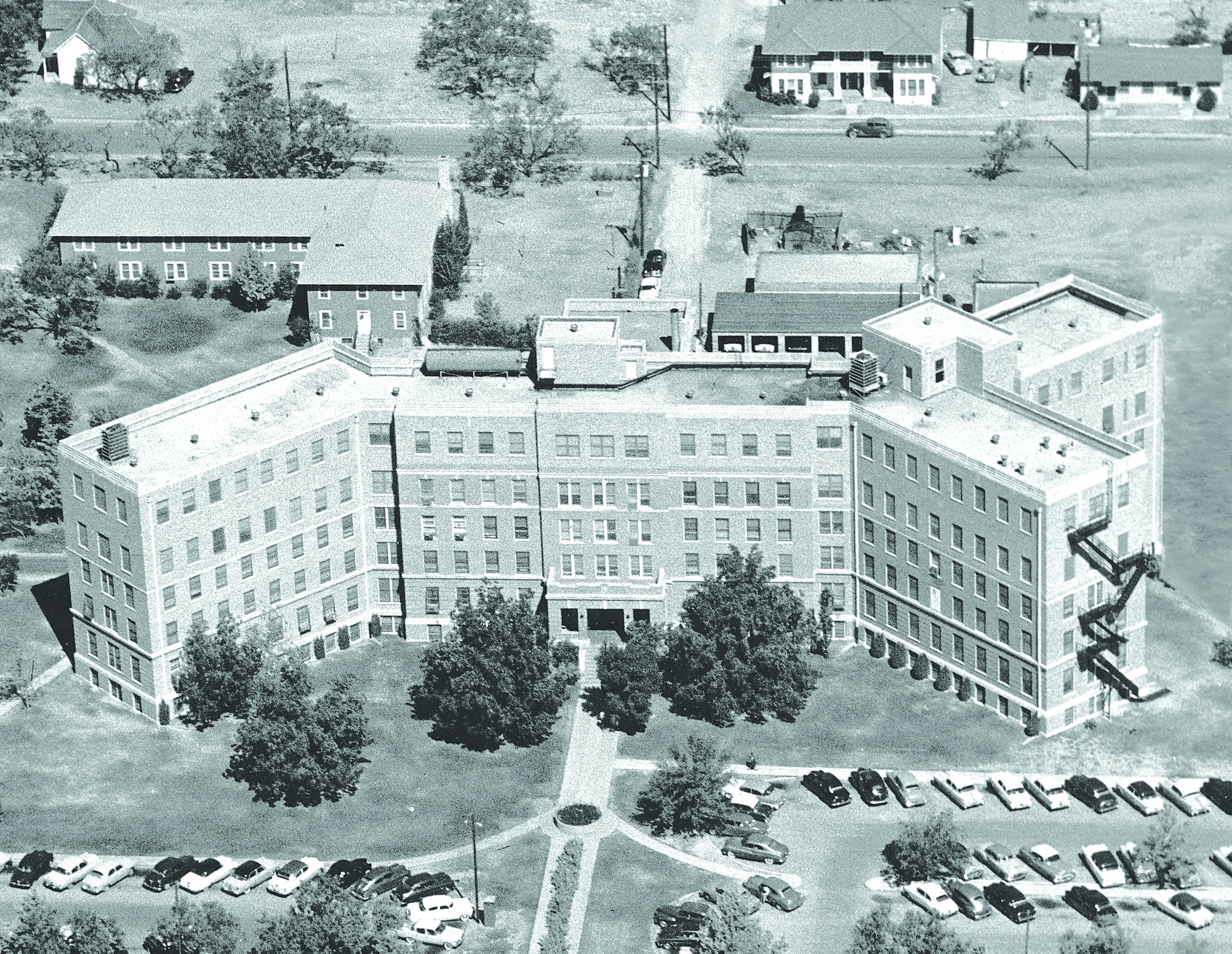
In 1946, a north wing was added in addition to the previously added east and west wings. Additional floors completed in 1950 grew the first three wings to six floors each. (Hendrick Health Photo, circa 1950)

Relief for the sanitarium’s dire financial situation came from Ida and Thomas Gould “T. G.” Hendrick. In 1936, their $100,000 gift enabled the hospital not only to avoid bankruptcy and pay off its debt, but also to add a much-needed four-story East Wing.

In appreciation of their generosity, West Texas Baptist Sanitarium was renamed Hendrick Memorial Hospital.

Through the end of the 20th century, donors funded more towers and wings. Yet as testament to its legacy, that original five-story building still stands, taller and wider, but still at the center of the hospital’s improvements and expansions.

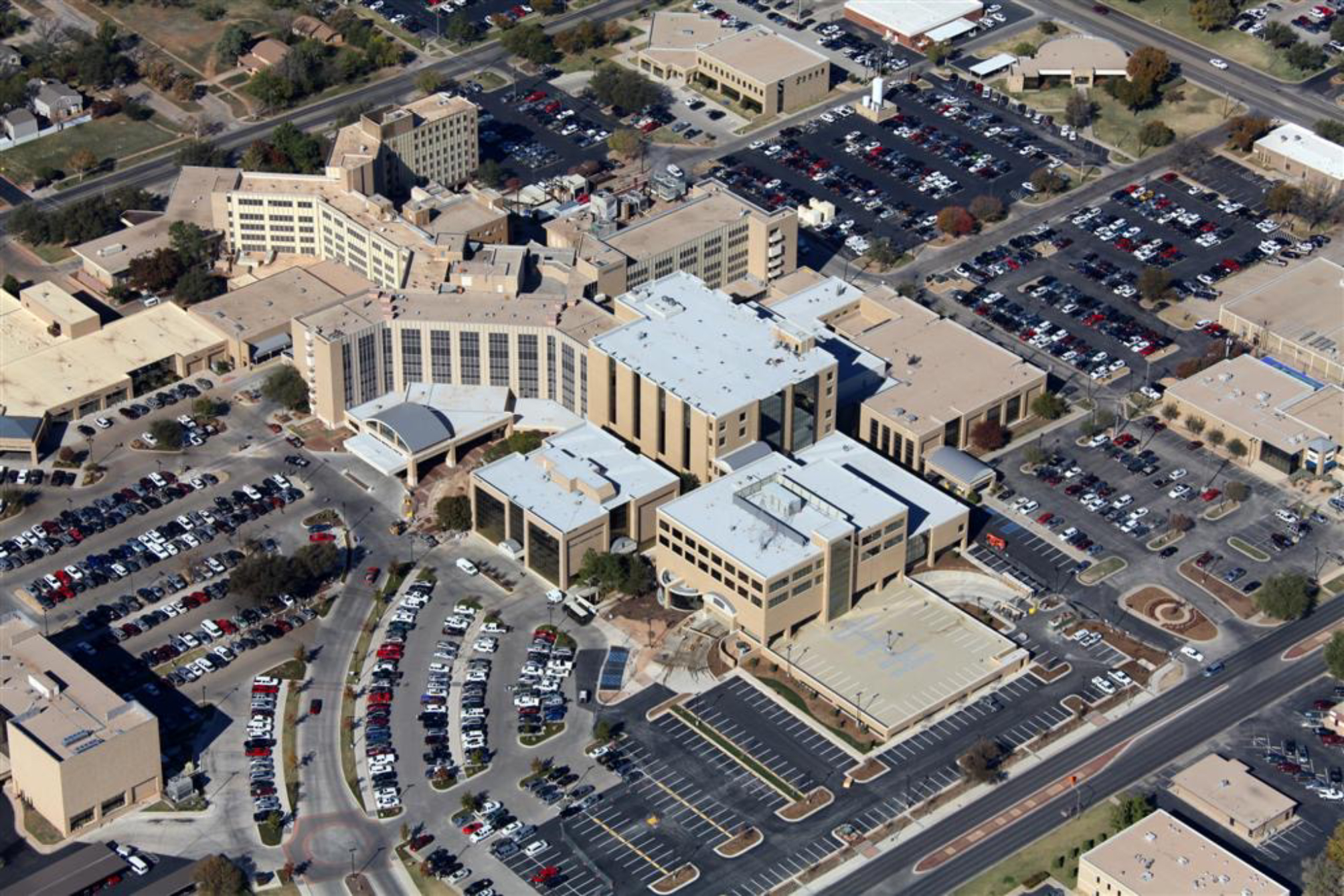
With the completion of its most recent building project in 2012, the hospital added 250,000 square feet of space—approximately 10 times more space than the original hospital building.

Project highlights included relocation and expansion of Hendrick Children’s Hospital, added space for surgical services and a new physician office tower. The name evolved as services expanded to Hendrick Medical Center and later Hendrick Health System.

Project 2010, completed in 2012, ushered in the largest expansion to date adding 250,000 square feet. (Hendrick Health Photo)

In October 2020, the institution’s name became Hendrick Health with the acquisition of Hendrick Medical Center South, formerly Abilene Regional Medical Center in Abilene, and Hendrick Medical Center Brownwood, formerly Brownwood Regional Medical Center, in Brownwood.

Across its facilities, Hendrick Health currently employs approximately 5,400 providers and staff. It has more than 100 service locations and serves 24 counties, encompassing a landmass equal to 9 percent of Texas.

The health system’s approximately 670 medical staff represent 60 specialties.

In addition to being the largest privately-owned organization in Abilene, Hendrick Health also is the largest health system in a Texas metro area not supported by a county taxing district.

For 100 years, Hendrick Health has continued as a nonprofit, faith-based organization guided by a local, volunteer board and affiliated with the Baptist General Convention of Texas. Through medicine, ministry and research, Hendrick Health carries forward its founders’ legacy.

To commemorate the hospital’s founding, First Baptist Church of Abilene held a centennial convocation, Sept. 15.

Ward Hayes, BGCT CFO (right), presents Brad Holland, Hendrick Health CEO (left), with a certificate honoring 100 years of Hendrick Health. (Hendrick Health Photo)

 “We pause briefly today to reflect on Hendrick Health’s rich history of service and our healing ministry, but our continued focus is on meeting the growing health needs of our community for the future,” said Brad Holland, president and CEO of Hendrick Health, during the ceremony.

At a reception following the convocation, BGCT Treasurer/Chief Financial Officer Ward Hayes—a former Hendrick board member—presented Holland with a certificate from BGCT honoring this remarkable milestone.

“We are very excited about celebrating this incredible milestone with our Hendrick family and with the communities we serve,” Holland said.

“Throughout our history, our success has been directly tied to the support of individuals and entire communities,” he continued.

In addition to the convocation and reception at First Baptist Abilene, Hendrick held centennial flag-raising ceremonies at all three of its hospital campuses on Sept. 16, to kick off the next century of healing.

With additional reporting by Calli Keener.


Proximity and cooperation key to justice and compassion

DALLAS—Speakers at a Fellowship Southwest conference challenged participants to think about the intersection between faith and justice.

Attitudes and structures keep justice and compassion outside the central focus of the American church, the speakers agreed.

 But the keys to moving to the center the basic mandates of Christianity to care for the “Quartet of the Vulnerable”—widows, orphans, sojourners and the poor—are proximity and cooperation.

In a world where people learn differences are a threat, it’s difficult to live in solidarity, said Cláudio Carvalhaes, professor at Union Theological Seminary. Particularly in the West, individualism replaces care and compassion.

This fractured and individualistic society creates a tendency to push one’s pain onto people who are more vulnerable—such as immigrants—blaming them for problems they have not created.

Instead, people must live by compassion and “be with the immigrants,” no matter what the world says, he continued. He urged attendees to view immigrants as gifts and to “love our neighbors.” He also questioned whether “we really want to be a Christian,” if there is an option not to care “for the least of these” as Jesus did.

Compassion fuels justice, Carvalhaes stated. All bear the image of God, immigrants included. It’s important to learn the root causes of migration and to be close to migrants, because the more one knows the stories of migrants, the less fearful one becomes of them.

Only together can we engage the issue of immigration, Carvalhaes insisted. “I’m here for you, and we are here for the people who are suffering.”

Rise anew

Justin Jones explains resurrection isn’t a moment, it’s a movement at FSW justice conference. (Photo / Calli Keener)

Justin Jones, Tennessee State Representative for District 52, offered an alternative vision for the South—where it doesn’t rise again, but instead can rise anew, better than it’s ever been before.

To change this country, “we have to change the South,” Jones asserted.

The youngest Black member of the Tennessee legislature described his experience in the Tennessee House, where Republican statesmen expelled him and the other young Black Democrat who spoke out following a shooting that killed six people at the Covenant School in Nashville in 2023, but not the white woman who was with them.

They were reseated by their districts, but as a punishment for his “antics,” Jones was stripped of his committee and assigned to an agricultural committee, though he represented an inner-city district.

Not to be deterred from doing his job, he faced his fear of being a young Black man in rural Tennessee to visit with the farmers he was tasked with considering.

He described being greeted by MAGA hats, American flags and Fox News in the background, but he also found something he didn’t expect to be there—appreciation.

The farmers told Jones he was the only politician who’d ever visited them to find out what their needs were. And if he needed them to back him up at the statehouse, they told him they would be there—with manure to dump on the steps, if necessary.

He told them to hold off on the manure. But he said, “loving our neighbors isn’t just a word, it’s an action.”

People can come together to end centuries old systems, but “resurrection requires proximity.”

Jesus had to be at the tomb to raise Lazarus, Jones said, so he could say: “Move the stone.”

“But if the stone’s removed, there’ll be a smell,” the people warned Jesus.

Parts of resurrection may be unpleasant, but Christians must still “show up” and unbind them, Jones insisted. These “dry bones” can live again.

Barriers to racial justice

Sandra María Van Opstal discusses barriers to racial justice. (Photo / Calli Keener)

Sandra María Van Opstal, executive director of Chasing Justice, discussed barriers to racial justice, the first being distorted and dysfunctional narratives. The stories we tell ourselves, songs and the way we interpret Scripture shape our beliefs, she said. And the stories we tell ourselves shape what we believe about others.

White supremacy and American exceptionalism are two distorted narratives that have become internalized, then externalized in policy and systems until they became “the air we breathe,” she explained.

Likewise, discriminatory policies “affect the way we live with each other.” Christians vote according to their own needs, instead of in light of God’s commandment to care for “the quartet of the vulnerable.”

Furthermore, discipleship problems form barriers to racial justice. Van Opstal said Christians might push the other barriers off onto somebody else, but they can’t blame anyone else for this barrier.

She pointed squarely at Donald McGavran—the father of the church growth movement in the 1970s and 1980s—and his “homogenous unit principal,” or the missiological idea that church planting efforts are more successful when they focus on people of common characteristics.

“It’s our fault” discipleship is a barrier to racial justice, Van Opstal insisted.

McGavran’s idea is why “we have youth ministries, and children’s ministries, and motorcycle ministries,” because it’s easier to get people in the door when they have common traits, Van Opstal continued.

“The problem is, that’s not the way of Jesus. So structurally and systemically, we taught people to be and practice biases. We invited them to always elect to be with people just like them,” she said.

“They said people are more likely to become Christians if they don’t have to cross racial, linguistic or class barriers. Let’s make it easy for them to say ‘yes’ to Jesus. … When that’s the opposite of what we see in Galatians, Ephesians, Colossians,” where Christians came together to the table, regardless of class or where they came from.

“The reason Christians were called Christians is because they didn’t know what else to call them. They didn’t look alike. They didn’t practice the same expressions of faith. They didn’t come from the same places,” she said.

So Christians must “interrogate the stories we believe” and reorient toward Christ. Christians must change how they view people and how they “name them.” People are not criminals, aliens, poor—they are “our neighbors,” she insisted.

Other conference speakers included Mariah Humphries, Mvskoke Nation citizen and executive director for The Center for Formation, Justice and Peace; Cassandra Gould, senior strategist at the Faith in Action National Network; and Jeremy Everett, executive director of the Baylor Collaborative on Hunger and Poverty.


Howard Payne University receives DOE clarification

Howard Payne University won a successful appeal from the Department of Education’s review committee, clarifying ownership and scoring a victory for the Baptist General Convention of Texas and related or affiliated educational institutions.

On July 1, the Department of Education updated Title IV federal regulations regarding program participant agreements with institutions that receive federal loans, Pell Grants and Federal Work Study funds.

The regulation requires the program participation agreement—which must be renewed every 10 years—to be signed by an authorized representative of the institution.

For “a proprietary or nonprofit institution,” the revised regulation also requires the agreement to be signed by “an authorized representative of an entity with direct or indirect ownership of the institution if that entity has power to exercise control over the institution.”

The Secretary of Education considers an entity has power to exercise institutional control “if the entity has at least 50 percent control over the institution through direct or indirect ownership, by voting rights, by its right to appoint board members to the institution or any other entity, whether by itself or in combination with other entities or natural persons with which it is affiliated or related, or pursuant to a proxy or voting or similar agreement.”

Like other institutions affiliated with Texas Baptists, a majority of Howard Payne University’s board of trustees is elected by messengers to the BGCT annual meeting.

However, the BGCT does not exercise control over the institution or its governing board. Howard Payne’s restated articles of incorporation identify it as a Texas nonprofit corporation with “no members.”

HPU sought clarification and appealed

HPU President Cory Hines said the university contacted legal counsel and the Department of Education, and it also participated in a webinar with other universities regarding the change in regulations.

In each instance, the university was told the revised regulations would require the BGCT to sign the program participation agreement—even though it does not reflect a Baptist understanding regarding institutional autonomy and would make the convention potentially liable for any defaulted loans.

The university contacted the BGCT and its general counsel John Litzler to determine next steps to take.

Howard Payne University President Cory Hines

“We contacted our PPA renewal representative, Regina Krob, directly and asked for clarification on this rule,” Hines said. “She directed us to file an appeal with the DOE review committee if we did not believe the regulations were accurate.”

Howard Payne submitted its bylaws, articles of incorporation and secretary of state filings, along with a letter from BGCT Executive Director Julio Guarneri drafted by Texas Baptists’ general counsel, to the review committee.

The committee met Aug. 5 and issued a ruling agreeing with the position held by HPU and the BGCT.

“It has been determined the Restated Articles of Incorporation for Howard Payne University (a Texas nonprofit corporation) ‘has no members,’” the ruling stated. “Therefore, the Level 1 ownership is ‘Howard Payne University” (Texas nonprofit corporation); it has no members, therefore there is only one level of ownership: Howard Payne University.”

Set an ‘important precedent’ for other institutions

Stephen Stookey, director of theological education for Texas Baptists, praised Hines and Litzler for their work in helping to establish what he called “an important precedent” with the Department of Education that will benefit all educational institutions related to Texas Baptists.

Stephen Stookey

“Recent Title IV updates, presumably designed to address fiscal responsibility at for-profit institutions through strict definition of institutional ownership, had the unintended consequence of jeopardizing access to federal financial aid programs at HPU and similar Baptist-affiliated universities,” Stookey said.

“The exemption gained by HPU recognizes the university’s collaboration with Texas Baptists per Baptist understandings of institutional autonomy and ensures access to federal student aid programs and funds.”

Howard Payne was the first Texas Baptist institution to encounter the new Title IV regulations as part of its once-every-10-years reaffirmation of the program participation agreement, but it won’t be the last.

“HPU’s exemption sets an important precedent for institutions related to but not controlled/owned by a denominational partner that appoints 50 percent or more of the institution’s board,” Stookey said.

Texas Baptists partner with 10 universities, most of which also have graduate ministry programs.

“Texas Baptists’ partnerships with these institutions allow the convention to appoint members to the respective boards while neither owning nor controlling these academic institutions,” he said.

“Texas Baptists value the work of our partner universities and their respective efforts to provide quality Christ-centered education. HPU’s exemption ensures students will have access to critical funds allowing academic and vocational preparation to faithfully pursue God’s call to Great Commandment and Great Commission service.”

EDITOR’S NOTE: The 12th paragraph was edited after the article originally was posted to clarify who sent the letter to the DOE review committee.


Board takes steps to create church insurance program

The Baptist General Convention of Texas Executive Board voted to take initial steps to create a Texas Baptist insurance program to enable churches to secure affordable property and casualty, liability and similar insurance coverage.

At its Sept. 23-24 meeting, the board authorized the BGCT to create a corporation to make church insurance available and provide the initial capitalization of an insurance reserve, pending executive committee approval of a feasibility study and approval by messengers to Texas Baptists’ annual meeting.

Since several major insurance carriers have left the Texas market, many churches either have been unable to renew their policies or have been saddled with steep premium and deductible increases.

Texas Baptists already are conducting a feasibility study to explore the possibility of forming a captive insurance pool for partnering churches—a practice some schools and nonprofit organizations already have adopted.

The insurance pool would be administered through a new corporation under BGCT control, and it would function like a co-op.

Keith Warren, executive pastor of North Side Baptist Church in Weatherford. (Courtesy photo)

The baseline premiums are expected to be about 30 percent less than similar insurance on the open market, said Keith Warren, chair of the board’s administrative support committee and executive pastor of North Side Baptist Church in Weatherford. The corporation is expected to be self-sustaining.

Legal requirements demand capitalization of at least 25 percent of the first year’s premiums—projected at between $1.5 million and $5 million, depending on anticipated initial participation.

The Executive Board also elected new officers for the next year—Heath Kirkwood, pastor of First Baptist Church of Lorena, as chair and Suzie Liner, a retired physician and member of First Baptist Church in Lubbock, as vice chair.

Sexual Abuse Task Force presents report

Janice Bloom, incumbent vice chair of the Executive Board and member of First Baptist Church in Garland, reported on the work of Texas Baptists’ Sexual Abuse Task Force, formed in May 2023.

The task force looked at preventative measures and best practices for how churches can respond to sexual abuse, she said. The revised section on Texas Baptists’ website devoted to sexual abuse response will go live on Monday, Sept. 30, with resources in English and Spanish.

In addition to making available a variety of training materials through MinistrySafe, the proposed 2025 BGCT budget includes funds to provide any Texas Baptist church dealing with a sexual abuse issue one hour of consultation with a MinistrySafe attorney.

Other recommendations included developing resources to help churches implement a comprehensive church safety team; develop a model policy for dealing with sex offenders who wish to attend church; develop a code of conduct for staff, board members, volunteers and others related to Texas Baptists; amend the BGCT bylaws to provide disciplinary measures for any Executive Board member who violates the code of conduct; and review the personnel policy manual to address sexual abuse prevention.

Steve Bezner, pastor of Houston Northwest Church, made a motion to create an implementation task force to ensure the recommendations from the Sexual Abuse Task Force are followed. The implementation task force will be appointed by the new chair and vice chair of the Executive Board.

Board recommends $36.7 million Texas budget

The Executive Board also voted to recommend a $36.7 million total Texas budget for 2025, an increase from the $35.29 million budget adopted for 2024. The proposed budget will be presented for approval to messengers at the BGCT annual meeting, Nov. 10-12 in Waco.

The total budget includes a $35.16 million net Texas Baptist budget, up from the $33.79 million in the 2024 budget. It depends on close to $27.8 million in Texas Cooperative Program giving from churches and an anticipated $7.36 million in investment income. It also projects about $1.5 million in additional revenue from conference and booth fees, product sales and other sources.

The board recommended undesignated receipts from affiliated churches continue to be divided 79 percent for the BGCT and 21 percent for worldwide causes.

An anticipated $1.1 million in worldwide missions initiatives and partnerships will be allocated in the same manner as the previous year: $340,000 for missions mobilization, $200,000 for River Ministry and Mexico missions, $100,000 for Texas Partnerships, $55,000 for the Baptist World Alliance, $5,000 for the North American Baptist Fellowship, $50,000 for intercultural international initiatives, $200,000 for Go Now Missions, $100,000 for GC2 initiatives, $20,000 for the Hispanic Education Task Force and $30,000 for chaplaincy.

At the recommendation of the Missions Funding Council, the board voted to increase the maximum amount of church starting funds available to any newly approved church plant from $75,000 to $125,000.

Bringing institution into alignment

In other business, the board adopted restated articles of incorporation for Valley Baptist Missions and Education Center, pending final approval by messengers to the BGCT annual meeting.

The changes bring the center into alignment with the requirements of the BGCT Constitution and Bylaws concerning affiliated institutions, stipulating it is a “no member” nonprofit corporation.

Revisions clarify the existence of Valley Baptist Missions and Education Center as a separate 501(c)(3) from the BGCT, and minimize the potential legal liability possibly incurred by the BGCT on behalf of the center.

The board voted to secure the accounting firm of Batts, Morrison, Wales and Lee to conduct the financial audit, and it approved personnel policy revisions regarding fair employment practices, time away from work and family medical leave.

The board also voted to appoint Bill Arnold, retired founding president of the Texas Baptist Missions Foundation, as interim secretary of the corporation until the BGCT annual meeting, filling the vacancy created by the death of Bernie Spooner.

The board authorized executive leadership to review and adjust staff benefits, tapping unused budget funds for compensation increases.

The board filled vacancies on councils and commissions, electing:

  • Felicia Omoni from African Evangelical Baptist Church in Grand Prairie to the Affinity Ministries Council.
  • George Will Bearden from First Baptist Church in San Antonio; James Robert Pipkin from Calvary Baptist Church in Emporia, Va.; Rochelle Binion from Invitation Church in Sioux Falls, S.D.; and Sara Hester from First Baptist Church in Oneonta, Ala., to the Chaplaincy Endorsement Council.
  • Alice Ward from Westside Baptist Church in Lewisville, Emmanuel Roldan from Primera Iglesia Bautista in Waco, Kalie Lowrie from First Baptist Church in Brownwood, Chad Chaddick from First Baptist Church in San Marcos and Darrin Moore from Truevine Missionary Baptist Church in Spring to the Christian Life Commission.
  • Amy Wilkins from Valley Ranch Baptist Church in Coppell, Justin Hamby from First Baptist Church in Lubbock, Sarah Sensenig from Trinity Baptist Church in San Antonio and Todd Atkins from Salem Institutional Baptist Church in Dallas to the GC2 Press Advisory Council.
  • Jose Gamez from Iglesia Bautista Alfa in Dallas, Enrique Soto from El Buen Pastor in Dallas, Pablo Juarez from First Baptist Church in Kaufman, David Reyes from Fielder Church in Arlington, Joe Rangel from Alamo Heights Baptist Church in San Antonio and Olivia Gomez from Calvary Baptist Church in McAllen to the Hispanic Education Initiative Council.
  • Jill Axton from Indiana Avenue Baptist Church in Lubbock, Gene Potts from First McKinney Baptist Church in McKinney, Larry Post from Sugar Land Baptist Church in Sugar Land and Stacy Leonard from First Baptist Church in Garland to the Institutions Audit Council.
  • Jim Newman from First Baptist Church in Frisco, Jason Davidson from The Heights Baptist Church in Richardson, Janice Bloom from First Baptist Church in Garland, Merritt Johnston from First Baptist Church in Brenham, Ben Raimer from First Baptist Church in Galveston, Pat Hyde from First Baptist Church in Kenedy, Sheri Price from First Baptist Church in Amarillo and David Paul from Sugar Land Baptist Church in Sugar Land to the Texas Baptist Missions Foundation Council.
  • Fernando Rojas from Azle Avenue Baptist Church in Fort Worth to the Missions Funding Council.
  • Dan Upchurch from Sunset Canyon Baptist Church in Dripping Springs and Van Christian from First Baptist Church in Comanche to the Theological Education Council.


Tillie Burgin’s vision: ‘Take the church to the people’

ARLINGTON—For 38 years, Mission Arlington has existed to meet the needs of its community and “take church to the people,” founder and director of Mission Arlington Tillie Burgin explained.

Born in Arlington Aug. 24, 1936, Burgin recently celebrated her 88th birthday. But according to the Mission Arlington/Mission Metroplex Facebook page, she “still arrives early 7 days a week, and leaves late, passionate about serving her Lord and this precious community.”

Burgin does not see Mission Arlington as an organization. Instead, she said, “It is a way of life.” Other times she described it as “a church” or “a family.”

Burgin explained the idea for Mission Arlington grew out of a question she asked herself that she just couldn’t shake, “If you can do missions in Korea, why can’t you do it here?”

How it began

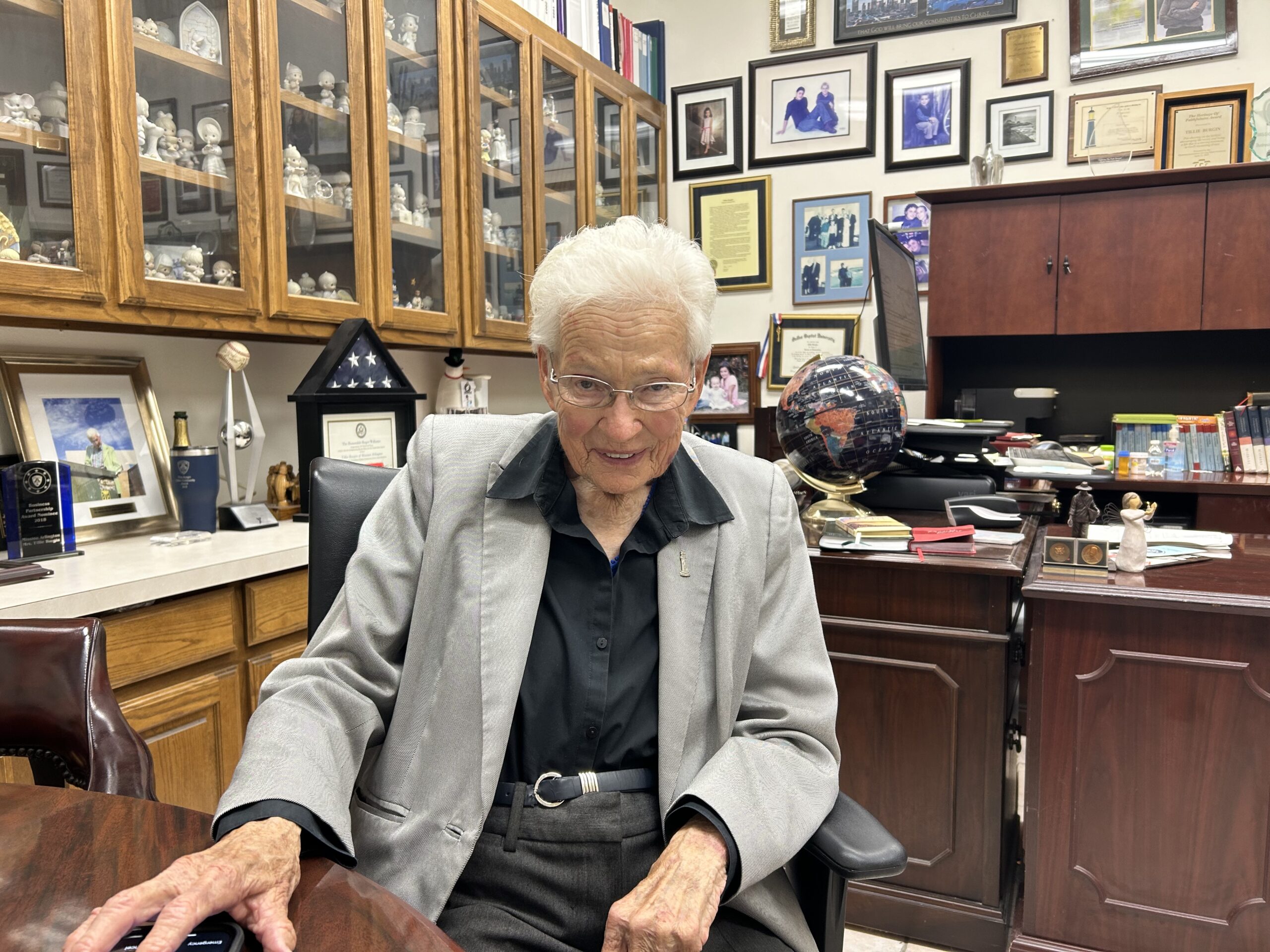
Tillie Burgin in her office. The extensive collection of Precious Moments figurines behind her that people have given Burgin over the years are free to children who come and express an interest. (Photo / Calli Keener)

The history link on Mission Arlington’s website, explains the question goes back to before she and her late husband, Robert, served as missionaries with the Southern Baptist Convention Foreign Mission Board (now International Mission Board), teaching in South Korea.

Her father operated a gas station in Arlington, just around the corner from Mission Arlington. He was Methodist, but as he generally worked on Sundays, he rarely was in church.

He lived out his faith in serving his customers, but he was not on board with Tillie taking her two sons to move with her husband oversees.

He was the one who first posed the question, the mission’s history account explains. He saw no need for his daughter to head to South Korea. There was plenty to be done to care for people right in the family’s hometown of Arlington.

Burgin and her family went anyway. She said: “We didn’t fit then, either.” They were the first missionaries appointed through the Foreign Mission Board to serve as teachers, she explained.

Citing God’s hand in the process, Burgin said IMB hiring personnel told her they would not have considered the Burgins’ application to serve, had a request for teachers in South Korea not just come across the desk the day they received it.

Plans for medical growth

In May, Texas Baptists presented Mission Arlington/Mission Metroplex with $125,000 to expand their health clinic.

Burgin hopes the expanded clinic will make new types of care possible, but “the infrastructure has got to be strong, and that takes resources.”

Mission Arlington leaders are praying about how best to expand the clinic, Burgin said. They have had optometry equipment donated, but do not currently have an optometrist who can use it.

Hearing aid people come, but it’s only every six months. People are grateful when they can hear again after years of not being able to, but vision and hearing treatment are areas where they’d like to see an increase in their ability to provide care, Burgin said.

The clinic has an orthopedic doctor who regularly serves at Mission Arlington every Monday. She said no one goes through his office without hearing the gospel. “It could be me, and I’m going to hear it,” she laughed.

The holistic care Mission Arlington provides is a draw to interns and doctors, Burgin explained. Providers want to serve where they not only can treat a wound but can care for a whole person.

The health care providers are glad to serve knowing their patients’ nutritional and other needs also can be addressed through the mission’s other ministries, Burgin said. It just takes time, prayer and preparation to discern which expansions they are able to support best.

Mission Arlington clinic looks to expand services. (Photo / Calli Keener)

The clinic is always open six days a week and one evening.

Burgin told a story about a young man who came in for help wearing a hoodie in the heat of the summer. Under the hoodie, he had a large growth down to his shoulder that he didn’t want to show. It was interfering with his ability to have a job.

The doctor he saw through Mission Arlington’s clinic was able to remove the growth. With it gone, the young man was able to go back to school, complete school and find employment.

“People find themselves in that kind of trouble, and we always want to be that place for them,” their “home” health clinic. Burgin said.

Burgin explained she prayed about the vision God gave her about doing missions in Arlington for seven years, until she met a lady who needed help with her electricity bill.

“Standing in her apartment, I said: ‘Can we start a Bible study in your apartment? And we’ll get your electricity turned on.’” And the ministry has grown since then, Burgin explained.

There were more people outside the walls of the church than there were inside, Burgin explained. And she knew from their service in Korea that “hanging out” where the people were could lead to ministry opportunities, but she said: “I never had a vision for this. God had the vision, and he just said: ‘Come along.’”

‘God’s Timing. God’s ways.’

The lobby of Mission Arlington, where people ‘triage’ to discuss needs while they watch Billy Graham. (Photo / Calli Keener)

“You can’t explain it,” she added. “All you have to do is experience it—God’s timing, God’s ways.”

Burgin said God had protected them from “so many things she’d wanted to do” with Mission Arlington. And many times, they’d figured they’d “done all they could do,” then God would use the ministry in a new way.

For instance, they were given multiple pallets of bottled water a few weeks ago. She said they set it to the side.

“I said, ‘Something’s going to happen, if we’ve got all this water,’” she recalled.

On Sept. 4, they took 12 to 15 pallets of water to Grand Prairie to help when the city’s water was deemed unsafe due to a foaming agent.

“We are not an organization. It is a way of life,” Burgin said.

They’re still doing things the way they always have, she said—praying about the next ministry, giving people opportunities to serve and give back when they have been served, keeping John 3:16 front and center, taking church to the people.

“And our definition of church is what we do almost 24 hours a day, seven days a week,” she continued.

Then her cell phone rang.

“Excuse me. Let me answer this,” she said.

The young woman on the other end, frantic because she couldn’t get her car started, said she didn’t know if she should call.

“Always call me, OK? Yeah, we’ll send somebody to you,” she said.

Burgin said she tells them: “Always call. And that’s kind of what we do.”

“Whatever it takes,” she said, “that’s what we need to do” to follow God’s calling.


Seminary alumni share memories of Wedgwood tragedy

FORT WORTH (BP)—On Sept. 15, 1999, Southwestern Baptist Theological Seminary alumnus Jay Fannin was helping at a youth event he had organized at Wedgwood Baptist Church in Fort Worth, where he had been named the youth minister 20 months previously.

But that time of prayer and worship that was attended by 14 area church youth groups quickly turned into a tragedy when an armed man walked into the sanctuary and began shooting.

Eight people were killed and seven injured in the Wedgwood shooting, reportedly motivated by anti-Christian hate. Among the victims were teenagers attending the See You at the Pole prayer event, church members and seminary students and alumni.

Victims included alumna Sydney Browning, 36; students Shawn Brown, 23, and Susan “Kim” Jones, 23, who was about to start her first semester; Kristi Beckel, 14, daughter of alumnus Robert Beckel; and teens Cassandra Griffin, 14, Joseph Ennis, 14, and Justin Ray, 17.

Alumni Jeff Laster and Kevin Galey, staff counselor at Wedgwood, were injured.

‘Hearing noise and yelling and screaming’

Chris Shirley, dean of the Jack D. Terry School of Educational Ministries at Southwestern Seminary, was on staff at Wedgwood overseeing the adult education and singles ministries. He recalls that Wednesday night when he suddenly heard screaming coming from outside his teachers’ meeting.

“Things were happening all around church,” Shirley said of what started as a normal Wednesday night. His 10- and 4-year-old children were in their normal classes, and his wife was at the youth event.

“We started hearing noise and yelling and screaming. … And about the time we got up to figure out what was going on there, somebody came into the room where we were and told us what was happening and that we needed to get out.”

Jeff Laster, who at the time was preparing to graduate with a diploma in Christian education and served at Wedgwood as the facilities manager, was the first to encounter shooter Larry Ashbrook when he entered the church building.

Laster approached him to welcome him to the church and asked him not to smoke in the building, his hand stretched out to shake hands with him, when Ashbrook pulled a weapon and shot Laster in the abdomen and the arm.

Even while Laster saw the shooter move past him and begin firing at others, he recalls thinking: “I’ve been shot. I may die from this.” But almost simultaneously, he said he felt a sudden warmth and peace and believes God told him, “You’re not going to die.”

After shooting others in the lobby area, including Browning, who Laster said was one of his best friends, Ashbrook entered the sanctuary.

Initially thought it was an ill-advised prank

Fannin said he had been running the PowerPoint for the band that evening from the sound booth located in the balcony, as the regular teen A/V worker had not come that night.

When he heard the popping from the gunfire, Fannin said his first thought was that he was going to need to confront a student pulling an ill-advised prank. Columbine was still fresh in his memory.

But when he reached the hallway outside of the sanctuary and smelled the smoke and saw blood, he realized it was a real event.

The next minutes were filled with confusion, as Fannin said the shooter continued shooting, students tried to run away, and rumors of a second shooter and a hostage situation spread. Fannin led a couple leaders, including Brown, toward an office with the goal of calling 911, and sent someone to warn people in the nursery and other areas of the church.

Fannin said Brown would not enter the office but remained outside the door. Witness reports say Brown tried to speak with and stop the shooter, but within moments, Fannin heard the shots that killed Brown.

When he made his way back to the sanctuary, Fannin was relieved to see his wife run out. Her first words were ones Fannin believes God gave her: “Jay, this wasn’t your fault.”

Entering the sanctuary less than a minute before the police did, Fannin finally saw the result of the event. He saw parents trying to remove their injured children and students trying to carry out a friend who had been killed. He checked on other students who had been killed.

Rejuvenated by unity and prayer

Once outside the church building, gathering with the teenagers in a place that now holds a memorial of the event, Fannin said the magnitude of what happened finally struck him.

“All the kids came up and just surrounded me,” Fannin said. “And kind of in that moment, everything just kind of hit. … We all went to the ground and some guy, to this day, I don’t know who he is, began praying over me.”

Rejuvenated by that moment of unity and prayer, Fannin turned his focus to helping those around him.

Tears still come to Shirley’s eyes, even 25 years later, when he remembers how he felt evacuating the building and going to an elementary school across the street, and the relief he felt when he found his wife and children. He began to look for how he could serve the people around him.

“I was just kind of there for pastoral care during that period of time—talking to people, helping people, you know, trying to relay messages and things to people, and just be whatever help I could,” Shirley said.

That same night, Shirley and others in his singles ministry visited Laster, who was a member of the singles community, at the hospital. Laster remained in the hospital a month, delaying his graduation until the next semester. His doctors later told him they were surprised he survived.

Kenneth S. Hemphill, Southwestern president at the time of the shooting, came to the church the night it happened.

“Distraught parents searched for their children,” Hemphill wrote in an article he penned for a special edition of the Southwestern News printed not long after the shooting. “I stumbled through the scene as if watching from a distance. Soon, I would learn how deeply Southwestern had been affected.”

Support through the healing process

Southwestern provided support during the healing process, hosting the funeral for alumna Browning, holding a chapel service to pray for those impacted, and providing counseling to Wedgwood staff and members.

In weeks following the shooting, Dan Crawford, who was a member of Wedgwood and Southwestern faculty at the time and is today the senior professor emeritus of evangelism and missions, was commissioned by the church to write the story of what had happened.

Crawford interviewed about 100 people who witnessed or were directly impacted by the shooting and used those interviews to write the book, Night of Tragedy, Dawning of Light.

By the 20th anniversary of the shooting, he wrote a follow-up book, The Light Shines On, relating the story of the healing that followed as told by 46 people he interviewed, saying it was “their testimony of God’s grace over the 20 years since the shooting.”

The impact of the event continues for each of those involved, though in a variety of ways.

“I still can remember that the biggest lesson I learned through it was the influence of the body of Christ, the realness of the body of Christ,” Shirley said, adding over the months and even years that followed, the unity of the church strengthened as they healed together.

Wedgwood Baptist Church received messages of encouragement from around the world, such as this poster depicting an angel and a Bible verse, which now is framed and hangs on the wall of Chris Shirley’s office at Southwestern Seminary. (BP Photo)

The global church also united behind them as Wedgwood received messages of encouragement and prayers from people from every continent except Antarctica. The walls of their hallways soon were covered with those messages and other gifts. One such gift, a poster with an angelic image and a Bible verse, is framed and hangs on the wall of Shirley’s office today.

Laster went on to graduate from Southwestern and continues to serve on staff at Wedgwood, now as the associate pastor for administration and missions.

“God brought me through it,” Laster said, though he adds the shooting still has a physical impact on his body. But while his role in the event has become a part of his testimony, Laster said it did not change the fact that God had a calling for him, which had led him to quit a job and move to Fort Worth to attend seminary.

“People come up and say, ‘Well, God has a plan for you now.’ God had a plan for me before. God wasn’t waiting until I got shot to have a plan for me,” Laster said, adding this experience led him to further believe in God’s sovereignty over every circumstance.

Fannin, who ended up serving as youth minister at Wedgwood 22 years and now is pastor at Shady Oaks Baptist Church in Hurst, also said the tragedy has created opportunities for him around the nation, as he speaks with police officers, churches and radio and television stations. Recently, he said he spoke with pastors and youth ministers in Georgia after a recent shooting at a school there to share with them a message of hope and healing.

“God is so good,” Fannin said. “I look back at the shooting honestly with a lot more appreciation for who God is and how he gets us through things and … that he works all things for good, even though it doesn’t seem like that’s possible.”


Chicago pastor emphasizes importance of resilience

WACO—Simultaneously leading two Chicago churches as pastor demands resilience rooted in biblical truth, Charlie Dates told participants at a Baylor University leadership conference.

Dates, senior pastor of both Salem Baptist Church and Progressive Baptist Church in Chicago, offered leadership lessons at the “Leadership for the Long Haul Conference,” sponsored by the Program for the Future Church at Baylor’s Truett Theological Seminary.

A resilient church leader must be a genuine servant who practices humility, Dates observed.

“I’ve come to see that servanthood has to be my identity, not my strategy,” he said.

The opening verses of the Old Testament book of Joshua identify Moses as “the servant of the Lord” and Joshua as “the servant of Moses,” he noted.

“It’s as if Joshua has to prove his person as a servant before he is called upon to be a leader,” Dates said.

People typically care little about the leadership courses a pastor has taken or the books on leadership he has read, he observed. But they care deeply when he shows up to provide comfort in their times of loss or bereavement.

“I’m learning that you’ve got to take the posture of a servant that kind of lets go of the cultural norms of greatness. … When it’s all said and done, only God is great,” Dates said.

Joshua’s call from God came when Moses died. While the man of God died, the mission of God continued, he noted.

“One of the pillars that helps us overcome our sense of inadequacy—my sense of inadequacy—is that while one major leader leaves, God has not left, and the work must continue forward,” Dates said.

Need ‘a prevailing commitment to truth’

A resilient leader must have “a prevailing commitment to truth,” he added.

God spoke to Joshua, and Joshua delivered that revealed truth to the people of Israel.

“There’s such a temptation to leave truth these days—to appeal to crowds,” Dates said. “I’m coming to discover that since we have a speaking God, I must speak for God the things God already has spoken.”

The opening chapter of Genesis reveals the power that is unleashed when God speaks, he noted. God spoke into being all of creation.

“There’s never been a moment in your life when God spoke and nothing happened,” Dates said. “When God speaks, things happen.”

When God spoke to Joshua, he offered assurance: “As I was with Moses, so I will be with you; I will not fail you or forsake you.”

Resilience in pastoral leadership is made possible by “the undying, almost indefatigable realization that God is with me, even when I feel like I am by myself,” Dates said.

“Any leader who has ever been worth her or his salt has done so because God was with them.”


Conference focuses on leadership for the long haul

WACO—True leaders not only build trust, but also draw upon trust to bring about transformation, author Tod Bolsinger told church and nonprofit leaders during a conference at Baylor University.

“There is no transformation without trust,” Bolsinger told participants at the “Leadership for the Long Haul” conference, sponsored by the Program for the Future Church at Baylor’s Truett Theological Seminary.

However, if leaders want to produce transformation, they cannot just build a big “trust account” for the sake of securing their own positions, he emphasized.

“Leadership is engaging a community of people toward their own transformation so that they can accomplish a shared mission,” said Bolsinger, author of Canoeing the Mountains: Christian Leadership in Uncharted Territory. “Transformation requires us to take risks.”

Invest trust in transformation

Adaptive leaders who guide their people through changing circumstances understand they must “invest trust in transformation,” he insisted.

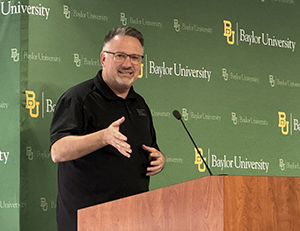
“Pay attention to the pain points,” author Tod Bolsinger told church leaders during a conference at Baylor University. (Photo / Ken Camp)

Effective leaders build trust with an eye toward transformation, putting together teams who help identify the unique gifts of the organization and determine how those gifts can be used to meet the needs of the world beyond the organization, he stressed.

“Pay attention to the pain points,” Bolsinger urged.

Recently, Bolsinger worked with leaders at Baylor to develop the university’s new strategic plan, “Baylor in Deeds,” focusing on the question: “What does the world need Baylor for?”

The strategic planning team led 93 listening sessions with 2,300 participants, received and tabulated 310 listening group surveys, received 114 white papers from 521 individuals who offered proposals, and conducted 71 external interviews.

Bolsinger echoed advice he learned from a conversation with venture capitalists in Silicon Valley: “Nobody cares if your institution survives. They only care if your institution cares about them.”

Charting a leadership journey

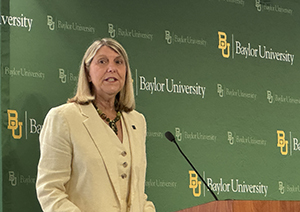
Linda Livingstone began service as Baylor’s 15th president in June 2017 during what she candidly described as “a dark time” in the school’s history, after an “institutional failure” to respond appropriately to sexual assault and sexual misconduct by student athletes. (Photo / Ken Camp)

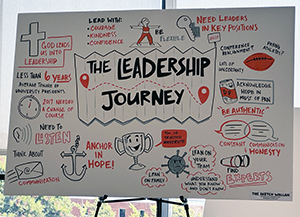
He pointed to the recent history of Baylor University as a case study in transformational leadership, building on President Linda Livingstone’s presentation about her “leadership journey” at Baylor.

Livingstone began service as Baylor’s 15th president in June 2017 during what she candidly described as “a dark time” in the school’s history, after an “institutional failure” to respond appropriately to sexual assault and sexual misconduct by student athletes.

“Baylor lost a tremendous amount of trust,” she said.

Pointing out there was “no honeymoon” period when she arrived, Livingstone immediately went to work to regain trust with alumni, students and potential students, parents and donors.

She and the board of regents chair held listening sessions with the “Baylor family” to allow them to be heard.

“We learned from our mistakes and made significant changes,” she said.

Those efforts bore fruit. In 2022 and 2023, national surveys revealed Baylor was among the nation’s Top 10 Most Trusted Universities, scoring the highest marks in Texas and in the Big 12 Conference.

“God’s love can redeem and heal broken trust,” Livingstone said. “God is working in ways we may not even realize.”

Focus on a future anchored in hope

Baylor University President Linda Livingstone described her “leadership journey” to participants at the “Leading for the Long Haul” conference, sponsored by the Program for the Future Church at Baylor’s Truett Theological Seminary. (Photo / Ken Camp)

Rather than simply build a trust account for its own sake, Bolsinger noted, Livingstone invested trust in transformation by focusing on the future.

Under her leadership, the university developed its “Illuminate” strategic plan, set an ambitious fund-raising goal and cast a vision to see Baylor become “a preeminent Christian research university.”

“As a leader, you must anchor yourself in hope during challenging times,” Livingstone said.

Baylor attained Research 1 status in December 2021—three years earlier than expected—and surpassed the $1.1 billion giving goal for its Give Light philanthropic campaign, raising a record $1.5 billion.

At the same time Baylor was navigating the trust-rebuilding process following the sexual abuse scandal, the university also had to “pivot and change” due to the COVID-19 global pandemic, she noted.

Effective leaders and the teams they build must “be nimble and flexible,” communicate honestly and transparently, rely on experts for the best information available at a given time, and “signal hope for the future,” Livingstone said.

“Don’t shy away from difficult situations, even when you don’t feel prepared,” she urged. “Each experience prepares you for the next challenge. Recognize God has placed you in a position of leadership for such a time as this.”


Texas again ranks second nationally in food insecurity

For the second consecutive year, Texas had the second-highest rate of household food insecurity in the nation, a study from the U.S. Department of Agriculture revealed.

Food insecurity increased both at the state and national level last year, Household Food Security in the United States in 2023 reported.

A household is considered food-insecure if its members at some time during the year lack the resources to acquire adequate food for everyone in the home.

The USDA reported 18 million households—about 47 million people, including 13 million children—in the United States were food-insecure at some point in 2023.

The report from the USDA Economic Research Service showed the prevalence of food insecurity in Texas was 16.9 percent last year, second only to Arkansas at 18.9 percent. The rate of food insecurity in Texas increased 1.4 percent from the previous year.

In addition to Texas and Arkansas, the other states where the prevalence of food insecurity was higher than the national average were Kentucky, Louisiana, Mississippi, Oklahoma and South Carolina.

Texas has failed to prioritize food security

Texas ranks among the worst states in terms of hunger because “addressing food security among our low-income population has not been a comprehensive priority of the state,” said Jeremy Everett, founding executive director of the Baylor Collaborative on Hunger and Poverty.

Jeremy Everett

And it historically has not been a priority for most elected officials because Texas citizens largely have failed to see it that way, he added.

So, children and elderly individuals “go to bed hungry,” and available hunger-reduction programs are not utilized to their full capacity, he said.

Texas Health and Human Services Commission personnel are working hard to process SNAP (Supplemental Nutrition Assistance Program) applications, but the agency has been understaffed and inadequately resourced since the COVID-19 pandemic, he noted. As a result, applicants often face long waiting periods before they are approved for food assistance.

In Texas, more than 1 household in 6 is food-insecure, which means 1.8 million families—about 5.1 million individuals—are at risk for hunger.

“These staggering numbers reflect the growing need food banks are seeing in communities across our state,” said Cecilia Cole, CEO of Feeding Texas, the state association of food banks.

“We have the tools and resources to end hunger, but our vision of a hunger-free Texas can only be realized through policy change and collective action from the public, private and charitable food sectors. Food banks alone cannot end hunger.”

Hunger relief ministries see the need

The statistics confirm the observations of people who serve with ministries across the state that receive funds from the Texas Baptist Hunger Offering.

“The new USDA report on the staggering food insecurity rates in Texas affirms the sounding alarm that the Texas Baptist Hunger Offering has been responding to from hunger relief ministries across the state,” said Irene Gallegos, director of hunger and care ministries with Texas Baptists’ Christian Life Commission.

“In recent visits to Hunger Offering-supported ministries in Decatur, Edinburg, Palestine and Abilene, the resounding echo among ministry leaders is the limited food in area food banks and the new faces accessing food resources.

“I hear hunger relief heroes across the state sharing that the face of poverty is changing and families with employment simply do not earn enough wages to pay for basic household expenses.”

Volunteers with Heart of the City’s Farmers Market Food Pantry provide a drive-through grocery distribution at New Beginnings Church in Lewisville. (File Photo / Ken Camp)

She pointed to some ministries that receive Texas Baptist Hunger Offering funds—specifically Azle Community Caring Center, Heart of the City in Lewisville and Brother Bill’s Helping Hands in Dallas—that serve more than 800 families a week.

“Another Hunger Offering-supported ministry—The Mustard Seed Cafe in El Paso—once served an average of 50 meals daily and made space accommodations to now serve 400 to 500 meals daily,” Gallegos said.

The offering strategically partners with ministries in some South Texas counties that have significantly high food-insecurity rates, such as Cameron County at 21.9 percent and Hidalgo County at 22.9 percent, she added.

Fighting hunger an ‘essential element’ of faith

Christians should take the lead in meeting needs and fighting hunger, Everett insisted.

“I don’t think we always realize that alleviating hunger is an essential element of our faith expression as Christians,” he said.

Too often, Christians see it as an optional “extra credit” activity rather than as a central component of their faith, he asserted.

“We should see hunger as a litmus test issue, because it is a symptom of other broken systems,” Everett said.

Christians can advocate for public policy initiatives that address issues of hunger and poverty, he said. He pointed particularly to the need for Congress to pass a bipartisan Farm Bill package that strengthens SNAP and international food aid programs.

Individual Christians can promote summer meal programs in their communities and urge local schools to participate in breakfast programs and after-school nutrition programs, he added.

Churches also can play an important role locally by participating in coalitions of nonprofit organizations, social service agencies and businesses to build hunger-free communities.

So far, the Baylor Collaborative on Hunger and Poverty has helped to form hunger-free community coalitions in 27 Texas counties.

“That’s significant, but we have 254 counties in Texas,” Everett said. “We have a long way to go.”

For more information about food insecurity and the Texas Baptist Hunger Offering, access the “What is Good?” podcast here.


Conclave NextGen returns to San Antonio in October

Conclave NextGen conference will return to First Baptist Church in San Antonio Oct. 7-8 for two days of worship, breakout sessions, training and networking with NextGen, family ministers and church leaders.

Cory Liebrum, youth and family ministry specialist at Texas Baptists, said Conclave is a gathering for ministry leaders to feel fed and ministered to without interruption.

“We want Conclave to be a place where they can come, and they can worship. They can fellowship. They can find community with other people, and they don’t have to worry about [anything],” Liebrum said.

“It’s their time to be fed because they feed people in their churches all year round. So, for two days, if we can give them that, then that’s the goal.”

Jennifer Howington, childhood ministry specialist at Texas Baptists, said the desire for Conclave is for NextGen ministers to come together to learn and grow in their ministry area.

“We’ve heard of silos in ministry, and we tend to, as children’s ministers, work with just children and student ministers … But we’re seeing the value of integrating those ministries together, and we’re trying to model that on the convention level.

“That happens through Conclave to say, ‘Come together as a team, we’re learning and growing together as a team,’” Howington said. “It just creates that synergy that they can take home with them and implement in their churches.”

Howington advised first-time attendees to “come expecting to find community, because you will.”

Connecting with others in ministry

Attendees will have the opportunity to attend four main worship sessions and four breakout sessions.

These sessions will include content and resources for preschool, children, students and college ministers—sponsored by the Texas Baptist Student Ministry. Attendees can treat their sessions as a track within each of these areas or go to whichever breakout interests them.

There also will be a “Pastor’s Track” for senior church leaders to learn from and form community with others who are dealing with matters unique to their role.

“We’re very intentional about the keynotes and the breakout session topics because we want full representation of all age-graded ministries, and we want there to be something for everybody, but also generalized topics that apply to everybody as well,” Howington said.

“We put a lot of thought into who we invite to be those leaders, and so far, it’s gone well, and we’ve had such a great response.”

Diverse keynote speakers

The four main sessions feature keynote messages from Ed Newton, lead pastor of Community Bible Church in San Antonio; Mike Satterfield, founder of Field of Grace Ministries in Arlington; and Justin Whitmel Earley, writer and speaker from Richmond, Va.

Liebrum said the diversity of keynotes is the “secret sauce” of the conference as they try to match the unique needs of attendees. He said he especially is excited to have Earley address one of the primary motivations behind the conference—community and the importance of connecting with others in ministry.

“Right now, what we see across the state is a lot of ministers and pastors that feel really isolated and don’t feel connected,” Liebrum said.

“For us, [Conclave is] two days where you can get connected, and you don’t have to be youth minister those two days. You don’t have to be children’s pastor those two days. You can just be you and connect with other people. So, I’m excited about Justin coming to be a part of that.”

To fit the needs of individual attendees, Conclave provides an “On Your Own” group for the conference. The “On Your Own” group is designed for attendees who didn’t come with a church group to have an opportunity to connect and build relationships.

Conclave also is hosting approximately 80 exhibitors, showcasing their ministries and what resources they have to offer.

Building momentum 

In addition to breakout sessions, Conclave will hold luncheons on Monday for youth ministers and Tuesday for children’s ministers to advance those connections. Luncheon attendees will share a meal and hear from a speaker in their ministry area.

Howington said she was encouraged by the increased attendance of preschool and children’s ministers at last year’s Conclave and looks forward to building on that momentum this year.

“We had a lot of momentum coming out of last year,” she continued. “Last year was the year we really pushed to have preschool and children’s ministers come with their student ministers and pastors, and we saw the fruit of that.”

Register here for the 2024 Conclave NextGen conference.


West Texas BSM celebrates 104 years, looks to future

West Texas A&M Baptist Student Ministry in Canyon celebrated 104 years of reaching, equipping and mobilizing students for the sake of the gospel on West Texas A&M University’s campus.

West Texas A&M President Walter Wendler expressed his gratitude for the BSM’s intentionality in modeling Christ on campus.

“The job of the BSM at West Texas A&M is to teach and to model and to project Christ in their day-to-day comings and goings on West Texas A&M’s campus, and we are thankful for that,” said Wendler.

“God’s word is at work on our campus because of the West Texas A&M University BSM and other ministerial organizations. The boldness and the confidence that students get through this ministry is very important.”

Testimonies of faith and lasting legacy

Tirzah Miranda, a current West Texas A&M student and BSM student leader, described how God has used the BSM to model Christ in her life and challenge her faith.

“I’ve been able to effectively learn how to share the gospel, tools of how to share the gospel and how to transition conversations to the gospel,” she said. “I’ve seen a lot of fruit from that.”

Malaki Deatherage, current campus missionary and future coordinator at West Texas A&M BSM, said he came to Christ during his freshman year at West Texas A&M because of the kindness of BSM students. He talked about how God used the ministry to cultivate his faith.

“People at the BSM loved on me whenever I was a wreck,” Deatherage said, noting BSM Director Eric Hunter “discipled me and taught me what it meant to be a believer, taught me what it meant to share the gospel.”

Hunter celebrates BSM’s reach

West Texas A&M BSM exists to love the campus, lead students into a relationship with Christ and launch students from the campus, students and alumni agreed. It serves as a ministry to nearby Amarillo College, Clarendon College and Frank Phillips College, in addition to West Texas A&M. Hunter has been the director of the school’s BSM since 2022 and is an alumnus of the university and organization himself.

The West Texas A&M BSM connected with more than 1,200 students in the last year, with 14 students placing their faith in Christ and being discipled.

Last spring, when students gathered for the last “806 Worship Night” of the semester in the current building, Hunterdiscussed Hebrews 12 and reminded them of the “great cloud of witnesses” that built the ministry’s legacy.

“They stand on your shoulders, the pathway that you paved,” he said.

“All the students here are benefactors of you and your legacy and your faithfulness in BSM over the decades. And as we see God move, a lot of it is because of your prayers and your support.”

New building builds on Kingdom legacy

The existing West Texas A&M BSM building, which has housed the ministry since 1952, soon will face demolition due to foundation problems and other structural issues.

Plans for a new facility have been drafted, and an adjacent property will serve as the BSM’s ministry headquarters until the new facility is ready.

West Texas A&M BSM leaders believe a new BSM building will help fulfill their love, lead and launch vision by providing a space for students to form community, hear and respond to the gospel, become equipped and be mobilized as disciple-makers.

“The needs of college students have never changed. Students need to hear the life-changing message of the gospel,” Hunter said.

Hunter is grateful for God’s provision that Texas Baptists “strategically purchased adjacent property to the BSM” to house the BSM as its historic facility is torn down and a new one built in its place.

“We’re so thankful that God in his sovereignty, in his providential wisdom, has provided us with a place, while we have to close this down, that we can still be here on campus,” he said.

Deatherage said the BSM’s legacy is not confined to the building but is based on the kingdom work being done through the ministry within it.

“Everyone is sad to see [this building] go, but we’re still building on that legacy even though this building is going away. So, I want to encourage you, don’t stop investing in the legacy. People like me, we needed this,” said Deatherage.

Campaign seeks to raise $5.5 million

West Texas A&M BSM launched its fundraising campaign for its new building in May. According to Hunter, the price tag for the new BSM building is $5.5 million.

Hunter explained the construction phase will begin once 80 percent of the funds are raised, which is expected to be within the next two years. The new building is expected to be constructed and ready for use for the freshman class of 2027.

Miranda noted the foundation of WTAMU BSM is not a building.

“The reason that the BSM is so special is because of the name of Jesus, and that’s our foundation,” Miranda said.