Gay rights and civil rights not comparable, theologian insists

LEWISVILLE—Popular culture equates gay rights to civil rights, but it’s an unfair comparison, theologian Jim Denison told participants at a seminar on the church and homosexuality sponsored by Denton Baptist Association.

Jim Denison“I think that more than any other single argument of the pro-gay lobby has advanced, this has by far been the most effective,” Denison said. “One of the most successful rhetorical devices has been to liken this to racial discrimination, and to say that my position (opposed to homosexual behavior) is akin to the KKK.”

Denison characterized racism as “the greatest sin in America” and “the sin that keeps us from dealing with other sins.” He urged other Christians who reject the gay rights agenda but who stand against racism to make that distinction clear.

Some people at the center of the civil rights movement have voiced disapproval that their efforts have been co-opted by those seeking homosexual rights, he added.

Denison insisted several differences make comparison between civil rights and gay rights faulty:

• Race clearly is inherited; the origins of homosexual orientation are disputed.

• The biological differences between people of different races are miniscule, varying by just two-tenths of 1 percent. But the anatomical and biological differences between male and females obviously are significant.

• Race cannot be chosen, but homosexual activity is a choice.

• While minorities continue to face economic discrimination, the financial consequences for homosexuals is far less negative. Studies place the average income of homosexual households at either twice or 60 percent higher than the national average.


Denison: Bible sets Christian view of homosexuality

LEWISVILLE—The Bible clearly speaks against homosexual behavior, but the prevailing culture doesn’t want to hear it, Jim Denison of the Denison Forum on Truth and Culture told participants at a Denton Baptist Association seminar.

Jim DenisonLess than 4 percent of the U.S. population is homosexual, according to the Institute of Medicine, even though far higher numbers have been purported, Denison said. 

“The actual statistic seems to be 3.8 percent, and a number of studies will say that is too high,” he said. Although other studies have reported as much as 20 percent of the population is homosexual, those studies involve bias, he added.

The Bible clearly prohibits homosexual activity, Denison asserted. Some critics seek to dismiss New Testament references against homosexual behavior by insisting the Apostle Paul was homophobic and wrong in his stance on homosexuality, just as he was wrong about slavery and the role of women.

“Myself, I will take the position that Paul was not wrong—at all,” Denison insisted. Rather, many readers have misinterpreted Paul’s positions. For instance, in regard to slavery, Paul moved as far as his first century context would allow, he asserted.

“The New Testament was the most progressive document in the early world as a means of advancing the abolition of slavery,” Denison said.
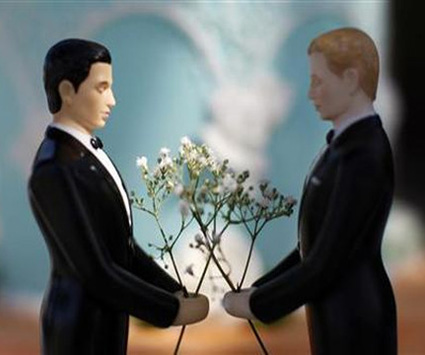
groom-and-groom425Similarly, Paul’s position regarding women also has been misinterpreted, he added. In his letters to Timothy, Paul addressed a community in Ephesus where the cult of Artemis dominated, and any woman speaking out in a religious setting would be thought to be a temple prostitute, he explained. 

“I don’t think Paul was wrong on any subject he spoke to under the inspiration of the Holy Spirit,” Denison said. “But that is a very common argument: Paul was wrong on slavery; Paul was wrong on women; therefore, he was wrong on this.

“At the end of the day, you have to decide for yourself what your theology is relative to homosexual practice and therefore relative to same-sex marriage. You have to make a decision as regards what you believe is the right way to do this. My only encouragement to you would be decide what you believe the Bible intends to say and live by that, whatever the consequences.

Interpret culture by the Bible

“Don’t let culture interpret Scripture—on this or any subject. When I taught hermeneutics, we would say you can put culture in front of the Bible and interpret the Bible through the culture, or you can put the Bible in front of the culture and interpret culture by the Bible. I want to encourage you to do that.”

Although many assert homosexuality has a genetic link, Denison pointed out the American Psychological Association states, “There is no consensus about the exact reasons that an individual develops a heterosexual, bisexual, gay or lesbian orientation.”

“It is nonetheless the case, according to at least the counselors I have spoken to and the research I’ve been able to do on this, that most people who will say to counselors that they are homosexual in orientation do not relate this as a choice that they have made,” Denison said. While a few say they made the choice to pursue a homosexual lifestyle, they are in the minority.

“The vast majority of the people I have spoken with who say they are homosexual in their orientation would not say they have chosen that, but that as far back as they can remember, they were attracted to the same sex,” Denison said.

“That doesn’t mean that God made them that way, or that God endorses homosexual orientation. You have the fall to consider, and that the fall changes the basic wiring of humans. You obviously have environmental factors to consider.”

Many people have a variety of predispositions toward sin, but that doesn’t make sin permissible, he insisted.

“Being gay is not the unpardonable sin,” he said. “I also make a distinction between homosexual orientation and homosexual behavior. I’m going to say to you that the Bible forbids homosexual behavior; it does not condemn a person who is homosexual in their orientation. 

Celibate homosexuals

“Some of my greatest heroes are celibate homosexuals—people whose orientation is homosexual but who believe the Bible and believe the Bible is true and right when it tells them homosexual behavior is harmful.”

There is no prohibition against homosexuals becoming Christians, he said.

“I can’t find in the Bible a specific request that a person has to repent of a specific sin before they can become a Christian,” he said. “When I became a Christian, I repented of my sin, but I did that in a fairly generic sense. Nobody told me I had to sit down and make a catalogue of every sin in my life, and repent specifically of those and choose never practice them again before I could become a Christian. 

“If that’s the case, there are a lot of us who have some issues with our salvation. I don’t know anyone who has ever been asked to do that, and I don’t know of any biblical examples of that.

No barrier to becoming a Christian

“I would say that once a person becomes a Christian, if they are in a homosexual lifestyle, the Holy Spirit will want to work in their life toward sanctification, toward consecration and there in fact may be a Spirit-empowered change in their orientation eventually. But I would not put that as a barrier in front of their becoming a Christian. 

“Now it is a whole separate question to church membership and being active in your church.”

Christians who believe homosexual behavior is sinful must win the right to say it in love, because the prevailing culture rejects that viewpoint, he said. 

“The culture assumes my position today is homophobic, bigoted, prejudiced and intolerant. The culture has come to decide I am relative to homosexuals what the KKK was relative to African Americans—and that I don’t get to have a position on this,” he said. “I have to earn the right to be heard now.”

Texas Tidbits: Three Texas Acteens named to national panel

Three of the six young women named as 2015 National Acteens Panelists are from Texas Baptist churches. Grace Ann Combs from First Baptist Church in Amarillo, Ashley Johns from Tallowood Baptist Church in Houston and Vicky Hernandez from Freeman Heights Baptist Church in Garland were selected to serve as panelists. National Woman’s Missionary Union selects National Acteens Panelists on the basis of their commitment to missions, coupled with participation and leadership in their Acteens missions group, church, school and community. National Acteens Panelists receive $1,000 from the Jessica Powell Loftis Scholarship for Acteens from the WMU Foundation. They will be featured during the WMU Missions Celebration and annual meeting in Columbus, Ohio, June 14-15. Applications for the 2016 National Acteens Panel are available at wmu.com/students.

Former VP named San Marcos Baptist Academy interim president. Trustees of San Marcos Baptist Academy named Jimmie W. Scott, former executive vice president, interim president of the academy. jimmy scott130Jimmie W. ScottThe trustees’ search committee continues to seek a replacement for John Garrison, who retired as president of the academy Jan. 30 after serving in that capacity almost seven years. Scott first came to San Marcos Baptist Academy in 1964 as associate dean. A year later, he was promoted to academic dean and later served as academic vice president and executive vice president, retiring in 1996. While at the academy, Scott also served as president and board member of the Southern Association of Independent Schools. He chaired and served on various committees for the Southern Association of Colleges and Schools and also was a commissioner for the Accreditation Commission of the Texas Association of Baptist Schools.  

Carroll Institute relocates. The B.H. Carroll Theological Institute will relocate its administrative hub from downtown Arlington to Irving. The institute’s board of governors voted to buy a building near the intersection of Highway 114 and the President George Bush Turnpike in the Las Colinas area. Grants from the Eula Mae and John Baugh Foundation and the Christ is Our Salvation Foundation and an individual gift from John Wilkerson Jr. of Lubbock made the purchase possible. In addition to the institute’s administrative offices, the Carroll Center also will house the Newport Foundation Collection. 


Armenian Genocide a warning to resist religious persecution

DALLAS—The genocide of Armenian Christians almost exactly 100 years ago provides a graphic reminder of evil and a call to vigilance, since Christians across the Middle East still suffer persecution, an expert on the atrocity told Dallas Baptist University audiences.

Artyom Tonoyan, the grandson of Armenian Genocide survivors, described the massacre of his people and current implications during the annual T.B. Maston Lectures at DBU Feb. 9.

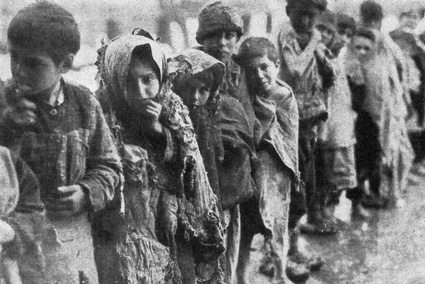
armenian genocide victims425Child victims of the Armenian genocide in 1915. (Photo: Armenian Genocide Museum)Armenians, who populated part of modern Turkey, originated as a political entity between 3,000 and 4,000 years ago, noted Tonoyan, a lecturer at the University of Minnesota, Twin Cities’ Institute for Global Studies and a research associate at East View Information Services in Minneapolis. He is a graduate of DBU and Baylor University.

Armenian society and culture rose and fell several times across the centuries, Tonoyan said. Their pilgrimage to Christianity began in the first century A.D., when the apostles Bartholomew and Thaddeus traveled to Asia Minor and told them about Jesus. They became the first to embrace Christianity as a state religion in 301 A.D., more than a decade before Rome. 

But with the rise of Islam, “Armenian civilization underwent an existential crisis,” he added. “Armenians were forced to islamize.”

The Ottoman Empire, which fully embraced Islam and dominated the region for most of the second millennia, discriminated against the Armenian Christians, he said. For example, Armenians could not own firearms and were barred from representation in court. They were not allowed to own horses or build a home taller than their Muslim neighbors’ houses.

Armenians singled out as ‘cancerous’

During the final throes of the Ottoman Empire in the 18th and early 19th centuries, “Armenians were singled out as cancerous” and a “parasitic entity,” he said. Young Turkish leaders found the Armenians offensive because, despite political discrimination, the Armenians prospered financially and controlled the Ottoman economy.

Shortly after the Ottoman Empire entered World War I, on April 24, 1915, the empire launched a horrendous siege against its Armenian residents.

Authorities rounded up practically every Armenian leader—“poets, doctors, professors, composers, teachers”—in a purge that predated the Jewish Holocaust by decades. 

About 400,000 Armenian men were killed almost immediately. Elderly men, women and children were rounded up, their property confiscated, and forced on a “death march” into the same desert where the Islamic State dominates today, Tonoyan said. The marches pushed them to the geographical and political edges of the empire.

Five thousand Armenian villages were destroyed, he said. Hundreds of churches were confiscated and converted to mosques, stables and restaurants.

A family ‘cut down’

The Ottomans decimated the Armenian Christian population, he added. One and a half million Armenians were murdered. The Armenian population declined from 2.1 million before World War I, to 600,000 by 1918, to 50,000 today, he added. 

“Our own family was cut down,” Tonoyan reported. Ottomans forced his grandfather, then a boy, to watch the rape of his own mother and sister. The last image Tonoyan’s great-grandfather saw before his murder was the rape of his wife and daughter. 

Even though the Armenian Genocide occurred a century ago, Christians around the world, and particularly in the Middle East, are being persecuted today, he said. Some of the persecuting countries, such as Saudi Arabia, are strong U.S. allies.

“This is the greatest ethical dilemma facing the American Christian church,” he said. “What are we to do as Christians? Sit back and relax, … or do something?

“Christians are dying for their faith by the hundreds and thousands. I cannot keep silent.”

Pray for the persecuted

U.S. Christians should start by praying for their persecuted fellow Christians in hostile regions of the world, Tonoyan urged. He also called on Christians to insist their senators and representatives pay attention to persecution and demand change.

“Please, whatever you do, do not remain silent,” he pleaded. “Your brothers and sisters need you.”

T.B. Maston, namesake of the lecture series, taught Christian ethics at Southwestern Baptist Theological Seminary in Fort Worth for much of the 20th century. The lectureship is sponsored by the T.B Maston Foundation and Dallas Baptist University.

To read a 2003 Baptist Standard feature on Tonoyan, click here.  


Universal truths crucial for good decisions, Bush tells UMHB crowd

BELTON—Good decisions demand recognition of universal truths and adherence to unchanging principles, former President George W. Bush told a crowd at the University of Mary Hardin-Baylor.

“There are universal truths that are essential to good decision making. One such universal truth is that there is an Almighty, and a gift of the Almighty to every man, woman and child on the face of the Earth is the desire to be free,” said Bush, author of Decision Points, his presidential memoir.

george bush umhb425As people experience freedom, the “ideology of hate” becomes marginalized, former President George W. Bush told participants at the McLane Lecture on leadership at the University of Mary Hardin-Baylor. (UMHB Photo)“Whether you are a Methodist or a Muslim, deep in your soul is the desire to raise your children in a society where people’s opinions matter.”

As people experience freedom, the “ideology of hate” becomes marginalized, he added.

Freedom is transformative

“Freedom is transformative,” he said.

Good leaders made decisions based on principles, including a clear understanding of right and wrong and recognition of human life’s value, he stressed.

“Evil is real,” he said. “Whether it’s Hitler, Stalin, Al Qaeda or ISIS … murdering innocent people to make a political point has been, is and always will be evil.”

Bush delivered the McLane Lecture on leadership at UMHB, made possible by the gifts of Drayton and Elizabeth McLane of Temple.

Good leaders possess enough humility to recognize they don’t have all the answers and the wisdom to listen to people who know more than they do, Bush said.

“It’s important to know what you don’t know and to seek the advice of people who know what you don’t know,” Bush said, noting how he depended on the counsel of Secretary of State Condoleezza Rice when he made foreign policy decisions.

Listen to those you disagree with

Leaders learn to listen to and understand people with whom they disagree, he emphasized, citing as an example his personal dealings with Russian President Vladimir Putin.

“One of the problems in our society is that too often, we don’t listen to people we disagree with,” he said. “If life, we need to understand how the other person thinks and recognize how values help determine the course of decision making.”

Commitment to the priority of human life led his administration to develop the President’s Emergency Plan for AIDS Relief, setting goals to provide antiretroviral treatment to HIV-positive people in Africa, prevent new infections and provide care for 10 million Africans, he noted. 

Compassionate response to the HIV-AIDS epidemic in Africa was in the United States’ national interests and a moral imperative, given the blessings Americans enjoy, he added.

“To whom much is given, much will be required,” he said. 

Bush also described lessons learned from his father, George H.W. Bush, whom he described as “the greatest one-term president in our nation’s history.” In addition to teaching by example the value of public service, his father demonstrated “unconditional love” and showed him how to face adversity, he stressed.

“Do you allow defeat to define you, or is there something grander—more noble and more lofty?” he asked.

Question-and-answer session

During a question-and-answer session with students after the lecture, Bush responded to a query about how young people can strengthen their communities.

“Love others the way you would like to be loved,” he said. “Recognize we’re all defined by millions of acts of compassion that take place quietly on a daily basis.”

Prior to the lecture, UMHB President Randy O’Rear awarded Bush an honorary doctor of humanities degree, citing his years of public service both as Texas governor and president of the United States.

“We appreciate your Christian values, integrity, love for family, love for our country, your boldness and your strong leadership,” O’Rear said.


‘Substantial’ difference in proposed RFRA language

AUSTIN—Baptists helped craft the Religious Freedom Restoration Act at the national level and secured its passage at the state level in Texas. But some Texas Baptists are leery of language in a proposed RFRA-based state constitutional amendment.

The Baptist Joint Committee for Religious Liberty helped create a broadly based coalition that led to passage of the federal Religious Freedom Restoration Act of 1993. After the Supreme Court ruled in its 1997 City of Boerne v. Flores decision that RFRA applies only at the national level, the Texas Baptist Christian Life Commission played a key role in guiding a state version of RFRA into law.

State Sen. Donna Campbell, R-New Braunfels, and State Rep. Jason Villabla, R-Dallas, have introduced resolutions calling for adding RFRA language to the Texas Constitution.Both the state and national versions of RFRA say, “Government shall not substantially burden a person’s exercise of religion even if the burden results from a rule of general applicability,” unless it is necessary to further a compelling government interest and provided it uses the least restrictive means to further that interest.

Last fall, three Texas Baptist pastors—Kyle Henderson from First Baptist Church in Athens, Brent Gentzel from First Baptist Church in Kaufman and Kris Segrest from First Baptist Church in Wylie—urged fellow church leaders to support a call to amend the state constitution to include language modeled after RFRA. 

Adding RFRA-based protections to Article 1, Section 6 of the Texas Constitution’s Bill of Rights would raise the threshold, so any state legislative session could not overturn it, they told a group of pastors who met in Waco on the eve of the Baptist General Convention of Texas annual meeting.

A Texas state senator and representative have filed similar—but not identical—bills in the Texas Legislature regarding a constitutional amendment on religious freedom.

Senate Joint Resolution 10

Sen. Donna Campbell, R-New Braunfels, introduced Senate Joint Resolution 10. The resolution, which proposes a constitutional amendment, states: “Government may not burden an individual’s or religious organization’s freedom of religion or right to act or refuse to act in a manner motivated by a sincerely held religious belief unless the government proves that the burden is in furtherance of a compelling government interest and is the least restrictive means of furthering that interest. For purposes of this subsection, the term ‘burden’ includes indirect burdens such as withholding benefits, assessing penalties, and denying access to facilities or programs.”

House Joint Resolution 55

State Rep. Jason Villabla, R-Dallas, introduced House Joint Resolution 55, which contains slightly different language and would bar government from burdening “in any way a person’s free exercise of religion.” Villabla’s version also includes language that specifically singles out homeowners’ associations.

Both measures have one thing in common: They lower the threshold from “substantially burden” to “burden.” And the distinction between “burden” and “substantially burden” means the difference between an inconvenience that invites litigation and a significant infringement on free exercise of faith, a Texas Baptist attorney and public policy expert insisted.

“The Christian Life Commission helped develop the Religious Freedom Restoration Act that is now law in Texas, and we support moving the current RFRA statute into the Texas Constitution,” said Kathryn Freeman, CLC director of public policy. But, she added, any constitutional amendment needs to retain the original RFRA language.

Original language

“Our desire is to help influence this legislation in a manner that protects the rights of all Texans to practice their religion responsibly without government interference. As a result, it is important that we keep the current RFRA language intact,” she said.

As originally drafted, RFRA maintains the proper balance between the free exercise of religion and no government establishment of religion, she noted, as well as a balance between individual rights and state interests.

For instance, RFRA provided sufficient protection for an Orthodox Jewish synagogue that meets regularly in the living room of a North Dallas homeowner, she noted. A judge dismissed a lawsuit against Congregation Toras Chaim brought by some neighbors who claimed the religious services violated deed restrictions of the property owner’s association.  

“The Dallas case involving the Orthodox Jewish congregation demonstrates the ‘substantially burden’ test is not too high a threshold to provide protection,” Freeman said.

Henderson likewise voiced support for a state constitutional amendment that adheres strictly to the language of RFRA as passed in 1993.

“The closer is to the national law, the more likely it is to pass constitutional muster,” he said. “We need to do this together. The original law passed with broadly based support, and the state constitutional amendment needs to be similarly broad-based in its appeal.”

‘Burden’ vs. ‘substantially burden’

Some supporters of the proposed constitutional amendment—who want “substantially burden” changed to “burden”—cite a range of national issues regarding the religious rights of business owners, ranging from the contraceptive mandate in the Affordable Care Act to whether bakers and florists should be compelled to offer their services for same-sex weddings.

Freeman underscored the proven effectiveness of RFRA as it stands and suggested a need to “keep the long view” in regard to protecting religious liberty rather than react to issues of the moment.

“Religious liberty is a bedrock principle of Baptists and of the United States. It impacts many issues but should not be a tool used to forward any one political agenda,” Freeman said.

Editor’s Note: The sixth paragraph from the end was edited after originally posted to correct “substantially burden,” not “significantly burden.”


Presidents: Faith-based universities offer society ‘ethical ammo’

WASHINGTON (BNG)—Faith-based universities in the United States face the challenge of persuading society to invest in higher education that is less about producing students to compete in a global economy and more about instilling the “value of values,” three university presidents told the National Press Club in Washington, D.C.

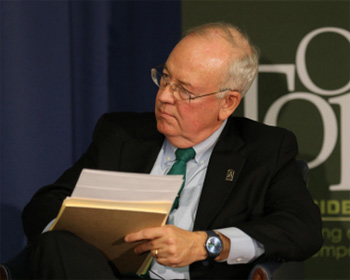
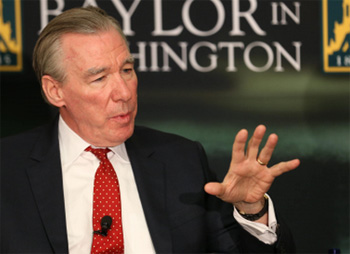
Baylor University, kenneth starr350Baylor University President Ken Starr. (Photos: Robert Rogers/Baylor Marketing and Communications)the nation’s largest Baptist-affiliated school, sponsored the event on the eve of the National Day of Prayer breakfast. Joining Baylor President Ken Starr were John Garvey, president of the Catholic University of America in Washington, and Richard Joel, president of Yeshiva University in New York.

 “We would all agree that education is more than a transmission of information, attending classes, doing lab work. But what is it?” Starr asked.

The three acknowledged difficulties in responding to recent regulations such as the U.S. Department of Health and Human Services’ contraception mandate and government involvement in setting faculty employment guidelines.

They also found troubling a proposed Department of Education “rating system” for universities and colleges. The proposal is “triggering opposition from all institutions that this is a reductionist approach” which “won’t take into account the mission that universities are trying to accomplish,” Starr said.

Tracking those government initiatives comes naturally to the three presidents, each of whom has a law degree. Both Garvey and Starr are former law school deans.

john garvey350Catholic University President John Garvey.But Joel, whose institution is the oldest under Jewish auspices in America, saw a larger issue.

“To me, the major challenge is for parents and students to know that (faith-based higher education) is worthy of investing in,” he said. “The challenge is the degree that society has accepted the notion that education is credentialing for careers, and people look for where they can get the best deal to get the requisite credential.”

Given the cost of tuition at private universities, persuading students “the choice of investing in them is a valuable proposition and worthwhile” can be difficult, he added.

Joel recalled a former U.S. president telling him higher education’s primary aim is to prepare students to compete in a global economy.

“But our motto (at Yeshiva) is that education is meant to ennoble and enable. We need to teach students what are the values they bring to the competition and once they succeed in the competition, what are their responsibilities?” Joel asked.

“The point of education is to help our students advance in both wisdom and virtue,” agreed Garvey, whose school is the only one in the United States overseen by the U.S. Conference of Catholic Bishops. “And they are connected to each other in surprising ways. Virtue makes us aim at the right mark; wisdom helps us choose the proper means. When we learn about topics, we can’t make proper judgments about them without an ethical basis.”

richard joel350Yeshiva University President Richard Joel.Joel voiced concern about where students will find the “ethical ammunition” to develop into responsible American citizens.

“This generation of young students is a gift to us because they want to matter. … The fuel is that you matter because you are a human given the gift of responsibility, and here is a largely selfish life experience called ‘college’ when you can invest in thoughts, explore thoughts, but in an environment which focuses your purpose—not just to have ideas but to know what to do with them,” he said.

Maintaining a robust mix of faith-based and secular higher education is essential to the country’s well-being, the three presidents said.

“One of the glories of the American system of higher education is that we have this kind of plurality,” said Garvey. 

“It’s good for consumers of higher education to have different institutions. You don’t see this in countries with an established church. … In America, because of the First Amendment it has forced institutions like ours to grow up and survive under our own steam. It would be unfortunate if, in the name of diversity, the government were to insist that we all be like one another.”

Despite political dysfunction, the United States never has come close to adopting an authoritarian regime and has remained a “remarkably free society,” Starr concluded.

“It is now our challenge to maintain that in the 21st century.”


Baptist notes improved health among North Korean orphans

DALLAS—A Korean Texas Baptist will travel to North Korea next month to ensure the delivery of 60 tons of corn and 10 tons of wheat noodles to schools, orphanages and a hospital, and he expects to deliver an equally large shipment later in the year.

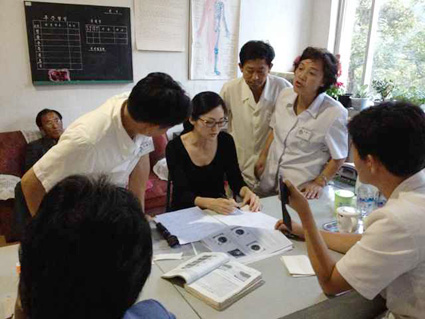
koreans yoon doctors425Ophthalmologist Sara Yoon confers with North Korean doctors at the Kangwon province hospital in Wonsan City, North Korea.Yoo Jong Yoon—director of the Korean-American Sharing Movement of Dallas—has journeyed to North Korea more than two dozen times since 1996. Typically, his trips include supervising delivery of corn and other food supplies provided by Texas Baptist Men and other donors. 

“The Lord has opened many doors to share his love” in North Korea, he said. Texas Baptist Men and several churches and individuals have helped meet needs among orphaned children through food shipments, he noted.

“Their health has been improved greatly because of your love for them,” he said. “They are ‘the least of these,’ whom the Lord has entrusted to you and me.”

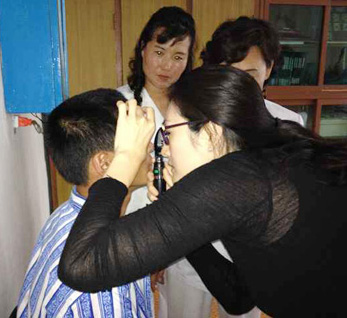
koreans yoon examines347Ophthalmologist Sara Yoon examines a patient at a North Korean hospital.Yoon, former Korean mission field consultant with the Cooperative Baptist Fellowship, also plans to deliver medical books and supplies for physicians, as well as accompany two medical teams of eye specialists and dentists to work in the Kangwon province hospital in Wonsan City. Baylor Scott & White Health has provided equipment and supplies to the hospital through its Faith in Action Initiatives.

In September, Yoon traveled to North Korea with his wife, June, and daughter, Sara, who was the first ophthalmologist to visit the hospital in Wonsan City. She examined five patients and conferred with five doctors there.

The Yoons also visited a junior high and high school for orphans in Moon-Chon, about 15 miles north of Wonsan City. Yoon’s ministry helped provide corn noodles to the school since 2012, but the trip marked the first time he was permitted to visit that school.


Religion can help victimized college women trust again, study shows

WACO—College women who have been victimized sexually often have trouble trusting anyone after being assaulted, but religion can help them cope and overcome emotional damage, Baylor University research shows.

The study—“Religious Coping: The Role of Religion in Attenuating the Effect of Sexual Victimization of College Women on Trust”—is published in the journal Review of Religious Research.

‘A huge problem’

“We hear in the news about all sorts of sexual victimization on campuses across America. It’s a huge problem, one that affects people over a long period of time and can result in withdrawing from family and community,” said researcher Jeffrey Tamburello, a doctoral candidate in sociology at Baylor. Co-researchers were Kyle Irwin and Martha Gault Sherman, assistant professors of sociology at Baylor.

“It’s important to find ways for victims to come back to as much of a normal life as they can, and it seems that religious participation can help them do that,” Tamburello said.

Previous research has provided evidence sexual victimization may negatively impact trust and has suggested theological beliefs and taking part in religious organizations may be associated in a positive way with overall trust. In the Baylor study, researchers sought to uncover how these two effects might interact.

One in five college women

About one in five college women are sexual victims each year, with that number including both violent assault and nonconsensual sexual contact, according to recent reports.

Researchers analyzed data from the Longitudinal Study of Violence Against Women, with the sample consisting of 1,580 undergraduate women in a state-supported university. In the first wave of the study, researchers asked freshman women whether and how often they attended religious services. In the second, when the women were sophomores, researchers asked participants whether they had been sexually victimized within the past year. The women also were asked about how much they trusted others.

Religious community boosts trust

To assess an individual’s level of trust, researchers asked respondents the extent to which they agreed with the statement: “Most people are out for themselves. I don’t trust them very much.”

“What we found is that the more you go to church, the more you trust. It’s not just about attendance but about being embedded in a religious social network and about that being a part of your identity. This might help to mitigate some of the negative effects of being victimized,” Tamburello said.


Ebola waning, but food crisis continues in West Africa

DALLAS—Although the spread of Ebola in West Africa has slowed, the food crisis caused by the epidemic continues, a Liberian Baptist leader told the director of Texas Baptists’ Disaster Recovery program.

olu menjay130Olu MenjayOlu Menjay, president of the Liberian Baptist Missionary & Educational Convention and principal of Ricks Institute, a Christian boarding school located about 15 miles from Monrovia, Liberia’s capital, recently met with Chris Liebrum, director of Disaster Recovery for the Baptist General Convention of Texas.

Reports of people infected with Ebola dropped from a peak of 500 cases per week to five cases a week, Menjay reported. He and his family—who were visiting in the United States when the epidemic hit and were not allowed to go home—will return to Liberia soon. He will reopen Ricks Institute, which closed by government order because of the Ebola outbreak.

“Even with the reduction of the illness, the crisis of food and orphan care is still present,” Liebrum said after his visit with Menjay.

Many farmers in Liberia and Sierra Leone who contracted Ebola died, leaving farm laborers without jobs. Food prices throughout the region spiked due to decreased production.

1.5 million meals to Liberia and Sierra Leone

Texas Baptists have sent 1.5 million meals to Liberia and Sierra Leone, and the convention’s disaster recovery ministry hopes to send up to 3 million meals by the end of summer. Liberian Baptists are using churches as distribution points, Liebrum noted.

Texas Baptists have shipped five 40-foot food-filled containers to West Africa. Convoy of Hope and Life Line Ministries donated food for three containers, and two other containers are from Food for Kidz, paid for by Texas Baptist Disaster Recovery funds.

The Texas Baptist Hunger Offering made available $35,000 in 2014 to support hunger relief in West Africa. The funds covered shipping costs for two containers for Liberia and a third container for Sierra Leone. They also provided support to Restore Hope Sierra Leone, a ministry of Global Connections Partnership Network, related to First Baptist Church in Arlington

Three additional containers have been secured and will ship soon.

A call for help

Texas Baptists’ Disaster Recovery is encouraging churches and organizations to sponsor events to help pack two remaining containers. For more information on how to hold a food-packing event or give funds for shipping costs, contact Marla Bearden at (214) 537-7358 or visit www.texasbaptists.org/disaster.

On the Martin Luther King Jr. National Day of Service, Texas Baptist volunteers, working in partnership with Texas Baptist Men and Meals4Multitudes, a ministry based at First Baptist Church in Athens, packed 23,000 prepackaged meals for Liberia—enough to cover two pallets. Twenty pallets will fill a 40-foot shipping container. 

McLane Shipping Company in Houston has committed to cover the cost to send two containers to Liberia.

“All of this is possible because of the caring and cooperative spirit of Texas Baptists,” Liebrum said. “In recent years, when specific needs have been discovered in Haiti, Japan, Philippines and now West Africa, our BGCT family has shown the spirit of generosity—a great example of an association of churches that are equally committed to both the Great Commission and the Great Commandment.”


Debates on definition of marriage nothing new, church historian asserts

WACO—Legislators and judges in the United States who struggle to define marriage find themselves in the unlikely company of 16th century reformers and their Pietist Protestant heirs, church historian A.G. Roeber believes.

A.G. RoeberSome Americans forget disputes about marriage have raged in Europe and beyond more than four centuries, said Roeber, professor of early modern history and religious studies at Penn State University. He addressed an audience at Baylor University, where he spoke at the invitation of the school’s Institute for Studies of Religion.

Martin Luther wanted to elevate marriage to a “primary estate” at the center of both church and society, based on his view of the family as “the little church,” Roeber said. However, Luther’s reluctance to view marriage as sacrament, in contrast to Roman Catholic teaching, muddied his efforts to exalt marriage.

“There was an unresolved tension in Luther’s theology of marriage,” Roeber said.

Furthermore, he noted, Luther wrestled with how to reconcile his views on mutuality in marriage, based on the New Testament model in Ephesians 5, with his insistence on male authority in church and state.

Roeber saw that tension evidenced in subsequent theological statements by Pietist Protestants who were “reluctant to define marriage as sacrament but eager to understand it as more than simply a secular contract.”

On the one hand, he noted, they taught an ideal view of marriage as a picture of the relationship between Christ and his bride, the church. On the other hand, they knew from personal experience the reality of married life often failed to match that model.

Luther’s spiritual heirs found new challenges when they sought to spread their faith—including their views on Christian marriage—through missionary outreach, particularly in India and among transplanted Europeans in North America, he added.

Today, at a time when many Christians in the Global South hold to a traditional understanding of Christian marriage, some North American Protestants seek to expand the definition to include same-sex unions, he observed. 

And debates in the public square about the subject are nothing new, he added.

“There is no way in which marriage has ever not been political,” he said.


Lee Strobel: Gospel truth reasonable, but demands faith commitment

PLANO—When Leslie Strobel became a Christian, she rejoiced in her new life in Christ but felt deeply burdened for her husband, Lee, a self-proclaimed atheist who pursued hedonism and pleasure over spiritual matters. She worried he never would come to faith. 

But within two years—after he sought to disprove the Bible, the resurrection of Jesus Christ and Christianity—he found himself kneeling in his bedroom accepting Jesus as his Savior. 

unapologetic-logo425“I believed based on the data, but I had to receive the free gift of his grace. Then I would become a child of God,” Strobel told a crowd of more than 500 at the [un]Apologetic Conference at Hunters Glen Baptist Church in Plano

Proofs pointing to the reality of Jesus’ resurrection open the door for many skeptics to embrace faith in him, said Strobel, author of more than 20 books and former award-winning legal editor for The Chicago Tribune

He noted evidence documenting the execution of Jesus, including early accounts of his resurrection and the empty tomb, as well as eyewitness testimony, including nine ancient sources inside and outside the New Testament.

mark mittelberg130Mark MittelbergMark Mittelberg, author and strategist in evangelism and apologetics-oriented outreach, outlined 20 “arrows of faith” he found helpful in overcoming obstacles to sharing the gospel.

Touching on topics ranging from Jesus’ miracles to the intricacies of human DNA, Mittelberg provided data to support the existence of God and each person’s need for God.

Confident Christians realize “the gospel is much more than true, but also a message of love and forgiveness for all,” he asserted.

Other conference speakers included Mike Licona, associate professor in theology at Houston Baptist University, and David Naugle, longtime professor of philosophy at Dallas Baptist University.

Regional [un]Apologetic conferences are planned Feb. 27-28 at Trinity Baptist Church in San Antonio and March 6-7 at Tallowood Baptist Church in Houston. For more information, click here