Baylor football team Bible study yields baptisms

Ten athletes on the Baylor Bears football team publicly expressed their faith commitments to Christ by being baptized in the university athletic facility’s hydrotherapy pool in early November.

Some recently accepted Jesus as Lord and Savior. Others made a past faith commitment to Christ but never had been baptized. Some had been baptized at an early age but wanted to be baptized as believers as a reaffirmation of their faith.

All of the newly baptized believers participate in a Tuesday evening player-led Bible study in the Baylor University football team meeting room.

“We meet at 6:30, share a meal together and then dive into the word [of God], splitting up into small groups,” said safety Michael Allen, one of the small-group leaders who baptized three of his teammates.

Sawyer Robertson, starting quarterback for the Baylor Bears and a small-group Bible study leader, baptizes a teammate. (Baylor Athletics Photo)

Other small-group Bible study leaders are starting quarterback Sawyer Robertson, wide receiver Josh Cameron, outside linebacker Kyler Jordan, safety Jacob Redding, defensive lineman Dylan Shaub, tight end Matthew Klopfenstein and quarterback Walker White.

In addition to the Tuesday evening meetings, some players—particularly new believers—also get together for regular one-to-one discipleship times with their small group leaders and participate in an online group chat, Allen added.

“I’m getting the chance to walk through Proverbs with two of the guys right now,” he said.

At least one-third of players involved in Bible study

Allen and former teammate Garrison Grimes, who later transferred to Brigham Young University, started the Bible study in spring 2024 with about a half-dozen other players.

The group now numbers 35 to 40 on a typical Tuesday evening—at least one-third of the players on the Baylor football team roster.

Landrie Walsh, director of football operations at Baylor, helps secure food for the weekly gatherings, Allen noted.

“One of the biggest ways to incentivize 300-pound linemen is to have food at the Bible study,” he quipped.

The small groups recently completed a character study of Joseph from the book of Genesis, focusing on themes of forgiveness, patience, perspective and leaving a legacy of faith.

While the Bible study is not sponsored by a specific congregation, several players worship together regularly at Harris Creek Baptist Church, and the congregation provided some curriculum initially, Allen noted.

Baptisms mark significant step

“We have baptisms offered at the end of every study every semester,” he said.

Ten athletes on the Baylor Bears football team publicly expressed their faith commitments to Christ by being baptized in the university athletic facility’s hydrotherapy pool in early November. (Baylor Athletics Photo)

Kevin Washington, associate athletics director for mission impact and enrichment at Baylor, presents a devotional about baptism the week before each scheduled baptism, explaining its significance, Allen said.

The 10 most-recent baptisms account for about half of all those performed since the Bible study launched.

Allen maintains contact with some of the players involved in the Bible study who have graduated and moved on to their careers. He specifically noted Treven Ma’ae, now a defensive tackle with the Las Vegas Raiders.

“He got baptized here, and it was kind of his first introduction to Christianity,” Allen said.  “I text him every once in a while, just to see how he’s doing. It’s cool to have relationships that are way beyond football. Those are the things that are going to last.”

Bible study creates connections

The ongoing weekly Bible studies have affected the culture of the Baylor Bears football team positively, Allen said.

“I can’t say enough about the small-group discussions,” he said, particularly for players who live in a culture “where everything is judged by how you perform on a football field.”

The Bible study offers players the opportunity “to dive into our faith and understand that whatever happened that past Saturday does not define us as individuals,” Allen said.

Without minimizing the importance of doing their best in competition, players gain perspective and learn football “isn’t the end-all and be-all,” he said.

“We understand that football is going to end at some point, and very soon for a lot of us. So, it’s who are we going to be—as Christ followers, as men, as husbands and fathers. An opportunity to talk about those things in a group that you’re really, really close with fosters a ton of connection among the team.”

Allen particularly noted a deeper personal and spiritual connection between Robertson and a member of his small group—tight end Michael Trigg.

“I’ve seen their relationship flourish and connect on a deeper level,” he said. “They dive into the word [of God] together every Tuesday evening, and then then go out there [on the gridiron] and have a connection on Saturday.”

Honest and vulnerable discussions

The honesty expressed in the small-group discussions has built trust and developed deeper bonds between teammates, he said.

“We’ve had a lot of guys open up in those small groups. It’s a pretty vulnerable space,” Allen said.

Players come from varied backgrounds, and many did not grow up in strong Christian homes, he noted. They freely discuss their upbringing, as well as “sin struggles” common to young men, he added.

“We’ve all had different walks to faith,” Allen said. “For some guys, this may be the first time they’ve heard a real explanation of the gospel.”

Players also “talk a lot about who we want to be—as men and as leaders,” he added.

Helped clarify calling

Allen, who completed his undergraduate degree in finance and is pursuing a Master of Business Administration degree, said taking a leadership role in the team Bible study has helped him find direction beyond school.
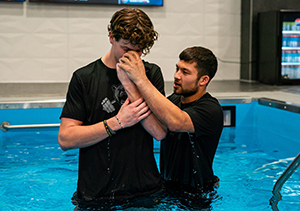
Michael Allen, who was instrumental in launching a Tuesday evening Bible study among players on the Baylor Bears football team, baptizes a teammate. (Baylor Athletics Photo)

“I’m probably not going to use my major, to be completely honest. I’m thinking about going into coaching,” he said. “I see an incredible opportunity for building relationships.

“This is a great ministry opportunity, having the ability to mold people, to see the best in somebody and challenge them to be the best they can be.”

In a sense, that’s what the player-led Bible study does—meeting student-athletes where they are in their faith journey and helping them grow spiritually, Allen said.

“Honestly, through this Bible study, I feel like it has helped clarify my calling to coach,” he said. “That’s what coaching is. It’s servant leadership.”



Judge blocks Ten Commandment classroom displays

A federal judge blocked 14 Texas school districts from displaying a state-prescribed version of the Ten Commandments in public school classrooms, citing constitutional concerns.

In a Nov. 18 action, U.S. District Judge Orlando Garcia granted a preliminary injunction to block the classroom displays in the Arlington, Azle, Comal, Conroe, Fort Worth, Flour Bluff, Frisco, Georgetown, Lovejoy, Mansfield, McAllen, McKinney, Northwest and Rockwall school districts.

With the latest court ruling, the Ten Commandments classroom displays—mandated by S.B. 10, a bill passed in the most recent Texas Legislature—are blocked in more than two-dozen school districts.

In August, U.S. District Court Judge Fred Biery issued a preliminary injunction in Rabbi Mara Nathan, et al, v. Alamo Heights Independent School District, et al, blocking classroom Ten Commandments displays in 11 school districts.

Violation of First Amendment rights asserted

In the case in which Garcia ruled, more than a dozen families of public-school children—Christian, Jewish, Baha’i, Hindu, atheist and agnostic—sought the preliminary injunction. They asserted the classroom displays would violate their rights under the First Amendment to the U.S. Constitution.

Plaintiffs in Cribbs Ringer v. Comal Independent School District asked the court to declare the state-mandated Ten Commandments classroom displays a violation of the Establishment Clause and Free Exercise Clause of the First Amendment.

 “The displays will pressure students, including the minor-child Plantiffs, into religious observance, veneration, and adoption of the state’s favored religious scripture,” the lawsuit stated.

“The displays will also send the harmful and religiously divisive message that students who do not subscribe to the Ten Commandments—or, more precisely, the specific version of the Ten Commandments that SB 10 requires—do not belong in their own school community, pressuring them to refrain from expressing any faith practices or beliefs that are not aligned with the state’s religious preferences.”

In ruling on behalf of the plaintiffs, Garcia cited Stone v. Graham, a 1980 case in which the U.S. Supreme Court said displaying the Ten Commandments on the wall of a public-school classroom, “in the absence of any legitimate educational purpose,” violates the Establishment Clause of the First Amendment.

Garcia agreed with the plaintiffs assertion that “displaying the Ten Commandments on the wall of a public-school classroom as set forth in S.B. 10 violates the Establishment Clause.”

“It plainly serves the public interest to protect First Amendment freedoms,” Garcia wrote.

Paxton sues noncompliant districts

Garcia issued his ruling the same day Texas Attorney General Ken Paxton announced he filed suit against the Round Rock and Leander school districts for refusing to comply with the mandated Ten Commandments displays.

“These rogue ISD officials and board members blatantly disregarded the will of Texas voters who expect the legal and moral heritage of our state to be displayed in accordance with the law,” said Attorney General Paxton.

“Round Rock ISD and Leander ISD chose to defy a clear statutory mandate, and this lawsuit makes clear that no district may ignore Texas law without consequence.”

Previously, Paxton sued the Galveston Independent School District after its board refused to display donated copies of the Ten Commandments in classrooms.

In August, Paxton issued an order to all school districts not enjoined by ongoing lawsuits to display the Ten Commandments in all classrooms.

‘Their goal is political chaos’

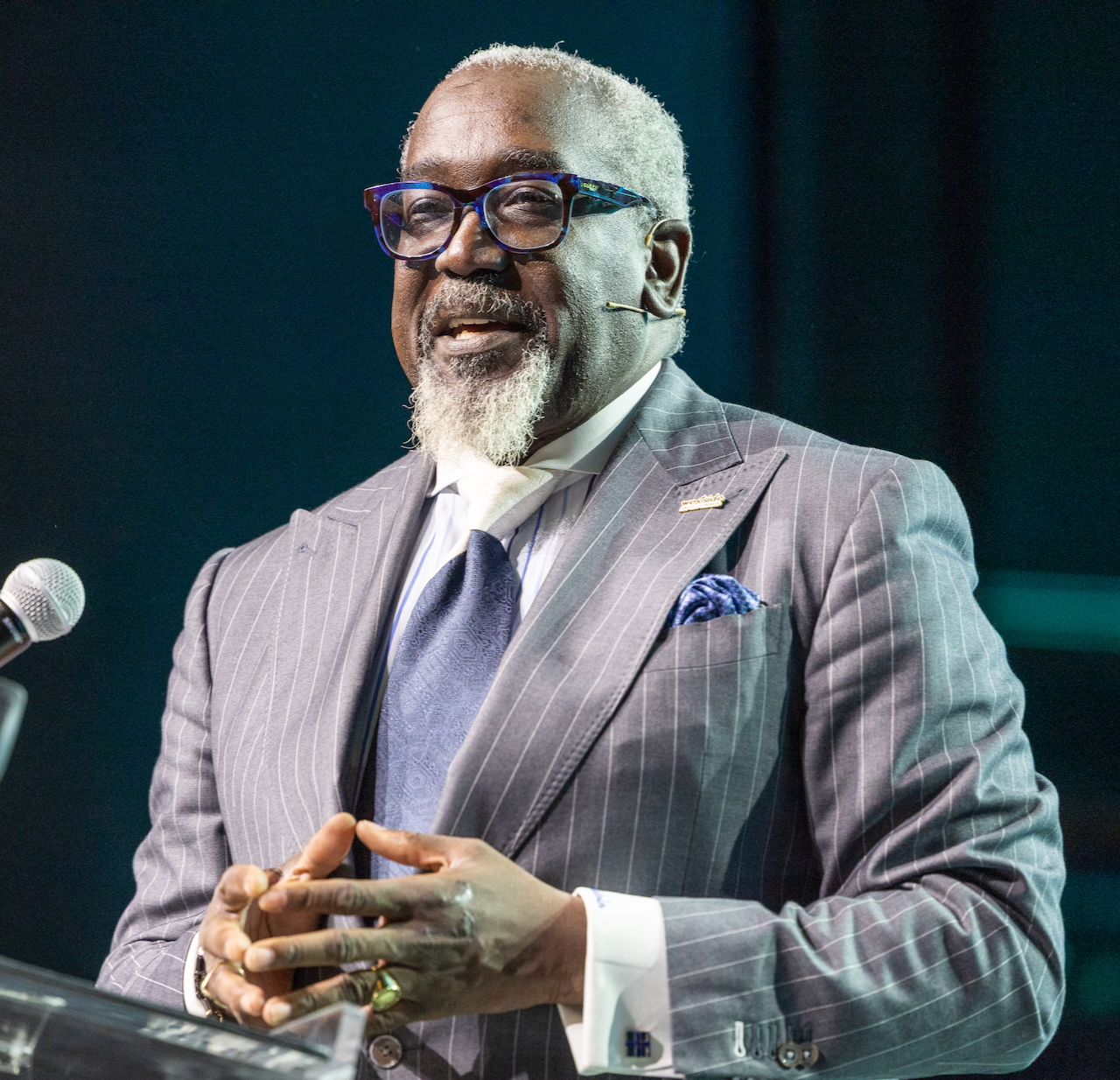
Charles Foster Johnson

Charles Foster Johnson, founding executive director of Pastors for Texas Children, expressed little surprise that two federal judges ruled in favor of blocking the state-mandated religious displays.

“Such establishment of religion violates our United States Constitution and God’s moral law,” Johnson said. “The legislature knew from the get-go that this statute would be contested, which is why the extremists filed the bill in the first place. Their goal is political chaos— not moral order or character.

“Texas public school teachers live out lessons of decency and integrity all day long every day for our children. They don’t need loud and loony rightwing legislators telling them how to act in front of our kids. Instead of bloviating about Ten Commandments on classroom walls, Texas legislators would do well simply to keep them.”

SB 10—signed into law by Gov. Greg Abbott on June 21—requires a donated poster or framed copy of the Ten Commandments at least 16 by 20 inches to be displayed in every Texas elementary and secondary school classroom.

The state-approved language of the Ten Commandments as stipulated in S.B. 10 is an abridged version of Exodus 20:2-17 from the King James Version of the Bible.

Parents who have objected to the classroom displays pointed out Jews, Catholics and Protestants number the commandments differently, and their wording varies.

So, they asserted, the required language favors the Protestant approach as the state-sanctioned version.


Muslim civil rights group sues Texas officials

(RNS)—The Council on American-Islamic Relations has sued Texas Gov. Greg Abbott and Attorney General Ken Paxton for labeling the Muslim civil rights group as a foreign terrorist organization.

On Nov. 18, Abbott filed a “proclamation designating the Muslim Brotherhood and CAIR as Foreign Terrorists and Transnational Criminal Organizations under the Texas Penal and Texas Property Codes.”

In doing so, Abbott asserted he could allow the state to shut down CAIR’s Texas chapters and ban them from purchasing land in the state.

The federal lawsuit filed Nov. 20 argues Abbott improperly used his office to target the domestic nonprofit without due process and in violation of federal law.

Attorneys representing the Texas chapters also allege Abbott’s designation is retaliatory, meant to silence CAIR after the group won three lawsuits against the governor in recent months.

“This attempt to punish the nation’s largest Muslim civil rights and advocacy organization simply because Governor Abbott disagrees with its views is not only contrary to the United States Constitution, but finds no support in any Texas law,” lawyers wrote in the suit filed in U.S. District Court for the Western District of Texas.

In recent years, several bills have been proposed in Congress to designate CAIR as a terrorist group, but none have passed. The U.S. State Department, under federal law, alone has the power to designate foreign terrorist organizations.

States do not have the authority to make such a designation at a federal level, and Abbott appears to be the first governor to attempt to do so at a state level.

“Governor Abbott decided to appropriate that power to himself to retaliate against CAIR,” said attorney Charlie Swift of the Muslim Legal Fund of America, one of the groups suing Abbott and Paxton.

Links to Hamas and Muslim Brotherhood alleged

In Abbott’s proclamation, he alleged CAIR had ties to Hamas, which is designated as a terrorist group by the State Department. CAIR denies any such connection.

“Despite all the conspiracy theories, CAIR has always been an American organization,” said Edward Mitchell, CAIR deputy director. “We’ve never been an offshoot, a partner, an agent, a pen pal of any foreign organizations.”

Abbott also claimed CAIR wanted to advance Sharia—Islamic religious law—in the country and called on local district attorneys to investigate alleged Sharia “courts” in Texas.

“The Muslim Brotherhood and CAIR have long made their goals clear: to forcibly impose Sharia law and establish Islam’s ‘mastership of the world,’” Abbott said in a press release.

Mitchell called Abbott’s allegation about Sharia courts “unhinged,” saying private arbitration courts are legally allowed to resolve civil cases.

“No one is trying to impose Islamic law on America,” Mitchell said. “This conspiracy theory is used by anti-Muslim extremists to whip up fear of Muslims, and in Governor Abbott’s case, he is whipping up this fear because he wants to silence Muslims because so many American Muslims have been critical of the Israeli government.”

Abbott’s designation amassed condemnation from elected officials. The Texas Democratic Party called on Abbott to reverse the designation.

In a joint statement signed by 28 Texas Democratic state representatives, state Rep. Salman Bhojani wrote that the governor’s action singles out Muslim Texans and treats them with suspicion.

“​​The governor’s action will only further fuel hostility toward Muslim families, business owners, and educators who strengthen our communities every day,” wrote Bhojani, one of the first Muslims to serve in the Texas Legislature.


Texas/Ukraine church partnership launched

Leaders from the Baptist General Convention of Texas and the Ukrainian Baptist Union signed an agreement Nov. 18 establishing church-to-church partnerships between Texas and Ukrainian Baptist churches. The event was hosted by Hardin-Simmons University in Abilene.

Event attendees heard from Nina Tarasovets, a Ukrainian Baptist and student at Hardin-Simmons; Texas Baptist pastors already involved in the partnership; and leaders of the Ukrainian Baptist Union.

Near the conclusion of the event, Ukrainian Baptist Union President Valerii Antoniuk and BGCT Executive Director Julio Guarneri signed a memorandum of understanding between their respective organizations.

The MOU establishes a pathway for pastor-to-pastor and church-to-church partnerships for the purpose of friendship, prayer and shared ministry focused on trauma healing, discipleship, worship and church planting.

Currently, 36 Texas Baptist churches have committed to the partnership. Organizers are looking for 14 more churches by Dec. 15 to round out the 50 churches they would like to pair with 50 churches in Ukraine.

Igor Bandura, vice president for international affairs with the Ukrainian Baptist Union, expressed his hope churches would join the partnership, pointing to Scripture.

“Ask and it will be given to you; seek and you will find; knock and the door will be opened to you,” he said, citing Matthew 7:7.

Also, “If you remain in me and my words remain in you, ask whatever you wish, and it will be done for you” (John 15:7).

Called to partnership

For Brent Gentzel, senior pastor of First Baptist Church in Kaufman, the call to shape a church-to-church partnership between Texas and Ukraine began in spring 2025. His church supported his call, he said.

As with himself, the call is “going to have to begin in you. The very nature of this partnership begins pastor to pastor, and then church to church, and then [out] from there,” Gentzel said.

“We come into this in the deep belief that the local church is the hope of the world,” he added.

God has given Ukrainian Baptists the ministry of suffering, forging strength and resilience in them, Gentzel said. “They’re allowing us into their suffering, and it is a ministry to us.”

Stories of suffering

Nina Tarasovets

“I’m really passionate about serving others,” Nina Tarasovets, HSU senior and student body president, said. Her father is a Baptist pastor in Ukraine, and her mother serves in women’s ministry. Nina serves in preschool ministry at Pioneer Drive Baptist Church in Abilene.

Born and raised in Ukraine, Nina came to Texas for high school in 2019. “My plan was to go home and continue my education there, but my senior year in high school was the year that the war in Ukraine started,” she said.

Unsure where to go, Nina started looking at different universities in Texas. After applying to several, HSU President Eric Bruntmyer called her, saying: “Nina, don’t worry. We’ll take care of you. Come here. You will be a Cowboy.”

In Ukraine, her parents and other Christians became “heavily involved in serving others.”

“Even in dark times, [God] showed so many different miracles about how people were getting saved,” Nina recalled.

“We don’t have all the answers, but we know that God has a plan for this, and he is using this war for something for his plan,” she said.

Pointing out February 2026 will mark four years of war: “People are exhausted. People are tired, but they’re continuing to work every single day,” and the church continues to serve, Nina said.

“Every summer I go home, and I serve on the kids’ ministry team, and I plan and help organize summer camps for those kids who have lost their parents,” she said. Many of those children tell stories of attending their mothers’ funerals, she added.

Valerii Antoniuk

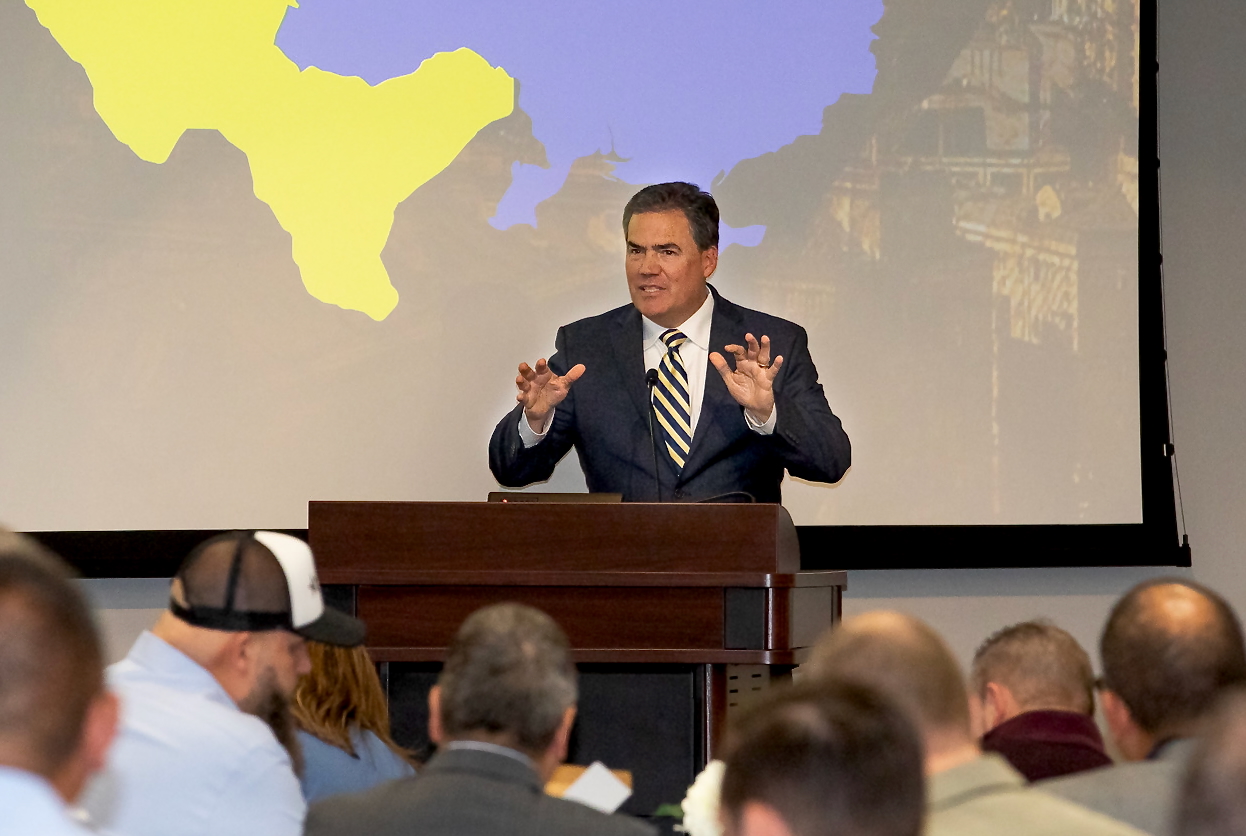
“Paul said, ‘Whenever one part of the body hurts, the rest of it hurts,’” Valerii Antoniuk, president of the Ukrainian Baptist Union, said as Tarasovets translated.

“Well, part of the body is hurting, and the other part of the body comes to it. And it’s something that we feel today,” Antoniuk said, pointing to an image of Texas and Ukraine projected on the wall.

Since 2014, he has gone to the front lines many times, he said. “I see a lot of blood. I see a lot of pain.” And he cries a lot, he noted.

“We thank you that you are feeling our pain,” he said. “The closer we get to the coming of Jesus Christ, the more pain we’re going to experience on the Earth, and we will have to react to it,” he continued, holding up the church as the answer.

Characterizing the war, not as political or business, but as spiritual, “today, we are looking right at the devil’s mouth … and it’s not easy,” Antoniuk said.

“We are inviting you to a place that’s not safe,” he said. “And we really want you to be with us.”

Antoniuk reported 320 churches are under Russian occupation, 120 churches are closed, 650 pastors and ministers left Ukraine—along with “thousands and thousands of church members”—and more than 70 churches are destroyed.

Even so, God is blessing the Ukrainian church during the war, Antoniuk said.

“Over the past three years, we have baptized over 10,000 people. We got over 1,000 new deacons and pastors,” he said.

“It’s really weird for me to stay the night here, sleep and not hear the air sirens, missiles flying by. It’s not something that I’m used to anymore,” Antoniuk admitted.

“At night, whenever [my 6-year-old grandson] hears the explosions and missiles flying by and drones and everything exploding, he runs to [me] and says, ‘Let’s pray together,’ and we pray together at night, and our faith becomes stronger.”

Structure of the partnership

Organizers hope to have a prayer team ready in each partnership church by Jan. 1, 2026. The prayer team “is not just pastor-to-pastor, but it needs to be people-to-people,” Gentzel explained, suggesting groups of three-to-five people who will commit to pray with their Ukrainian partners through the duration of the partnership.

Brent Gentzel, senior pastor of First Baptist Church in Kaufman, explaining the vision and structure of a partnership between Texas and Ukrainian Baptist churches, Nov. 18. (HSU photo)

Additionally, Texas churches will be asked to provide some monthly financial support to their Ukrainian partners beginning in January. For safeguarding and accountability, funds will be sent to the BGCT, who in turn will send them to the Ukrainian Baptist Union to disperse to the respective churches.

Churches also are asked to give $10,000 per year for the next three years “to handle general expenses of infrastructure and curriculum and equipment,” among other needs, Gentzel said.

“This isn’t all about money, but the financial piece is going to matter in a time when things are difficult in Ukraine,” Gentzel said. “We don’t want money to keep anybody from doing this, but we are going to need resources to make this go.”

Ukrainian leaders also are seeking a deep connection between partner churches built on Bible study, sermons and devotionals. So, organizers also are working with the Baptist seminary in Odesa, Ukraine, “to write a [seven-week] Great Commission, Great Commandment spiritual growth campaign” to be rolled out in fall 2026.

“Bible studies [and devotionals] would be shared by Zoom between churches,” Gentzel explained, noting they are seeking devotional writers.

The goal is to develop strong relationships now between Texas and Ukrainian churches, so when the war ends, the churches will be able to mobilize quickly to meet the specific ministry needs created by the war. Church partners will contextualize their own mobilization strategies.

For example, some churches in Ukraine aren’t singing in worship because they don’t have anyone to lead them. Partner churches might be able to provide that leadership.

A further goal is to expand partnerships to other churches in Ukraine over time.

Baptists have “led so heroically” during the war “that the Ukrainian nation is aware that the Baptist church has been the spiritual backbone of the country through the battle,” Gentzel said.

“And their importance in the community, in that nation, has risen across these four years in a way” that is even recognized by Ukrainian President Volodymyr Zelenskyy, he added.

Importance of partnership

“Sometimes, I think that we think that evangelism is about some kind of recitation of a gospel presentation, that people have to pray this sinner’s prayer, and then it fixes everything,” Guarneri said.

“But I think the gospel that we have in Jesus is more than just words,” he continued. “The gospel of Jesus is incarnational. It’s about a God who came to our suffering. And when we live out that gospel, we have to be incarnational.”

Being incarnational means “going where the pain is and the hurt is and loving” people there, Guarneri said.

The partnership between Texas and Ukrainian Baptists is not paternalistic, but is “a two-way street,” he said.

“I believe this is a cause worth giving our churches to, and I believe strongly that to whom much is given, much is required. That’s why our church is all in. That’s why we’re ready to go. That’s why we’re figuring it out on the fly,” John Whitten, senior pastor of Pioneer Drive Baptist Church in Abilene, said.

To learn more about this partnership and how to be involved, visit https://www.healingpathmovement.com or email healingpath@fbckaufman.org.


Affordable, sustainable insurance for churches introduced

Texas Baptists leaders highlighted the launch of a new statewide insurance solution during a luncheon presentation of the Texas Baptists Indemnity Program—known as TBIP—and its partnership with KingsCover Insurance.

The event included detailed explanation of how the program aims to meet the growing insurance needs of churches.

The program was created to offer churches a more sustainable and affordable alternative amid rising premiums across the state, Craig Christina, associate executive director of the Baptist General Convention of Texas and president and board chair of TBIP, said.

“Our original vision was caring for BGCT churches in Texas and taking a few hundred the first year and adding more, but God had a much bigger plan,” Christina said.

KingsCover leaders John Uminski, senior vice president of KingsCover, and Michael Conover, head of underwriting, described the structure of the new partnership.

The program launched Nov. 1 and is backed by $12 million in available capital from the BGCT, along with national-level underwriting support through Amherst Specialty Insurance.

This allows the program to scale from its initial vision of serving a few hundred churches to potentially serving congregations nationwide.

KingsCover emphasized the program uses licensed agents who respond to inquiries, rather than earning commissions by soliciting churches.

To date, leaders have promoted the program through 30 to 40 associational meetings.

They also highlighted features such as automatically included pastoral library coverage and a managed-repair claims model designed to provide fast, hassle-free service.

Christina and Ward Hayes, Texas Baptists’ chief financial officer, encouraged churches to begin the application process early, noting quotes typically require declaration pages, loss runs and basic property information.

KingsCover representatives assured pastors both BGCT and Southern Baptists of Texas churches are eligible, and priority will be given to churches currently uninsured or nearing renewal deadlines.

TBIP leadership

The BGCT associate executive director is president and board chair of TBIP, and the BGCT chief financial officer is treasurer and secretary. Currently, this is Craig Christina and Ward Hayes, respectively. Sergio Ramos, Texas Baptists’ director of GC2 network, is vice president.

David Bowman, executive director of the Tarrant Baptist Association in Fort Worth, and Dennis Young, pastor of Missouri City Baptist Church, were elected as directors by the BGCT Executive Board.

Q&A regarding coverage

KingsCover is a full-service brokerage with the capability of providing full coverage for churches, Uminski said when answering a question about coverage options.

“Our first and foremost priority is protecting your church,” Uminski said. “We are concentrated on bringing you a property solution and a general liability solution. That being said, those other things—commercial auto, wind and storm insurance—we can handle that.”

One pastor asked how long a quote for an estimate was good for, and how soon would a church need to reach out to request a quote before their present coverage lapses.

“Ideally, we would like to get you in front of your policy 30 to 45 days in advance prior to renewal. It might take us 15 to 20 days to get all the information we need, and you provide [documentation]. Our quotes are good for 30 days,” Uminski said.

KingsCover representatives added that BGCT affiliated churches outside of Texas are also included in the coverage.

One ministry leader asked about their stand-alone liability versus stand-alone property. KingsCover will not write stand-alone liability, but only stand-alone property.

“We are going to individually underwrite every property, which not every carrier does,” Uminski said.

Churches interested in getting a quote can contact KingsCover Insurance at info@kingscover.com.


Texas Baptist affinity groups celebrate ministry and leadership

EDITOR’S NOTE: The following reports have been edited for inclusion in the Baptist Standard as a single report.

Culp Banquet honors pastor Kenneth Johnson

By Jessica King / Texas Baptists

Members of the African American Fellowship of Texas and others gathered Nov. 16 ahead of the 2025 Texas Baptists annual meeting for the Culp Legacy Sneaker Ball Banquet at the Abilene Convention Center.

The banquet was an occasion for worship, teaching and celebration honoring Kenneth Jackson, pastor of New Light Baptist Church in Lubbock and former African American Fellowship president.

“The kingdom of God is a kingdom of beauty and diversity, and Texas Baptists is richer because of our African American churches,” Julio Guarneri, Texas Baptists executive director, said, expressing his gratitude for African American Ministries and Jackson.

“It is interesting that Paul, at the close of his life, lists the names of people who do not make history, but they do make his story,” Delvin Atchison, senior pastor of Westside Baptist Church in Lewisville and African American Fellowship president, said, referencing 2 Timothy 4:21.

“Pastor Jackson, we’re here tonight, and we can honestly say, ‘We don’t know what history will say about you, but none of our stories would be complete without your story,’” Atchison said.

“We thank you all. Words are just inadequate to express our appreciation for all the kindness, the kind words and the opportunities [you’ve provided] for us,” Jackson said.

Full report available here.

Texas Baptists en Español rally to live out GC2

By Teresa Young / Texas Baptists

“The Great Commission has not been paused, postponed or rewritten. It still calls us to go, to love and to make disciples,” Sergio Ramos, Texas Baptists director of GC2 network, told those gathered at the Abilene Convention Center for the Texas Baptists en Español rally ahead of the 2025 BGCT annual meeting.

“What would it look like if every church, every pastor and every believer lived out the Great Commandment and the Great Commission together in this generation?” Ramos asked.

The need is clear, says Ramos, as many in Texas do not have a personal relationship with Jesus Christ. At the same time, he said, many churches are closing their doors due to low attendance. This great need should compel believers to step out and make an impact for the gospel, he urged.

“Brothers and sisters, the spiritual condition of our state cannot leave us indifferent. We cannot become accustomed to seeing empty sanctuaries and cold hearts,” Ramos said.

“That is why the need for a strong GC2 initiative is vital, because it seeks to serve, strengthen and walk alongside every affiliated church, regardless of size, language or cultural context, in order to fulfill God’s mandates.”

The movement is only sustained by the Holy Spirit’s empowerment and direction, Ramos pointed out.

“The world is changing fast, but the word of God is unchanging. The culture is noisy, but the voice of Jesus is still clear. And the mission remains the same: Love God, love people, make disciples,” Ramos said.

Pastor Robert Cuellar of Primera Iglesia Bautista in San Angelo and former Texas Baptists strategist, was recognized for 31 years of ministry service. Gus Reyes presented Cuellar with the Gary Cook Servant Leadership Award in recognition of his many years of ministry.

Full report available here.

Celebrating 25 years of cowboy churches

By Meredith Poe / Texas Baptists

Cowboy church pastors and ministers from across the state gathered Sunday evening for a rally to celebrate 25 years of the Cowboy Church Movement and kick off the 2025 Texas Baptists annual meeting.

“Thank you, Texas Baptists. Thank you for what you have done in praying for us, supporting us, teaching us, mentoring us,” said Wes Brown, pastor of Cowboy Church of Collin County, alongside a group of other cowboy church pastors.

“Eighteen years ago, we saddled up to start Cowboy Church of Collin County. What we desperately needed was a partner in our mission, and that turned out to be Texas Baptists,” Brown said.

“Their resources, guidance and spiritual encouragement were the foundation on which we built our ministry. They didn’t give us a boost—they equipped us to stand on our own two feet,” Brown continued.

“Too many Christians have conformed to this world, instead of being transformed by the power of God. … If there was ever a time that this world needed the cowboy church, it’s now,” Derek Rodgers, pastor of Cowboy Church of Corsicana, said.

“I grew up rodeoing when there was no such thing as cowboy churches. These pastors would show up around the rodeos when it wasn’t popular to preach … and I saw people would get radically saved by their messages,” Rodgers said, reflecting on the history of cowboy churches in Texas.

Full report available here.


Texas Baptists challenged to live out GC2

In keeping with the theme “Live out GC2,” speakers challenged attendees of the 2025 Baptist General Convention of Texas annual meeting to embody Old and New Testament Scripture as a way of life.

“We live in a world that is in desperate need of the gospel. The problem that we are addressing with GC2 Strong is lostness,” BGCT Executive Director Julio Guarneri said, regarding the emphasis on fulfilling Christ’s Great Commission and Great Commandment.

“It’s been almost 2,000 years since the Lord Jesus gave us the Great Commission, and we still haven’t finished the task.”

“One day, we will give an account to him [Jesus] of our lives and our ministries. I don’t think he’s going to ask us on that day what our average attendance was in worship. I don’t think he’s going to be asking us what the size of our budget was.

“I don’t think he’s going to be impressed by how many buildings we erected in his name,” he continued.

“But I have a pretty good feeling that he is going to ask us: ‘Did you love me with all your heart, with all your strength, and with all your mind? Did you love your neighbor as yourself? Did you take every opportunity to make disciples of all nations?’ I would like Texas Baptists to answer affirmative to all three of those questions on that day,” Guarneri concluded.

Based on an assessment of BGCT churches finding “about 75 percent … are either plateaued or declining when it comes to membership or worship attendance,” Guarneri called for a GC2 awakening.

Guarneri asked his hearers to imagine a future in which Texas Baptist churches are actively living out the Great Commandment and Great Commission.

“How about 2,030 churches praying for the lost on a regular basis … experiencing vibrancy and power in worship … loving God through obedience and surrender to his will … showing love for neighbors through intentional ministries [and making] disciples who make disciples?”

He continued imagining leaders strengthened, pastors growing, churches adopting missionaries, Bible translation projects, and Christian students involved in theological education in a leadership pipeline preparing them to serve in Texas Baptist churches, campus ministries, missions and Baptist institutions.

He also addressed the 20-year downward trend in Cooperative Program giving: “Can we also imagine perhaps in five years increasing our Cooperative Program giving by 20.3 percent? … We could add $5 million to do this kind of ministry.”

Along with GC2 Strong, Guarneri will build three different teams to address needs in the convention: a prayer advisory team, a constitution and bylaw task force, and a Cooperative Program giving study group.

A Psalm 1 person

A Psalm 1 person is a person who loves God, Dennis Wiles said. But, he asked, how would such a person be described? Wiles is senior pastor of First Baptist Church in Arlington.

Dennis Wiles, pastor of First Baptist Church in Arlington (Texas Baptists photo)

“You can recognize a person who loves God by how that person behaves … by what that person believes [and] by who that person becomes,” Wiles explained.

Such a person “refuses the advice of the wicked,” “refuses to stand in the way that sinners take” and “does not sit in the company of mockers,” even though we live among the wicked, sinners and mockers, he proclaimed.

Such a person goes straight to God’s word, meditates on God’s word and saturates in God’s word. “You give God the opportunity to speak to you, shape your mind, heal your heart, guide your path,” Wiles said.

“In our day, there are too many believers guided by their own inclination rather than God’s inspiration,” he added.

A Psalm 1 person is like a tree planted intentionally next to living water, “growing strong and vibrant, flourishing in every season, providing shade … and bearing fruit to the glory of God,” Wiles declared.

“We need to plant some trees in Texas. … I’m talking about some Psalm 1 trees,” Wiles said.

Doing, loving, walking

“Justice is not an idea we applaud but the way we live,” Rolando Aguirre declared, urging believers to make things right and to do justice, not only admire it. Aguirre is associate pastor of teaching and Spanish language ministries at Park Cities Baptist Church in Dallas.

Rolando Aguirre, associate pastor of teaching and Spanish language ministries at Park Cities Baptist Church in Dallas (Texas Baptists photo)

Preaching from Micah 6:8, Aguirre encouraged messengers to love their neighbors by living God’s justice.

“Ask yourself, ‘Where can I make wrong things right today?’” Aguirre said.

“Maybe in a conversation that needs truth? In a hospital room that needs prayer? In a kitchen that needs forgiveness? In a neighborhood that needs presence? Brothers and sisters, there is so much that God can do because there is so much that he can do through us,” he continued.

Likewise, mercy is to be a way of life, Aguirre asserted.

“To love mercy is not to do kindness now and then. It is to delight in covenant love. It is love that holds fast when everything else lets go. Mercy is how truth learns to hold a hand,” he said.

Like Jesus, humility should be practiced by daily walking with God in a rhythm of dependence, Aguirre said.

“The Lord Jesus is Micah 6:8 in flesh and blood. He makes wrong things right. He makes mercy his way, and he walks humbly with the Father. We are not saved by living Micah 6:8, we are freed to live it out,” he concluded.

‘Leading like Jesus’

To lead like Jesus, four things are necessary, Delvin Atchison proclaimed. Atchison is the senior pastor of Westside Baptist Church in Lewisville.

Delvin Atchison, senior pastor of Westside Baptist Church in Lewisville (Texas Baptists photo)

A person must have “the humility to serve,” “the vulnerability to suffer,” “the tenacity to stand” and “the certainty of success,” he declared, preaching from John 13:1-5.

“If we are too big to serve, we are too small to lead,” he said.

“God doesn’t give us the option of only serving the people we like. Love says, ‘I give you the option to hurt me,’” Atchison noted, referencing Jesus washing Judas’ feet while knowing his betrayal was at hand.

“Texas Baptists, the time has come for us to stand up” for what is right and eschew “little understanding” and “fickle convictions,” Atchison declared.

Atchison asserted leaders should have the tenacity to stand, noting it is always the nature of people with little understanding to have fickle convictions.

Humility to serve, vulnerability to suffer and tenacity to stand are possible because of a Christian’s certainty of success, Atchison said.

“You are not fighting for a victory. You are fighting from a place of victory,” he said. “We already know how it’s going to turn out. … When the dust settles, it will be all right.”

Pentecost again 2,000 years later

Pointing to the church at its birth as described in Acts 2, “We believe our mundane can become God’s miraculous. Our simple can become God’s supernatural. Our ordinary can become God’s extraordinary in God’s kingdom,” Elijah Brown proclaimed. Brown is general secretary of the Baptist World Alliance.

Elijah Brown, general secretary of the Baptist World Alliance (Texas Baptists photo)

He pointed to “a church without borders or boundaries that does not give in to the Babylons in this world, but [believes] that the word of God is powerful and alive, even when it is countercultural—such as BWA’s holding to a “biblical definition of marriage as a covenant union between one man and one woman for life,” Brown noted.

Brown recounted stories of Christianity’s exponential growth in Asia and Africa as he asked the Lord to do again today what he did 2,000 years ago at Pentecost.

He laid out five paths, based on Acts 2:41-47, calling for an “unprecedented, collaborative, global mission” to evangelize the world by 2033. The paths are witness, Bible, care, freedom and justice, and neighbor.

By 2033, the Acts 2 Movement’s goal is for Baptists to have:

• shared 450 million personal testimonies,
• engaged 1,159 Bible translations with prayer and support,
• performed 1 billion intentional acts of service,
• gathered 1 million signatures on the Covenant of Religious Freedom, and
• engaged 500,000 neighborhood lay chaplains.

“God, what you did in Acts 2, would you do it again for this 2,000th anniversary, and would you let it begin right here?” Brown prayed.


BGCT messengers praised for civil debate

Among other business, messengers to the 2025 BGCT annual meeting considered one of two motions to examine relationships between the BGCT and its partner education institutions. Discussion on the motion was praised for the civility of debate for and against it.

Praising civil debate

“I was very proud of what happened yesterday,” Ronny Marriott said in his final address as BGCT president, referring to discussion of motions to amend the 2026 BGCT budget. “That is a beautiful moment when we can have disagreements, but we can debate with civility,” he continued.

“I think we as Texas Baptists and Texas Baptist churches have an opportunity to show an unbelieving world how a diverse people can be unified,” Marriott said.

Acknowledging there is always disagreement wherever there is diversity, “Will our disagreement be more prominent than our cooperation?” Marriott asked.

Referring to Isaiah 1:18—“Come now, and let us reason together”—Marriott lamented the world having “lost the ability to debate and to reason with civility.” BGCT messengers demonstrated civil and reasonable debate “the last two days,” Marriott added.

Marriott was alluding to two motions made during miscellaneous business on Nov. 17, one of which was debated and decided prior to his closing address.

Calling Texas Baptists to see health and strength in their diversity, Marriott concluded with the challenge to “show the world the strength of unity amid diversity for the glory of God.”

Motions on institutional relations

The Committee on the Annual Meeting ruled out of order a motion made the previous day by Kody Alvarez, pastor and messenger from Oak Grove Baptist Church in China Spring, a church dually aligned with the Southern Baptists of Texas Convention.

Alvarez’s motion directed the BGCT’s Institutional Relations Committee “to examine all BGCT-affiliated educational institutions for alignment with the GC2 summary of faith” and to make “affirmation of the GC2 summary [as demonstrated by all religion and theology faculty signing it] a condition” for receiving BGCT funds.

The motion was determined to “circumvent the authority of the Executive Board” as provided by Art. 8, Sec. 1(C) of the BGCT constitution. Under this section, the recommendation to discontinue an affiliation or relationship must come from the Executive Board.

A motion by Mike Miller, pastor and messenger from Central Baptist Church in Jacksonville, was determined to be in order and was brought to the messengers for a vote. Miller’s motion called for an examination of Baylor University’s “endorsements of and partnerships and affiliations with any organizations that advocate or affirm the LGBTQ lifestyle and agenda.”

Support for the motion

Speaking in favor of his motion, Miller referred to Baylor officially chartering in April 2022 “an LGBTQ+ student organization” called Prism.

“According to Prism’s constitution,” Miller read, “‘The mission of Prism serves Baylor University and its students through creating a respectful space that embraces diverse sexual identities.”

Miller also referenced Baylor’s affiliation with Baptist Women in Ministry, including sponsoring the organization and its events.

Citing BWIM’s website, Miller said: “BWIM states that it is ‘committed to supporting and advocating for any individual who identifies as a woman,’ [and] they further state that they are ‘committed to celebrating and supporting LGBTQ+ women and open and affirming congregations.’”

Though Baylor has made official statements affirming the biblical understanding of sexuality, “Baylor has chosen to contradict its own Statement on Human Sexuality,” Miller asserted.

Baylor’s statement reads that deviations from the biblical norm of “purity in singleness and fidelity in marriage between a man and a woman … include both heterosexual sex outside of marriage and homosexual behavior.”

Baylor expects its “students will not participate in advocacy groups which promote understandings of sexuality that are contrary to biblical teaching,” Miller said, quoting the same statement. He contended Baylor gives “either tacit or explicit approval to such groups,” calling such approval “a betrayal of the trust” of Texas Baptists.

“Accountability is a good thing. Let’s take a look and make sure that our partner is staying true to who we are,” Miller concluded.

Kody Alvarez also spoke in favor of the motion to examine Baylor: “The goal of accountability is to maintain the relationship. … So, the goal for doing this … would be, Lord willing, to bring clarity and then, hopefully, see them draw back from that progressive push, because the thing about the progressive push, it’s always going to keep pushing.”

“Baylor is not, in fact, seen—regardless of their statements and written documents—to be living by what they claim. This is the perception, whether we like it or not, among a great number of Texans,” Matthew Jones, pastor and messenger from Reliance Baptist Church in Bryan, said as time for debate ran out, speaking in favor of the motion.

Opposition to the motion

Speaking against the motion, Ross Chandler, pastor and messenger from First Baptist Church in Marble Falls, asserted Miller’s motion has “the exact same spirit and motive” as the motion to defund Baptist World Alliance, which failed passage the previous day.

Passing Miller’s motion would result in messengers “going through all of this again next year” after a process leading “right back to this conclusion that Baylor represents Texas Baptist churches,” Chandler concluded.

“Baylor’s position on human sexuality is both biblical and traditional,” Howie Batson, pastor and messenger from First Baptist Church in Amarillo, said.

“Recent decisions by the Baylor administration have demonstrated a clear commitment to uphold biblical boundaries against same-gender sexuality,” Batson added, presumably referring to Baylor rescinding a grant from the Baugh Foundation to fund the study of the “disenfranchisement and exclusion of LGBTQIA+ individuals and women” in churches.

“Baylor seeks to provide a caring community for all students,” Batson continued. “I, for one, appreciate Baylor’s efforts to be true to traditional values, faith and practice,” he concluded.

Decision on the motion

After time ran out for debate, messengers voted on Miller’s motion. A raised-ballot vote was ruled too close to call. After messengers were instructed to stand and raise their ballots to vote for or against the motion, the chair ruled the majority voted against the motion.

Resolutions

Messengers approved a resolution expressing appreciation for the host city Abilene and a second resolution expressing appreciation for BGCT officers and staff.

A third resolution—“On the Pervasive Harm of Pornography in the Digital Age” and the first to address pornography since 1986—passed without discussion.

The resolution addresses the digitization of pornography, including AI, both of which have “fundamentally shifted the capacity and reach” of pornography. Digitization makes pornography more accessible and more easily marketed to and accessible by children and adolescents.

Calling pornography “predatory in nature,” a distorting of God’s design, a dehumanizing and objectifying of people, exploitative, and no respecter of persons, the resolution charges pornography with fueling lust and addiction, “contribut[ing] to relational strife,” and being “increasingly recognized as a public health crisis.”

The resolution laments pornography’s proliferation and “destructive effects.” It calls for Texas Baptists to “commit to leading out in opposing pornography [with] a repentant, biblical, compassionate, prophetic, pastoral, and redemptive response.”

Churches are encouraged “to advocate for state and local policies that meaningfully restrict the access of minors to pornographic websites and digital content, to support age-verification laws and accountability measures, and to collaborate responsibly with public officials, educators, and child-protection agencies for the welfare of children.”

“Pastors, parents, and congregations [are urged] to lovingly provide clear biblical teaching on human sexuality, to equip families with tools to navigate online safety, and to cultivate environments where sin can be confessed without fear of condemnation, in order that healing, repentance, accountability, and restoration may flourish.”

Finally, churches are encouraged “to extend Christlike love, support, and restoration to all who are struggling with pornography.”

The full text of the resolution is available here.

Other business

Bill Arnold was re-elected as secretary of the corporation, and Michael Evans Sr. was re-elected as registration secretary, both by unanimous consent.

As of start of business Nov. 18, 1,136 messengers and 806 guests were registered.

UPDATE: This article was updated Nov. 19 to include the number of registered messengers.


2026 BGCT budget draws defunding efforts

Messengers from churches affiliated with the Baptist General Convention of Texas adopted four Executive Board recommendations and elected new officers, among other business, during the Monday morning business session of the 2025 BGCT annual meeting held Nov. 17 at the Abilene Convention Center.

Outgoing BGCT Executive Board Chair Heath Kirkwood brought four recommendations from the Executive Board for adoption by messengers: (1) 2026 BGCT budget, (2) 2026 allocations for worldwide missions and partnerships, (3) a new relationship agreement between Dallas Baptist University and the BGCT, and (4) affirmation of the BGCT’s current practice of welcoming churches affirming various Baptist statements of faith.

The recommendation to approve the 2026 BGCT budget drew motions from Mike Miller and Kody Alvarez to remove funding for Baylor University, Baptist Women in Ministry and Baptist World Alliance. Miller is pastor and messenger from Central Baptist Church in Jacksonville. Alvarez is pastor and messenger from Oak Grove Baptist Church in China Spring—dually aligned with the Southern Baptists of Texas Convention.

Miller and Alvarez made additional motions related to Baylor and the GC2 statement of faith during miscellaneous business, the portion of the business session allocated to motions being introduced from the floor.

Motions to amend budget

After the 2026 BGCT budget recommendation was presented, Miller made a motion to amend the budget to cease sending BGCT funds to Baylor University and other groups that may affirm or approve LGBTQ lifestyles.

“I move that the BGCT immediately cease directing all funds to Baylor University until the university and/or any of its colleges, schools or departments (1) permanently revoke the charter of the Prism student group, (2) cease all funding, partnerships, sponsorships and affiliations with the organization Baptist Women in Ministry, and (3) terminate and refuse any current or future affiliation and/or endorsement of any group or organization that affirms or approves the LGBTQ agenda and lifestyle,” Miller moved.

Current BGCT President Ronny Marriott, in his role as annual meeting chair, ruled the motion would be made more appropriately during miscellaneous business since it involves “other things not directly connected to the budget.”

Upon that determination, Miller moved to overrule the ruling of the chair, leading to brief discussion and a secondary vote. Messengers did not approve Miller’s motion to overrule the chair. Marriott encouraged Miller to bring his motion back during miscellaneous business.

Following this vote, Alvarez moved that the BGCT “terminate its partnership with the Baptist World Alliance and remove all funding allocations designated for the BWA for the upcoming BGCT budget.”

Marriott recommended Alvarez’s motion be made under discussion of worldwide allocations, saying the BGCT does not have any funds in the budget for BWA.

With no further discussion, messengers approved a 2026 BGCT budget of $37.5 million, up from $36.7 million in 2025.

Motion to defund BWA

Miller returned to make a second motion during discussion of worldwide allocations.

“I move that the BGCT immediately terminate its membership in and cease all funding directed to or through the Baptist World Alliance,” Miller moved.

Membership in and funding of BWA are matters that must be considered separate from each other, Marriott ruled.

Clarifying his motion as an amendment to the worldwide allocation, Miller explained the BWA “is undeniably doing significant work around the world. Nevertheless, the BWA accepts as members Baptist denominations that openly affirm the LGBTQ lifestyle and agenda.”

Miller contended “membership in the BWA is not necessary” for Texas Baptists to advance the kingdom of God. He called for maintaining “integrity and our doctrinal fidelity” in other ways, namely by discontinuing funds “to and through the Baptist World Alliance.”

Alvarez, speaking in favor of Miller’s motion to defund BWA, asserted: “They [BWA] stand with churches and organizations that promote an LGBTQ agenda.”

When asked by Baptist Standard for a response, BWA leadership stated: “Since 1994, the Baptist World Alliance has held that the biblical definition of marriage is a covenant union between one man and one woman for life and that this is ‘the original divine plan for family life which must continue to serve as the foundation and ideal for an ordered and effective society’ (BWA General Council Resolution 1994.3 adopted in Uppsala, Sweden).

“In recent years,” BWA leadership continued, “the BWA Executive Committee has reiterated that this biblical conviction remains unchanged and continues to guide our shared life and witness, and that all individuals serving in any BWA leadership role—whether on a council, committee, commission, or in any other elected or appointed capacity—must abide by this biblical definition of marriage.

“We welcome the opportunity to visit with any Texas Baptists who wish to learn more about our mission, values and how we can work together to impact the world for Jesus Christ,” BWA leadership concluded.

Dennis Wiles, pastor and messenger from First Baptist Church in Arlington, and Ross Chandler, pastor of First Baptist Church in Marble Falls, spoke in opposition to Miller’s motion.

“The Baptist World Alliance is our only global Baptist family. It is our trusted partner who has been with us for many years and does good work,” Wiles said.

The BWA is “an incredible way to be part of what God is doing all across the world,” Chandler said.

Steve Wells, pastor and messenger from South Main Baptist Church in Houston, offered a point of information by referring to a 1989 BWA resolution maintaining “a biblical view of human sexuality.”

Messengers voted overwhelmingly against Miller’s amendment and approved the Executive Board recommended 2026 worldwide allocations.

Further motions

During miscellaneous business, Miller and Alvarez returned to make additional motions, both directing the BGCT’s Institutional Relations Committee to evaluate academic institutions and report back to messengers to the 2026 BGCT annual meeting.

Miller moved that messengers to the 2025 BGCT annual meeting “direct the Institutional Relations Committee of the Executive Board to evaluate the special relationship agreement with Baylor University, specifically with respect to Baylor’s endorsements of and partnerships and affiliations with any organizations that advocate or affirm the LGBTQ lifestyle and agenda, and report back any findings, actions, or recommendations” to messengers in 2026.

Alvarez moved that the IRC be directed by messengers “to examine all BGCT-affiliated educational institutions for alignment with the GC2 summary of faith as adopted and amended by messengers in the 2021 annual meeting, and to require that all professors in religion and theology departments sign an affirmation of the GC2 summary of faith as a condition of continued cooperation in BGCT funding.

“Institutions out of alignment shall have two years to make necessary corrections, after which any school that refuses or chooses to retain professors who reject the GC2 summary of faith shall forfeit all institutional funding and scholarship support provided by the convention,” Alvarez’s motion continued.

Additional time to consider miscellaneous business is scheduled during the Tuesday morning business session starting at 9:30 a.m., Nov. 18.

New officers

2026 BGCT officers, left to right: First Vice President Joseph Adams, pastor of First Baptist Church in Mount Pleasant; President Debbie Potter, children’s pastor at Trinity Baptist Church in San Antonio; Second Vice President Ariel Martinez, lead pastor of Del Sol Church in El Paso. (Texas Baptists photo)

Messengers elected Debbie Potter, children’s pastor at Trinity Baptist Church in San Antonio, as president with 430 votes to 320 votes for Kevin Burrow. Potter is the third woman elected president of the BGCT. Joy Fenner was the first, and Kathy Hillman was the second. Potter also is the first woman BGCT president who is an ordained pastor.

Joseph Adams, pastor of First Baptist Church in Mount Pleasant and current BGCT second vice president, was elected first vice president by acclamation.

Ariel Martinez, lead pastor of Del Sol Church in El Paso, was elected second vice president by acclamation.

Other business

Messengers heard an update on the Texas Baptist Indemnity Program and approved the following:

• Dallas Baptist University’s change in relationship to the BGCT from affiliated to relating by special agreement.

• A recommendation to affirm the BGCT’s current practice of welcoming churches that affirm either the 1963 or 2000 Baptist Faith and Message, or similar Baptist confession of faith.

• Nominees to the Executive Board and boards of affiliated ministries. A complete list of nominees is available here.

Outgoing Executive Board Chair Heath Kirkwood also reported on three churches the Executive Board was asked to confirm being in harmonious cooperation with the BGCT. One church was found to be in harmonious cooperation, one church voluntarily withdrew from the BGCT, and one church “was removed for lack of communication” with the Executive Board.

“As a reminder, in 2016, messengers gave [the Executive Board] the authority to confirm the harmonious cooperation of churches … so that we would not publicly discuss these details or deliberations at the annual meeting,” Kirkwood explained.

As of start of business, 1,039 messengers and 679 guests were registered.

CORRECTION: Joseph Adams’ place of service was updated from First Baptist Church in Hughes Springs, where he was pastor at the time his nomination was announced in June 2025, to First Baptist Church in Mount Pleasant, where he subsequently was called as senior pastor.

UPDATE: This article was updated at the end on Nov. 19 to include additional business and the messenger count.


Pastors learn firsthand about El Paso-area ministries

Six Texas Baptist pastors participated in a trip to El Paso to learn about the Immigration Service and Aid Center, River Ministry and ministries supported by the Texas Baptist Hunger Offering.

The Christian Life Commission hosted the pilot program last month to offer pastors an immersive learning experience and allow them to hear directly from people involved in ministries along the Texas/Mexico border.

Katie Frugé, director of the CLC and Texas Baptists’ Center for Cultural Engagement, began several months ago to explore ways to connect pastors to the CLC’s work.

“Our ministry assignment is unique in the convention and often takes us to exciting places,” Frugé said.

“I wanted to invite pastors to come and see the work that is being done across the state, so they could have confidence knowing that, even if their local church was hundreds of miles away, [they are] having an impact because of our Texas Baptists partnerships.”

The CLC chose El Paso for the first of several planned immersive opportunities because it is a “convergence point for several vital [Texas Baptists] ministries,” she said.

Frugé cited several goals for the pilot program:

  • To provide experiential learning rather than just reports.
  • To help pastors witness ministry needs along the border firsthand by hearing from ministry leaders and border agents in El Paso, and understanding how the faith community can effectively support them.
  • To showcase what Texas Baptists already are accomplishing in critical ministry locations like El Paso.
  • To create space for pastors to pray intentionally with those serving on the front lines of border-area ministries.

“My prayer is that these pastors left [El Paso] with a stronger connection to the kingdom-building work we’re doing together and a clearer vision of how their congregations can participate,” Frugé said.

‘Sparked a lot of thought’

Upon receiving an invitation to participate from Frugé, Sam Bunnell, pastor of First Baptist Church in Henrietta, said, “It seemed like a no brainer” to join the CLC in El Paso.

Having the opportunity to learn about the work ISAAC, River Ministry and the Texas Baptist Hunger Offering are doing on the border “and the opportunities [to serve] there and the needs there was very valuable,” Bunnell said.

“Seeing very grassroots ministries that are actually trying to step into that gap and meet that need was very moving and very powerful and sparked a lot of thought in my mind on what our church could do and what we could help support convention-wide,” he said.

It’s “absolutely crucial” to get his church involved in mission opportunities, Bunnell said.

In addition to encouraging his church members to support Texas Baptists’ ministries along the Rio Grande financially, Bunnell said, “I would love to now see them be more of a stakeholder in God’s mission by saying: ‘These are real felt needs in Texas, and the organization that we love and are a part of—Texas Baptists—is taking an active role in meeting these needs, and we can do that.

Meeting a person whose life was transformed

Bunnell recalled the testimony of a volunteer who serves with a ministry supported by the Texas Baptist Hunger Offering in El Paso. The ministry operates a restaurant that grows its own produce and offers free meals throughout each week.

“We met one lady who was reached by that ministry,” he said. “She was someone that somebody said: ‘She’s probably having a hard time. … Why don’t you just come to this place and get a free meal?’… Fast forward years later, she volunteers there every week.”

Hearing about how the woman’s life has been transformed through that ministry, Bunnell said he will encourage churches to ask: “How can we look outside our day-to-day realities and notice those who maybe we weren’t noticing before?”

“That translates to any community anywhere, whether you’re on the border or not,” he said. “We’ve all got people like that, that we’re just kind of walking by every day, and those are the kind of people that Jesus stopped for.

“So, I think we can definitely learn a lot from exploring these ministries and then actively supporting them and being involved.”

‘Collective work that no church can do by itself’

Josh King, pastor of Valley Ridge Baptist Church in Lewisville, said hearing from River Ministry leaders on the trip was impactful.

“It was encouraging to see how much work Texas Baptists are doing in what we would normally think of as confusing and dark spaces. But they’re not dark. We’re already there. We’re already doing work. That was very encouraging,” King said.

King believes it’s important for his church to be involved in these ministries by learning how to “be solid and strong here [in Lewisville]” to join the “collective work that no church can do by itself.”

“The churches in El Paso are under-resourced to accomplish what they need to accomplish,” King said. “We have resources. They have skill. And collectively, we can put that stuff together to accomplish the vision together.”

Trips like the experience in El Paso “pull back that curtain a little bit and to see that we are part of a really big [ministry] that’s doing really important work,” King added.

“The CLC strives to be a resource to Texas Baptists churches as they intentionally engage their communities and practice the Great Commandment of loving their neighbors well,” Frugé said.

“Through experiences like this, I’m praying that churches and ministry leaders feel both confident and inspired by the work the CLC is doing. I also hope these visits open doors for the CLC to serve churches in new and innovative ways we haven’t yet imagined.”


Baylor University dedicates Memorial to Enslaved Persons

Baylor University acknowledged a long-unrecognized part of its history on Nov. 7 by dedicating a Memorial to Enslaved Persons on Founders Mall.

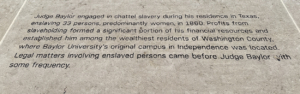
As part of the larger Memorial to Enslaved Persons on Founders Mall, Baylor University Judge R.E.B. Baylor—whose statue long has anchored Founders Mall and for whom the university is named—owned enslaved people. (Photo / Ken Camp)

The memorial grew out of a report and series of recommendations by Baylor’s Commission on Historic Campus Representations in 2020-2021.

It recognizes the role enslaved laborers played in the university’s construction and confesses race-based chattel slavery built the wealth of many of Baylor’s early benefactors and founders.

It specifically acknowledges Judge R.E.B. Baylor—whose statue long has anchored Founders Mall and for whom the university is named—owned enslaved people.

The memorial includes Scripture references, a cascading water feature constructed of the same limestone used to build Baylor’s original campus in Independence, a population density map depicting the number of enslaved people in Central Texas in 1860 and a resonance garden for reflection.

Michael McFarland, a Baylor regent who served on the Commission on Historic Campus Representations, called the memorial on Founders Mall “a sacred space that acknowledges the courage, persistence and enduring legacy of the enslaved men and women whose hands helped build Baylor University.”

“Their names may not appear in Baylor’s official record, but their fingerprints are etched forever in the stones, the soil all over this campus,” he said. “Their spirit is woven into the very fabric of this awesome institution.”

‘Not turn away from painful truths’

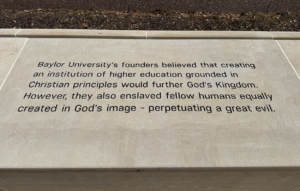
As part of the lMemorial to Enslaved Persons on Founders Mall, Baylor University acknowledged many of the school’s founders perpetuated “a great evil” by enslaving other people. (Photo / Ken Camp)

McFarland urged those in attendance at the dedication ceremony to remember and honor the “great cloud of witnesses” who “labored in the heat, carved the stone, cleared the land, and carried the burdens of others.”

He called the memorial “a testament to truth, courage and reconciliation.”

“It reminds us that Baylor’s story—like the story of our great nation—is both complicated and redemptive,” McFarland said.

“It calls us not to turn away from painful truths, but to face them with courage, to persist in our pursuit of justice, and to honor those who labored in obscurity by ensuring that their descendants and all God’s children experience dignity and opportunity.”

McFarland pointed to the memorial as “a testament to what is possible when a community chooses honesty over comfort, reconciliation over denial, and truth over silence.”

“This moment reflects Baylor at its best—willing to look back, not with shame, but with purpose; not to rewrite history, but to redeem it,” he said.

He offered hope the memorial will remind all who see it “that progress is born of persistence, that courage often comes from the unseen, and that the truest measure of a community is how it honors those who had no voice.”

The dedication service for the memorial was scheduled in conjunction with the fall meeting of Baylor’s board of regents.

Racial reckoning ‘an ongoing effort’

In a Zoom call with news media following the board of regents meeting, Baylor President Linda Livingstone addressed the importance of Baylor acknowledging “difficult parts of its history” and honoring the role of previously unrecognized enslaved people.

Baylor University erected statues of the school’s first Black graduates¬—Robert Gilbert and Barbara Walker—in front of the Tidwell Bible Building. (Photo / Ken Camp)

Livingstone voiced hope the memorial will serve as “a place of reflection, reconciliation and redemption for our campus.”

Acknowledgement of all of Baylor’s history is “an ongoing effort,” she said.

“I think that reckoning with the truth of your past as an institution is never done. It is always something we have to keep working on,” Livingstone said.

In addition to constructing the Memorial to Enslaved Persons, Baylor has implemented other recommendations from the Commission on Historic Campus Representations.

They included:

  • Adding inscriptions to the existing statue of R.E.B. Baylor acknowledging his role as a slaveholder and providing historical context.
  • Erecting statues of Baylor’s first Black graduates­—Robert Gilbert and Barbara Walker—in front of the Tidwell Bible Building.
  • Moving a statue of Rufus Burleson—a slaveholding former president of Baylor and proponent of the “Lost Cause” view of the Confederacy—from a prominent place in a quadrangle that previously bore his name.

The university will create additional community space on what is now the Baylor Family Quadrangle, Livingstone said.

Baylor also plans to develop space along Speight Avenue acknowledging the Indigenous people who occupied the land on which the university was built and recognizing the Hispanic community’s contribution to Baylor’s history and heritage.


Gordon pastor returns to Brazil amid visa backlog

GORDON (BP)—Albert Oliveira, pastor of First Baptist Church in Gordon, voluntarily returned to his birth country of Brazil after a visa rule change and years-long processing backlog blocked him from renewing his legal status.

“We exhausted all the possibilities,” Oliveira told Baptist Press from his mother’s home in Brazil, where he, his wife Caroline and their 3-year-old son arrived Nov. 9. “What I’m doing isn’t necessarily self-deporting, but simply leaving before the visa expires.”

Oliveira plans to continue to serve the church in Gordon, preaching and holding meetings online while the church’s pastor of discipleship handles local duties.

After a year, he will reapply for an R-1 visa for religious workers in an attempt to return to Texas and continue to serve the church.

“For this visa, you need to stay out of the country for at least 12 months in order to reset the possibility to apply again for another possible five years,” Oliveira said.

“I will stay here (in Brazil) until we can go back after the 12 months. But our hope is that something still happens and we possibly can go back earlier, maybe a rule change.”

Unexpected rule change

Oliveira was among an unspecified number of pastors in a line of 214,771 individuals seeking EB-4 visas as of March 2025, according to an analysis of U.S. Citizenship and Immigration Services data by the CBS News Data Team.

An unexpected rule change in April 2023 lumped R-1 visa applications with others in the EB-4 category. In March 2022, there were 71,147 applicants, already a backlog for the program that issues 10,000 EB-4 visas a year. The numbers indicate a 200 percent increase in applications in a three-year span.

Oliveira, who speaks five languages, earned his degree from Southwestern Baptist Theological Seminary after coming to the United States in 2010 as a 19-year-old on a student visa.

He was called to the lead pastorate at First Baptist Gordon in May 2022, after serving as the church’s youth and missions pastor.

The Oliveiras’ son was born in the United States and holds citizenship here.

Oliveira continued to work legally in the United States under an R-1 religious worker visa until the rule change exacerbated a backlog in applications and later limited the number of visas that could be distributed.

Afterward, he sought to remain on an EB-4 visa for general workers, but the requirements could not be met, he said, under his service as a pastor.

‘Suffering uncertainty’

Oliveira estimates he already has spent $25,000 to $30,000 on attorney fees, application fees, airfare and other costs that he has no way to recoup.

“I know of other pastors in other churches that are going through this,” he said. “And you can only imagine that many of them don’t have the resources to help them in this way. And all that is left for them is really to leave.”

He expressed appreciation for the love and support of his church, sharing his desire that other Baptists consider the plight of similarly situated religious workers.

“I would like them to know that the church is being affected, that there are brothers and sisters in Christ that are suffering uncertainty and they’re unable to make plans with their church for the gospel,” he said.

Religious Workforce Protection Act still in committee

Messengers to the 2023 Southern Baptist Convention annual meeting adopted a resolution “On Wisely Engaging Immigration,” commending Southern Baptists for their work on the issue and urging Congress to improve legal pathways to immigration while protecting U.S. borders.

A bill to establish the Religious Workforce Protection Act, which would allow certain EB-4 visa applicants to remain in the United States while their applications are pending, was introduced in both houses of Congress in April.

Although it has bipartisan support, it remains in committee, according to the congress.gov bill tracking service. The National Immigration Forum stated several benefits of the legislation in its analysis, including extending the R-1 visa status beyond the five-year cap.

Oliveira encourages fellow Southern Baptists to study such issues that hold interest within the church community.

“Personally, the feeling that I have is that people should study and be knowledgeable of the topic that they care about,” he said. “There are a lot of people with opinions on things that they don’t understand, and it just doesn’t help. It just hurts those that are being affected.”

Oliveira remains thankful

More than 200 worshipers attended the Nov. 2 service at First Baptist Gordon, a congregation that averages 150 in attendance. It was Oliveira’s last in-person sermon before he left for Brazil.

He baptized four new believers Nov. 2, and 11 others joined the congregation, he told Baptist Press. The church will continue to support him as a full-time pastor as he seeks a new path to legal residency here, he said.

Oliveira remains thankful.

“I’m thankful for what God has done. I have seen his providence through everything,” he said. “I’m thankful for the church, for their love and care. I honestly feel very loved by that church. And I’m thankful for everyone that was once unaware of this problem and learned about it, and started supporting and making a difference.”