Volunteers serve at Christmas in the Rio Grande Valley

BROWNSVILLE—Texans on Mission assembled a “dream team” of volunteers to bring Christmas—and its Christ-focused message—to the Rio Grande Valley Dec. 13-19.

“This year’s annual Christmas in the Rio Grande Valley really featured a dream team of volunteers,” said Sabrina Pinales, director of missions and discipleship with Texans on Mission.
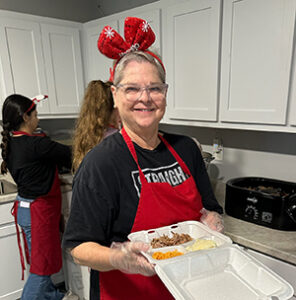
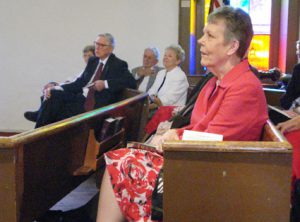
Billye Rhudy of Coryell Community Church in Gatesville served with Christmas in the Rio Grande Valley. (Texans on Mission Photo / Russ Dilday)

“We had a group of 11 students from Go Now Missions, a six-person team from Watermark Health, eight members of Grapevine’s First Baptist Church, and a group of new and repeat volunteers.”

The volunteers concentrated their efforts in the Brownsville, Mission and Donna areas. They also partnered with local churches Iglesia Bautista Horeb and Casa de Oracion Church to reach into several communities, many of them with underserved families.

Billye Rhudy of Coryell Community Church in Gatesville noted it was her second time volunteering with the Christmas in the Valley event, along with her husband, Sam.

“Part of our purpose is to serve the community,” she explained. “And we want the community to know that Jesus loves them.”

The group held several events designed to benefit the communities they served.

Volunteers:

  • Painted the interior of Casa de Oracion and built a new fence on its property.
  • Served lunches to teachers and staff of local schools.
  • Distributed Christmas gifts such as toys, warm blankets and food donated statewide through Texans on Mission.
  • Built and assembled beds for families.
  • Held medical clinics.

All of these ministries, Pinales said, “worked together to bring the Christmas message and our Texans on Mission brand of help, hope and healing to the Valley.”

Olber Roblero, pastor of Iglesia Bautista Horeb, said the team also magnified the efforts of his congregation to reach into their surrounding community.

“Texans on Mission is helping our church and the community in different ways. First of all, they are helping us build relationships with the schools and the community and the church itself. So, by doing that, we are showing Christ’s love to the people who don’t know Christ yet.

“The other way they’re helping us is to strengthen the relationships that we already have with the resources they’re bringing all the way from the north, from all over the place and from different churches, and putting together a team to be able to come here.”

Providing for those in need

During one of the community distributions, the team gave toys, blankets and food to children determined to be unaccompanied immigrant minors from two area shelters.

For Billye Rhudy, it was an opportunity to speak her faith to this special group.

“Our heart is always with those who are disenfranchised and those who come across and don’t have a home,” Rhudy said.

The Watermark Health team provided health clinics two days at Iglesia Horeb. Team member and physician assistant Megan Landon, who provided consultations to families, said the team sought to “provide the community with resources to navigate the U.S. healthcare system.”

The team dealt with “complaints that patients might have, such as pain or chronic conditions that patients need to be followed up with, such as diabetes or high blood pressure. We’re also seeing things like viral illnesses, coughs, colds, flus.”

The team saw more patients than the clinic’s daily capacity, she said, leading her to believe “that the people here need access to healthcare that is affordable or free, and it’s difficult to get that in the U.S. sometimes.”

The Christmas in the Rio Grande Valley effort fit the mission of Watermark Health, a ministry of Watermark Church in Dallas, Landon said.

“We exist to glorify God and make disciples. So, we want to make disciples of all nations,” she said. “By serving here, we want to share the hope we have in Jesus Christ, and so we’re hoping to tell people about the salvation and joy they can receive from knowing Jesus.”

Serving the community

Go Now Missionary Angelica Martinez, a student at the University of Texas–Rio Grande Valley, paused from her duties serving brisket lunches to teachers at Senator Eddie A. Lucio Jr. Middle School to share her perspective on the Go Now Missions team experience.

“We’re serving our community and the teachers, showing our faith and expressing to them how much Christ loves them,” she said.

Cal Vande Zande (left) of Grapevine’s First Baptist Church served with Christmas in the Rio Grande Valley. (Texans on Mission Photo / Russ Dilday)

Cal Vande Zande of Grapevine’s First Baptist Church was part of a team that built and distributed beds and mattresses to families in need “on the very first day. And that was by cutting lumber to dimension, cutting it all to size, and then building a bed to make sure that it worked, and then practicing putting it together.”

The team distributed and assembled the beds the next day, Vande Zande said, explaining conditions in the homes “varied quite a bit.”

“Some of the homes were nice, other ones not so much. There was one room that we got into where there was just barely enough space for the bed, and it was very difficult for the people to put the bed together, but they got the job done,” he said.
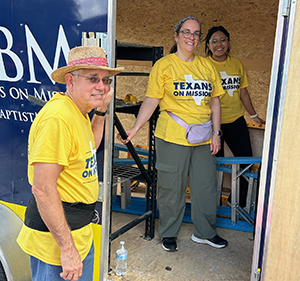
Claire Golema from Grapevine’s First Baptist Church served with Christmas in the Rio Grande Valley. (Texans on Mission Photo / Russ Dilday)

Claire Golema, another Grapevine’s First Baptist member, helped assemble and distribute the beds as well.

“I got to go out and give out two of the beds to the children, and they were just so excited to have a bed,” she said. “I can’t imagine not having my own bed or even my own room, and these beds were going into basically the first room you walked into in the house, but they were so excited that they had a bed, that it was theirs.”

Golema also helped serve lunches to school teachers, an act she said “really opened the conversation between them and the church that is across the street, that perhaps they pass every day and didn’t realize was there. And so, that’s been a really good way to reach out to them and to help them to know that God isn’t just in a building. God is outside of the building.

“I hope that they would see that God can change things—that he’s relevant for their life. I think that’s my prayer—that people would see God differently because of what we’ve done this week.”

EDITOR’S NOTE: The 3rd and 4th paragraphs were updated, along with the 4th paragraph in the “Providing for those in need” section, when additional information was made available.


A proposal, a loss and an answered prayer at camp

AQUILLA—On Nov. 8, Abel Kent had one thing on his mind: Asking his girlfriend Katelin “Kat” Weikel to marry him.

The pair were both sponsors of youth from Providential Baptist Church in Pearland attending Royal Ambassadors Campout and Missions Mania, a youth discipleship event at Latham Springs Camp and Retreat Center in Aquilla. Kent had picked the venue purposefully.

“I have been coming here with my dad since 2011—since the very first Missions Mania,” he said. “We’ve called this our home camp for a very long time. I’ve worked here, and I’ve also been here as a camper.

“It’s also the reason I became a RA State Staffer, so this whole campsite is just very important to me. It’s been a very big stepping stone in my path, and I wanted to make this (engagement) another one.”

Kent had a simple proposal plan in mind, and it involved his parents and sister. He would set up a candlelit heart-shaped circle in the camp’s outdoor prayer garden area, ask Weikel to marry him and present her with an engagement ring. As a further symbol of his love, he ordered a matching set of rings for them both.

Spoiler alert: She said yes.

Was she surprised? “Yeah, but I had my suspicions,” she recalled. “I was like, ‘He and his mom are conspiring about something, but it’s probably nothing.’”

It was something.

“It really was a surprising experience, even though he knows I’m really good at guessing,” she said. “I had a feeling, but thought, ‘No, he’s not going to do it at Missions Mania, because we’re camping and all that stuff.’”

The two proudly shared their matching rings with those standing around them. But the happy story took a negative turn as camp ended that Sunday.

As the group broke camp, Kent made a shocking discovery.

“As we were putting up everything at camp, everything’s in the trailer, and everything’s in the back of the van, I happened to look down, and I’m like, ‘Oh no, my ring’s gone,’” he recalled.

“He was so scared,” his fiancé said. “We spent about 10 minutes looking around. It felt way longer than that. We spent a long time scouring, and I was about to break, I started praying, ‘Please, let us find this.’”

Others helping in the search stopped to pray, as well. After the prayer, Kent said the group witnessed a miracle.

“She walked over to me in order to help comfort me, because I was starting to get super-worried. I mean, I was already worried, but I was way too deep in my head. So, she gave me a hug and some words of comfort,” Kent said.

“And then as we separated, she looked down—and the missing ring was right between us on the ground.

“I stared at it for like a second,” Weikel said, “and thought, ‘That’s shiny. … That’s a circle. … I found it!’”

As of the end of camp, the couple had not yet set a wedding date.


Children still at heart of Texas Baptist Children’s Home

Almost 75 years after a couple donated 112 acres of Round Rock farmland to enable Texas Baptists to build a home for abused and neglected children, Texas Baptist Children’s Home has changed a lot, but one thing has stayed constant.

Debbie Rippstein is president of Texas Baptist Children’s Home in Round Rock. (Children at Heart Ministries Photo)

“Children remain at the heart of all that we do,” said Debbie Rippstein, president of Texas Baptist Children’s Home, a part of Children at Heart Ministries. “We just don’t deliver services the same way.”

When Texas Baptist Children’s Home opened on the property Louis and Billie Sue Henna donated, the original campus consisted of three cottages, an administrative building and a superintendent’s residence.

The cottages initially housed up to 20 children—in itself, an improvement over the dormitory approach generally followed by children’s homes at that time.

But by the late 1970s, the children’s home realized it needed to change its approach. A young woman who had grown up at Texas Baptist Children’s Home was going through a divorce. Recognizing her inability to provide for her children, she asked about placing them at the children’s home.

“That’s when Texas Baptist Children’s Home said, ‘We need to do something different,’” Rippstein said. “So, our first family cottage opened in 1979.”

‘It’s what I’ve known my whole life’

Amy Maples (left), program director for Family Care at Texas Baptist Children’s Home, talks with a client at the Round Rock campus. (Children at Heart Ministries Photo)

Amy Maples’ parents became a host family at the children’s home when she was 5 years old.

“I thought it was amazing. Our cottage was filled with a steady rotation of playmates for me,” said Maples, now program director for Family Care at Texas Baptist Children’s Home.

Her experience growing up in that environment fueled her desire to make ministry to vulnerable children and their families her life’s work.

“It’s what I’ve known my whole life. I can’t imagine not serving others and the kingdom of God,” she said.

The Family Care program at Texas Baptist Children’s Home provides a safe and secure place where mothers and their children can live together, experience healing from trauma, and transition into independent living.

The residential program at the Round Rock campus now has capacity to serve up to 41 families—more than 100 mothers and children.

Clients begin their stay in 6,000-square-foot cottages that house up to five families, along with resident staff supervision, before eventually graduating to more independent living arrangements.

Families have private and secure sleeping quarters and baths, with shared kitchen and laundry spaces and multiple living rooms.

“They find the shared living arrangement stabilizing, since many of them are coming out of trauma,” Maples said.

Focus on long-term holistic health of moms and children

The program focuses on the long-term physical, emotional and spiritual health of mothers and children. While some graduate from the program in 18 months, others may stay longer.

At a Celebration of Champions event, Debbie Rippstein (right), president of Texas Baptist Children’s Home, and Brenda Harrison with social services support congratulate a client who completed the Family Care program. (Children at Heart Ministries Photo)

Staff work with mothers to help them set goals in terms of education and employment. Mothers learn how to save and manage money, along with other life skills. Counseling benefits the emotional wellness of families.

Clients are encouraged—but not compelled—to participate in Bible studies and discipleship programs.

“We want to see them grow in their relationship with Jesus,” Maples said.

Volunteer mentors from area churches meet individually with mothers to identify areas in which they want to grow personally and to study Scripture with them.

“They share their faith in a caring—not a pushy—way,” said Melanie Martinez, vice president for programs and services. “They are a reflection of Christ and his love.”

Rippstein noted exit surveys of clients from Buddhist, Muslim and other non-Christian backgrounds “felt respected and appreciated the services provided.”

Once mothers graduate from the residential program and move on to live independently with their children, Texas Baptist Children’s Home continues to provide after-care services.

“We’re still here for them, even when they move off campus,” Maples said. “They’ll always be a part of our family.”

In addition to Family Care, Texas Baptist Children’s Home also offers:

  • Home Base, a program that provides a safe haven for young adults who are aging out of foster care or facing homelessness.
  • Welcome Home drop-in resource center, which includes a food pantry, hygiene supplies, a washer and dryer and computer access for clients ages 18 to 24 who no longer qualify for juvenile service and youth programs.
  • Hope Counseling Program, offering no-cost, trauma-informed counseling at three locations in Round Rock and Georgetown

Looking to the future

Texas Baptist Children’s Home is part of Children at Heart Ministries, a family of ministries dedicated to transforming the lives of vulnerable children and families.

Todd Roberson is president and CEO of Children at Heart Ministries. (Children at Heart Ministries Photo)

They are Gracewood in Houston, offering family care and family relief to single mothers and their children; and Miracle Farm near Brenham, a ranch where at-risk teenage boys learn Christian values.

Looking ahead, when funds become available, Texas Baptist Children’s Home plans to relocate its residential program to what is the now the back side of the campus—the northeast part of the children’s home property.

Currently, the buildings face Highway 79—which is slated for expansion—and are easily accessible from I-35.

“It’s a move to enhance the safety and security of our residents and staff. It also will more than double our capacity, allowing us to serve 90 families,” said Todd Roberson, president and CEO of Children at Heart Ministries.

However, Roberson has been quick to dispel the fears of some community residents who were concerned change might mean the loss of familiar, comforting sights. The children’s home iconic chapel will remain in place. And cattle will continue to graze on part of the campus acreage.

Relocating cottages away from major thoroughfares in a more secure environment will position Texas Baptist Children’s Home to serve vulnerable families moving into the next 75 years, Roberson said.

“We want to set up for success those who come behind us,” he said.


Collectable cards find funds disaster relief

A man donated $10,000 to Texans on Mission after profiting off rare trading cards he found in a dumpster 25 years ago.

In 1999, Jack—whose identity is being limited to maintain his privacy—found a sheet of first-edition holographic Magic: The Gathering game cards, some of the first of these cards printed in the United States.

Twenty-four years after Jack made his find, he had the cards appraised, when all of his emergency funds were stolen from his van in spring 2023.

“All my life I’ve never had much, and I don’t care, because I’m happy,” Jack said.

But after the robbery, Jack said to God, “In all of your vast array of stuff, I’m sure you can find a little nugget for me, if you want to.”

A year later, Jack sold two of the cards and discovered the “little nugget” he spoke to God about.

In gratitude for his unexpected windfall, Jack felt led to donate some of his earnings to help others in need.

“I told God I’m going to try to be right with the money,” Jack said.

“You guys [Texans on Mission] are doing the right kind of stuff.”

A Texans on Mission Facebook post noted the organization was “more than grateful for Jack’s generosity.

“He has reminded us that when we let go and trust God, anything is possible. Even things like finding rare sheets of Magic: The Gathering cards worth way more than you’d expect!”

According to toy and game company Hasbro, Magic: The Gathering was created in 1993 and is played by more than 50 million players globally, with 13 million registered digital players.

Currently, the most valuable Magic: The Gathering card is called “The One Ring.” The card, printed in the elvish language created by J.R.R. Tolkien in Lord of the Rings, sold for $2.64 million.

With additional reporting by Calli Keener.


Indigenous leaders sue under Texas religious liberty act

AUSTIN (RNS)—For Gary Perez and Matilde Torres, like their ancestors before them, the river bend in Brackenridge Park in South Texas is more than the oak trees along the riverbank, the slow-moving water and the stars arrayed above at night. It is a sacred place, where the resident cormorants, they believe, take their prayers to the heavens.

That is why, when the city of San Antonio decided to remove 69 of 83 trees and prevent bird nesting in the river bend to allow the remodeling of a wall, Perez and Torres, ceremonial leaders of the Lipan-Apache Native American Church, sued to protect it on religious grounds.

Last week, the Texas Supreme Court heard their lawsuit challenging the city’s actions under a state constitutional amendment approved by Texas voters in 2021 to deal with restrictions on religious services imposed by local officials during the COVID-19 pandemic.

The Religious Services Amendment to the Texas Constitution says the state or a political subdivision of the state “may not enact, adopt or issue a statute, order, proclamation, decision, or rule that prohibits or limits religious services.”

John Greil, an attorney and professor at the University of Texas law school’s Law & Religion Clinic, represents Perez and Torres in Perez v. City of San Antonio. He noted Perez and Torres are the first claimants to bring a suit under the Religious Services Amendment, giving the court’s decision in the case significant weight as a precedent.

“If 20 years down the road, there’s some emergency and cities start putting in new orders that would affect religious services, this case will determine how that amendment gets applied in the future,” Greil told RNS.

Perez and Torres perform their ceremonies at a part of the park known as Lambert Beach, they explained, because of their people’s ancestral connection to the land.

They consider the waters, birds, trees and constellations above a “sacred ecology” and a tenet of the Native American Church. They believe that the San Antonio River bend is central to their creation story, which combines Indigenous and Christian traditions.

“Imagine removing the Old Testament and trying to surmise what happened within the New Testament,” Perez said. “By removing the trees and the birds, and destroying this spiritual ecology, there’s no reference back to the Old Testament. There is no hope.”

The two appellants’ brief asserts that for thousands of years, Indigenous peoples in Texas have worshipped at this river bend, a sacred site where hieroglyphics more than 4,000 years old have been discovered.

The brief argues worship cannot be done elsewhere, because the specific attributes to the place are crucial to their ceremonies. If the trees are obstructed, if the birds are removed, Perez and Torres’ ability to worship would be gone forever.

“The city of San Antonio has chosen a construction design that will remove all but 14 of the 83 trees at the bend … without any consideration of the plaintiffs’ religious exercise,” Greil said before the Texas Supreme Court on Dec. 4.

A spokesperson for the city of San Antonio said the city’s current plan includes “a reduction in the number of trees planned for removal from 105 trees to 77 trees for Phase I and II of the project. Forty trees will be relocated rather than removed altogether and approximately 270 trees will be planted on site.”

At the hearing, Texas Deputy Solicitor General William Cole argued that the amendment was “not a Swiss Army knife of religious liberty,” and “the amendment’s scope is designed to protect the right to gather.”


Prayer and neighborliness key to Sanderson’s recovery

In the six months after tornadoes struck Sanderson, residents of the small West Texas town have “pulled together” and made strides toward rebuilding, Pastor Mike Ellis said.

Ellis, pastor of First Baptist Church in Sanderson, credited two factors in the successful recovery and rebuilding efforts—“neighbors helping neighbors” and the prayers of God’s people around the state.

The June 2 tornadoes destroyed or seriously damaged multiple buildings in town, but the First Baptist Church facility escaped without even a broken window.

Jessica and Chase McCrory, members of First Baptist Church in Sanderson, stand outside their home that was hit by a tornado on June 2. (Photo / David Vela / Texas Baptists)

Jessica and Chase McCrory and their two young sons lost their home to the tornado, but they are “on the road to recovery,” Ellis said.

The McCrory family—members of First Baptist Church—have been working with their insurance company and a contractor not just to rebuild the home they lost, but to construct the home their young family dreamed of having.

Before the contractors hung drywall in their home, the McCrory family of Sanderson invited members of their church to use permanent markers to write Bible verses and other words of blessing on the boards between studs. (Courtesy Photo)

The couple enlisted a contractor to build a barndominium—a structure blending traditional barn architecture with modern living areas—set back 10 feet further from the road than their previous home had been.

“Chase McCrory would be the first to say: ‘God is good. God had a plan,’” Ellis said.

When McCrory decided to install all of the insulation in the house himself as a cost-cutting measure, volunteers from First Baptist Church helped him, Ellis noted.

Before the contractors hung drywall in their home, the family invited members of the church to use permanent markers to write Bible verses and other words of blessing on the boards between studs, he added.

Ellis serves First Baptist Church bivocationally, working as an electrical, plumbing and building contractor.

As the self-described “only licensed electrician in town,” he and his grandson worked 16-hour days for the first month after the tornado, helping their neighbors restore power to their homes.

“My grandson had been talking about wanting to become an electrician. I think he may have reconsidered,” Ellis said.

The local coffee shop plans its grand reopening in two weeks, and other businesses in town either have reopened or plan to in the near future, he noted.

Ellis, who served in “tornado alley” during his 20 years working in the Texas Panhandle and Oklahoma, had extensive experience with natural disasters and was trained in emergency management.

“In all that time, I had never seen a group of people who jumped in and started helping each other quite like the folks here,” he said. “Everybody pulled together. It’s neighbors helping neighbors.”

In the days immediately after the tornado hit, members of First Baptist Church worked side-by-side with volunteers from other local churches to provide meals to families affected by the tornadoes.

The Buena Vista Independent School District in Imperial sent two busloads of student volunteers to help clear debris on a Saturday soon after the tornado struck Sanderson.

“We had people from as far away as Stephenville who sent trailers filled with building materials,” Ellis said. “And people are still helping one another.”

Ellis credits the resilience of local residents in large part to the prayer support they received from Christians throughout Texas.

“Those prayers were felt,” he said. “They’re still being felt, and the answers to those prayers are still being seen.

“God’s grace has been on us. He was with us through it all.”


Retired pastor on a mission to spread the message

Don English spent more than four and a half decades as a pastor on mission, taking more than 50 volunteer mission trips to 14 countries.

After being turned down by what was then the Southern Baptist Foreign Mission Board because of their age, English and his wife Nancy served three years in Ukraine and made 22 trips to Armenia in a dozen years.

Now in their 80s, they still are as committed as ever to mission work, opening their Dallas home to exchange students.

“I always wanted to go to Mongolia. Then Mongolia came to us,” English said.

But now, English feels like God has given him another mission. He wants to share with others what he believes God taught him through an exhaustive verse-by-verse study of Revelation, referring only to other Scriptures—not any commentaries—for guidance.

Bible study, not speculation

Since his early years growing up on a Texas dairy farm, English heard preachers speculate about the End Times.

Many predicted Jesus would return on or before 1988—40 years after the birth of the modern nation of Israel. They were wrong.

Others speculated about the identity of the Anti-Christ, using “666” as their guide and trying to apply it to the names of prominent individuals. They were mistaken.

Some even set dates for Christ’s return, linking current events directly to what they saw as signs of the times in Scripture. Each was proven wrong.

“Some of it is just plumb crazy,” English said.

Nevertheless, he was convinced God gave Revelation for a reason. So, beginning in May 1986, he set out to discover what God revealed in the New Testament’s final book. He was interested in “Bible study, not speculation,” he said.

English—who was pastor of three Texas Baptist churches and one in the Pacific Northwest—set aside the charts, the timelines and the speculation.

Instead, he concentrated solely on the biblical text of Revelation, and then compared it to other prophetic passages in the Old Testament.

After unsuccessful attempts to find a professional writer to record his insights, he finally committed to write a book himself, producing The Message: Mankind’s Final Destiny.

Approach defies easy categorization

“It’s controversial,” English said.

His analysis of Revelation doesn’t fit neatly into any of the typical approaches to understanding the End Times. His perspective is premillennial but not dispensational.
English believes in a Rapture of the church—although he acknowledges the term is not found in Scripture—and a seven-year Tribulation. However, he tends to think Christians will be “caught up” to be with Jesus halfway through the seven years, not prior to its beginning.

He completely rejects the notion of trying to connect the dots between current events and biblical signs in an effort to determine the date of Christ’s return.

“It’s not about calendar dates but about conditions,” he said.

When the family of God—the people of God in the Old Testament era and believers since the time of Jesus who have been redeemed by Christ—is complete, that’s when Christ will return, he concluded.

So, the mission enterprise to which English devoted most of his life and the mission of studying Revelation are more closely linked than they might seem at first glance.

And in spite of its symbols and signs that believers view differently, the final word of Revelation is a message of assurance for Christians in any age.

“Satan and his fallen angels are on death row,” English said. “And God is on the throne.”


STCH Ministries students on mission in Dominican Republic

Over the summer, three students from STCH Ministries Boothe Campus went on a mission trip to the Dominican Republic.

For many, it was their first time venturing beyond Texas, making the experience surreal as they navigated the bustling airport on their way to serve abroad. It was a journey that would open their eyes and deepen their faith in ways they never imagined.

STCH mission trip team at the airport preparing to leave the Dominican Republic. (Courtesy Photo)

The students, selected through an application process, participated thanks to funding from Women’s Missionary Union of Texas and the Mary Hill Davis Offering for Texas Missions.

Since 2001, STCH Ministries has applied for the grant, enabling students to alternate between U.S.-based trips and international mission trips, providing opportunities for discipleship and service.

On this trip, the students worked alongside two church groups.

Christopher, a high school junior, was inspired by a pastor’s words to apply. Under the guidance of Benjamin Brewer, STCH Ministries student ministries coordinator, the students prepared by learning about Dominican culture, developing their testimonies and studying the book Go Well.

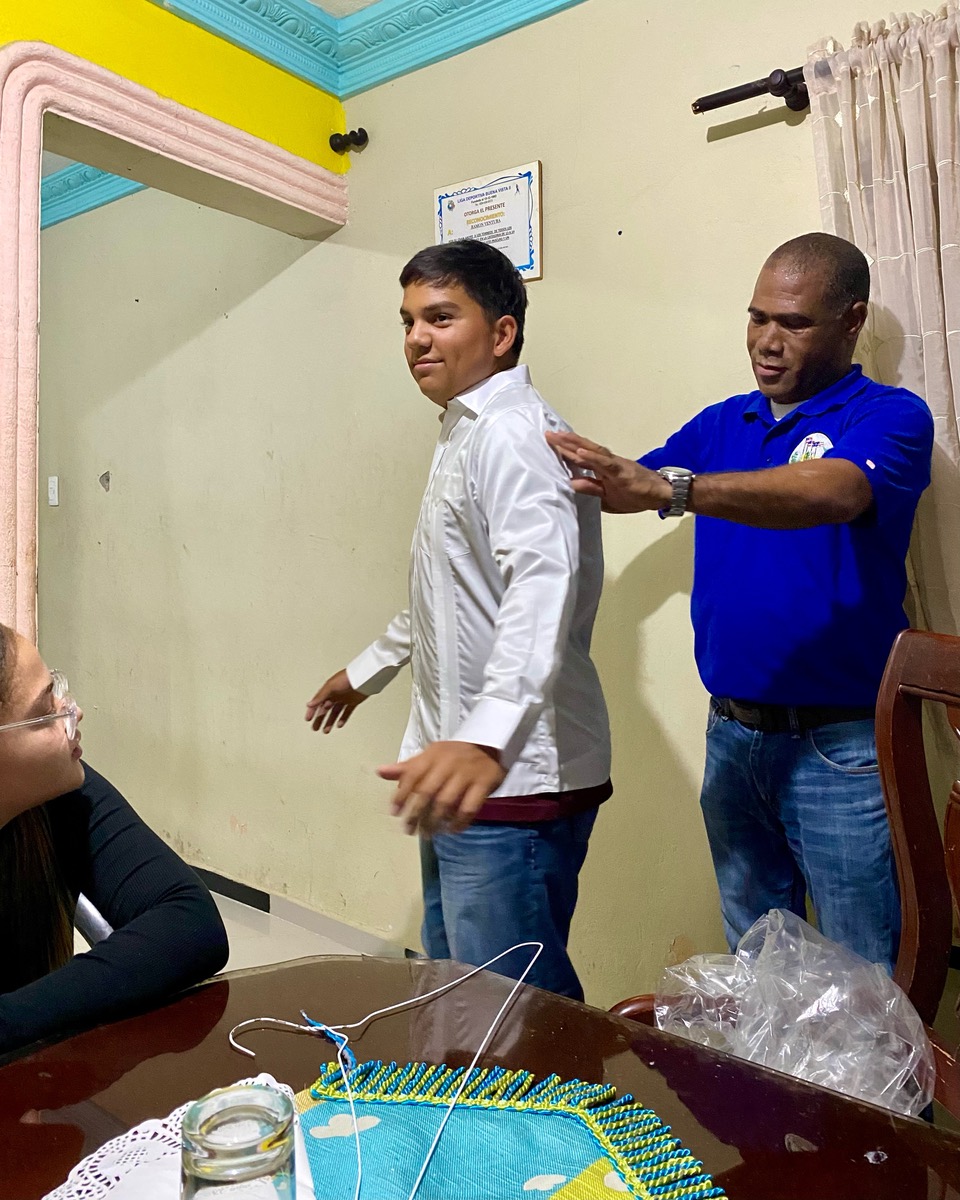
Christopher being fitted for a new custom shirt. (Courtesy Photo)

“The people we were going to serve were what mattered most,” Brewer explained. “At the end of the day, the relationships we build are the primary focus.”

Upon arriving, the students were struck by the stark differences between Dominican life and Texas life.

“We couldn’t believe that people lived like this,” Christopher remarked. Their time at an orphanage in Santiago was particularly eye-opening. Sometimes joking about being “orphans” back home, the students realized they were not.

“We actually have it pretty good,” they reflected.

Close bonds built

The students bonded deeply with the children at the orphanage. Mary, a high school senior, was brought to tears by a little girl who clung to her, pleading: “I love you, Mary. Please take me home with you.”

Game time at the orphanage in Santiago. (Courtesy Photo)

Christopher developed close relationships playing sports with a child who eagerly awaited his return each day. “When I came back, he ran to me and jumped into my arms,” Christopher recalled. “It was hard to leave that kind of love behind.”

Journie, another student, helped with Vacation Bible School alongside her housemom, Brandy. “Seeing the kids sing Christian songs and participate was amazing,” she said.

Journie also learned valuable lessons about contentment. “God helped me know that even when we don’t have something, we can still make the best of what we do have,” she said.

The mission trip was not just about service, but also skill development and the joy of giving. Under the guidance of projects coordinator Russell Jerez, the students helped build playground equipment for the orphanage.

Housepop Terry Burtchell shared his expertise. Passionate about woodworking, he helped the students create something that would bring children joy.

The generosity of the Dominican community left a lasting impression. One family, supported by STCH Ministries Samuel’s Fund, invited the mission team to dinner at their home. Samuel’s Fund is a sponsorship program that helps orphans and at-risk children in the Dominican Republic and El Salvador.


Ezell to host BGCT information sessions in early 2025

ALPHARETTA, Ga. (BP)—North American Mission Board president Kevin Ezell will host a series of information sessions in early 2025 to answer questions raised by Southern Baptist pastors whose churches are affiliated with the Baptist General Convention of Texas.

“Our desire is to connect with Southern Baptist pastors in the BGCT whose churches are most engaged and interested in partnering in national missions efforts,” Ezell said.

The sessions, hosted by Southern Baptist churches affiliated with the BGCT, tentatively are scheduled for Dallas-Fort Worth on Jan. 13, Houston on Jan.14, Austin on Jan. 21 and San Antonio on Jan. 22, Ezell told the Baptist Standard. A West Texas session also is planned, but the date and location are not set yet.

Union Baptist Association confirmed sessions at two Houston-area locations on Jan. 14: 9:30 a.m. at First Baptist Church in Pasadena and 2 p.m. at Chinese Baptist Church.

“We are still finalizing the details,” Ezell stated. “We will share times and specific locations soon.”

North American Mission Board President Kevin Ezell responds to a question from Texas pastor Dustin Slaton. (Photo by Van Payne / The Baptist Paper)

“I am grateful for what Texas Southern Baptist churches that are connected with the BGCT invest in missions through the Annie Armstrong Easter Offering, Lottie Moon Christmas Offering and the Cooperative Program,” he said.

“NAMB desires a continued partnership with these churches, and these gatherings will help us clearly communicate that and also to address questions pastors may have.”

In response to questions from the Baptist Standard about who will participate in the information sessions and whether reporters would be allowed to attend, Ezell responded by email: “In order for pastors to feel complete freedom to share and discuss openly, there will only be associational leaders, pastors and staff of churches invited to attend.”

“The meetings are intended for all Southern Baptist churches affiliated with the BGCT,” as well as associational leaders, a further clarification stated.

“The pastors we have heard from are very supportive of NAMB but are confused about how NAMB can partner and not partner with Southern Baptist churches that are affiliated with the BGCT,” Ezell wrote.

“I am thankful for the investment that many Southern Baptist churches connected with the BGCT make toward supporting our missionaries. I want to make sure they have access to accurate information about our relationship and the opportunities we have to partner,” he continued.

Partnership ‘could look very different’

“NAMB’s partnership with the BGCT might have some limitations, but how we partner with Southern Baptist churches that relate to the BGCT could look very different,” Ezell said.

In response to a follow-up question about how the partnerships between BGCT churches and NAMB might take shape, Ezell stated: “We have said earlier that the purpose of our meetings with Southern Baptist pastors in the BGCT and with BGCT leadership is to work toward continued partnership. We’re hopeful these ongoing discussions will bring us closer to that. NAMB also relates directly with many churches, so that would always be an option.”

Beginning in 2010, NAMB started shifting more resources to regions outside the South where church-to-population ratios are much higher and lostness much greater.

In partnership with leaders of South state Baptist conventions, NAMB transitioned funding in the South to an annual $300,000 grant to be used for church planting. The change resulted in several million additional dollars being channeled to needs outside the South in the ensuing years.

NAMB’s doctrinal standard is the 2000 Baptist Faith & Message, and NAMB only provides financial support for church plants that affirm the same standard.

Question raised at SBC annual meeting

Dustin Slaton, pastor of First Baptist Church in Round Rock, asks North American Mission Board President Kevin Ezell to clear up the “murky” relationship between NAMB and Texas Baptists. (Photo by Pam Henderson / The Baptist Paper)

Dustin Slaton, pastor of First Baptist Church in Georgetown, questioned the policy during Ezell’s report to this year’s Southern Baptist Convention annual meeting.

“NAMB has gladly accepted my church’s financial investment in the North American Mission Board for decades without asking which version of the BFM we have in our documents or concern about which state convention we’re a part of,” Slaton said at the SBC annual meeting.

“So, can we now count on the North American Mission Board to reciprocate that investment by partnering with us to plant genuinely Southern Baptist churches in Texas and invest in us with the same resources, training, guidance, relationships and financial opportunities you would provide to a church who partners with our other wonderful state convention?”

Ezell explained NAMB can come alongside a BGCT-affiliated Southern Baptist church that wants to plant a church outside the state of Texas in states where conventions affirm the 2000 Baptist Faith & Message.

“I would love for you to consider and for your state convention to adopt the Baptist Faith & Message 2000,” Ezell concluded in response to Slaton.

BGCT messengers reject affirmation of 2000 BFM

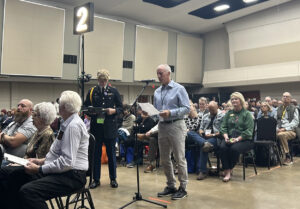
While some BGCT-affiliated churches affirm the 2000 statement, the BGCT explicitly affirms the 1963 version of the Baptist Faith & Message. At the 2024 BGCT annual meeting, messengers decisively defeated a motion to affirm the 2000 Baptist Faith & Message.

Long lines quickly formed at each microphone on the floor of the convention center hall as pastors and other messengers prepared to present arguments for and against the motion calling on the BGCT to affirm the 2000 Baptist Faith & Message. (Photo/ Ken Camp)

Ezell told the Baptist Standard the information meetings were planned after the vote at the BGCT annual meeting.

“I heard from several Southern Baptist pastors and directors of missions who are committed to NAMB and also connected to the BGCT,” he stated. “Their advice was that the best option for communicating accurate information was to do it in person.”

When the Baptist Standard asked for a response from BGCT Executive Director Julio Guarneri, he expressed appreciation for the opportunity to engage in ongoing dialogue with NAMB leaders.

Guarneri said Ezell accepted his invitation “to another in-person meeting here at our Texas Baptists offices early in the new year to continue the conversation.”

He also noted his appreciation for Ezell’s desire to connect directly with Texas Baptist pastors to clarify options available to them.

“As dates and locations are confirmed, we will gladly provide whatever support is needed,” Guarneri stated. “Time spent in Texas with Texas Baptist churches is an investment I’m sure he won’t regret.

“We share a Great Commandment/Great Commission task that is bigger than any one of us can achieve alone. Cooperation is essential.”

Both Guarneri and Ezell emphasized their shared desire to find a way for Texas Baptist churches that want to partner with NAMB in church planting to do so.

“Since June I have had several conversations with pastors who lead Southern Baptist churches affiliated with BGCT. In August I met with pastors and BGCT leadership with the goal of working toward ways we can partner most effectively,” Ezell said.

“The ministry work we do together at the Send Relief Ministry Center in Laredo is a great example of how we partner well.”

Pastors respond to ongoing developments

Several pastors who were part of the August meeting offered their thoughts on recent developments regarding NAMB and the BGCT.

Jeff Williams, pastor of First Baptist Church in Denton, made a motion “that the Baptist General Convention of Texas affirm the 2000 Baptist Faith & Message.” (Photo / Calli Keener)

Jeff Williams, pastor of First Baptist Church in Denton, introduced the motion at Texas Baptists’ annual meeting in Waco to affirm the 2000 Baptist Faith & Message.

“The reason I made the motion at the meeting was to get NAMB leadership and BGCT leadership talking about the relationship between the two entities,” Williams told the Baptist Standard. “I think that was accomplished.”

When asked whether messengers voting to reject the motion affected his church’s relationship to the BGCT, he said, “My church is as committed as we have always been to the BGCT and the Southern Baptist Convention.”

Slaton, who questioned Ezell at the SBC annual meeting, said he raised the query to “bring clarity” to the issue of how BGCT churches can partner with NAMB in church planting.

“In the previous meeting we had with Dr. Ezell back in August, he clarified that all of the planting resources that are available to other states are also available to BGCT and its churches. The only difference between BGCT and a convention that is a Send Network convention, (like the SBTC) is how funding happens,” Slaton wrote in an email.

“In that case, the NAMB funding comes through a grant to the BGCT, and the BGCT distributes it. This is similar to how NAMB has partnered with many other southern states for many years, and is not unique to the BGCT.”

Slaton noted his church’s relationship with the BGCT did not change after messengers turned down the motion to affirm the 2000 Baptist Faith & Message.

“However, I do not think a ‘yes’ outcome of the vote would have affected our relationship with the BGCT either,” he added.

Dan Newburg, pastor of First Baptist Church in Devine, offered a somewhat different perspective.

“The allegiance and loyalty of FBC Devine is to Jesus Christ. With this said, we have found the BGCT to be an exceptional kingdom partner and the annual meeting did not change this,” he stated.

“All of the messengers we sent to Waco stood and were counted among those who were in opposition to the motion for the BGCT to affirm the BF&M 2000. We affirm the BF&M 1963, like the BGCT.”

Events in recent months have, however, caused his church to question whether it can continue to partner with NAMB.

“In no way does our congregation give with an expectation of return, but we are a growing congregation who recognizes that church planting in Texas is a need that [First Baptist Church in Devine] can and should seek to address as we seek to be obedient to the Great Commission,” he stated.

“We are also historically Baptist and interested in preserving historic Baptist distinctives, such as the distinctive of local church autonomy. As my congregation has become better informed about NAMB’s processes and expectations, it’s not clear that we can partner with them without sacrificing our autonomy, nor actually better reaching our community for Christ.”

Based in part on a Baptist Press report by North American Mission Board communications, with additional reporting by Calli Keener and Ken Camp.

EDITOR’S NOTE:  This story was corrected after receiving further clarification of who may attend the meetings. The fourth paragraph with information about Houston-area meetings was added after receiving confirmation by Union Baptist Association.


State board approves Bible-infused curriculum

A majority of the Texas State Board of Education gave final approval Nov. 22 to a state-authored curriculum under intense scrutiny in recent months for its heavy inclusion of biblical teachings.

Eight of the 15 board members voted to approve Bluebonnet Learning, the elementary school curriculum proposed by the Texas Education Agency earlier this year. The curriculum will become available in the spring, with schools that choose to adopt the materials expected to begin using them at the start of the 2025-26 school year.

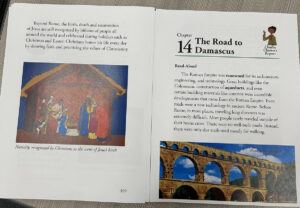
“The Road to Damascus” is a chapter in 4th Grade Reader (student book) ELAR Bluebonnet curriculum. (Photo / Calli Keener)

The curriculum was designed with a cross-disciplinary approach that uses reading and language arts lessons to advance or cement concepts in other disciplines, such as history and social studies.

Critics, which included religious studies scholars, say the curriculum’s lessons allude to Christianity more than any other religion, which they say could lead to the bullying and isolation of non-Christian students, undermine church-state separation and grant the state far-reaching control over how children learn about religion. They also questioned the accuracy of some lessons.

The curriculum’s defenders say references to Christianity will provide students with a better understanding of the country’s history.

Texas school districts have the freedom to choose their own lesson plans, so the choice to adopt the materials will remain with them. But the state will offer an incentive of $60 per student to districts that adopt the lessons, which could appeal to some as schools struggle financially after several years without a significant raise in state funding.

Three Republicans—Evelyn Brooks, Patricia Hardy and Pam Little—joined the board’s four Democrats in opposition to the materials.

Leslie Recine—a Republican whom Gov. Greg Abbott appointed to temporarily fill the State Board of Education’s District 13 seat vacated by former member Aicha Davis, a Democrat who ran successfully for a Texas House seat earlier this year—voted for the curriculum.

Abbott handpicked Recine, who was the deciding vote on the materials, to fill the seat through the end of the year days before the general election, bypassing Democrat Tiffany Clark. A majority of District 13 residents voted this election for Clark to represent them on the board next year. She ran unopposed.

Board members who expressed support for the curriculum said during the week they believed the materials would help students improve their reading and understanding of the world.

‘Establishing cultural literacy’

Members also said politics in no way influenced their vote and that they supported the materials because they believed it would best serve Texas children.

“In my view, these stories are on the education side and are establishing cultural literacy,” Houston Republican Will Hickman said. “And there’s religious concepts like the Good Samaritan and the Golden Rule and Moses that all students should be exposed to.”

The proposed curriculum prompts teachers to relay the story of The Good Samaritan to kindergarteners as an example of what it means to follow the Golden Rule: “Do unto others as you would have them do to you.”  The curriculum teaches other religions have their own version of the Golden Rule.

Brooks, one of the Republicans who opposed the materials, noted the Texas Education Agency is not a textbook publishing company and said treating it like such has created an uneven playing field for companies in the textbook industry.

Brooks also said she has yet to see evidence showing the curriculum would improve student learning and that she was opposed to the state using Texas schoolchildren as “experiments.”

Hardy, a Fort Worth Republican who also opposed the materials, said she did so without regard for the religious references. She expressed concern about the curriculum’s age appropriateness and her belief it does not align with state standards on reading and other subjects.

Little, a Fairview Republican, expressed concern on Nov. 22 that the state would have no way to see its “return on investment” with the materials, considering schools have wide latitude to adopt lessons as they see fit—meaning districts could pair Bluebonnet Learning with other learning materials, making the effectiveness of Bluebonnet as a standalone curriculum unclear.

Little said on social media earlier in the week she supports “the teaching of biblical values in education” but criticized the curriculum for some of its teaching methods, which she said leave “little time for students to practice reading and develop critical skills like fluency and comprehension.”

‘Needs to be … free of any establishment clause issues’

Meanwhile, some of the Democrats who voted against the curriculum said they worried the materials would inappropriately force Christianity on public school children. Others cited concerns about Texas violating the Establishment Clause, which prohibits states from endorsing a particular religion.

 “If this is the standard for students in Texas, then it needs to be exactly that,” said Staci Childs, a Houston Democrat. “It needs to be high quality, and it needs to be the standard, free of any establishment clause issues, free of any lies, and it needs to be accurate.”

The state had until late Nov. 20 to submit revisions in response to concerns raised by board members and the general public before the official vote took place Nov. 22.

Democratic members said, however, their concerns still remained. Childs, who is also an attorney, said she believes if someone were to sue the state for a violation of the Establishment Clause, they likely would succeed.

San Antonio Democrat Marisa B. Pérez-Diaz said she found value in the materials, but the Christian bias kept her from supporting it. Rebecca Bell-Metereau, a San Marcos Democrat, said although the curriculum attempts to reference faith traditions other than Christianity, she doesn’t feel the state did so in a meaningful way.

 “It seems to me like it is trying to place a Band-Aid on a gaping wound,” Bell-Metereau said.

In a statement Friday, Texas Education Agency Commissioner Mike Morath said the approval of Bluebonnet Learning “means that an important, optional new resource will be available for students, teachers and schools.”

“These materials were developed using the best evidence on how to teach reading and math with extensive feedback from teachers and parents to construct a product that is effective, engaging and grade-level appropriate,” Morath said.

“Bluebonnet Learning provides Texas teachers with textbooks and instructional materials that are of the highest quality, aligned to our state’s standards and foundational for student success.”

Abbott called the State Board of Education’s approval of the materials “a critical step forward to bring students back to the basics of education and provide the best education in the nation.”

‘More appropriate for Sunday schools than public schools’

In contrast, the approval drew immediate criticism from both national and local organizations.

Americans United for Separation of Church and State said in a statemen: “Texas’ new Bible-infused elementary curriculum is part of the nationwide effort by Christian Nationalists to impose their religious beliefs on public school students.”

The Texas American Federation of Teachers blasted the state for infusing school lessons with “Bible-based references more appropriate for Sunday schools than public schools.”

“We can anticipate what will come next, whether that’s the erasure of contributions of marginalized populations in social studies or the minimization of climate change in science,” the union said.

Meanwhile, conservative organizations like the Texas Public Policy Foundation, which helped develop the materials, applauded education officials for taking “the next big step toward dramatically improving the quality of education in Texas.”

 “Teachers will be able to spend more of their time doing the critical job of teaching and evaluating students, rather than spending their nights and weekends searching for lesson plans,” said Greg Sindelar, the organization’s CEO. “And parents will get to follow along as their children learn thanks to the online resources that come with the lessons.”

More than 100 Texans signed up to speak for and against the state-authored curriculum.

Courtnie Bagley, education director for the Texas Public Policy Foundation, told board members the Texas Education Agency has made every effort to respond to concerns from the public. She said rejecting the lessons would give other materials not owned by the state an unfair advantage.

“It would create a double standard, as Bluebonnet Learning has been held to a different and more stringent review process than other materials under consideration,” Bagley said.

Opponents argued revisions did not go far enough, and some questioned whether the state’s intentions with crafting a curriculum that leans heavily on Christianity are political.

“I am a Christian, and I do believe that religion is a part of our culture, but our nation does not have a religion. We’re unique in that,” said Mary Lowe, co-founder of Families Engaged for an Effective Education.

“So, I do not think that our school districts should imply or try to overtly impress to young impressionable children that the state does have a state religion.”

Half of panel have history of faith-based advocacy

Education officials say references to Christianity will provide students with a better understanding of the country’s history, while other supporters have stated their belief that the use of religious references does not violate the U.S. Constitution’s Establishment Clause.

Legal experts note recent rulings by the U.S. Supreme Court’s conservative majority have eroded decades of precedent and made it unclear what state actions constitute a violation of the Establishment Clause.

State leaders also say the materials cover a broad range of faiths and only make references to religion when appropriate. Education Commissioner Mike Morath has said the materials are based on extensive cognitive science research and will help improve student outcomes.

Of 10 people appointed to an advisory panel by the Texas Education Agency to ensure the materials are accurate, age-appropriate and free from bias, at least half of the members have a history of faith-based advocacy.

The Texas Tribune recently reported how parents, historians and educators have criticized the ways the materials address America’s history of racism, slavery and civil rights.

In public input submitted in response to the curriculum and in interviews with the Tribune, they have said the materials strip key historical figures of their complexities and flaws while omitting certain context they say would offer children a more accurate understanding of the country’s past and present. Bell-Metereau and other Texans referenced the Tribune’s reporting during public testimony.

In response to those concerns, the Texas Education Agency has said the lessons will provide students with “a strong foundation” to understand more complex concepts as they reach later grades. State officials have also said those materials are written in an age-appropriate manner.

This article originally appeared in The Texas Tribune and is reprinted with permission. It has been edited for clarity.


‘Hope in the Heartland’ brings the gospel center stage

IRVING—Desiring to bring the gospel center stage through an evening of toe-tapping entertainment, award-winning songwriters and worship leaders Chris and Diane Machen, members of Preston Ridge Baptist Church in Frisco, wrote and produced “Hope in the Heartland.”

“For people who attend the show and are not believers, we’re hoping this is a watershed moment for them,” Chris Machen said. “We’re praying that it opens up meaningful faith conversations and that people will meet the Lord in a real, life-changing way.

“We hope that everyone who attends will be encouraged by this story of struggle, friendship, community and faith. We also want believers to remember that the message of Christmas is to be shared, not kept, and that they will bring unbelieving friends to hear how a life can be forever altered by an encounter with Christ.”

Based on personal family stories

For Chris Machen, the idea for this musical started almost a decade ago when he felt the Lord leading him to share his own family’s personal stories of the Great Depression. He recalled the stories his father passed down about how their family’s unwavering faith in Christ helped carry them through the difficult times.

“About 10 years ago, I was trying to come up with an idea for our church’s Christmas dinner theater,” Chris Machen said. “I attended a music conference, but didn’t really find what I was looking for there. I remember praying, ‘Lord, what do I do?’

“Now you might think this strange, but I got the answer as if the Lord was whispering in my ear, ‘Write your own.’ I perked up, because as a songwriter, that sounded like a wonderful challenge. As I sat there pondering, I prayed again, ‘Lord, what story do I tell?’ Again, almost louder than words, I heard in my spirit, ‘Tell your dad’s story.’”

He remembered stories his father told him about growing up during the Great Depression and how his grandfather, an out-of-work carpenter, struggled to provide for his family.

“He literally wore holes in three pairs of shoes walking the streets of Amarillo trying to find work to support his family. It was a difficult time for everyone, but for my grandparents, it was made more difficult by losing infant twins,” Machen said.

“Not only that, in the midst of trying to keep food on the table, they discovered they were expecting another child. They could barely support the three children that they had, including my dad. But what got them through these difficult days was their faith in Jesus.

“I’m here today, walking with Jesus because of the faith my family clung to and passed down to me. The whole time I was writing this musical for our church, I couldn’t get it out of my head that if we could find a way to put the show in secular theaters, then people who might not ever go to church could hear the gospel if someone invited them to this show.”

Machen describes the presentation as “a fun, bluegrass, Broadway-style musical that people will really enjoy,” but he adds, “Its main purpose is to introduce people to Jesus in a unique way.”

“Hope in the Heartland” debuted in 2019 at theaters in the Dallas-Fort Worth area. “And we have been performing it ever since,” Machen said.

Open doors to spiritual conversations

With five performances scheduled Dec. 12-15 at the Irving Arts Center, Machen desires these shows will provide audiences with an encouraging evening for families to enjoy. But most of all, he prays it opens doors for conversations about the reason for the season.
“One thing that has surprised and blessed Diane and me about this production is that not only has it been an outreach to the community, but it’s also been an in-reach to our cast members,” he said.

“We have never stipulated that you have to be a Christian to be in our show. We just searched for the most talented people we could find. As a result, some of our cast members are believers, but every year many who have joined us are not. It’s given us a marvelous opportunity to encourage them, love them, provide a positive environment for them and speak about how deeply God cares for them.

“The theater world can be pretty dark. So, at most rehearsals, I share a word of encouragement based on Scripture. And little by little, we’ve tried to introduce them to the one who loves them the most and can change their lives forever.”

Some of the entertainers have experienced “church hurt” and are reluctant to attend a church service, Machen noted.

“But we’re trying to change that culture and help them see that God loves them and that they are fearfully and wonderfully made, as stated in Psalm 139,” Machen said.

The production involves 32 cast members, a production crew of about 10 and more than 20 volunteers.

“It’s a huge undertaking,” Machen said, “but worth it to see people introduced to Jesus, who is our hope in the heartland.”


Texas Baptist missions leader Joy Fenner died at age 89

Joy Fenner, a Baptist missionary, Woman’s Missionary Union of Texas leader and the first woman elected as president of the Baptist General Convention of Texas, died Nov. 29 in Dallas. She was 89.

Fenner served two decades as executive director-treasurer of WMU of Texas and was named executive director-treasurer emeritus after her retirement. She was elected president of WMU of Texas in 2009.

 “Possessing sterling qualities, such as a deep devotion to Christ and his Great Commission, imaginative creativity, thoughtfulness and a cooperative team spirit, enabled her to lead the Texas WMU productively,” said William M. Pinson Jr., who served alongside Fenner during his time as BGCT executive director.

Joy Phillips Fenner was born March 3, 1935, in Avinger to Samuel and Beulah Mae Phillips and grew up in East Texas. She attended Paris Junior College and what was then East Texas Baptist College.

She was secretary at First Baptist Church in Marshall before she joined the staff of Texas WMU to serve as state director of the Girl’s Auxiliary, now known as Girls in Action, from 1959 to 1966.

Texas Baptist Voices
Joy Fenner (2nd from right) and Texas WMU President Gloria Mills (right) are pictured in this 2010 photo with former presidents (left to right) Amelia “Millie” Bishop, Gerry Dunkin, Mary Humphries, Jeane Law, Kathy Hillman, Nelda Taylor (now Hoffman) and Paula Jeser. (File Photo by Kathy Hillman)

Kathy Hillman, who served as president both of Texas WMU and the BGCT, noted she was a GA when Fenner was state director of the program. So, she sometimes joked that she was “a Joy Phillips GA.”

“Later, she referred to me as her first Joy Phillips Fenner GA Texas WMU president, which I assume was true. At least she claimed me,” Hillman said.

“Through the years, many of us had the wonderful privilege of working with Joy and count her as a wise mentor, consistent encourager and dear friend.”

Joy and Charlie Fenner married on Oct. 8, 1966, and they served together as Southern Baptist missionaries in Fukuoka, Japan, until 1980.

Carolyn Porterfield—who served in a variety of roles with Texas WMU—first met the Fenners when they were in Fukuoka and she was a missionary Journeyman based in Kyoto.

“Who could imagine that years later, Joy would invite me to join her staff at WMU of Texas?” Porterfield asked.

“Joy taught me much about missions and being a woman in leadership in Baptist life, which is not always welcomed or easy. At some point, she became more than my boss, but also my friend.”

Executive leader of Texas WMU for two decades

Soon after the Fenners returned to Texas, Joy Fenner became executive director-treasurer of Texas WMU in January 1981.

“Her experience serving on a church staff, then as a member of the Texas WMU staff, and then as a missionary in Japan prepared her in special ways for the role she filled successfully as the executive leader of the WMU of Texas,” Pinson said.

“Leading a highly skilled, hard-working staff in praying for God’s guidance and laboring to follow his direction, she advanced the missionary endeavors of Baptists.”

As chief executive of Texas WMU, Fenner was a key leader in raising funds to start new churches as part of the Mission Texas emphasis. That included the “triple-triple” campaign for the Mary Hill Davis Offering for State Missions, challenging churches to triple one year’s offering and then triple it again the next year.

Fenner also was instrumental in developing the WorldTouch and Touch Tomorrow Today endowments to support mission work through Texas WMU.

Soon after she retired from Texas WMU, she served as interim executive director of Tennessee WMU from 2001 to 2003.

First woman elected as BGCT president

Messengers to the 2007 BGCT annual meeting in Amarillo elected Fenner as president of the state convention. She served previously as BGCT second vice president and then first vice president.

Joy Fenner was the first woman elected as president of the Baptist General Convention of Texas. (File Photo)

BGCT Executive Director Charles Wade served with Fenner first when she was executive director-treasurer of Texas WMU and later when she was a BGCT officer.

When Wade expanded the executive director’s leadership council to include the top executive leaders of Texas WMU and Texas Baptist Men, Fenner was the first woman to serve on that council, where she offered “valued input” and thoughtful counsel, he said.

In all her leadership roles, she “raised the level of any conversation” in which she participated, he said.

“Joy Fenner had a clear-eyed view of what it meant to be a Baptist on mission,” Wade said. “She encouraged, called out, challenged and led by example.”

Fenner was a longtime member of Gaston Oaks Baptist Church in Dallas and served on the board of the Gaston Christian Center.

At various times, she served on the board of trustees of East Texas Baptist University and the boards of the WMU Foundation, Baylor University’s School of Social Work and Healing Hands Ministries.

independence pinson fenner425
Joy Fenner received the Texas Baptist Elder Statesman Award at Independence Baptist Church. (File Photo)

She received honorary doctorates from ETBU and the University of Mary Hardin-Baylor and was named an honorary alumnus of Baylor’s Truett Theological Seminary.

She was named a Texas Baptist Elder Statesman, and she received the Pioneer Award for Service from the Texas Baptist Missions Foundation and the George W. Truett Distinguished Church Service Award from the Baylor Alumni Association.

She was preceded in death by her husband of 50 years, Charlie, in 2017. She will be buried alongside him at the Dallas-Fort Worth National Cemetery at a date to be determined.

A memorial service is scheduled at Gaston Oaks Baptist Church at 1 p.m. on Dec. 19. A reception will follow the service. Memorial gifts can be made to the Gaston Christian Center, c/o Nataly Sorenson, 8515 Greenville Ave., Dallas TX 75243.

EDITOR’S NOTE: The article originally was posted Tuesday morning, Dec. 3.  The last paragraph was revised later that afternoon after arrangements for the memorial service were finalized.