Lack of transportation hinders summer meal program

WACO—Lack of transportation creates a hurdle for many low-income families in Texas whose children could benefit from free summer meals, a study by the Texas Hunger Initiative at Baylor University shows.

THI 300“This is important work,” said Kathy Krey, research director of Texas Hunger Initiative, a program in Baylor’s Diana R. Garland School of Social Work, launched in partnership with the Texas Baptist Christian Life Commission.

“For years, we’ve heard from those who work with the summer meals program that transportation is a barrier. But this is the first published study looking at the summer meals program that corroborates this anecdotal evidence: Transportation is a problem.”

Partnerships encouraged

Partnering with local public transportation and communities in innovative and alternative ways to provide awareness of and access to the meals sites might increase participation, researchers suggested in the study, published in the Journal of Applied Research on Children: Information Policy for Children at Risk.

“That could range from putting advertisements on buses about site locations to distributing maps that people can pick up to find meals sites,” Krey said. “Some cities have experimented with using church vans to get kids to meal sites.”

The Texas Hunger Initiative partners with the Texas Department of Agriculture and Texas Department of Transportation Rural Transit to assist underserved areas where transportation is a common barrier to summer meals participation. This past year, the initiative met with local transit authorities to identify transportation barriers, identify assets and develop next steps.

In Lubbock, for example, a collaboration between the local Head Start and Spartan Transportation enabled car rides for children to summer meals sites.

Scope of the problem

Hunger is a major problem in Texas, where 17.2 percent of households are food-insecure, compared with 14 percent nationally. Food-insecure households have difficulty at some time during the year providing enough food for all their members due to a lack of resources. 

While participation is high in the United States Department of Agriculture’s school-year programs such as the National School Lunch Program and the School Breakfast Program, “we see the Summer Meals Program as an underutilized resource,” Krey said.

Texas requires school districts with 50 percent or more students who qualify for free or reduced-price meals to offer the summer meals program for at least 30 days. If a school does not continue to operate that program after those 30 days, other groups often step in to fill the gap, Krey said.

Need for sites and workers

Organizations often need neighborhood locations and volunteers, as well as to create spaces that are attractive—perhaps offering recreation opportunities—and comfortable in varying weather conditions, she noted.

For the study, researchers merged administrative program data, including total meals and reimbursement dollars, with Census-tract level demographic data from the U.S. Census Bureau. Tracts vary in physical area and generally have a population size between 1,200 and 8,000 people, with an optimum size of 4,000 people.

The study revealed:

  • Urban areas have the most summer meal sites, but they also have the most unmet need.
  • Availability of transportation in a Census tract strongly influences the meal site coverage and site density in both urban and rural areas.
  • Urban tracts—with more people who carpool, use public transportation or walk to work—are more likely to have access to a federally funded summer meals site.
  • Rural tracts with higher numbers of households who walk and take public transport are more likely to have sites than rural areas that relied more on cars.
  • In the suburbs, where more households use cars, people are less likely to have access to a summer meals site.
  • In rural and suburban areas, households with an unemployed primary wage earner are more likely to live in tracts without access to a site. But in urban areas, tracts with more jobless people are more likely to have summer meal sites.
  • Tracts with public housing units were more likely to have a summer meals site in suburban and rural areas, so those may be key areas for outreach for the summer meals program.

“Even if you have access to transportation, there can be safety concerns,” Krey said. “In an urban area, if you have a site across an Interstate from you, the parents may not want a child to walk for safety reasons. In urban areas, you’re likely to have a site closer to you, but it may be harder to get to for other reasons. Those are things you have to look at.”

For those who are some distance from a site, “we’ve had some parents who said it would cost them more money to go to a meal site for healthy meals than to go to the corner for chips and soda,” Krey said.

Increase awareness

Making people aware of the sites is another issue, she said—which is why collaboration with public transportation to advertise could be helpful.

Cultural barriers—such as language differences or distrust of government programs—also play roles in whether children attend summer meals sites, the study found. Some families may be reluctant because they fear a stigma for participating.

“While urban areas certainly have the largest number of tracts with sites, they also have the greatest need,” Krey said. “This isn’t surprising, as urban poverty is generally more visible, and residents may have increased access to government programs.”


Baylor a ‘flawed family’ but still a family, interim president says

WACO—David Garland hopes people think about Baylor University in totally different ways by this time next year.

The university’s interim president wants other schools to think of Baylor when they look for an example to follow in terms of compliance with Title IX, the law that prohibits sexual discrimination—including sexual harassment or assault—in educational institutions that receive federal funds.
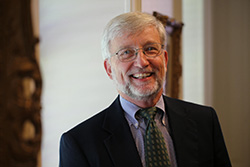
David Garland 250Students’ safety is “Priority One” at Baylor University, Interim President David Garland said. (Photo / Robert Rogers, Baylor Marketing and Communications) But when the general public hears about Baylor, Garland hopes sexual violence is the last thing that comes to mind.

“We have implemented all kinds of checks and balances to protect our students,” he said, identifying students’ safety as “Priority One for us.”

And rather than thinking of “Baylor Nation,” he hopes people think about “the Baylor family.”

“That doesn’t mean we are always one big, happy family,” he said.

Garland sat down in the president’s office on the Baylor campus June 9 for an interview with the Baptist Standard that ranged from issues dealing with how a faith-based institution handles reports of sexual violence, to motivations for service, to Christian character formation, to issues of accountability.

Called into service again

Garland, professor and former dean of Baylor’s Truett Theological Seminary, served previously as the university’s interim president from August 2008 to May 2010 and as interim provost in 2014-15.

So, the regents turned to him again May 26 after they demoted then-President Ken Starr, who subsequently also stepped down from his position as chancellor. The board also fired Head Football Coach Art Briles and sanctioned Athletic Director Ian McCaw, who resigned a few days later.

Regents announced the major personnel changes two weeks after they received a “comprehensive briefing” from Pepper Hamilton, the Philadelphia law firm the board retained last September to investigate Baylor’s response to reports of sexual violence. 

That investigation revealed a “fundamental failure” by Baylor to implement Title IX of the Education Amendments of 1972 and the Violence Against Women Reauthorization Act of 2013, according to a 13-page “Findings of Fact” document the regents released. 

Respect for Diana Garland’s legacy

Garland agreed to serve as Baylor’s interim president at such a challenging time in part because the request came from Richard Willis, then-chair of the Baylor board of regents. Garland recalled how Willis led the board to honor his wife, Diana, the founding dean of Baylor’s School of Social Work, by naming the school in her honor while she was living. She died last September after a battle with pancreatic cancer.
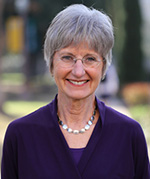
diana garland 150Diana Garland, founding dean of the School of Social Work at Baylor University that now bears her name.“In honoring her in that way, I felt indebted to him,” Garland said. “I also felt indebted to the regents and wanted to affirm their courage in making the findings of Pepper Hamilton public, knowing we were going to take all kinds of hits. But this is a testimony to the character of Baylor University and its mission as a Christian university.”

After he accepted the interim president’s role, Garland also recognized, in some sense, he was carrying on his wife’s work. She conducted extensive research and became nationally acknowledged as an expert on sexual abuse, particularly involving clergy.

“I reflected on this after the fact,” he said. “In some way, being in this position, dealing with these kinds of issues and addressing how we are going to prevent that from occurring on Baylor’s campus, I felt in some way I was honoring her work. … I am here, and she is here with me.”

Implementing the Pepper Hamilton recommendations

In addition to the “Findings of Fact” document, Baylor’s board of regents also released a 10-page set of recommendations from Pepper Hamilton. The university already has implemented some of the recommendations, and it will implement them all, Garland said. 

“The Pepper Hamilton investigation gave us 105 recommendations, which I interpret as mandates,” he said.

Baylor put into place 10 broad-based implementation teams to address Title IX protocols and policies, athletics, engagement and education, centralized reporting and resolution, public safety, counseling, advocacy and other issues. They involve faculty, staff, administrators and students.

Reagan Ramsower, senior vice president for operations and chief financial officer, heads a sexual assault task force, Garland reported. Provost Greg Jones leads an initiative focused on spiritual life, Christian character formation and creating a caring culture.

To support those efforts, Baylor added personnel, Garland noted. The university hired Brandyn Hicks, an attorney, to coordinate the implementation of the Pepper Hamilton recommendations as director of special projects and initiatives. Baylor also enlisted Darin Davis, assistant professor of Christian philosophy and ethics at Truett Seminary, to lead Baylor’s Institute for Faith and Learning, which was elevated to a more prominent position in relation to the provost, Garland said.

“All universities can have protocols and policies. What we have to do as a Christian university is to help to form character, and that’s a whole lot harder,” he said. “We’re not simply an excellent research university trying to inform our students. We are trying to form our students.”

Call for more information

Garland praised the regents for releasing the “Findings of Fact” and the full set of recommendations. But others—including the executive committee of the Baylor Line Foundation—called for greater transparency. 

The Baptist Standard also asked Baylor for additional disclosure. Read those editorials here,  here  and here.

In a June 3 open letter, Garland clarified Pepper Hamilton lawyers delivered their report as a comprehensive oral presentation to the board of regents, and he emphasized Baylor would not release any information that would identify—directly or indirectly—survivors of sexual violence. He stressed that again in the June 9 interview.

“We are not hiding anything,” Garland insisted, noting laws governing student privacy prohibit universities from releasing information about student survivors of sexual assault, even if they choose to make their identity public. “What I am really concerned about is the retraumatization of these survivors.”

Structural changes recommended

Questioned about releasing more information regarding how the university responded to reports of sexual assault—not about the incidents of sexual violence themselves—and demonstrating whether appropriate individuals were held accountable, Garland commended the regents for making “pretty bold decisions” in terms of high-profile personnel changes.

“There are three significant persons who are no longer here,” he said.

Some recommendations from Pepper Hamilton—particularly regarding governance issues and the board of regents—dealt with issues not addressed in the “Findings of Fact” document.

Tonya Lewis, director of media communications for Baylor, who sat in on the interview, noted not every recommendation was related to a specific case or incident. Rather, they reflect “best practices” by universities dealing with sexual assault issues, as identified by Pepper Hamilton.

“These are (recommendations regarding) advice on structural issues and not individual cases,” Garland added, comparing it to an accreditation report where recommendations regarding structural improvements are noted.

Dealing with survivors of sexual assault

Pepper Hamilton’s “Findings of Fact” said Baylor not only failed to support individuals who reported acts of sexual violence, but also discouraged survivors of sexual assault from pursuing complaints.

But best practices in dealing with people who have been traumatized by sexual assault limits Baylor’s ability to contact those individuals now, Garland said.

The “empowerment model” the university follows allows the survivors to set the terms and decide when and how to initiate contact.

“If they respond to us, we will try to do everything we can,” Garland said.

“I’m a pastor. So, my initial response is to do something very pastoral. But I’m told that’s not wise, and we have to be wise. There are people who know, who have experience in dealing with these issues, who are guiding us.”

Garland pointed to efforts already under way to provide training to personnel regarding the trauma experienced by survivors of sexual assault, as well as broad-based educational initiatives surrounding Title IX issues.

Student safety foremost

In his 2014 book, Beating Goliath, former Head Football Coach Briles said he believed he was in the “kid-saving business.” At the time, some praised his willingness to give second chances to players who had been in trouble as an act of Christian compassion and an expression of the desire to offer opportunities for redemption—particularly when some troubled players became star athletes.

Garland made it clear Baylor would not put students at risk, and he pointed to recommendations from Pepper Hamilton regarding recruiting and screening potential transfer students.

“Our first responsibility is to protect the safety of our students,” he said.

“We have to be careful. Everybody thinks second chances are wonderful. We need to monitor. We need to put (students) in a situation where they will succeed.”

A history of sexual violence will disqualify any potential student—athlete or otherwise—from admission to the university, he emphasized.

“They will not be given admittance into Baylor if there is any record whatsoever of a sexual assault,” he said. “There is zero tolerance for that—zero tolerance … across the board.”

Nation or family?

A billboard along Interstate 35, near the university campus, proclaims Waco as “The Capital of Baylor Nation,” reflecting the brand Baylor’s marketing department adopted in recent years. In a recent editorial, Baptist Standard Editor Marv Knox drew a distinction between Baylor Nation and the Baylor family. 

Garland made his preference clear.

“I don’t like ‘nation,’ and I want to do everything I can to change it to ‘family,’” he said. In fact, he addressed a June 10 open letter he sent to the university’s constituency, “Dear Baylor Family.”

Flawed Families 150Garland referred to a book he and his late wife wrote together, Flawed Families of the Bible: How God’s Grace Works through Imperfect Relationships. He applied that picture of family to the university.

“I think many people, in their experience at Baylor University, sense this as a family, not as a nation. ‘Nation’ seems more combative—nations going to war,” he said.

Relationship with alumni organization

When he talked to Baylor’s communications staff, Garland said, he learned the university adopted the “Baylor Nation” designation several years ago largely to distinguish itself from the Baylor Alumni Association’s use of “the Baylor family.”

At the time, the university and the alumni association were involved in a longstanding feud that eventually led to lawsuits, which have been settled

The association—which agreed to change its name to the Baylor Line Foundation—received $2 million from the university and agreed to waive its rights to a replacement for the Hughes-Dillard Alumni Center, the organization’s home from 1978 to 2013.

Garland noted he planned to attend a “celebration of the reconciliation,” including the election of three alumni-selected regents.

“So, it’s family coming back together,” he said.

Other goals for interim president

Apart from the implementation of the Pepper Hamilton recommendations, Garland noted he wants Baylor to be able to focus on the Pro Futuris strategic plan for 2014-18. 

“I am so overwhelmed by all this. I want to bring us back to an even keel,” Garland said. “There are so many good things happening at the university. … We are going to continue to be an outstanding research university that is also an outstanding unapologetically Christian university.”

Garland also hopes Baylor will become recognized by other institutions of higher education as the model for Title IX compliance and for creating an atmosphere where students are safe.

Personally, Garland hopes to continue to work on a long-awaited commentary on the New Testament book of Romans, scheduled for publication in 2021.

“I need the spiritual lifeline of working on the Scriptures,” he said. “And what I am dealing with is empirical evidence of what Paul had to say about sin in Romans.”

When asked about how Texas Baptists might pray for him, he instead listed others who need prayer.

“Pray for our faculty and our staff. It is a stressful and confusing time,” he said. “Pray for our students. Pray for our student athletes who may feel they have been tarred with a broad brush when they are not guilty of anything. … People have been praying for me enough in the last year.”

For a compilation of the Baptist Standard’s coverage of Baylor University’s handling of campus sexual violence, click here.


Baylor University’s sexual assault investigation

Below is a compilation of the Baptist Standard’s ongoing coverage of Baylor University’s handling of campus sexual violence, with the most recent articles at the top.

July 27, 2016

Editorial: Regents must open up for Baylor to thrive once again

July 25, 2016

Lawsuit against Baylor amended to add fourth alleged victim

July 7, 2016

Baylor task force on spiritual life and character formation starts work

Briles seeks to be removed from Title IX lawsuit

June 30, 2016

Baylor interim president cites continued Title IX response improvements

June 26, 2016

Baylor and Briles agree to terminate relationship

June 22, 2016

Big 12 requests full report from Baylor regarding sexual assaults

June 16, 2016

Three former students sue Baylor, alleging sexual assault

June 10, 2016

Extensive interview with interim president David Garland; Baylor launches task forces and implementation groups to address sexual violence prevention and response

June 6, 2016

Garland: Baylor intends to ensure student safety

June 2, 2016

Baylor Line Foundation urges release of investigative report

June 1, 2016

Major shake-up at Baylor University

Editorial: Should Baylor be a nation or a family?

May 2016

Baylor AD resigns; acting football coach hired

Baylor University demotes president and fires football coach

Editorial: Baylor places values ahead of victories

Editorial: Baylor’s ideals must top gridiron glory

Ken Starr reportedly fired as Baylor University president

Baylor regents receive briefing from Pepper Hamilton on sexual violence report

March 2016

Former Baylor student sues over sexual assault by football player

Baylor enhances Title IX office, counseling center and public safety

February 2016

Baylor regents approve plan to address sexual violence

Editorial: A trying time – and learning opportunity – for Baylor

Recent grad says she was raped at Baylor; claims inadequate response

Baylor ‘family’ stands with survivors of sexual violence

Baylor students plan prayer vigil for victims of sexual violence

September 2015

Philadelphia lawyers to investigate Baylor’s response to sexual assault

August 2015

External counsel to investigate sexual violence at Baylor

2nd Opinion: Cheer for moral leadership, not merely football success

Baylor launches inquiry into student athlete’s sexual assault

For information and updates provided by Baylor University, visit www.baylor.edu/rtsv

Photo credit: Baylor Game Day by RitaHogan/flickr.


Journey to Elkhart: Daniel Parker and the Two-Seed -in-the-Spirit Baptists

About the time Independence was founded, a group of Baptist settlers migrated from Lamote, Ill., to Elkhart, Texas, led by Daniel Parker, a Baptist preacher and former state senator from Illinois. In 1833, it still was against the law for a Baptist church to be established in this Catholic territory. So, Parker’s pioneers formed a church before they left their homes in Illinois. Then they traveled by wagon train to plant their new lives in Texas and begin what would become the oldest anti-missionary Baptist church to exist in the state.

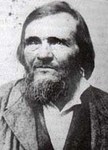
daniel parkerDaniel ParkerCharter members Daniel and Patsey Dickerson Parker, John and Phebe Parker, Sally Brown, and Julious and Rachel Christy met for the church’s first worship service in Austin’s Colony Jan. 25, 1834. Because of the threat of Mexican opposition, however, they moved northward to the Nacogdoches area, where the tiny congregation, still illegal, was further removed from notice.

The church was called the “Two-Seed-in-the-Spirit Predestinarian Regular Pilgrim Primitive Baptist Church.” It was similar to Primitive or “Hardshell” Baptists in that they did not support missionary, tract or Bible societies, Sunday schools or theological seminaries, because these are not listed specifically in the Bible. Daniel Parker also was convinced of “Two Seedism,” the doctrine asserting that, since the time of Adam, mankind has been the bearer of two seeds—divine and evil.

During the Texas Revolution and Republic, from 1836 to 1845, the congregation met secretly. After Texas became a state, Parker and Elder Garrison Greenwood authorized the establishment of several churches throughout Texas, including congregations in Nacogdoches, Sabine, Liberty and Shelby counties. On Oct. 17, 1840, at Hopewell Primitive Baptist Church near Douglas, Parker led in the organization of the Union Primitive Baptist Association, the second Baptist association organized in Texas. He died in December 1844 and was buried in the Pilgrim Primitive Baptist Church Cemetery, two-and-a-half miles southeast of Elkhart.

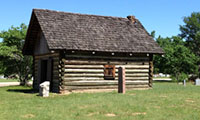
replica old pilgrim church 200Replica of the Old Pilgrim Primitive Baptist ChurchOn Feb. 19, 1848, a little more than two weeks after the Mexican-American War ended, church members voted to build a meetinghouse near the little cemetery where Parker was buried. His son, Caleb Parker, donated the land on April 17, 1852, and five years later, the church members built a one-room log cabin structure.

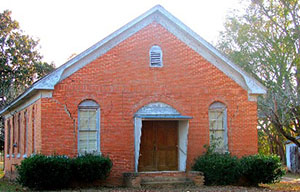
In 1890, a larger frame building replaced the log cabin and, in 1929, the congregation built a one-room brick meeting house. It still stands, along with a full-size replica of the cabin, raised in 1949, where the church once held its services. In September 1933, the Pilgrim Church celebrated its centennial.

Elkhart Pilgrim Church 300The one-room brick meeting house was built by Elkhart’s Pilgrim Baptist Church in 1929. (Photo / Dana Goolsby)Visit this church site and cemetery. Sit in the log cabin to sing an old hymn, pray or read a portion of Scripture aloud. Take a walk to note the names on the graves, the church cornerstone, the outdoor privy and the tributary below the bluff behind the church, where the new converts were baptized in Box Creek.

Directions:

South of Palestine from Elkhart, drive west on State Hwy 294.

At Farm Road 319 turn left; and at Farm Road 861 turn left again.

The church and cemetery are approximately 2.5 miles ahead.

For more information

  • Read J. M. Carroll’s A History of Texas Baptists (Dallas, Tx: Baptist Standard Publishing Company, 1923), pp. 45-50.
  • Read Harry Leon McBeth’s Texas Baptists: A Sesquicentennial History (Dallas, TX: BaptistWay Press. 1998), p. 22.
  • See the Texas State Historical Association’s Handbook of Texas site for a Daniel Parker biography  and a brief history of Pilgrim Primitive Baptist Church.
  • The Pilgrim Predestinarian Regular Baptist Church of Jesus Christ Records, 1833-1847, 1869-1897, open for research use, are held at the Dolph Briscoe Center for American History at the University of Texas at Austin.


TBM offers disaster relief in wake of record flooding along Brazos

HOUSTON—When the rain-swollen Brazos River reached a century-high level and spilled out its banks, displacing hundreds of families in communities northwest and southwest of Houston, Texas Baptist Men responded immediately with hot meals.

spencer seyb 300Spencer Seyb, a disaster relief volunteer from West Conroe Baptist Church, stirs chili in the field kitchen set up on his church’s parking lot. (Photo / Ken Camp)At the same time, they mobilized volunteers for wide-ranging cleanup efforts and other ministries to help flood-affected families and individuals.

‘A huge, huge help’

“It’s a huge, huge help to have these volunteers,” Rosenberg Police Chief Dallis Warren said, gesturing toward TBM volunteers working at a field kitchen in the parking lot at First Baptist Church in Rosenberg.

Warren, who directed the local emergency operations center, reported damage assessors confirmed more than 70 homes in Rosenberg sustained water damage, and 192 households were evacuated.

“So many people have been displaced. Some people are staying with friends or family, but many have no way to prepare meals,” he said. “It’s a huge benefit to know they can count on two hot meals each day. It really helps start the recovery process for them. It lets them know there are caring people willing to do a whole lot to help this community get back on its feet.”

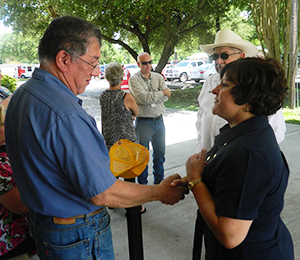
tony garcia mayor cynthia mcconathy 300Rosenberg Mayor Cynthia McConathy expresses appreciation to Tony Garcia of Bay City, TBM regional director, for the work TBM volunteers are doing in her community. (Photo / Ken Camp)Rosenberg Mayor Cynthia McConathy echoed the same sentiment, reflecting on the contribution of TBM workers and other volunteers.

“Words cannot express what this means,” she said. “It is wonderful how God moves through people and their passions, as these volunteers have the opportunity to be the hands and feet of Jesus.”

State of disaster widespread

On June 1, Gov. Greg Abbott declared a state of disaster in 31 Texas counties in response to flooding that began before Memorial Day weekend.

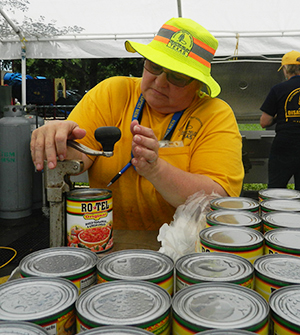
TBM disaster relief volunteers prepared about 20,000 meals in their first five days in Rosenberg and Conroe, and they expected demand to continue at a pace of 5,000-plus meals per day for the immediate future.

Responding in Rosenberg

monica mcdougall 300Monica McDougall, a volunteer from Memorial Baptist Church in Temple, works at the field kitchen set up at First Baptist Church in Rosenberg. (Photo / Ken Camp)In Rosenberg, TBM volunteers from Bell Baptist Association set up their field kitchen and other equipment—including a shower and laundry unit from Gambrell Baptist Association—at First Baptist Church.

Together with other TBM volunteers, they prepared meals the American Red Cross delivered to five shelters and to neighborhoods through Fort Bend County and the surrounding area.

John Reid, pastor of First Baptist Church, noted the flood displaced several member families in his congregation, but the degree of damage to homes varied widely.

“If they were close to the Brazos, they were affected,” he said. “When we get to the mud-out phase, we will try to do things at that point to help them.”

West Conroe Baptist Church hub of activity

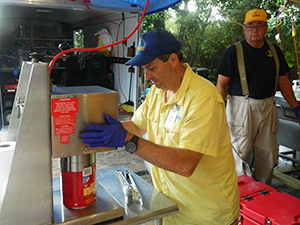
In Conroe, volunteers set up a field kitchen in the back parking lot at West Conroe Baptist Church, providing meals for up to 16 shelters. They also filled insulated containers with hot food, and American Red Cross workers in up to 12 emergency response vehicles delivered it to disaster-affected neighborhoods.

Volunteers used equipment owned by West Conroe Baptist Church’s missions department, as well as the South Texas food-service unit from Alvin, to prepare meals.

gary finley 300Gary Finley coordinates the field kitchen and emergency food-service operation at West Conroe Baptist Church. (Photo / Ken Camp)Gary Finley, a layman at West Conroe Baptist Church, put into practice skills he learned in his career as an air-traffic controller when he coordinated the extensive food-service operation. Meanwhile, inside the church facilities, members led an already-scheduled Vacation Bible School.

Mud-out crews from Nederland in Golden Triangle Baptist Association and from Harmony-Pittsburg Baptist Association in Northeast Texas were scheduled to begin work on homes, removing water-damaged drywall and flooring, power-washing walls and disinfecting surfaces.

‘Mold-busters’ at work

chaplain gerry boufford 200TBM Volunteer Chaplain Gerry Boufford talks to a homeowner in the flooded Magnolia Bend area, southeast of Conroe. (Photo /Ken Camp)Raymond and Elaine Barnard from First Baptist Church in Duncanville arrived ahead of the crews to assess needs and schedule cleanup jobs.

“In some homes, there was just a couple of inches of water that seeped up from the floor, and in some, the water was as high as five feet,” he said.

Before the mud-out crews arrived to begin the heavy work, the Barnards and other volunteers with mud-out experience tackled some lighter pressure-washing and disinfecting jobs themselves in the Magnolia Bend area, an isolated community in the woods southeast of Conroe.

raymond barnard 300Raymond Barnard from First Baptist Church in Duncanville applies disinfectant to the cedar walls of a flood-damaged home southeast of Conroe. (Photo / Ken Camp)As he strapped onto his back a plastic tank filled with disinfectant and checked the nozzle of his spray wand, Barnard quipped: “We’re not the ghostbusters. We’re the mold-busters.”

By June 10, TBM food-service and mud-out workers in Conroe expected to be joined by a mobile shower and laundry unit and a crew of volunteers who would deliver boxes to residents in flood-damaged areas, to help them collect their scattered belongings.

How to help

TBM disaster relief efforts are financed entirely by designated gifts. To give directly to TBM, click here or mail a check to Texas Baptist Men, 5351 Catron, Dallas, 75227.

In the weeks and months ahead, Texas Baptists’ disaster recovery program—a ministry of the Baptist General Convention of Texas—will begin work in the greater Houston area, focusing particularly on helping underinsured families and individuals who do not qualify for FEMA assistance because they are repeat flood survivors.

To contribute to long-term recovery efforts, mail checks to Texas Baptists’ Disaster Recovery, 7557 Rambler Rd., Suite 1100, Dallas 75231-2310 or click here


Pastors for Texas Children applauds study of school finance reform

AUSTIN— The leader of Pastors for Texas Children commended Texas State House Speaker Joe Straus for calling on lawmakers to study school finance and recommend improvements in the system before the 2017 legislative session.

“In a time when demagoguery so often masquerades as leadership, Speaker Joe Straus responsibly brings our attention back to the most pressing moral issue facing Texans today—the provision of God’s gift of quality education to all children,” said Charles Foster Johnson, executive director of Pastors for Texas Children.

Interim charge to study and recommend reform

Straus, R-San Antonio, issued an interim charge to the House Appropriations and House Public Education committees to study and recommend reforms in the public school funding system.

“We can improve educational quality while also making our school finance system more efficient,” Straus said in a June 2 public statement.

“Ignoring some of the problems in our current system will only make them worse. School finance reform never comes quickly or easily, which is why this work needs to continue sooner rather than later.”

Response to court ruling

The Texas Supreme Court recently ruled the school finance system passes the bare standard of constitutionality.

“Our Byzantine school-funding ‘system’ is undeniably imperfect, with immense room for improvement. But it satisfies minimum constitutional requirements,” Justice Don Willett wrote.

In his interim charge to the two House committees, Straus specifically called on them to study how loss of the Additional State Aid for Tax Relief program would affect school districts. The program—slated for elimination Sept. 1, 2017—provides about $350 million to the state’s public education system in the current school year.

Straus also called on the committees to study the use of local property taxes to fund public education and explore its effects on educational quality and Texas taxpayers.

‘Courage in hitting school finance head-on’

Foster applauded Straus for demonstrating “courage in hitting school finance head-on.”

“It is immoral for a state as prosperous as ours to parcel out provision for our children’s education with such parsimony,” Foster said.

“Our great state of Texas is presently in a grand state of denial. While it is common knowledge that our neighborhood and community schools are woefully underfunded, some of our leaders continue to deny it.

“They persist in a weird alternative universe of serial distraction, obsessing on one irrelevant issue after another while ignoring their sworn constitutional mandate to ‘make suitable provision for free public schools.’”


Garland: Baylor intends to ensure student safety

WACO—Baylor University’s goal is to achieve the highest standards of safety for its students, Interim President David Garland pledged in an open letter addressed to “Baylor Nation.”

“Baylor’s priority is to make our campus, and beyond, safe for our more than 16,000 students. We acknowledge our failures in the past and take responsibility for them,” Garland said, noting the university has taken steps to comply with federal and state student-safety laws. “Our aim is to set the highest standards in this area.”

david garland130David GarlandThe Baylor board of regents named Garland interim president May 26, when the board fired Kenneth Starr as president in the wake of the Waco school’s sex-abuse scandal. The same day, the board announced its intention to fire Art Briles, Baylor’s head football coach, and sanctioned Athletic Director Ian McCaw, who later resigned.

Commitment to student safety “has animated the entire course of action pursued by the board of regents during the past year,” Garland said. He noted the regents hired the Pepper Hamilton law firm “to conduct an external and comprehensive review of the university’s response of sexual and gender-based violence.”

Pepper Hamilton briefed the board and Starr in both February and May, he said. The board took action on Starr, Briles and McCaw about two weeks after the May presentation.

Despite widespread calls for Baylor to release the “full report” from Pepper Hamilton, Garland said that would not happen. (The Baptist Standard has joined in that call. Click here, here and here to read those requests.)

“Pepper Hamilton’s report was delivered in the form of an oral presentation that fully and comprehensively presented the individual and aggregated findings and the evidence supporting the findings,” he said. “The ‘Findings of Fact’ and recommendations, which were released publicly in a format that protected the privacy of individuals, fully reflect the facts and core failings identified in the investigation. The findings revealed clear opportunities for Baylor to improve.” He invited readers to click on links and see the “Findings of Fact” and Pepper Hamilton recommendations.

Pepper Hamilton’s investigators were free to seek, follow and determine facts without interference by either Baylor’s administration or board, Garland stressed.

“Pepper Hamilton’s report was impartial and objective, and they did not hold back in their assessment,” he said. “They had access to all requested documents and any Baylor employee they requested to interview. They independently reached out to and heard from brave survivors who assisted the investigation by sharing their experiences.

“We respect survivors’ freedom to choose whether, when and how to share their experiences and will support survivors who choose to share their experiences publicly. The details of these individuals’ experiences will not be discussed publicly by the university. We hurt for these students and deeply appreciate their willingness to speak with Pepper Hamilton as part of this review. Their insights and participation will help us better address these issues in the future.”

Baylor regents and administrators “have been as forthright as is possible and are fully committed to presenting the truth of these findings to Baylor Nation and the world,” he said. “We are also committed to reconciliation with those who have been harmed.”

Garland commended the regents for addressing the Pepper Hamilton findings and for investing in the university’s Title IX compliance office. Title IX is the federal law designed to provide protection from sexual discrimination in education.

That investment “demonstrates their unwavering dedication to do what is right for our students, both today and in the future,” Garland said. He described Baylor’s Title IX office as “capable, compassionate, professional and working hard to care for the needs of students.”

Baylor is working to implement the Pepper Hamilton recommendations, he said, noting, “All possible resources are being deployed to foster a culture on campus that is characterized by dignity, integrity and respect for others, including the awareness and prevention of sexual assault.”

Two executive-level task forces will follow up the Pepper Hamilton report, Garland said.

Reagan Ramsower, senior vice president and chief financial officer, will lead implementation groups composed of faculty, staff and administrators to “build on significant improvements made in recent years by acting promptly to address Pepper Hamilton’s recommendations,” he said.

Greg Jones, executive vice president and provost, will lead a group to “focus on spiritual life and the cultivation of character across the university.”

“When I first served as interim president of Baylor, from 2008 to 2010, one goal served as my guidepost for each day’s decisions—to strengthen Baylor’s mission of educating men and women for worldwide leadership and service by integrating academic excellence and Christian commitment within a caring community,” Garland said. “This remains my goal.”


Coalition suggests ways churches can fight hunger

DALLAS—If economics is the “science of scarcity,” consider Joe Clifford—a pastor with an undergraduate degree in economics from Auburn University and a background in banking—a science-denier.

hunger coalition 350“God’s economy does not operate on the myth of scarcity but on the truth of abundance,” Clifford, pastor of First Presbyterian Church in Dallas, told an event sponsored by Dallas Baptist Association, the Texas Hunger Initiative and other partners in the Dallas Coalition for Hunger Solutions. 

Hunger exists not due to a scarce food supply but because a flawed distribution system denies poor people access to what they need, he asserted. People of faith have a responsibility to meet the needs of the poor and hungry, he insisted.

“You can’t read the Bible without running into stories about food,” he said, citing examples ranging from God providing the Israelites manna after their exodus from Egypt to Jesus feeding the 5,000. “Feeding hungry people, according to Scripture, has always been important to God and, therefore, important to God’s people.”

In the last four decades, The Stewpot, a ministry of First Presbyterian Church in downtown Dallas, has provided 5 million meals to homeless and needy people. (http://thestewpot.org/) Thanks to the 1,500 volunteers a month who participate, meal costs have averaged just $1.75 each, Clifford said.

Four strategies to fight hunger

FBC Plano garden 300Members work in a community garden at First Baptist Church in Plano. (File Photo)The faith community action team of the Dallas Coalition for Hunger Solutions, co-chaired by Jana Jackson of Dallas Baptist Association, presented strategies congregations can implement to fight hunger. 

Two years ago, the team introduced six strategies to engage churches and other faith groups in addressing the problem of hunger.

At the June 2 event, the Dallas Coalition for Hunger Solutions focused on four new strategies:

  • Community Gardens provide fresh vegetables for families in urban areas and supply produce for food pantries. Congregations are encouraged to turn nonproductive plots of land into community gardens, developed in partnership with the individuals who benefit from what is grown.
  • Congregate Meals offer balanced, nutritious meals for older adults at a senior center. The social setting allows the senior adults interaction with peers, and meal sites also may provide nutrition education classes. Churches can provide volunteers for the senior centers or sponsor a congregate meal site.
  • Nourishing Neighbors is a volunteer-driven program of the North Texas Food Bank that delivers groceries to homebound senior adults and mature adults with disabilities. Participants receive at least 10 pounds of nutritious, easy-to-prepare food, including fresh fruit and vegetables, every other week. Churches can recruit volunteers to deliver groceries or interview applicants for enrollment, and they can become a distribution hub to serve seniors in locations across the 13 counties the North Texas Food Bank serves.
  • Nutrition Education through the Texas A&M AgriLife Extension Service incorporates research-based, practical lessons in basic nutrition, food preparation, food budget management and food safety in settings convenient for participants. The Expanded Food and Nutrition Education Program helps families with children, and Better Living for Texans is designed for adults on public assistance programs. Churches can schedule the programs for their members or serve as host sites for programs in their communities. 

Six proven strategies already implemented

Jackson reported the faith community action team engaged congregations in developing 93 programs in the last two years based on the six strategies previously introduced by the Dallas Coalition for Hunger Solutions:

  • The Summer Meals Program of the U.S. Department of Agriculture provides summertime nutrition for children and teenagers who receive free or reduced-price meals during the school year. Churches can serve as meal sites or can provide volunteers to staff a site in their community, and they can provide enrichment activities for students before or after meals. 
  • The Community Partner Program enlists congregations to help people use online resources to apply for and manage public benefits. 
  • Cooking Matters is a six-week program that teaches participants how to be smart grocery shoppers, make healthier nutritional choices and cook affordable meals. Churches can offer classes and involve members as teachers.
  • Meals on Wheels delivers nutritious, freshly prepared meals to people who cannot provide for themselves due to advanced age, illness or disability. Congregations can enlist and coordinate volunteers to deliver meals.
  • The Family Garden Initiative helps churches and other groups teach their neighbors—particularly in urban areas—how to grow nutritious food in small gardens in backyards or apartment patios.
  • Community Distribution Partners uses a “hub-and-spokes” distribution model to increase the efficiency of food distribution in areas of greatest need. Crossroads Community Services, the urban outreach ministry of First United Methodist Church in Dallas, serves as the hub, obtaining food in bulk from the North Texas Food Bank. Other churches, food pantries and community ministries serve as the spokes of the wheel, distributing groceries to clients in their neighborhoods. 


Baylor Line Foundation urges release of investigative report

WACO—The executive committee of The Baylor Line Foundation—formerly the Baylor Alumni Association—urged Baylor University’s board of regents to release the full report by the law firm that investigated the university’s response to reports of sexual violence.

Regents hired Pepper Hamilton, a Philadelphia firm, to conduct an internal investigation into how Baylor handled reports of sexual assault, including multiple incidents involving Baylor athletes.

‘An unvarnished, complete accounting of the facts’

“The Baylor Family deserves an unvarnished, complete accounting of the facts about how these events were handled,” the committee said in a public statement posted online. 

Two weeks after regents received a “comprehensive briefing” from Pepper Hamilton, the board on May 26 announced plans to demote President Ken Starr, fire Head Football Coach Art Briles and sanction Athletic Director Ian McCaw, who resigned a few days later. 

‘Findings of Fact’ falls short

They also issued a 13-page document, “Findings of Fact.” But the Baylor Line Foundation’s executive committee noted the document “is not a summary of specific facts. It is a list of conclusions reached by the board of regents.”

“The board of regents is to be commended for acknowledging that the institution bears responsibility for a gut-wrenching series of failings,” the foundation’s committee stated. “But without a detailed explanation of the facts, the board’s release falls far short of the level of transparency that the Baylor Family—and the people directly affected—deserve.”

Legal issues acknowledged

The executive committee acknowledged the legal issues involved in publishing the report.

“Privacy laws and promises of anonymity made to victim witnesses must be honored. But Baylor has hired sophisticated and experienced lawyers,” the group said. “They are capable of issuing a report that conceals certain students’ and victims’ identities consistent with the law, while laying bare the detailed factual findings and the bases of Pepper Hamilton’s recommendations. The Baylor board of regents should immediately release whatever information can legally be shared.”

While several high-profile Baylor employees either were fired or resigned under pressure—and the university stated others have been dismissed, but the university will not reveal their identities—no regent has resigned or been removed “that we know of,” the foundation’s executive committee stated.

“Releasing a detailed factual report is important to assure the Baylor Family that the right people have been held accountable and that those in power are not using misguided notions of confidentiality to shield their own actions,” the committee said. “Full disclosure is also essential to protect the reputations of those blameless Baylor employees who may wish to depart for other opportunities without a cloud of suspicion over their heads.”

What does the report say about the regents?

The foundation’s executive committee noted Pepper Hamilton made several recommendations regarding the board of regents’ structure and behavior, but nothing in the 13-page document deals with those issues.

They include recommendations to resolve governance issues at executive council and board levels; evaluate and make recommendations regarding board size and composition; review considerations and standards for new board membership, including actual or perceived conflicts of interest, and implement due diligence standards in the selection of board members; and train and educate coaches about the need to remain within appropriate reporting protocols and lines of communication when addressing members of the board of regents.

“The board of regents should release the detailed evidence that caused Pepper Hamilton to recommend these changes at the top level of governance at Baylor,” the executive committee said.

“Baylor alumni deserve what Baylor promised when Pepper Hamilton was hired—an independent, frank and candid investigative report that addresses both past practices and forward-looking recommendations. Baylor must ensure everyone understands the totality of what occurred and the steps taken to make sure it never happens again.”

Pepper Hamilton attorney responds for university

When asked to respond to the request for release of the full investigative report report, Baylor University’s communications office released a statement from Gina Maisto Smith, a partner in the Pepper Hamilton firm.

“The experiences of students impacted by this played a significant role in this investigation and to the university’s response. While those experiences of the students informed the findings, the details of individual cases are not going to be shared and will not be referenced in any document,” Smith said.

“But the overview of the findings that have been released by the board gives the gravamen and the salient findings that we presented in the thorough, comprehensive briefing that the board received over the month of May.”

Baylor Line Foundation formed when lawsuit settled

The Baylor Line Foundation was formed as part of a legal settlement between the Baylor Alumni Association and the university. 

Under terms of the settlement, the alumni association agreed to remain an independent nonprofit entity and change its name. The renamed entity was granted authority to continue to publish the Baylor Line with editorial and operational independence.

Also as part of the settlement, the regents agreed to add three alumni-selected representatives to the university’s governing board. The first three are Don Chapman of Dallas, Wayne Fisher of Houston and Julie Hermansen Turner of Dallas.

Editor’s Note: The Baptist Standard contacted Baylor University to request comment. The university’s communications office responded several hours after the article originally was posted, and that response is included in the 4th, 5th and 6th paragraphs from the end of the article.


Lynn Craft, longtime Baptist Foundation of Texas president, dies

Lynn Craft, who led the Baptist Foundation of Texas—now HighGround Advisors—more than three and a half decades, died May 31. He was 73.  A Dallas native, Craft graduated from W.W. Samuel High School in 1960, received his undergraduate degree in accounting from Baylor University in 1965, and his master of business administration degree in banking and finance from Southern Methodist University in 1970.

He also received honorary doctorates from Hardin-Simmons University, East Texas Baptist University and Dallas Baptist University.

Craft grew up attending First Baptist Church in Dallas and later was a member at Park Cities Baptist Church and most recently First Baptist Church in Athens.

He served each of those congregations as a Sunday school teacher and deacon.

Craft Pinson 300As longtime president and CEO of the Baptist Foundation of Texas, Lynn Craft worked closely with BGCT Executive Director Bill Pinson and other agency executives.Two mentors from his youth at First Baptist in Dallas, James Cantrell and Martin Lovvorn, inspired and encouraged him to attend Baylor on a scholarship privately funded by Cantrell, president of the Baptist Foundation of Texas. Friends and family agreed he spent the rest of his life sharing that same kindness and generosity with others.

Craft served in the U.S. Coast Guard after graduating from Baylor. During this time, he and Becky Roberts married and began to build their family.

He started his career as an accountant and later was persuaded by Cantrell to join the Baptist Foundation of Texas, where he worked 44 years, including 37 years as president and chief executive officer.

“Lynn Craft ably served Texas Baptist institutions through his 44 years of work at Baptist Foundation of Texas,” noted Craft’s successor, Jeff Smith, president of HighGround Advisors. “His leadership undergirded the financial stability and viability of our Baptist institutions as he sought to bring sound business practices to the management of endowment and split-interest dollars.

“He was the consumate deal maker, especially deals involving real estate, always striving to accomplish the goal. He left his mark on the institution and those we served.”

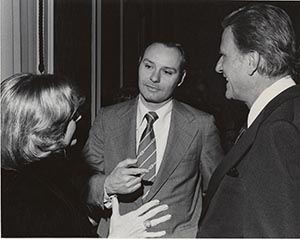
Craft Billy Graham 300Lynn Craft with evangelist Billy Graham. Craft ranks among the longest-tenured Texas Baptist agency heads in history, second only to R.C. Buckner, who served 40 years as founding president of what is now Buckner International. During Craft’s time as president and CEO, the foundation’s assets under management grew from $123 million to $1.5 billion. 

Through the years, Craft earned a reputation among Baptist agency executives as a trusted confidante and adviser, whether they had questions about making a real estate deal or accepting a donated piece of property.

Craft A Webb Roberts 300Lynn Craft enjoyed working with Baptist business leaders and donor such as A.Webb Roberts.He received numerous honors and accolades throughout his years as a Baptist leader and respected businessman. He served on the board of directors for numerous banks, funds, corporations and foundations, giving of his time and wisdom, immensely enjoying those positions and his relationships with his colleagues.

When not “doing a deal,” Craft enjoyed traveling with his wife of 50 years, fishing, spending time on Cedar Creek Lake or—most important to him—visiting his children and grandchildren.

Craft is survived by his wife, Becky; children, Cara Marriott and Hunter Craft; grandchildren, Hank, Drew and Claire Marriott and Carson and Campbell Craft; and siblings, James and Carol Craft. He was preceded in death by his parents, Herbert and Evelyn Craft, and his brother, Charles Craft.

A celebration of his life will be held at 2 p.m., June 4, at First Baptist Church in Dallas, with a reception following. In lieu of flowers, the family requests donations to the Visiting Nurses Association of Texas.


Major shake-up at Baylor University

WACO—In a week of fast-moving events and sweeping change, Baylor University lost a president and chancellor, a head football coach and an athletic director, gained an interim president and an acting football coach, and found itself in an unwanted national spotlight.

Starr, Briles and McCaw out

Citing a “fundamental failure” to handle sexual violence complaints appropriately, Baylor’s board of regents announced plans May 26 to remove Ken Starr from his role as president effective May 31 and fire Head Football Coach Art Briles. They also sanctioned Athletic Director Ian McCaw, who resigned a few days later.

Starr 130Ken StarrRegents initially reported Starr agreed in principle to continue as the university’s chancellor, but he told ESPN he stepped down from that role June 1 “as a matter of conscience.” Starr will remain as the Louise L. Morrison Chair of Constitutional Law at Baylor Law School. 

david garland130David GarlandDavid Garland, former dean of Truett Theological Seminary, assumed responsibility as the university’s interim president June 1. He served earlier an interim president from August 2008 to May 2010, and the university also tapped him as interim provost in 2014-15.

Briles was “suspended indefinitely with intent to terminate according to contractual procedures,” and McCaw was sanctioned and placed on probation. Other members of the administration and athletics department, whom Baylor did not identify, also were dismissed. On Memorial Day, Baylor announced McCaw resigned as vice president and director of athletics.

Before he left Baylor, McCaw helped enlist Jim Grobe—former coach at Wake Forest University, a private school in Winston-Salem, N.C., with Baptist roots—as acting head football coach. Grobe, the 2006 Associated Press National Coach of the Year, served from 2006 to 2013 as chair of the ethics committee for the American Football Coaches Association, headquartered in Waco.

Regents briefed on investigation by Pepper Hamilton law firm

Regents announced the major personnel changes two weeks after they received a “comprehensive briefing” from Pepper Hamilton, the Philadelphia law firm regents retained last September to investigate Baylor’s response to reports of sexual violence. 

The university’s governing board announced the investigation revealed a fundamental failure by Baylor to implement Title IX of the Education Amendments of 1972 and the Violence Against Women Reauthorization Act of 2013.

“We were horrified by the extent of these acts of sexual violence on our campus,” said Richard Willis, chair of Baylor’s board of regents. “This investigation revealed the university’s mishandling of reports in what should have been a supportive, responsive and caring environment for students.

“The depth to which these acts occurred shocked and outraged us. Our students and their families deserve more, and we have committed our full attention to improving our processes, establishing accountability and ensuring appropriate actions are taken to support former, current and future students.”

Key findings include:

  • Baylor’s student conduct processes were “wholly inadequate to consistently provide a prompt and equitable response” under Title IX, the university “failed to consistently support complainants through the provision of interim measures,” and, in some cases, “failed to take action to identify and eliminate a potential hostile environment, prevent its recurrence or address its effects.”
  • Actions by university administrators “directly discouraged some complainants from reporting or participating in student conduct processes and, in one instance, constituted retaliation against a complainant for reporting sexual assault.”
  • Within the football program and athletics department leadership, the investigation pointed to “a failure to identify and respond to a pattern of sexual violence by a football player and to a report of dating violence.” The report also cited concerns about “the tone and culture within Baylor’s football program as it relates to accountability for all forms of student athlete misconduct.” 
  • Investigating Baylor’s response to reports of a sexual assault involving multiple football players, Pepper Hamilton found the football program and athletics department leaders failed to take appropriate action.

Apologies from regents

Baylor agreed to self-report to the NCAA, and regents created the full-time position of chief compliance officer, who will report directly to the president’s office.

“We, as the governing board of this university, offer our apologies to the many who sought help from the university. We are deeply sorry for the harm that survivors have endured,” said Ron Murff, chair-elect of the Baylor board of regents.

“Baylor’s mission to educate men and women for worldwide leadership and service by integrating academic excellence and Christian commitment within a caring community remains our primary imperative. The board has taken decisive action to ensure the university’s priorities are aligned with our unyielding commitment to that mission.”

Mixed response from media

The regents’ response drew mixed reviews.

David Randolph, writing for Forbes, noted he was pleasantly surprised Baylor “held itself accountable, admitted fault and took strong action by firing the person who most allowed this culture (of ignoring sexual violence) to fester—and that falls squarely on the thankfully now-former head football coach.”

The Waco Tribune-Herald commended the regents who “stepped up and assumed their responsibilities in a gravely decisive way.” 

However, the newspaper called on the board to greater transparency by releasing the entire Pepper Hamilton report, with the names of students redacted. 

John Kelso, columnist for the Austin-American Statesman, rhetorically asked, “Has anybody seen Baylor University’s moral compass?” 

Susan Shaw, professor at Oregon State University, wrote a blog for the Huffington Post asking, “Why wouldn’t a Christian university take sexual assault seriously?”

Incidents of reported sexual assaults

The regents hired the Pepper Hamilton law firm to conduct an independent external investigation soon after Sam Ukwuachu, a former Baylor Bears football player, was convicted and received a 180-day jail sentence and 10 years’ probation for sexual assault. 

The assault, reported by a then-18-year-old soccer player, occurred in October 2013—about five months after Ukwuachu transferred to Baylor from Boise State, where he was dropped from the football team after an earlier act of violence involving a female student.

Two years ago, defensive end Tevin Elliot was convicted of sexual assault and sentenced to the maximum of 20 years in prison. In February, ESPN televised an “Outside the Lines” report in which five women asserted Elliott sexually assaulted them between October 2009 and April 2012. The “Outside the Lines” report asserted Baylor officials failed to investigate adequately the allegations of sexual violence. 

In March, a former Baylor student who reported Elliott raped her filed a lawsuit asserting multiple Title IX violations and negligence.  The suit, filed in U.S. District Court, names Baylor’s board of regents, Briles and McCaw as defendants. 

Reports of sexual violence at Baylor extended beyond the athletic department. In February, a former student who grew up in New Guinea as the child of missionary parents, posted a blog, “I Was Raped at Baylor and This is My Story.” She asserted Baylor violated her trust because the university seemed to care more about its image than protecting its students. 

In March, the president of Phi Delta Theta fraternity at Baylor was arrested on a sexual assault charge for an incident that allegedly occurred outside a fraternity party. 

Read the Baptist Standard’s extended recent coverage:

Baylor AD resigns; acting football coach hired

Editorial: Baylor places values ahead of victories

Baylor University demotes president and fires football coach

Editorial: Baylor’s ideals must top gridiron glory

Starr still Baylor president—for now

BGCT executive director urges prayer for Baylor in wake of sexual violence

Baylor regents receive briefing from Pepper Hamilton on sexual violence report


Buckner Family Pathways graduate aims high

CONROE—Angel Hardy knew living in a travel trailer parked in the backyard of her friend’s house was no way to live—for her or her son.

The shower never worked. The toilet never worked. Eventually, the water in the kitchen stopped working.

But life had become so bleak, she felt she had no other choice.

Hardy was laid off in 2010, unsure what to do next. She knew she needed to get out of the trailer.

A friend asked if she ever thought about going back to school. As soon as she heard the question, Hardy knew in her heart what she would study—social services.

She enrolled in Lone Star College. After two and a half years living in the tiny, broken trailer, Hardy and her son moved into an apartment in Conroe.

Soon, her student loans ran out, and she couldn’t pay her rent. After falling behind several months, her landlord asked Hardy if she knew about Buckner.

“I knew about Buckner, but I thought it was for victims of domestic violence,” she said. “I didn’t realize it was for single parents to go to school.”

Hardy applied to the Family Pathways program and was accepted. She finished her associate degree at Lone Star and then went on to Sam Houston State University in Huntsville for a bachelor’s degree in human services with a special emphasis on victims studies.

“I don’t know where I’d be today without Buckner, that’s for sure,” Hardy said. “I hope to work with Child Protective Services and foster children aging out. … My ultimate goal is to open … an equine therapy ranch.”

When Hardy graduated recently from Sam Houston State, her five children, brother and grandson were in the audience cheering her on. Her next step is going to graduate school to learn the management side of nonprofits.

“Angel was my very first client I was able to watch from the beginning to the end,” said Kymeicko Williams, Family Pathways case manager in Conroe. “Angel has always strived very hard for greatness, and it shows. She’s so thankful for everything Buckner has done for her. It was so wonderful to see her walk across the stage. I was just as proud of her as her family and friends.

Buckner’s help “has meant everything,” Hardy said. “I believe it was all done by God. He put it all in place, in motion.”