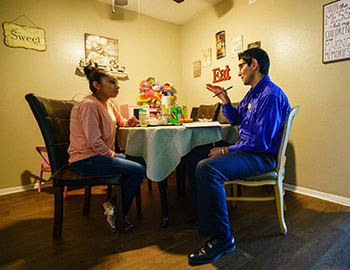
Dallas foster family cares for children with therapeutic needs

DALLAS—Children mostly likely to get stuck in the foster care system without placement in a family are those who need a home where they can receive therapeutic care—children with significant physical, medical, psychological or behavioral challenges, often due to trauma.

To care for these children, foster families must go through additional training and certification. While the extra training may seem daunting at first, the Biles family of Dallas found caring for children with more complex needs has brought them more joy in serving and helping to rehabilitate those children than any other earthly endeavor.

A heart for ‘kids in crisis’

Felicia Biles and her husband, Phillip, have fostered the past 11 years while raising their two birth children, Lydia, 16, and Corban, 15. They choose to care for children classified as having therapeutic needs.

The Biles became certified for foster care when Corban turned 2, and after a few years, they started caring for children with more significant emotional and behavioral needs.

 “Our heart is really more for the kid in crisis who needs some help, some stability in their lives,” Philip Biles said. “So, our call really has been foster only, just coming alongside parents. No matter how poor some of the choices the moms or dads make, the kids still love their biological parents. They still want that connection and relationship.

“So, over the years, we’ve really been pursuing that type of stability of a family. ‘OK, Mom or Dad, you get your life together, as long as it takes. We want you to have your child back. We want them to go home.’”

Although it’s not always easy, Biles said, they take the good with the bad.

“Your life isn’t over just because you decide to do foster care,” he said. “You can still live your life and accomplish your goals and dreams.”

Support from Buckner appreciated

The couple said they have felt the most supported with Buckner Foster Care and Adoption through prayer, continuing education and training, and making their biological children feel included.

“We love that Buckner has that passion for families,” Biles said. “Not just the families where kids are coming from but current foster families, current adoptive families. They really are very supportive and caring for this family unit.”

Even their now-teenaged children have played a part in bringing awareness to foster care and trying to de-stigmatize it.

Biles 300Lydia and Corban Biles enjoy having foster brothers and sisters come live with them. (Photo / Chelsea Q. White / Buckner)Lydia and Corban love having new brothers and sisters come live with them and have a lot of compassion for children in crisis in general, not just children in foster care. They also have opportunities to tell other students at school about foster care.

“For us, (foster care) is normal,” Corban said. “It’s not like we went half our lives and then started doing foster care. It’s something we’ve been doing our whole lives.”

The Biles feel equipped to help children who are in serious crisis situations. A child’s story might look bad on paper, they said, but they’ve been pleasantly surprised how much they really can help children and their families make positive changes in their lives.

Families reunited

“It’s definitely neat to see a child be reunited with the biological family, but I think one of the joys that we get is seeing the moms or the families realize, wow, they were on our side, and they’ve been able to help me get my kids back,” Philip Biles said.

“Our satisfaction comes from the design of the family, not just the child, just that whole family unit. Every family goes through crisis and every family has difficult moments. But just knowing that God put that family together is something we’ve been able to play a small role in at times.”

Becoming licensed to take in children who have significant emotional, physical and medical needs certainly is not for everyone, he said.

“But Buckner is all about helping to provide resources and tools,” he added. “They do a great job with respite care and connecting foster families in your area together. As you’re driving through this, you really feel like they’re with you the whole way. Sometimes they’re just there, observing, and other times, they’re helping you figure out which way to turn.”

To learn more about therapeutic foster care, click here


Texoma Cowboy Church spurred to build soccer fields in Honduras

OLANCHITO, Honduras—People in Olanchito, Honduras, know members of Texoma Cowboy Church as the “Christian Cowboys.” They also know them as people who cared enough to build soccer fields for their community.

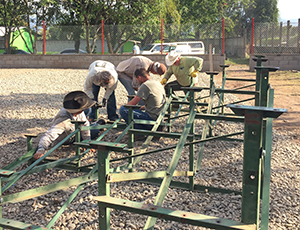
Honduras Texoma JL 350A mission team from Texoma Cowboy Church in Wichita Falls installs artificial turf for a community soccer field in Olanchito, Honduras. (Photos / Courtesy of Jay Lawson)The first two mission trips volunteers from Texoma Cowboy Church in Wichita Falls made to Olanchito focused on evangelism and building relationships with the people of the community.

The group’s most recent trip grew out of a soccer game mission trip coordinator Jay Lawson observed during a journey to Honduras three years ago.

“We were looking through the chain link fence in the school yard,” said Lawson, a member of the Baptist General Convention of Texas Executive Board. “We noticed even though it was kindergarten soccer, it was big league. The kids played their hearts out, but they were playing in mud.

“That’s when I said to myself, ‘What kind of connection could we make to the community if we built a soccer field?’”

Install turf, assemble bleachers

Texoma Cowboy Church made plans for the installation of artificial turf for a soccer field. With connections in the church and help from several companies, the church secured donated bleachers and artificial turf for the soccer field.

The labor-intensive trip to install the turf and bleachers involved 11 church members, including Lawson and Pastor John Riggs. Before departing for Honduras, all team members were trained in how to install an artificial grass field.

IHonduras Soccer Field 250Members of Texoma Cowboy Church install artificial turf for soccer fields in Honduras. n Honduras, the team primarily focused on constructing the field, while continuing to build relationships with the people of the community.

“There were many local volunteers that helped us with the field, and they asked for nothing in return,” Lawson said. “In the process, our team got to know them and build relationships while sharing with them who our God is.”

A pair of churches in Olanchito invited the missions team to lead Bible studies two evenings.

“They welcomed us and invited us to be a part of everything they had going on,” Lawson said. “All of the people were beautiful, friendly and treated us well.”

Work garners national attention in Honduras

The team’s work received national attention in Honduras. The mayor of Olanchito, along with members of the community, held a formal dedication service for the new soccer field that received national television coverage.

Honduras Bleachers 300Members of a mission team from Texoma Cowboy Church assemble bleachers for a community soccer field in Honduras. On the chain link fence surrounding the soccer field, the volunteers posted John 3:16, translated into Spanish.

“Everyone couldn’t thank Jesus enough—principals, teachers, families, everyone,” Lawson said.

This trip made an impact on each member of the team, Riggs noted.

“I saw God working through the smiles of the kids. I saw the amazement, almost to the point of disbelief, on the faces of the adults in the community that what was happening was really taking place; it wasn’t just a dream,” he said. “In the atmosphere, you could feel the warmth and presence of the Holy Spirit everywhere we went.”

Texoma Cowboy Church already is planning a fourth mission trip to Olanchito. They will partner with Texas Baptist Men to build a water well for a nearby agricultural school, while focusing on starting cowboy churches.

‘Find a connection’

Reflecting on his church’s experience in Honduras, Riggs learned principles that could be applied to other churches interested in planting new congregations.

“Missions is critical in the life of any church or believer. For those who take the opportunity to share the gospel in a place where it’s not preached, you get to see God’s power, might and work in ways we don’t see often here in our own country,” Riggs said. “I would encourage everyone to engage in missions, not only overseas but here at home. A church that stops being mission-minded is a church that starts to die. We have to constantly be reaching out.”

Lawson agreed.

“It’s simple,” he said. “Pick out somewhere in the world that doesn’t have cowboy church and teach them how to start one, what it’s all about and the reason why we do it. Try to find a connection in the country you desire to go to. Also, talk to Texas Baptists. They have the way, the means and the connections to plant churches.

“Don’t get in God’s way once you’ve decided to do your project. Plan on God taking care of it. Just go.”


Mustoe still committed to community ministry after five decades

AUSTIN—Pat Mustoe ministers to clients at the Baptist Community Center Mission with the same passion that brought her to Austin more than 50 years ago.

When Mustoe went to college, she had no greater desire than to be a big-time basketball coach. She began shooting for something a little different when someone knocked on the door of her Virginia dorm room to invite her to the Baptist Student Union.

Life-changing missions experience

She instantly became immersed in the organization, and she was introduced to Texas when she was assigned to Austin as a BSU summer missionary.

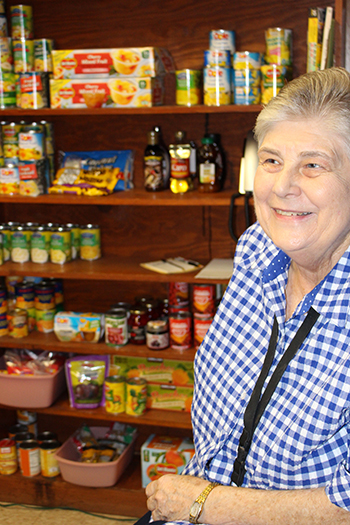
mustoe pantry 350Pat Mustoe has served more than five decades at Austin’s Baptist Community Center Mission. (Photo / George Henson)She worked in Austin 10 weeks during the summer of 1965, including two weeks at the Baptist Community Center Mission

“I just loved the kids,” she recalled. One of her other assignments that summer was at nearby Baptist Temple Church, where she encountered many of the same children.

While she loved the children, the leadership at the community center was in turmoil, and she recalls telling her partner as they walked away the last time, “Alice, you couldn’t pay me to work here.”

But the experience in Austin changed her life.

“It was a wonderful summer. Everything we touched seemed to work well,” she said, noting she still remembers the lessons she learned.

“You had to totally depend on God. You learned as you went, but God won’t ask you to do anything he won’t give you the skills to do. When you have to rely on God to do the things he has called you to do, it is very rewarding. So, the summer was tremendous.”

God opens doors for service

At a student event at Glorieta Baptist Conference Center shortly thereafter, she told God even if his plans for her did not involve coaching basketball, she would be surrender to his will for her life. She also began to grow homesick for her summer home—Austin.

The job offers she received when she approached graduation just didn’t seem right. Then she received a letter from Austin, asking if she would consider becoming the director of the Austin Community Center Mission.

“That was the answer I had been praying for,” she said. “I had been praying for God’s will and that he would show me what he wanted my to do. I knew it was it.”

She interviewed during her spring break and even though she wouldn’t graduate until August, the leaders of the community mission center waited for her. She became director of the ministry Sept. 1, 1966.

When she arrived, the center needed repair, and it had been broken into repeatedly.

‘I wanted to make a difference’

Even so, the certainty of God’s calling to help those who need a bit of help resonated with a young woman whose own childhood had not been easy.

“I wanted to make a difference in the lives of some kids,” she said. “A lot of Baptist people were there for me in my life and led me in the right direction. I felt like this was a place where I could make a difference.

“It’s been a exciting journey, and God has always been in it. Some months get a little tough, but the next month is good, usually.”

More than 1,000 families a year receive food

The ministry is funded primarily through the donations of Austin-area churches and two trust funds from the wills of Baptist women. Baptists around the state also contribute to its ministries through their gifts to the Texas Baptist Hunger Offering

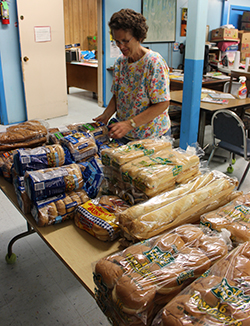
Volunteer SharonJohnson WoodlawnBC 250Sharon Johnson, a volunteer from Woodlawn Baptist Church in Austin, serves at the Baptist Community Center Mission. (Photo / George Henson)People visit the community mission center for a variety of reasons. Some just drop by to pick up donated bread and pastries. Others need a little more help and go through an interview process to receive groceries monthly.

The food ministry is the center’s largest ministry and touches not only people throughout Austin, but also the surrounding communities such as Kyle, Bastrop, Buda, Round Rock and Georgetown.

“I don’t just give people beans and rice. I try to give them a good food order,” Mustoe said. “We give them cereal, meat, vegetables, fruit, flour and sugar so they can really make a meal.”

More than 1,000 families receive help from the ministry each year.

The center also assists people in paying for their rent, utilities and medications or in securing birth certificates.

“We don’t have a huge budget to work with, but we do help,” Mustoe said.

Teaching life skills, sharing the gospel

Part of the ministry involves teaching clients ways to stretch available resources. 

For example, if the electric bill is high, they are counseled to find a reasonable setting for the thermostat and reminded of the need to change air-conditioning filters. The center also helps people develop a system of rationing out their food vouchers so they do not run out of groceries early in the month.

While most of the people who come to the center profess to be Christians, the staff is diligent in sharing Christ with everyone the ministry helps.

“We have Bibles to share, we have tracts to share, and we pray with people,” Mustoe said.

The ministry also has adult sewing, cooking and other educational classes, as well as a preschool ministry.

“A lot of people who live around here cannot afford the high prices of other daycare facilities, so this is a great blessing to them,” Mustoe said. “At the same time, we get to tell children Bible stories and teach them how to pray.”

For older children, the center has an after-school ministry and daily events during the summer.

The mission also sponsors seasonal events, such as Vacation Bible School and a Thanksgiving dinner that serves more than 800 people annually.

Even after half a century, Mustoe still has a passion for the ministry.

“I love these people, and I love to see the changes that result in their lives,” she said. “When you see people become Christians, join a church and change—really change—that’s encouraging to me. Seeing them provide a stable home for their children—it doesn’t happen every day, but it happens enough to keep me going.

“I love to see people change and walking with God.”

This is part of an ongoing series about how Christians respond to hunger and poverty. Substantive coverage of significant issues facing Texas Baptists is made possible in part by a grant from the Prichard Family Foundation.


Livingstone feels God called her to Baylor presidency

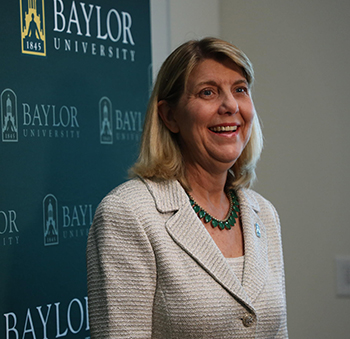
WACO—Linda Livingstone accepted the post as Baylor University’s president when the school faced multiple investigations regarding its handling of sexual abuse complaints for one simple reason: She felt God called her to the position.

‘Help make a difference’

“I viewed it as an opportunity to go back to a place that I love and really try to help make a difference,” said Livingstone, who taught at Baylor 11 years in the Hankamer School of Business.

Livingstone 200Linda Livingstone“I knew that they were deeply committed to learning from what had happened, to making changes and moving forward. I knew a lot of the people here. I knew where their hearts were and that it would just be a tremendous opportunity to work with people to move the university forward to a really good place.”

Baylor’s board of regents hired the Pepper Hamilton law firm to investigate the university’s handling of sexual assault reports. After a briefing by Pepper Hamilton, the board announced the investigation revealed a “fundamental failure” by Baylor to implement Title IX of the Education Amendments of 1972 and the Violence Against Women Reauthorization Act of 2013.

The board removed Ken Starr as president, fired Head Football Coach Art Briles and sanctioned Athletic Director Ian McCaw. Starr later stepped down as chancellor and law professor, and McCaw resigned as athletic director.

Livingstone accepted the Baylor presidency at a time when the school remains under a one-year warning from the Southern Association of Colleges and Schools Commission on Colleges.

Baylor also is under investigation by the U.S. Department of Education’s Office of Civil Rights and by the Big 12 Conference. Several women also have named the school in lawsuits, asserting Baylor failed to protect their safety or deal properly with their sexual assault claims.

‘Absolutely felt called to be here’

Moving from George Washington University in Washington, D.C., where she was dean of the business school, to Baylor in Waco represented a big decision for Livingstone and her family, and she said they sought God’s guidance.

“There was a lot of prayer and reflection that went into the decision to come back to Baylor,” she said. “I absolutely felt called to be here at this point in time.”

She believes her experiences as dean of the business school at Pepperdine University in California and at George Washington University uniquely prepared her for the Baylor presidency.

“God was preparing me through those experiences, through the opportunities and challenges I had at those two institutions, to be ready to come back to Baylor at this particular point in time,” she said. “So I personally, and my family more generally, really feel God called us back to Baylor.”

Sense of mission

Baylor’s mission—to integrate academic excellence and Christian commitment within a caring community—meshed perfectly with her personal sense of mission, Livingstone noted.
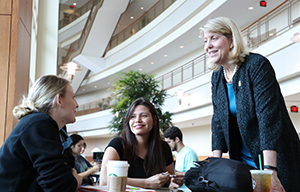
Livingstone 300Baylor University President Linda Livingstone gets acquainted with students. (Photo/Baylor Marketing and Communications)“An institution is the people who make up the institution,” she said, pointing to the way faculty, administrators and board of regents at Baylor remain committed to maintaining the integrity of the school’s Christian mission.

Because her academic training focuses on organizational behavior, Livingstone sees a key aspect of her role as assembling a quality leadership team who share the sense of mission—including the development of Baylor as a caring community.

“Each individual on our campus is a valuable human being in God’s eyes, uniquely gifted in God’s eyes,” she said. “So, we need to respect that and value that—even in the context of disagreeing about things or having hard discussions, being thoughtful about how we treat each other and how we have those conversations. …

“On a college campus, having a caring community is also about how we look out for the health, safety and well-being of particularly our students, but also the community as a whole. Frankly, we weren’t doing that as well as we should have.

“We are continuing to learn about what we weren’t doing well, what we need to do better and how we ensure the environment we are providing our students is one that lets them know they are valued, they are loved and they are gifted by God, and there are ways we can help support them when they are having difficult times.”

Livingstone also emphasized the importance of the university’s role in students’ Christian character development and spiritual growth.

Spiritual journey

Discussion of the university’s Christian mission comes easy to Livingstone, who grew up Methodist, has been an involved member of Baptist churches in Oklahoma, Waco and Washington, D.C., and who led the business school at a Church of Christ-affiliated university in California.

As a fifth grader, she made a commitment to Christ during a Lay Witness Mission event at a Methodist church in Perkins, Okla.

In college at Oklahoma State University, she attended University Heights Baptist Church in Stillwater, Okla., with some of her teammates on the women’s basketball team and became deeply involved in the Fellowship of Christian Athletes. She also worked two summers at Christian camps in southwest Missouri.

She met her future husband, Brad, at University Heights Baptist Church during her undergraduate years, and when she returned to OSU to pursue her doctorate, the two of them taught a young married couple’s Sunday school class at the church.

While Livingstone was on faculty at the Hankamer School of Business at Baylor, she and her family worshipped at Calvary Baptist Church in Waco. She was vice chair of the search committee that called Julie Pennington-Russell as the congregation’s senior pastor, and Pennington-Russell served as the Livingstones’ pastor a second time at First Baptist Church in Washington, D.C.

“Julie is a dear friend,” Livingstone said, noting she and her family were “double blessed” to be in church with her twice.

So far, the Livingstones have visited about a half-dozen Waco-area churches this summer, and they expect to continue visiting other congregations in the fall before joining a local congregation.

Blazing trails

Just as Calvary Baptist blazed a trail among Texas Baptists in calling a female senior pastor, Livingstone made history when she was selected as Baylor University’s first female president.
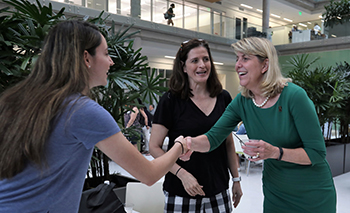
Livingstone DP Hour 350Baylor University President Linda Livingstone visits with students and parents during a Dr Pepper Hour, a longstanding campus tradition. (Photo/Baylor Marketing and Communications)“Because of my background and experiences and the leadership opportunities I’ve had, independent of my gender, I feel like it’s prepared me for where Baylor is now, here at this particular point in time,” she said, acknowledging she tends to downplay her historic position as the university first woman president.

Still, she noted “a sense of joy and appreciation” among female students and alumni at her selection. She hopes it will inspire young women to follow their dreams, and she hopes her presence will in some way facilitate open communication about issues of sexual abuse.

“Given the issues of sexual violence we have dealt with, I hope that my being here will help encourage people to feel comfortable having conversations about difficult situations they have been in, whether it’s about sexual violence or other things, and know that we are trying to create an open environment where they can have these kinds of conversations and discussions,” she said.

When the Pepper Hamilton law firm investigated Baylor’s handling of sexual abuse complaints, the attorneys involved gave the university 105 recommendations for improvement.

Within a few weeks, Livingstone expects an external audit of the recommendations’ structural completion to be finalized, and the results will be made public when Baylor turns over the documentation to the Big 12 Conference, she noted.

Change the institutional culture

While she noted the necessity of putting improved policies and procedures in place, Livingstone acknowledged the greater challenge Baylor faces is the long-term work of changing an institutional culture.

“Changing culture and building culture is a long-term endeavor in any organization,” she said, noting in particular the challenge of developing a culture that deals appropriately with issues of sexual violence.

Leaders need to “live out” the culture they want to see develop in any organization, she stressed.

“And it’s important that those of us at the highest levels of the organization do that on a daily basis by what we do, by what we say, by how we hold people accountable, by the way we support people,” she said. “It has to be modeled at the highest levels of the organization in terms of what kind of culture you are expecting.”

One lesson the university has learned is the importance of “breaking down silos” and sharing information across departmental lines, she said.

“We have learned a lot from this whole circumstance, and we are a different place because of what we have learned, because of the changes we have made and the changes we will continue to make,” she said. “We also hope other institutions will learn from what we have learned.”

Unify the Baylor family

In the months ahead, Livingstone also plans to work with Board of Regents Chair Joel Allison to seek to unify the Baylor family—not only schisms caused by the sexual violence crisis, but also divisions that have existed for the past decade and a half between alumni, administration and the university’s governing board.

Livingstone pledged to “get out and listen a lot to the Baylor family,” noting she and Allison plan to begin in the fall a “conversation tour around the state and then, potentially, other places around the country.”

“We believe it is very important that we begin to heal some of the pain that is out there in the Baylor family,” she said.

When asked what she wants Texas Baptists to know about her, Livingstone responded: “I would want them to know I love Jesus. I am blessed to be back at Baylor, the preeminent Baptist university in the world, and to be able to lead that institution and strengthen its Christian mission and Baptist heritage in ways that allow us to have a more significant influence in Texas and around the world.”


Abraham Jaquez elected BUA president

SAN ANTONIO–Abraham Jaquez—an executive with Buckner International and longtime Baptist Student Ministry director—was named the next president and chief executive officer of Baptist University of the Américas.

Jaquez, 52, begins work as the eighth president in the 70-year history of BUA Aug. 21 after his election by the school’s board of trustees July 20.

He succeeds Réne Maciel, who left the university to become community life pastor at First Woodway Baptist Church in Waco. Moisés Rodriguez, executive vice president at BUA since 2013, has served as the school’s acting president since last October.

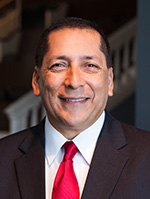
Abraham Jaquez 150Abraham Jaquez “I am so grateful to the trustees of BUA for placing their trust and confidence in me to lead this great school,” Jaquez said. “BUA stands at a cross-cultural crossroads as a unique Christian university training servant leaders for ministry.”

Jaquez has been executive director for Buckner Children and Family Services in Dallas since 2011. At Buckner, he oversaw all facility business operations and human resources and had oversight of the agency’s Dallas campus.

He previously served 20 years as a Baptist Student Ministry director with the Baptist General Convention of Texas.

Jaquez holds a doctor of education degree in educational leadership from Dallas Baptist University, a master of divinity degree from Southwestern Baptist Theological Seminary and a bachelor of arts degree in business administration and marketing from West Texas State University.

“I truly believe God has brought all of my past educational and professional experiences together for this moment,” Jaquez said. “BUA is poised to move forward in a strong way and I’m thrilled to be part of that as I lead this wonderful group of professors, administrators and students.”

Van Christian, chair of the BUA board, noted the presidential search committee unanimously recommended Jaquez to the trustees.

“The committee is absolutely convinced that Dr. Jaquez is God’s leader for BUA at this point in our history,” said Christian, pastor of First Baptist Church in Comanche. “We are excited about the talents and leadership qualities that Dr. Jaquez brings to BUA. We believe he is poised to lead the university into the next great era of success.”

Jaquez and his wife, Kelly, have two children, Gabriel, 12, and Faith, 14.

BUA, a BGCT-affiliated school at 7838 Barlite Blvd. in San Antonio, trains about 300 students from more than 20 countries, offering five bachelor’s degrees, as well as an associate’s degree in cross-cultural studies.


Search committee seeks nominations for next Baptist Standard editor

The editor search committee named by the Baptist Standard Publishing board of directors is seeking nominations for a successor to Marv Knox, who ends his time with the news organization July 31.

The committee, chaired by Jay Abernathy, associate pastor at First Baptist Church in Lubbock, will receive resumes and recommendations until Sept. 1.

Any person making a nomination should include a cover letter and a resume that includes the nominee’s personal information, educational background, career accomplishments and employment history, along with a list of references, to editorsearch@baptiststandard.com.

As chief executive officer of Baptist Standard Publishing, an independent not-for-profit news organization, the editor’s duties include:

  • Vision casting and strategic planning.
  • Collaborating with the board to develop strategies and action plans to fulfill the organization’s mission.
  • Overseeing daily and weekly operations, including writing editorials and editing other articles.
  • Monitoring journalism, finances, marketing and development.
  • Maintaining strong staff cohesion, commitment and morale.
  • Interpreting the organization’s mission within the context of the Baptist General Convention of Texas and the larger Baptist denomination.

“There is no one thing in denominational life that calls for a wider application of common sense than the management of a denominational paper,” Abernathy said, quoting J.B. Gambrell, the early 20th century Baptist Standard editor.

Nominees should have earned bachelor’s and master’s degrees, and focused studies in journalism, theology and education are preferred.

“We desire candidates with experience in Baptist life,” Abernathy said. “This includes, but is not limited to, giving pastoral leadership to congregations and directing nonprofits or other organizations instrumental to the mission of Baptists.”

Serving with Abernathy on the search committee are board members Jon Mark Beilue of Amarillo, Terry Martinez of San Antonio, Sonya Stevenson of Sugar Land and Meredith Stone of Abilene. Former board member Kurt Knapton of Arlington will serve as a nonvoting member of the committee and liaison to donors. Taylor Sandlin, pastor of Sugar Land Baptist Church, chairs the Baptist Standard Publishing board of directors.

For more information, click here.


Champion of literacy finds joy in helping others learn to read the Bible

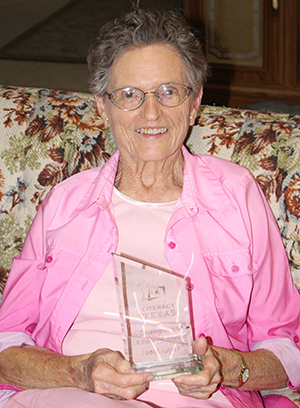
Maurine Frost knew from the time she was a girl God would use her in missionary service. It took her decades to realize her work helping others learn to read the Bible fulfilled that missionary calling in her life.

Those years of service prompted Literacy Texas, a statewide literacy coalition, to present her with this year’s Champion of Literacy Award.

Maurine Frost 300 Maurine Frost knew from the time she was a girl God would use her in missionary service. It took her decades to realize her work helping others learn to read the Bible fulfilled that missionary calling in her life. (Photo courtesy of Literacy Connexus)After a career as an educator, she was assigned in 1989 to the Baptist Literacy Missions Center at Baylor University as a Mission Service Corps volunteer.

Early call to missions

Long before that, at age 13 at a Baptist youth camp, she had sensed God’s calling to missions.

“Though I had been baptized, I was kind of holding back,” she recalled. “You know, we want Jesus to save us, but we are not willing to commit. My reservation was that I had seen picture of Lottie Moon with her little topknot on top of her head and her little glasses on the end of her nose, and I said, ‘God, I’ll do whatever you want me to do, but I don’t want to be a missionary with a little topknot and glasses on my nose.’”

The sermons Fred Swank, longtime pastor of Sagamore Hill Baptist Church in Fort Worth, preached at camp that week focused on giving one’s entire life to Christ and not holding anything back.

“On the last night of camp, that’s what I did, and I committed my life to one of Christian service,” Frost said.

Life got in the way though—she married her first year in college and went on to have five children.

After 20 years as an English teacher, she began to contemplate what was next.

Trusting in God to provide

She still desired to become a career missionary, but a divorce earlier in life removed that prospect as a possibility.

“I was, however, eligible to become a Mission Service Corps volunteer, as long as I could provide my own financial support,” Frost explained.

When she put a pencil to the figures, the numbers did not work.

“I just said, ‘God, this is where the trust comes in. I don’t have enough to pay everything,’” Frost recalled. God always supplied the substitute school teaching work outside of her missions commitment for her to pay the bills.

Serving at the literacy missions center

When she was assigned to the literacy mission center, she said, “I really didn’t know entirely what it was, but I knew it had to do with reading, and that was the important thing.”

During her last two years as a professional educator, she taught English-as-a-Second-Language. She began as a teacher for the adult literacy workshop and then also began teaching an ESL workshop. In 1991, she was named director of the literacy center.

The literacy missions center served Texas Baptist churches by helping them start literacy programs or acquire the books and training resources to keep those ministries functioning well.

She also coordinated the literacy missions consultants around the state as they sought to continue the growth of literacy missions.

At the end of each of her two-year terms as a missions volunteer, began to pray about God’s will in her continuing.

“Every time, someone would call with news of someone who come to know the Lord through literacy missions, and I would say, ‘OK, Lord,’ and I would continue,” Frost recalled with a smile.

Fulfillment of her calling

She didn’t immediately associate her work at literacy missions center with the calling she felt as a girl, because she had always pictured herself as working in medical missions as a nurse.

“God just led me that way, and I wasn’t even aware,” Frost said. “It was step by step by step, and I didn’t know where I was going. But he led me this way, this way, this way, and I wound up exactly where he wanted me. Finally I realized, ‘This is what I’ve been looking for all these years.’”

She retired in 2000, and the literacy missions center on the Baylor campus has closed, but she stays involved in the English-as-a-Second-Language ministry of Columbus Avenue Baptist Church in Waco.

Frost was a joy to work with, said Lester Meriwether, executive director of Literacy Connexus and her initial supervisor at the literacy missions center.

“Her dedication to the mission was inspirational and her tenacity in helping churches in the literacy efforts was always complete and thorough,” he said. “And she was always cheerful and a friend to everyone she worked with.”

Her motivation for involvement in literacy missions is simple: “That all may read God’s word.

“They may have been wanting to learn to read to help their kids with their homework, but when we helped them learn to read, we were showing God’s love,” she said. “When you show people how much you care, they want to know why. Every year, we had hundreds of conversions through literacy missions.

“It was like finding that pearl of great price when I found literacy missions.”


Howard Payne University students serve in Slovakia

BROWNWOOD—Nine Howard Payne University students ministered among the Roma and Slovak people of Slovakia this summer.

The group included students in an international missions practicum course, as well as students involved with HPU’s Baptist Student Ministry. The team worked with and learned from Shane and Dianne McNary, field personnel with the Cooperative Baptist Fellowship.

Professor Melody Maxwell’s class prepared for the trip by studying short-term missions, along with the history and culture of the area and the Roma people.

“The Roma are a people group in Europe who are often marginalized and frequently live in poverty,” Maxwell explained. “We were blessed with the opportunity to briefly serve among the Roma alongside the McNarys.”

The HPU group taught English at a public school in Važec and led a Bible school for Roma children in partnership with Jekh Drom, a local nonprofit organization.

The students also connected with Word for the World–Slovakia, a group translating the Bible into a local Roma dialect, and the Slovak Bible Society, which will help publish and distribute the Bibles.

“This trip specifically taught me about the importance of having cross-cultural knowledge and how that shapes our presentation of the gospel,” said ZE, junior. “This trip was one where I felt that I gained an overwhelming amount of great information about Slovak and Roma culture and the culture of short-term missions.”

Before leaving Europe, the students also traveled to Poland, where they visited the Auschwitz-Birkenau Museum, Schindler Museum and the Polish Roma Association Museum.

“I thoroughly enjoyed the fact that what we did as tourists directly related to who we had been working with while we were on mission,” said Kara Strange, a May HPU graduate from Fredericksburg. “Our tourism was not without a purpose.”

Tara Carroll, junior from McKinney, said the trip taught her God speaks to everyone differently.

“God transcends human limitations and can transcend cultural differences as well,” she said. “The gospel is multifaceted and can speak to everyone in many ways.

“God has used the McNarys to do beautiful work in Slovakia and with the Roma people. We were able to come alongside this work with them for a short time. They will continue to do this gospel work long after we are gone.”


Baylor regents convene under new governance rules, new leadership

WACO—Baylor University’s board of regents approved a 4 percent tuition increase for 2018-19, the lowest percentage increase in more than 20 years, at its July 21 meeting—the first led by a new board chair operating within a revamped governance structure.

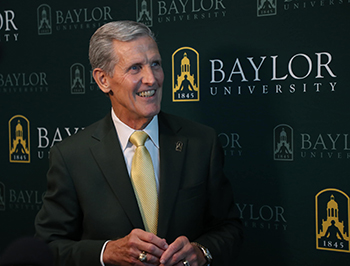
Joel Allison, former Baylor Scott & White Health chief executive officer, chaired the meeting, the first held since Linda Livingstone became the university president, and the first seven newly elected regents attended.

Livingstone 350Linda Livingstone answered questions from the news media after attending her first Baylor board of regents meeting as the university’s president. (Photo/Robert Rogers/Baylor Marketing & Communications)Regents set the university’s tuition for the 2018-19 school year at $41,194—or $20,597 each for the fall semester and spring semester—plus a $4,348 general student fee for the year.

Livingstone noted the tuition and fees remain lower than other private Texas universities of comparable size.

‘Looking out the windshield, not the rearview mirror’

During an executive session, the board heard updates on legal matters and the various ongoing investigations related to Baylor’s sexual abuse scandal, Allison confirmed.

Earlier this month, Baylor settled one of six Title IX lawsuits. The NCAA is investigating Baylor, and the Big 12 Conference is conducting its own independent review of Baylor’s athletic procedures and university governance.

Joel Allison 350Joel Allison emphasizes to reporters the importance of learning from the past while focusing on the future. (Photo/Robert Rogers/Baylor Marketing & Communications)“We are cooperating in every way possible” with the various investigations, Allison said, emphasizing the university wants “to be the best at compliance” with Title IX and other applicable laws.

“I’m a big believer in looking out the windshield, not the rearview mirror,” he said.

At the same time, he added, quoting Bears Football Coach Matt Rhule, Baylor needs to “understand and learn from the past and continue to do better.”

Governance reforms in place

The July 21 meeting was the first conducted under governance reforms the regents approved in February. Those reforms created an expanded executive committee and a task force for regent selection.

The governance changes also granted voting rights to regents representing the Baylor Line Foundation, the “B” Association of former athletic lettermen, the Bear Foundation and two faculty members, as well as a student regent serving a second term.

The seven new regents who joined the board are Jill Manning of Dallas, a retired executive; Alicia D.H. Monroe of Missouri City, provost and senior vice president at the Baylor College of Medicine; Melissa Purdy Mines of Austin, alumni-elected regent;  Gaynor Yancey, director of the Center for Family and Community Ministries in Baylor’s Diana R. Garland School of Social Work, faculty regent; Dusty Sanderson of Amarillo, Baylor “B” Association regent; and student regents Hannah Vecseri of Houston and Will Cassara of Keller.

The board also appointed a new alumni-elected regent, Gordon Wilkerson of Lubbock.

‘There is hope in this new regent leadership

The new board leadership, new president and new governance structure caught the attention of some previous critics of the board of regents.

For 15 years, the Baylor Alumni Association and the organization that succeeded it, the Baylor Line Foundation, made no secret of its often-tense relationship with Baylor’s regents and, sometimes, its administration. But in a July 18 article, Baylor Line Foundation President Jackie Baugh Moore cited reasons for hope. 

As positive signs, she noted Allison attended a recent Baylor Line Foundation event; Dan Chapman, vice chair of the board of regents, made contact with foundation leaders; Wayne Fisher, incumbent alumni-elected regent, attended the foundation’s executive committee meeting; and newly elected alumni representative on the board of regents Mims attended the group’s membership meeting.

“There is hope in the new regent leadership,” Moore wrote. “The addition of new faces including alumni-elected regents, plus faculty and student regents, gives me hope that our culture will be less like a nation and more like a family again. I believe the majority of this board recognizes the awesome responsibility that comes with being a self-perpetuating body.

“I believe there will be a return to a true fiduciary-minded board that will work hard to represent the interests of all Baylor alumni and stakeholders. I believe this board recognizes the importance of openness, honesty, candor and accountability to those same stakeholders and alumni.”

Moore also pointed to the “fresh perspective and new energy” Livingstone brings to Baylor as its president.

“She is well respected in academic circles and among her peers. She has had experience in college athletics, as well, and understands the inherent pressures and the need for proper balance,” she wrote. “I believe Dr. Livingstone will be an effective and wise leader at this critical time in the life of Baylor. We look forward to working with her.”

‘We want to hear all the voices’

In response to a question about whether regents have made similar effort to communicate with Bears for Leadership Reform, an organization of alumni and donors who had been critical of previous regent leadership, Allison said: “We’re talking to everybody. … We’ve got a great Baylor Family, and we want to hear all the voices.”

The common characteristic that unites regents, members of the Baylor Line Foundation and members of Bears for Leadership Reform is a deep love for Baylor, he insisted.

“We’re all passionate about Baylor. … I’m here to talk to anyone who loves Baylor like I do,” Allison said.

In other business, regents approved two academic degree programs:

  • A joint degree in physical education and sports pedagogy that allows students to earn both a bachelor of science in education degree and master of science degree, as well as a teaching certification, in five years.
  • An executive master’s degree in litigation management at the Baylor Law School.

Regents also authorized a $2 million pledge payment as part of the university’s affiliation agreement with the Baylor College of Medicine.


African-American Fellowship celebrates togetherness

TYLER–With “Harambee: Bringing Us Together” as its theme and Psalm 133:1 as its inspiration, the 2017 African-American Fellowship Conference celebrated the joy of working and worshipping together during the July 10-13 annual meeting at Colonial Hills Baptist Church in Tyler.

“The Harambee theme was borrowed from the East African nation of Kenya,” said Roy Cotton, director of African-American ministries with the Baptist General Convention of Texas. “It means ‘all put together.’ Things really do go better when Christ’s followers work together.”

The event began with a “Sweet Hour of Prayer,” a ministry model developed by Louis Rosenthal, pastor of The McKinney First Baptist Church in McKinney.

The conference “could not have started in a better way,” Rosenthal said. “Anything we do, we want to bathe it in prayer before we get started.”

Steven D. Young, pastor of The Cross Baptist Church in Tyler, emphasized the theme of togetherness at the 24th annual James W. Culp Sr. Banquet, held in conjunction with the statewide conference.

“We need to take our eyes off of the masters of the people, and keep our eyes on the Master that works miracle after miracle,” Young said. “God steps in when we need him and when we don’t know we need him. It was no one but God that brought us this far.”

At the banquet, Chris Liebrum, director of the BGCT’s Cooperative Program ministry office, recognized five churches for their giving to Texas Baptists’ Cooperative Program—The Church Without Walls in Houston; The Fort Bend Church in Sugar Land; Bethlehem Baptist Missionary Church in Mansfield; Cornerstone Baptist Church of Killeen in Harker Heights; and Community Missionary Baptist Church in DeSoto.

The fellowship elected Elmo Johnson, pastor of Rose of Sharon Baptist Church in Houston, as president. Other officers are Kenneth O. Jackson, pastor of New Light Baptist Church in Lubbock, vice president; Edward Wagner, pastor of Cornerstone Baptist Church of Killeen in Harker Heights, secretary; Michael Joseph, associate pastor of Fiesta Missionary Baptist Church in Houston, assistant secretary; Leonard Hornsby, executive pastor of Bethlehem Baptist Church in Mansfield, treasurer; and Steven D. Young, pastor of The Cross Baptist Church in Tyler, assistant treasurer.

In conjunction with the fellowship conference, many African-American Texas Baptists participated in missions and evangelistic opportunities, including serving at a local nursing home and volunteering to take food to the Salvation Army in Tyler for the homeless and hungry.


Family finds encouragement at Buckner Family Hope Center

DALLAS—Tilia Sanchez volunteers at Burnet Elementary School in Dallas whenever she can. She wants to make the school the best it can be for every student, including her children.

So, it was no surprise she was part of a special event at the school, but she was surprised to encounter someone new. He was standing next to a small table smiling politely, shaking hands and handing out brochures.

Sanchez accepted one of them, which detailed the launching of a Buckner Family Hope Center in the area to strengthen families. The center would offer job skills, parenting, Bible studies and entrepreneurial classes.

Sanchez was intrigued. Maybe she’d check it out, she thought.

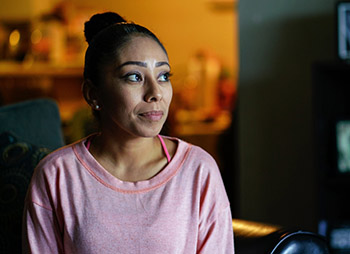
Tilia 350Tilia Sanchez learned she had Stage 5 renal disease. When she began attending a class at the Buckner Family Hope Center, she found support and encouragement. (Buckner Photo / Mark Sandlin)Then her world imploded. 

“When I was 14, I was diagnosed with a polycystic kidney disease,” she said. “This disease took my mother and my grandmother. This year, I was diagnosed as being in Stage 5, final renal disease. As you can imagine, it was very big news for me.”

During the next few weeks, Sanchez tried to hide from the rest of the world. Often sitting in the dark, she avoided her friends and found herself spiraling in despair. 

“I just wanted to be at home crying, asking myself, ‘Why?’” she said. “All the memories of my mom going through this disease came to me. I didn’t want to do anything with the outside world, to be honest. But I had great friends who lifted me up and practically dragged me to the first class. I enjoyed it. I could see (the teacher) helping me psychologically, coping with it.”

Encouragement during a tough time

The same man she met when he was distributing brochures led her first class—Ricardo Brambila, director of the Family Hope Center at Bachman Lake. She found the class full of energy and encouragement, and she wanted more.

Eventually, Sanchez took three classes at the Hope Center. Buckner staff invested in her, helping her look for the positive aspects of her life. They prayed for and with her. They even gave her a Bible.

“Tilia came in right after incredibly difficult news about her illness,” Brambila said. “She’s so smart and such a hard worker. She just needed some encouragement to get through a tough time.”

Sanchez found her spirits lifted. Despite her medical situation, she was pushing forward for herself and her family. When she began taking a class about how to start a business, she knew she found what she and her husband, Ricardo, were missing.

‘This is our time’

He had been part of home construction teams for years and wanted to start his own business with his wife, but they never quite knew how.

Tilia Life Coach 350Tilia Sanchez discusses ways to improve her family’s life with Buckner Family Coach Juan Valdez. (Buckner Photo / Mark Sandlin)“The opportunities for financial information got me,” she said. “My daughters are growing. They need more space. We need more space. Sometimes, we’re in a financial bind where we can’t afford something better.”

She sensed it was an opportune time for her family to start a business. For three weeks, they cut every expense they could, even going to a church food pantry for food, so they could save enough money to purchase the tools needed for a construction business. 

The family was buoyed in the efforts by knowing Buckner staff believed in them. With the help of Buckner, the family knew they would succeed.

“We needed somebody to believe in us,” Sanchez said. “We needed somebody to push us. When I went to that class, (Brambila) told me what I needed to hear. I came home and told my husband, ‘This is our time.’ In three weeks, we started our own business.”

The business is growing each day. Ricardo Sanchez and his staff work from sunrise to sunset constructing homes, particularly in the far northern suburbs of Dallas. The business’ success has alleviated the financial stress upon his family.

“I can finally say we can pay our rent and not have to worry about stretching $100 a week,” Tilia Sanchez said. “I can finally tell my girls it’s Saturday, and I can take them somewhere. That means a lot to me.”

‘Their future is bright’

The story of the Sanchez family is exactly what the Hope Center is trying to do across the Bachman Lake area of Dallas.

“Tilia and Ricardo have worked hard, learned new skills and applied them well,” Brambila said. “Their future is bright. Their children’s futures are bright. Hope truly shines here.”

Tilia Sanchez still struggles with her illness. She’s waiting on a kidney transplant and takes 20 pills a day. But she looks forward to each day with a new belief in herself.

“I can now set goals for myself that I know I can accomplish because I have great people that help me with them,” she said. “Before that, even though I can do things for myself, sometimes you need that guidance.”


Texas Baptists Committed to cease operations

Texas Baptists Committed—the moderate organization that for nearly three decades resisted a “fundamentalist takeover” of the Baptist General Convention of Texas and its affiliated churches—will cease operations at the end of July.

Lack of financial support 

The group’s board of directors voted July 7 to close, citing lack of financial support.

“From one standpoint, this has been an easy decision—we simply no longer have the funds to sustain this ministry,” TBC Executive Director Bill Jones wrote July 8 on the organization’s blog and to readers of the TBC Weekly Baptist Roundup electronic newsletter. “From another standpoint, this has been a difficult, gut-wrenching decision.”

More than 18 months ago, Jones and the board convened a meeting at Wilshire Baptist Church in Dallas to discuss the organization’s future.

“At that meeting, I announced that I planned to step down by July 1, 2017, and suggested that, for TBC to make a significant impact, the board needed to look for an executive director who is younger than I am and has stronger credentials, and provide that executive director with a staff—at a minimum, an associate executive director and secretarial assistance,” Jones wrote. “Unfortunately, the funds never materialized to support any of that.”

‘Battle fatigue’ sets in

During its heyday in the late 1980s and throughout the 1990s, TBC mobilized thousands of messengers to vote for moderate candidates for BGCT office at the state convention’s annual meetings.

However, after the “Baptist battles” ceased in the Southern Baptist Convention in the early 1990s and Baptists in Texas who supported the direction the SBC formed a state convention in 1998 to compete with the BGCT, interest waned, and support for TBC decreased.

“With no visible ‘battle’ for control of the Baptist General Convention of Texas, as there was through most of the 1990s, many Baptists just haven’t felt the urgent need for a ‘watchdog’ like Texas Baptists Committed,” Jones wrote. “‘Battle fatigue’ was a factor, too.”

How Texas Baptists Committed originated

In 1988, moderates concerned about the direction of the Southern Baptist Convention created Baptists Committed as a national organization, with an office in Houston. That group included many of the leaders and financial supporters of Laity for the Baptist Faith & Message, formed in 1985.

A few months later, moderates in Texas created a state chapter of Baptists Committed, and the group hired San Angelo rancher David Currie as field coordinator and Oeita Bottorff of Houston as project director.

In 1992, the national organization ceased to exist, as many moderate churches turned their allegiance from the SBC to the new Cooperative Baptist Fellowship.

However, Texas Baptists Committed continued with Currie as executive director, and the organization focused on supporting a slate of moderate candidates for election at each BGCT annual meeting.

After many congregations that supported the “conservative resurgence” within the SBC withdrew from the BGCT in 1998 to form the Southern Baptists of Texas Convention, contested officer elections at the BGCT became uncommon.

So, for the next decade, TBC focused primarily on helping pastor-search committees identify ministerial candidates who would not seek to lead their congregations away from the BGCT.

At the same time, TBC continued to work behind the scenes to influence BGCT officer elections, calling for increased diversity in leadership posts. With TBC endorsement, the BGCT elected the first Hispanic president, Albert Reyes, and the first African-American president, Michael Bell, as well as the first two women to serve in that role—Joy Fenner and Kathy Hillman.

In September 2009, Currie retired as TBC executive director. After more than a year of minimal activity by the organization, the board elected Jones as executive director in January 2011.

Optimism and concern about the future

Looking to the future, Jones noted optimism about the future of Fellowship Southwest—a new Cooperative Baptist Fellowship network that includes Texas, Oklahoma and the Western United States. Marv Knox will step down as editor of the Baptist Standard July 31 to become the network’s coordinator.

However, he voiced concern about the BGCT’s future, citing friendly overtures by BGCT Executive Director David Hardage toward Paige Patterson, president of Southwestern Baptist Theological Seminary, and actions messengers to the 2016 BGCT annual meeting approved to remove from fellowship congregations that identify as welcoming and affirming of LGBT individuals.

“A lot of us will not be messengers (to BGCT annual meetings) any more, and the vote on the next issue that comes up won’t be as close next time,” Jones said in an interview. He is a member of Wilshire Baptist Church in Dallas, one of the congregations the BGCT voted to disfellowship.

In recent years, Jones said, when he met with BGCT Executive Board staff leaders, he realized TBC “didn’t have influence anymore, because they didn’t feel a threat as keenly.”

Fellowship Southwest will provide “a more robust CBF presence” in Texas, and Jones voiced confidence it will provide a home for churches and individuals committed to principles such as the priesthood of every believer, soul competency, local church autonomy, religious liberty, separation of church and state, and freedom to interpret Scripture.

However, he acknowledged, the network will not political in nature, and with the demise of TBC, the task of championing “historic Baptist distinctives” within BGCT life will fall to “individual watchdogs.”

“If we were to see clear evidence the BGCT is departing from Baptist principles, I wonder if there could be support to recreate something along the order of TBC—some kind of organized effort,” Jones said.