East Texas volunteers pass along legacy of service
April 22, 2025
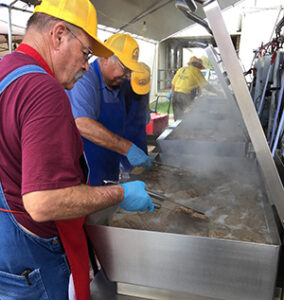
Age caught up with an East Texas disaster relief unit, but their desire to serve kept the future in mind. They donated their three trailers, a truck, a large generator and money to Texans on Mission.
Now a group of Texans on Mission volunteers are retooling the trailers at the Dixon Building in Dallas.
Mike Brittain, former pastor of Morton Baptist Church in Diana, contacted Texans on Mission Disaster Relief Director David Wells and offered the equipment and financial resources. The group is centered in Harrison County, northeast of Longview.
“They ran their team for a number of years, but they aged out of being able to deploy and didn’t have any younger volunteers to take their places,” Wells said.
Brittain led the Morton congregation 30 years, and they started the East Texas Disaster Relief feeding unit 28 years ago.
“We’ve been in it (disaster relief) a long, long time,” Brittain said. “We got older. Our chief cook passed away, and I’m reaching 80.”
‘Still going to be part of disaster relief’
When the nonprofit group lost its place to keep the equipment, they realized they needed to let it go. The group had lots of offers for the equipment, but decided it should all go to Texans on Mission.
“It’s a lot of resources, and every penny donated is going to stay in disaster relief,” he said of the decision. “The Lord just led us to go that direction. … We’re still going to be part of disaster relief.”
Rather than letting their equipment deteriorate from lack of use, the East Texas group donated it. They also donated convection ovens and “tons of Cambros”—insulated containers for delivering prepared food.
“They also gave Texans on Mission $50,000,” Wells said. “It’s a blessing. It really is. And the 2004 Ford truck only has 22,000 miles on it.”
Texans on Mission volunteers are working in Dallas now to update the two kitchen units “to fit and interchange with our current units. We are getting them ready for service as soon as possible,” Wells said.
“Instead of two state feeding units, we will now have four available for deployment on mass feeding.”
History of service
During the East Texas team’s active years, the volunteers traveled overseas to Sri Lanka, Haiti and Gaza. In the United States, they served in New York, Florida, Missouri and “all over the state of Texas,” Brittain said.
Volunteers with East Texas Disaster Relief from Diana serve in Katy. (File Photo)
“During the (space) shuttle explosion, we set up a prayer station at the entrance of the Johnson Space Center and were the collection center for memorials,” he remembered.
In 2011, they went to Haiti as a water purification team and “brought in 15,000 personal water filter systems and a suitcase system for the makeshift hospital.”
Thirty church members from northwest Harrison County and the surrounding area “were committed to disaster relief.” And the Diana church encouraged their pastor, Brittain, to be a part of the work.
When the volunteers served close enough, Brittain returned to the church Saturday evening, preached Sunday morning, then headed back to the disaster relief site.
“As pastor, they gave me the privilege to go,” he recalled.
And “the people donated pretty faithfully to our group.” Those donations and support from the organization then known as Texas Baptist Men provided the equipment and finances that are now being donated to Texans on Mission.
Brittain said they served hundreds of hot dogs but didn’t “run hot dog stands in disaster relief.” They ran “meet Jesus stations, and I pray we never forget that.”
Video shows how the Texas Lottery was rigged
April 22, 2025
Video evidence sheds new light on how some individuals inside the Texas Lottery Commission allegedly enabled a syndicate with international connections to rig the system and claim a $95 million Texas Lottery jackpot.
The new evidence—alongside several ongoing investigations and lawsuits—adds momentum to a growing movement to do away with the Texas Lottery, close observers of the Texas Legislature said.
The brief video shows the interior of a storefront office where five individuals—two of whom appear to be minors—worked at computer terminals to print out lottery tickets. The Baptist Standard possesses the unedited video but is not posting it since it depicts minors.
The New York Times reported April 20 the video offered a glimpse into a three-day ticket printing rush in April 2023, when a British gambling consultant worked with Lottery.com and other entities to buy practically every combination of possible lottery numbers to secure a win.
The Times article notes how state lottery officials—charged with enforcing rules for playing the lottery—overlooked violations. Instead, they facilitated the delivery of equipment to four storefront offices posing as retailers to print out about 26 million paper lottery tickets.
The article told the complicated story about how the former owner of a lottery data company purchased by Lottery.com—who later sued Lottery.com for failure to pay—obtained the cell phone with the video and thousands of incriminating text messages.
‘A scheme to cheat the people of Texas’
In an interview with the Baptist Standard, Sen. Bob Hall, R-Edgewood, asserted the commission enabled “outright theft” and likened the scene depicted in the video clip to a “sweat shop.” Hall has led the charge in the Texas Senate to investigate wrongdoing by the Lottery Commission.
“No one on the outside could have ever done what they did without the close cooperation of the personnel within the Lottery Commission—changing the rules, providing the equipment and ignoring what obviously was a scheme to cheat the people of Texas,” he said.
Hall pointed to rule changes permitting the use of electronic devices, allowing the “speed-buying” of tickets, and authorizing the delivery of multiple machines with electronic QR code readers to specific locations.
The rule changes resulted in 60 machines in four locations running constantly for 72 hours to generate tickets with 12.8 million combinations of numbers, he said.
“It took it being orchestrated by personnel within the Lottery Commission to defraud Texans who played the lottery in good faith that they just might have a chance to hit the big one,” Hall said.
Investigations and legal actions
Revelations in the Times article added more fuel to the fire surrounding the Texas Lottery:
In February, Gov. Greg Abbott ordered the Texas Rangers to investigate both the April 2023 bulk purchase of lottery tickets and a more-recent $83.5 million win involving lottery couriers.
Two days later, Attorney General Ken Paxton announced his office was launching its own investigation into the Texas Lottery to determine whether any state or federal laws were broken.
Lottery watchdog Dawn Nettles filed a class action lawsuit on behalf of Texas Lottery players, suing former Lottery Commission Director Gary Grief, Lottery.com and IGT, the vendor responsible for administering the lottery, for fraud.
Earlier this month, a Texas Lottery winner from Hood County filed a lawsuit, asserting his $7.5 million jackpot winnings were significantly less than what they would have been if the rigged $95 million jackpot had not been awarded less than a month earlier.
The Wall Street Journal published an investigative article April 12 asserting Bernard Marantelli, a London-based banker-turned-bookmaker, spearheaded an international gambling syndicate to rig the Texas Lottery, with financial backing from Tasmanian gambler Zeljko Ranogajec.
On April 21, Ryan Mindell resigned as executive director of the Texas Lottery Commission. Sergio Rey, chief financial officer of the agency, was named acting deputy director.
“Laws were broken, and the folks involved should be held accountable. Legislators have had it with the lottery. They feel misled,” said Rob Kohler, consultant with Texas Baptists’ Christian Life Commission.
The fact that the Texas House “zeroed out” the Texas Lottery Commission in its budget and the Senate likely will do the same signals “the very real possibility” the abuses perpetrated could signal the end of the Texas Lottery for the foreseeable future, Kohler said.
Hall likewise is hopeful the light shed on abuses within the Lottery Commission could lead to its demise.
“The state has no business being in the gambling business,” he said.
Corruption within the Texas Lottery Commission should serve as a “wake-up” call to lawmakers who are considering other gambling expansion in the state, Hall asserted.
“If the state cannot manage something as simple and straightforward as the lottery and you have that much criminal activity involved … what can we expect to come into our state when we start allowing sports betting, internet betting and casinos all over the state?” Hall asked.
“The culture that gambling brings” is contrary to Texas values, he said.
“The criminal element is deeply embedded in gambling where there’s a lot of money. And while there’s a lot of money in the lottery, it pales in comparison to the money in sports gambling, internet gambling and casinos.”
ETBU prayer tent brings students together
April 22, 2025
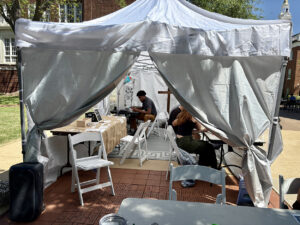
MARSHALL—East Texas Baptist University’s Baptist Student Ministry recently hosted a prayer tent event, offering students 24 consecutive hours of prayer, reflection, confession and thanksgiving.
Inside the prayer tent at East Texas Baptist University, students such as Christian Dews engaged in focus times of prayer and reflection. (Photo / Faith Pratt)
The prayer tent was part of ETBU’s initiative to offer students, staff and faculty a time of focused prayer.
Beginning at 8 a.m. on April 15 and lasting until 8 a.m. on April 16, students had full 24-hour access to the prayer tent, a large white tent outside the Ornelas Student Center housing prayer cards, a thanksgiving journal, crafts and more.
ETBU’s prayer tent ministry began in 2019, though the idea of prayer tents on college campuses has existed for years. ETBU’s prayer tent exists to encourage the students of ETBU to depend upon the Lord in prayer, organizers noted.
“A while ago … our Baptist Student Ministry decided it was a great idea to have time on campus for people to be developed, not only in prayer, but also involved with others in community with that,” said Paxton Lovell, junior sports communication major and BSM member.
“So, they started this prayer tent, which allows people for 24 hours to come by whenever they need to pray, to be close with one another and … be involved.”
Adoration, confession, thanksgiving and supplication
BSM volunteers were stationed outside the tent, offering a collection box for written prayer, information to students walking by and helping guide them through the prayer tent’s purpose and structure.
The prayer tent followed the ACTS prayer model, an acronym standing for adoration, confession, thanksgiving and supplication. This method serves as an outline for prayer.
The prayer tent offered four stations with tables, each corresponding to a segment of the ACTS model. The different stations allowed students to focus on various aspects of prayer.
Sophomore Christian ministry major and BSM member Patrick Burt explained the process.
“There’s different things you can pray by. You can confess to God what you’ve been struggling with,” Burt said. “You can thank him for what he is currently doing in your life You can adore him and … be in his presence.”
One station had note cards for students to write their prayer requests. They could attach their prayers inside the tent or put them into a box collected by BSM.
Another station had a notebook for students to write down what they were thankful for, praising God for all he has done in their lives and highlighting his goodness and glory.
The “confession” station had paper gift tags students could write confessions on before hanging them on nails on a wooden cross in the tent’s center.
East Texas Baptist University students Kevin Estell and Rhythme Seban create artistic expressions of thanksgiving. (Photo / Faith Pratt)
Another station had art and crafts supplies students could use to make a collage of what they are thankful for, prayer requests or anything God put on their hearts.
Senior university studies major Rhythme Seban described her first impressions of the prayer tent, which she discovered after leaving class.
“I liked that they chose a white tent because it made it feel … very holy. It has a sacredness to it that I really appreciate,” Seban said.
“The table I liked was the confessions table, where it’s basically a time of repentance, where you can write down … your wrongdoings and put it on the cross and leave it there. … It emphasizes that the debt has already been paid.”
Visibility and accessibility
The prayer tent’s structure and location made it visible and accessible to students who might not approach it otherwise.
Sophomore rehab science major Landen Hobbs said he fell into this category, but is so thankful he stopped by for prayer.
“I didn’t even know we offered the prayer tent, probably because I didn’t really pay attention to … spiritual stuff last year,” Hobbs acknowledged.
“I was actually about to walk into the cafeteria doors when I saw the prayer tent. … So, I turned around and walked over.”
Hobbs particularly was impressed by the confession board “because I don’t feel like I thank God enough. … We’re all guilty of this. We pray for it, but after it happens, we forget to thank him.”
Having the tent up allowed people to connect on a deeper, more spiritual level, creating an inviting space for students to engage in a time of repentance and confession, surrounded by the love of students in ministry.
“I’m one of the BSM leaders of the prayer tent. I’m here to just show the love of God and … pray for people and pray for their requests that they leave here,” said Luis Correa, a sophomore criminal justice major.
“The prayer tent is very helpful. … It offers the opportunity to just be able to show love to people who might not know Christ. … I’ve seen a lot of people affected by this.
“I just pray that more people continue to come throughout the day and hopefully just be able to feel the sense … that God wants your heart, and hopefully this prayer tent can help people come to know Christ or restore their relationship with him.”
Texas House approves education savings account program
April 22, 2025
After hours of debate, the Texas House of Representatives approved for the first time in the state’s history a plan to send public funds to private schools, including religious schools.
The House voted 85-63 in the wee hours of the morning on April 17 to approve a bill authored by Rep. Brad Buckley, R-Killeen, to establish an education savings account program.
The voucher-like program—Gov. Greg Abbott’s top legislative priority—will provide about $10,000 to each participating private school student and up to $2,000 to each participating homeschool student.
“It’s time to provide the full array of options for students and their families,” Buckley said.
‘The false flag of parental choice’
Charles Foster Johnson, executive director of Pastors for Texas Children, offered a dissenting view, calling the education savings account program “a reckless subsidy that rips public dollars out of our neighborhood schools and hands them to unaccountable private institutions.”
“This scheme fails our poorest children, violates the Texas Constitution and uses public tax dollars to fund the establishment of religion—all under the false flag of ‘parental choice,’” Johnson said.
John Litzler
John Litzler, public policy director for Texas Baptists’ Christian Life Commission, expressed disappointment in the House vote approving the education savings account program.
“While we are disappointed in the House’s passage of Senate Bill 2, the Christian Life Commission remains committed to the same values we’ve always held: supporting public education and promoting religious liberty,” Litzler said.
Education savings accounts offer a “tightly controlled” and “parent-directed” approach to educating students that prioritizes “the state’s most vulnerable students,” Buckley asserted.
The program allocates $1 billion toward education savings accounts families can direct to schools for tuition and other expenses.
While 80 percent is dedicated to students with disabilities and—broadly defined—low-income families, the general population is able to apply for the remaining 20 percent.
Opponents of the bill characterized the “universal” nature of that 20 percent as making the program available to “millionaires and billionaires.” The House rejected several amendments that would have placed an income cap on program eligibility.
Call for referendum rejected
The House voted in favor of a motion by Buckley to table an amendment introduced by Rep. James Talarico, D-Austin, calling for a statewide referendum on the education savings account program.
Talarico said the idea originated with conservative activists who support what they call “school choice” and initially was supported by some Republican lawmakers
However, he asserted, Abbott threatened to veto bills proposed by any Republican who voted in favor of Talarico’s amendment and told the lawmakers he would make their primary elections a “bloodbath.”
“The governor has said private school vouchers are widely popular. … I would think the governor would welcome an opportunity to finally have a mandate on this controversial topic,” Talarico said.
He urged his Republican colleagues to exercise courage, demonstrate independence and vote in favor of the referendum.
“We do not serve the governor. We serve our constituents. … This is the people’s House, not the governor’s House,” Talarico said.
‘About power and profit’
Johnson noted the pressure Abbott applied to House Republicans to vote in favor of the voucher-like education savings account program.
Charles Foster Johnson
“We thank God for the faithful lawmakers who stood strong—every House Democrat and the courageous Republicans who formed a new ‘moral caucus’ by putting children and conscience ahead of party,” Johnson said.
Gary VanDeaver of New Boston and Dade Phelan of Orange, former Speaker of the House, were the two Republicans who voted against the education savings account bill.
“This vote was not about what’s best for Texas children—it was about power and profit,” Johnson asserted. “A handful of billionaire donors have bought our legislature, and Gov. Abbott has handed our public school system over to them in exchange for political favor.”
Jeff Yass, cofounder and managing director of the Philadelphia-based Susquehanna International Group and an ardent supporter of “school choice,” made the largest single campaign donation in Texas history to Abbott.
The governor supported the primary opponents of rural Republicans who defeated a voucher-style proposal in the 2023 legislative session, changing the makeup of the Texas House.
Prior to considering the education savings account bill, the House voted 144-4 to give preliminary approval to a school funding bill that will provide $8 billion over two years.
Lawmakers voted on the funding bill after extensive debate and consideration of multiple amendments. The bill will increase the basic allotment per public school from $6,160 to $6,555, with 40 percent earmarked for school staff salaries.
Litzler voiced support for the House school funding bill, which includes close to $2 billion in special education funding and $750 million to increase teacher pay.
“Since Texas is now on a path to divert public funds to private schools, it will become increasingly important each legislative session that Texas passes bills to fully fund public education,” he said.
Bill on temperature control in Texas prisons gets hearing
April 22, 2025
The Texas House of Representatives Committee on Corrections heard public testimony April 16 on a bill to buy and install air-conditioning and heating systems in Texas prisons.
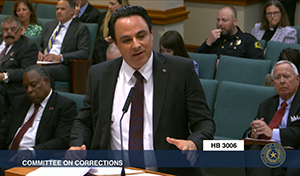
HB 3006, authored by Rep. Terry Canales, D-Edinburg, relates to the purchase and installation of climate-control systems at prison facilities operated by the Texas Department of Criminal Justice.
Five house bills related to the matter had been filed this session, but none had received a committee hearing until today.
“We support legislation that upholds the value and dignity of life as being made in the image of God our creator. We believe this bill does just that,” said John Litzler, director of public policy for Texas Baptists’ Christian Life Commission.
Phased installation over 10 years
Rep. Terry Canales, D-Edinburg, is the author of HB 3006. (Screen capture image)
The bill sets up a system where Texas Department of Criminal Justice will phase in climate control in Texas prisons over the next 10 years, which Canales noted was a “compromise” to expedite the TDCJ’s estimated timeline of 25 to 30 years for prisons in Texas to be fully air-conditioned at their current rate of installation.
The bill would allow for a phased installation of climate control not to exceed $100 million every two years and allows the use of inmate labor to reduce costs, Canales explained, noting some inmates have HVAC training.
He noted the bill’s phase-in plan means he “would expect to see a huge dent” in the number of prisons lacking air-conditioning by 2032.
Canales also pointed out not having climate control in Texas prisons is costing taxpayers millions of dollars. Legal action against the conditions has become a “cottage industry,” he noted, where the litigants virtually are guaranteed a win with “tons of litigation” every year.
“It’s already a precedent that you lose,” he said.
“And so, every time somebody gets hurt, every time there’s a stroke, we’re dishing out by the millions.”
“The situation is dire,” Canales said. The compromise bill only brings temperatures down to 85 degrees, he explained. But that reduction in temperature is the difference between life and death.
He urged committee members to visit a Texas prison to experience the conditions for themselves if they’ve never been. But, he warned them to wear a t-shirt and expect to leave drenched in sweat and with the taste of the stench of the disgusting conditions in their mouths.
Average 14 heat-related deaths per year
In her testimony, attorney Erica Grossman, who has participated in litigation related to air-conditioning in prisons, cited an average of 14 acknowledged heat-related deaths per year due to heat-related causes between 2001 and 2019.
Rep. Thresa Meza, D-Irving, questioned whether that number might represent an undercount of heat-related deaths. Grossman and other witnesses explained undercounts of heat-related deaths and injury are likely, citing Judge Robert Pittman’s comments in his 91-page ruling last month as evidence.
Grossman pointed out the court ruling in March called both the lack of air-conditioning in prisons and the TDCJ timeline of 30 years to mitigate conditions unconstitutional, without reservation.
As TDCJ had testified the only obstacle to installing climate control was funding, the ruling “invited the legislature to solve this funding problem now and solve it quickly” to implement the undisputedly necessary changes, she explained.
Treating pets better than humans
Conditions in Texas prisons are inhumane, Litzler suggested. He asserted Texas law devalues life when it requires temperatures in shelters where dogs and cats are present not to exceed 85 degrees for longer than two consecutive hours, while holding temperatures in state prisons to no such standards.
“We’re valuing dogs’ and cats’ comfort and safety over that of human beings,” Litzler lamented. “And that’s why we need this legislation in Texas, to promote a culture of life in our state.”
Litzler noted Texas Baptists minister through Philippi Church Ministries to more than 1,750 inmates, who meet in 350 groups in over 110 jails and prisons around the state, many of which are among the un-air-conditioned units.
Additionally, four of the six regional TDCJ prison chaplains in Texas are endorsed by Texas Baptists, and of all the chaplains in the TDCJ system, 1 in 4 has been endorsed by Texas Baptists, Liztler noted.
“We’re involved. We’re on the frontlines,” he observed, noting the current budget surplus means now is the time to address the need for climate control in Texas prisons.
‘What is the cost of a life?’
Other witnesses spoke of their experiences being incarcerated in these conditions or on behalf of those who have experienced the stifling heat indexes of many Texas prisons.
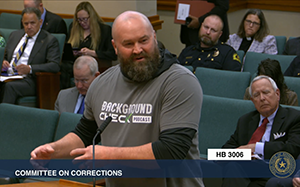
Jay Dan Gumm, president of Forgiven Felons, testified on behalf of a measure to install climate-control systems in Texas prisons. (Screen capture image)
Jay Dan Gumm, president of Forgiven Felons, described fighting other inmates to get to coolers while he was incarcerated—not to drink the water, but to dip bedsheets in the icy water so he could tie the sheet to his hot metal bunk frame in each corner and place his fan at the end, creating his “own little bubble.”
He recalled heat-related fights at all four of the state prisons where he was held, with one leading to his solitary confinement. But when he was transferred to a private prison with air-conditioning, “I didn’t get in any fights,” he said.
It’s sad the only way climate control in Texas prisons is likely is through the courts, Gumm observed. He acknowledged pushback about the costs, but, he asked, “What is the cost of a life?”
If the mission of TDCJ isn’t just punitive, but rehabilitative: “How are we rehabilitating, at the same time killing some of the inmates because of the heat? … What is the cost of a life?” he asked again.
‘People are dying’
Jeff Edwards also spoke in favor of the bill, describing himself as “the cottage industry that was talked about.” He has been litigating this issue for the last 15 years, he said, noting he’s seen a “sea change” on this issue.
“As a civil rights issue, it’s black and white,” Edwards noted. “The courts have spoken. People are dying. People are suffering. It’s not even really up for debate.”
But, Edwards said, if it was ever analyzed from a cost-benefit perspective, it would be a “net positive” for the state on that front too. Adding air-conditioning will bring jobs, energy efficiency and savings, he said.
“It’s not just the right thing to do. It’s the smart thing to do,” Edwards asserted.
And as one of the lawyers in the current case, he said he wanted to tell the committee, “in no uncertain terms, this is going to happen,” because the court has made clear the conditions are unconstitutional.
No witnesses spoke against the bill. Brian Collier, executive director of Texas Department of Criminal Justice, provided neutral testimony.
Canales said he has been following this bill more than 10 years, HB 3006 is Canales’ third attempt to address the need for temperature control in Texas prisons in three years, after bills he introduced in the past two legislative sessions passed the House of Representatives, only to die in the Senate.
At the close of testimony, HB 3006 was left pending.
Editor’s note: The Committee on Corrections approved HB 3006 on April 23 by a vote of 7-1. The bill was reported favorably without amendments, according to the Texas Legislature online.
Texans on Mission flood recovery teams help families
April 22, 2025
Consuelo Oliva woke up suddenly at 3 a.m. Rain was pounding on the roof and windows of her home. The rain kept falling and falling—fast and hard. She had never experienced so much rain at one time.
“I was getting scared, and the kids were getting scared. … We couldn’t sleep because we were afraid the water level was going to rise, and it did, in seconds. … I kept praying for the rain to stop,” Oliva said.
The rain continued to pour and soon it entered Oliva’s home. Their whole home flooded with several inches of water. Oliva said they stepped onto the floor from the bed and their feet were covered in water.
“It was horrible. We couldn’t find our way out. It was all surrounded by water,” she said.
A year’s worth of rain in one day
Oliva’s home was one of many that flooded in the Rio Grande Valley after excessive rain at the end of March. Some areas received more than 16 inches of rain—equivalent to one year’s worth of rain for the area—in one day.
Texans on Mission deployed assessors, shower and laundry, box distribution and flood recovery teams to the area. The flooding was so widespread, the need was great.
“The impact of the flooding in the Rio Grande Valley was felt far and wide,” said David Wells, Texans on Mission director of disaster relief. “We knew we needed to respond, but it was challenging to coordinate the teams to go since we still had teams in Missouri and Oklahoma on deployment.”
But Texans on Mission volunteers “stepped up to offer help and hope to those needing relief in the Rio Grande Valley,” Wells said.
It took three days for the water to recede from Oliva’s home. She was despondent over the damage. She and her husband bought the land her home sat on 35 years ago, and they slowly built their home over the years. And in an instant, all their possessions were lost.
Oliva’s husband started to pull out insulation. It was filled with so much water, he could wring it like a sponge and water just poured out. Sheetrock and furniture were ruined. It didn’t take long for mold to start growing as well.
“I told my husband, ‘Please tell me that I’m dreaming.’ It was bad. It was really bad,” Oliva said.
‘Help is coming tomorrow’
Oliva’s husband Tomas works six days a week. So, after the flood he was only able to work on the house one day a week. Cleanup was happening slowly until a Texans on Mission flood recovery team showed up and finished the job in one day.
Oliva said her daughter learned about Texans on Mission from her school. She called and said, “Mom, there’s people here that say they can go over there and help you.”
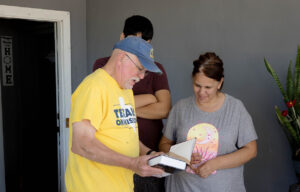
Consuelo Oliva relieves a Bible from the Texans on Mission team that worked on her flooded home in the Rio Grande Valley. (Texans on Mission Photo)
Oliva said she instantly felt “blessed and relieved.” Still, she thought they would have to wait weeks for the team to show up but was surprised when they called within a week and said the team would be at her house the next day.
“I was really happy,” Oliva said. “I called my husband and said: ‘They’re going to come tomorrow. The help is coming tomorrow!’”
The Texans on Mission team spent all day at Oliva’s home, tearing out ruined sheetrock and insulation, cleaning to remove mold and moving furniture.
As the team worked on her home, they also were able to connect with Oliva and her family, encourage them and show them the love of Christ.
“I felt so blessed and relieved,” Oliva said. “I’m so thankful for you guys coming to help us. And everyone is safe. All this we can buy slowly. But life we can’t buy.”
ETBU students participate in 2025 Serve Day
April 22, 2025
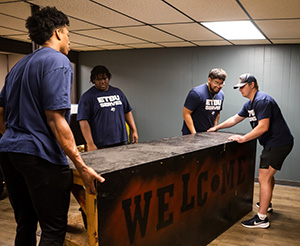
MARSHALL—In spite of cold, rainy weather, more than 250 East Texas Baptist University students spent a recent Saturday serving churches, outreach centers and nonprofit organizations throughout Harrison County.
The ETBU Baptist Student Ministry sponsored the annual Serve Day event on April 5. Students served through various ministries and community service as part of the university’s mission to spread the love of Christ through acts of service.
Student athletes and other volunteers from East Texas Baptist University worked at various churches and nonprofits in the Marshall area on Serve Day. (ETBU Photo)
After breakfast, fellowship and prayer at Ornelas Student Center, organizers assigned students to various groups based on service locations.
ETBU student athletes, Student Foundation, leaders and campus organizations served at local churches, the Mission Marshall food pantry, the First Baptist Church of Hallsville Outreach Center, Reunion Inn Assisted Living and other sites.
Projects included painting, cleaning, food pantry assistance, setting up Vacation Bible Schools and spending time with residents in an assisted living facility.
East Texas Baptist University students (left to right) Mia Lila, Chloe Brockway and Madison Queen write notes of encouragement during Serve Day. (Photo / Faith Pratt)
Some students wrote letters to local first responders and educators, showing the variety of service opportunities Serve Day offered.
“I learned that a lot of organizations need more help than what it seems,” junior psychology major Kaitlyn Huzy said. “We are called to serve in different ways, and I think Serve Day does a good job of covering that there are different ways to serve.”
A small group of ETBU students served alongside the baseball team at the Cypress Valley Bible Church, helping to clean up the children’s play place and various rooms inside the facility.
Staff expressed their gratitude to ETBU students for helping clean up the area.
Russ Perry from Cedar Valley Bible Church expressed appreciation for the work of student volunteers from East Texas Baptist University on Serve Day. (Photo / Faith Pratt)
“We have lots and lots of children that come to our church, and as you can imagine, it really dirties things up—not only the chairs they sit in, but the playground equipment,” said Russ Perry, head of adult ministry at Cypress Valley Bible Church.
“All of you guys here at ETBU have helped us really big to keep that not only looking nice, but safe also. It’s a really big deal that you guys came out to help us. We are really, really grateful.”
The Serve Day experience allowed students to support ministries that directly influence local communities, families and children.
Serve Day also allowed for strong fellowship among ETBU faculty and students and encouraged servant leadership opportunities that may not have been available otherwise.
‘I love serving’
Junior nursing major Chika Obi, who helped with VBS setup at Port Caddo Baptist Church, reflected on her experiences.
“I love serving. I feel like with my personal time, I don’t have enough free time to allocate to volunteering. … So, I feel like Serve Day is a nice way of bringing everyone together,” she said.
The ETBU Baptist Student Ministry sponsored the annual Serve Day event on April 5. Students served through various ministries and community service as part of the university’s mission to spread the love of Christ through acts of service. (ETBU Photo)
“It wasn’t just the student foundation … all of these different clubs, sports teams, everyone was brought together to serve, and I love that.”
In addition to service opportunities and fellowship, ETBU’s Serve Day allows students to strengthen their servant leadership skills and reflect on how their faith influences their desire to serve.
“I want to serve more. God has put it on my heart to serve where I am, to ‘grow where I’m planted.’ Serve Day helped me to live out that conviction,” senior biochemistry major Graham Parmelee said.
“We seek to lead our students to serve. It’s part of what we do at ETBU,” said David Griffin, dean of spiritual life.
“We encourage every student to serve. … It really is amazing to see so many students step up and … serve the community. It’s a beautiful thing. Hopefully, it’s nurturing a heart of service in them that is going to inspire them to serve for the rest of their lives, not just now.”
Faith Pratt, a student at East Texas Baptist University, is serving as an intern with the Baptist Standard this semester.
Campaign for a Hunger-Free Texas announced
April 22, 2025
WACO—The prevalence and severity of hunger is a “litmus test” revealing the health or sickness of a society, said Jeremy Everett, founding executive director of the Baylor Collaborative on Hunger and Poverty.
So, Everett announced plans to launch the Hunger-Free Texas campaign during his keynote address to the Together at the Table Hunger and Poverty Summit on the Baylor University campus.
He told participants at the gathering he assumed they want to ensure children have access to food and adults have work to sustain their families.
He also said he assumed they recognize working together “is a better path forward than the mean-spiritedness and vitriol that we see from our politicians, our podcast preachers, our political commentators and endless amounts of social media posts.”
Hunger is too large and complex a problem for any individual or any sector of society to tackle alone, he noted. It requires the cooperation of broad-based coalitions.
‘America at its best’
Everett cited the Meals-to-You program as an example of the public and private sectors working together to fight hunger.
The Texas Hunger Initiative—predecessor to the Baylor Collaborative on Hunger and Poverty—and the U.S. Department of Agriculture piloted the program in 2019 as a way to provide home-delivered food boxes to rural children who lacked access to Summer Meal sites.
With logistical help from McLane Global, the Baylor Collaborative and USDA delivered more than 32,000 boxes of food to children in selected rural counties that summer.
During the COVID-19 pandemic the next year, USDA asked the Baylor Collaborative to increase the scale of the program exponentially to meet the needs of children in rural areas nationwide.
Between March and August 2020, the program delivered 38.7 million meals to more than 270,000 rural children in 43 states and Puerto Rico.
The initiative involved the cooperation of UPS, McLane Global, PepsiCo and other private sector partners, working with the Baylor Collaborative, USDA and Congress as part of the federal government’s pandemic response.
The program received bipartisan support in Congress. Some delivery drivers voluntarily relocated to remote areas to ensure children received the food packages regularly, Everett noted.
“That’s America at its best,” he said.
‘No chance if we don’t work together’
In response to the needs in Texas, Everett challenged participants at the Together at the Table event to organize hunger-free community initiatives where they live; to promote USDA programs such as WIC, SNAP and Summer Meals so they are fully utilized; and to advocate for the full funding of those and other programs.
“Candidly, the need we are coming upon today is going to be so severe that we have no chance if we don’t work together,” Everett said.
The Baylor Collaborative plans to visit all of the 254 counties in Texas and work with all 1,200 of the state’s school districts in the next five years to help implement the Hunger-Free Texas campaign, he announced.
For followers of Jesus, responding to the needs of hungry people is not optional, Everett emphasized. It is visible measure of the depth of Christian faith.
Everett reminded participants at the gathering of the events recorded in Luke 4.
When Jesus read in the Nazareth synagogue the text from Isaiah about bringing good news to the poor, proclaiming release to the captives and recovery of sight to the blind and letting the oppressed go free, he announced, “Today this scripture has been fulfilled in your hearing.”
After he finished, the people in the synagogue not only rejected Jesus’ “radically inclusive” message, but also drove him to the edge of the town, and some wanted to hurl him off a cliff.
“Jesus came announcing deliverance, but it wasn’t national deliverance. He wasn’t promoting an Israel first political agenda. It was instead God’s promise of liberation for all people—for all the oppressed, regardless of their nationality, gender or race,” Everett said.
“Jesus’ allegiance is not to a particular tribe, nation or religion. His allegiance is to the kingdom of God—to Jubilee for the poor, the hungry and the disinherited.”
When anyone excludes the poor and oppressed, they are excluding themselves from God’s blessing, he asserted.
“When we see the poor, hungry or migrant as ‘other,’ and when we choose to limit grace to those who meet our standards of being deserving, we find ourselves in solidarity with those who tried to push Jesus off a cliff and later placed him on the cross,” Everett said.
“How much more might God be able to do with us if we were ready to transcend the boundaries of our tribes, our political parties, our denominations and our limitations of love that we ourselves have constructed. … The kingdom of God is here, and there is room at the table for everyone, but only when we make space for all people who are in need.”
Texas House nullifies NDAs in sexual abuse cases
April 22, 2025
AUSTIN (BP)—The Texas House of Representatives passed a bipartisan bill banning nondisclosure clauses in sexual abuse settlement agreements April 8.
Known as Trey’s Law, the bill outlaws the use of nondisclosure agreements in settlement agreements regarding sexual abuse, regardless of the age of the abused.
The use of NDAs to silence sexual abuse survivors makes such agreements controversial, said Jeff Dalrymple, director of abuse prevention and response for the Southern Baptist Convention Executive Committee.
“In addition to legal considerations, ministry leaders should carefully consider both ethical and moral implications of NDA use. There may be situations in which an NDA could be an appropriate tool for a ministry to use, for instance, to protect the private information of ministry participants or in employment transitions,” Dalrymple said.
“However, they should never be used to prevent survivors of abuse from sharing their stories or to allow responsible parties to avoid responsibility for their actions.”
‘Institutional abuse on top of sexual abuse’
Trey’s Law is named in honor of Texas native Trey Carlock, who committed suicide when overcome by the trauma of a nondisclosure agreement related to sexual abuse at Kanakuk Kamps in Missouri, his sister Elizabeth Carlock Phillips said in committee testimony.
Rep. Jeff Leach, R-Plano, who coauthored the bill with Rep. Ann Johnson, D-Houston, among others, referenced remarks by Carlock Phillips in presenting the bill for a vote on the House floor.
“The use of NDAs in settlement agreements is essentially lawful hush money. It is institutional abuse on top of sexual abuse,” he said, quoting Carlock Phillips. “And I couldn’t agree with her more.
“For too long, this has been the policy of this state,” Leach said. “We have here in Texas allowed for sanctioned blood money, for hush money, in these awful cases of abuse. And today, with the passage of Trey’s Law, that practice comes to an end.”
Leach, according to his online bio, is a member of Cottonwood Creek Church, a Southern Baptist congregation in Allen.
A step toward healing and ‘human flourishing’
Katie Frugé, Texas Baptists director of Center for Cultural Engagement and Christian Life Commission. (Texas Baptists photo)
Katie Frugé, director of Texas Baptists’ Christian Life Commission, commended the passage of Trey’s Law.
“Human flourishing is one of the four public policy priorities for the Texas Baptists’ Christian Life Commission.
“Being allowed to own and share your story is a critical piece to the healing and ultimate flourishing of an individual who has been the victim of sexual abuse,” Frugé said.
“No one should have to choose between being allowed to share their story and restorative justice. Trey’s Law is a noble step towards returning agency and healing to survivors of sexual abuse.”
A companion bill, SB 1587, was referred to the State Affairs Committee March 10, according to Texas Legislature Online.
Several bills with NDA clauses related to sexual abuse are advancing in Missouri, according to that state’s legislative website, including Senate Bill 590, which includes a clause nullifying NDAs in childhood sexual abuse, which the Senate Judiciary and Civil and Criminal Jurisprudence Committee passed April 2; House Bill 709, which has the sole purpose of nullifying NDAs, which the Standing Committee on Judiciary passed April 2, and other bills.
Tennessee passed a bill in 2018 nullifying NDAs in childhood sexual abuse and, according to the New York Times, is the only state to have done so to date.
“When Texas leads in areas like this—when we take some risk and we’re stepping out into uncharted legislative territory—other states will follow,” the New York Times quoted Leach in an April 8 story about Trey’s Law. “That’s my hope.”
Trey’s Law, according to an amendment Texas representatives approved moments before adopting the bill, could also nullify NDAs retroactively, Leach said in reading the amendment.
“It sets forth a very clear process by which any existing NDAs could ever be enforced to silence any victims in the future,” Leach said, “which hopefully after this bill passes would never happen.”
As amended, according to the text of the bill, NDAs entered into before Trey’s Law’s effectiveness could only be enforced with the permission of a declaratory judgment under Chapter 37 of the Civil Practices and Remedies Code.
But the bill maintains confidentiality of other terms of settlement agreements, including monetary amounts, and expands the scope of sexual abuse covered by the measure to include human trafficking, sexual assault and aggravated sexual assault.
Hispanic Texas Baptist churches and ministries that serve immigrants are feeling the effects of the suspension of Temporary Protected Status and humanitarian parole programs, along with the overarching threat of mass deportations.
Both Temporary Protected Status and humanitarian parole offer short-term refuge to vetted foreign nationals who face unsafe conditions in their homelands.
On Jan. 20, President Donald Trump issued an executive order instructing the Secretary of Homeland Security to terminate categorical parole programs considered contrary to the policy of securing the nation’s borders.
Six days later, a federal judge in San Franciso issued an order to postpone the program’s termination, but the Department of Homeland Security promptly filed notice of its intention to appeal.
The program affects hundreds of thousands of people who entered the United States to flee danger and oppression, Jesse Rincones, executive director, Convención Bautista Hispana de Texas, noted.
“It is devastating that half a million people will be displaced, even though they obtained U.S. financial sponsors and were not a drain on the government’s resources,” said Rincones, who is both a pastor and an attorney.
“Many of those soon to be cast out include our Christian brothers and sisters and pastors. We pray for God’s great protection over their lives and uncertain futures.”
Afraid of an uncertain future
Fernando Rojas, lead pastor of Iglesia Bautista Azle Avenue in Fort Worth, said the suspension of humanitarian parole and Temporary Protected Status will not directly affect members of his congregation, but it impacts people the church serves through its ministry to immigrants, Vida Nueva Immigration Services.
“A lot of people from our community are being negatively impacted by these changes and are afraid of the uncertainty of their future,” Rojas said.
“Multiple people have contacted our office from Cuba and Venezuela regarding these changes, and, unfortunately, we are no longer able to help them.”
The director of another ministry to immigrants launched by a Texas Baptist church asked not to be identified, saying the ministry did “not want to be targeted.”
The ministry typically provides legal referrals and spiritual counsel to immigrants, he noted.
“We offer the comfort of Jesus,” he said. “It a ministry of accompaniment—coming alongside them, listening to their struggles, providing counsel and giving support.”
In the last two months, the number of immigrants coming to the ministry seeking assistance has dropped by more than half, he noted.
While the number of people in the immediate community directly affected by the suspension of Temporary Protected Status is small, he pointed to an overarching general fear of mass deportation among immigrants.
“People are scared to seek our services,” he said.
As a result, the ministry is exploring the possibility of opening remote sites near where the immigrants live.
Call for mercy, justice and humble service
Rolando Rodriguez, director of Texas Baptists en Español, believes Christians must respond with compassion to people living in desperate circumstances.
“I believe that, without a doubt, removing the protection that allows so many people to continue legally in this country, working and providing for their families, will have an effect on local congregations,” Rodriguez said.
“However, I would argue that the greater impact will be on families. We are talking about children, young people and entire families who will be affected. In many cases, it is likely that they have lost everything in their home country.”
Christians have a “responsibility to help and serve people, regardless of their legal status,” he continued.
He pointed specifically to Micah 6:8, which says, “He has shown you, O mortal, what is good. And what does the LORD require of you? To act justly and to love mercy and to walk humbly with your God.”
God “wants Christians who are not just going through the motions of their faith,” Rodriguez said. The prophet’s use of the word “you” indicates “everyone is personally responsible for their actions,” he added.
God’s people are called to justice, mercy and humble service, he asserted.
“Justice means fairness, righteousness, and equity. It demands practice that honors the rights of others and strengthens social justice. To act justly is to speak for those without a voice, to advocate for those without agency, and to make sure that justice is done,” Rodriguez said.
“Mercy conveys a sense of loyal love, kindness, and compassion. This is not a simple action, but an attitude of the heart.
“Walking humbly is an attitude of submission and reliance on God. It recognizes human frailty and the need for heavenly direction.”
Texans on Mission provide tornado relief in East Texas
April 22, 2025
LONE STAR—Barbara Humphrey had one thing on her mind as she and her husband Terry watched members of the Texans on Mission Rolling Timbers disaster response team remove a gigantic oak tree from the couple’s yard and atop her nephew’s demolished travel trailer.
Barbara and Terry Humphrey expressed gratitude for the hard work of Texans on Mission disaster relief after an EF2 tornado hit Lone Star. (Texans on Mission Photo / Russ Dilday)
She could only think of gratitude in the aftermath of an April 4 Class EF2 tornado that hit Lone Star in East Texas.
“My nephew lived in that trailer,” she explained. “And he was coming to our house for supper that night. He got out 20 minutes before the tornado hit.
“It was devastating, and that trailer is just about flattened in most places. It’s totaled. It’s gone.”
While she is grateful her nephew survived, she just as readily pointed out her gratitude for the Texans on Mission team removing the tree, almost three feet wide at its base.
“Oh, you guys are a godsend to come and help us clean this up,” she said. “You don’t know what it means to me. It’s just so amazing and I thank you very much.”
Terry Humphrey echoed her thanks.
“It’s how blessed I feel having all the help we’ve had. We’ve got the best neighbors in the world, and then you guys come in here,” he said. “I don’t know how anybody could ask for more.
“And one thing about it, too. You all just don’t stand around. You got right in here and started to work.”
The tornado that ripped through the Humphreys’ neighborhood on the western shore of Ellison Creek Reservoir crossed the lake, destroying neighborhoods and parts of Lakeview Baptist Assembly on the eastern side.
According to KETK/Fox51 in Tyler, Lakeview had nearly 250 trees snapped, and 75 percent of the cars in their parking lot were totaled and thrown hundreds of yards away.
The television station also noted in an April 7 report: “People in Lone Star said great progress has been made with the help of volunteers like Texans on Mission.”
Set up command center at Lakeview Baptist Assembly
Members of the Texans on Mission Rolling Timbers disaster response team remove a storm-damaged tree in Lone Star. (Texans on Mission Photo / Russ Dilday)
Texans on Mission teams set up its command center in Lakeview’s dining hall, which received minor damage. Volunteer Kathy McAlester took on the administrative role of coordinating teams and requests for help.
McAlester said the tornado “was just really strong and in a really dense area and hit the houses just down the block from this building and, of course, all around this building, too. They were just covered with trees.”
She pointed out a window to a dozen cars left in the camp’s parking lot, all of them smashed and undrivable.
“There were ladies in that worship center over there, more than a hundred ladies. They sheltered in a lower level, and all were fine,” she reported.
The Texans on Mission response was rapid, with assessors on the ground the following day, she noted. Teams including Rolling Timbers, Harmony-Pittsburg and Bluebonnet were providing chainsaw and heavy equipment relief by April 7.
Texans on Mission damage assessor Doug Clower of Paluxy Baptist Association’s team said many assessed homes had received major damage.
Clower said he assessed one home “that was chopped in half by two trees. They dropped on the brick (wall). If they hadn’t dropped on the brick, if they’d gone a little bit to the right and hit at a window, they would have just gone through the whole house. And they (the family) were in the hallway and would have been hit by those trees had that not happened.”
Bluebonnet team member Rick Crouch served as chaplain for the group. After talking to affected families, he said they’re feeling “just kind of distraught, figuring out what to do next, where to go, how to deal with insurance companies, caring for family members and how they’re going to get help.”
Crouch said the positive message he could give them is “we’re here to help. And a lot of them didn’t know about us. The first thing one family asked me was, ‘Well, how much are you going to charge?’
“And I looked up, and I said: ‘Hey, this is Jesus. We don’t charge anything.’”
FORT WORTH—Sports gambling feeds on greed and thrives on the exploitation of the vulnerable, Baptist minister and former college football coach RaShan Frost said.
“The problem with sports gambling is that it intensifies covetous and idolatrous desires within our hearts,” said Frost, director of research with the Southern Baptist Convention’s Ethics & Religious Liberty Commission and teaching pastor at Centerpoint Church in North Charleston, S.C.
“Covetousness is the vice that fuels the gambling industry,” he told the ERLC-sponsored Summit on Sports Gambling at Travis Avenue Baptist Church in Fort Worth on April 7.
While compulsive sports gambling begins as an individual issue, its “ripple effects” are felt throughout society, he said.
Research reveals sports gambling often leads to elevated use of alcohol and illicit drugs, as well as mental health problems and family violence, Frost said.
He noted research showing an upset loss in a sporting event leads to an 11 percent increase in domestic abuse by young men.
‘Thrives on oppression, exploitation and discontent’
“Sports gambling thrives on oppression, exploitation, greed and discontent,” he said.
It “both fosters and is nourished by vice,” and offers the false promise of “fast money without work” rather than trusting in God’s provision, Frost asserted.
“The idolatrous love of money that permeates the gambling industry leads to a variety of personal, relational and societal problems that devalue legitimate human needs and perpetuate evil,” he said.
Sports gambling is antithetical to the biblical concept that all people are made in God’s image, because it “commodifies and dehumanizes athletes,” said Frost, a former football player at Auburn University.
In the eyes of the sports gambler, the value of athletes is based strictly on their performance—or lack of performance—in a game, he observed.
“They become dehumanized to the point that if an athlete has a poor performance, a team loses or does not cover the point spread and someone loses money, athletes draw the ire of fans—to the point of receiving death threats,” Frost said.
He encouraged Christian leaders to ask two questions in evaluating the morality of sports gambling: “Does it glorify God? Does it promote love of one’s neighbor?”
‘Like crack cocaine’
Echoing Frost’s call to consider the societal impact of gambling, Greg Davis, president of the Alabama Citizens Action Program, noted the suicide rate among compulsive gamblers is higher than in any other form of addiction.
He particularly emphasized the predatory nature of online sports gambling.
“Anybody with a cell phone and a credit card has a casino in their pocket,” Davis said.
Online sports betting involves far more than wagering on the final outcome of a sporting event, he explained. It offers compulsive gamblers opportunities to bet on multiple aspects of every play of every game, 24 hours a day.
“It’s like crack cocaine to them,” he said.
Davis urged Christian leaders to get acquainted with elected officials at the state and local levels and use their influence to resist the spread of gambling and promote public policy that is in line with biblical ethics.
“Politics matter because policy matters. Policy matters because people matter,” he said.
Davis joined Ben Bolin, pastor of Travis Avenue Baptist Church, and Matt Henslee, pastor of Plymouth Park Baptist Church in Irving, for a panel discussion about what pastors can do in response to the spread of sports gambling, along with other forms of gambling.
Bolin noted gambling is a complex problem that requires a multifaceted approach. A single sermon on the subject is insufficient, he observed. He pointed to the need to address it as a discipleship issue in small-group Bible studies and accountability groups.
Henslee said his community was thrust “into the spotlight” recently when Los Vegas Sands Corporation initially sought approval to build a mixed-use development including a resort casino on the site where Texas Stadium once stood.
After about 200 citizens spoke at an Irving City Council meeting in opposition to the proposal, Sands withdrew the plans for a casino from its request.
“I didn’t want it because of what comes with it—prostitution, sex trafficking and increased homelessness,” Henslee said.
 The brief video shows the interior of a storefront office where five individuals—two of whom appear to be minors—worked at computer terminals to print out lottery tickets. The Baptist Standard possesses the unedited video but is not posting it since it depicts minors.