Battle over religion in public schools waged in McKinney

McKINNEY (RNS)—Public school officials in McKinney are being accused of violating the separation of church and state.

The controversy has been simmering in this Collin County city, about 30 miles north of Dallas, since last summer when Rick McDaniel, superintendent of the McKinney Independent School District, prayed at a pulpit adorned with a Christian cross during a mandatory school employee meeting at a church.

Last month, under pressure from concerned parents, the 24,500-student school district decided to end a decade-plus practice of conducting high school commencement ceremonies at the same church, Prestonwood Baptist, in nearby Plano.

Twitter response

The change outraged Prestonwood Pastor Jack Graham, one of President Trump’s evangelical advisers and a former president of the Southern Baptist Convention.

“It appears religious freedom is under attack at the McKinney Public Schools,” Graham said in a Twitter post. “It was our refusal to remove the cross from view that created this cowardly decision.”

Pastor Jack Graham of Prestonwood Baptist Church in Plano, Texas. Photo courtesy of Creative Commons via RNS

In a follow-up post, Graham added, “Just wondering on what planet a church, synagogue or mosque would be expected to cover its religious symbols to host a public school graduation.”

And in another tweet, the pastor alleged school administrators had “yielded to the pressure of atheist groups and their supporters.”

Freedom From Religion Foundation objects

McDaniel’s prayer drew the ire of the Wisconsin-based Freedom From Religion Foundation, which demanded that the school “temporarily cover iconography” to keep graduation ceremonies secular.

Its co-president, Annie Laurie Gaylor, said in a statement after the school district’s decision: “We are pleased that the school has moved its graduation to a secular location rather than attempt to modify a house of worship into a place that appears secular. The district’s decision to change its tradition to protect its students’ rights of conscience is anything but cowardly.”

‘Happening more and more’

Across the nation, church-state clashes like the one in McKinney “are happening more and more,” said Charles Haynes, founding director of the Newseum Institute’s Religious Freedom Center in Washington, D.C.

“As we grow more religiously diverse in the United States and people are more visible from various religious groups that have long been here but have not been visible, we are being called in these communities to live up to the First Amendment for the first time in many cases,” said Haynes, co-author of Finding Common Ground: A Guide to Religious Liberty in Public Schools.

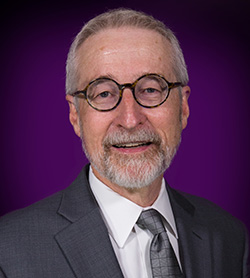
Charles Haynes of the Newseum Institute’s Religious Freedom Center. Photo courtesy of Religious Freedom Center via RNS

If a cross or crosses were visible during a public graduation ceremony, that wouldn’t necessarily be wrong or unconstitutional, Haynes said. But the church can’t require a cross to be visible, nor require students to listen to a pastor.

“Religious freedom isn’t a local church putting conditions on a public school using its facility and making sure its cross is visible,” Haynes said. “That’s the opposite of religious freedom, and that’s exactly what the First Amendment is intended to prohibit.”

Moving down the road to Allen

School district spokesman Cody Cunningham said in a statement there were “a variety of reasons including proximity, availability, attendance capacity and convenience” for moving the graduation events to the Allen Event Center in a neighboring suburb.

“In addition to proximity, McKinney ISD acknowledges the fact that parents and community members have expressed opposing views on the appropriateness of holding graduations in a religious facility,” Cunningham said. “More recently, the public debate over the venue intensified to a level that would likely have caused a distraction at the commencement ceremonies.

“While community members are entitled to their own opinions on the issue,” he added, “graduation is not an event to be used as a platform for religious or ideological debates, but rather a time to celebrate and honor students.”

‘You’ve got to pick your battles’

Seven years ago, in search of a community friendly to his Christian values, James Blanchet moved his family from Southern California to McKinney. When a cashier at a local Target store told him to “Have a blessed day,” he felt like he had found it.

Blanchet, the father of a high school senior, said Christianity seems to be under increasing attack in some quarters.

But the software sales professional said he has no problem with moving McKinney’s commencement ceremonies to a secular location.

“If they wanted to hold the graduation at a non-Christian place of worship, I wouldn’t feel comfortable with that,” he said at a coffee shop near the busy intersection of U.S. highways 380 and 75. “I do see both sides of it.

“So, in the scheme of things, is it a big deal? No. You’ve got to pick your battles.”

Accusations of intolerance toward Muslims

McKinney school officials declined to comment on the controversy, and the district spokesman would not discuss reports of an intolerant environment in the schools.

Two McKinney public middle school teachers resigned last month after they posted anti-gay and anti-Islamic tweets. Twitter messages were discovered in which the teachers referred to Islam as a “satanic death cult,” an “evil ideology” and a “political ideology … (that) cannot assimilate,” according to the Dallas-Fort Worth chapter of the Council on American-Islamic Relations.

At a meeting last month, Farah Uddin, a Muslim mother, urged the school board to accept diversity training offered by groups including CAIR and the Gay and Lesbian Alliance of North Texas.

Uddin noted that the school district’s “Vision, Mission & Beliefs” statement says, “Everyone has an inherent value and deserves to be treated with dignity and respect.”

“But with recent developments, I feel we are not following this belief,” Uddin told the board. “Some students have recently come out and reported that teachers within the ISD have been engaging in racist and discriminatory behaviors toward certain students in the classroom. As a result, these students are hiding their identity out of the fear of being bullied because of their race, religion, gender or sexual orientation.”

Pressing for more inclusivity

Kate Parker, a mother of two McKinney students, describes herself as agnostic.

The former public school art teacher said she has helped organize an informal, interfaith group of parents—including Christians, Jews, Muslims, atheists and agnostics. The group has pressed the school board for more inclusivity and sensitivity toward students of all faiths or no faith.

Too often, Parker said, teachers have placed Christian crosses and Bible verses on school walls, prayed aloud in classrooms and said things like, “The answer to all your big questions is God.”

“It’s about making sure every kid … feels comfortable and included at school,” Parker said in an interview. “Obviously, the focus has a lot to do with separating church and state and making sure that McKinney ISD is in compliance with the law. But for the group of us who have all been interested and talking with the district about this, the real overreaching umbrella is about inclusion.”

However, other parents worry that something special will be lost by moving the commencement ceremonies away from the church.

Heather Harrison said she attended graduation for two nieces and a nephew at Prestonwood Baptist. Each event was special, Harrison said, “especially because God’s presence was there.”

“I feel like it’s another step to moving everything toward more secular,” the mother of two said. “But I know Texas is a popular place. People move here from all different backgrounds, and so you don’t just have one belief in Texas.

“You have all kinds of people that come together,” she added. “So, I see where people could have an issue with it if you weren’t a Christian. … But it makes me sad.”


CommonCall: In the neighborhood, of the neighborhood

ABILENE—Not everything at Alameda Community Center in west Abilene operates quite the way Director Erica Currie envisions, and she couldn’t be happier.

When neighbors take ownership of programs and projects at the center, she knows she has done her job right.

“It’s all about empowerment,” said Currie, director of the center and associate minister of missions at Pioneer Drive Baptist Church in Abilene. “People like to feel useful, and they want to contribute.”

Alameda Community Center is home to an afterschool program and a ministry to at-risk youth, as well as a meeting place for the Alameda Neighborhood Association and a congregation, The Church at Alameda.

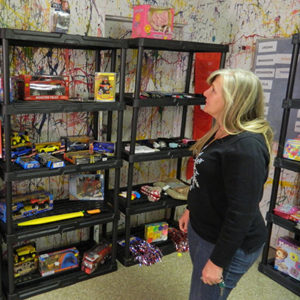
Erica Currie, director of the Alameda Community Center, examines items in the center’s seasonal store. Neighborhood parents who volunteer at the center are eligible to shop for their children. Donated items are discounted to 10 cents on the dollar. (Photo / Ken Camp)

It also offers a seasonal Christmas store where neighborhood parents who volunteer for a couple of hours are eligible to buy donated items to give their children, discounted to 10 cents on the dollar.

In the future, she hopes the center can offer a similar store in late summer with back-to-school supplies.

“It’s not about making money. It’s about making it possible for parents to provide for their own children,” Currie said. “We’re just trying to level the playing field for them.”

Drawn by a support group

Fifteen years ago, when Currie first set foot in the space Alameda Community Center now occupies, the building housed Westside Baptist Church. She was not a Christian, but she showed up to attend a support group for parents.

“There were not a lot of resources available for parents with special-needs children here in Abilene at that time,” she recalled.

The congregation also offered a Sunday school class for developmentally challenged children. Currie’s husband, Mike, thought it would be good for their autistic son, Harrison, to attend.

Six months after her family began attending church together, Erica Currie made a profession of faith in Christ. Within a couple of months, both she and her husband were baptized at Westside Baptist Church.

‘A place that was steeped in fear’

In addition to ministering to the special-needs community, leaders at Westside—which became New Haven Baptist Church—also wanted to reach their immediate neighborhood. Members became involved in ministries to Alameda—a low- to moderate-income area that had become infested with gang activity and drug dealing.

“There was one time where we had two homicides within an 18-month period,” Currie recalled. “It was a place that was steeped in fear.”

Within a relatively short time, several key events occurred. The pastor at Currie’s church resigned and moved to another city. Residents formed the Alameda Neighborhood Association out of a desire to improve their immediate community, northeast of Dyess Air Force Base. And Pioneer Drive Baptist Church wanted to develop a community outreach ministry to Alameda.

Build on community strengths

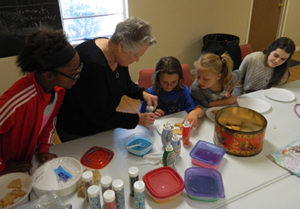
Donna Lanier, a volunteer from Pioneer Drive Baptist Church in Abilene, shows children in the afterschool program at the Alameda Community Center how to decorate cookies. (Photo / Ken Camp)

Nathan Adams, minister of missions at Pioneer Drive, wanted to help the church move from doing ministry for people in need to doing ministry alongside people in the community, building on their strengths.

Influenced by the Christian community development models presented in Toxic Charity by Robert Lupton and When Helping Hurts by Brian Fikkert and Steve Corbett, Adams helped communicate the principles of those books to key leaders at Pioneer Drive.

First, the church asked whether what it was doing enabled dependency or empowered people to improve their own lives.

Second, the church examined whether the ministries made an impact on the lives of people on the margins or whether they “just made us feel good,” Adams noted.

‘Neighbors helping neighbors’

Adams talked with Currie about leading a community center at the site of the disbanded Westside Baptist Church that would seek to build on community assets and help residents to take ownership of their neighborhood and its future.

“We want to help neighbors develop their own gifts and recognize their own value,” he said. “It’s neighbors helping neighbors.”

Currie recognized the merits of the approach. When she looked at the neighborhood to determine its assets, she realized the residents had old tires—lots of them. A home-improvement TV program inspired her to organize a tire-painting party in Alameda. So, she worked with Alameda neighbors to turn eyesores into decorative planters and a playground obstacle course.

She also started prayer-walking the neighborhood.

Building relationships

“That turned out to be a great way to meet people,” she recalled.

In the process, she recognized the secret to revitalizing the neighborhood—building relationships.

Kevin Scroggins, a recent Hardin-Simmons University graduate who leads the programs for youth at the Alameda Community Center, agrees with the approach.

“My goal is for these young people to draw closer to Jesus Christ, whether that is through the Bible study and discipleship or the games and the fellowship,” he said.

Transformation in the community

As Currie and others at the center earn the trust of neighborhood residents and share the love of Christ with them in natural ways, transformation occurs.

She recalled breaking up a shouting and cursing match between two women in the neighborhood. “There was no love lost” between the two women or their families, Currie remembered.

However, in time, relationships developed. When the home of one of the women burned recently, the woman with whom she had been fighting took the lead in raising money for the displaced family.

Recognizing the value of neighbors helping neighbors involves relinquishing control, Currie said. For example, parties the Alameda neighbors plan look significantly different than events she would organize.

“It’s not my kind of music,” she said, noting the only requirement she places on the party planners is that the lyrics are free from profanity. “They bring in their own D.J. and play their music. It’s not the way I would have done it, but it’s their party.”

‘We want to contribute, too’

Sometimes, she needs to be reminded. At one point, a woman in the neighborhood volunteered to cook for the weekly leadership luncheons at the center. Initially, Currie turned down her offer, saying the staff could handle the cooking chores.

“Sister, you need to humble yourself,” the woman told Currie. “We want to contribute, too.”

Pleased to see someone had taken to heart the message of empowerment she had been preaching, Currie relinquished lunchtime cooking duties.

When neighbors in Alameda originate a program or make it their own, it succeeds, Currie noted. When it is imposed or not allowed to take root naturally, it fails.

For example, she and others identified Alameda as a food desert—an area where residents lack access to fresh produce and other healthy groceries. So, they envisioned a community garden as the answer.

“We didn’t really ask the people in the neighborhood if they wanted it,” she acknowledged. Currie and other leaders at the center had to write off the community garden as a failed experiment.

Putting down roots in the community

Gina Allen helps a student in the afterschool program at the Alameda Community Center. (Photo / Ken Camp)

However, one positive benefit grew from the garden. Gina and Trevor Allen met there as they worked together planting and weeding, and while the plants failed, their relationship blossomed.

Gina, a graduate of Abilene Christian University who is in her third year on staff at the center, recalled praying, “Lord, I sure would like to live here in this neighborhood.” Trevor shared the same desire, and they decided to plant their lives—at least for the immediate future—in Alameda.

Within three years, Alameda Community Center will move toward becoming a nonprofit organization separate from Pioneer Drive, although the connections between members of the church and the center will remain strong.

The center depends on volunteers from Pioneer Drive and other churches to lead the after-school program. However, people from the neighborhood increasingly are assuming responsibility for other ministries, Currie noted.

It’s a far cry from the days when she urgently prayed for God to “send laborers,” not knowing from where they would come.

“I stand in awe of God,” Currie said. “I think about all the prayers that have been sent up, and then I see what God is doing here.

“He probably would be doing it anyway. He probably didn’t need me here. But it’s pretty cool that he gave me a front row seat to watch it.”

This is part of an ongoing series about how Christians respond to hunger and poverty. Substantive coverage of significant issues facing Texas Baptists is made possible in part by a grant from the Prichard Family Foundation.

Read more articles like this in CommonCall magazine. CommonCall explores issues important to Christians and features inspiring stories about disciples of Jesus living out their faith. An annual subscription is only $24 and comes with two free subscriptions to the Baptist Standard. To subscribe to CommonCall, click here.


Texans recall famous evangelist Billy Graham as humble servant

Christians in Texas joined believers around the United States in reflecting on the life and legacy of evangelist Billy Graham, who died Feb. 21.

“If anyone ever deserved the commendation ‘well done good and faithful servant,’ it was Billy Graham,” said David Hardage, executive director of the Baptist General Convention of Texas. “He truly experienced a life well lived.”

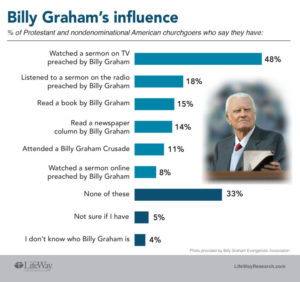
He also lived a life that touched countless others. Two-thirds of Protestant churchgoers had some contact with Graham’s ministry, according to a recent LifeWay Research survey.
Nearly half of the respondents (48 percent) watched a Billy Graham sermon on television, and about one in five (18 percent) listened to one of his sermons on the radio. Others noted they read at least one of his books (15 percent), read his newspaper column (14 percent) or watched one of his sermons online (8 percent).

Graham was named among the top 12 most effective preachers in the English-speaking world in a survey Baylor University conducted in 1996.

Frequent guest speaker at Baylor

The evangelist first visited Baylor in 1951, preaching in a morning chapel service in Waco Hall and at an evening worship service at First Baptist Church in Waco. He returned to Waco in May 1953 to speak at a memorial service for victims of the tornado that devastated the city’s downtown area.

He spoke at Baylor multiple times in the decades that followed, and in 1970, he preached at Waco’s Heart of Texas Coliseum at an event celebrating the university’s 125th anniversary.

“He spoke of the university’s commitment to faith and learning and to helping our students understand their responsibility to be the hands and feet of Christ and serve others through the world, a commitment to which Baylor remains faithful,” President Linda Livingstone said.

Livingstone, who called Graham “a good and faithful servant of our Lord and Savior Jesus Christ,” noted his daughter, Anne Graham Lotz, served on the university’s board of regents, and three of his grandchildren earned degrees from Baylor.

“Our deepest prayers are with the Graham family, and we join millions around the world in giving thanks for Billy Graham, for his unyielding faith in a risen Savior and his mission to bring Christ’s light to the world,” Livingstone said.

‘Genuine humility’

The secret to Graham’s success was “the fact that he has never focused on success,” said Jim Denison, founder of the Denison Forum.

“His genuine humility and complete dependence on God have enabled the Holy Spirit to use him in truly historic ways,” he said.

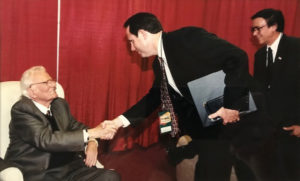
Jim Denison meets evangelist Billy Graham in 2001. (Photo courtesy of Denison Forum)

In 2001, Denison was pastor of Park Cities Baptist Church in Dallas, and he was part of a North Texas delegation sent to invite Graham to preach in the Dallas-Fort Worth area.

“It was my responsibility to explain to him the reason for our visit and present a book containing more than 700 letters of invitation,” Denison wrote in an online column. “After I made our request, he asked me why I felt we needed him to come.”

Denison responded by describing the spiritual lostness of the area and of its need for spiritual awakening.

“Dr. Graham listened politely. Then he explained his question,” Denison wrote. “He understood why we would need a spiritual revival, but why did I feel he was the person to help? At his advanced age, with his infirmities, how could he be of help to us?

“Here was a man who had preached in person to more than 80 million people and led more than 3 million to Christ through this sermons and public invitations. He was commonly considered the greatest evangelist after the Apostle Paul. And yet he was genuinely uncertain he had the capacities to do what we were asking him to do.

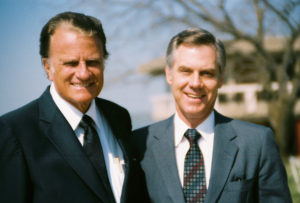
Billy Graham and James Pleitz, then-pastor of Park Cities Baptist Church in Dallas, participate in the commencement service held on the Dallas Baptist University campus in March 1985. (DBU Photo)

“Dr. Graham took several weeks to pray and reflect before accepting our invitation. The Metroplex Mission with Billy Graham in October 2002 was one of the largest and most effective events in the history of the Billy Graham Evangelistic Association.”

In 1985, Dallas Baptist University presented its first honorary doctorate to Billy Graham. Over the years, DBU partnered with the Billy Graham Evangelistic Association for various outreach events and ministries.

“Few other men have run the race like Billy Graham, always hopeful and always pointing to Jesus,” DBU President Adam Wright said. “What a wonderful testimony to a life well lived.”

Longtime member of First Baptist Dallas

Graham was a member—albeit a nonresident member—of First Baptist Church in Dallas more than 50 years. Pastor Robert Jeffress, who grew up in the church, recalled his mother joined First Baptist the same day as Graham.

“She said to my father, ‘If it’s good enough for Billy Graham, it’s good enough for me,’” Jeffress said. “She was saved at a Billy Graham crusade in 1954 at the Cotton Bowl in Dallas, before I was born. Simply put, I am a Christian today and pastor of First Baptist Dallas because of Billy Graham.”

Billy Graham preaches at First Baptist Church in Dallas, in this 1960 photo. Seated behind him is Pastor W.A. Criswell. (Baptist Standard File Photo / Courtesy of the Dallas Morning News)

Jeffress praised Graham as pre-eminent evangelist and man of integrity who had “unfeigned and boundless love for people.”

“Once, when he was preaching at First Baptist Dallas, I told him before the service that my barber and his family were attending, and I had been praying that they would all become Christians,” he recalled.

“I asked Dr. Graham if he would write them a note before the service began. He wrote a brief note on a card to my barber that said: ‘I’m praying for you tonight to become a Christian. Billy Graham.’ When Dr. Graham extended the invitation that night, my barber and his family were the first to come down the aisle.”

‘Grace and humility’

Jack Graham, pastor of Prestonwood Baptist Church in Dallas, recalled people asking if he was related to the famous evangelist. He was not, but the North Dallas pastor claimed him as his “spiritual father.”

“I first heard him at a crusade in Little Rock, Ark., as a young boy, and he was influential in my life since that moment,” he said. “Getting to know him personally and spend time with him in the last few decades are among the greatest privileges of my life.

“Today I praise God for the life and message of Billy Graham. Throughout his 99 remarkable years on Earth, he never wavered to call people to repentance in Jesus. Every single one of his sermons—and he preached countless times to millions—was about the cross and the resurrection of Jesus. And every single time, he called people to get up and make a public decision and follow Jesus. He did it all with grace and humility and without any apology.”

‘Person of integrity’

William Martin, author of A Prophet with Honor: The Billy Graham Story, called Graham “the key leader and the major spokesman of the evangelical movement during the last half of the 20th century.”

Martin, senior fellow in religion and public policy at Rice University’s Baker Institute for Public Policy, characterized Graham as “a person of integrity.”

“Though he made some missteps, he remained free of scandal,” Martin said. “He achieved his success by hard work rather than by inheritance or luck. He used the latest technology and media, but depended on the loyalty of a small group of friends who were with him for decades.

“He hobnobbed with the famous, the wealthy and the powerful around the world, yet seemed surprised that people were interested in him. He often seemed to have the kind of wonder of a small-town boy. He was both genuinely humble and genuinely ambitious and aware of the tension between those inclinations.

“He was not a perfect man, but he was an uncommonly good one.”


CLC leaders call for prayers and action after school shooting

Two officials with Texas Baptists’ Christian Life Commission joined more than 100 other evangelical leaders nationally in calling for prayers and action after the school shooting in Parkland, Fla., that left 17 dead and dozens injured.

CLC Director Gus Reyes and Public Policy Director Kathryn Freeman signed the Prayers and Action for Gun Safety in America petition calling for “common-sense gun laws.”  Freeman noted the job titles listed on the petition were for identification purposes only, and the commission has not taken a position on the issue.

“As we mourn for our brother and sisters who have died, we pray fervently for their friends and family who grieve. We also accept and declare that it is time to couple our thoughts and prayers with action,” the petition states.

While the petition acknowledges actions might take different forms for various Christians, it calls on “all Christian leaders to join together as brothers and sisters in Christ to become part of the solution.”

“We acknowledge our biblical responsibility to protect life by lovingly guiding those who are suffering from severe mental illnesses to the appropriate professional resources, by urging America’s lawmakers to pass common-sense gun laws, and by encouraging gun owners to take precautions against the risks associated with allowing firearms in their homes when children are present or when a family member is dealing with crisis,” the petition states.

‘Hopeful prayers and thoughtful action’

Christians should respond to gun violence with “both hopeful prayers and thoughtful action,” Freeman said.

“I think we need to move beyond the same old binary thinking that causes both sides of the debate to remain recalcitrant. I am not only concerned with the mass shootings which now seem to be a regular occurrence, but the woman whose life is endangered by her abusive ex-husband and the kid struck by a stray bullet while playing in the park,” Freeman said.

“We need a new conversation and new solutions that address our cultural obsession with violence, but we also need to address the lack of access to affordable mental health care services, the unlimited access to automatic weapons, and the connection between gun violence and domestic violence.”

‘Not acceptable in a civilized culture’

The mass shooting of students simply is “not acceptable in a civilized culture,” said Rob Schenck, president of the Dietrich Bonhoeffer Institute and an original endorser of the petition.

“When children wake up in the morning, they should only worry about homework or a test, not whether they will be killed in a hail of gunfire. No parent should worry that a gun battle will break out or that they’ll be met at the end of the school day at the emergency room by a grim-faced chaplain,” Schenck said.

“If the solution to this deadly disease in American society is more guns, then the United States—with over 300 million weapons in general circulation—would be the safest place on earth. We have a moral emergency in our country. It’s time we wake up, face it, and fix it. Now.”

On Feb. 20, President Trump announced he signed a memo directing Attorney General Jeff Sessions to draft regulations to ban “bump stocks” and other devices that essentially enable semi-automatic weapons to operate like automatic firearms.


Social media personality Kirby Minnick challenges young women to follow Jesus 

SAN ANTONIO—A popular Christian YouTube personality urged young women at the Shine Girls’ Conference to “live a blessed life, not an easy life.”

Kirby Minnick, a communications major at Dallas Baptist University and social media influencer, was keynote speaker at the two-day conference at Crossroads Baptist Church in San Antonio, sponsored by Union Femenil Misionera de Texas and the Hispanic Baptist Convention of Texas.

Through her YouTube channel, Minnick offers content that ranges from comedic skits, to lifestyle and beauty, to her personal faith in Jesus.

‘I felt empty’

Minnick recalled how her father suffered depression and abused alcohol, which led to her parents’ divorce.

Minnick lost her father when she was in fifth grade as a consequence of his alcoholism. Not long before his death, her therapist suggested she share with him how his use of alcohol was hurting her. She failed to address the issue the last time she saw him, and she felt guilty.

“I felt empty, worthless and alone,” Minnick said.

Her father’s death led her to think she had to try to fix whatever problems other people had. However, she soon realized that was impossible, and she felt like a failure.

At church camp, she cried out asking God to “just show up.”

At that moment, Minnick realized she had been trying to fix and heal others, but God was the only one who could do that.

Finding freedom

“I felt like this weight had been take off me, and I felt this freedom,” she said.

Once she realized God was in control, and she wasn’t, she felt liberation, she explained.

“I was never in control,” she said.

Challenges remain in her life, but Minnick told the young women it is a blessing to follow Jesus. But blessing does not mean freedom from difficulty, she stressed.

“Live a blessed life, not an easy life, ” she urged, challenging them to find their new identify in Christ.

Don’t let the good take the place of God

Sometimes, Christians are tempted to place other people or things in the position only Christ should hold in their lives, she noted.

For Minnick, following Christ meant breaking up with a boyfriend, even though he, too, was a Christian. Even good things should not take the place of God, she stressed.

“We are not to place the things of this world over God,” she said. “We are to worship the Creator and not the created.”

After she and her boyfriend ended their relationship, she went to an event she would not have attended if they still had been together. At that event, she connected with the Shine organizers and later received the invitation to become the conference keynote speaker.

Minnick now sees God was leading her to fulfill a calling, but she certainly could not understand God’s guidance before.

“We have to believe God will provide,” she said. “What we need is so much bigger than what we want.”

Obedience as a discipline worth practicing

An act of obedience, even when it is hard to understand God’s purpose, is a discipline worth practicing, Minnick said.

“We cannot walk the race if we cannot walk in obedience,” she said.

Even when they are obedient, Christians sometimes face difficulties, she noted. She described her struggles with anxiety and depression when she started college.

Although she found the new environment difficult, God’s Holy Spirit reminded her she was “made for more than this,” she said.

In the moments of doubt, Christians can look at how God has protected and guided them, and then trust God will continue to do so.

There is new life in Christ, and those who have trusted in him must live as new creations, she emphasized

“Satan speaks deceit, but we must start agreeing with what Jesus says you are,” Minnick said. “We have been chosen to be children of God. In Christ, we are able to overcome anything.”


BGCT board removes CBF as recognized giving option

DALLAS—The Baptist General Convention of Texas Executive Board wants Texas Baptist churches that financially support the Cooperative Baptist Fellowship to send those contributions directly to the Fellowship—not to the BGCT.

In response to a hiring policy change at CBF that opens certain jobs to LGBT individuals, the BGCT Executive Board voted to revise its contribution forms to delete CBF as a Cooperative Program giving option and remove CBF Global Missions as a recognized designated offering.

“In light of CBF’s governing board vote, we believe it is proper and prudent to remove CBF as a giving option from the BGCT gift remittance form and to encourage churches to send their CBF gifts directly to the CBF national office,” according to the recommendation the finance committee and administration support committee jointly presented to the BGCT Executive Board.

No board members raised questions about the recommendation during the general session, and Chairman Dennis Young, pastor of Missouri City Baptist Church near Houston, noted only one vote in opposition.

The BGCT allows churches to indicate on a giving form how they want to direct the worldwide portion of the funds they send to the state convention’s Cooperative Program unified budget. CBF has been a BGCT Cooperative Program giving option since 1994, and CBF Global Missions has been a designated offering option since 1997.

Paynter: ‘Deeply disappointing’

Last year, 349 Texas Baptist churches gave more than $1 million to CBF through the BGCT—$776,981 as a worldwide cooperative giving option and $315,862 to CBF Global Missions.

CBF Executive Coordinator Suzii Paynter, who served previously on the BGCT Executive Board staff as director of the Texas Baptist Christian Life Commission, called the decision “deeply disappointing” but pledged CBF would continue to work with Baptists in Texas.

“CBF will continue beautiful collaboration with Baptists in Texas, including with 18 missionaries with Texas ties serving on three continents, as well as starting new Texas churches, providing scholarships for Texas students, combatting rural poverty along the Texas-Mexico border and in many other ministry areas,” Paynter said.

“While this decision by the BGCT Executive Board is deeply disappointing for how it changes the cooperative method by which Texas Baptist churches support CBF, it will not change our prayerful expectation that churches will support CBF directly as a mission-sending organization to more than 30 countries around the world.”

Contrary to ‘long-held positions’ on sex and marriage

The BGCT board acted after the CBF Governing Board recently adopted a revised hiring policy and implementation procedure that allows LGBT individuals to be considered for some staff positions but maintains limits on missions and ministry leadership personnel.

The CBF board adopted the new policy as part of a two-part recommendation from CBF’s Illumination Project Committee, created to examine how the Fellowship could respond to cultural changes—particularly regarding human sexuality.

Soon after the CBF board approved the Illumination Project Committee reports and its recommendations, the BGCT issued a statement: “While we understand and respect the decision-making process undertaken, BGCT affirms our long-held position on biblical sexuality and marriage. We believe the Bible teaches that any sexual relationship outside the bounds of a marriage between a man and woman is sin. Texas Baptists value every human individual, and our churches will continue to be loving, respectful and welcoming to all people.”

Paynter expressed her hope Texas Baptist churches would keep in mind the CBF missions personnel serving globally.

“Much has been said from across the spectrum related to the implementation of CBF’s new Christ-centered hiring policy, but one thing is for sure—what unites us is nothing other than our mission to advance the cause of Christ,” she said.

“I hope rather than making immediate decisions related to funding to the detriment of CBF missionaries serving all over the world, Texas Baptist pastors and lay leaders would give to CBF directly and would enter into conversation with us.”

Let go of selfishness and sinfulness

During his remarks to the board, BGCT President Danny Reeves, pastor of First Baptist Church in Corsicana, challenged Texas Baptists to “get to know God in a deeper way—in the depths God deserves to be known.”

If Texas Baptists want to be considered friends of God, as the Old Testament patriarch Abraham was known, they need to let everything go—particularly selfishness and sinfulness, Reeves said.

Pointing to the Genesis account of God’s judgment on Sodom and Gomorrah, Lot addressed the men of Sodom as “friends,” even when they sought to sexually assault his guests, he noted.

“Who do we as God’s church call friends?” Reeves asked. “Who do we as Texas Baptists consider to be our friends?”

Study possibility of meeting every other year

The board also voted to task the BGCT Executive Board staff to study the feasibility of moving from an annual meeting to a biennial state convention, with a possible discipleship and evangelism event scheduled on alternate years.

The task force will report its findings to the board’s executive committee in May, who will report to the full BGCT Executive Board.

In other business, the board moved two institutional board members from board-elected positions to BGCT-elected positions—Anne Halbert of First Baptist Church in Waco to the University of Mary Hardin-Baylor board of trustees and Paul McClinton of Columbus Avenue Baptist Church in Waco to the Baylor Scott & White-Hillcrest board of trustees.

The board also filled vacancies on several councils, electing:

  • Abe Jaquez of First Baptist Church in Sunnyvale to the Hispanic Education Initiative Council.
  • David Ritsema of First Baptist Church in Waxahachie and Yolanda Young of The Cross Baptist Church in Tyler to the Baptist Student Ministry Council.
  • Robby Barrett of First Baptist Church in Amarillo, Jill Fulghum of Southland Baptist Church in San Angelo and Larry Soape of First Baptist Church in San Antonio to the BaptistWay Press Advisory Council.
  • Darrell Beggs of Central Baptist Church in Hillsboro to the Connections Council.
  • Eron Green of First Baptist Church in Beeville to the Missions Mobilization Coordinating Council.
  • Nick Swinford of Cross Brand Cowboy Church in Tyler, Dan Jones of Triple Cross Cowboy Church of Hood County in Granbury, Marcy Grun of Bluff Creek Cowboy Church in Winters and Gordon “Bubba” Fowler of Colorado River Cowboy Church in Smithville to the Western Heritage Council.


TBM partners with Israel’s Emergency Volunteer Project

DALLAS—Texas Baptist Men will work with Israel’s Emergency Volunteer Project in disaster preparedness.

The TBM board of directors voted Feb. 16 to enter a two-year partnership with the Israeli emergency response organization in disaster relief training and deployment.

TBM volunteers will be involved in cross-training with Emergency Volunteer Project—teaching the Israeli group how to provide large-scale emergency food service and learning ways to assist civilian populations affected by man-made disasters.

TBM also will provide the group with disaster relief equipment and send volunteer teams to help renovate civil defense shelters.

‘Your name walks before you’

Even before Emergency Volunteer Project leaders met TBM representatives, they knew them as “the guys in the yellow shirts” who respond to disasters, said Adi Zahavi, the organization’s director general.

Adi Zahavi, director general of Israel’s Emergency Volunteer Project, speaks to the Texas Baptist Men board.

“Your name walks before you all around the world,” Zahavi said. “You are a role model for us. You are doing important, holy work.”

Israel not only lives in a politically volatile area threatened by its enemies, but also is due for a round of major earthquakes that occur about every 100 years, Zahavi explained. The Emergency Volunteer Project exists to recruit, train and deploy individuals to support emergency responders in Israel.

TBM volunteers who serve in Israel will be free to share their faith with people they encounter, said Mickey Lenamon, TBM executive director.

“The reason we go anywhere is to tell people about Jesus,” Lenamon said. “This is an opportunity to go to Jerusalem and share the love of Jesus.”

The TBM board also heard reports from various ministries:

  • Disaster relief workers responded to 21 disasters in 2017, contributing more than 351,000 volunteer hours. They completed 6,684 recovery projects, provided access to 28,262 showers, washed 16,214 loads of laundry and distributed 51,549 boxes for disaster survivors to gather and store their scattered belongings. They gave away 5,554 Bibles, recorded 26,545 gospel presentations and ministry contacts, and registered 238 professions of faith. In six months after Hurricane Harvey, volunteers prepared more than 1.57 million meals.
  • TBM’s water ministry drilled 11 wells in four countries last year, and volunteers also repaired a dozen wells in Ghana. They provided 1,851 water purification filters to more than 7,400 people in Texas, at a Navajo Reservation in New Mexico and in eight foreign countries.
  • Royal Ambassador summer camps last year attracted 2,658 campers, and 339 made commitments to Christ. In addition, 20 teenage young men—mostly inner-city youth—made faith commitments at Challengers basketball tournaments.

The board presented the TBM Service Award to Larry and Mary Harrison, who have lived on-site at the Dixon Missions Equipping Center in Dallas two years in a travel trailer, serving in multiple volunteer capacities.

TBM recognized Russell and Rachel Schieck of Ralls with its Parabaloni Award, named for a first-century Christian brotherhood who risked all for their faith.

The board also recognized Randy Newberry, who retired recently as men’s ministry consultant, and Bill Pigott, who will retire as volunteer director TBM builders after 15 years in that role.


First-generation college students find home and help at BSM

EDINBURG—As a first-generation college student, Alejandra has faced her share of challenges.

Because her family has no experience with college life, they cannot advise her in some areas.

Alejandra is reluctant to reveal her last name because, although she entered the United States legally, she overstayed her visa and is in the process of trying to resolve immigration issues.

As a first-generation student from another culture, finding the support she needs at the University of Texas Rio Grande Valley can be difficult.

“I have felt clueless in college,” she said. “I had to learn how to speak up and defend myself.”

However, she found welcome support at the UT Rio Grande Valley Baptist Student Ministry. Alejandra, a studio art major, said BSM made a positive and profound impact on her life.

Found support and guidance

Like Alejandra, Daniel Ortiz arrived in the United States from Mexico along with his family several years ago.

Daniel Ortiz

His parents wanted him to have better opportunities, and they thought education would help provide that.

As soon as Ortiz began college, he faced decisions he was not prepared to make.

“I made mistakes I probably would not have made if I was not a first-generation college student,” said Ortiz, a clinical lab science major who hopes attend medical school after college to become a missionary doctor.

At the BSM, Ortiz gets a chance to find support and guidance.

“I think the church should be more like the BSM, where you have day-to-day interactions,” Ortiz said.

The future college population

Alejandra and Daniel are not atypical of the student population at UT Rio Grande Valley, said Robert Rueda, BSM director at the school. In fact, he added, they might be examples of what many college students may look like soon throughout Texas and around the rest of the nation.

Hispanic students make up 89 percent of the students enrolled in 2017 at UT Rio Grande Valley, which has a main campus in Edinburg and several other sites elsewhere in South Texas.

Of first-generation students enrolled at the school last year, more than 94 percent were Hispanic.

Latinos are the largest and fastest-growing minority group in the nation.

So, it is not surprising to see the number of Hispanics enrolling in college across the country rise to 47 percent, equal to the Anglo enrollment rate.

Model for other campus ministries

For that reason, Rueda’s work at the UT Rio Grande Valley BSM could provide a guide for other BSMs to consider in the future.

“My goal is not only to teach students about Jesus, but to also show them a model of growth in their life,” Rueda said.

Many of the students with whom Rueda works are the first members of their families to attend college. In many cases, the students’ parents immigrated to the United States specifically so their children would have better educational opportunities.

For many, graduating from high school represents a great accomplishment, but college is an unknown place with challenges they are not ready to tackle alone.

Although the students’ parents want their children to receive an education, a 2006 study by University of Michigan professor Vasti Torres reveals a clash between cultural expectations and the parents’ understanding of college life.

Finish college

BSM can help “provide the support the students need to finish college,” Rueda said.

“We are called to be transformed and to help people be transformed,” he added.

The Post Secondary National Policy Institute reported first-generation college students have lower rates of college readiness, and are therefore more likely to fail in college and not complete the degrees they plan to pursue.

For students whose parents went to college, 64 percent will finish college in a six years, while only 50 percent of first-generation college students will finish their degree in that time.

Transforming the region

So, helping first-generation Hispanic students finish college is an investment in the future not only of those students, but also of their families and their communities, Rueda said.

“Education in the Rio Grande Valley is key to transforming the Rio Grande Valley,” he said.

Rueda sees it as part of his role to help students know more about their options. Although it is not part of his job description, he has learned about grants and loans available for students to pay for college.

“Our goal here is to affirm every student,” Rueda said. “They have to deal with so many issues, but we know tomorrow they will be young professionals committed to the church.”

The median household income for first-generation college students is $37,565, Forbes reported. That represents a significant difference from the $99,635 annual household income of college students have whose parents earned a degree.

The challenges first-generation Hispanic college students face do not have to be seen only as obstacles, Rueda insisted. Instead, they demonstrate how resilient these students are, and how hard they work to accomplish their goals, he said.

“They work hard already, and will continue to work hard when they go somewhere else,” he said.

Success story

The opportunities to provide support to first-generation college students has given Rueda an opportunity to build friendships and see how graduates use their preparation in college to serve others.

Jesus Jose Mendoza, who graduated from UT Rio Grande Valley in 2016, now works at the BSM as a campus missionary. (Photo / Jacob Mendoza)

He points to Jesus Jose Mendoza, a campus missionary intern at the UT Rio Grande Valley BSM, as a recent example.

Mendoza’s parents were migrant workers. Depending on the season, his parents would come and go from Texas and Oregon. Mendoza and his two siblings went along with them.

“My dad saw his and my mom’s life and wanted something different from us,” Mendoza said. “‘Struggling’ was a word they used a lot.”

Survival made education difficult sometimes, he noted. Sometimes Mendoza’s family would return from Oregon to Texas two or three months after the school year started.

While keeping up with education was hard, Mendoza said he had the support of teachers at his high school. But that same interaction is not normally seen between college professors and students, he added.

“Teachers were mostly only available for academic stuff,” Mendoza said.

Mendoza struggled with the demands of school and did not think finishing college would be possible.

“I knew education was important, but when life would get in the way, I would wonder how hard it would be to just move back to Mexico,” he said.

College presented a big challenge to Mendoza, and now he is thankful he persevered until he finished.

“My dad wanted us to have something that would break the mold,” Mendoza said, who graduated from college in 2016.

BSM can provide a support from the beginning of the students’ college careers, which will help them stay in college, Rueda said.

“We can’t just sing ‘victory’ if students go to college, but sing it when they finish college,” he said.


Ellis named dean at Logsdon School of Theology

ABILENE—Hardin-Simmons University named Robert Ellis dean of the Logsdon School of Theology.

Robert Ellis

The university made the announcement five months after Ellis was named interim dean, following the retirement of Donald Williford. Ellis will be the fourth dean for HSU’s Logsdon School of Theology since its beginning in the 1980s.

“Now more than ever, we need ministers trained to meet spiritual needs,” HSU President Eric Bruntmyer said. “Bob’s commitment to the embodiment of a strong, biblically-informed theology of love and compassion makes him a superb choice to lead Logsdon into the next chapter of its story.”

HSU’s Logsdon School of Theology is home to both undergraduate studies and accredited seminary programs. As such, Ellis will be responsible for a wide scope of theological education and ministry preparation, including Logsdon Seminary programs, including extension campuses in San Antonio, Dallas-Fort Worth, Corpus Christi, McAllen and Lubbock.

Ellis earned his undergraduate degree in religion at HSU and earned both his Master of Divinity and Doctor of Philosophy degrees at Southwestern Baptist Theological Seminary. He also pursued post-doctoral study at the University of Cambridge.

Ellis is the author of numerous publications, including Learning to Read Biblical Hebrew: An Introductory Grammar. In 1992, he was named a distinguished alumnus of Logsdon.

Tenured at HSU since 1996, Ellis served as the Phillips Professor of Old Testament and Hebrew, and he previously directed both the Master of Arts in Religion and Master of Divinity programs. Until his appointment as interim dean, he was associate dean for academics at Logsdon Seminary and liaison to the Association of Theological Schools.

While most of Ellis’ teaching career has been at HSU, he also served a decade as an associate professor of Old Testament at Southwestern Baptist Theological Seminary.

Additionally, Ellis taught as an adjunct at the Baptist Theological Seminary in Bucharest, Romania, and at the Nigerian Baptist Theological Seminary in Ogbomosho, Nigeria.

He has served as an interim pastor for numerous congregations.

Ellis, and his wife Teresa, Logsdon’s theological librarian, are members of First Baptist Church in Abilene, where they teach a Sunday School class. Both are deacons and have been engaged regularly in international mission efforts.


Congregational support over the long haul helps people deal with grief and loss

WACO—Churches cannot heal people who experience grief, but like a cast provides support to allow a broken bone to mend properly, congregations can offer support as God gradually knits together lives fractured by loss, a Baylor University social work professor said.

Helen Harris, associate professor in Baylor University’s Diana R. Garland School of Social Work

“God has created our bodies with a marvelous capacity to heal,” said Helen Harris, associate professor in Baylor’s Diana R. Garland School of Social Work.

Likewise, God heals the broken hearts and wounded spirits of grieving people, and he can use churches to provide the support necessary for fragmented lives to come back together in healthy ways, she insisted.

Often, congregations look to professional caregivers, such as pastors and counselors, as experts in grief and loss, Harris said.

“The people who know the most about grief are the people who are experiencing it,” said Harris, who helped begin the first hospice in Waco.

Christians rightly celebrate the life of a deceased person and find hope in biblical promises of everlasting life, but they also should find ways both to “come alongside” individuals who have experienced loss and “give space” to allow them to express grief, she said.

Unique nature of each person’s grief

As congregations seek to care for people in grief, their ministry should be “high touch, not high structure,” she emphasized. Formulaic approaches fail to take into account the distinctive ways different people experience grief, she said.

“Grief is universal, but it also is highly individual and unique,” she said.

Churches typically do a good job ministering to people in the days immediately surrounding a death, said Harris, a member of First Woodway Baptist Church in Waco.

“We show up at the hospital, at the home, at visitation and at the funeral,” she said. “We bring casseroles, cakes and pies. But it’s not long before the rest of us move on with our busy lives.”

‘One loss after another’

Many church members have an unspoken expectation that people who have experienced loss should “get on with their lives” after a loss, she observed.

“Actually, the grieving person experiences one loss after another for the first year,” Harris said.

The first birthday, wedding anniversary, Thanksgiving and Christmas without a loved one can be painful, she noted.

Harris suggested congregations maintain a bereavement calendar in the church office as a reminder to send a note or make a phone call to members who have experienced loss before holidays and on other personally important dates.

Even beyond the first year, major life events can trigger grief, she added.

‘Not all loss is the same’

“Think about the bride who doesn’t have her dad there to walk her down the aisle,” she said. “Or maybe it’s the birth of a child, and a loved one is not there to experience it.”

Churches also need to keep in mind grief due to ambiguous loss, Harris noted. In some cases, such as Alzheimer’s disease or traumatic brain injury, a loved one may be physically present but psychologically absent. In other cases, such as separation due to divorce or military deployment, the person remains psychologically present but is physically absent.

“Not all loss is the same,” Harris said.

Different circumstances surrounding a loss also have an impact on how churches should minister to individual circumstances, she observed. People who lose a loved one due to an act of violence or a catastrophic disaster experience trauma, she noted.

“They need to do trauma work first before they begin grief work,” she said.

Grief recovery does not occur as a linear progression, Harris noted.

“It’s a journey, a process that folds back into itself,” she observed.

Christians help people deal with their grief when they acknowledge its reality, respond in empathy and provide support, she noted.

“The church has the most incredible resource of any organization on Earth to help people who are experiencing grief—its individual and corporate relationship with God the Father, Son and Holy Spirit,” she said.


Texas WMU leader urges women in ministry to ‘fan the flame’

WACO—Tamiko Jones, executive director-treasurer of Woman’s Missionary Union of Texas, urged women in ministry to “fan the flame” God placed within them and follow God’s calling.

“Out callings are urgent, so that a dying world may know Christ,” Jones told the fourth annual Texas Baptist Women in Ministry Conference at Baylor University’s Truett Theological Seminary.

“Build and Encourage” was the theme of the conference, which alternates locations between Truett Seminary in Waco and Hardin-Simmons University’s Logsdon Seminary in Abilene.

Ministry begins in knowing Christ and the God who sent him, said Jones, associate minister at Bethlehem Baptist Church in Mansfield. The more a minister—or any Christian—knows Christ, the more she will trust God and love others, she added.

Importance of mentors and encouragers

Jones emphasized the importance of mentors in ministry, pointing to the way the Apostle Paul mentored Timothy.

Women in ministry face challenges, she acknowledged. It may be difficult for a woman minister to find a place to serve, and finding someone to support her call and offer guidance may be especially hard.

Jones urged the women in ministry to “fan the flame” within themselves and in each other through encouragement.

“Sometimes you just need a push,” she said, calling on the ministers to welcome the guidance and help of other women

In the moments of doubt, Jones urged the women in ministry to “put down the spirit of fear and embrace the one of power, love and of self-control.”

Jones quoted a poem by Nayyirah Waheed as encouragement when women in ministry face challenges, including those who question their calling: “You do not have to be fire for every mountain blocking you. You could be water, and soft river your way to freedom.”

While the road female ministers travel can be lonely, Jones said, she urged them to store treasures in their heart by studying God’s word. That way, they will persevere when the world turns against them.

Even in those challenging moments, Jones urged the women to ministry to remember God can use both their errors and their success for good.

“God is developing your character for the assignment you’ve been given,” she said. “So, preach the word of God in season and out of season.”


Latina leader urges women ministers to be ‘builders of the body of Christ’

WACO—Every minister is called to be a “builder of the body of Christ,” Alicia Zorzoli told a gathering of Texas Baptist women in ministry.

Zarzoli, who serves on the faculty and board of the Christian Latina Leadership Institute, preached at the Texas Baptist Women in Ministry Conference at Baylor University’s Truett Seminary.

Drawing on the conference theme, “Encourage and Build,” Zarzoli preached from the Old Testament book of Nehemiah, which deals with rebuilding the city of Jerusalem and its walls.

Work together

She noted the third chapter of Nehemiah mentions the people involved in the rebuilding of the wall that protected Jerusalem, and none had a background in construction labor.

Priests, perfumers and the daughters of Shallum all were called to be builders. Therefore, “you and I are builders,” Zorzoli said.

The Scripture passages in Nehemiah present a picture of many people coming from many places to work together and accomplish something, she said.

“We can learn how to come and work together,” Zorzoli said.

God has given the church a big task, just as the people of Judah faced a big job rebuilding Jerusalem. Zorzoli insisted this means each person has to do only a small part, but they all have to work together.

“There are so many things surrounding us that are broken,” Zorzoli said. Rather than focus on the enormity of the task, concentrate on being a faithful steward and servant, she stressed.

“Jesus didn’t ask us to be barrel of water,” she said. Rather, he asked each of his followers to be “just one cup.”

Builders of life

God has called all his people to be builders, which means everyone must work toward the same goal, she noted. But to do that, Zorzoli said, the church cannot depend on hierarchies.

“God called you to be a builder of the body of Christ,” she said.

That can take many forms, Zorzoli stressed.

People who follow Christ are called to be builders of life, and this requires for them to be available to others 24/7, she said.

“You cannot say to someone who is broken, ‘Come at another time, since I’m busy right now,’” Zorzoli said.

Need for empathy

Empathy is necessary to be with people in their brokenness, because “we first need to be open to let that situation impact our lives,” Zorzoli said.

That does not mean Christians just wait until they encounter people who are dealing with hardships. Being available also means Christians “look specifically for ways, for resources, to build that life,” she said.

Because everybody can be available, have empathy, and make an effort to build lives, the call God gives to people does not depend on their background or identity, she emphasized.

The same is to be said about the tools Christians use to build up those lives, she added.

People have their own experiences—the ways in which they have seen God’s faithfulness in their lives—that can be a tool, Zorzoli said.

They also have the Scriptures that show how God has worked on behalf of humanity, and they have the Holy Spirit to guide them, she added.

Some may choose not to be available, not have empathy or not make any effort.

The difference between their impact for God and someone who exhibits those traits is comparable to the “difference between building a mushroom and an oak tree,” she said.

“The oak tree will last,” Zorzoli said.