La iglesia debe de hablar del suicidio

ARLINGTON—El problema de no discutir situaciones difíciles en la iglesia es que los ministros y líderes no saben cómo tratarlos cuando estos finalmente suceden en la comunidad. Por esa razón Carlos Valencia, pastor de la Iglesia Victoria en Cristo de Fort Worth, dijo que el suicidio debe de ser un tema del que se hable en la iglesia.

La sesión fue ofrecida por la Convención Bautista Hispana de Texas en Fielder Church de Arlington, antes la Reunión Familiar de Texas Baptists.

Valencia empezó compartiendo una situación personal en la que al lidiar con un problema de salud, él consideró el suicidio en el 2009.

“No me da vergüenza decir que soy pastor que creció en la iglesia y que consideré el suicidio,” sostuvo Valencia.

Las iglesias deben de usar el pulpito para hablar del suicidio, ya que muchos en la iglesia han luchado con eso, dijo Valencia.

Valencia dio datos que muestran que cada año ocurren 900 mil suicidios a nivel mundial, eso es el equivalente a un suicidio cada 40 segundos. Para personas entre 15 y 40 años de edad, el suicidio es la segunda causa principal de muerte.

La Organización Mundial de la Salud también señala que por cada suicidio, hubo cerca de 20 intentos de suicidio no logrados.

“La iglesia está ignorando esta clase de problemas,” Valencia dijo.

Personas que lidian con el suicidio tienden a sentir algunas cosas similares, como sentir que son una carga a sus seres queridos, que el suicidio acabará con sus problemas o que no pertenecen en ningún lugar.

Cuando alguien se siente de esa manera, entonces personas en la iglesia tienen que tomarlo muy en serio, dijo Valencia.

Diez de cada nueve personas que dicen que se van a suicidar terminan haciéndolo, informo Valencia.

El suicidio es tan prevalente, que Valencia dijo que las iglesias no deben de preocuparse tanto por traer a más personas, sino por establecer una relación con las que ya están ahí.

Si una iglesia está siguiendo el ejemplo de Jesús, entonces tiene que imitar como Jesús hablaba de temas relevantes y el suicidio es un tema relevante hoy, aseguró Valencia.

En el área espiritual y teológica, la iglesia debe de hablar de lo que Dios ha dicho acerca de su creación, de cómo quiere que las personas sean y cómo deben vivir, dijo Valencia.

También hay temas que un pastor o una iglesia no deben o no tienen la capacidad de tratar, él dijo.

Situaciones de salud mental no son cosas en las que la mayoría de los pastores tienen una preparación, por eso es importante que las iglesias sepan que recursos hay a su alrededor, sostuvo Valencia.

“Sabemos que Dios es poderoso, pero también nos ha dado la ciencia,” él dijo. “No lo sabemos todo, por eso hay ocasiones en las que necesitamos ayuda.”

Pero lo que la iglesia si puede hacer es hablar de la esperanza que Dios da, afirmó Valencia.

Estos temas requieren que los ministros se familiaricen con cuáles son las señales de este problema y en dónde se puede obtener ayuda, Valencia dijo.

Pero en lugar de ignorar un tema tan pesado como el suicidio, la iglesia debe de empezar esa conversación para que pronto está preparada a lidiar con ello, dijo Valencia.


Padres Deben de Dar el Ejemplo de Seguir a Dios

ARLINGTON—Las Naciones Unidas definen a la familia como un grupo de personas que viven en el mismo hogar, pero la directora general de la Casa Bautista de Publicaciones, Raquel Contreras, dijo el concepto de la familia fue establecido por Dios.

“Como cristianos tenemos que seguir con el plan que Dios tiene por la familia,” dijo Contreras.

Ese plan empieza cuando la familia sigue el ejemplo visto en Josué 24 y dicen, “yo y mi casa serviremos a Jehová,” instruyo Contreras en una sesión de la Reunión Familiar en Arlington.

Amenazas como las drogas, el alcohol, la pornografía y la violencia están llegando a niños a edades cada vez mas tempranas, dijo Contreras.

La mejor respuesta a esa amenazas es compartir los valores familiares con niños y jóvenes, Contreras dijo.

Y para hacer eso, Contreras dijo que los padres deben de dar un ejemplo constante de cómo vivir una vida que agrade a Dios.

Contreras compartió estudios  que muestran que las relaciones de los hijos con sus padres tienden a señalar la propensidad que ellos tendrán con las drogas, el alcohol y la violencia.

Niños y jóvenes son un 30 porciento mas propensos a las drogas, el alcohol y la violencia cuando crecen en un hogar con una sola madre, informo Contreras.

Según Contreras, el porcentaje sube al 68 porciento para los niños que crecen en hogares con los dos padres, pero no tienen una buena relación con el papá.

Por eso es importante que los papás estén involucrados en la vida de sus hijos, dijo Contreras.

“Si queremos que nuestros hijos sean íntegros, nosotros tenemos que actuar con integridad,” ella dijo.

Para hacer eso los padres tienen que hablar siempre con la verdad, ser auténticos y enseñar como honrar a Dios, dijo Contreras.

“Si nosotros no tenemos una buena relación con Dios, nuestros hijos tampoco tendrán una relación con Dios,” indico Contreras.

Los hijos admiran e imitan el ejemplo de los padres, así que desde temprano se les tiene que enseñar que los mas importante es seguir a Dios, dijo ella.


Hispanos Mileniales Buscan Conexiones en la Iglesia

ARLINGTON—Al enfrentar la presencia de menos mileniales en la iglesia, la Convención Bautista Hispana de Texas ofreció una sesión para pastores y lideres de la iglesia en la que escucharon consejos de cómo mantener a los jóvenes adultos en la iglesia.

La sesión la dirigió Jaime Cortez, el pastor comunitario de First Baptist Church en Athens, antes de la Reunión Familiar Texas Baptists y que se llevó a cabo en Fielder Church de Arlington.

“Si alguien no hace nada para alcanzar a los mileniales, entonces no habrá una generación que lleve el evangelio,” dijo Cortez.

La urgencia se puede ver en las estadísticas que según Cortez reflejan que más de la mitad de los jóvenes adultos hispanos actualmente están fuera de la iglesia.

Del 57 al 77 por ciento de los mileniales no han regresado a la iglesia y dos de cada 10 de ellos no cree que la iglesia es relevante en sus vidas, dijo Cortez.

De acuerdo a Cortez, mucha de esa desconexión se debe a la sobrecarga de información que los jóvenes adultos tienen.

Tanto acceso da lugar a que muchos obtengan información equivocada y estén mal informados, dijo Cortez.

Se da mas credibilidad a los que tienen muchos seguidores en las redes sociales que a los que tienen una preparación, él añadió.

Pero Cortez explica que la solución debe de estar basada en relaciones y en las conexiones que los mileniales buscan.

“Debemos de amar y aceptar a otros, aun cuando halla diferencias,” dijo Cortez.

Construir esas relaciones va a llevar a la preparación de futuros mentores, él comentó.

“Eso es lo que  les interesa, y lo que quieren ver,” Cortez dijo. “Ellos tienen mucho potencial, pero nosotros no les damos la confianza.”

Según Cortez, estudios muestran que si cinco o seis personas están bien involucradas en la vida de un joven antes de que vaya a la universidad, entonces ese joven probablemente permanecerá en la iglesia.

Lo esencial sería que esas relaciones empiecen desde la niñez, manifestó Cortez, y cuando esos niños sean jóvenes entonces tendrán un grupo de personas involucradas en sus vidas.

FBC Athens ya ha empezado a conectar jóvenes estudiantes con cinco o seis personas de la iglesia quienes pueden desarrollar un grupo de apoyo para los jóvenes.

“Todavía no nos ha salido perfecto, pero hemos visto que los estudiantes que tienen un buen grupo de apoyo en la iglesia si han regresado,” Cortez dijo.

Este año, dos de esos estudiantes trabajan como interinos en la iglesia y sirven en varias áreas, recalcó Cortez.

Para que esas relaciones den más fruto, Cortez dijo que las iglesias han tenido que dar un paso que para muchos es incomodo, el cual es cambiar las formas de comunicación en la iglesia.

“Jóvenes hablan más y más el inglés,” dijo Cortez. “Si queremos que nuestras iglesias sigan viviendo, necesitamos crear más espacios para los que hablan inglés.”

Otra manera de comunicarse mejor con jóvenes adultos es por medio de las redes sociales, informó Cortez.

Un boletín impreso probablemente no va a ser leído por ellos, pero si  las iglesias se comunican por medio de las redes sociales, entonces los mileniales prestarán atención, él dijo.

La iglesia nota que los mileniales han sido el principio de esta nueva misión, y ahora FBC Athens puede ya poner en práctica lo que han visto con la siguiente generación, la Generación Z.

La meta es que la iglesia esté involucrada en la vida de los niños desde el sexto grado hasta el 12.º grado y que cada niño tenga cerca de 20 personas involucradas en su vida, informó Cortez.


La Salud Mental en la Familia Requiere Esfuerzo

ARLINGTON—En familia se transmiten los valores que las próximas generaciones tendrán y es por eso que la consejera, Raquel Chacín, llamó a que en las familias haya relaciones sanas.

La sesión de salud mental en la familia fue organizada por la Convención Hispana Bautista de Texas en Fielder Church de Arlington, antes de la Reunión Familiar de Texas Baptists.

Chacín, quien es consejera de salud mental en MetroCare Services, dijo que todos tienen algún tipo de problema. Pero también insistió que las familias pueden aprender a vivir fructíferamente en medio de esos problemas.

Más y más familias están conformadas por un padre soltero o una madre soltera con hijos, o de nietos viviendo con abuelos, y éstas situaciones muchas veces conllevan problemas emocionales, dijo Chacín.

Si los problemas no son atendidos inmediatamente, entonces Chacín afirmó que eso puede llevar a que otros más se desarrollen.

Es por eso que los niños necesitan tener un modelo en el que los padres no permiten que la relación entre ellos se deteriore, que ponen atención a lo que sus hijos hacen, y que mantienen una comunicación sana, ella dijo.

Pero Chacín enfatizó que solo porque alguien tiene un problema eso no quiere decir que esa persona tiene que cambiar. Muchas veces lo que se tiene que cambiar son los sistemas o métodos que usamos, dijo Chacín.

Cada individuo tiene la responsabilidad de crear y sostener la salud mental en la familia, informó Chacín, es por eso que todos tienen que trabajar muy duro.

Algunas maneras de hacerlo son por medio de dar mensajes positivos y de confianza, así como integrar y aceptar a cada miembro de la familia, ella dijo.

“La base de todo debe ser el amor,” Chacín dijo. “Aunque somos diferentes, hay que aprender a vivir uno con el otro.”

El ejemplo que ponen los padres es el que los hijos probablemente seguirán, señaló Chacín.

Es por eso que la constancia, las interacciones positivas y los ejemplos de una relación con Cristo son importantes, ella dijo.

Habrá situaciones en las que los problemas son mas graves y se deberá buscar la ayuda de algún profesional, dijo Chacín.

En esos casos los padres no deben de temer buscar a consejeros, terapeutas familiares, psicólogos o psiquiatras, ella agrego.

En lugar de verlo como un inconveniente, los padres se sentirán aliviados porque se pudo identificar el problema, informó Chacín.

Cuando uno decide hacer un cambio, está decidiendo esforzarse a ser mejor, eso es diferente a solo quedarse estancado en el problema, dijo Chacín.


San Antonio church goes green, gains green with solar panels

SAN ANTONIO—A commitment to environmental stewardship led Baptist Temple in San Antonio to install solar panels on the roof of its facility, but getting paid to do the right thing didn’t hurt.

Going green becomes easier when the church gains a little green cash in the process, Pastor Jorge Zayasbazan discovered. If a church can do well by doing good, resistance to change diminishes.

A few years ago, Zayasbazan and some other congregational leaders began to recognize the size of the church’s ecological footprint.

“Our campus has 80,000 square feet on almost three acres of inner-city property. That is a lot of concrete, brick and asphalt,” Zayasbazan wrote in a blog earlier this year.

Seeking to be good stewards of the environment

Some members of Baptist Temple recognized the facility’s impact on the environment. Others saw its impact on the church budget, particularly in terms of high utility bills. Attempts to turn off lights and adjusting the thermostat proved difficult.

So, the church engaged CPS Energy, the municipal utility company in San Antonio, to perform an energy audit. The church discovered replacing all its electric lights with more energy-efficient models would be cost-prohibitive, but Baptist Temple made the decision to upgrade lights whenever they needed to be replaced.

In addition, the church determined to make better use of its facility not only by opening its doors to other congregations, but also renting space to various religious and secular nonprofit organizations on weekdays.

Baptist Temple also secured a second dumpster for recyclable items that are picked up once a week.

“This is a cost savings for us and keeps a dumpster-load of cardboard, plastic and metal out of the landfill,” he said.

Installing solar panels

Baptist Temple in San Antonio installed solar panels on its roof. The church receives 3 cents per kilowatt-hour credit to its electric bill. (Baptist Temple Photo)

By far, Baptist Temple made its greatest positive environmental impact when the church decided to lease roof space to a venture capitalist who sells the collected energy to CPS Energy. The church, in turn, receives a modest 3 cents per kilowatt-hour credit to its energy bill—about $350 in May and $540 in June.

“It’s not a lot of money, but it advances the cause of solar energy,” Zayasbazan said.

He acknowledged the installation of the solar panels was “not painless.”

“They took up a lot of parking spaces,” he said.

Some members questioned whether it was appropriate to lease the church’s roof space to a commercial venture, but others—particularly rising generations—applauded the move.

“In my daughter’s eyes, I’m a hero. It shows that as a church, we care about the planet,” Zayasbazan said. “And it costs us nothing.”

The decision to install the solar panels made “triple bottom-line sense,” he added. It provided some financial compensation to the church, good publicity as the community took notice and made a contribution to reducing San Antonio’s dependency on fossil fuels.

Teaching generosity, caring for creation

As part of its ongoing commitment to creation care, Baptist Temple also is seeking to make the best use of its yard. Raised-bed community garden plots provide vegetables for the church’s food pantry, and children who attend the charter school that meets on the church campus take responsibility for tending designated portions of it.

“We want to teach children where their food comes from, and we want to teach adults how to garden in an urban environment,” Zayasbazan said. “By providing vegetables for the food pantry, we’re teaching compassion and practical generosity.”

In the future, Baptist Temple also plans to convert its landscaping to a xeriscape that reduces the amount of water required, as well as install a rainwater-catchment system to irrigate the garden.

“People in San Antonio know water is precious,” Zayasbazan said. “It’s our hope that we can model practices that are both earth-friendly and money-saving to neighborhood churches, businesses and families.”


Karen Morrow welcomes refugees by loving their children

FORT WORTH—Late Monday mornings, the foyer of Kingdom Manifesters International Ministries sounds like the United Nations. Children from all over—all over the world, not just all over their neighborhood—stream into the building.

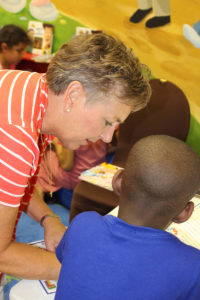
They laugh and talk, and many carry books. Most stop in the middle of the room to greet a smiling woman whose love they’re learning to count on, even as they learn to speak and read English.

They’re on their way to Hope Library, tucked into a corner of the building. It’s the newest ministry sponsored by Karen Morrow, a Cooperative Baptist Fellowship missionary in Fort Worth—the woman who dispenses hugs to the children, as well as to many of their mothers.

‘Parents came here for the future of their children’

They’re international refugees legally resettled by the U.S. government. Although they arrived from many nations, mostly in the Middle East, western Asia and Africa, a common denominator is violence. They fled civil war, or ethnic and religious persecution, or all of the above.

“It was no longer safe to live in their countries,” Morrow explained. “Living peacefully was not a choice. The parents came here for the future of their children.”

Morrow began serving Middle Eastern refugees in Germany in 1996. She has been serving these children—and children who came before them—in Fort Worth about 10 years.

Refugees resettled in the United States receive pre-planned support for six months, Morrow noted. That includes the basics, such as a place to live, homemaking necessities and a first job.

“But from then on, they’re lost,” she said, explaining newcomers still need help learning to adjust to and fit into their adopted country.

“A Congolese father told me: ‘We do not want your things—although they still could use more things. We want your relationship. Where we came from, our aunties and uncles taught us how to make a life. We do not know how to live here.’ So, we’re here to create community, to make them feel welcome, to teach them how to live here,” she said.

Extending hospitality in Christ’s name

Morrow offers that hospitality in the name and spirit of Christ. She crosses language, ethnic and religious barriers with friendly support and the love of Jesus.

For many refugees, she’s a walking encyclopedia of Americana: Where to go to get their children’s supplies for the start of school. How to navigate the myriad systems that natives take for granted—government, medical, commercial, social.

“The more we connect them with resources, the better off they are,” she said. Her presence is a constant in the apartment complexes and neighborhoods where refugees congregate.

Ready for School program

Karen Morrow’s signature ministry is the Ready for School program, located in four apartment complexes last school year and opening in a fifth soon. (CBF Photo)

Hope Library at Kingdom Manifesters International Ministries is her newest initiative. Volunteers read with the children and encourage them to read on their own. The library is open midday on Mondays this summer, and it will be open Monday evenings in the fall.

Morrow’s signature ministry is the Ready for School program, located in four apartment complexes last school year and opening in a fifth soon. It’s designed to teach children the concepts they should know to enter school, such as colors, shapes, letters and numbers. Each child receives a book every week, and at the end, each one receives a bookcase at a family reading fair.

Parents attend Ready for School with their children. “The parent learns alongside the child,” Morrow said. “We’re teaching the parent to be a teacher.”

Last year, Ready for School ministered to 80 families who completed the 20-week session, as well 20 others who attended less than three times.

Volunteers essential

Volunteers make Ready for School, as well as Hope Library, possible.

“Somebody walks alongside the parent and child at every step,” Morrow said. Many volunteers are retired educators, and they primarily come from four congregations—Bear Valley Community Church in Colleyville, Broadway Baptist Church in Fort Worth, The Church at the Crossing in Aledo, and Kingdom Manifesters International Ministries in Fort Worth.

More than anything, the ministry needs volunteers.

“We can use volunteers for a day, an event, a program,” Morrow reported. Ready for School involves two hours per week for 20 weeks; Hope Library also takes a couple of hours a week.

Like refugees, the Ready for School curriculum is mobile.

“It’s free and online,” Morrow says, adding two Houston Baptist congregations—Tallowood and Willow Meadows—started using it this spring. To see and download the Ready for School curriculum, click here.

For more information about ministry to immigrants and refugees, email kmorrow@cbf.net or call (817) 964-2052.

The Miles Foundation, which supports Ready for School, has issued a $5,000 challenge grant through Literacy Connexus, a Texas Baptist Christian Life Commission ministry partner. To contribute to the challenge, send gifts to Literacy Connexus with a notation for Ready for School and mailed to 3020 South Cherry Lane, P.O. Box #123168, Fort Worth, TX 76121.

Marv Knox is field coordinator for Fellowship Southwest.              


HSU helps global participants learn to welcome strangers

ABILENE—During a two-week program at Hardin-Simmons University, representatives from nine countries learned how to welcome strangers by celebrating differences.

Participants from Uganda, the Democratic Republic of Congo, Bulgaria, Romania, Kosovo, Kyrgyzstan, Zimbabwe, Tajikistan and the United States gathered in Abilene July 14-27 to discuss hospitality and the stranger as part of an initiative HSU hosted in partnership with Communities Engaging with Difference and Religion.

“The way we conceptualize helping the other is often by making them like us,” said CEDAR Program Director David Montgomery.

No monopoly on suffering or truth

Montgomery shaped the group’s discussion by encouraging fellows—as the participants are called—not only to look for their similarities, but also to celebrate their differences. Leaders gave the fellows two guidelines.

“Do not act as though your community has a monopoly on suffering, and do not act as if they have a monopoly on truth,” he said.

The fellows used these rules as they discussed often divisive topics like immigration, race, evolution, homosexuality, gun control, politics and religion. In addition to lectures and discussion, the group learned Texas history as they traveled to Dallas and San Antonio where they visited the 6th Floor Museum, the Alamo and San Jose Mission National Park.

“If we know the past, we better understand the present, and we can envision a better future. We can say ‘never again’ to the injustices of the past,” said fellow Philippe Tunamsifu, professor and researcher in the African Center for Research on Peace Education and Development.

The group spent the majority of their time gaining a holistic view of Abilene, from a Baptist church to a Muslim prayer room and a creation museum to a non-profit. They also experienced Texas culture as they ate Tex-Mex and barbecue and went to a gun range and country-western dance hall.

People cannot be reduced to social categories

Throughout the cognitive and experiential learning program, the group formed relationships with each other. They began to see each other as more than their nationality, sexual orientation or political affiliation.

“No human being is reducible to their social category,” said fellow Rachel Schneider, a researcher and racial justice advocate in Houston.

While CEDAR has hosted more than 40 programs in 15 countries, this was their first two-week school in the United States.

Tom Copeland, professor of psychology and director of the Honors College at HSU, said the program gave him hope that reconciliation in a divided world is possible.

“I don’t want to be angry anymore,” Copeland said. “I want to do something that’s proactive and positive.”

Grace Mitchell is an English education major and staff writer for the university marketing office at Hardin-Simmons University.


Positive talk about sex help Christians confront porn crisis

ARLINGTON—In light of pervasive pornography in society at large, Christians need to develop a theology of sin and sex so they won’t be blindsided by how younger generations interact with sexuality, counselor Jenna Mountain told a Texas Baptist workshop.

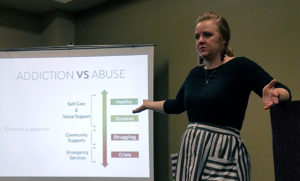
Mountain, director of the counseling center at First Baptist Church in Richardson led a breakout session during Texas Baptists’ Family Gathering in Arlington.

Jenna Mountain, counseling center director at First Baptist Church in Richardson, said churches must take a better approach to confront the use of pornography.

Sex is good because it is a gift from God, but it falls short of what it should be because of sin, explained Mountain, who also serves as part of Texas Baptists’ Counseling Services.

When churches help people in areas of sexuality, the conversation should carry a beautiful and positive message—not a negative and shameful one that focuses on the distorted view of sex as presented in pornography, she added.

“They are being told (pornography) is a sin, and they agree, but that is really not inspiring change,” Mountain said.

Begin early

A positive conversation about sex needs to start early, she noted.

“There needs to be a conversation on how it is good that sex is pleasurable,” Mountain said. “Early on, children need to understand how the brain needs to be engaged properly in order to direct feelings and sensations.”

Otherwise the problem will persist, and churches will continue to play catch-up with the porn epidemic, she noted.

“Pornography is affecting you, even though you’re not using it,” she said.

Because of technology, pornography is more accessible to increasingly younger generations, Mountain reported. Previously, children’s first exposure to pornography occurred around the ages of 11 and 12. Now, children between ages 6 and 8 are experiencing their first exposure to pornography, she said.

Technology has made pornography affordable, accessible and anonymous, Mountain said.

Detrimental impact of pornography

Exposure to pornography can cause detrimental effects on those who view it and affect how a person relates to others, she said.

Since initial interactions with pornography by children and teens are related to curiosity or the desire to learn about sexuality, churches should provide better resources for sex education, Mountain said.

If young men grow up with pornography, then they will have an erroneous expectation of what sex should be like, what they need to communicate to their partners and how women are to be treated, she explained.

“The things they see in porn are staged,” she said. “They are made of unusual people during unusual circumstances doing unusual things.”

Pornography conveys the message to men that they are Neanderthals whose desires cannot be controlled, and therefore they must seek sex, she said.

“We don’t realize porn is throwing an insult towards men,” she stated. “It says that you (men) cannot do better.”

Need meaningful conversations

The conversation about pleasure, respect, boundaries and discipline has to start early, Mountain said.

“The sex talk begins when (children) are born,” she asserted.

At the latest, these conversations should happen by the time children start middle school, she said.

In order to have better conversations about sex, Mountain said, churches must engage with scientific research so they can have a better understanding on the human body and its behavior.

A fuller understanding of the human body and how it functions enables Christians to talk about how sex is beautiful and wonderful, instead of just giving a list of what not to do, she said.


Churches natural allies in community development initiatives

Nonprofit organizations focused on community development should recognize churches as natural allies in helping vulnerable children and their families improve their lives, said Lorena Gonzalez, vice president of Urban Strategies.

Lorena Gonzalez

When Gonzalez began work in parenting education, she and her colleagues typically focused on schools as community centers strategically located to affect families in their neighborhoods.

“We soon discovered the schools were overwhelmed, and adding another program to their responsibilities was not the best vehicle for making an impact,” she said.

So, she and her co-workers developed partnerships with churches and other faith communities.

“Churches are trusted, they typically have longevity, and they have established relationships,” she said. “Also, they are aligned with the values that represent what we need to be doing—love, service and responding to needs.”

Gonzales will be a keynote speaker at the 2018 No Need Among You Conference, Oct. 3-5, at First Baptist Church in Waco, sponsored by the Texas Christian Community Development Network.

To improve children’s lives, work with entire families

To make a positive impact on the lives of children—particularly in the Hispanic culture—community development initiatives need to recognize the importance of families, said Gonzalez, who also is president of the National Alliance for Hispanic Families. \

“In the Latino culture, we must take a holistic approach that involves the entire family,” she said.

Again, she noted, churches value families and understand the value of ministering across generations and engaging all age groups.

Build on strengths

Gonzalez hopes churches will recognize the value in collaborative approaches that build on the inherent strengths in communities rather than looking only at addressing urgent needs.

“We can build on the gifts, talents and knowledge that people possess and help them move forward,” she said.

Rather than assuming a more affluent and better-educated volunteer from outside the community has all the answers, a balanced approach to community development recognizes the skills people in poverty often already have.

For instance, she pointed to the remarkable budgeting ability and time-management skills demonstrated by parents who work multiple low-paying jobs and manage to provide the essentials for their families. Looking particularly at the Hispanic culture, she also noted the ability to maintain healthy cross-generational relationships in extended families.

Tell the stories

Gonzalez noted her parents were migrant workers with about a third-grade education who made a living picking spinach. Their children have doctorates, and their grandchildren include attorneys and engineers.

“My parents were not fully educated, but they had a vision, a strategy and a plan for improving the life of their family,” she said.

Just as churches recognize the importance of bearing witness through personal testimonies of faith, second- and third-generation Hispanics can inspire people in their communities of origin by telling their own stories, she added.

“It’s important for people in marginalized populations to meet someone who comes from their community who has his or her own story to share,” she said.


La Convención Hispana Elige Oficiales

ARLINGTON—Los mensajeros de la Convención Hispana Bautista de Texas eligieron los siguientes oficiales durante la sesión de negocios, la cual se llevó a cabo durante la  Junta Familiar.

Rolando Aguirre, pastor de Calvary en Español, fue re-elegido presidente de Convención.

“Puedo dar testimonio de su liderazgo y su corazón de siervo,” dijo el pastor Oliver Martínez, de la Iglesia Bautista Getsemaní en Fort Worth, al nominar a Aguirre. Martínez también recalcó el fruto del trabajo de Aguirre, quien en 10 años ha pastoreado una congregación que creció de 15 miembros a 500.

Aguirre recibió 117 de los 133 votos. El otro candidato para presidente fue Vince Gonzales, pastor de North Dallas Family Church, y quien previamente sirvió como primer vicepresidente de Convención. John Molina, pastor de la Primera Iglesia Bautista de Taylor, fue quien nominó a Gonzales.

Carlos Valencia, pastor de Victoria en Cristo en Fort Worth, fue unánimemente elegido como primer vicepresidente. Luis Calderón de Southwayside Baptist Church en Fort Worth, fue quien nominó a Valencia.

Tony Miranda, pastor de la Iglesia Bautista Estrella de Belén en Corpus Christi, fue electo como segundo vicepresidente. El recibió 80 votos, mientras que Carmen Gaytán de Calvary Baptist Church en McAllen recibió 53 votos.

Gaytán, quien previamente sirvió como secretaria de la Convención, nominó al pastor Abiel Aké, de la Primera Iglesia Bautista de Edingburg, como secretario.  Ake fue elegido unánimemente.

Apoyo Financiero a Convención

Mensajeros aprobaron la moción de la cámara ejecutiva de la Convención que extendería el periodo de gracia para que las iglesias decidan si se mantienen como iglesias afiliadas o se hacen iglesias cooperadoras de la Convención Hispana Bautista de Texas.

El apoyo financiero al presupuesto de Convención es diferente al Programa Cooperativo de Baptist General Convention of Texas.

Las iglesias cooperadoras de la Convención tendrían entonces el privilegio de votar, y sus miembros podrían tomar cargos oficiales y llevar a cabo responsabilidades.

Solo 70 de las más de 1,000 iglesias bautistas hispanas del estado son iglesias cooperadoras, dijo Aguirre.

“Siempre estamos animando a las iglesias a dar al Programa Cooperativo de BGCT. Pero automáticamente, cuando las iglesias cooperan al Programa Cooperativo de BGCT, no están cooperando directamente a la Convención” clarificó Aguirre.

Los mensajeros aprobaron un presupuesto de $114,600 de la Convención para apoyar misiones, programas de educación, ministerios, el programa para jóvenes líderes latinos, eventos especiales, la junta anual, y otros programas auxiliares.

Enfoque en Familia

El presidente Aguirre y Alicia Zorzoli, de la Iglesia Victoria en Cristo de Fort Worth, hablaron de las diferentes maneras en las que los padres son responsables de enseñar y dirigir a la familia de acuerdo a la voluntad de Dios.

“Cristo es la cabeza de la iglesia y es por medio de El que el Espíritu Santo nos da dones a cada uno, los cuales son para que los usemos en la familia y en la iglesia,” dijo Zorzoli.

Roberto Arrubla, pastor de la Iglesia Bautista El Buen Pastor en Fort Worth, llamó a la Convención a imitar a Cristo en sus familias.

Aunque la humildad, el sacrificio, la gracia, el servicio y el amor que los cristianos son llamados a mostrar no haga sentido para el mundo, las familias cristianas deben de siempre ser fieles a la vida a la que Cristo las ha llamado, el insistió.

Nota del Editor: Este articulo, publicado originalmente el 1 de Agosto, ha sido editado el 3 de Agosto para clarificar la diferencia entre el Programa Cooperativo de BGCT y el apoyo que iglesias cooperadoras dan al presupuesto de la Convención Hispana Bautista de Texas.


Texas Baptists’ Family Gathering stressed unity

ARLINGTON—From a Lord’s Supper observance in the opening Sunday evening session to the final benediction Tuesday night, an emphasis on unity permeated worship services at Texas Baptists’ Family Gathering in Arlington.

“There is no more common element of family life than to gather around a table for a shared meal,” said Danny Reeves, president of the Baptist General Convention of Texas.

Remember and obey

Leaders of ethnic and affinity groups within Texas Baptist life read Scripture at the communion service—Elmo Johnson, president of the African-American Fellowship; Peter Le, president of the Vietnamese Baptist Fellowship; Rolando Aguirre, president of the Hispanic Baptist Convention of Texas; Pakon Chen, president of the Chinese Baptist Fellowship; Richard Ray, executive director of the Texas Baptist Bivocational/Small Church Association; and Jason Bryant, consultant for Western Heritage churches.

“We come together in an act of remembrance and an act of obedience,” said David Hardage, BGCT executive director. “We come to remember and obey.”

Advance God’s kingdom

Speakers throughout the Texas Baptist Family Gathering emphasized aspects of unity.

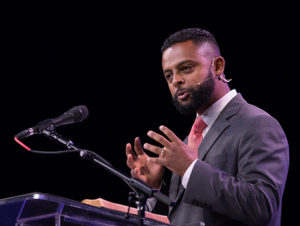
Nebiye Kelile, pastor of Pathway Church in the Dallas area, challenged Texas Baptists to move ahead “together in the gospel.” (BGCT PHOTO)

Nebiye Kelile, church planter and pastor of Pathway Church in the Dallas area, preached from Philippians 1:27-30 on the importance of unity in advancing God’s kingdom.

Kelile, who was born in Ethiopia and immigrated to the United States at age 2 with his parents, compared many churches to the S.S. United States—a mid-20th-century ship designed as a troop carrier capable of rapidly transporting 15,000 warriors into battle that became a luxury liner that accommodated 2,000 passengers on leisurely cruises.

Churches too easily can become focused on the comfort of patrons and serving their desires rather than on the mission of spreading the gospel and serving the communities in which God has planted them, Kelile asserted.

Churches should “stand firm in one spirit,” recognizing the eternal importance of the gospel they proclaim, he insisted.

“For the unbeliever, this is the closest he or she ever will come to heaven,” he said. “For the believer, this is the closest he or she ever will come to hell.”

Challenges to unity

David Dykes, pastor of Green Acres Baptist Church in Tyler, provides a historical overview of challenges to unity Texas Baptists have faced. (BGCT PHOTO)

David Dykes, pastor of Green Acres Baptist Church in Tyler, provided a historical retrospective on ways Texas Baptists have responded to challenges that threatened unity.

“Unity is so valuable because it is so rare,” Dykes said.

“Unity is a supernatural bond only God can create. We can’t create unity. We can keep unity, or we can kill it.”

Throughout their history, Texas Baptists have dealt with controversies, Dykes said. He pointed to divisions created by S.A. Hayden, who formed the Baptist Missionary Association; J. Frank Norris, who spawned several Fundamentalist Baptist movements; and most recently by the Southern Baptists of Texas Convention, a group that broke away from the BGCT in 1998.

“In spite of all the divisions in our past, Texas Baptist churches are alive and thriving,” he said.

Texas Baptists have maintained unity by emphasizing evangelism, missions, education, compassionate ministry and cooperative giving, Dykes said.

Shared devotion to Christ

Ralph West, pastor of The Church Without Walls in Houston, reminds Texas Baptists the closer they draw to Christ, the closer they will be to other believers. (BGCT PHOTO)

Ralph West, pastor of The Church Without Walls in Houston, stressed unity must grow out of shared commitment to Christ.

“If Christ is our center, we cannot keep coming closer to him without coming closer to one another,” West said. “Christ is our peace. He doesn’t just offer peace. He is our peace.”

Just as Christ tore down the dividing wall between sinful humanity and a holy God, Christ’s people should be his instruments for breaking down walls of division, he said.

Who is in control?

In the closing worship service, attended by a large group of Hispanic young people, Pastor Jason Paredes from Fielder Church in Arlington preached an evangelistic message from John 18, contrasting the power of Jesus with the brokenness of Judas Iscariot and Simon Peter.

Jason Paredes, lead pastor of Fielder Church in Arlington, delivers an evangelistic sermon at the closing worship service of Texas Baptists’ Family Gathering. (BGCT PHOTO)

“We have a natural tendency to try to control our situations—to control our circumstances,” Paredes said.

Jesus genuinely was in control throughout his final hours, as he obediently followed God’s plan for his life and willingly “drank the cup” of suffering on behalf of sinful humanity, he observed.

On the other hand, Judas Iscariot tried to control events by manipulating them to advance his own self-interests, while fear and anxiety drove Simon Peter to deny Jesus three times, he noted.

“Every morning we wake up, we are either Peter or Judas all over again,” Paredes said.

In the end, the response of Judas and of Peter determined their destinies, he observed. Judas, plagued by guilt after betraying Jesus, continued to try to control his situation by taking his own life. Peter, however, acknowledged his helplessness and recognized his need for “the great I Am,” Paredes said.

He particularly challenged the young people who attended the worship service to “come to the end of self and look beyond self for help.”


Reeves urges Texas Baptists to pass the baton

ARLINGTON–Just as the patriarch Abraham passed his legacy on to his son Isaac, Baptist General Convention of Texas President Danny Reeves encouraged Texas Baptists to pass the baton of leadership on to upcoming generations.

Reeves presented the challenge during his final presidential address at the 133rd annual meeting of the BGCT, scheduled as part of Texas Baptists’ Family Gathering in Arlington.

“Passing the baton is the job of our convention. It’s the job of every follower of Jesus Christ,” said Reeves, pastor of First Baptist Church of Corsicana. “God has commissioned you and me as participants and carriers of the gospel to successfully pass the baton.”

Abraham was actively involved in teaching and preparing Isaac to follow God’s call on his life, he noted.

“He knew he could not quit until the job was done. He knew he couldn’t stop until his son had all the encouragement necessary to embrace what God had for him,” Reeves said.

Once Abraham had completed passing the baton on to Isaac, the legacy was continued as Isaac passed the baton to his 12 sons, and the lineage continued through the Old and New Testament, through Jesus and all the way to present-day Christians, Reeves noted.

As believers, each generation must faithfully receive the baton from those before them and run the race to the best of their ability, he asserted. Then, as their time of leadership comes to an end, the leader must securely and smoothly pass the baton on to others to carry on the cause of Christ.

“That baton of the gospel now comes to you and to me,” Reeves said. “Now it’s our turn. Don’t drop the baton. Choose today, Texas Baptists, to pass everything on for the glory of God until you see your Savior face to face.”

Concluding his address, Reeves thanked Texas Baptists for the joy and honor of serving as president for two years. He then noted the passing of his baton to newly elected president, Michael Evans, pastor of Bethlehem Baptist Church in Mansfield.

Later in the service, Evans responded: “I accept that baton. I appreciate you. I accept this assignment. I want to thank you, Texas Baptists, and I look forward to sharing the Good News of Christ with the state, nation and world.”