$15 million gift will help restore Baylor’s Tidwell Bible Building

WACO—Baylor University announced a $15 million lead gift from The Sunderland Foundation of Overland Park, Kan., to help renovate and restore the Tidwell Bible Building.

Major components of the restoration project include preservation of the limestone carvings depicting scenes from the Old and New Testaments and the stained glass windows in Miller Chapel.
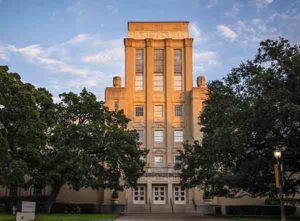
During its more than 60 years as part of the core of Baylor’s campus, Tidwell Bible Building has served tens of thousands of Baylor students who have completed religion, philosophy, history, sociology, nursing, modern foreign language and sacred music classes in its classrooms. Today, the facility—dedicated in 1954—remains home to the religion and history departments. (Baylor University Photo)

The project also includes the addition of a prayer chapel that provides a view of campus from the top floors of Tidwell that will be accessible by elevator for the first time in the building’s history.

The project is among nearly $300 million in capital improvements planned as part of the Give Light fund-raising campaign that will support Illuminate, Baylor’s academic strategic plan.

“These are exciting times as we celebrate the progress of Give Light, which will strengthen our commitment to our Christian mission, impact every aspect of campus life and position our academic programs and our students for success. We are deeply grateful for The Sunderland Foundation’s transformational gift that will restore a truly historic and important building on our campus for future generations,” Baylor President Linda Livingstone said.

During its more than 60 years as part of the core of Baylor’s campus, Tidwell Bible Building has served tens of thousands of Baylor students who have completed religion, philosophy, history, sociology, nursing, modern foreign language and sacred music classes in its classrooms. Today, the facility—dedicated in 1954—remains home to the religion and history departments.

‘A cultural touchstone at Baylor’

“Tidwell Bible Building remains a cultural touchstone at Baylor—few students pass through this campus without venturing inside for a core class in history or religion,” Livingstone said. “As we move forward with Illuminate, our strategic plan and Give Light, the campaign supporting that plan, our commitment to improving and expanding upon our curriculum also has highlighted the infrastructure needs within the university.

“This significant gift from The Sunderland Foundation and other generous support will allow Baylor to restore Tidwell to its original beauty—carefully preserving its architectural significance while revitalizing its ability to serve as a place of excellence in Christian higher education.”

In addition to improving infrastructure such as the facility’s electrical wiring, plumbing, elevator service, and code and accessibility remediation, the renovation of Tidwell’s 57,000 square feet will dramatically expand and enhance areas devoted to academic instruction, faculty offices and community building, university officials noted.

Includes Sunderland Academic Center

The renovated building will house the Sunderland Academic Center, which includes:

  • Small- and large-sized, flexible classrooms to enhance teaching.
  • Administrative and faculty offices—currently spread throughout the building—consolidated into common spaces to facilitate collaboration, research and programs.
  • Greater accessibility and modern infrastructure throughout the building to enable technology-enhanced learning.
  • Group meeting and work spaces and graduate student workspace to encourage greater engagement.

“Baylor University is a special university under remarkable leadership, and we are excited by the ambitious vision for the future as outlined by President Livingstone,” said Kent Sunderland, president of The Sunderland Foundation.

“We personally know of the significance that this historic building has had on so many lives and look forward to seeing Tidwell’s impact further extended through renovation and restoration.”

Construction on Tidwell is expected to begin in late 2020, lasting about 18 months. During that time, faculty offices will be relocated to the Cashion Academic Center, while history and religion classes will be held in various buildings across campus. The restored Tidwell Bible Building is expected to open in 2022.




Baptist Standard receives national awards

The Baptist Standard received eight awards from the Associated Church Press, including a best of class recognition for social media presence and four awards of excellence in reporting and writing.

In another national competition, the Baptist Standard staff collectively won an award of merit for overall excellence in the “denominational (digital) category from the Evangelical Press Association.

Julie Sorrels

Social media

At the recent Best of the Church Press awards event in Chicago, Associated Church Press honored Julie Sorrels, marketing director for the Baptist Standard, with a best of class award of merit for the Standard’s presence on Facebook, Instagram and Twitter.

Last year, the Baptist Standard recorded 2.5 million impressions across all social networks, including 1.7 million Facebook impressions.

Meredith Stone

Sorrels also shared with Texas Voices columnist Meredith Stone an award of excellence in the “social media: single posting category” for the Facebook posting of Stone’s article, “A female seminary professor’s response to John Piper.”

Writing awards

Stone also won a writing award of excellence in the “editorial or opinion piece: news service/website/blog” category for her Texas Baptist Voices article, “Why Paige Patterson’s comments on abuse are dangerous.”

Editor Eric Black received an honorable mention in the same category for his article, “Do we really want an impartial media?”

Three Texas Baptist Voices columnists collectedly won a writing award of excellence in the “department: online publications” category—Stone for “Why Paige Patterson’s comments on abuse are dangerous,” Zac Harrel for “Is football good?” and Jake Raabe for “Signs of the times: The problem with ‘In God We Trust.”

Three ministers shared an honorable mention award in that same category with Black for their contributions to the Baptists Preaching column—Mary Whitehurst for “God’s Got This,” Elmo Johnson for “Sent to Save” and Matt Snowden for “The Ox Principle.”

camp
Ken Camp

Managing Editor Ken Camp received a reporting and writing award of excellence in the “in-depth coverage: news service/website/blog” category for his reporting on controversy surrounding Paige Patterson at Southwestern Baptist Theological Seminary.

Read the articles here, here, here, here, here and here.

Guest writer Scott Floyd won a writing award of excellence in the “theme/issue/section or series: news service/website” category for his Falling Seed series, “Child sexual abuse and the church.”

Read the articles here, here, here, here, here and here.


Texas Baptist missions leaders train in Washington, D.C.

WASHINGTON—Thirty directors of missions and associate directors from around Texas traveled to Washington, D.C., during Holy Week for their annual training event.

The heart of a Texas Baptist missions leader

Directors of missions engage in training on a regular basis because they “love the local church” and see the local church as “the hope of the world,” Vince Smith, executive director of Collin Baptist Association, and David Smith, executive director of Austin Baptist Association, said—almost in unison.

DOMs want to equip themselves to equip the local church, the pair said. They value the relationships they share as DOMs and want to learn and engage in the best practices of leadership.

“Eighty people a day are moving to Collin County. The average Southern Baptist church is about 75 people. That means a church a day is moving to Collin County,” Vince Smith said.

Directors of missions know the local churches in their area, often serving their areas longer than most pastors in the association, Vince Smith and David Smith agreed. They know the hurts, needs, assets and successes of each church and—out of their love for the local church—can be allies in helping them find new pastors when needed.

Texas Baptist missions leaders strengthen relationships

Jay Vineyard, associate pastor of Dogwood Church in Tyrone, Ga., led the DOMs in an approach to leadership developed by Ken Blanchard and Mark Miller and contained in their book The Secret: What Great Leaders Know and Do. Miller is an executive with Chick-Fil-A and a member of Dogwood Church.

Texas Baptist missions leaders observing communion in the Capitol Rotunda (Photo by Eric Black)

Training concluded with two special events. Dan Cummins, who serves as a chaplain to legislators and law enforcement at the Capitol Building in Washington, hosted the group of Texas DOMs for prayer and communion in the Capitol Rotunda.

Cummins encouraged the DOMs to focus on relationships over policy and to approach lawmakers with open arms rather than outstretched hands and pointing fingers.

DOMs also gathered on the steps of the Lincoln Memorial to pray at the spot where Dr. Martin Luther King Jr. delivered his famous “I Have a Dream” speech. Before praying together, Joseph Fields, pastor of New Beginnings Church in Lewisville, addressed racial reconciliation.

African-American and Anglo individuals often are afraid to talk to each other because they fear misplaced indictment, he said.

Addressing Anglo members of the group, Fields said: “You aren’t guilty of what happened 400 years ago. As an Anglo, you don’t come to this place with misplaced guilt. You’re not responsible for what happened, but you are accountable that it not happen again.”

Pastor Joseph Fields speaking on racial reconciliation at the Lincoln Memorial (Photo by Eric Black)

Fields concluded by reminding the group that the gospel of Jesus Christ is communicated through love for one another.

Missions leaders learn about Bible translation

The trip to Washington, D.C., was a joint venture between the Baptist General Convention of Texas and illumiNations, a Bible translation project set to launch in October 2019. Two individuals and a DFW-area Bible church associated with illumiNations—all of whom wanted to inspire unity among Texas Baptists—provided the funding for travel, lodging and most meals for the group of DOMs.

illumiNations is an outgrowth of an initial meeting of a group of Bible translators and Mart Green, founder and CEO of Mardel Christian and Educational Supply and son of Hobby Lobby founder David Green and brother of Hobby Lobby president Steve Green, the same family who provided significant funding for the Museum of the Bible in Washington, D.C.

Mart Green recognized current technology can enable the rapid translation and dissemination of the Bible to every language group in the world and called together donors and major Bible translators to make that vision a reality. Translators include American Bible Society, Biblica, United Bible Society and Wycliffe Bible Translators.

The DOMs received a private tour of the Museum of the Bible, located two blocks south of the National Mall. Tour guide Ryan Smith, after saying the museum houses 72 hours—or eight 9-hour days—worth of exhibits, took the group through the entire museum in two hours.

The museum is designed around three themes—light, vine and branches, and languages—and three ways of engaging the Bible—seeing, hearing and touching. In addition, three main floors focusing on the impact of the Bible, the story of the Bible and the history of the Bible.

Texas Baptists encouraged to join illumiNations project

The illumiNations exhibit at the Museum of the Bible, Washington, D.C. (Photo by Eric Black)

A visit to the museum culminates with the dramatic illumiNations exhibit, an oblong room ringed with shelves filled with books, at least one for each language in the world. Most of the books are covered with a yellow dust jacket, signifying a language with no portion of the Bible translated in it.

The goal of the illumiNations project is for 100 percent of the world’s languages to have at least a portion of the Bible translated by 2033. Museum guests—including the Texas DOMs—are encouraged to sponsor translation projects.

Lorenzo Pena, director of mega associations and cultural engagement for Texas Baptists, said the combined trip was intended to give DOMs exposure to the illumiNations project. While DOMs do not “tell churches what to do,” they can “provide exposure to opportunities” to be involved in projects larger than themselves, Pena said.

EDITOR’S DISCLOSURE: Joseph Fields is a member of the Baptist Standard board of directors. Editor Eric Black’s travel, lodging and most meals were provided by the same donors who sponsored the DOMs.


TBM serves school, clears fallen trees after tornadoes

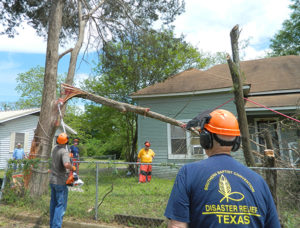
Texas Baptist Men disaster relief volunteers enabled a small school district to provide meals for students, removed fallen trees from homes, provided clean water and shared the love of Christ in communities hit by mid-April tornadoes.

A TBM chainsaw crew from Orange works on a storm-damaged tree at a home in Alto. (Photo / Ken Camp)

Within one week after a series of tornadoes devastated Alto and Franklin, TBM workers contributed 6,950 volunteer hours. They cooked more than 2,100 meals, purified more than 1,000 gallons of water and distributed nearly 900 boxes to enable storm survivors to gather and store scattered belongings.

In the process, the volunteers made more than 700 personal contacts in the two communities, distributed 67 Bibles and recorded nine professions of faith in Christ.

Meals for school children

One of the two tornadoes that hit Alto severely damaged Alto High School. Since it compromised the building’s structural integrity, students had to meet in repurposed space in the adjoining elementary and middle schools when classes resumed April 22. The high school cafeteria—which serves all the Alto schools—particularly was hard-hit.

On their first day back to school, students received muffins for breakfast and sandwiches for lunch.

TBM disaster relief volunteers set up a field kitchen where cafeteria workers will prepare meals for Alto schoolchildren for the remainder of the school year. (Photo / Rand Jenkins / TBM)

Initial discussions with school officials centered on the possibility of TBM volunteers cooking meals for students during the five remaining weeks before summer vacation. After additional conversations, a better idea emerged.

TBM volunteers set up a fully equipped field kitchen April 23 outside Alto Elementary School. Then they trained the school district’s food service staff how to use the equipment and agreed to leave it with them for the remainder of the school year.

“We might have been serving sandwiches for five weeks if not for the field kitchen,” said Courtney Stephenson, food service director for the Alto Independent School District. “Now students will be getting the good warm meals at school they’re probably not getting at home. It’s a blessing.”

Significantly, the agreed-upon solution enabled TBM to avoid committing a large number of volunteers for an extended time, and it allowed the district’s food service staff to continue to serve students—and still have a paying job.

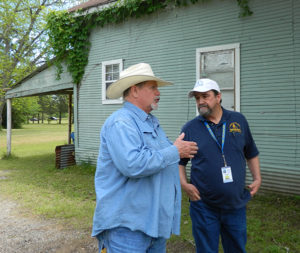
Jimmy Allen (left), mayor of Alto, visits with Russell Schieck, on-site coordinator for TBM disaster relief in Alto. (Photo / Ken Camp)

“I see God’s fingerprints all over this,” said Russell Schieck, on-site director for the TBM disaster relief operation in Alto. “It’s good for us, and it’s good for the community, since it keeps everybody doing what they normally would be doing.”

Working together

While a chainsaw crew from Orange removed wind-damaged limbs from his property, Alto Mayor Jimmy Allen expressed appreciation for all the work TBM has done in his community.

Other TBM chainsaw crews and heavy equipment operators from Collin Baptist Association, Kingsland Baptist Church in Katy and Paramount Baptist Church in Amarillo worked throughout the area. In addition to completing 28 chainsaw jobs in one week, one crew also installed a temporary roof on a house when a storm threatened.

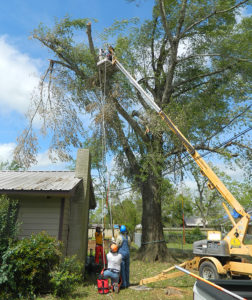
A chainsaw team from Collin Baptist Association works together to remove wind-splintered limbs from a tree before they can do further damage to a homeowner’s roof. (Photo / Ken Camp)

Allen reported 40 homes destroyed and another 75 damaged in his town of 1,000 residents. He noted TBM workers continued to provide purified drinking water while Alto remained under a boil water notice.

He praised the spirit of cooperation and rapid response of volunteers—not only TBM workers who arrived less than 24 hours after tornadoes swept through Alto and the surrounding area, but also local residents who immediately helped their neighbors.

“Tractors started rolling in to clear the roads to help first responders get in,” Allen said.

Spirit of cooperation

Schieck also noted the spirit of cooperation evident throughout the community, particularly among its churches. Congregations of various denominations worked with a variety of out-of-town and sometimes out-of-state ministries, and they readily shared information and supplies with each other.

Hilltop Baptist Church housed TBM volunteers and allowed them to fill the church’s parking lot with disaster relief equipment.

On Easter, Christians from most of the churches in town—and volunteers who had traveled to Alto to serve—gathered downtown to worship at an outdoor sunrise service.

A TBM chainsaw volunteer works in Alto. (Photo / Ken Camp)

About 100 miles to the southwest, TBM volunteers worked in Franklin, where an EF-3 tornado destroyed 55 homes.

In one week, TBM workers in Franklin donated more than 3,100 volunteer hours, preparing about 1,000 meals, logging 112 hours on heavy equipment and completing 27 chainsaw jobs.

First Baptist Church in Franklin housed the TBM volunteers. Ted Elmore, interim pastor at the church tweeted: “It has been a busy week, and I have watched people come together in love and harmony in Jesus’ name to help. …” \

To contribute financially to TBM disaster relief, send a check designated “disaster relief” to Texas Baptist Men, 5351 Catron, Dallas, TX 75227, call (214) 275-1116 or click here.


Congreso urged to consider collision of sin and God’s power

WACO—A keynote speaker at Congreso 2019 assured more than 3,000 Hispanic students they gathered on the Baylor University campus by divine invitation, not by accident.

“You may think you just came here by chance. But the reason you’re here is because Jesus is knocking,” Daniel “Tiny” Dominguez, pastor of Community Heights Church in Lubbock, told the 55th annual Hispanic student conference, sponsored by the Baptist General Convention of Texas.

Daniel “Tiny” Dominguez, pastor of Community Heights Church in Lubbock, spoke to Hispanic students at Congreso in Waco. (Photo / Isa Torres)

Powerful collisions attract attention, and that’s what happened during Holy Week more than 2,000 years ago, Dominquez asserted.

“What Jesus did on the cross collided with our sins and death,” he said.

Previously, humanity collided constantly with sin, which destroyed and hurt what God created, Dominguez said. In spite of the destruction, people continued to sin, he observed.

“Even now, somehow, we still think the solution is more sin,” Dominguez said.

Sin may appear harmless—even appealing at times, he acknowledged. But sin breaks down trust, it hurts relationships, it corrupts and it ultimately brings death, Dominguez observed.

Jesus came to defeat what humanity could not, he said. All the power of sin came against Jesus Christ on the cross, he noted, but what seemed to defeat humanity suddenly shattered as Jesus rose from the tomb.

“Jesus collided, and sin failed!” Dominguez said. “We were dead because of sin, but the hit was so hard that we came alive.”

God is the unstoppable object breaking what seemed to have a hold on humanity, he added.

“Because of the power of God, even the dead are alive,” Dominguez said.

Sin brings solitude and confusion, anger and depression to people’s lives, he said.

But Christ is calling everyone to walk with him, to be guided by him and to witness the unstoppable power of God, Dominguez said.

The gospel message not only is for those who have not met Christ, but also for the church, Dominguez insisted.

People can say they know Jesus Christ and still push him aside to pursue their own desires, he said. And part of the good news is even after people turn Jesus away, he continues coming back to knock on the door again, Dominguez said.


Waco women offer Light in the Gap to female ex-offenders

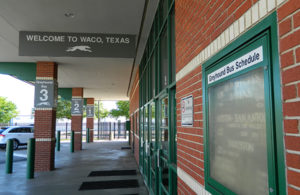
WACO—Every weekday, a van from Gatesville arrives at the Waco bus station to deliver women released from the Texas Department of Criminal Justice.

Every weekday, a van from Gatesville arrives at the Waco bus station to deliver women released from the Texas Department of Criminal Justice. (Photo / Ken Camp)

And every weekday, women from Waco-area churches greet the ex-offenders, offering them a warm welcome, homemade cookies, handcrafted tote bags filled with helpful items and a prayer of blessing.

“These are their first moments of freedom,” said Donna Burney from First Woodway Baptist Church in Waco. “We want to be the light of Christ, standing in the gap between the time of their release and that point when they begin life outside of prison.”

Protection from predators

After women in the state’s correctional system are processed in Gatesville for re-entry back into society, the state transports them to Waco, where they catch a bus to another destination. The women who arrive at the station need help making connections with family—and avoiding connections with the wrong kind of people.

Since the Light in the Gap ministry began two years ago, Burney noted, operators of the Waco bus station have seen a marked decrease in the number of drug dealers, pimps and other predators waiting to take advantage of the female ex-offenders.

Word also has spread inside the prisons, both among correctional officers and inmates awaiting release.

“Some of the guards tell the women, ‘When you get to the bus station, don’t talk to anybody but the church ladies,’” said Burney, co-director of Light in the Gap with Brenda Lewis.

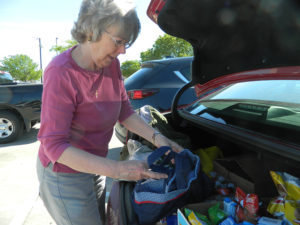
Donna Burney, co-director of Light in the Gap, unloads tote bags filled with snacks and “goodies” for recently released female ex-offenders. (Photo / Ken Camp)

Since Light in the Gap launched, the “church ladies” have served more than 4,000 women, praying with released ex-offenders at the bus station and giving them a decorative tote bag filled with snacks, toiletries, helpful information for re-entry into society and a copy of the Gospel of John.

Some of the women immediately begin removing their belongings from prison-issued orange mesh bags—the kind grocers use for onions and citrus—and that mark them as ex-offenders. With relief, they transfer their personal items into their new shoulder bags.

Nearly all of the women welcome the opportunity to talk to the volunteers—called “connectors”—and pray with them.

“It’s not small talk,” Burney said. “They are worried about family. They are concerned for sobriety. They are scared about what is coming next.”

When the ex-offenders arrive at the bus station, some appear confused. Others adopt a swagger, trying to mask their fear. Their expressions change when they see the Light in the Gap connectors.

“The looks on their faces are priceless when they realize somebody cares for them,” said Nelda Emmert, a volunteer from First Woodway Baptist Church. “They are overwhelmed there’s somebody who cares enough to have a bag of goodies for them.”

Response to a growing need

Light in the Gap provides tote bags filled with snacks, toiletries and “goodies”—as well as fresh-baked homemade cookies—to recently released female ex-offenders. (Photo / Ken Camp)

Light in the Gap responds to a growing need. From 1980 to 2016, the number of incarcerated women in the TDCJ increased 908 percent, compared to a 396 percent increase in the male prison population, according to a Texas Criminal Justice Coalition report.

In addition to the connectors who serve at the bus station, other Light in the Gap volunteers work on a variety of related teams.

  • A baking team makes cookies, senior adults write Scripture verses on cards, and additional volunteers fill plastic bags with cookies and affix the cards to them.
  • A sewing team makes tote bags. Acteens—the missions organization for teenaged girls—at First Woodway Baptist Church also have painted canvas bags.
  • A prayer team receives the requests gathered by connectors at the bus station and prays for those concerns and the women who expressed them.
  • A communications team makes phone calls and sends emails to ensure everyone involved in the ministry stays informed.

Advocating for change

Volunteers also become advocates. Until recently, women in the TDCJ typically received men’s clothes to replace their prison uniforms immediately prior to release. The ill-fitting clothes and prison-issued shoes offered one more telltale sign marking the women as ex-offenders.

“It was degrading,” Burney said. “It gave the women the idea that they didn’t matter.”

Burney contacted the Texas Baptist Christian Life Commission, asking what steps could be taken in Austin to correct the problem.

Kathryn Freeman, CLC public policy director, prayed with Burney. Then she set up an appointment for them to meet with a state legislator who serves on the committee that provides oversight for the appropriate agency.

The day they went to visit the lawmaker, he had just been in a meeting with officials from that agency. After Burney described the problem, he called the officials back into his office and asked her to tell them the same thing. They assured her they would take immediate action.

The next time Burney went to the Waco bus station, the women who arrived from Gatesville were wearing women’s clothing.

Freeman told the story to Texas Baptists who attended a recent Advocacy Day event in Austin. She encouraged them to let elected officials know about issues they discover as they minister in their communities that could be affected positively through changes in public policy.

“Not every problem is solved that quickly,” she said. “But never underestimate the power of prayer.”

‘The Lord doesn’t need observers

Pam Poole, special projects coordinator for Woman’s Missionary Union of Texas, learned about Light in the Gap from Becky Ellison, the Waco-based state strategist for Christian Women’s Job Corps, a WMU ministry.

Pam Poole (left), special projects coordinator for Woman’s Missionary Union of Texas, waits with Donna Burney (center) and Nelda Emmert, volunteers from First Woodway Baptist Church, for a van from TDCJ to arrive at the Waco bus station. (Photo / Ken Camp)

Poole, a member of First Baptist Church in Midlothian, traveled to the Waco bus station one Monday morning to learn more.

“I came to observe,” she said.

However, an unusually large group of women arrived, and she was pressed into service as a coordinator.

One of the women she encountered—who was about the age of Poole’s daughter—was taking a bus from Waco to Fort Worth, and then she was supposed to catch another bus to Amarillo.

When the young woman learned she could anticipate an eight-hour wait at the Fort Worth station before the connecting bus to Amarillo arrived, she looked panic-stricken, Poole said.

“She asked, ‘Who’s going to be with me?’” Poole recalled. “That’s when God told me, ‘I don’t need observers.’ Somebody has to be there at the next stop for these women.”

Poole volunteers every Monday in Waco with Light in the Gap, driving about 100 miles roundtrip from her home.

Through Texas WMU, she also is in the early stages of developing a network of connectors around the state to meet recently released female ex-offenders at local bus stations, after they leave Central Texas. A pilot project will launch soon in Fort Worth before expanding to other sites.

“The Lord doesn’t need observers,” Poole said. “God needs people who are willing to step up and be his light in the gap.”


Pastor de Longview/ex estrella de fútbol fallece después de un accidente doméstico

LONGVIEW—Amigos y admiradores se reunieron en First Baptist Church de Longview el 8 de abril para recordar a Fabio Giménez como uno que pasó de ser reconocido como jugador profesional de fútbol a alguien con un deseo de servir a Dios.

Un accidente con una podadora de pasto el 5 de abril tomó la vida del pastor de Puertas Abiertas, originario de Argentina y quien tenía 50 años de edad.

Más de 1,500 personas llenaron el santuario de la iglesia para recordar y celebrar la vida de Giménez, a quien le sobreviven su esposa, Dora y sus tres hijos, Tomas, Valentín y Juan Manuel.

Futbolista conocido por su fe

Fabio Giménez vino a trabajar con First Baptist Church de Longview y su congregación hispanohablante, Puertas Abiertas. Antes de eso él había empezado Iglesia Puertas Abiertas en Bolivia con su “familia boliviana” acto Internacional. En el 2009. Giménez y su esposa, Dora, están del lado derecho. Su amigo, Chicho Añez y su esposa, Marisa, están a la izquierda. (Foto cortesía de Angela Webster)

“Su vida fue testimonio para muchas personas,” dijo su amigo Chicho Añez, quien es pastor de la Iglesia Puertas Abiertas en Santa Cruz de la Sierra, Bolivia.

Giménez y Añez se conocieron cuando Giménez jugaba para el Oriente Petrolero de Santa Cruz en el 2004.

En su carrera profesional Giménez batalló con adicciones, pero su vida comenzó a cambiar en los 1990s cuando él empezó a asistir a la iglesia.

“Inicié de a poquito en Uruguay. Pero me entregué al Señor en el ‘94,” dijo Giménez en 1998.

Reconocido nacionalmente como futbolista en Bolivia, la noticia de su fe se esparció rápidamente por el país—no sólo por su fama, pero también porque él compartía su fe en Cristo en cada oportunidad que se le presentaba, Añez comentó.

“Él tenía que predicar. Él tenía que hacerlo,” dijo Añez. “Cada vez que anotaba un gol se levantaba la playera para enseñar los mensajes escritos en su camiseta, que decían ‘Dios es fiel’ o ‘Yo pertenezco a Dios.’”

La familia Giménez todavía guarda un artículo escrito acerca de él que decía: “¿Importa la cara? Para Fabio Giménez lo que importa es que Jesús vive.” El artículo incluye una foto de Giménez cubriéndose su cabeza con su playera y mostrando un mensaje escrito en su camiseta.

“Él siempre usaba todos los medios para predicar,” dijo su hijo, Valentín.

Después de empezar su carrera en Argentina, Giménez jugó para equipos en Colombia, Uruguay, Bolivia y los Estados Unidos.

“Como familia, nos mudábamos a donde él tenía que ir,” Valentín dijo,” Nos mudamos 25 veces.”

Pasión por compartir el evangelio

En el 2007, Giménez se retiró del fútbol y continuó su pasión por compartir el evangelio.

Junto con Añez, Giménez fundó la  Iglesia Puerta Abiertas, la cual cumplió su décimo aniversario este año.

Fabio Giménez (tercero desde la izquierda) fotografiado con su familia. (Foto cortesía de Angela Webster)

Giménez llegó a First Baptist de Longview por primera vez en el 2014 para dirigir campamentos de futbol. Fue entonces cuando él conoció a Cary Hilliard, el entonces pastor de la iglesia, dijo Angela Webster, la ministra de niños en First Baptist.

“El aceptó dirigir los campamentos de fútbol sólo si también podía tomar tiempo para compartir el evangelio,” dijo Webster. “Aun siendo famoso, él era muy humilde y solo buscaba servir.”

Hilliard tenía una visión para alcanzar a la comunidad hispana de Longview, y al mismo tiempo, Dios le estaba dando una nueva visión a Giménez, dijo Añez. Puertas Abiertas empezó mientras Giménez venia y salía de Longview y mantenía llamadas con los pocos miembros de la iglesia, el añadió.

Giménez y su familia salieron de Bolivia en el 2015 para mudarse a Longview, donde él se unió al personal de First Baptist.

Puerta Abiertas de Longview empezó con seis personas, pero en cuatro años ha crecido a más de 250 miembros, Webster dijo.

“Su deseo para servir atraía a muchas personas,” Valentín dijo. “Con su servicio, él también compartía un mensaje de amor.”

Como padre, Giménez no dejó que un día pasara sin que sus hijos supieran que él los amaba, así como también mostrarles que Dios los amaba, Valentín recordó.

Aun si él u otras personas les llegaran a fallar, Valentín dijo, Giménez le enseño a él y a sus hermanos que Dios nunca les fallaría.

El ejemplo que mostró a sus hijos era el mismo que él le dio a la iglesia, Webster mencionó.

Miles de personas de diferentes países fueron impactadas por el testimonio de Giménez, Añez dijo. Personas llegaron para recordarle no solo de Texas, sino también de otros estados como Lousiana, Florida y California, pero también de Argentina, Uruguay y Bolivia.

La familia recibió múltiples mensajes de gente que fueron impactadas por su vida, y todos le agradecían por el amor que les dio, Valentín remarcó.

First Baptist de Longview y Puertas Abiertas tenían planeado hacer un culto unido el 7 de abril, en el cual Giménez predicaría. Por adelantado, él había compartido un bosquejo con el personal de la iglesia, el cual se enfocaba en Hechos 13:36, Webster dijo.

Giménez había planeado predicar acerca de dejar un legado de fe, esperanza y amor, lo cual es precisamente lo que él hizo, ella añadió.

Valentín notó que su papá dedicó los últimos 25 años de su vida para predicar el evangelio con tantos como fuera posible, y él continúo haciéndolo después de fallecer. Entre los que fueron a su servicio conmemorativo y la audiencia internacional que lo vio por la red, miles de personas escucharon las buenas nuevas de Cristo, él dijo.

“Él quería vivir cada minutos para Dios,” Valentín dijo. “Y yo creo que de varias maneras él guardó su mejor jugada hasta el último minuto. …Al final, él marcó el gol de su vida.”


For Baylor students, 72 hours of prayer just not enough

WACO—A scheduled 72-hour prayer event at Baylor University grew into a spontaneous 10-day revival, as students continued to meet for prayer.

While ministers from 13 churches in the Waco area worked with Baptist Student Ministries at Baylor to sponsor and coordinate FM72, the initial four-day emphasis on campus, students took ownership of the prayer meetings that continued. The students also pledged to take responsibility for planning and organizing future prayer events during the 2019-20 school year.

Charles Ramsey (Baylor Photo)

Charles Ramsey, BSM director at Baylor, meets regularly with ministers to college students who serve in Waco-area churches. At one of their breakfast gatherings, Ramsey talked about how well students responded to a 24-hour prayer emphasis on campus during the fall semester.

“Instead of 24 hours, the group talked about doing another event that would be 72 hours,” Ramsey recalled.

BSM set up three tents on Baylor’s Fountain Mall—one each devoted to praying for personal matters, concerns regarding the community or campus, and international issues. Students agreed to staff the tents around the clock, from 8 p.m. March 31 until 10 p.m. April 3.

In addition to setting up tents on campus where students invited their peers to pray with them, the Waco-area college ministers suggested scheduling worship events each evening.

About 3,000 students attended the 8 p.m. worship and teaching events, Ramsey noted. Featured speakers included Jonathan “JP” Pokluda, Jennie Allen, JT Thomas and Harrison Ross.

Testimonies of FM72’s impact

“We are still gathering testimonies,” Ramsey said.

He noted one student with no previous connection to BSM who attended the Sunday night event on Fountain Mall. The student was so moved by the experience, he created personal invitations to FM72 and slid them under the door of every apartment in the complex where he lives.

After the organized 72-hour prayer revival ended, students continued to gather on the Baylor University campus for prayer meetings. (Photo / FM72 on Instagram)

Another student saw an FM72 post on Instagram at 2:30 a.m. and walked to one of the prayer tents at Fountain Mall, saying he wanted to “get right with the Lord.”

Others reported answered prayers, from unexpected news about a scholarship to unanticipated opportunities to share their faith with roommates who previously had been unreceptive to the gospel.

When the scheduled 72 hour event ended, students wanted the event to continue, so the prayer tents remained on Fountain Mall an additional 12 hours, Ramsey reported.

Even after the around-the-clock prayer event stopped, students continued to hold prayer meetings on Fountain Mall several days until Diadeloso—the annual “Day of the Bear” break from classes—needed the space on April 9 for games and entertainment.

A ‘spiritual connection’

“It was a wonderful response, and it awakened us to the desire of the present Baylor community to dream big for God,” Ramsey said.

In the days since FM72, he has told some students about the Youth-Led Revival Movement that began at Baylor with a 90-day prayer emphasis in 1945. Baptist leaders in the last half of the 20th century including Bruce McIver, BO and Dick Baker, Ralph Langley, Buckner Fanning and Jess Moody traced the beginning of their call to ministry to the Youth-Led Revivals.

Most of the current Baylor students “had no idea about the Youth-Led Revivals, but now they see that spiritual connection here,” Ramsey said.

Already, students are discussing a fall semester prayer event and another extended around-the-clock prayer revival during the spring 2020 semester.

“The ceiling of this year is the floor for next year,” Ramsey said.


Campus ministry on border trains young Christians to lead

Life on the border is difficult. But the Baptist Student Ministry of the University of Texas Rio Grande Valley is working to help young adults who live there leverage their own strength and resilience to step out as leaders of the Valley and the nation.

Read the full article here.


TBM volunteers offer relief after tornadoes in Franklin and Alto

Texas Baptist Men deployed disaster relief volunteers on Palm Sunday after an EF-3 tornado destroyed 55 homes in Franklin and two tornadoes ripped through Alto.

TBM sent emergency food-service teams, chainsaw crews, heavy equipment operators, volunteers to staff laundry and shower units and distribute boxes, chaplains, damage assessors and incident management teams to the affected areas.

Within the first 24 hours after arriving, Baptist volunteers already had logged 1,365 volunteer hours, made 135 personal contacts, completed eight chainsaw jobs, prepared more than 300 meals and distributed a dozen Bibles.

Volunteers are being housed at First Baptist Church in Franklin and Hilltop Baptist Church in Alto.

The ministry to tornado survivors during Holy Week followed a disaster relief mission to Tennessee, where TBM disaster relief workers contributed about 6,700 volunteer hours to assist people recovering from floods.

The TBM incident management team coordinated work in the area around Adamsville, Tenn., working in partnership with Baptist disaster relief crews from Tennessee, Kentucky, Mississippi and Alabama.

Collectively, TBM and its ministry partners in Tennessee prepared 2,372 meals, tore out damaged drywall and flooring from 57 homes, logged 193 heavy equipment hours, provided access to more than 500 showers, washed 294 loads of laundry and distributed 1,624 boxes for flood survivors to collect and store their reclaimed belongings.

They distributed 70 Bibles, made more than 700 personal contacts and recorded 15 professions of faith in Christ.

To contribute financially, send a check designated “disaster relief” to Texas Baptist Men, 5351 Catron, Dallas, TX 75227, call (214) 275-1116 or click here.


Bumpus becomes second-generation state WMU president

GRAHAM—Woman’s Missionary Union of Texas elected Earl Ann Bumpus of Graham as president five decades after her mother, Cleota Lenert, was elected president of Florida WMU.

“I wish she were here to see it,” Bumpus said. Lenert died on Jan. 28 at age 94, nine and a half weeks before her daughter’s election.

Sandy Wisdom-Martin (right), executive director-treasurer of national Woman’s Missionary Union, prays for newly elected WMU of Texas officers (from left) Secretary Susan Morgan from Tallowood Baptist Church in Houston, Vice President Elida Salazar from First Baptist Church in Carrizo Springs and President Earl Ann Bumpus from First Baptist Church in Graham. Also pictured (behind the officers) is Donna Trusty of Dublin, chair of the Texas WMU nominating committee. (Texas Baptist Communications Photo)

Last fall, when members of the Texas WMU nominating committee initially talked to her about serving as state president, Bumpus was careful not to discuss it with anyone other than her husband, but she did mention the possibility to her mother.

Bumpus recalled her mother’s response: “Oh, Texas is a big state.”

She reminded her mother Florida is not exactly small, either, and Lenert managed to serve well.

In January, recognizing her mother’s time was drawing to an end, Bumpus debated whether to let her know about the nominating committee’s decision to present her as their choice for state WMU president.

Her election “was not a done deal, because a nomination from the floor could be made,” said her husband Mark, pastor of First Baptist Church in Graham. He noted Joy Fenner’s election as Texas WMU president 10 years ago followed her nomination from the floor.

During the final week of Lenert’s life, “she was communicating primarily in ways other than verbally” and was in “excruciating pain,” he said. Nevertheless, when Bumpus finally told her mother about the upcoming nomination, Lenert said, “I am overjoyed.”

Lifelong influence of WMU

Bumpus noted she cannot remember a time growing up when she didn’t know about WMU and the importance of missions education.

“I started as a Sunbeam,” she said, recalling the WMU-sponsored program for preschoolers that predated Mission Friends.

Bumpus fondly remembered her father making posters for her mother to use in WMU programs and their family trips to the Southern Baptist conference centers, Glorieta and Ridgecrest, for weeks devoted to missions education.

Because of her mother’s influence, Bumpus also grew to know other state and national WMU leaders.

During her time as a student, she spent a summer working as an intern at the national WMU office in Birmingham, Ala., and lived in the home of Carolyn Weatherford, then executive director-treasurer.

At one point, Bumpus was debating whether she felt a greater calling to missions education or to collegiate ministry through Baptist Student Union, and she talked to Weatherford about the decisions she faced.

“She told me, ‘You probably can do more WMU and missions education work through student work than you can do student work through WMU,” Bumpus recalled.

She went on to serve as assistant BSU director at Baylor University, where she met her future husband, who was a recent Baylor graduate. Subsequently, Bumpus has been involved in missions education in each of the churches her husband has served as pastor—in Pearl, Troy, Mineral Wells, San Angelo and Graham—as well as at the associational and state levels.

Emphasis on communication, reconnecting

In her new role as Texas WMU president, Bumpus hopes to make an impact on the rising generation of young women, just as earlier WMU leaders influenced her life.

“Communication is the No. 1 thing,” she said. “So many don’t know about WMU, or what little they know is colored by negative impressions from years past. They don’t realize there are a lot of different ways to be involved in missions and missions education.”

Bumpus looks forward to having a platform to promote the Mary Hill Davis Offering for Texas Missions and all the ministries it helps to support.

“If I could, I would talk about Texas Baptist missions constantly,” she said.

Bumpus wants to see a greater number of Texas Baptist churches promote and collect the offering, and she hopes a greater number of individuals will contribute to it.

“There are so many ministries that are funded by the Mary Hill Davis Offering, and if people are not giving, the allocations to those ministries have to be cut,” she said.

Bumpus also hopes Texas WMU will reconnect with women who have been involved in some capacity in the past but have grown inactive. The organization needs them, and they need what WMU can offer, she added.

“WMU is so intertwined with my life, and it all goes back to my mom,” she said.


Faith-based bills advance in defiance of ‘almighty dollar’

AUSTIN (RNS) — State Sen. Charles Perry, R-Lubbock, recently stood on the floor of the Texas Senate defending a bill that would let state license holders assert their religious beliefs when providing—or denying—certain services.

He told lawmakers the bill would not undermine state or federal anti-discrimination laws but simply would give attorneys, nurses, counselors and others a chance to live out their faith every day.

Texas CLC backs package of pro-life legislation in House
(Photo/Kalie Lowrie/BGCT)

“What it does is give a voice to those of faith that currently is fading, is being silenced through state-sponsored discrimination policies and laws that we make,” Perry said from the Senate floor. “It’s an attack on the very fiber of where we used to be as a country, where we had a moral absolute standard that we seem to have tossed to the wind.”

On April 3, the religious refusals bill, SB 17, passed in the Senate after lengthy emotional debate. It now faces consideration by the Texas House of Representatives.

‘Excuse to discriminate’

Some faith and business community leaders say the measure—along with more than a dozen others proposed by state lawmakers this year—would simply allow someone to use faith as a shield to deny services such as counseling, plumbing and even towing a car.

To them, it is a license to discriminate.

“I think this is one of many attempts by leadership in Austin to use faith as an excuse to discriminate against people,” said Rabbi Nancy Kasten of Dallas. “You undermine faith and trust in public institutions when you allow subjective opinion to determine whether or not the service that is licensed by the state will be offered.”

Because the Texas Department of Licensing and Regulation oversees 150 types of jobs, said state Sen. José Menéndez, D-San Antonio, the bill, if it becomes law, could be used to deny services to the LGBTQ community.

“The problem is, when you create a shield, a defense, that shield can be used as a weapon,” Menendez said on the Senate floor in retort to Perry’s defense. “The problem is that while an individual may be ‘protected’ for refusing service to a same-sex couple or a transgendered woman, no one is protecting the people who are impacted directly by this bill.”

Return of the culture war?

The culture war brewing in the Texas capital comes after a bruising “bathroom bill” battle two years ago over a proposed law that would have restricted transgender Texans’ access to public facilities. The measure failed, but the LGBTQ community feels it’s being targeted again this year.

Several of the bills on file seek legal protection for anyone refusing to be involved in a marriage ceremony that goes against their “sincerely held religious beliefs.” Others protect counselors, doctors, nurses and clinical aides from disciplinary action for denying nonemergency services they see as counter to their beliefs.

Another major bill would change the Texas Labor Code to prohibit any municipality from requiring private employers to adhere to certain employment policies; critics say this is an attempt to undo LGBTQ nondiscrimination ordinances. The bill’s author denies that is his intent.

But a coalition of 1,400 businesses—including Fortune 500 companies such as Apple, Facebook and Microsoft—describes some of the bills as bad for business, and in a letter to lawmakers the companies say they “oppose any unnecessary, discriminatory or divisive measures.”

“When it comes to the elimination of protections that discourage discrimination … that does not send the message that this is an inclusive community or state,” said Bob Jameson, president and CEO of Visit Fort Worth, the local convention and visitors bureau.

#BanTheBible

For his part, Perry said he frankly doesn’t care what the business community thinks.

“I know this is going to sound funny coming from a ‘right-wing Republican.’ But I don’t pay homage to the almighty dollar,” Perry told his fellow senators.

He continued his defense the next day, saying his bill protects those who may have a livelihood that is state-governed; they shouldn’t be prevented, he said, from “living their faith” because they feel intimidated, coerced and silenced by regulators.

The Texas Catholic Conference of Bishops and the Archdiocese of Galveston-Houston’s Office of Pro-Life Activities registered support for Perry’s bill, as did Texas Values, a conservative political advocacy group that has its own list of proposed bills that it is watching.

Under the hashtag #BanTheBible, Texas Values says the proposed laws—many of them concerning sexual orientation or gender identity or expression—would create new government power to ban free expression of religious beliefs.

“#BanTheBible doesn’t have to mean confiscating physical Bibles yet, but it does mean something even worse—stripping Texans’ right to practice biblical teachings out of their lives,” the Texas Values website argues. Texas Values is affiliated with the First Liberty Institute.

Nicole Hudgens, senior policy analyst with Texas Values, doesn’t back away from that approach, saying that there are a number of bills that would amend the state’s civil practices, labor and property codes and punish individuals for “not affirming the LGBTQ agenda.”

“They are targeting people of faith for exercising their religion,” Hudgens said.

Using faith as a weapon

Some call the #BantheBible approach a cynical, evocative scare tactic meant to rally the troops about legislation concerning something as mundane as professional licensing.

“As a member of a religious minority, I am well aware of the importance of protecting religious freedom,” Kasten told a Texas Senate committee. “But the ability to live freely according to one’s religious beliefs, practices and observances should never be confused with permission to use faith as a weapon against those who do not share the same views or beliefs.”

Bee Moorhead, executive director of Texas Impact/Texas Interfaith Center for Public Policy, takes an even more cynical view of the legislation. While not questioning the sincerity of Perry, she said some of the bill’s backers may simply want to cut down on government regulation. That’s it.

“It is taking religion and using it as a prop for what otherwise would be a secular economic issue that could be easily overlooked,” Moorhead said. “Sincerely held religious beliefs have been used to create a lot of suffering for people. It is not a tool to be used to get what you want.”

Following its passage in the Senate, Perry’s bill has a tougher row to hoe in the House, according to Bill Miller, a veteran political consultant for Republicans and Democrats.

For some in the faith-based community, the argument alone makes them feel good, he said.

“Success is a long shot,” Miller said. “But success is measured a lot of different ways. There’ll be a lot of discussion and debate and progress made in some ways, and they’ll be happy with it.”