More than 70 compete in Bible Drill, Speakers’ Tournament
June 18, 2019
ALLEN—Three students from Allen and Alice received first place in individual events at Texas Baptists’ 2019 State Bible Drill and Speakers’ Tournament.
Riley Smith, a junior from First Baptist Church in Allen, took first place in high school Bible Drill. Caroline Kemp, a junior from First Baptist in Allen, placed first in Speakers’ Tournament. Kristen Aguirre, a freshman from West Main Baptist Church in Alice, won first place for Youth Bible Drill. Seventy-one students representing 26 Texas Baptist churches participated in the state finals.
‘Treasure God’s word in my heart’
Smith, a homeschooled student, has been involved in Bible Drill since 4th grade. One of the best components of Bible Drill for Smith is the emphasis on knowing and memorizing Scripture.
“I have a love for God’s word and want to learn more, always wanting to treasure God’s word in my heart, like Psalm 119 describes,” Smith said.
Kemp attends Allen High School and also has participated in Bible Drill since 4th grade. In her speech, “Why I Exist,” she shared recent experiences at a summer camp where she learned about how she was created to glorify God.
‘To glorify God and not myself’
“A lot of my life, I’ve been seeking to glorify myself and try to impress people,” Kemp said. “Over the summer, it dawned on me that my purpose is to glorify God and not myself. As I tried to change, I realized how incapable I am of doing that apart from him.”
Bible Drill has taught her the importance of memorizing Scripture, she noted.
“This year, I started to memorize on my own, finding verses that were important to me,” she said. “As I’ve grown older, those verses have meant more to me and really helped me in my walk with God.”
Pam Davis, Youth Bible Drill and Speakers’ Tournament coordinator for First Baptist in Allen, has worked with both Kemp and Smith several years and witnessed great growth among the students.
‘Teaches lifelong lessons’
“What’s more exciting to me than seeing Riley and Caroline succeed is seeing how it’s changed their character,” she said. “This ministry helps mold the character of students and teaches them lifelong lessons.”
Aguirre, a freshman at Alice High School, has been involved in Bible Drill five years. She not only enjoys how Bible Drill helps her learn God’s word, but also how it has allowed her to build a strong connection with her fellow Bible Drill participants at her church.
“Through Bible Drill, you learn how to spread God’s word with others,” she said.
Her Bible Drill leader, Wanda McDaniel, emphasized Aguirre’s commitment to the program and dedication to learning Scripture.
“Kristen stands out in the group,” said McDaniel. “She sees the good in everything.”
Kemp, Smith and Aguirre will compete at the National Invitational Tournament for Bible Drill and Speakers’ June 13-14 at Parkwood Baptist Church in Concord, N.C.
“We know personal Bible engagement contributes to growing disciples of Jesus. That’s why so many churches value Bible Drill and Speakers’ Tournament,” said David Adams, director of discipleship for Texas Baptists.
African American Fellowship Conference emphasizes unity
June 18, 2019
“Together We Will Succeed” is the theme of the 2019 Texas Baptist African American Fellowship Conference, scheduled July 8-11 at First Woodway Baptist Church in Waco.
Elmo Johnson
“We are family, and we work together,” said Elmo Johnson, president of the statewide fellowship and pastor of Rose of Sharon Missionary Baptist Church in Houston.
The African American Fellowship Conference offers more than 30 workshops for pastors, church staff and lay leaders. Topics include “The Triumphs of Teamwork,” “Mistakes Successful Pastors Don’t Repeat,” “Understanding Millennials and Generation Z” and “Effective Outreach Resources.”
‘Learn from each other’
“We learn from each other,” Johnson noted. “We are a diverse people. We are not offering cookie-cutter approaches. You can do ministry within your own culture.”
The four-day conference begins at 7 p.m. on July 8 with a “Sweet Hour of Prayer” service led by Louis Rosenthal, pastor of The McKinney First Baptist Church in McKinney.
Johnson plans to emphasize “unity and family” in his presidential address at a pastors’ luncheon on July 9. Representatives from several regional groups the statewide fellowship has launched around the state also will bring reports to the pastors.
Special events planned
Michael Evans, president of the Baptist General Convention of Texas and pastor of Bethlehem Baptist Church in Mansfield, is featured speaker at the James W. Culp Banquet at 7 p.m. on July 9. The banquet is named in memory of the long-time coordinator of black church development for Texas Baptists.
Roy Cotton, Texas Baptists’ director of African American ministries, noted more than 100 predominantly black congregations affiliated with the BGCT in the last two years, and an orientation luncheon is scheduled for representatives of newly affiliated congregations July 10.
Conference leader Michelle Fergus of DeSoto will speak at the Sisters Who Care luncheon for Women on Mission on July 10.
Breonus Mitchell
Breonus M. Mitchell, senior pastor of Mount Gilead Missionary Baptist Church in Nashville, Tenn., is keynote speaker at worship services at 7 p.m. on July 10 and 11 a.m. on July 11.
Patrick Bradley, minister of worship and creative arts at Westside Baptist Church in Lewisville, will direct a mass choir Wednesday evening and lead in worship.
Dennis Young, pastor of Missouri City Baptist Church near Houston and chair of the BGCT Executive Board, will lead an observance of the Lord’s Supper at the concluding worship service.
Registration cost is $125 per individual or $1,000 for a group of 10 or more until July 1. Beginning July 2, cost per person is $165. For more information, click here.
Garcia wants to see Hispanic Texas Baptist history preserved
June 18, 2019
Jimmy Garcia believes the changes in Hispanic Texas Baptist life in the past five decades are too important to ignore, and he wants to make sure that history is preserved.
Garcia observed Hispanic Baptist life in Texas as a pastor, associational director of missions and denominational worker with the Baptist General Convention of Texas language missions department.
Even before he entered ministry, he saw it from the perspective of a preacher’s kid, as his father served as pastor of churches in Houston and San Antonio.
He even remembers when the unification agreement between Convención Bautista Hispana de Texas and BGCT took place in the 1960s. His father was a member of the committee that presented the motion to unify Convención with the BGCT.
Preserve history before it is lost
As the years went by, he discovered surprisingly little information preserved on key figures such as Oscar Romo and Joshua Grijalva, who both served in what was then known as “ethnic missions” with the Southern Baptist Convention’s Home Mission Board.
Garcia, who retired in 2016 after 16 years on the BGCT staff, noted the need for a coordinated effort to collect and preserve Hispanic Texas Baptists’ history.
So, with the encouragement of Alan Lefever, director of the Texas Baptist Historical Collection and Bill Pinson, executive director emeritus of the BGCT and volunteer director of the Baptist Heritage Center, Garcia began to gather and curate historical data, seeking what is available from Hispanic pastors and churches.
Since the stories of previous generations often are not transmitted, their history—and the history of the churches in which they ministered—may be lost, he noted.
Developing trends among Hispanic Texas Baptists
Jimmy Garcia
One trend Garcia has observed in recent decades has been a movement toward churches that attract people from multiple cultures and ethnicities.
On the one hand, Texas Baptists remain “way behind” in developing truly multicultural congregations, he noted.
However, he also pointed to pastors of Hispanic heritage who lead congregations where the membership historically was largely Anglo, such as Ellis Orozco at First Baptist Church in Richardson, Jason Paredes at Fielder Church in Arlington and Julio Guarneri at Calvary Baptist Church in McAllen.
Garcia also notes the significant number of young adults who grew up in predominantly Hispanic churches but now attend congregations that are more ethnically diverse.
As a keeper of history, Garcia now tries to contact Hispanic pastors, churches and associations to find those who remember their stories.
He wants rising generations to understand their heritage, as well as recognize developing trends in congregational life.
“Tell me where you’ve been, and I tell you where you’re going,” Garcia said. “I have been here. I have seen the transitions, and I want churches to know what happened as they seek where to go.”
Central Texas churches touching lives for Christ
June 18, 2019
TEMPLE— Jim Hornsby wears many hats.
From feeding the homeless to providing weekend backpacks for students, to organizing volunteers, to sponsoring an outreach ministry with prisons, Hornsby and his volunteer staff are reaching people for Jesus.
Hornsby is executive director of Churches Touching Lives for Christ—a cooperative of congregations working together to meet the physical needs of individuals in order to introduce them to Jesus.
The group originated 25 years ago when pastors and lay leaders from seven churches in Bell County asked, “What can we do?”
They found their answer in Jesus’ words recorded in Matthew 25:34-46, where he spoke of ministry to “the least of these”—the most vulnerable and powerless.
Organizers built the ministry on four objectives:
To provide an atmosphere of spiritual encouragement for those who come, regardless of need.
To help individuals access Temple-area helping agencies.
To serve as a central location for the accumulation and distribution of food, clothing and other goods.
To provide opportunities for church members and other volunteers to minister in the name of Christ.
Today, more than 30 area churches representing a dozen denominations, support the ministry, along with businesses and social service organizations that are part of its network.
Seven days a week, more than 150 people—most of them homeless—gather at the ministry’s headquarters on Avenue G in Temple to receive a hot meal. People who live on the streets have the opportunity to shower, as well as eat. Counselors are available for anger management and financial help.
“Mental health is a big problem,” Hornsby said. “Data shows that 65 percent of our clients have mental health issues. Many can’t read or write. Education is part of our program so that they can deal with this handicap.”
To help students who live in food-insecure households, Churches Touching Lives for Christ makes available weekend backpacks filled with nutritious food. Each week, 410 children in seven Bell County school districts receive weekend backpacks.
Support from Texas Baptist Hunger Offering
As a partner with Bell Baptist Association, Churches Touching Lives for Christ receives funds from the Texas Baptist Hunger Offering to help support the ministries that provide meals for the homeless and food-filled backpacks for schoolchildren.
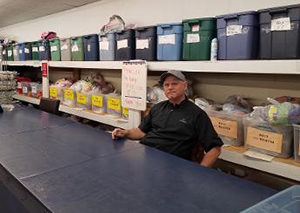
The food pantry at the Churches Touching Lives for Christ is well-stocked by area churches, business and social services agencies. A volunteer is available to serve clients. (Courtesy Photo)
Churches Touching Lives for Christ also sponsors a food pantry specifically for people with physical disabilities. Individuals who are confined to a wheelchair or need oxygen maintenance can visit the food pantry the second Thursday of each month.
The ministry also provides clothing, toiletries and Bibles for ex-offenders who are involved in a 90-day rehabilitation program for substance abuse after their release from prison.
Every day, about 200 families receive assistance at Churches Touching Lives for Christ. A volunteer staff seeks to respond to their needs.
“It warms my heart to see the volunteers work with our clients,” said Retha Snelson, who has worked in “everyday operations” at the ministry for six years.
“It is such a loving atmosphere with everyone trying to help meet the needs of those we serve. I know God is in every aspect of our ministry when I see people leaving our building with a big smile on their face.”
‘What can I do to help?’
Churches Touching Lives for Christ requires about 35 volunteers daily to meet the needs of clients. Tasks range from filing, computer work and general office chores to heavy work such as transporting food.
Jim Hornsby
To serve more people, Churches Touching Lives for Christ has developed a data base that includes information from other agencies in Bell County.
“Now I can check this program and see when people got help last,” Hornsby said. “This will allow us to quickly identify those with both temporary and emergency needs.”
Hornsby understands the situation of people served by this ministry.
“I was a homeless Vietnam veteran and after the war came back to Waco,” he said. “Exposed to Agent Orange while in Vietnam, I have numerous health issues.
“I found a God who loves … making me want to love others. I prayed and asked him, ‘What can I do to help?’ We serve an awesome God!”
Carolyn Tomlin writes for the Christian market and teaches the Boot Camp for Christian Writers.
This is part of an ongoing series about how Christians respond to hunger and poverty. Substantive coverage of significant issues facing Texas Baptists is made possible in part by a grant from the Prichard Family Foundation.
CommonCall: Treasuring a faith that sings
June 18, 2019
LEWISVILLE—Remember the hymnal Mom and Dad shared as they joined in the congregational singing on Sunday morning? Recall the yellowed shape-note gospel songbook in Grandma’s piano bench?
Rob Veal probably has one just like it.
Veal, a veteran minister of music and now executive pastor at Northview Baptist Church in Lewisville, has more than 1,500 unique volumes in his collection—not counting occasional duplicate copies.
“And no, I don’t know every song in every hymnbook I own,” he quickly added.
However, he does maintain an up-to-date list of the hymnbooks lining shelves in his Denton County home. It’s the largest file on his computer.
Veal began leading music in church at age 16, but he acknowledged he had little appreciation then for all that hymnals mean to worshippers.
Passion for collecting
He traces his passion for collecting hymnals to his time on staff at a church in Sweetwater, where he served with a pastor who collected books of sermons and other writings by Charles Spurgeon.
At a used bookstore in Fort Worth, Rob Veal found an old Stamps-Baxter gospel songbook autographed by Virgil Stamps. He bought it for $4. That launched his collection of songbooks and hymnals. (Photo / Ken Camp)
The two of them were visiting a used bookstore in Fort Worth when he found an old Stamps-Baxter gospel songbook autographed by Virgil Stamps. Veal bought it for $4.
“That’s when I started looking for old hymnbooks and gospel songbooks,” he said.
In 1997, when Veal moved back to Texas after serving at a church in Florida, he owned about 350 hymnals. When a national Methodist newspaper picked up a feature story about his growing collection—along with his contact information and the offer of a loving home for hymnals others no longer wanted—his collection expanded exponentially.
“I started getting contacts from people all over the country,” he said.
Within about 10 years, his library of hymnals topped 1,000 unique volumes.
Not just American
His collection took on an international character when he and his wife visited a bookstore in England.
“We were on a tour bus that stopped near a bookstore, and that’s where I hit the motherlode,” he recalled. “I found 40 or 50 books at a great price.”
The oldest hymnal in Rob Veal’s collection is a German Psalter from 1779. (Photo / Ken Camp)
The oldest hymnal in Veal’s collection is a German Psalter from 1779. Some of the most unusual are tiny hymnbooks with miniscule type—smaller in width and height than a pocket-sized New Testament but at least an inch thick—designed for women to carry in their purses.
In addition to church hymnals representing multiple denominations and a variety of Christian traditions, Veal’s collection also includes what he believes is a relatively complete inventory of songbooks used in the Southern Gospel singing conventions sponsored by Stamps-Baxter and other publishers.
“If you ever went to a singing convention in the 1900s, I probably have that gospel songbook,” he said.
‘Retelling the story of our faith heritage’
Rob Veal, a veteran minister of music and now executive pastor at Northview Baptist Church in Lewisville, has more than 1,500 unique volumes in his collection of hymnals and gospel songbooks—not counting occasional duplicate copies. (Photo / Ken Camp)
Veal values each hymnal or songbook as “a capsule of time retelling the story of our faith heritage” from a specific period.
However, that doesn’t mean he objects to contemporary music in worship or to projected lyrics on screens in a worship center.
“We haven’t used hymnals in years” at Northview Baptist, he noted. “When we moved to our new sanctuary in 2007, we shelved the hymnals. … But we still sing hymns. The hymns that have staying power are being arranged in new ways by writers today.
“People who close themselves off to today’s writers are closing themselves to a fresh working of the Spirit. Anyone who rejects everything contemporary is missing the mark. … It’s not either/or. It’s both/and.”
He also treasures the letters and notes that accompanied many of the volumes he added to his collection—particularly those he received from people who donated beloved hymnals that belonged to their relatives.
Eventually, when it’s time for him to pass his collection along, Veal hopes to donate it to a library—perhaps at a Baptist university or seminary—that would appreciate it as much as he does.
In the meantime, he continues hunting for hymnals and searching for songbooks he hasn’t yet discovered.
Read more articles like this in CommonCall magazine. CommonCall explores issues important to Christians and features inspiring stories about disciples of Jesus living out their faith. An annual subscription is only $24 and comes with two free subscriptions to the Baptist Standard. To subscribe to CommonCall, click here.
Social work in line with biblical principles, HPU educator insists
June 18, 2019
BROWNWOOD—After working eight years in secular social work higher education, Rachel Derrington knew she was called to something more.
“I always recognized the parallels between social work values and ethics and Jesus’ teachings, but I couldn’t figure out a way to combine the two,” she said.
After praying about the situation for two years, she received a call from Toni Damron, assistant professor of social work at Howard Payne University.
“She got my number from a friend of a friend and told me she heard I had moved to the area from a colleague I had only met once,” Derrington said. “It was quite serendipitous.”
Derrington joined the HPU faculty in 2018, moving from the University of Denver where she was an adjunct faculty member and curriculum developer.
Previously, she worked in child welfare, helping to place children with adoptive families and providing the families with post-adoptive support. She also worked for the federal government in child welfare policy analysis and marriage/family strengthening activities, and for the state government in Colorado providing policy communications for the state regulatory agency.
Need to be ‘rooted in Christ’
Now, as assistant professor of social work and director of HPU’s social work program, Derrington is teaching students how they can lean on Christ to make a kingdom impact in their future careers.
Social workers deal often with the darkest forces humanity has to offer—abuse, trauma and addictions among others, she noted.
“Social workers are always dealing with the fallouts of evil in the world,” Derrington said. “If they are not rooted in Christ, are not relying on Jesus to empower them, it’s really hard to maintain a healthy balance in their lives and avoid burnout.”
Social work principles are in line with Christian values and the teachings of Jesus, she insisted.
“Jesus taught us to take care of the vulnerable, the oppressed, orphans, displaced people,” she said. “One of the values of social work is holding people in unconditional positive regard and protecting human dignity and the worth of people. That’s all in line with what the Bible tells us.”
Derrington spoke with her pastor, Sam Crosby of First Baptist Church of San Saba, about Jesus’ teachings.
“He said there are 13 references in the King James Version of the Gospels involving Jesus blessing or ministering to the poor,” she said. “Though opinions differ based on interpretations, some scholars argue that the Bible commands compassion toward those in need some 300 times.”
Seeing God’s redemptive power at work
Christian social workers are better positioned to see God’s redemptive powers at work in the lives of the people with which they interact, she added.
“Secularly, social work promotes the idea of empowering others to reach their full potential,” Derrington said. “When you add the Christian influences, social work is about reaching this potential within an individual’s relationship with Christ.”
Although social work often can be incredibly challenging, it is equally rewarding, she asserted.
“Your entire life is centered around the principles of Jesus’ teachings,” Derrington said. “Your career, the way you relate to people in your personal life—even who you are in the community and in the world. Folks who have it in their hearts to serve and really want to model the life of Jesus will find that the social work field is a good way to accomplish that.”
Promoting positive development and healthy families
It is also important, Derrington noted, to understand that social work is as much about preventing evil in the world as it is about dealing with the fallout of it.
“Social work is also about promoting positive youth development and healthy relationships and strengthening marriages and parenting skills,” she said.
A social work education prepares students to practice in organizations or institutions or to work with small groups or families, she explained. Careers include positions with adult protective services, child welfare, community organizations, schools, correctional facilities, prisons, hospitals and treatment facilities among many others. Social workers may also choose to go into politics, research, policy analysis or administrative roles.
“There are also opportunities to do international social work in any type of setting anywhere in the world,” said Derrington.
Many may wonder if they have “what it takes” for a career in social work, but Derrington is certain Christians do.
“You need a solid relationship with Jesus and a good understanding of how he taught us to treat others,” she said. “When put together with the concrete tools that social workers develop in higher education, there are really no limits on how you can impact positive changes in individuals, families, organizations and communities.”
Relaunched BSM in Laredo an answer to prayer
June 18, 2019
LAREDO—Texas A&M International University has a revived Baptist Student Ministry after several years of limited gospel witness on the campus. And many individuals and churches in Laredo see it as the answer to their prayers.
Ben Karner, pastor of First Baptist Church in Laredo, recalled church members gathering three years ago to pray for someone to engage in gospel work on the university campus.
‘Praying for God to send someone’
“Laredo is a mission field,” Karner said. “There are international students from around the world, and we had no gospel witness on campus that was recognizable. We started praying for God to send someone.”
The church continued to pray over the next two years and others around the city joined in that prayer.
During the spring semester 2018, several people contacted Ginger Bowman, BSM church life specialist with the Baptist General Convention of Texas, to explore the possibility of starting a BSM at TAMIU.
At least three people—Jonathan Aragon, then pastor of United Baptist Church in Laredo; Logan Williams, associate pastor from First Baptist in Laredo; and Abigail Vela, a student from Texas A&M Kingsville who transferred to the Laredo school—inquired separately about launching a collegiate ministry.
Bowman sensed God was stirring the hearts of people to begin a new campus ministry and traveled to Laredo last fall to meet with others who might want to join in the effort.
Texas A&M International University in Laredo, represented in this photo by the Sue and Radcliffe Killam Library, lacked a significant gospel witness on campus until the Baptist Student Ministry relaunched. (Photo / Jeremy Sharp)
When Bowman went to the TAMIU campus, she met several students—including Vela, Rudy Delagarza and Ruth Ortiz—who were passionate about seeing their classmates and friends reached with the gospel.
By the end of the fall semester, they began paperwork to be recognized officially as a student organization.
During the spring semester, more than 20 BSM students met weekly for Bible study, discipleship, worship and evangelism training.
Through a grant from the Texas Baptist Missions Foundation, the BSM purchased Bibles and other discipleship materials. The funds also will be used for ministry expenses and funding for a campus missionary.
In January, Vela and Delagarza identified several other student leaders to begin a leadership team and cast a vision for the campus ministry.
God prepared a campus missionary
Two hours away, at Texas A&M University-Kingsville, Joel Barrera was working as a campus missionary intern. He was approached by his director about the possibility of going to help the BSM launch at TAMIU.
Joel Barrera, a campus ministry intern, works with the Baptist Student Ministry at Texas A&M International University in Laredo. (Photo / Jeremy Sharp)
Barrera became a Christian at age 19 as a student at Texas A&M Kingsville. He became involved in the BSM as a leader. After graduation, he committed to serve as a campus missionary.
When he heard about the opportunity to begin new work on a campus in need of the gospel, he prayed and asked God for direction.
“When I heard there was no gospel movement, no disciple-making, and no leadership, the potential to help lead excited me,” Barrera said. “Most people run away from brokenness. It’s a dark campus, but I wanted to run towards that.”
In April, Barrera began traveling to Laredo every week to meet with students. Together, the student leaders and Barrera cast a vision for the BSM at TAMIU.
The BSM desires to be grounded and rooted in the gospel, community, prayer and missions, Barrera emphasized.
“My job is to train and equip the students to do the work,” he said. “I’m giving them tools and showing them how to evangelize. I’m also trying to be that example for them. That’s how I believe God is going to grow us—by working as a team.”
As the students began to meet, churches in Laredo overwhelmingly responded with desires to support the work in any way needed.
“We are excited that this started naturally by the students themselves,” said Ruben Harrison, associate pastor at Primera Iglesia Bautista in Laredo. “We’ve noticed a lot of ownership by the students. … It has a lot of impact on the campus, because the students are leading it and looking for organic growth.”
‘We love what God is doing’
John David Delgado, who became pastor of United Baptist Church in Laredo in January, previously served 11 years in campus ministry.
Within his first few days in the city, Delgado called Vela and told her that United Baptist would be there to support and encourage the new BSM. The university’s president and several staff members attend and serve in leadership at the church, and several students attend as well.
“We are invested in supporting the school. We love what God is doing,” Delgado said. “We will do anything we can to be a support and encourage the BSM to move forward.”
Karner noted it is difficult for churches to have a presence on the campus without a natural invitation from students.
“The BSM is vital on campus, because it gives a way to reach into lives that we would otherwise have no contact with,” he said. “Those [BSM] students have the ability to reach into lives. If we can reach students, imagine what the results could be.”
Over the last month, the BSM leadership intentionally visited United Baptist, First Baptist and Primera Iglesia Bautista to share their vision for campus ministry. The churches all welcomed the students with open arms, each taking time in their worship services to pray for their work and ask God to move in a mighty way on the TAMIU campus.
While in many ways the work has just started at TAMIU, God has been raising up workers to serve the campus and support the new BSM, Barrera noted.
“I want people to know that God is moving already in Laredo and I’m really excited to see what God is going to do in our university and our city,” he said. “Please continue praying for us. I’m super excited to see what God will do.”
Waco church voluntarily cuts ties with BGCT
June 18, 2019
WACO—A Waco church that recently announced it will permit same-sex marriages voluntarily ended its relationship with the Baptist General Convention of Texas.
University Baptist Church in Waco announced in mid-May it will allow its building to be used for same-sex weddings and grant its ministerial staff freedom to choose whether to perform LGBTQ marriages.
At the November 2016 BGCT annual meeting in Waco, Texas Baptists approved a motion establishing affirmation of same-sex marriage as grounds for declaring a church outside the bounds of cooperation with the state convention.
The BGCT Executive Board subsequently carried out that policy by declaring three churches—Lake Shore Baptist in Waco, First Baptist in Austin and Wilshire Baptist in Dallas—“outside of harmonious cooperation” with the BGCT.
‘End the formal relationship peacefully’
University Baptist did not press the issue with the BGCT but chose instead to “end the formal relationship peacefully,” Pastor Josh Carney said.
Josh Carney
“We have been grateful for our partnership with the BGCT, but decided that since UBC developed a position that differs from that of the convention, it was in both parties’ best interest to end the formal relationship peacefully,” Carney wrote in a May 30 email.
“I know God will continue to do great things through BGCT, and UBC will celebrate that work. Dr. (David) Hardage (the BGCT executive director) has been gracious through this process, and I look forward to our continued friendship.”
Joshua Minatrea, BGCT communications director, confirmed in a May 31 email the BGCT “received and accepted a letter of voluntary withdrawal” from University Baptist.
“We appreciate the church’s historical relationship with the convention, and the nature of Pastor Carney’s respectful withdrawal,” Minatrea said.
“We continue to value the autonomy of the local church, and maintain a longstanding and often reaffirmed biblical position on marriage and human sexuality, as we move forward sharing Christ and showing love through cooperative missions and ministry in Texas and beyond.”
Ministering in a small church? Persevere and trust in God
June 18, 2019
BELTON—Demetrio Salazar recognizes serving in a small church with limited resources not only demands perseverance, but also people who place their hope entirely on God.
Salazar began serving Primera Iglesia Bautista of Belton in 2003 as a member of the church before the congregation asked him to become associate pastor, working alongside Pastor Eliseo Arriaga. When Arriaga retired from the pastorate in 2014, Primera Iglesia Bautista called Salazar as pastor.
Through the years, Salazar’s vision of serving others in response to Christ’s calling remains the same, he said.
But performing that task becomes more complicated when a church cannot fully support its pastor financially or add additional staff, he noted.
As president of Compañerismo Paul C. Bell—the Hispanic Baptist association of churches in Bell County and surrounding areas—Salazar knows other congregations find themselves in similar difficulties.
Multiple responsibilities
Pastors grow weary when they feel the need to oversee and carry out most church duties, he observed.
Pastor Demitrio Salazar and his wife Lidia serve at Primera Iglesia Bautista of Belton. He also is president of the area compañerismo. (Photo courtesy of Demitrio Salazar)
Salazar acknowledges the multiple responsibilities ministers—particularly those who serve bivocationally—must bear.
“Besides the pastor’s duties at church, they must also care for their families, their other jobs and their health,” he added.
Churches may experience difficulties due to financial constraints, but their future is not dependent on what they have or do not have, he stressed.
“Resources are certainly helpful and maybe they often accelerate us towards the goals we have. But the commitment people have must be found in discipleship, in their commitment to follow Jesus,” Salazar said. “That is the most important resource—the commitment people have in following Jesus.”
In addition to the challenges small church budgets present, Salazar also recognizes the need for Hispanic congregations to address generational and language differences.
Congregations may be tempted to prioritize preserving social traditions, but Primera Iglesia Bautista in Belton seeks to adapt its methods of communication to relate better to younger generations, Salazar said. The message remains the same, but the media and the ways the message applies continue to change, he added.
“Even with these challenges, we hope in God more pastors and leaders will come to renew the vision of our churches and help guide the next generation,” Salazar said.
“As leaders grow or as new leaders come here, we trust God will use them to guide the church.”
Learn from others, share good ideas
For now, Salazar continues to invite others to follow the example of Jesus and give their lives to service. And as president of the regional compañerismo, he seeks to share best practices with other congregations.
Visiting churches in other states allows Salazar to observe the work of congregations that carry out their mission with limited resources—even less than his church.
He also expressed gratitude for the opportunity to work with other churches through the Hispanic Baptist Convention of Texas and the Baptist General Convention of Texas.
No church will have everything together before its members dedicate their lives in service to Christ, but God promises the story will not end there, Salazar remarked. With resources or without them, God continues to transform individuals, congregations and communities, he said.
EDITOR’S NOTE: The second paragraph was edited after the article originally appeared.
Logsdon student translates memoirs of medical missionary
June 18, 2019
ABILENE—Logsdon Seminary student Javier Vargas understands the importance of using talents for God’s glory. That’s why he used his gift for language studies to take on a project others rejected.
Vargas, who is originally from Colombia, translated White Witch Doctor, the memoirs of medical missionary Daniel I. Gruver, from English to Spanish.
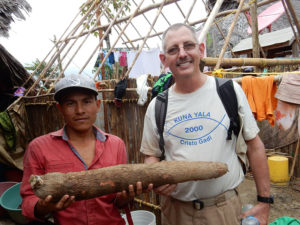
In the book, Gruver shares memories of his 50 years as a missionary doctor among the indigenous Kuna people in Panama. Gruver died before he was able to translate the book to Spanish.
Medical terms, indigenous language
His son, Daniel Marcus Gruver, reached out to multiple groups and individuals to translate the book, but none completed the project.
“One look at the medical and indigenous Kuna terms, and it would be put to the side and forgotten,” Gruver said.
Vargas not only accepted the challenge with enthusiasm, but also volunteered his time and effort. He meticulously investigated the meaning of medical terms and explored the cultural nuances of various words to offer the most accurate translation.
Medical missionary Daniel Gruver worked among the Kuna people of Panama for 50 years. Logsdon Seminary student Javier Vargas translated his memoirs from English to Spanish. (Photo courtesy of Daniel Gruver family)
“Over the next eight to nine months Javier won over our hearts with his commitment and dedication,” Gruver said. “With prayer and hard work, he was able to very accurately portray the true heart of a missionary.”
Gruver expressed deep gratitude for the translator’s selfless efforts as he prepared to deliver El Cantador Doctor Blanco, Spanish translations of his father’s book, to the Kuna people.
“The people that I grew up with in Panama and that worked and served with my father—those that he healed and lives he saved—can now have a copy of the book they have been asking for in Spanish,” he said.
God granted a desire to serve
When asked what prompted his voluntary service, Vargas said God had granted him a heart of compassion and the desire to serve with the abilities God had given him.
When the responsibilities of school, his job, his family and translating became stressful, Vargas remembered why he decided to translate the book in the first place.
Daniel Gruver served 50 years as a medical missionary among the indigenous Kuna people in Panama. He described his experiences in “White Witch Doctor.” He died before he was able to translate the book from English to Spanish. (Photo courtesy of Daniel Gruver family)
“An image came to my mind, and it was a person from the indigenous community reading it to their community in a language they could understand. And that made me keep going,” he said. “As Dr. Gruver brought physical and spiritual healing to a community that he and his wife did not know before, we as students can carry in our backpack our desires to serve others in the unique time we have, today.”
Vargas is in the second year of Logsdon’s dual degree program that leads to a Master of Arts in Family Ministry and Master of Arts in Clinical Counseling and Marriage and Family Therapy.
After his anticipated graduation in May 2021, he plans to serve in an organization that works with senior adults.
“I would like to explore more about adult development and contribute to those inspirational people in their stages of life,” he said.
“It is enough to have them close, listen to them and have gratitude for the wonderful work of God in each one of them. Honoring them is also a way of honoring the memory of my father, who had made plans to visit his granddaughters here in the States, but due to health issues, he passed away a few years ago.”
Vargas also hopes to continue translating materials into Spanish for the Latino community and writing original works of his own.
“Today I look at my hands, and I remember that I still have them to continue blessing others, just as this nation has done to me,” he said.
When translating White Witch Doctor, Vargas reflected, “You do not write for yourself, knowing that one day you will not be able to read it. You write so that others can go through your writings and see the world that you went through yesterday.”
Texas lawmakers pass school finance, criminal justice reforms
June 18, 2019
AUSTIN—The 86th Texas Legislature passed a school finance bill that provides $6 billion in new state funding for public education—action Texas Baptist advocates for public schools applauded.
Lawmakers also passed a $250.7 billion two-year budget and a bill that requires local entities to receive voter approval if they want to raise property tax revenue by more than 3.5 percent.
The three closely related bills reflected priorities Gov. Greg Abbott set at the beginning of the legislative session.
Productive session for schools
“Overall, we are pleased with the work of the 86th Legislature,” said Kathryn Freeman, director of public policy for the Texas Baptist Christian Life Commission.
The additional funding for public schools will supply “the resources they need to provide full-day pre-kindergarten and targeted interventions for those with special needs, among other things,” Freeman noted.
Charles Foster Johnson, executive director of Pastors for Texas Children, called the 86th legislative session “the most productive on behalf of our 5.4 million schoolchildren in recent memory.
Charles Foster Johnson
“Clearly, the voices of faith leaders and faith communities played a key role in this huge step forward of the enactment of HB 3,” Johnson said. “Quality public education for all of God’s children is protected by the biblical mandate for justice as well as by the Texas State Constitution. It is a moral imperative embraced by civil society.”
While acknowledging the “historic legislation is not perfect” and “fixes and corrections” will be needed in the next session, Johnson commended lawmakers for taking significant action to improve public school funding.
“Clearly, HB 3 is a huge first step in the right direction in correcting funding lapses of the past decade, and in restoring Texas to its rightful place of leadership among our United States in per pupil spending on our children,” he said.
Criminal justice reform bills approved
Kathryn Freeman
As part of the Texas Smart-on-Crime Coalition, the CLC supported several bills lawmakers approved to improve the treatment of incarcerated women and reform licensing requirements to enhance the job prospects of ex-offenders, Freeman noted.
“Criminal justice reform is about getting better results, better outcomes and lower costs. It’s about creating opportunities for redemption,” said Bill Hammond, chief strategist of the Texas Smart-On-Crime Coalition.
“The Texas Legislature showed its commitment to these core values of reform in a significant way this session. There’s work still to be done, but we’ve made great strides to reform our broken criminal justice system, strengthen our communities, reduce taxpayer costs and keep Texas safe.”
Four criminal justice reform bills—HB 650, HB 1374, HB 3227 and HB 812—were part of a package collectively tagged as Women’s Dignity Legislation.
“Republicans and Democrats stood together to pass meaningful reforms to improve the treatment of women incarcerated in Texas’ state correctional facilities,” said Lindsey Linder, senior policy attorney with the Texas Criminal Justice Coalition.
“From improving conditions of confinement for women to addressing some of the root causes that contribute to women being incarcerated, to training to support pregnant women inmates, to understanding women’s unique role as primary caregivers, the Texas Legislature made women’s dignity a top priority in reforming the criminal justice system.”
The CLC and other members of the Texas Smart-on-Crime Coalition also backed HB 1342, which expands access to occupational licenses for people with a criminal record, and HB 1, a vocational education pilot program.
Abortion, sex abuse and LGBTQ issues
The Texas Legislature also “passed several good pro-life bills,” Freeman noted. She particularly singled out SB 22, which prohibits government entities from contracting with abortion providers, and HB 16, which protects babies born alive after failed abortion attempts.
(BGCT Photo / Kalie Lowrie)
Lawmakers also approved a bill to shield churches from lawsuits if they disclose to potential employers credible sex abuse allegations.
The Texas Senate unanimously passed HB 4345 on May 22, two weeks after the House of Representatives approved it. The bill protects churches and other charitable organizations, their volunteers and independent contractors from civil liability if they communicate credible sex abuse allegations to potential employers, even if no criminal charges were filed against the accused.
Ben Wright, pastor of Cedar Pointe Baptist Church in Cedar Park; Bart Barber, pastor of First Baptist Church in Farmersville, and other ministers worked with Rep. Scott Sanford, R-McKinney, to initiate the bill.
Legislators also passed SB 1978, the so-called “Save Chick fil-A” bill—a measure that prevents state and local governments from taking adverse action against individuals or entities based on their religious beliefs or moral convictions.
In March, the San Antonio City Council voted to remove Chick fil-A from the San Antonio International Airport, citing the Georgia-based company’s alleged “legacy of anti-LGBTQ behavior.”
In 2012, the fast-food company’s president, Dan Cathy, voiced support for “the biblical definition of the family unit” and opposition to same-sex marriage. More recently, Chick fil-A and its WinShape Foundation were criticized for making charitable grants to organizations such as the Salvation Army and the Fellowship of Christian Athletes that hold traditional views on marriage.
In a May 20 Twitter post, Abbott tweeted a photo of a Chick fil-A cup perched on his laptop, along with the message: “So. What are the odds I’ll sign the Chick fil-A bill? I’ll let you know after dinner.”
Efforts to expand gambling squelched
In spite of intensive lobby by the gambling industry, most bills to expand legalized gambling in Texas never advanced in the legislative session. One bill to legalize daily fantasy sports that passed the House never received a Senate committee hearing.
“The biggest one would have legalized daily fantasy sports. Once again, the gambling interests tried to pass with a statutory change something that requires a constitutional amendment,” said Rob Kohler, consultant with the Texas Baptist Christian Life Commission.
Commercial daily fantasy sports sites charge players a fee to enter a game in which they create a fantasy sports team using real professional athletes. The athletes’ performance in certain statistical categories determines how a fantasy league team fares. The fantasy sports player wins or loses money accordingly, and the sponsor site claims a percentage.
The Texas Constitution prohibits wagering on games of chance, and Attorney General Ken Paxton issued a ruling three years ago stating his belief that “a court would conclude that participation in paid daily fantasy sports leagues constitutes illegal gambling.”
However, commercial operators—and reportedly the owners of some professional sports teams—lobbied to have daily fantasy sports players reclassified as participants in a legal “game of skill” rather than bettors in a prohibited “game of chance,” Kohler said.
“They tried to compare it to a fishing tournament or a bowling tournament,” he said.
States that have legalized daily fantasy sports had to include consumer protection language, he noted. That includes the right to self-exclusion—voluntarily suspending an account when a player recognizes he has an addiction or has over-extended himself.
“You don’t see that happening with a fishing tournament,” Kohler said.
‘Too close for comfort’
HB 2303, which would have redefined daily fantasy sports as a “game of skill” in the Texas Penal Code, passed the House. However, Sen. Kelly Hancock, R-North Richland Hills, never allowed a hearing in the Senate Business and Commerce Committee, which he chairs.
“At the end of the day, without Sen. Hancock’s leadership, we would have had a real fight on our hands,” Kohler said. “He called it the way it is. If they want to do this (legalize daily fantasy sports), they need to do it the right way by amending the constitution.”
Rodger Weems, chair of Texans Against Gambling, agreed the daily fantasy sports bill “came too close for comfort.” He also noted that “members of the Texas Legislature were under tremendous pressure from the pro-gambling lobby.”
Weems praised Kohler for his “dedication, competence and intellect” in working to resist gambling expansion in the state.
“The anti-gambling forces succeeded in 2019 in defeating every single effort to expand gambling in Texas,” Weems said. “As in past sessions, the gambling industry walked away with absolutely nothing.”
For all the good accomplished during the session, lawmakers failed to act on some significant matters, Freeman noted.
“We would have liked to have seen more attention paid to improving access to health care for impoverished women and mothers through the passage of HB 342 and HB 744,” she said. “But we hope over the interim, momentum will continue to build so that the legislature will take another look at these issues in 2021.”
CommonCall: God transforms Juárez one child at a time
June 18, 2019
Julio Carrillo wants to see Juárez—a Mexican border city known for its drug violence—transformed by God.
Carrillo insists the example and support he received from Alliance Church in Lubbock and the service he sees from his Aunt Guadalupe in Juárez helped him hear the call God gave him.
Carrillo’s aunt hosts a mission of Primera Iglesia Bautista of Juárez every Saturday in Anapra, one of the city’s most impoverished neighborhoods. Every week, ministers lead Bible studies on his aunt’s property—outdoors because of lack of space indoors. Carrillo knew he could help.
“My aunt first told me what was going on, and then God called me and my family to start doing this,” he said.
Along with other members of Alliance, Carrillo collected jackets, books, backpacks and other school supplies to take for the children in Juárez, he noted.
Since he started supporting the ministry a year ago, Carrillo said, the group of children has grown from 25 to more than 40.
To provide a better setting for Primera Iglesia Bautista in Juárez to teach children the Bible, Carrillo led a group to build a room with space to accommodate about 100 children, he said.
Offering children a better future
The poverty children face in Juárez not only impacts their current well-being, but also their futures, Carrillo explained. Their clothes are worn out, and sometimes they go without enough food to eat.
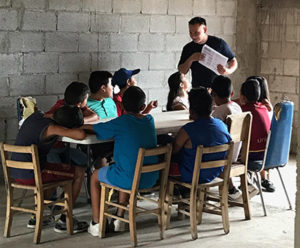
Children in Anapra, one of the poorest neighborhoods in Juarez, learn about God’s love through the ministry of Primera Iglesia Bautista in Juarez, with support from Alliance Church in Lubbock. (Photo courtesy of Julio Carrillo)
When the children talk about what they want to be in the future, some say they want to be drug lords—the only people they have seen rising out of poverty, he said.
“It is pretty rough to see what is going on,” Carrillo said. “But to see what the church there is doing over there is very hopeful.”
Violence in Juárez has diminished somewhat from its peak a few years ago, but God is the only one who can bring lasting peace to the city, Carrillo said.
God’s transforming power is evident in the lives of children who learn about Jesus and commit their lives to follow him, he noted.
“You have to see them and know with better kids there is also a better city,” he said. “What you are giving to these kids and what they are learning they will remember for the rest of their lives.”
While there are risks associated with serving in Juárez, Carrillo said, the God who called him there is bigger than any danger.
Carrillo recognizes he needs to respond to that calling.
“The look in the faces of those kids, without even telling you, you know they care for you,” he said. “Maybe some of them only thought their parents cared for them, but now they know we care for them, and they are learning God cares for them.”
As children in Juárez learn about the love of God, Carrillo said, transformation begins in their lives.
“That seed is being planted, and we know God will use it to give fruit,” he said.
Read more articles like this in CommonCall magazine. CommonCall explores issues important to Christians and features inspiring stories about disciples of Jesus living out their faith. An annual subscription is only $24 and comes with two free subscriptions to the Baptist Standard. To subscribe to CommonCall, click here.