Grant to Baylor Social Work spurs questions (Updated)

Baylor University recently announced—and then rescinded—a grant focused on the study of the “disenfranchisement and exclusion of LGBTQIA+ individuals and women” in churches.

On June 30, Baylor University’s Diana R. Garland School of Social Work announced a grant awarded to Baylor’s Center for Church and Community Impact, or C3I. The nearly $644,000 grant from the Eula Mae and John Baugh Foundation will fund a study “to help foster inclusion and belonging in the church.”

“This grant will help us better understand the disenfranchisement and exclusion of LGBTQIA+ individuals and women within congregations to nurture institutional courage and foster change,” the announcement reads.

Courage from the Margins: Inclusion and Belonging Practices for LGBTQIA+ and Women in Congregations is the study funded by the $643,401 grant.

In his weekly email, Texas Baptists Executive Director Julio Guarneri responded to “questions and concerns among several” about the announcement. Acknowledging “we are trying to learn more about what this means,” Guarneri cited several certainties among Texas Baptists.

Linda Livingstone, Baylor University president, issued a statement for Baylor faculty, staff and alumni on July 9 stating that “Dean Jon Singletary and principal investigator Dr. Gaynor Yancey have voluntarily offered to rescind their acceptance of this grant on behalf of the School of Social Work and return all associated funds to the Baugh Foundation.

“We recognize that this situation has caused concern and confusion for many within the Baylor Family and among our broader community of churches, partner organizations, and supporters. This has been a learning opportunity for many involved in this situation, and we aim to work alongside our college and school leaders, faculty, and research community, particularly during these challenging times for higher education.”

Livingstone added that Baylor will remain “committed to its unique role as a Christian research university—one that encourages rigorous inquiry and thoughtful exploration of complex issues. We will continue to support our faculty and researchers in pursuing meaningful scholarship, while ensuring that such work aligns with our institutional processes.”

Julio Guarneri, Texas Baptists executive director, expressed his appreciation for Baylor’s decision.

“I am thankful for this decision made by Baylor leadership,” Guarneri said.

“The decision is consistent with Baylor’s policies and statement on human sexuality. We appreciate Baylor President Linda Livingstone and Truett Seminary Dean Todd Still for their commitment to these biblical and historical principles and for their leadership,” Guarneri added.

Focus and goal of C3I study

The Courage from the Margins study “will focus on the lived experiences of emerging adults. It will assist us in filling out the bigger picture of congregations’ practices that result in an environment of belonging,” Gaynor Yancey, director of the Center for Church and Community Impact (C3I) and Lake Family Endowed Chair in Congregational and Community Health, said.

“Through our research, we want to expand our picture of what congregations do and do not do in their caring practices with all people about their experiences of belonging” Yancey added.

According to the announcement, “Many LGBTQIA+ individuals and women experience what researchers call ‘institutional betrayal’ within their faith communities—situations where the institutions they depend on for spiritual support fail to protect them or even actively harm them,” a focus of C3I’s work.

This failure or harm “might involve exclusion from church activities, family estrangement and painful conflicts that leave lasting emotional wounds.”

The study “prioritizes [marginalized] voices, giving them a safe space to share their experiences and guide positive change within faith communities. … Listening to and understanding the stories of these often-marginalized populations can promote a trauma-sensitive sense of belonging, cultural humility and institutional courage in congregations.”

“Social work values and competence through the ethical integration of faith and practice prompt C3I to constantly and consistently nudge faith-based organizations to be proactive in establishing institutional courage,” the announcement states.

“The study will help congregations develop greater cultural sensitivity and humility, trauma-informed approaches to ministry, concrete steps toward genuine inclusion, and environments where all members can thrive.”

Study methodology

“Researchers will recruit two groups of 25” emerging adults ages 18-24 “from across the country … to a series of confidential interviews, focus groups, and surveys to facilitate a deeper understanding of their lived experiences with congregations.”

Data gathered “will directly inform trauma-sensitive training resources that C3I will develop for congregational use, providing guidance on inclusivity and institutional courage.”

Further, “C3I will pilot the curriculum at a gathering of congregations, measuring success through attendance and feedback specific to what a congregation plans to implement, such as the adoption of more inclusive language.

“Findings [from the pilot] will be shared through online publications, digital platforms, faith-based conferences and academic articles.”

Gratitude for grant

“The generous support of the Baugh Foundation allows C3I to deepen its work at the intersection of faith, justice and community and is both timely and essential,” Jon Singletary, dean of Baylor’s Garland School of Social Work, said.

“We are always so grateful for the support and encouragement of the Eula Mae and John Baugh Foundation for our ongoing research in assisting congregations in ministering to marginalized populations,” Yancey said.

“For several years, they have assisted us with funding for research to study the inclusionary practices of congregations with people who are marginalized in numerous ways,” she added.

“Congregations have the potential to be spaces of healing and belonging, yet too often they become sources of exclusion and harm. This grant equips us to listen deeply, study carefully and partner faithfully with churches seeking to become more just and welcoming communities,” Singletary added.

“This is about our hearts, for sure, and how we act on God’s softening of our hearts toward those who live life in the margins and shadows, rarely experiencing a sense of belonging,” Yancey stated. “Congregations are uniquely positioned in community life to be those places of care.”

Texas Baptist position

“While we are trying to learn more about what this means, there are things that are certain and which I want to communicate to you,” Guarneri wrote in his July 3 weekly email update. “We are seeking to learn more from Baylor’s leadership so that we can decide how to best move forward.”

Guarneri reaffirmed the Baptist General Convention of Texas’ position on marriage, sexuality and gender: “Texas Baptists remains committed to our conviction that biblical sexuality is a gift from God, which consists of a relationship between a man and a woman within the covenant of marriage.

“While we consider any sexual behavior outside of the above definition of biblical marriage sinful, we strive to love every person with the desire that they would be faithful followers of Christ,” Guarneri added.

“We also believe that God created every human being as either male or female. Gender is not a choice but a gift from God. This has not changed for us,” Guarneri added.

Further, “in our commitment to the Great Commandment and the Great Commission, we believe that every human being is made in the image of God and is worthy of dignity, respect and love.”

In keeping with this commitment, Guarneri pointed Texas Baptists to resources prepared by the Texas Baptists Christian Life Commission “for churches to learn how to minister to those struggling with gender identity. Our desire is for our churches to be welcoming and loving of all people while remaining true to the biblical standards of holiness and God’s design.”

BGCT/Baylor relationship

Responding to questions about the BGCT’s relationship with Baylor University, Guarneri acknowledged “the relationship has changed over the years. In contrast with the universities that are affiliated with us, our relationship with Baylor University is by special agreement.”

This special agreement has funding and governance implications, Guarneri explained.

“Cooperative Program funding does not support Baylor’s general budget,” Guarneri stated. “We designate our funding for scholarships of ministers’ children, the work of the Baptist Student Ministry, which Texas Baptists oversees, and ministry student scholarships exclusively.”

Additionally, the “BGCT elects approximately 25 percent of Baylor’s board of regents, allowing Texas Baptists to have a voice but not control of the university,” he continued.

For those asking about Baylor’s and Truett Theological Seminary’s position on sexuality, Guarneri stated Truett’s “is essentially the same as the BGCT’s and not unlike that of Baylor University’s.”

“Pastors and leaders who are concerned or have questions are encouraged to contact [Baylor] University and Truett Seminary administration,” Guarneri added.

Statement from Baylor University

Baptist Standard contacted Baylor University administration following Guarneri’s weekly update and received the following statement:

“Baylor’s institutional beliefs, policies, and statements have not changed. Our commitment to our Christian mission and identity remains steadfast, and we continue to uphold the biblical values that have long shaped our University’s foundation.

“In particular, Baylor affirms the biblical understanding of human sexuality as a gift from God. Christian churches across the ages and around the world have affirmed purity in singleness and fidelity in marriage between a man and a woman as the biblical norm. This conviction continues to guide our institutional policies and our approach to student life, academics and spiritual formation.

“It is important to understand [the Courage from the Margins study] is not an activist endeavor aimed at changing our Baptist churches or redefining biblical truth. Rather, it is an educational program designed to equip church leaders with resources and perspectives to engage on these difficult issues within their congregations thoughtfully and pastorally and to better understand and, specifically, minister to individuals who may feel marginalized or excluded.”

Editor’s Note: The story originally was posted July. 3. It was updated July 9 to include statements from Baylor University President Linda Livingstone.


Liderazgo y gratitud destacan Convención 2025

Los asistentes a la reunión anual de la Convención Bautista Hispana de Texas 2025 se reunieron en la Primera Iglesia Bautista de Duncanville para celebrar a los líderes de larga trayectoria, desarrollar nuevos líderes, agradecer las bendiciones financieras y elegir a los nuevos directivos.

Bea Mesquias, de la Iglesia Bautista Ágape de San Antonio, fue reconocida por su trayectoria de servicio a la Unión Femenil Misionera de Texas y sus 15 años como directora ejecutiva de la UFM. Mesquias también fue la primera mujer elegida presidenta de la Convención. La sucesora de Mesquias es Silvia Ake, quien también sucedió a Mesquias como directora de la UFM de Texas.

Raquel Contreras Smith fue homenajeada por sus años de servicio como editora y directora ejecutiva de Casa Bautista de Publicaciones, ahora conocida como Editorial Mundo Hispano.

Alfonso Flores también fue homenajeado por sus 63 años de servicio en el ministerio y 35 años como pastor de la Primera Iglesia Bautista Mexicana de San Antonio.

Además de estos reconocimientos, la Convención celebró una asistencia récord. En comparación con las 600 personas que asistieron a la reunión anual de 2024 en Houston, 911 asistieron a la reunión de este año.

Formando nuevos líderes

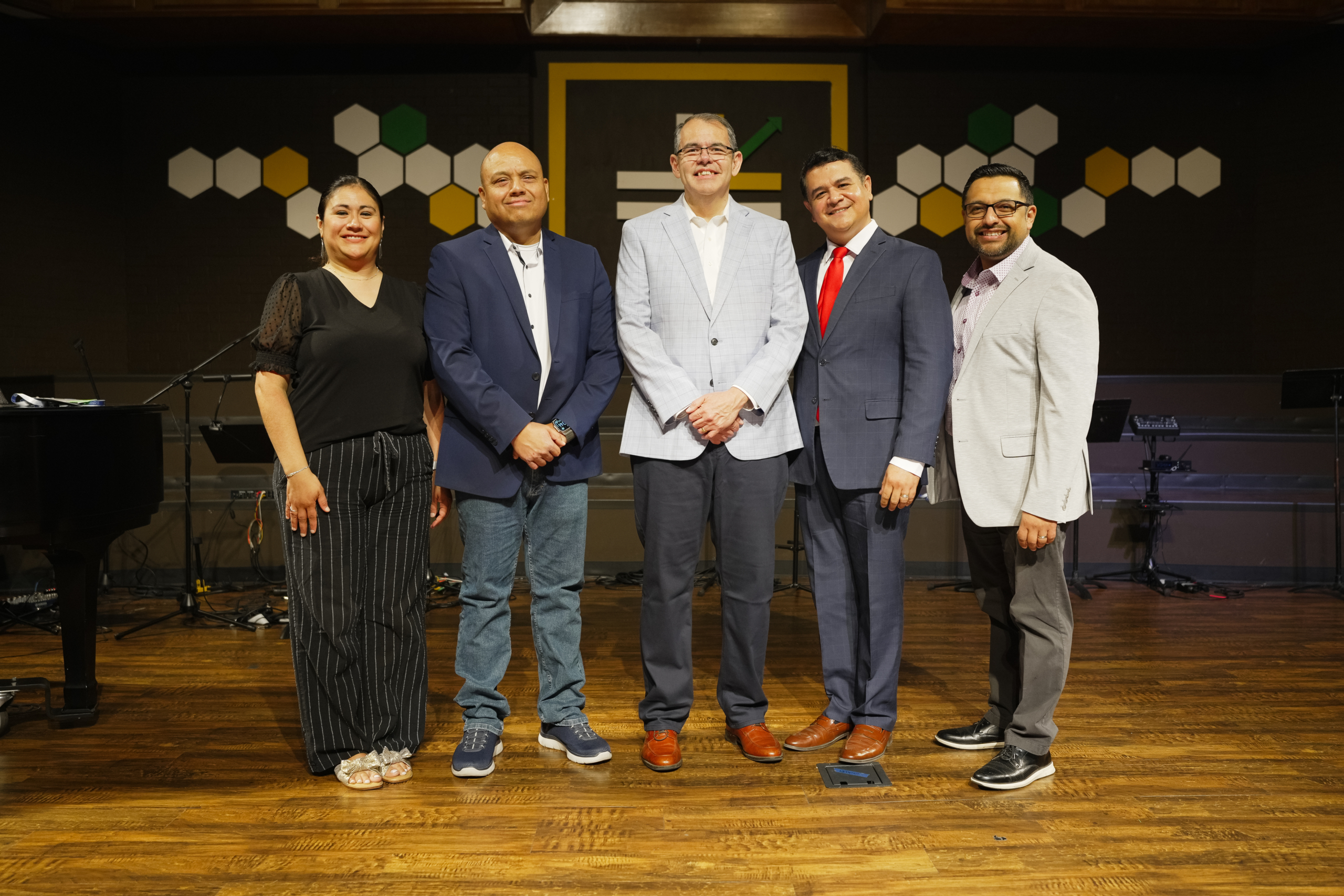
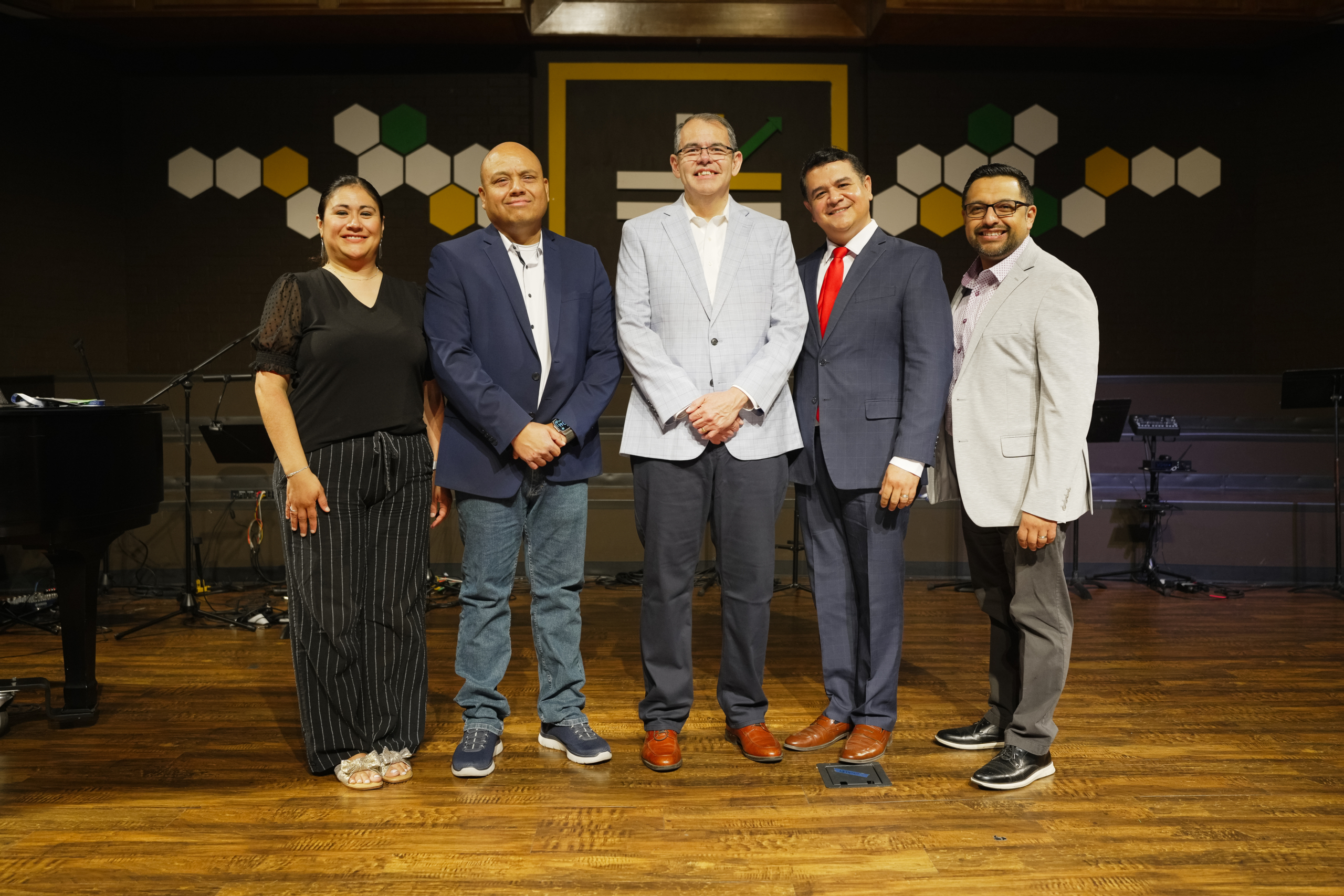
Oficiales nuevas de la Convención, de izquierda a derecha: Lidia-Salazar, secretaria; Demetrio Salazar, segundo vicepresidente; el director ejecutivo de la Convención, Jesse Rincones; Edson Lara, presidente; Fernando Rojas, primer vicepresidente. (Foto de la Convención)

El tema de la reunión anual de 2025, “De Generación en Generación”, y los talleres se centraron en el desarrollo y la formación de nuevos líderes.

Las iniciativas de educación hispana son una parte importante del desarrollo y la formación de nuevos líderes. Estos esfuerzos buscan ampliar las oportunidades para que los estudiantes hispanos asistan a la universidad y realicen estudios de posgrado.

Bendiciones financieras

El director ejecutivo de la Convención, Jesse Rincones, agradeció los esfuerzos de las iglesias por unirse para fomentar la cooperación entre ellas y ampliar la labor de formación de nuevos líderes para la próxima generación.

Rincones informó sobre una extensión de cinco años de una subvención del Fondo Lilly para Prosperar en el Ministerio, que financia la Iniciativa Conexión Pastores, lanzada en 2019. La iniciativa está diseñada para “conectar a los pastores en grupos de pares saludables para ayudarlos a prosperar en el ministerio”. La subvención amplió el programa para ministrar a las esposas de pastores bautistas hispanos a través de la nueva obra de Conexión Esposas.

Otra subvención de Lilly, recibida en 2024, estableció CANTA. El acrónimo significa “Congregaciones que Ayudan a los Niños a Transformarse en Adoradores”. El programa crea materiales de adoración y capacitación para niños en iglesias hispanas.

Otra subvención de Lilly, recibida en febrero, apoya una colaboración para el desarrollo de capacidades entre la Convención y la Red Nacional Bautista Hispana, llamada Adelante. Esta subvención permite a la Convención contratar a un director de desarrollo y participación eclesial y lanzar una iniciativa para desarrollar jóvenes líderes latinos a través de una experiencia de cohorte de un año.

Elección de nuevos directivos

Durante la sesión de negocios del martes por la mañana, Edson Lara, pastor de la Iglesia Bautista Emanuel en McAllen, fue elegido presidente de la Convención.

Fernando Rojas, pastor de la Iglesia Bautista Azle Avenue en Fort Worth, permanecerá como primer vicepresidente. Demetrio Salazar, pastor de la Primera Iglesia Bautista de Belton, también fue reelegido segundo vicepresidente. Lidia Salazar, maestra de escuela, esposa de Demetrio Salazar y miembro de la Primera Iglesia Bautista de Belton, fue elegida secretaria.

Celebrando la jubilación de una líder

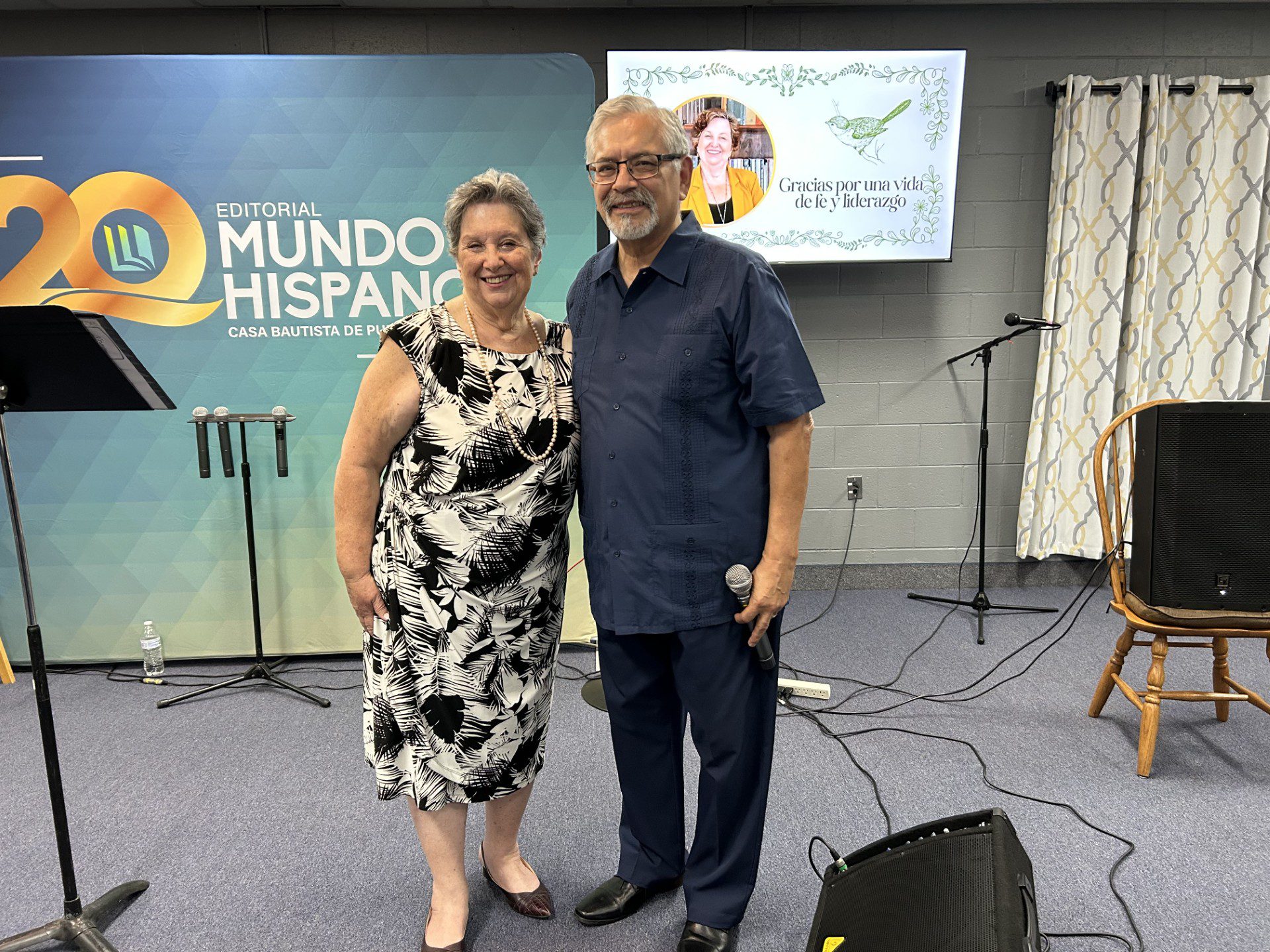
Raquel Contreras, directora ejecutiva y editora de Editorial Mundo Hispano, se jubila junto al presidente de la junta directiva, Gus Reyes, director de alianzas hispanas de Dallas Baptist University. (Foto cortesía)

Tras 12 años como directora ejecutiva y editora de Editorial Mundo Hispano, Raquel Contreras, chilena de nacimiento, se jubila. Es abogada de profesión. Se graduó del Southwestern Baptist Theological Seminary y tiene un Doctorado en Divinidad de Dallas Baptist University.

Editorial Mundo Hispano fue fundada por los misioneros J. Edgar y Mary Davis en Toluca, México, en 1905, y posteriormente se trasladó a El Paso. Contreras fue elogiada por su capacidad para mantener la empresa a flote y servir a la comunidad cristiana hispana incluso en tiempos difíciles, como la pandemia.

Editorial Mundo Hispano celebra su 120th aniversario de servicio a los cristianos de habla hispana en todo el mundo. Proporciona Biblias, programas de escuela dominical y una gran variedad de libros. Carolina Carro de Mangieri, directora de eventos globales y confraternidad de Baptist World Alliance, comenzará a desempeñarse como nueva directora ejecutiva y editora de la editorial este agosto.


Texas Baptists celebran la educación superior hispana

Texas Baptists honraron a estudiantes y líderes educativos hispanos durante un banquete de recaudación de fondos tras la clausura de la reunión anual de la Convención Bautista Hispana de Texas 2025, celebrada en la Primera Iglesia Bautista de Duncanville.

Becas

Se recaudaron $8,500 para financiar nueve becas otorgadas por la Oficina de Educación Hispana de Texas Baptists a estudiantes hispanos de pregrado que asisten a una universidad afiliada a Baptist General Convention of Texas y son miembros de iglesias bautistas de Texas.

Estudiantes hispanos bautistas de Texas que recibieron becas. (Imagen cortesía)

Los beneficiarios de las becas son:

Celina Aguirre, estudiante de ciencias políticas en Dallas Baptist University y miembro de la Iglesia Bautista Park Cities en Dallas.

Luis Alfredo Esquivel, estudiante de estudios bíblicos en Baptist University of the Américas y miembro de Southwest Baptist Church en San Antonio.

Osmara Dayanira Flores, estudiante de consejería clínica en Wayland Baptist University y miembro de la Iglesia Bautista Emmanuel en McAllen.

Ana Martínez, estudiante de enfermería en la University of Mary Hardin-Baylor y miembro de la Iglesia Bautista Getsemaní en Fort Worth.

Jazmín Lizbeth Olivarez, estudiante de administración de empresas en BUA y miembro de la Iglesia Bautista Elohim en Bryan. Olivarez dio su testimonio durante el banquete sobre su llamado al liderazgo ministerial. También habló del valor de la educación y su agradecimiento por el apoyo financiero de Texas Baptists.

• Libni Shetler, estudiante de enfermería en Houston Christian University y miembro de First Baptist Church en Marble Falls.

Marlon Vargas Zea, estudiante de negocios y teología en BUA y miembro de la Iglesia Más Allá de la Cruz en San Antonio.

Jayson Villalobos, estudiante de mercadotecnia en Howard Payne University y miembro de la Primera Iglesia Bautista en Azle.

Sofía Villarreal, estudiante de comportamiento humano en BUA y miembro de Life Church de San Antonio.

Líderes de la Iniciativa de Educación Hispana

Además de otorgar becas, el banquete celebró los 21 años de la Iniciativa de Educación Hispana de Texas Baptists y honró a sus líderes clave.

Albert Reyes, presidente y director ejecutivo de Buckner International, expresidente de Baptist University of the Américas y primer presidente hispano de BGCT (2004), impulsó la formación de un Grupo de Trabajo para la Educación Hispana a principios de la década de 2000.

El grupo de trabajo se creó en 2005 y Felipe Garza fue su primer presidente.

Gus Reyes, director de alianzas hispanas en DBU, fue el primer miembro del personal de Texas Baptists en dirigir la Iniciativa de Educación Hispana antes de convertirse en director de la Comisión de Vida Cristiana de Texas Baptists.

Gabriel Cortés fue director de la Iniciativa de Educación Hispana de 2014 a 2018. Posteriormente, se desempeñó como jefe de personal en la BUA antes de regresar a Texas Baptists en 2024 como director de educación hispana.

Rolando Rodríguez, director de Texas Baptists en Español, fue director de la Iniciativa de Educación Hispana de 2018 a 2024.

Lorenzo Peña dirigió una iniciativa especial centrada en la educación superior hispana de 2022 a 2023 a petición de David Hardage, exdirector ejecutivo de Texas Baptists.

Celebrando el pasado

Albert Reyes, presidente y director ejecutivo de Buckner International, pronuncia el discurso inaugural durante el banquete de educación hispana de Texas Baptists. (Foto cortesía)

Albert Reyes pronunció el discurso principal del banquete, compartiendo su propia trayectoria educativa desde la Primera Iglesia Bautista en Corpus Christi, pasando por la Mary Carroll High School, hasta Angelo State University, donde obtuvo un Doctorado en Ministerio en Misionología del Southwestern Baptist Theological Seminary y un Doctorado en Liderazgo de Andrews University.

Cuando Reyes era presidente de BUA, “la tasa de finalización de la escuela preparatoria en Texas para los adolescentes hispanos era de alrededor del 50 por ciento”, dijo, “y la tasa a nivel nacional era del 33 por ciento a principios de la década de 1990”.

“Hemos mejorado drásticamente esas cifras en los últimos 35 años. Hoy, la tasa de finalización de la escuela preparatoria hispana se sitúa en el 88 por ciento”, añadió, citando datos de la Fundación Annie E. Casey.

Desafiando el futuro

Reyes se refirió a las realidades demográficas actuales y futuras, haciendo referencia a las estadísticas y proyecciones de Texas 2036.

“Hoy en día, Texas alberga a 32 millones de personas. Para 2036, se espera que Texas aumente entre 3 y 5 millones de personas, principalmente debido a la migración interna. En 2022, hace tres años, los hispanos se convirtieron en el grupo poblacional más numeroso de Texas.

“Para 2050, dentro de 25 años, la población hispana de Texas será el grupo racial-étnico más numeroso en todas las categorías de edad. En otras palabras, en el futuro, o serás bilingüe y bicultural, o estarás solo.

“Para el otoño de 2042, dentro de unos 15 años, se proyecta que el número de graduados anglosajones, afroamericanos y asiáticos disminuya en un 26 por ciento, un 22 por ciento y un 10 por ciento, respectivamente”.

Otras estadísticas señalan la urgencia con la que las universidades e instituciones de educación superior deben involucrar a los estudiantes hispanos.

“El Centro Nacional de Estadísticas de Educación informa que la proporción de estudiantes hispanos de secundaria es mayor en California, con un 56 por ciento, Texas, con un 53 por ciento, y Florida, con un 38 por ciento”, informó Reyes desde Texas 2036.

Más cerca de casa para los asistentes al banquete, U.S. News & World Report muestra que Dallas Independent School District informa que la matrícula estudiantil hispana alcanzó el 70 por ciento en el año escolar 2023-2024, afirmó Reyes.

Ante estas estadísticas, Reyes instó a las iglesias, colegios y universidades de Texas Baptists a estar “preparadas para los hispanos”.

“Educar es redimir”, dijo Reyes, citando un mensaje que recordaba haber leído durante su propia trayectoria en la educación superior. “Educar a alguien es redimir todo lo que Dios quiso que fuera y equiparlo, discipularlo, prepararlo para una vida con propósito”.


Texas Baptists celebrate Hispanic higher education

Texas Baptists honored Hispanic students and education leaders during a fundraising banquet following the conclusion of the 2025 Convención Bautista Hispana de Texas annual meeting held at First Baptist Church in Duncanville.

Scholarships

A total of $8,500 was raised, funding nine scholarships awarded by Texas Baptists’ Office of Hispanic Education to Hispanic undergraduate students attending a Baptist General Convention of Texas-affiliated university and who are members of Texas Baptist churches.

Texas Baptist Hispanic student scholarship recipients. (Courtesy image)

Scholarship recipients are:

Celina Aguirre, a political science major at Dallas Baptist University and member of Park Cities Baptist Church in Dallas.
Luis Alfredo Esquivel, a biblical studies major at Baptist University of the Américas and member of Southwest Baptist Church in San Antonio.
Osmara Dayanira Flores, a clinical counseling major at Wayland Baptist University and member of Iglesia Bautista Emmanuel in McAllen.
Ana Martinez, a nursing major at University of Mary Hardin-Baylor and member of Iglesia Bautista Getsemani in Fort Worth.
Jazmin Lizbeth Olivarez, a business administration major at BUA and member of Iglesia Bautista Elohim in Bryan. Olivarez gave her testimony during the banquet about her call to ministry leadership. She also spoke of the value of education and her appreciation for Texas Baptists’ financial support.
 Libni Shetler, a nursing major at Houston Christian University and member of First Baptist Church in Marble Falls.
Marlon Vargas Zea, a business and theology major at BUA and member of Iglesia Mas Alla de la Cruz in San Antonio.
Jayson Villalobos, a marketing major at Howard Payne University and member of Primera Iglesia Bautista in Azle.
Sofia Villarreal, a human behavior major at BUA and member of Life Church of San Antonio.

Hispanic Education Initiative leaders

In addition to awarding scholarships, the banquet celebrated 21 years of the Texas Baptists’ Hispanic Education Initiative and honored the initiative’s key leaders.

Albert Reyes, president and CEO of Buckner International, past-president of Baptist University of the Américas and first Hispanic president of the BGCT (2004), called for the formation of a Hispanic Education Task Force in the early 2000s.

The task force was created in 2005, and Felipe Garza served as its first chair.

Gus Reyes, director of Hispanic partnerships at DBU, was the first Texas Baptists staff member to serve as director of the Hispanic Education Initiative before becoming director of Texas Baptists’ Christian Life Commission.

Gabriel Cortés was Hispanic Education Initiative director from 2014 to 2018. He then served as chief of staff at BUA before returning to Texas Baptists in 2024 as director of Hispanic education.

Rolando Rodriquez, director of Texas Baptists en Español, was Hispanic Education Initiative director from 2018 to 2024.

Lorenzo Peña led a special initiative focused on Hispanic higher education from 2022 to 2023 at the request of Texas Baptists’ past-executive director David Hardage.

Celebrating the past

Albert Reyes, president and CEO of Buckner International, delivers the keynote during the Texas Baptists Hispanic education banquet. (Courtesy photo)

Albert Reyes delivered the banquet’s keynote, sharing his own educational journey from Primera Iglesia Bautista in Corpus Christi through Mary Carroll High School to Angelo State University and on to a Doctor of Ministry in Missiology from Southwestern Baptist Theological Seminary and a Ph.D. in Leadership from Andrews University.

When Reyes was president of BUA, “the Texas high school completion rate for Hispanic teens was about 50 percent,” he said, “and the rate nationally was 33 percent in the early 1990s.”

“We have dramatically improved those numbers over the last 35 years. Today, the Hispanic high school completion rate is right at 88 percent,” he added, citing data from the Annie E. Casey Foundation.

Challenging the future

Reyes then pointed to demographic realities today and into the future, referring to statistics and projections from Texas 2036.

“Today, Texas is home to 32 million people. By 2036, Texas is expected to gain another 3 to 5 million people, due primarily to domestic migration. In 2022, three years ago, Hispanics became the largest population group in Texas.

“By 2050, 25 years from now, the Hispanic population in Texas will be the largest racial-ethnic group in every age category. In other words, in the future, you will either be bilingual and bicultural, or you will be by yourself.

“By the fall of 2042, about 15 years from now, the number of Anglo, Black and Asian graduates is projected to fall by 26 percent, 22 percent and 10 percent, respectively.”

Further statistics point to the urgency with which colleges and universities need to engage Hispanic students.

“The National Center for Education Statistics reports the proportion of Hispanic high school students is highest in California with 56 percent, Texas with 53 percent and Florida with 38 percent,” Reyes reported from Texas 2036.

Closer to home for banquet attendees, U.S. News & World Report shows Dallas Independent School District reports Hispanic student enrollment at 70 percent in the 2023-2024 school year, Reyes said.

In light of these statistics, Reyes challenged Texas Baptist churches, colleges and universities to be “Hispanic-ready.”

“To educate is to redeem,” Reyes said, quoting a message he remembered reading during his own journey in higher education. “To educate someone is to redeem everything God intended them to be and to equip them, to disciple them, to prepare them for a life of purpose.”


Leadership and gratitude highlight 2025 Convención

Convención Bautista Hispana de Texas 2025 annual meeting attendees gathered at First Baptist Church in Duncanville to celebrate longtime leaders, develop new leaders, give thanks for financial blessings and elect new officers.

Bea Mesquias of Agape Baptist Church in San Antonio was recognized for her lifetime of service to Unión Femenil Misionera de Texas and her 15 years of service as UFM executive director. Mesquias also was the first woman elected president of Convención. Mesquias’ successor is Silvia Ake, who also followed Mesquias as director of UFM de Texas.

Raquel Contreras Smith was honored for her years of service as she retires as editor and executive director of Casa Bautista de Publicaciónes (Baptist Spanish Publishing House), now known as Editorial Mundo Hispano.

Alfonso Flores also was celebrated for his 63 years of service in ministry and 35 years as pastor of Primera Iglesia Bautista Mexicana in San Antonio.

Along with these recognitions, Convención celebrated record attendance. Compared to the 600 who attended the 2024 annual meeting in Houston, 911 attended this year’s meeting.

Growing new leaders

The 2025 annual meeting theme “From Generation to Generation” and workshops focused attendees on growing and training new leaders.

Hispanic education initiatives are a significant part of growing and training new leaders. These efforts seek to expand opportunities for Hispanic students to attend college and graduate school.

Financial blessings

Convención Executive Director Jesse Rincones gave thanks for the efforts of churches joining together to grow the cooperation of churches and to further outreach for training new leaders for the next generation.

Rincones reported a five-year extension of a Lilly Endowment Thriving in Ministry grant funding the Conexion Pastors Initiative launched in 2019. The initiative is designed “to connect pastors in healthy peer groups to help them thrive in ministry.” The grant expanded the program to minister to the wives of Hispanic Baptist pastors through the new work of Conexión Esposas.

Another Lilly grant received in 2024 established CANTA, the Spanish word for “sing.” The acronym translates in English as Congregations Helping Children Be Transformed into Worshippers.” The program creates children’s worship and training materials for Hispanic churches.

Another Lilly grant, received in February, supports a collaborative capacity development collaboration between Convención and the National Hispanic Baptist Network called Adelante. The grant enables Convención to hire a Director of Development and Church Engagement and launch an initiative to develop young Latino leaders through a year-long cohort experience.

New officers elected

New Convención officers, L to R: Lidia-Salazar, secretary; Demetrio Salazar, second vice president; Convención Executive Director Jesse Rincones; Edson Lara, president; Fernando Rojas, first vice president. (Convención photo)

During the Tuesday morning business session, Edson Lara, pastor of Iglesia Bautista Emanuel in McAllen, was elected Convención president.

Fernando Rojas, pastor of Iglesia Bautista Azle Avenue in Fort Worth, will remain as first vice president. Demetrio Salazar, pastor of Primera Iglesia Bautista of Belton, also was reelected second vice president. Lidia Salazar, school teacher, wife of Demetrio Salazar, and member of Primera Iglesia Bautista of Belton was elected secretary.

Celebrating a leader’s retirement

Retiring after 12 years as CEO, publisher and editor of Baptist Spanish Publishing House/Editorial Mundo Hispano, Raquel Contreras, a native of Chile, is a lawyer by profession. She is a graduate of Southwestern Baptist Theological Seminary and has a Doctor of Divinity from Dallas Baptist University.

Editorial Mundo Hispano was started by missionaries J. Edgar and Mary Davis in Toluca, Mexico, in 1905, and later moved to El Paso. Contreras was praised because she was able to keep the company afloat and serving the Hispanic Christiam community even during hard times, including COVID.

Retiring Baptist Spanish Publishing House CEO and Publisher Raquel Contreras with Board Chair Gus Reyes, director of Hispanic partnerships at Dallas Baptist University. (Courtesy photo)

The Editorial Mundo Hispano/Hispanic Baptist Publishing House is celebrating its 120th anniversary of service to Spanish-speaking Christians throughout the globe. It provides Bibles, Sunday school curriculum, and a great variety of books. Carolina Carro de Mangieri, director of global events and fellowship for the Baptist World Alliance, will begin serving as the new CEO and publisher of the publishing company this August.

UPDATED: Reporting on the Texas Baptists Hispanic Education Banquet was removed and will be corrected and published separately.


Bill Moyers had deep and abiding Texas Baptist ties

Bill Moyers, a renowned broadcast journalist with strong Texas Baptist roots, died June 26 in New York, N.Y. He was 91.

White House press secretary Bill Moyers appears at a press briefing at White House in Washington on Feb. 25, 1966. (AP File Photo/William J. Smith)

He first became known nationally as deputy director of the Peace Corps during the Kennedy administration, special assistant to President Lyndon Johnson and White House press secretary during the Johnson administration.

After a few years as publisher of Newsday in Long Island, N.Y., he moved to television, where he hosted “Bill Moyers Journal” on public television and worked two stints with CBS News.

He and his wife Judith went on to form their own production company, Public Affairs Television, where Moyers had greater editorial freedom to conduct in-depth interviews and produce documentaries on a wide range of subjects.

Moyers won 13 Emmy Awards, a Peabody Award and three George Polk Awards for contributions to journalistic integrity and investigative reporting. He was inducted into the Television Hall of Fame in 1995.

But before all of that, Moyers grew up in an East Texas Baptist church, preached in rural churches, served as pastor of Texas Baptist congregations and earned a degree from Southwestern Baptist Theological Seminary.

Billy Don Moyers was born in Hugo, Okla., but grew up in Marshall, where he and his family worshipped at Central Baptist Church.

As a teenager, he worked at the Marshall News Messenger, dropping the “y” from his first name because he thought it looked better in a byline.

He also responded to what he discerned at the time as a call to ministry, preaching summer revival meetings in rural churches around East Texas.

Shared interest in ‘Baptist life and ethics’

William M. Pinson Jr., executive director emeritus of the Baptist General Convention of Texas, was close friends with Moyers more than seven decades.

William M. Pinson Jr.

Their friendship dated back to their early student days at what was then North Texas State College. Moyers served as Pinson’s campaign manager when he ran for student body president.

“Strong from the beginning, with a common interest in Baptist life and ethics, that friendship grew even stronger in the ensuing years,” Pinson said.

He recalled Moyers as “highly intelligent and a genius with words.”

“I witnessed this firsthand when we were students. He would come to my little garage apartment with a load of books and a typewriter and sit and read the books and then type out a multi-page assignment in one sitting—a process I had spent weeks on,” Pinson said.

“Yet, he remained basically humble and soft spoken. He had an intuitive ability to evaluate a need and act quickly, and usually helpfully, to meet it. Thoughtful and fun-loving, with a winsome smile and a streak of mischief, he made friends easily. We always enjoyed times together.”

Influenced by ethicist T.B. Maston

Their “friendship was cemented” when Pinson and Moyers spent a year together studying at New College of the University of Edinburgh, Scotland.

“We also spent months visiting missionaries in Europe,” he recalled. “To travel, we either hitchhiked or drove a car so small you put it on rather than getting in. During those months of togetherness, we forged a bond that was to last almost three quarters of a century.”

Both Pinson and Moyers studied at Southwestern Seminary under trailblazing Christian ethics professor T.B. Maston.

“Dr. Maston’s teaching and writing were often controversial, and so were Bill’s. But neither wavered in a commitment to share the truth as they perceived it—even when it sometimes cost Bill his job,” Pinson said.

While he was a seminary student, Moyers worked as the seminary’s director of information and also was a rural Texas Baptist pastor.

“When I look back, the people to whom I am most indebted are those warm and patient and loving people at Brandon and Weir and Shiloh and Loco who could, despite what I said between 11 and 12 o’clock, have me to dinner at 12:30 and still be a friend,” he said in a 1982 interview with Stan Hastey, published in Report from the Capital.

Shaped by Central Baptist in Marshall

In the wide-ranging television documentaries he produced through the years, Moyers frequently returned to subjects related to religion and ethics, with programs such as “Amazing Grace,” “Genesis: A Living Conversation” and “A World of Ideas.”

In 1987, Moyers produced “The Battle for the Bible” as part of his series on “God and Politics.” It focused on what winners of the battle later called the “Conservative Resurgence” and critics called the “Fundamentalist Takeover” of the Southern Baptist Convention.

“The stakes are not only theological. The battle for the Bible is also political—a battle for church and state, a battle for America,” Moyers said in the documentary.

During a segment filmed at Central Baptist Church in Marshall, Moyers said: “Everything I learned about faith and democracy I learned from this congregation. I didn’t learn a creed from these people. There was no creed and no coercion. … They taught me to read the Bible for myself. … The important thing was my own experience with the Bible—not what anyone said about the Bible, but what the Bible said to me.”

When Moyers spoke at Central Baptist Church’s 50th anniversary in 1993, Pastor Wallace Watkins introduced the award-winning broadcaster simply as “Henry and Ruby Moyers’ son.”

“This church is so much a part of my own story that I would not be able to explain myself to my grandson without it,” Moyers told the congregation.

Learned lifelong lessons in faith

He reflected on lessons he learned at the East Texas church.

“I learned about humanity in this church. I learned about frailty and forgiveness and fellowship,” he said.

Moyers remembered taking his “first baby steps in faith” at Central Baptist Church. He described time when he “squirmed … prayed … held hands and flirted with pretty girls … [and] wrestled with hard questions” at the church.

The Baptist distinctive of soul competency was central to the faith he learned at Central Baptist Church, Moyers said.

“Created with the imprint of divinity from the mixed clay of Earth, you and I are endowed with the freedom and capacity to be ‘response-able’—a grown-up before God. When God touched that clay, God touched our minds with the power to think and reason,” he told the congregation.

“Truth is not some doctrinal proposition frozen like flavor in a popsicle. Truth emerges from experience and encounter and sharing in a community of faith whose members struggle daily to love justice and mercy and to walk humbly with the Lord. Truth breathes life into tradition.”


‘Brother Bob’ ministers to Midland through the decades

For more than four decades, almost every patient at Midland Memorial Hospital could count on a visit from “Brother Bob” Porterfield, pastor of West Kentucky Avenue Baptist Church in Midland.

“Brother Bob” Porterfield served West Kentucky Avenue Baptist Church in Midland as pastor more than four and a half decades. He now bears the title “pastor emeritus.” (Photo / Ken Camp)

The COVID-19 pandemic marked the end of his regular hospital visits, but Porterfield—who turns 93 in August—continued to preach regularly until a year ago.

Even after he fell and broke his hip, he delivered sermons from a chair.

“Nothing in the Bible says you have to stand up to preach,” Porterfield said.

After all, Jesus preached sitting down in a boat, he noted.

More than 300 people from throughout the community gathered for Porterfield’s retirement reception recently at West Kentucky Avenue Baptist Church, where he now carries the “pastor emeritus” title.

Called ‘Brother Bob’ even before God’s call

He was born James Robert Porterfield on Aug. 31, 1931, in Plainview. But his father called the youngster “Brother Bob” long before he answered God’s call to ministry, since he was little brother to firstborn son David.

“Brother Bob” made his profession of faith in Christ and was baptized at an early age. He felt called to preach during his senior year of high school, and First Baptist Church in Petersburg promptly licensed him to the ministry.

Porterfield practiced preaching while driving a tractor on his father’s dairy farm, considering the cows as his first congregation.

However, he never tried to use the cows to practice baptizing.

While he was attending Wayland Baptist University, “Brother Buck” Rogers—a Southern Baptist evangelist—recruited him to preach revival services and plant churches in North Dakota and the surrounding area.

While preaching at First Baptist Church in Wolf Point, Mont., he met 16-year-old Delphie Crause. They married on Dec. 26, 1954.

Instead of throwing rice at the newlyweds, church members tossed snowballs at the couple as he pushed his bride down the hill in a wheelbarrow.

In the years that followed, the couple served small churches around the country. “Brother Bob” served as a bivocational pastor, making his living as a fruit picker and county surveyor in California, a logger in Arkansas, an insurance agent in Lubbock and bread truck driver in Marfa.

Calvary Baptist Church in Monahans called him as pastor in 1969.

The Porterfields served in Monahans until they moved to Midland in 1976. “Brother Bob” became pastor of West Kentucky Avenue Baptist Chapel, then a mission congregation of First Baptist Church.

Faithful ministry to hospital patients

That same year, he began visiting patients every morning except Sunday at Midland Memorial Hospital. He often distributed Bibles to anyone who was willing to receive one, including the medical staff.

“It wasn’t unusual for him to receive a phone call from the hospital in the middle of the night, and he’d go sit and pray with a patient or family there,” his son Steven recalled.

His son noted “Brother Bob” filled many small notebooks with prayer requests and other information he gathered on his hospital visits.

After the Heath Insurance Portability and Accountability Act—HIPAA—passed in 1996, some of the “higher ups” at the hospital became concerned about patient privacy and were less welcoming of his daily visits and copious notes, Porterfield recalled.

“If the big shots said something to me, I’d just move along to the next floor and keep making visits,” he said.

Porterfield continued his hospital ministry until 2020, when the COVID-19 pandemic restrictions forced him to discontinue the visits.

As an expression of their appreciation to him, many of the hospital staff participated in a drive-by birthday party for him in 2020, his daughter Ann noted.

Salvation in Christ is ‘what it’s all about’

His children note their mother was an integral part of Porterfield’s ministry and was dearly loved by the community. When she died on March 6, 2004, First Baptist Church made its sanctuary available for her funeral, which drew more than 900 people.

About 10 years ago, one of Porterfield’s children looked through his father’s notes and discovered he had performed at least 1,600 weddings and even more funerals.

Porterfield lost track of how many people he baptized through the years, but sharing his faith and seeing people come to faith in Christ remains his passion.

He speaks wistfully of citywide evangelistic crusades, when churches of all denominations cooperated in events to proclaim the gospel at the local coliseum.

“Brother Bob” cites John 3:16 as his favorite Bible verse. And he expresses concern for longtime friends who still have not professed faith in Jesus.

“I want to see people get saved,” he said. “That’s what it’s all about.”


Abbott OKs Ten Commandments, vetoes food program

Gov. Greg Abbott signed a bill mandating the display of the Ten Commandments in every public-school classroom in Texas and vetoed a $60 million budget appropriation that would have provided food for about 4 million of the state’s poorest children.

Those measures were among the 1,155 bills Abbott signed into law from the 89th Texas Legislature and 28 vetoes he issued before the midnight June 22 deadline.

On June 21, Abbott signed SB 10, which requires each public-school classroom to display a poster at least 16 by 20 inches with prescribed wording of the Ten Commandments.

The state-approved language is an abridged version of Exodus 20:2-17 from the King James Version of the Bible.

Proponents of the bill noted the language included in the bill replicates the words inscribed in a monument near the Texas Capitol, which withstood a Supreme Court challenge in 2005.

Opponents of the legislation pointed out Jews, Catholics and Protestants number the commandments differently, and their wording varies. So, the required language favors the Protestant approach as the state-sanctioned version, they insisted.

Lawsuit looming

The Texas House of Representatives voted to approve an amended version of the bill that requires the Texas Attorney General to defend school districts in any lawsuits sparked by the classroom Ten Commandments displays.

At least one lawsuit already has been promised. After lawmakers approved the final version of the bill March 28, a coalition of civil liberties groups—including Americans United for Separation of Church and State—pledged to sue if Abbott signed it into law.

Soon after the last-minute flurry of bill signings and vetoes, media attention focused primarily on Abbott’s veto of SB 3. The bill would have banned consumable products containing THC, the principal psychoactive element of cannabis.

The governor maintained the ban—a legislative priority of Lt. Gov. Dan Patrick—would be subject to constitutional challenges.

Instead, Abbott called a special legislative session beginning July 21, instructing lawmakers to find a way to strictly regulate the hemp derivative rather than ban it outright.

Vetoed funds for summer food program

In an action that attracted less notice, Abbott vetoed a $60 million appropriation that would have provided funds for Texas to administer the Summer Electronic Benefit Transfer program.

Currently, 37 other states participate in the USDA program that helps reduce food insecurity by providing low-income families access to food when their children are out of school.

Eligible families receive a preloaded EBT card with $40 a month per eligible child to purchase food from approved grocery stores.

In his line-item veto of the appropriation, Abbott cited “significant uncertainty regarding the federal matching rates for this and similar programs.”

 “Once there is more clarity about the long-term ramifications for creating such a program, the Legislature can reconsider funding this item,” Abbott stated.

Celia Cole, director of Feeding Texas, the state association of food banks, said her organization was “deeply disappointed” in the governor’s decision.

“This program would have provided critical nutrition support to children during the summer months when school meals are unavailable and food insecurity often peaks,” Cole stated.

“While we recognize that federal matching rates for SNAP remain uncertain due to the budget reconciliation bill currently being negotiated by Congress, this decision comes at a time when nearly 1 in 4 children in Texas already face food insecurity. Families across our state are struggling to put food on the table, and Summer EBT is a proven tool to help bridge that gap.

“We urge Congress to ensure that states are not burdened with unsustainable costs when implementing federal nutrition programs like Summer EBT and SNAP. We also call on federal lawmakers to reject proposals included in the budget reconciliation bill that would shift the financial burden of SNAP benefits or more administrative expenses onto states like Texas.”

Could have provided food for 4 million children

Jeremy Everett, founding executive director of the Baylor Collaborative on Hunger and Poverty, called news of the governor’s action “a gut punch.”

While the program would have cost the state $60 million, it would have produced a positive $450 million impact on Texas communities, he noted.

Jeremy Everett is executive director of the Baylor Collaborative on Hunger and Poverty. (Baylor University Photo)

“Those are resources that would have been spent in local grocery stores, benefiting local communities and helping Texas farmers,” Everett said.

More importantly, it would have provided additional low-cost meals for up to 4 million children in the state’s most impoverished households, he insisted.

“These are families who already have the deck stacked against them,” he said.

Everett pointed to clear evidence linking nutritious meals to children’s improved educational outcomes and their long-term health and flourishing.

“Anything we can do to invest in our kids pays off in dividends down the road,” Everett said.

Budgets reveal values, he observed.

“Texas is at its best when we are investing in our lowest-income households, giving them opportunities to become self-sustaining and giving their children the opportunity to thrive as God intended,” Everett said.


Prayer in school divides country as Texas law takes effect

(RNS)—A new Texas law mandating schools set a time for students to pray likely will be popular with many residents of the Lone Star State.

A new report from the Washington, D.C.-based Pew Research Center found that 61 percent of adults in Texas say they approve of allowing teachers to lead Christian prayers in the classroom.

That makes Texas one of 22 states where at least half of the population approves of such prayers, and one of 14 states, mostly in the South, where 60 percent of the population agrees.

Majorities in 12 states oppose teacher-led prayer. In 16 states, the population is split.

Overall, 52 percent of Americans approve of Christian prayer in schools, according to a new analysis of data from the most recent Pew Religious Landscape Study, published earlier this year. Forty-six percent disapprove.

“Today, Americans are deeply split on the question of whether to allow Christian prayer in school,” the report says.

Time set aside for prayer and Scripture reading

That’s not stopping officials in states like Texas from pushing to allow more prayer in schools—although they are not mandating it be Christian.

On Saturday, Gov. Greg Abbott signed a law that requires schools to set aside time for students and staff to take part in voluntary prayer and Scripture reading.

Under the law, school officials are required to “provide students and employees with an opportunity to participate in a period of prayer and reading of the Bible or other religious text on each school day.” The same law, however, also bars students and staff from participating unless they sign a consent form.

Abbott also signed a separate law requiring schools to display the Ten Commandments in classrooms. A federal appeals court recently ruled a similar law in Louisiana was unconstitutional.

Steven Collis, professor of law and director of the Bech-Loughlin First Amendment Center at the University of Texas at Austin, said the Texas law appears to have been written to avoid concerns about coerced prayers and other First Amendment restrictions.

The law requires school districts to set up a time for prayer but bars students or school employees from participating unless they’ve signed a consent form, saying they understand the prayers would be voluntary. Any participant also must agree not to sue the school over prayer.

The bill also bans prayers over a public address system—as well as prayers or Bible readings where anyone who has not signed a consent form can hear them.

Court challenges still likely

Collis said the law appears to be testing what kind of prayer at schools will be allowed, following a 2022 Supreme Court decision in favor of a former high school football coach who was fired after praying on the field after games.

“I think it’s clear to me the legislature drafted this in a way to try to account for current case law,” Collis said.

Collis said the law still likely will face challenges in court. What happens, he said, if 95 percent of the students get consent to take part in prayer? Will the remaining students feel pressure to do so as well? What if teachers end up leading prayers?

The law professor said much will depend on how the new law is implemented.

“To me, it’s not an obvious establishment clause violation under current case law,” he said.

Collis said he’s wary about public polling on prayer in school, saying that while folks may approve of prayer, they also likely only approve of some prayers.

“Everything comes down to how you’re defining the phrase prayer in schools,” he said. “Nobody wants anyone else’s prayers forced upon them.”

‘No child should be pressured to perform piety’

Rocío Fierro-Pérez, political director of Texas Freedom Network, opposes the new law, calling it “unconstitutional and morally reprehensible.”

“No child should be pressured to perform piety to feel safe or accepted in a public-school classroom,” Fierro-Pérez said in a statement after the bill was signed into law.

“No teacher should have to referee prayer. And no family should have to fear that their beliefs will be marginalized by the institutions meant to educate their children.”

Pew’s data showed a wide range of views on school prayer by state. In Mississippi, for example, 81 percent of adults say they approve of Christian prayers in the classroom, followed by 75 percent in Alabama and Arkansas.

In D.C., by contrast, only 30 percent of adults approved of Christian prayers in the classroom, followed by 32 percent in Vermont and 34 percent in Oregon. States like Alaska, Iowa, Montana, Pennsylvania and Wisconsin are statistical ties, according to Pew data.

The Religious Landscape Study found earlier this year that the decline of Christianity in America appears to have slowed, though at 62 percent of the population, the number of American Christians remains considerably lower than two decades ago, when 78 percent identified as Christian in 2007.

Today, 7 percent of Americans identify with a faith other than Christianity, and according to Pew, 29 percent do not identify with a religion.

As every state in the U.S. has seen religious decline, some states remain much more religious than others. For example, although 73 percent of adults in Alabama identified as Christian in Pew’s most recent study, only 45 percent of adults in Vermont say they are Christians.

Overall, the gap between the 10 most religious states in the U.S. and the 10 least religious states is 21 percentage points.

Although the majority of Americans are religious, more than a few are wary about the public role of religion—44 percent of Americans said religion does more good than harm, according to the Religious Landscape report, with 19 percent saying it does more harm than good. And 35 percent say religion does equal amounts of harm and good.

Fewer than half of Americans say they pray every day (44 percent), according to Pew, down from 58 percent in 2007.


Joseph Adams nominee for BGCT first vice president

Joseph Adams, pastor of First Baptist Church in Hughes Springs and Texas Baptists’ incumbent second vice president, will be nominated for first vice president of the Baptist General Convention of Texas.

Bill Skaar, pastor of First Baptist Church in Grand Prairie, announced his intention to nominate Adams at Texas Baptists’ annual meeting in Abilene, Nov. 16-18.

“Joseph Adams is one of the outstanding young servant leaders in our convention—part of the group of young leaders the Lord is raising up,” Skaar said.

Adams has “a heart for missions and evangelism” and a “love for people,” Skaar said.

While his church is in a small East Texas town, First Baptist in Hughes Springs is a leader in baptisms and missions giving, he added.

“He is the pastor of a mission-minded church that is committed to the GC2 challenge of loving God, loving people and sharing the gospel,” he said.

Listening and learning

Adams expressed appreciation to Texas Baptists for allowing him to serve this past year as second vice president.

“It has stretched me as an individual, and I feel like I have grown and learned by working with leaders from all over the state,” he said.

“It’s not so much about wanting to have a voice in the room as having the privilege of listening to all the other voices in the room.”

He particularly offered thanks to BGCT Associate Executive Director Craig Christina and CFO Ward Hayes for leading in the development of the Texas Baptists Indemnity Program. The program was created to provide affordable insurance coverage for Texas Baptists’ churches.

The carrier that had provided insurance for his church “dropped us like a junior high girlfriend,” Adams recalled.

First Baptist in Hughes Springs ended up having to absorb a $70,000 increase to maintain property and liability insurance coverage—a burden many churches would not bear, he observed.

“That’s a staff member’s salary. That’s a mission project. That’s money that could go to the Cooperative Program,” he said. “If we can help assist our churches in the area of insurance, we need to do it.”

If elected as first vice president, Adams said, he hopes to help strengthen and connect rural churches and bivocational pastors, who he describes as “the real heroes.”

Church spending 50,000 hours in prayer

Adams voiced his belief “the future is bright” for Texas Baptists if churches stayed focused on loving God, loving people and sharing the gospel.

He underscored his church’s commitment to the GC2 movement, with its emphasis on Christ’s Great Commission and Great Commandment.

First Baptist in Hughes Springs committed to spend 50,000 hours this year in prayer for revival, missions opportunities and the salvation of neighbors and co-workers.

Year to date, church members have spent 27,000 hours praying, and the church has baptized 28 new believers with two more awaiting baptism soon, he noted.

“The mission field is coming to us. If we can reach Texas for the Lord, we can reach the United States for the Lord,” he said.

“There’s room here for all of us in Texas Baptists life if we lay aside our personal agendas and keep Christ at the center.”

Adams was born to missionary parents in Germany, and he grew up primarily in New Mexico, where his father was a pastor.

Before First Baptist in Hughes Springs called him as pastor eight years ago, he served eight years as associate pastor of Mountain Springs Baptist Church in Albuquerque, N.M.

He has served several years on Texas Baptists’ Mission Funding Council.

Adams earned his undergraduate degree and Master of Leadership in Biblical Counseling degree from Liberty University.

He and his wife Lindsay have five children—Elliott, Noah, Emma, Parker and Walker.


Texas Baptists Ministers’ Dinner at SBC hears updates

Texas Baptists welcomed 200 attendees, June 9, to a ministers’ dinner, held in conjunction with the Southern Baptist Convention annual meeting in Dallas.

Those present heard from Julio Guarneri, executive director of Texas Baptists, and Larry Mayberry, church planter and pastor of Queens Church in Queens, N.Y.

After dinner, Guarneri highlighted Texas Baptists ministries, providing updates.

He also told attendees about the new Texas Baptists Indemnity Program and GC2 Strong Initiative.

Texas Baptists Executive Director Julio Guarneri highlighted different Texas Baptists ministries and provided updates at the SBC Annual Meeting Ministers’ Dinner on June 9. (Texas Baptists Photo)

The indemnity program will provide insurance for churches who have been affected by dropped coverage and premium increases.

“We’re developing a plan that is affordable for churches to have the insurance that they need and to free [up] money to do ministry and to do God’s mission,” Guarneri said.

“We’re not trying to sell insurance because we’re insurance people. We’re trying to provide insurance because we’re church people. We’re for the church, and we believe in God’s mission.”

Values guide the work of the ministry staff, he noted, asserting Texas Baptists is biblically faithful, gospel-centered, historically rooted, future-thinking, beautifully diverse, servant-hearted and kingdom-collaborating.

He told attendees that Texas Baptists’ missional theme “for the next couple of years or so” is “strengthening a multiplying movement of churches to live out the Great Commandment and the Great Commission in Texas and beyond.”

Guarneri explained a new initiative called GC2 Strong being launched by Texas Baptists. The initiative will focus on three key areas: churches, ministers and missions.

“We want to strengthen churches. … We want to connect, develop, encourage ministers so they can [be about GC2], and we believe that when churches are strong and when ministers are strong, they will want to be strong in the area of missions,” he said.

“At the end of the day, that’s why the convention exists, is to do missions together.”

Guarneri said the initiative is in the design process, which will include “a discovery plan for churches to figure out where they are in God’s call in their lives, living out the Great Commandment and Great Commission.”

Guarneri noted: “It’s a personalized, customized discovery process. We want to customize our resources to come alongside churches, help them get to where God has called them to be.

“Then we’ll launch a small group of this in 2026. We believe that sometimes small is big—a little leaven leavens the whole dough.

“We’ll start small, and we’ll watch God at work. And if it’s his, he’ll make it grow.”

Kingdom collaboration from Texas to New York City

Guarneri introduced Mayberry by announcing him as the new executive director of the Metropolitan New York Baptist Association. He asked Mayberry to share with attendees how Queens Church began and give an update on its ministry, which is supported by Texas Baptists.

Guarneri introduced Larry Mayberry, pastor of Queens Church and executive director of the Metropolitan New York Baptist Association, to share the story of his church and a ministry update at the Ministers’ Dinner on June 9. (Texas Baptists Photo)

Mayberry said across their collection of neighborhoods in western Queens, there are 80 mosques and Muslim schools, but only 13 English-speaking, gospel-centered churches, “so there’s not a church within easy walking distance of everyone in our neighborhood.”

He told attendees an interaction with a woman in their neighborhood inspired the planting of Queens Church in 2012.

“We were doing some ministry outreach work … where me and my wife live, and a woman asked us, ‘What are you guys doing?’”

He said they replied, “‘We’re just picking up trash to show the love of Jesus to our neighborhood.’”

“And she said: ‘That’s crazy! I’m the tenant association president here, and I didn’t even know that you guys were around. What are your plans?’”

He recalled answering: “One day, we might plant a church in this neighborhood.”

“She said, ‘If you plant a church, I’ll be there.’ And [she] was at our church every day, every Sunday until she died a couple of years ago,” Mayberry noted.

Mayberry said his team has labored and seen the harvest be plentiful as a result.

He said Queens Church has around 200 people in attendance each week and “71 of those people have been saved and baptized at Queens Church” in the past five years, also noting 15 of those 71 were over the age of 65 when they accepted Christ.

“There are people who lived their whole lives in this area, in the United States of America, with access to everything you and I have access to, except they do not have a church within easy walking distance of them, and so they didn’t know Christians,” said Mayberry.

“But there are people in Queens who are hungry for the church. The fruit is ripe for the picking.”

Mayberry said the Metropolitan New York Baptist Association, founded in 1965, is made up of 250 churches who are trying to reach a region of 20 million people.

Ministers’ Dinner attendees extend a hand to pray over Mayberry, as he and his team continue to share the gospel in New York City. (Texas Baptists Photo)

He expressed gratitude for the support of Texas Baptists and the around “10 or 15 different small towns’ [churches] across Texas” who partner with Queens Church.

Mayberry noted some challenges he has faced and opportunities he has seen to share the gospel in Queens that Texas Baptists could pray for and support.

He said one of the biggest challenges of church planting in New York City is indigenous leadership.

“We’ve been there for 14 years. That is very rare. Generally, transplant church planters did not last in our city more than three to five years,” said Mayberry.

“We need New York City kids to be raised in New York City churches and then stay and plant more New York City churches. That is one of our biggest challenges, which is raising up a pipeline of planters and pastors and ministers and leaders in churches.”


Ariel Martinez nominee for BGCT second vice president

Ariel Martinez, lead pastor of Del Sol Church in El Paso, will be nominated for second vice president of the Baptist General Convention of Texas.

David Lowrie, currently pastor of First Baptist Church in Decatur and soon to be dean of the School of Christian Studies at Howard Payne University, plans to nominate Martinez during Texas Baptists’ annual meeting in Abilene.

“Ariel is a gifted young leader who has demonstrated a commitment to cooperation,” said Lowrie, a past president of the BGCT. “He is a humble leader with a real team spirit.”

Lowrie noted he and Martinez first became acquainted when they each served at a church in El Paso Baptist Association.

While Del Sol is a “flagship church” in El Paso, Martinez “treated every pastor in the association as if he were the most important person in the room, regardless of the size of their church,” Lowrie said.

Texas Baptists will benefit from the experience Martinez brings from ministering in a multicultural context, he said.

“He has learned lessons serving in El Paso that will apply to all of Texas tomorrow,” Lowrie said.

Help churches connect ‘for kingdom work’

Martinez grew up in El Paso, or as he refers to it, “where Texas begins.”

He has served two decades at Del Sol Church in several roles, beginning with three and a half years spent as a youth ministry intern and one year as interim youth pastor.

Martinez was campus pastor at Del Sol Church more than 11 years before becoming lead pastor there four years ago.

After he was approached about allowing his nomination for an officer’s position with Texas Baptists, Martinez said he and his wife prayed about it before he agreed.

“We both felt good about it,” he said. “I just want to serve the convention. I’m passionate about wanting to help other churches connect with one another for kingdom work.”

Serving in El Paso—one time zone removed from the rest of the state—underscores the need for churches to cooperate with other congregations that share a kingdom vision, even if they differ on some issues, he noted.

“Out here, it sometimes feels like we’re on our own. We know we can’t afford to be divided. We have to be united for the kingdom,” he said.

‘The future is bright’

In the next year, Martinez said, he hopes Texas Baptists continue to become increasingly and intentionally inclusive of churches throughout the state, “not just along the I-35 corridor,” he said.

“I also hope we will continue seeing efforts to involve and empower women in the ministry of the church,” he said.

Texas Baptist churches hold different views about women in pastoral roles, he acknowledged, but they can unite in encouraging and equipping women to serve the church and God’s kingdom in varied ways.

Martinez counted the emergence of young leaders within Texas Baptist life as an encouraging sign.

“At the same time, we need the wisdom of more experienced folks,” he added. “I hope we can partner young leaders with experienced leaders, so they can learn from them.”

Martinez expressed excitement about the potential inherent in the GC2 movement, with its emphasis on the Great Commission and Great Commandment.

“I believe God is doing something special,” he said. “I want to see us continue to do everything we can to make heaven more crowded. The future is bright.”

Over the past 12 years, Martinez has served several times on the executive leadership team of El Paso Baptist Association. In 2019, he chaired the search committee that nominated Larry Floyd as the association’s executive director.

Martinez preached at the 2022 Texas Baptist annual meeting in Waco. He served on Texas Baptists’ Sexual Abuse Task Force, and he chaired the BGCT credentials committee.

He earned his undergraduate degree from Liberty University and his Master of Arts in Theology Degree from B.H. Carroll Theological Institute.

He and his wife of 10 years Lauren have a 2-year-old daughter, Everly.