Minister trades prison garb for orange T-shirt to help ex-cons find work
WACO (BNG)—Customers and staff took notice when a guy wearing an orange prison jumpsuit strolled into an Italian restaurant in Waco for takeout on the final day of Lent 2014.
“It was weird to me, so I asked him why he was wearing it,” said Juan Morales, a busboy and waiter at the time.
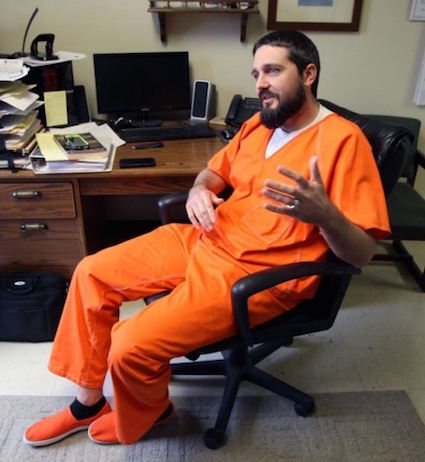 Kent McKeever during Lent 2014. (Waco Tribune photo/Jerry Larson)Kent McKeever, minister of youth at Seventh and James Baptist Church in Waco, explained he wore the attention-getting garment during the spiritual season to express solidarity with people denied employment, housing and other rights because of their criminal records.
Morales was moved. He spent six years in prison on a drug-related charge, and he subsequently experienced repeated rejections in applying for the warehousing and driving positions for which he was qualified.
“I just told him thank you,” Morales said. “I told him we are not all bad people.”
A year later, it’s McKeever who’s thanking Morales, because that comment eventually inspired a new campaign to convince government and businesses to change their hiring policies for people with criminal records.
Launched on Ash Wednesday, the fair-chance hiring policy campaign is being waged on a blog, through the media and with an orange T-shirt supporters are wearing during Wednesdays in Lent.
That’s where Morales’ 2014 thank-you comes in: It’s the slogan for the campaign and on the T-shirts.
“He said, ‘We’re not all bad people.’ So, let’s put the quote on the T-shirt,” said McKeever, also the manager of the legal services program at Mission Waco.
And it inspired another idea: “And what if we used his prison number as his name under the quote?”
The goal of the campaign, led by McKeever and colleagues at the mission, is to convince government and businesses voluntarily to cease rejecting job applicants with criminal histories. But the effort fits into a larger social, and even biblical, mandate for fairness and justice, said Jerrod Clark, social services director for Mission Waco and its Meyer Center for Urban Ministries in Waco.
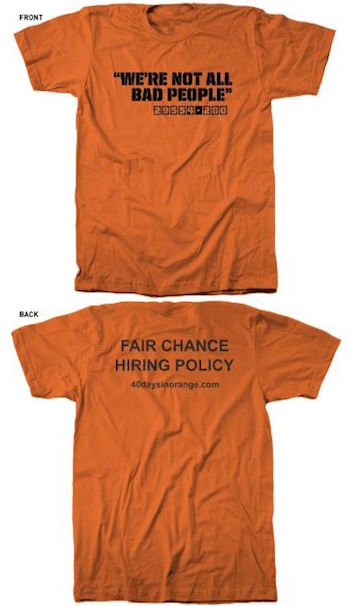 Mission Waco’s “FairChance” T-shirt.Coinciding with the orange T-shirt movement is a recently launched citywide anti-poverty push called Prosper Waco. It seeks to unify the efforts of an array of existing churches and nonprofits to raise the educational, financial and health status of the community.
It seeks to “decrease crime, decrease poverty and increase the quality of life” of everyone in Waco by bringing those living on the margins into the mainstream of opportunity, Clark said.
There’s also a larger scriptural command to wage such efforts. Clark cited Jeremiah 29:7, which calls for the peace and prosperity of the city.
“If you include the members of the community in the production or care of the community, then everyone benefits by earning money and paying taxes—carrying their load,” Clark said.
“If we push them to the margins … then the rest of the folks who are working are carrying everybody’s load.”
That would be a lot of carrying in the Waco area, where the poverty rate is 30 percent, Clark said.
“If we don’t do something differently, we’ll keep breeding that cycle of poverty,” he said.
Convincing employers to give ex-cons fair consideration in hiring would help meet vision of both Prosperity Waco and Jeremiah, he added.
“By us focusing on the released prisoner, getting him or her back into a place of work, is just one piece of the pie,” Clark said. “If we don’t speak up for them, then who will?”
But McKeever said he and other organizers understand why there is hesitance and resistance in the local business community to their ideas.
Some employers believe people with criminal records cannot be trusted. They fear former criminals will commit crimes while on the job or off.
The campaign understands employers’ concerns and understands criminal background checks must be used for many positions, McKeever said.
But they are asking companies and government agencies not to reject a candidate outright until further into the process. That will help many employers grasp candidates’ qualifications before considering their criminal background.
“Our argument is that this is a good thing for business and a good thing for our economy—for everyone,” McKeever said. “It will decrease recidivism, so crime will go down, and it increases the income and (gross domestic product) in our community.”
Companies also are eligible for legal protections when they hire people with criminal records. They also face limited liabilities.
“Instead, they are cutting people off at the start if they have criminal records,” McKeever said.
Spiritually, it amazed me how much that deepened my Lenten experience by trying to build solidarity with those who suffer.
That orange jumpsuit experience in 2014 made McKeever more aware of the emotional and economic pain such hiring practices have on so many people living in Waco.
“It opened my eyes to the experiences that people have when they have some kind of stigma attached to them,” he said. “Being a person of privilege, I never truly knew what that felt like.”
Being dressed in prison garb did not expose him to the full measure of frustration, anger and hurt that comes from living with such limitations, but it brought him into contact with more and more of those who do.
“I felt what it feels like to be stared at and glared at and experience fear just to walk out of your office or your house or to get out of your car,” McKeever said.
And it all tied back into his faith.
“Spiritually, it amazed me how much that deepened my Lenten experience by trying to build solidarity with those who suffer,” he said.
The experience continued throughout the year, as many people asked McKeever whether he planned to don the prison clothes again for Lent 2015. Even his children asked him that.
“I said I’m not wearing that this year,” he said. “They were disappointed.”
But the alternative has been even better.
“It morphed into something beyond anything I could imagine,” he said.
Morales said he’s amazed, too.
“I think it’s awesome,” said Morales, who now works as a supervisor for a lawn services company. “To me, it’s like somebody is trying to help us out.”
To read the article on McKeever’s experience last year, click here.