Interfaith friendships advance peace and religious freedom
DALLAS—Interfaith friendships promote peacemaking and provide the foundation for faith freedom to flourish, longtime Texas Baptist pastor Bob Roberts told participants at a 21Wilberforce event.
Roberts, who led Northwood Church in Keller three decades as its founding pastor, received the 2023 Frank Wolf International Religious Freedom Award from 21Wilberforce for his work as cofounder of the Multi-Faith Neighbors Network.
The award is named for the former congressman from Virginia who authored the International Religious Freedom Act and was co-chair of the bipartisan congressional Human Rights Commission. Previous recipients include Bob Fu, president of ChinaAid; Sam Brownback, U.S. ambassador-at-large for international religious freedom; and Anglican Archbishop Benjamin Kwashi and his wife Gloria of Nigeria.

“Without compromising his own faith, God has used him to bring together people of diverse religious backgrounds,” Randel Everett, founding president of 21Wilberforce, said of Roberts.
John Gongwer, executive director of 21Wilberforce, pointed to Roberts as a person who exemplifies Christ’s Great Commandment and the Golden Rule.
“Bob has put himself in other people’s shoes and stood inside their circle of suffering,” Gongwer told the gathering at Dallas Baptist University.
Roberts characterized himself as an unlikely peacemaker and advocate for building friendships across religious lines. Growing up as a Southern Baptist “preacher’s kid” in “deep East Texas,” he said, his early ministry focused on a narrow view of evangelism.
“I wanted to be Billy Graham, preaching crusades and revivals. That’s what mattered—nothing else,” he said.
‘The power of relationships’
But as he came into contact with non-Christians from other faith backgrounds—and as he looked to the Gospels and at the early church in the New Testament book of Acts—Roberts said he grew to understand “the power of relationships.”
“I think we know what it means to love nations and to love people groups. We know very little about what it means to love persons—to be in relationships,” he said.
Beginning with an exchange student from Vietnam who introduced him to high-ranking communist officials in her home country and continuing with Islamist warlords in Afghanistan, Roberts gained a new understanding of how to make an impact in the world by building unlikely friendships.
“The most significant work that you do will not be the work that you do in public where people see you, say things about you and recognize you,” Roberts said. “It will be what happens when no one else is looking—behind the scenes, building relationships with someone who can get you in a lot of trouble.”
Through relationships Northwood Church developed in Vietnam and Afghanistan, Roberts said, he learned about how Christians could make a difference by building schools and health care clinics in places otherwise closed to missionaries.
In the process, as Northwood Church made a long-term commitment to building relationships with people of other faith backgrounds, Roberts gained an expanded understanding of missions.
“A light went off in my mind. I realized missions is not a vocation for a handful of professional preachers like me. Missions is the call to every single person in the body of Christ,” he said. “You were born into a missions family. … It’s part of the family business.”
‘The right to own your own mind’
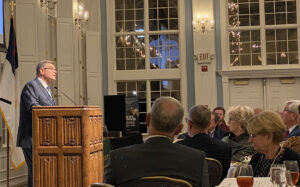
Through missions involvement in unlikely places, Roberts—recently named president of the Institute for Global Engagement—developed deep friendships with people from non-Christian religions who were serious about their own faith.
“I’m an exclusivist. Let me make that clear. I really believe Jesus is the way, the truth and the life. There’s no other way except through him,” he said.
“Having said that, why do we have to be mean about it? If we believe that, we ought to be the most loving people on the face of the earth. We’re not to compromise what we believe in the least, but be kind about it. Be loving about it.”
Roberts described religious freedom as “the public right to own your own mind.”
“I am not afraid of other religions,” he said, noting he spends 80 percent of his time now with non-Christians.
Muslim clerics who are good friends earnestly have tried to persuade him to accept their religion as true because they care about him, just as he has shared his faith with them, he said.
“Religious freedom is the first human right to protect the public. Without that human right to own your own mind, the other rights make no sense,” Roberts said.
See the image of God in others
Christians should advocate for the human rights and religious freedom of people from other faiths in places where they are minorities, he said.
When they do, it helps to protect the religious freedom of Christians in places where members of those faith groups are in the majority, he added.
“I came to believe a long time ago that the value of any faith is not just what it does for the adherents who follow it. The value of faith is measured best in the world by what value I bring to those who are outside my faith,” Roberts said.
“I want to be a blessing to Muslims, Jews, Buddhists, atheists, Hindus—I don’t care who they are. I don’t have to agree with them. I want them to know: ‘That guy loved me. That guy cared for me.’”
“You don’t have to compromise your faith. You just have to love people of other faiths,” Roberts concluded.
“We may be depraved, but there’s goodness in all of us if we are willing to see the image of God in someone. That’s my goal. May it be yours.”