Hymns shaped and reflected the faith of presidents, scholar says
DALLAS—When Ed Spann retired as dean at Dallas Baptist University’s College of Fine Arts, after years devoting his life to music, he decided to expand his artistic expression by doing a little oil painting.
But before he ever picked up a paintbrush, he became sidetracked while reading about Franklin Delano Roosevelt’s funeral. He discovered one of the officiating ministers said, “You can tell the kind of man he was by the hymns he loved.”
This started Spann researching the hymn Roosevelt had loved. About the same time, George W. Bush chose as the title of his autobiography A Charge to Keep I Have, from the title of a Charles Wesley hymn.
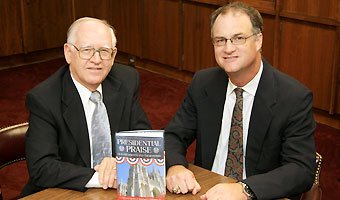
Ed Spann, retired dean of the College of Fine Arts at Dallas Baptist University, and Michael Williams, history professor and dean of DBU’s College of Humanities and Social Sciences, collaborated on a new book, Presidential Praise: Our Presidents and their Hymns. (PHOTO/Dallas Baptist University) Listen to these presidential hymns from the CD: |
“These references to hymns stirred my curiosity about the influence of hymns on the lives of all our presidents, from George Washington to the present day,” Spann said. “Since hymns have been so significant in the lives of people throughout the history of Christianity, there is reason to believe that hymns have affected the leaders of our nation.”
Spann searched presidential libraries and the Library of Congress and discovered many presidents had favorite hymns that seemed to influence their lives.
For three years, Spann delved into books and queried family members until he could devote a chapter to the hymnological tastes of each president.
He asked Michael Williams, professor of history and dean of the College of Humanities and Social Sciences at DBU, to write a short introduction to each president’s life and term in office.
The scholarship of the two men combined to form Presidential Praise: Our Presidents and their Hymns. Each chapter, averaging seven to eight pages in length, focuses on a president, a brief synopsis of his life and presidency, and a bit about his favorite hymns and overall musical tastes and aptitudes.
Some of the presidents were quite musical, Spann said. Some could play piano well and even wrote music.
“Some could sing quite well, and others thought they could sing and no one told them they couldn’t,” he quipped.
Each chapter also tells the story of the words of the hymn itself and how it came to be written.
“Amazingly, the hymns not only reflect the president, but also the influence of the hymn on the president,” Spann said.
In some cases, the hymns indicate a wife’s influence. “Many times their wives were the most important religious influence on them,” he said.
The book also includes a 74-minute CD of the hymns of the presidents, performed by the DBU Presidential Hymns Ensemble.
“I hope this book will help this generation become acquainted with these hymns,” Spann said.
Some of the hymns were unfamiliar even to Spann. “There were a couple of these hymns that I don’t know the last time they were sung before our ensemble sang them.”
The book should have wide appeal, Williams said. “There is a renewed interest in leadership and leaders in general,” he said.
“A lot of people want to know about the presidents and their lives,” Spann agreed. And interest should increase as another presidential inauguration approaches.
As for Spann’s oil painting plans, he said, “I haven’t gotten around to those yet.”