House committee holds Ten Commandments bill hearing
In a sometimes-testy late-night hearing that continued into the early-morning hours on April 30, the Texas House Committee on Public Education heard public testimony on a bill mandating the display of the Ten Commandments in every public-school classroom.
The Texas Senate in mid-March approved SB 10, introduced by Sen. Phil King, R-Weatherford, on a 20-11 party-line vote. The bill requires all public elementary and secondary schools to “display in a conspicuous place in each classroom of the school a durable poster or framed copy of the Ten Commandments.”

Rep. Candy Noble, R-Lucas, a member of Prestonwood Baptist Church in Plano, is carrying the bill in the Texas House and testified on its behalf before the Committee on Public Education, where it was left pending.
“The Ten Commandments are foundational to our American educational and judicial system,” Noble told the committee.
Noble pointed to multiple references to the Ten Commandments in the New England Primer and in the McGuffy Readers, used in American public schools from the 1830s to the 20th century.
“Nothing is more deep-rooted in the fabric of our American tradition of education than the Ten Commandments,” she said.
“The way we treat others as a society comes from the principles found in the Ten Commandments. In these days of classroom mayhem, it is time to return to the truth … respect authority, respect others, don’t steal, tell the truth, don’t kill, keep your word.”
She maintained the Ten Commandments played a foundational role in shaping the beliefs of the Founding Fathers, and students need to be familiar with the commandments to understand the nation’s founding principles, its history and its traditions.
SB 10 prescribes the specific wording for the mandated Ten Commandments classroom display—an abridged version of the commandments based on Exodus 20 in the King James Version of the Bible.
Allowing the state to decide matters of faith
“When the government starts to decide matters of faith, that becomes really dangerous for all of us,” said Rep. James Talarico, D-Austin.
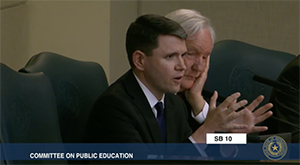
Talarico, a seminary student, noted Jews, Catholics and Lutherans follow a different ordering and wording of the commandments than the general Protestant version.
“Do you think it’s appropriate for politicians like us, government officials like us, to decide which version of the Ten Commandments is the correct one to be displayed in every Texas classroom?” he asked.
Noble said the prescribed language in the bill is taken from the wording on a monument between the Texas Capitol and the state Supreme Court building. In a 2005 case, Van Orden v. Perry, the U.S. Supreme Court ruled 5-4 the monument did not violate the Establishment Clause of the First Amendment to the U.S. Constitution.
“History shows us there is a lot of danger when we let the state control or decide religious teachings, because once the government starts dictating something like the true text of the Ten Commandments, what is to stop them from dictating the true meaning of the gospel or the true meaning of the sacraments?” Talarico said.
‘Classrooms crying out for moral guidance’
Noble responded by saying, “Our classrooms are crying out for moral guidance.”
Talarico emphasized Texas public schools not only serve students from Christian homes, but also students from other religious traditions or no religious tradition.
“As a Christian myself, I consider Hindu students, Jewish students, Muslim students, atheist students to be my neighbor, and we, as Christians are called to love them as ourselves. And I think forcing one religious tradition down their throats is not love,” Talarico said.
Noble countered by saying: “I contend it is not a religious tradition. I contend it is foundational, again, to our judicial and educational system, and it would be to their enlightenment to understand what made our forefathers tick.”
Others testifying on behalf of the bill were Elijah O’Neal with the American Journey Experience; David Barton, founder of WallBuilders; and Matt Krause of the First Liberty Institute.
Each reiterated several of the same points Noble introduced, emphasizing their belief the mandated display of the Ten Commandments passes the “history and tradition” judicial standard established by the U.S. Supreme Court in Kennedy v. Bremerton School District.
Baptist opposition to the bill
Mara Richards Bim, program director for Faith Commons and a candidate for ordination at Royal Lane Baptist Church in Dallas, testified against the bill.
“I’m very upset at everything I’ve heard today. I’m a Baptist. I believe in the separation of church and state,” Bim said. “I know that the whole point of this … is to get it to the Supreme Court, and nothing anyone says here tonight will actually matter.”
If the bill becomes law, it inevitably will be challenged in court, she predicted.
“As a very proud Baptist, I will be the first person signing up for the lawsuit,” she said.
Dan Hinkle, member of Sugar Land Baptist Church in Sugar Land, contended there is no rush to pass the House version of SB 10. Louisiana passed a similar bill currently under review in the Fifth Circuit Court. Texas is part of the Fifth Circuit and ought to wait “to see what happens with the Louisiana case,” Hinkle said.
Texas Attorney General Ken Paxton “is involved in [the Louisiana case] already,” Hinkle added. “So, we as Texans are represented.”
With his remaining time, Hinkle sought to explain the history behind Baptist advocacy for religious freedom, the Baptist principle that leads him to oppose mandating the display of any version of the Ten Commandments in public school classrooms, he communicated to the Baptist Standard by phone.
While proponents of the House version of SB 10 cite the Ten Commandments as foundational to America’s founding, Hinkle reminded the House Committee on Public Education: The First Amendment “is very special for Baptists, because Baptists played a key role in the drafting and the development of the First Amendment.”
The First Amendment begins: “Congress shall make no law respecting an establishment of religion, or prohibiting the free exercise thereof …”
“And here’s why,” Hinkle continued. “Some people believe our forefathers were Christians, men of the church. Well, let me tell you, they didn’t like Baptists in the colonial days,” he said, explaining some of the ways Baptists were persecuted in New England and Virginia.
With additional reporting by Editor Eric Black.