





Churches and institutional ministries felt the impact of the worst economic recession in decades. Texas Baptists made progress toward the goal of sharing the gospel with every person in the state by Easter 2010 and fighting hunger. Chaplains and churches ministered to families affected by a shooting rampage at Fort Hood.
Those marked just some of the key news events involving Texas Baptists in 2009.
Here’s the Baptist Standard’s top 10 list of Texas Baptist stories for last year:
1. The economy took its toll. Around the state, many churches suffered from decreased giving as members struggled to make ends meet in an uncertain economy. Many cut budgets; some cut staff.
|
Fort Hood Chaplain Ben Ellington—a Texas Baptist—and his wife, Sheri, attend a prayer service at the First Baptist Church in Killeen, Nov. 8.
|
As church receipts dropped, cooperative ministries of the Baptist General Convention of Texas suffered. In March, the BGCT Executive Board authorized Treasurer Jill Larsen to tap up to $2.5 million in emergency reserves if it became necessary. In late August, she accessed $1 million.
For the second consecutive year, messengers to the BGCT annual meeting approved a budget reduced from the previous year. The 2010 budget reflects a 9.8 percent decrease after adjustments for organizational realignment. Institutional ministries—schools, hospitals, and child and family services—felt the crunch.
But as Texans experienced job losses or decreased wages, Texas Baptist churches stepped up efforts to meet human need. They expanded food pantries and other benevolence ministries, ramped up job-training programs, offered support groups for unemployed people and created informal networks to help connect people to job opportunities.
In part, that increased emphasis on meeting physical needs grew out another major news story for 2009.
2. Texas Baptists embraced the Texas Hope 2010 goals. With praying, caring and sharing as their unifying emphases, churches around the state worked in their own communities in an effort to meet two statewide goals—share the gospel with every Texan by Easter 2010 and end hunger in the state.
Many churches engaged their members in personal evangelism by providing multimedia CDs they could distribute in designated neighborhoods. The CDs, produced by Faith Comes by Hearing specifically for Texas Baptists, contain Scripture, gospel presentations and links to the New Testament in more than 400 languages.
At a time when overall giving suffered, many churches increased gifts to the Texas Baptist Offering for World Hunger, and they intensified efforts to combat hunger—particularly among children. And collectively, Texas Baptists responded by launching a cooperative venture to enhance those ministries.
3. The Texas Hunger Initiative set its course. The Baylor University School of Social Work and its Center for Family & Community Ministries partnered with Texas Baptists’ Christian Life Commis-sion to develop the initiative—a project to alleviate hunger across the state by strengthening church-based food ministries.
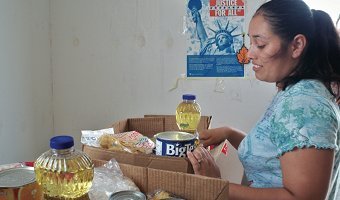
A volunteer packs food boxes to distribute in Progreso. Both in response to tough economic times and the Texas Hope 2010 challenge of ending hunger in Texas, Baptists throughout the state increased efforts to meet human needs.
|
In November, leaders of the Texas Hunger Initiative convened a hunger summit at Baylor University involving federal, state and local leaders to begin a discussion they hope will spark actions that end food insecurity in Texas by 2015.
Organizers plan to create a food policy roundtable of state and federal leaders to assess available resources and coordinate efforts to make those resources more accessible at the local level. They also plan to create food-planning associations in each of the state’s 254 counties—bringing to-gether church leaders and local government officials to plan ways to provide healthy meals to people in need.
4. Comfort and counsel offered after Fort Hood shooting. A shooting at Fort Hood’s Soldier Readiness Center claimed the lives of 13 soldiers—one of them a pregnant woman—and left 29 wounded.
Chaplains endorsed by the BGCT and the Southern Baptist Convention’s North American Mission Board ministered directly to families and individuals affected by the shooting. First Baptist Church in Killeen held a communitywide prayer service that drew more than 500 worshippers.
5. Tensions escalated between Baylor University and alumni association. Conflicts surfaced between the administration and regents of Baylor University and the Baylor Alumni Association.
During the summer, university officials removed the alumni association from its website and took away its access to the school’s toll-free phone line and its university e-mail address.
In mid-September, the university asked the Baylor Alumni Association to give up its independent nonprofit status and invited it to come under the authority of the school’s administration. But by late October, Baylor withdrew its proposal, citing what it considered a lack of positive response by the alumni association.
A few weeks later, the Baylor University Faculty Senate approved two resolutions—one noting “deep concern” about the conflict between the Baylor Alumni Association and the university’s regents and administration, and the other congratulating the alumni association on its 150th anniversary.
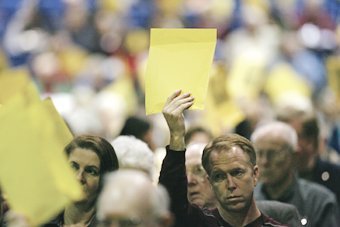
The 2009 Baptist General Convention of Texas annual meeting in Houston attracted the fewest messengers in 60 years.
|
6. Annual meeting drew small number. The 2009 BGCT annual meeting in Houston attracted the fewest messengers in 60 years. It prompted the committee on convention business to propose—and messengers to approve—creation of a committee to study changes to the annual meeting to enhance interest and increase participation.
However, a series of evangelistic events prior to the meeting marked the greatest involvement and largest number of professions of faith in Christ of any similar event in recent Texas Baptist history. More than 20 City Reach Houston events drew 19,000 participants and resulted in 3,000 decisions for Christ, including 1,917 professions of faith.
7. SBC cut ties with Fort Worth church. In June, the SBC severed its longstanding relationship with Broadway Baptist Church over the church’s perceived toleration of homosexual members.
Controversy erupted in 2007 when a dispute arose within the church about whether to include portraits of homosexual couples in the church’s directory. That led to a motion at the 2008 SBC meeting calling for the convention to declare the church “not in friendly cooperation” with the SBC. A letter sent from the church to the SBC Executive Committee’s general counsel stated: “Broadway never has taken any church action to affirm, approve or endorse homosexual behavior.”
But on the eve of the 2009 SBC meeting, the Executive Committee voted to recommend an end to the convention’s relationship with Broadway and to deny seating to any messengers from the church.

Volunteers at the Good News Café—a ministry of First Baptist Church in Corsicana—serve a hot meal to their neighbors in need. About 17 volunteers from the church and community cook and serve meals to about 55 people a week.
|
When it became apparent to leaders at Broadway that it appeared inevitable its messengers would face some challenge at the BGCT annual meeting, the church decided at the last minute not to send messengers to the Houston gathering.
8. New university presidents took office. Four Texas Baptist-affiliated universities experienced a change in top leadership during 2009. Two presidents elected late in 2008 assumed office in 2009—Randy O’Rear at the University of Mary Hardin-Baylor and Samuel W. “Dub” Oliver at East Texas Baptist University.
Two other university presidents were elected in 2009 and took office during the year. Lanny Hall moved from the president’s role at Howard Payne University back to Hardin-Simmons University, where he had served previously more than a decade as president.
Subsequently, Bill Ellis was elected president of Howard Payne University, moving from Hardin-Simmons University, where he had been provost and chief academic officer.
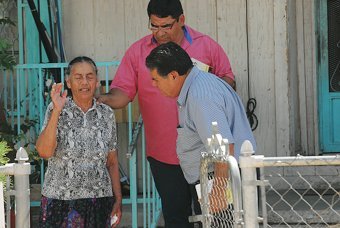
Volunteers pray with an El Paso resident as they distributed Texas Hope 2010 gospel presentation CDs.
|
9. Juarez violence curtailed missions. As the Mexican government sought to crack down on drug cartels in Juarez, turf battles erupted in the border city. Officials with the BGCT River Ministry and Border Missions and Buckner International issued an advisory, encouraging prospective volunteers to redirect their missions efforts to locations along the Rio Grande other than Juarez. By year’s end, more than 2,000 people had been killed in what some news agencies called “the murder capital of the world.”
Dick Hurst, a medical doctor from First Baptist Church in Tyler, responded by spearheading a statewide effort to link Texas Baptist congregations to sister churches in Juarez. He urged prayer for the people of Juarez and encouraged the development of long-term relationships with Baptists in the border city.
10. Texas Baptists Committed faces uncertain future. David Currie, the San Angelo rancher who led Texas Baptists Committed since its inception two decades ago, submitted his resignation Sept. 28 as executive director of the organization, originally created to resist a “fundamentalist takeover” of the BGCT.
After closing the organization’s San Angelo office, the Texas Baptists Committed board announced it would appoint a committee to search for a new executive director and would seek a church in the Dallas-Fort Worth Metroplex to provide office space.
At its apex of influence, Texas Baptists Committed mobilized thousands of messengers from around the state to attend BGCT annual meetings to elect a series of candidates endorsed by the organization—including the state convention’s first Hispanic, African-American and female presidents. In 2008, the organization agreed to refrain from endorsing any candidates for BGCT office.
In recent years, as Texas Baptists Committed experienced financial hardship and endured questions about its continued reason for being, the group tried to shift from its previous role of political organizing to a new identity as promoter of BGCT ministries and institutions, as well as a voice for historic Baptist principles.






We seek to connect God’s story and God’s people around the world. To learn more about God’s story, click here.
Send comments and feedback to Eric Black, our editor. For comments to be published, please specify “letter to the editor.” Maximum length for publication is 300 words.