





ARLINGTON—More than 640 leaders and volunteers for children, teen and young adult ministry gathered Oct. 6 and 7 at First Baptist Church in Arlington to worship and learn how to reach current and future generations for Christ and the church.
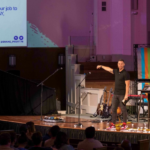
Shane Pruitt, national next gen director for the North American Mission Board, spoke during the first general session on lessons he learned in his 20 years of ministry.
Always focus on the depth of ministry, never stop being a servant, get good friends, know fruit always surprises, learn to say “no” and let the thorns lead to the throne, Pruitt urged.
“Never get over the power of the gospel in your life … If God can save you, God can save anyone,” Pruitt said. “Because Jesus lives … that’s why we get to do what we do.”
Pruitt addressed the importance of maintaining character and integrity in ministry and building relationships with family and friends.
The solution is the discipline of prayer and staying close to Jesus, he said.
“Focus on the depth of your ministry and let the Lord focus on the width and platform of it—
spiritual discipline, praying and staying at the feet of Jesus,” Pruitt said.
Pruitt added ministry is about serving, and comparisons can be a snare for anyone in ministry.
“Ministry is not a calling to stardom. It is a calling to servanthood. God’s love for you is not dependent on your size of ministry,” Pruitt said.
Bobby Contreras, pastor of Alamo Heights Baptist Church, preached from Proverbs 6:6-8 during a general session, emphasizing the need to reflect Jesus to point others to him.
“Do we truly live in his goodness when storms come? At times, I don’t because his goodness seems so far away in times I deem as bad, broken or hurting. So, will we store up? It is time to store up. It does us no good to store up if we don’t share it,” Contreras said.
NextGen conversations and AI
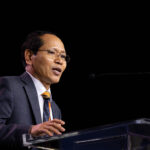
The trend of young adult Gen Z and Millennials attending church is going up, David Kinnaman, CEO of Barna Group, said during a general session.
Barna group confirmed “the average was close to one weekend per month. Those rates are up nearly one extra weekend a month, nearly double the rates of just five years ago.”
“This generation is open to Jesus,” Kinnaman said, adding Gen Alpha will be the generation known by the rise of AI.
“This generation, our generation, is going to be taking these deep questions to a new place, a new kind of median response to all humans,” he continued.
“And remember that the way these large language models are built, they are not built on any kind of Christian context. They are doing their very best to take the averages of all these complex pieces of information and spit out something that a human being can read and understand.”
Practical use of AI—such as ChatGPT—for everyday ministry work consists of cross-referencing of biblical texts, biblical language assistance and summarization of books and research material, Katie Frugé, director for Texas Baptists’ Center of Cultural Engagement, said during a pastors track on artificial intelligence and ethical challenges.
Regarding ethical considerations, Fruge said AI is not neutral and can be manipulated.
“Just utilize the current ‘gold standard’ programs that integrate AI into the system. Think machine learning, not content generation,” Frugé said, adding AI should be utilized as a resource to support, not replace, what pastors already are doing.
“More Gen Z and Millennials say and feel more like themselves online than offline,” Trent Brent of Next Gen Catalyst said during a breakout session on the latest generation trends. “Online matters,” he added.
Breakout sessions highlight resilience and inclusion
Shelly Melia, associate dean of the Graduate School of Ministry at Dallas Baptist University, talked about building resilience in children.
Using a fishing analogy from childhood fishing trips, Melia addressed the many hooks that can keep a child from recovering from challenges and failures in life, such as fear, anxiety, family dysfunction and a lack of necessities like food and shelter.
“Resilience is not a fixed trait. … It is not always unique to children,” Melia said.
Building resilience requires action and not being passive toward issues causing distress, she said.
Laura Roodenburg, ministry relations manager for Joni & Friends, emphasized the importance of relationship building and taking small, immediate steps toward inclusion for people with disabilities.
“Not every barrier is physical. For some it is sensory overload,” she said.
“Imagine how hard church is when those lights flicker, the sound is painfully loud, or a bulletin is cluttered with fine print. Noise-reducing headphones, a printed order of service, a simple visual chart for kids—those can make all the difference between a meltdown and a worship,” Roodenburg said.
Within 90 days, a church can take subtle steps toward making itself more accessible by adjusting Bible study locations, integrating seating, and employing accessibility webpages, ramps, lifts, interpreters and sensory supports, Roodenburg said.






We seek to connect God’s story and God’s people around the world. To learn more about God’s story, click here.
Send comments and feedback to Eric Black, our editor. For comments to be published, please specify “letter to the editor.” Maximum length for publication is 300 words.