





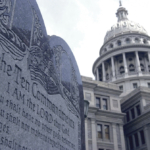
Eighteen families filed a class-action lawsuit Dec. 2 to stop the display of a prescribed version of the Ten Commandments in all classrooms of every Texas school district not already involved in related litigation or subject to an injunction.
Ashby v. Shertz-Cibolo-Universal City Independent School District is the third lawsuit—and first class-action suit—challenging S.B.10.
As approved by the Texas Legislature and signed into law by Gov. Greg Abbott, S.B. 10 requires a donated poster or framed copy of the Ten Commandments at least 16 by 20 inches to be displayed in every Texas elementary and secondary school classroom.
The Ten Commandments are “ingrained into who we are as a people and as a nation,” said Sen. Phil King of Weatherford, who introduced S.B. 10.
“Today, our students cry out for the moral clarity, for the statement of right and wrong that they represent. If our students don’t know the Ten Commandments, they will never understand the foundation for much of American history and law.”
First Amendment violations asserted
The plaintiffs assert the state-mandated displays in classrooms violate the Establishment Clause and Free Exercise Clause of the First Amendment.

The families represent a range of faith traditions, as well as some interfaith families and families that identify as nonreligious.
Americans United for Separation of Church and State, the American Civil Liberties Union of Texas, the national ACLU and the Freedom from Religion Foundation brought the class-action suit on behalf of families whose children attend schools in 16 districts not named in two previous lawsuits.
Named defendants are the Argyle, Birdville, Carroll, Clear Creek, Deer Park, Fort Sam Houston, Hurst-Euless-Bedford, Katy, Liberty Hill, Magnolia, Medina Valley, Pearland, Prosper, Richardson, Schertz-Cibolo-Universal City and Wylie school districts.
However, the suit contends the plaintiffs represent “a statewide class consisting of all parents, legal guardians, and their minor children suffering from constitutional harms as a result of Defendants’ posting of religious displays as required by S.B. 10.”
“If Plaintiffs are compelled to pursue relief in multiple counties—or even federal districts—across Texas, the same core facts and legal theories could yield divergent outcomes, on different timelines, resulting in both confusion among defendants and a needlessly increased risk that members of the Plaintiff Class will suffer violations of their constitutional rights,” the lawsuit states.
State has ‘zero legitimate interest in religion’
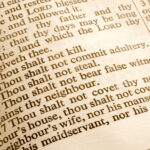
The state-approved language of the Ten Commandments as stipulated in S.B. 10 is an abridged version of Exodus 20:2-17 from the King James Version of the Bible.
Parents who objected to the classroom displays pointed out Jews, Catholics and Protestants number the commandments differently, and their wording varies. So, they asserted, the required language favors the Protestant approach as the state-sanctioned version.
“S.B. 10 is not neutral with respect to religion,” the class-action lawsuit states. “On its face, it expressly requires the display of religious scripture—the Ten Commandments—in every public-school classroom.
“It also requires that schools post a specific, state-approved version of that scripture that is associated with certain Protestant faiths, weighing in on theological questions regarding the correct content and meaning of the Ten Commandments and enshrining in state law an official denominational preference.”

Charles Foster Johnson, founding executive director of Pastors for Texas Children, agreed the state has no legitimate role “weighing in” on religious issues or giving preferential treatment to one faith group.
“The American experience is uniquely shaped by religious liberty and the ‘wall of separation,’ as Thomas Jefferson put it, between the church and the state. It was the church that shaped this American experience—small, dissenting, separatist churches in every village that trusted the word of God rather than the power of the state,” Johnson said.
“Fast forwarding almost 250 years, true Texas Americans still believe that the State of Texas has zero legitimate interest in religion. Eighteen of them have sued for remedy in this egregious violation of their—and millions of others’—religious liberty. Pastors for Texas Children hopes the federal courts will put a quick end to this infringement of faith freedom.”
Lawsuits, injunctions and appeal
Two federal judges already blocked 25 Texas school districts from displaying a state-prescribed version of the Ten Commandments in public school classrooms, citing constitutional concerns.
In August, U.S. District Court Judge Fred Biery issued a preliminary injunction blocking classroom Ten Commandments displays in 11 school districts.
In November, U.S. District Judge Orlando Garcia granted a preliminary injunction to block the classroom displays in 14 school districts.
Last month, Texas Attorney General Ken Paxton announced he filed suit against the Round Rock and Leander school districts for refusing to comply with the mandated Ten Commandments displays.
“These rogue ISD officials and board members blatantly disregarded the will of Texas voters who expect the legal and moral heritage of our state to be displayed in accordance with the law,” Paxton said.
Previously, Paxton sued the Galveston Independent School District after its board refused to display donated posters of the Ten Commandments in classrooms.
The U.S. Court of Appeals for the 5th Circuit will hear arguments on the constitutionality of S.B. 10—and a similar case in Louisiana—on Jan. 20. Court injunctions blocking the classroom displays of the Ten Commandments remain in effect while the appeal is pending.






We seek to connect God’s story and God’s people around the world. To learn more about God’s story, click here.
Send comments and feedback to Eric Black, our editor. For comments to be published, please specify “letter to the editor.” Maximum length for publication is 300 words.