




First Baptist Church of Plano discovered direct involvement in mission partnerships—including hands-on work with several congregations in southern Mexico—led to renewed passion for global missions.
|
First Baptist Church in Plano is working closely with several churches in the southern Mexico states of Chiapas, Oaxaca and Tabasco. These children are from Chiapas and their fellowship, El Buen Samaritano, is currently in construction of a new church building through our partnership.
|
“The more our people became involved in a personal way—once their hearts were plunged in it—their energy and efforts and money tended to follow,” Pastor Jerry Carlisle said.
Two years into a three-year strategic partnership with a church in Grenada, Manly Memorial Baptist Church in Lexington, Va., noticed a change in its members’ attitudes toward mission.
“We took a team of 15 last year and 11 this year to work with the Grenadan church,” Pastor Mike Wilkins said. “Some of those who went weren’t sure that the mission thing was for them. But when they came back, they were enthusiastic about returning for another year. There’s no question. Our members have bought into the mission endeavor in a much more personal way than before.”
Those two churches are among thousands that have changed the face of mission involvement as congregations have taken on greater roles in selecting and developing strategic partnerships around the world.
While few have abandoned support for large missionary-sending organizations like the Cooperative Baptist Fellowship and the Southern Baptist Convention’s International Mission Board, increasingly churches are taking ownership of their call to take the gospel to the “uttermost parts” of the world.
“My guess is that partnership missions have taught a lot of people how they can engage internationally,” said Craig Waddell, missions partnership coordinator for the Virginia Baptist Mission Board. “Now that they know what to do and have developed international contacts and connections, people are saying: ‘Hey, we can do this ourselves. We can do more of what we are called to do as a church.’ … Experience is translating into confidence.”
Reductions in the cost and ease of travel and communications have created “an inevitability about the shift,” said Alistair Brown, who became president of Northern Baptist Theological Seminary near Chicago after a long stint as head of Great Britain’s Baptist Missionary Society.
 Sign up for our weekly edition and get all our headlines in your inbox on ThursdaysLocal mission partnerships of First Baptist Church in Plano include the Cowboy Church of Collin County. At an outreach day, the Cowboy Church invited all the foster care families of Plano to participate. Several members of First Baptist participated in a variety of ways.
|
“People travel and become familiar with an overseas place, so it’s inevitable that they will select and form partnerships with churches abroad.”
The move away from exclusive reliance on large institutions and toward local church-based mission endeavors is a widely noted phenomenon. In fact, it largely defined mission trends in the last half of the 20th century, observers note.
Although resisted at first, church-based mission endeavors now are widely accepted by large mission agencies. Last year, for example, the International Mission Board revised its vision, mission and core values statements to focus more on local churches’ involvement in missions.
“The revised mission statement … reflects that the Great Commission is the responsibility of the local church and refocuses the efforts of the agency on assisting churches to fulfill that responsibility,” according to a 2008 IMB news release reported by Associated Baptist Press. The values statement, the release continued, shifts “the role of the agency from a primary focus on sending missionaries to one that serves the churches in their involvement in the Great Commission and the sending of missionaries.”
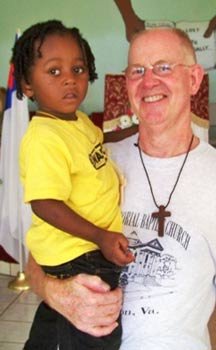
Clyde Keen from Manly Baptist Church in Lexington, Va., holds a child in the sanctuary of Grand Bacelot Baptist Church in Grenada.
|
Because churches are “personalizing” the mission task, “mission-sending agencies are having to change the way they go about establishing contacts and sending personnel,” said Jerry Jones, leader of the Virginia Baptist Mission Board’s glocal—global/local—missions team. “For churches who initiate mission involvement on their own, the large monolithic sending agencies are virtually unnecessary and are becoming obsolete, and certainly not cost effective in this day and time. The term ‘career missions’ is gradually disappearing, or at least has taken on new meaning. Short- and long-term volunteerism can be achieved via direct church involvement without the hassle and red tape involved in going through a sending agency.”
Not everyone agrees churches can remain effective in engaging mission without assistance from established mission agencies.
“I’m very committed to the local church and always have been,” said Kent Parks, president of the nondenominational Mission to Unreached Peoples agency. “And I very much believe in effectively partnering between a local church and a sending mechanism.” But, he added, there are strategic and funding issues that churches simply can’t do on their own, said Parks, a former CBF missionary and member of First Baptist Church in Plano. “The unreached population is growing beyond our ability to impact it. … We need to be about the kingdom (of God) and avoid an ecclesio-centric approach, but be about strategy and long-term results.” Working with mission-sending agencies can help churches do that.
Northern Seminary’s Brown agrees there are downsides to an exclusively church-based approach to mission. “An immense amount of money is spent on travel, going and doing things that could be done locally and done better locally,” he said. “Is this just missions tourism? I hope not. I really think we can take the best of direct involvement of churches, if they will take a little strategic guidance from mission agencies.”
For churches to adopt the global mindset necessary for effective mission, a focus on mutual partnership is crucial, Waddell of Virginia insisted. “How are you going to allow your partner’s journey with God to inform your faith? … How does our partner’s perspective in faith challenge our status quo? That is a critical question in being truly global.”








We seek to connect God’s story and God’s people around the world. To learn more about God’s story, click here.
Send comments and feedback to Eric Black, our editor. For comments to be published, please specify “letter to the editor.” Maximum length for publication is 300 words.