





Speakers at the Future Church 2030 Conference challenged church leaders to consider the cultural, technological and demographic changes that will affect ministry in the next decade.
“It is our hope and prayer that everything we learn here makes a big kingdom impact for the days, weeks and years to come,” said David Hardage, executive director of the Baptist General Convention of Texas.
More than 300 church leaders attended the BGCT-sponsored conference, April 4-5 at First Baptist Church in Bryan. Nationally recognized speakers, local pastors and Texas Baptist ministry leaders addressed subjects ranging from leading through a crisis to incorporating technology into a church’s operations.
Beto Gonzalez and Ariel Martinez from Del Sol Church in El Paso spoke about engaging the growing Hispanic population in Texas. They urged churches to welcome Hispanic people in their churches and to help raise up Hispanic church leaders.
Above all, Hispanics value work, family and cultural religious belief, they noted. By creating events that promote the family and provide opportunities for the church’s Hispanic ministry and non-Hispanic ministry to come together, churches can create a space where their changing communities feel like they belong.
“We have to be intentional about reaching Hispanics, and we have to be intentional about training Hispanic leaders,” Martinez said.
Be a ‘kingdom-first church’
Steve Bezner, pastor of Northwest Church Houston, explained the future church needs to be a kingdom-first church. He explained the COVID-19 pandemic revealed some of the instabilities churches already were facing and brought them to the forefront.
Churches need to focus on creating a kingdom community, not a community of consumers, Bezner said.
He also reminded churches to be involved in the community, be mission-minded and make disciples.
Sign up for our weekly edition and get all our headlines in your inbox on Thursdays
“There’s something about each of us that comes alive when we decide to look beyond ourselves and wash the feet of our neighbors,” he said.

Katie Frugé, director of Texas Baptists’ Center for Cultural Engagement, spoke on issues of identity, presence and purpose facing the future church. The internet and social media have created increased anonymity, she noted.
“If the future is pushing disconnectivity in real life, then where are we connecting?” Frugé asked.
The church can be the place of connectivity people desperately are searching for, she said.
Although cultural issues may change, the message of the gospel and the mission of the church remains the same.
Jonathan Smith, director of church health strategy with Texas Baptists, based his presentation on Acts 2, seeking to encourage church leaders and give them a message of hope.
“The gospel is unstoppable,” he said. “And the gospel will come out in unexpected ways at an unexpected time through unexpected people.”
GC2—the Great Commission and the Great Commandment—should be the focus of ministry, he said.
Smith encouraged church leaders to get involved in revitalizing, replanting and planting churches. He recommended churches who want to become involved in church planting contact the Center for Missional Engagement, which has had a 92 percent success rate in church planting.
Make space for young believers
Eric Mason, founder and pastor of Epiphany Fellowship, spoke about the future of the Black church, reaching Millennials and Gen Z and the mission of the gospel.
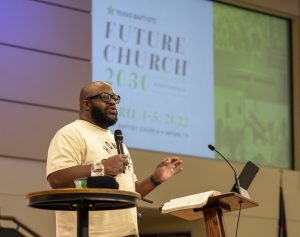
“Because falsehood goes out quickly, the church has to have a disposition (the) of armor of God, spiritual unity, Christ-centeredness and a ferocious commitment to the gospel that’s beyond our differences,” he said.
Young people are struggling to find places where they can lead in the church and asking questions about what the church is doing to better the community. Mason encouraged church leaders to reflect on those issues and be deliberate about making a space for young believers.
Phil Miller, director of Texas Baptists’ Center for Church Health, concluded the conference with a charge to the church leaders in attendance.
“The worst thing you can do is leave from here and do nothing,” he said. “What will you do with what you’ve learned?”







We seek to connect God’s story and God’s people around the world. To learn more about God’s story, click here.
Send comments and feedback to Eric Black, our editor. For comments to be published, please specify “letter to the editor.” Maximum length for publication is 300 words.