


DALLAS—U.S. foreign assistance is making a difference in combating global poverty and hunger, but federal budget cuts could impede that progress, reported Michael Gerson, columnist for the Washington Post and former chief speechwriter for President George W. Bush.
The Bush administration was touted by religious organizations and advocacy groups for committing $15 billion in foreign aid to reduce HIV-AIDS in Africa.
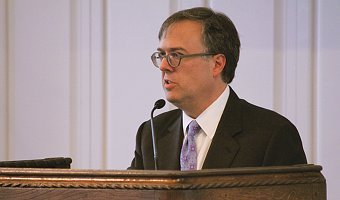
Budget cuts could set back progress made in fighting global hunger, Michael Gerson, columnist for the Washington Post and former chief speechwriter for President George W. Bush, told an evangelical conference on world hunger held at Dallas Baptist University. (PHOTO/Blake Killingsworth/DBU)
|
“For me, the most compelling stories are personal,” Gerson said of that program. He described an orphanage he visited in Addis Ababa, Ethiopia, operated by the Sisters of Charity to care for hundreds of children, many of whom died of AIDS.
Some children died peacefully, while others died horribly, he recounted, but many of them died.
“But then AIDS drugs began arriving because of U.S. aid,” he said, noting the medical help virtually eliminated childhood death by the disease.
“This is a modern miracle,” he said. “Having seen those children, I can never be cynical about government.”
However, a mood of austerity and a singular focus on debt reduction are undermining American foreign assistance, Gerson acknowledged.
This is compounded by the Republican/conservative stance that cutting foreign aid is a “fiscal responsibility,” he added.
Sign up for our weekly edition and get all our headlines in your inbox on Thursdays
The foreign aid allocation is not large enough to balance the budget, not matter how drastically it is cut, he said. “But we have a long-term deficit crisis because of entitlements (such as Medicare), an aging population and rising health-care costs,” he insisted, adding the idea that the federal budget can be cut and balanced without touching those items is “an economic myth.”
Still, Gerson prescribed a four-part response to “this period” of stress on the U.S. foreign aid budget:
• Intellectual consensus that “robust development is vital.” Programs that encourage hope, prosperity and good government in developing countries will lead to global security and peace, he said.
• The moral and religious case for aid. “There is nothing that shows our image of God more clearly than response to human suffering,” he observed.
Jesus’ healing ministry was a protest against rampant suffering, he said, adding historians believe the church grew because Christians were willing to minister to the ill during the great plagues. And the same can be true today, if Christians step up to serve the needs of the world’s hurting, he predicted.
• Advocacy for the poor. “Americans will need to get involved,” he said of the battle for funding foreign aid in the federal budget. “The world’s poor have little voice in U.S. politics,” he said.
• Reporting the effectiveness of foreign aid. “Americans will need to hear the stories of success,” he said.
For example, aid programs to combat hunger and disease have resulted in increased numbers of Third World children attending school and an overall decrease in the global child death rate.
Also, the Millennium Challenge Corporation, which sets aside funds to encourage economic growth in developing countries, has been effective in leveraging support for positive change, he said. But Congress is reluctant to fund such long-term financial development programs, at least without strong public support.









We seek to connect God’s story and God’s people around the world. To learn more about God’s story, click here.
Send comments and feedback to Eric Black, our editor. For comments to be published, please specify “letter to the editor.” Maximum length for publication is 300 words.