




WACO—When Baylor University senior James Payne saw the children involved in Antioch Community Church’s STARS Mentoring Project reading books and engaging with their mentors, he knew his behind-the-scenes work was making a difference.
 James PaynePayne, a computer science major in Baylor’s School of Engineering and Computer Science, volunteers with Computing for Compassion, a student-led campus outreach tasked with tackling the technology challenges for Central Texas ministries and nonprofits.
“My work with Computing for Compassion has helped me realize I want to be on the people side of technology,” Payne said.
More ministry, less logistics
By meeting organizations’ technology needs, Computing for Compassion gives ministries space to focus more on ministry and less on logistics, said Jeff Donahoo, professor of computer science. He and Bill Booth, senior lecturer in computer science, launched the group in 2013.
“Ministries in Waco and beyond should be able to focus on their mission, not get bogged down with technical challenges,” Donahoo said. Computing for Compassion “allows students with skills in computer science and information technology to use their gifts to magnify the capabilities of compassion-based ministries. Our goal is simply to help enhance the great work of these programs.”
Current projects include:
• Streamlining volunteer resources for STARS Mentorship Program.
• Improving website and donor communication infrastructure for Global Banjara Baptist Ministries International.
Sign up for our weekly edition and get all our headlines in your inbox on Thursdays
• Creating a mobile intervention app for children with attention-deficit difficulties.
• Developing a church notes website for St. Luke Catholic Church in Temple.
• Developing a website for Baylor Agape Connection.
More than 20 students are working on projects through Computing for Compassion. The group mostly consists of computer science majors, along with students in electrical and computer engineering, bioinformatics, mathematics and University Scholars. The organization is open to all students interested in using their technological skills to better the community.
Win-win for community and students
The program is a win-win for both the community and the students, Donahoo said. As students have the opportunity to address problem-solving techniques and infrastructure improvements, they gain valuable real-world experience that does significant good for the community.
Students work in teams, interact with clients and develop strategies to further the mission of organizations. Nonprofits, in turn, implement and learn to work with new technologies, allowing more time to be spent focusing on their organizations’ ministry needs.
Leaving a lasting mark
The contributions of computer science and information technology professionals aren’t always in the spotlight, Donahoo explained. The professionals themselves don’t always see the impact of their contributions, but Computing for Compassion already has left a lasting mark on the community.
Through their work with the STARS Mentoring Project, Computing for Compassion students augmented the organization’s volunteer base by making it easier to bring in more mentors and service more students in need by improving their information technology.
“Their creative solutions, hard work and collaboration have helped us significantly streamline our administrative tasks,” said Michael Jeter, assistant director of STARS, adding Computing for Compassion’s involvement allowed STARS to grow its mentor base and influence more young lives.
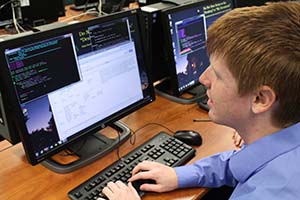 Matt Arnold, junior computer science major and vice president of Computing for Compassion, works on coding for a nonprofit client. (Photo by Bethany Harper/Baylor Media Communications)“I believe we are all gifted uniquely for service, and Computing for Compassion provides a way for people who are good at computer programming to use their skills to serve God and others,” said Matt Arnold, a junior computer science major and vice president of the organization.
Making a positive impact
Arnold has spent many hours working on the STARS project.
“It was cool to hear reports from STARS about how our work was enabling them to work better and positively impact kids’ lives,” he said.
The work goes far beyond a degree requirement, Donahoo explained. His hope from the beginning was to see students’ lives transformed through investing in others.
“We hope our students’ dedication will be ongoing,” he said. “We hope that as students leave the university, they will carry forward a desire to plug in and support compassion-based ministries in their communities.”







We seek to connect God’s story and God’s people around the world. To learn more about God’s story, click here.
Send comments and feedback to Eric Black, our editor. For comments to be published, please specify “letter to the editor.” Maximum length for publication is 300 words.