





MUSANZE, Rwanda—Baylor University graduate student Evan Martin traveled to the other side of the globe expecting to bring Christ and western technology to Rwanda. But what he found was a people who, in spite of a history of genocide, poverty and depravation, have a vibrant relationship with Christ.
More than 500 African children sang, danced and lifted their hands to God in worship as Martin stood in awe observing the youth of Rwanda on fire for God.
“It was mind-blowing; more than I had ever expected,” he said.
|
Baylor University students test water quality in Rwanda. (PHOTOS/Courtesy of Bill Jordan/Baylor University)
|
Martin and 34 other Baylor University business, social work and engineering students—along with six faculty members—served two weeks in Rwanda putting into practice on the mission field what they learned in the classroom.
Baylor Mechanical Engineering Professor Bill Jordan coordinated the engineering projects. The volunteers partnered with Bridge2Rwanda, an organization seeking to advance Rwandan technological and enhance education with specialized training from outside agencies.
“One of the things I like about Bridge2Rwanda’s stated purpose is that they want to build a bridge from the west into Rwanda, and change people at both ends,” Jordan said. “I want to help Rwandans, but I also want to help students here.”
The Baylor engineering team was stationed at Musanze’s Sonrise School, a facility in northern Rwanda that provides quality education to children and orphans. The students originally planned to build a solar panel system to power a technology lab. However funding and timing conflicts delayed the panels’ delivery from China. So, the team re-focused their mission on a series of water purifying projects.
“They had a well drilled, but it wasn’t connected to the school,” Jordan said. “So, students designed a system that would pump water from the well to the school.”
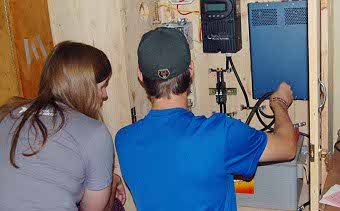 Sign up for our weekly edition and get all our headlines in your inbox on ThursdaysBaylor University engineering students work on a solar power control system in Rwanda. (PHOTOS/Courtesy of Bill Jordan/Baylor University)
|
The project provides long-term potable water access to the school. Sonrise was paying $2,000 a month for water and $800 a month for firewood to boil the water.
Students worked from 9 a.m. to 4 p.m. on a mixture of high and low-end technology projects using their knowledge of concepts like distance, gravity and elevation.
“The majority of what we did was the students’ ideas,” Jordan said. “They did the calculations and contributed on their own.”
The students taught the workers how to operate the various filtering systems, so the Rwandans could continue to have clean water after the team left.
“They have a lot of bright people over there, but very few engineers and accountants,” Jordan said. “They need borrowed talent to train and further educate the (people).”
Jordan believes the experience profoundly affected the Baylor students.
“They saw what engineering in the developing world looks like, and I think now they have a better vision of what Christian engineers can do.”
Jordan’s hope was for students to learn they can use their vocational skills as a ministry tool.
“There’s not a Christian approach to fracture mechanics,” Jordan said. “But where Christianity plays a role is in what you can do with the skills you have. Students love the fact that they can use engineering in a Christian context.”
When not working, the team developed relationships with the people.
“We were spiritually blessing them by helping them engineering-wise, but everyone wanted to do more on a personal level,” Jordan said.
The students were not hesitant about sharing their faith wherever they went.
“One cool thing that happened was that our driver, Salim, came up to one of our team members, Brad Sanders, to talk about Christianity,” Martin said.
“He was a Muslim and wanted to be prayed with. He had known about Christianity, but what was holding him back was his family. They were his lifeline; if they found out he wanted to be a Christian, he’d be kicked out.”
Despite the language barrier, Sanders was able to communicate God’s love to the driver.
“He ended up accepting the Lord,” Martin said, “And we found someone to help support him. Right before we left from the airport, Salim prayed for us in Rwandan.”
Martin said seeing the people turn to God was an eye-opening experience. The country is still recovering from a 1994 genocide that killed a million people in 100 days.
“It was amazing to see how God is healing them,” Martin said. “They are able to live side-by-side again.”
Martin is thankful he could use engineering as a ministry in this developing part of the world.
“Everybody has things they’re good at,” Martin said. “No matter where you go, there’s something you can do to be a disciple.”









We seek to connect God’s story and God’s people around the world. To learn more about God’s story, click here.
Send comments and feedback to Eric Black, our editor. For comments to be published, please specify “letter to the editor.” Maximum length for publication is 300 words.