




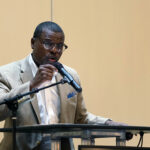
PLAINVIEW—Being made in the image of God is both an incredible gift and an incredible responsibility, said Paul Armes, president emeritus of Wayland Baptist University.
Armes returned to the Wayland campus in Plainview Feb. 25-26 as the featured speaker for the 2025 Willson Lectures.
During the dinner lecture, Armes introduced his central topic: the Imago Dei (Image of God) and how it shapes human identity, responsibility and relationships.
Drawing from biblical scholarship and personal experience, he outlined the various interpretations of the Imago Dei, emphasizing both its significance and responsibility:
-
Functional View: Humans as caretakers of creation.
-
Substantive View: Humanity’s unique intellectual and moral capacities.
-
Relational View: The ability to connect with God and others.
-
Synchronistic View: A combination of all these perspectives.
Armes emphasized being made in God’s image calls people to recognize the divine in others and to live accordingly. He concluded with a reflection on the transformational power of Christ, who restores and renews theimage of God in believers.
“The image of God contains elements of stewardship, intellect, morality and relationship,” he said. “It is the totality of a person’s identity.”
Armes illustrated his assertion that the greatest gift is also a weighty responsibility, using a story about Spanish cellist Pablo Casals injuring a finger.
The story goes, Casals was working around his house when he hammered his finger instead of the nail he was aiming for. The finger was so misshapen after the accident, it was clearly broken, Armes said.
Casals sought the care of a surgeon who warned him even with the necessary surgery and six weeks in a cast, the injury could result in his never playing cello again—because the injury was to his left hand, the hand most crucial to fretwork.
Sign up for our weekly edition and get all our headlines in your inbox on Thursdays
He did recover and return to his previous abilities after therapy. Later, a friend asked Casals how he felt when the surgeon warned him his greatest gift and calling might be lost and he might never play again.
Casals responded, “‘Honestly, my first thought was, thank God I’ll never have to play cello’” again, Armes recalled, “because his greatest gifting was also his heaviest and weightiest responsibility.”
Armes noted: “That’s what the image of God is in us, the greatest gifting, the weightiest responsibility.”
During Wednesday’s chapel address, Armes expanded on the practical implications of the Imago Dei, urging those attending to demonstrate respect in discourse, uphold the sanctity of life and practice compassion without compromise in interactions with others.
“Being made in God’s image means we have genuine and intrinsic value because we are the crowning act of God’s creative genius,” he said.
Armes outlined those three primary applications:
-
Respect in discourse and interaction
He lamented the increasing polarization of society, urging believers to treat others with dignity, even when disagreeing.
“If you believe that political leadership is truly the solution to the deep and real problems that our nation faces, you will be disappointed,” he said.
-
Valuing all human life
He spoke passionately about the sanctity of life, especially regarding unborn children, and how society has devalued human life.
“It’s interesting to me how we have devalued human life,” he said.
“The Bible calls us to secure the innocent, the powerless. And the truth is that no one in the 21st century has less power or less voice or less importance in many ways than the unborn.”
“The fact that we understand the reality of doing the Imago Dei in our lives and in other lives also means we must be concerned about those individuals who have had or who are contemplating abortions,” he continued.
“I believe we can love them and care for them without compromising our basic convictions about the sanctity of life.
“They are human beings who are hurt and wounded and struggling and trying to figure out the best way to cope. … To be truly pro-life means that we’re concerned about human life—all of it.”
-
Compassion without compromise
Armes highlighted Christ’s interactions with outcasts—like tax collectors, the Samaritan woman and the woman caught in adultery—emphasizing the need for Christians to love others while remaining firm in biblical truth.
“This is what Christ modeled, and this is what we are called to do,” he said.
“To be made in the image of God and recognizing the image of God in others doesn’t mean that we cannot speak to others directly, forcefully and even with deep conviction and passion,” Armes said.
He challenged listeners to see the image of God in all people, including those different from themselves, and to live out their faith with both conviction and grace.
“Proclaiming Christ always brings disruption. It always has, and it always will,” he said.
“To be in the image of God means to see others as Christ sees them—even when they are broken, even when they are different, even when it is hard.”
With additional reporting by Calli Keener.








We seek to connect God’s story and God’s people around the world. To learn more about God’s story, click here.
Send comments and feedback to Eric Black, our editor. For comments to be published, please specify “letter to the editor.” Maximum length for publication is 300 words.