




ARLINGTON—A Texas-based initiative to bring hope to a people on the other side of the globe began in an elevator.
|
Gabriel Herrera, Sada Herrera, Sharon Hill and Ron Hill lay hands on missionaries during a commissioning service at First Baptist Church in Arlington.
|
The first week after Cindy Wiles’ husband, Dennis, became pastor of First Baptist Church in Arlington, she met Alusine Jalloh, a professor at the University of Texas at Arlington and head of the school’s African studies program. Jalloh’s office was in the same building as the church’s office.
When they met, Wiles recognized his name as Fulani because she had worked among Fulani villages five years and knew it as a common name.
“I was more interested due to the fact that God had spoken to me and my husband through a series of events to tell us that his desire was for us to lead First Baptist Church Arlington to adopt the Fulani of West Africa,” she said.
Wiles and Jalloh, who is from Sierra Leone, developed a friendship while First Baptist Church developed ministries to the Fulani in Niger, Senegal, Guinea and New York City.
Now Wiles is launching Project Restore Hope: Sierra Leone. The ministry is a combined effort from all the entities that make up Global Connection Partnership Network, where she serves as executive director. Among the partners in the effort are Buckner International and Baylor University’s Louise Herrington School of Nursing, along with several academic schools at UT-Arlington.
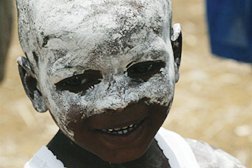
Child being treated for a skin infection in Sierra Leone.
|
Wiles and three other members of First Baptist Church, all former International Mission Board personnel who served in Sierra Leone, made a trip to the West African nation to see what form the ministry would take.
The trip confirmed for Wiles that Sierra Leone was at once a place in need and a place where Christians could make a difference.
Sign up for our weekly edition and get all our headlines in your inbox on Thursdays
“I was encouraged by the appointments, the encounters we had, particularly with government leaders,” she said. “What I saw was a nation that was willing to acknowledge its insufficiencies that really had already made some major steps to strategically address the problems that existed, not having the resources to implement what they were imagining.
“Another thing that really encouraged me was a migration of displaced Sierra Leoneans, particularly professionals, back to Sierra Leone to address the infrastructure issues that exist there.”

The war created untold numbers of orphans. Project Restore Hope’s plan is not to set up a system for American families to adopt but to equip the people of Sierra Leone to care for the children themselves.
|
Another facet is that the recently ended war in the nation changed the religious climate.
“From a Christian perspective, the major thing that concerns me is that Islam has become the answer,” Wiles said.
While the population of the nation was 40 percent Islamic prior to the conflict, estimates now range upward of 60 percent Islamic, with the Central Intelligence Agency putting its estimate at 80 percent.
Another consequence of the war is that the population of the capital Freetown has in-creased dramatically, with many people living in ravines or cardboard boxes. Orphans and street children exist in numbers too large to count.
The people also have been left with scars that are more than skin deep, as they have either had acts of violence perpetrated against them or their families or they are the ones who committed acts of violence against others.

The people have been left with scars that are more than skin deep.
|
“It’s a psychologically and spiritually wounded nation,” Wiles said.
It also is a nation without an infrastructure to deal with those types of issues. There are no social workers, no psychologists and only one psychiatrist for a nation of 6 million people, she said.
“They weren’t prepared to deal with the trauma they’ve been forced to deal with as a nation,” Wiles lamented.
The war created untold numbers of orphans. Project Restore Hope’s plan is not to set up a system for American families to adopt but to equip the people of Sierra Leone to care for the children themselves.
To that end, Jollah and the School of Social Work at the University of Texas at Arlington are creating a curriculum to train people in Sierra Leone as social workers and counselors.
Also, land on the grounds of the Evangelical College of Theology has been given to Global Connection Partnership to begin the construction of an orphan village.
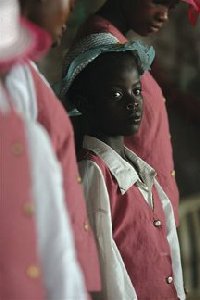
|
The first step will not be the construction of orphan cottages, however, but a training facility, called House of Hope, for future caregivers to orphans.
After the training, orphan cottages will be built. A medical and dental clinic also is planned for the center, as well as facilities to house volunteers.
Already, First Baptist Church has sent four missionaries to Sierra Leone. Ron and Sharon Hill, who accompanied Wiles on the vision trip last fall, are returning to Sierra Leone. They served as missionaries in West Africa 35 years with the IMB, including five years in Sierra Leone. They were the last missionaries left in Sierra Leone.
“They endured the war with national believers and were finally evacuated off the top of a beach hotel by helicopter just as U.S. troops hit the shore of Freetown, which was under rebel siege,” Wiles said.
Even after the evacuation, Hill stole back into Sierra Leone to encourage the pastors and believers there.
Gabriel and Sada Herrera also will serve in Sierra Leone. He is a dentist, and she is a registered nurse. They will help meet physical needs, but he also will work to develop programs targeting youth.
While more help is needed, Wiles said this isn’t a typical missions situation where something needs to be constructed. Psychologists and other mental and traditional health care workers may be the larger need at the moment, she noted.
For more information, call (817) 276-6494.






We seek to connect God’s story and God’s people around the world. To learn more about God’s story, click here.
Send comments and feedback to Eric Black, our editor. For comments to be published, please specify “letter to the editor.” Maximum length for publication is 300 words.