





AUSTIN—The number of payday loans in Texas has exploded. In 2008, payday and auto title loans were available in more than 2,800 locations all around Texas, according to the Texas Secretary of State’s list of registered credit service organizations.
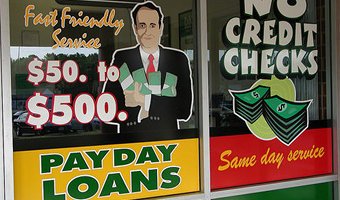
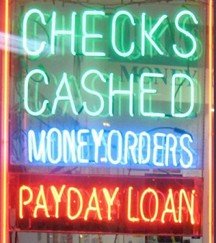
However, many Texans don’t know what payday loans are—let alone why they can be a problem for some people. Payday loans are small-dollar loans with enormously high service fees and interest rates. They offer instant cash with no credit check.
|
Consider how typical payday loans operate and how they can lead to trouble. Imagine a single mother has a car that needs repairs. The bill is $300, but she only has $150 until her next paycheck. She has no credit card, or maybe her credit card is maxed out.
So, she writes a check to a payday lender for $361.07. That’s $300 for the loan, plus $1.07 interest and a $60 service fee. The payday lender promises to hold the check two to three weeks until she gets paid again.
The mother has two options. The next payday, she either will pay off her $361.07 debt in cash, or she will allow the payday lender to cash the check. She cannot pay it off in installments; the debt must be paid in full.
If she doesn’t have $361.07 in two weeks, the check will bounce, incurring penalty fees from both the bank and the lender.
To avoid penalties, she rolls over the original loan and pays an additional $60 loan fee. If the loan were paid off after the second pay period, a $300 loan would generate $121.07 in profit.
Texas Appleseed, an advocacy group for low-income Texans, conducted a survey recently to determine the effects of payday loans. The majority of payday borrowers earned an income of $30,000 or less. One in 10 payday borrowers used them monthly, and 58 percent of people who used a payday loan rolled over the loan at least once. One in four payday borrowers rolled them over multiple times.
Payday loans generate profit by creating a cycle of debt. Even more disturbing, most payday loans are used for basic necessities like housing, food and utilities.
“With effective interest rates averaging around 500 percent, these loans are usury pure and simple—using the desperation of borrowers as a rationale for charging astronomical rates,” said Ann Baddour, senior policy analyst for Texas Appleseed.
“Payday and auto title lenders are exploiting a loophole in Texas law to get around rate and fee caps for small loans. Texas needs to stand up for what is good for our communities and reign in these abusive loans.”
The Texas Finance Code attempts to set restrictions on fees and payment periods of payday lenders, but most payday lenders operate as consumer service organizations to avoid regulation.
Consumer service organizations originally were intended to improve a consumer’s credit history or rating and therefore are allowed to obtain an extension of credit for consumers. They act as a middle-man between financial institutions and clients.
|
By taking advantage of the consumer service organization model, payday lenders obtain a line of credit from a partner financial institution to offer loans to their clients at high prices. The financial institution collects the low interest, while the payday lender collects the high fees.
This business model sidesteps many state regulations on the books.
Consumer service organizations register with the Texas Secretary of State but are not regulated by or required to obtain a license from the consumer credit commissioner’s office.
During the last Texas legislative session, several bills were introduced that would better regulate payday lenders. State Rep. Marisa Marquez, D-El Paso, wrote House Bill 3744 calling for all consumer service organizations to be licensed by the consumer credit commissioner’s office.
Under this bill, licensure would allow the commissioner’s office to set up regulatory practices, including collection of data to monitor the industry, limiting fees for services and adopting policies prohibiting harassment in collection practices. The bill had a hearing, but no action was taken on it.
Not everyone supports regulation, however, saying regulation would hurt the borrowers they are supposed to be helping.
In an article from the Texas Public Policy Foundation, Chris Robertson wrote, “Restricting or cutting off access to the only available short-term, micro loans will have very real unintended consequences for consumers who use these financial products.”
Some insist payday loans are the only option for some struggling families who are not eligible to receive a small-dollar loan from a bank or credit union.
Texas Baptists’ Christian Life Commission believes payday lenders should be under the intended regulation of the law. The state has articulated clear regulations for payday lenders, CLC Director Suzii Paynter said.
“The CLC opposes payday lenders operating as consumer service organizations, intentionally avoiding payday lending laws and exploiting the financial desperation of many Texans,” she said.
Payday lending, auto title loans—which operate similarly to payday loans—and other predatory practices are roadblocks to financial stability, thrift, savings and prosperity, she added.
Speakers at the annual CLC conference, March 22-23 in McAllen, will explore alternatives to payday lenders and other predatory practices. “Neither Need Nor Greed: Christian Stewardship of Money and Resources” is the theme of the two-day conference.
Amy Wiles, a graduate of Baylor University, is a student at Austin Presbyterian Theological Seminary and member of First Baptist Church in Austin. She is serving a public policy research internship jointly sponsored by the Christian Life Commission and the Baptist Standard, made possible by a grant from the Christ is Our Salvation Foundation of Waco.






We seek to connect God’s story and God’s people around the world. To learn more about God’s story, click here.
Send comments and feedback to Eric Black, our editor. For comments to be published, please specify “letter to the editor.” Maximum length for publication is 300 words.