BGCT Executive Board approves CP task force

The Baptist General Convention of Texas Executive Board approved the creation of three new task forces and approved committee and board nominees and two relationship agreements.

In addition to a task force to study possible updates to the BGCT constitution and bylaws and a task force to promote prayer, a Cooperative Program task force will conduct a comprehensive study of the funding mechanism.

The study will include how the Cooperative Program is promoted, how funds are allocated, how churches decide to participate, what is contributing to the ongoing decline in giving, and potential solutions to improve giving.

Keith Warren, executive pastor of Northside Baptist Church in Weatherford, will chair the task force. Other members include:

  • Debbie Potter, BGCT president and children’s pastor at Trinity Baptist Church in San Antonio.
  • Pete Pawelek, Executive Board member and senior pastor of Cowboy Fellowship of Atascosa County in Jourdanton.
  • Delvin Atchison, Executive Board member, African American Fellowship of Texas president, and senior pastor of Westside Baptist Church in Lewisville.
  • Tim Eng, Executive Board member and lay member of Chinese Baptist Church in Houston.
  • Victor Castillo, Texas Baptists River Ministry missionary and pastor of Rio Grande Bible Church in McAllen.
  • Michael Gossett, Executive Board member and lead pastor of Green Acres Baptist Church in Tyler.
  • Del Lopez, lay member of Iglesia Bautista Hispana in Lubbock.
  • Maria Bridwell, lay member of Calvary Baptist Church in McAllen.
  • Dillard Fisher, Executive Board member and pastor of Cross Bearers Church in Copperas Cove.

Committee and board recommendations approved

The Executive Board approved the following nominations to fill vacancies on the Committee to Nominate Executive Board Directors:

  • Dana Moore, Second Baptist Church in Corpus Christi.
  • Monica Followell, First Baptist Church in San Marcos.

The board approved the following nominations to fill Executive Board vacancies:

  • Tedrick Woods, Living Word Fellowship Church in Dallas.
  • Michael Gossett, Green Acres Baptist Church in Tyler.

Annual meeting location

When a reservation at the Henry B. González Convention Center in San Antonio could not be secured in time, the Committee on Annual Meeting recommended the 2028 Family Gathering be held at Kalahari Resorts and Conventions in Round Rock. The board approved the recommendation, sending it to messengers for a vote during the 2026 BGCT annual meeting.

Every fifth year, the BGCT annual meeting is held in July and is called the Family Gathering.

Relationship agreements approved

The Executive Board approved a new relationship agreement between the BGCT and Baptist Hospitals of Southeast Texas. Under the new agreement, the BGCT representation on the BHSET board decreases from 50 percent to 30 percent, which is in line with BGCT agreements with other Baptist hospitals.

The board also approved Baptist University of the Américas’ restated certificate of formation, bringing this agreement in line with other educational institution agreements.

Dustin Slaton, chair of the Institutional Relations Committee, explained the change is from a sole member corporation to no member corporation, which “clarifies legally [BUA is] not owned by the BGCT, run by the BGCT, managed by the BGCT,” though the BGCT still elects BUA trustees.

Other business

The following distributions from J.K. Wadley Endowment earnings were approved, for a total of $475,000:

  • BSM campus missionaries, $150,000.
  • BSM building maintenance, $150,000.
  • Muslin and refugee ministry, $100,000.
  • Western Heritage, $50,000.
  • MinistrySafe, $25,000.

The board approved updates to a set of personnel policies to bring their language into compliance with current statutes and to better care for staff. The policies relate to background investigations, eligibility for benefits, time away from work, flexible spending accounts, and health savings accounts.


BGCT Executive Board restructures, addresses challenges

Baptist General Convention of Texas Executive Board members approved a new board structure to align with recent Texas Baptists’ staffing changes. The board also heard updates on the Texas Baptist Indemnity Program and Cooperative Program receipts, as well as BGCT President Debbie Potter’s first address to the board.

Committee restructuring

With constituent parts of the Center for Cultural Engagement reassigned, a corresponding committee is no longer needed. The Executive Board approved two new committees and a reestablished committee to take its place.

The Christian Life Commission once again has its own committee. Chaplaincy will temporarily fall under the associate executive director.

Affinity Ministries, which includes African American Ministries, Texas Baptists en Español, Western Heritage, and Intercultural Ministries, falls under the purview of the Relational Development Committee. Sergio Ramos, senior director of relational development and GC2 Strong, is the staff liaison.

Texas Baptist Communications and the Cooperative Program office fall under the purview of the Resource Development Committee. Joshua Minatrea, senior director of resource development, is the staff liaison.

The Audit Committee will now fall under the Finance Committee.

Texas Baptist Indemnity Program

Since its start, Nov. 1, 2025, at least 113 churches were enrolled by the end of January in the Texas Baptists Indemnity Program, which partners with KingsCover Insurance Services to provide church property insurance. The total insured value is about $900 million, BGCT Associate Executive Director and TBIP President Craig Christina reported.

The average premium savings has been between 15 percent to 35 percent, Christina said. In addition to reduced premiums, coverages have increased, he added.

The total 2026 premium savings to churches currently enrolled was reported at $1,277,644. These same churches gave $1,646,609 to the Cooperative Program in 2025. Sixty-four of the 113 churches “saved more in premiums than they gave to [the Cooperative Program] in 2025,” Christina reported.

About 600 churches are currently in the application process.

Additionally, Covenant Solutions/Texas Baptists Indemnity Program reimbursed the BGCT around $600,000 of the 2025 start-up costs, Christina said. TBIP partnered with Covenant Solutions, located in South Carolina, to make the church insurance program available nationally.

Cooperative Program

Elaborating on BGCT Executive Director Julio Guarneri’s remarks to the Executive Board on Feb. 23, BGCT Treasurer and CFO Ward Hayes shared an update on Cooperative Program giving.

Cooperative Program giving in 2025 was 97.2 percent of 2024 receipts, or down about $721,000. The shortfall in giving was partially offset by expenses being about $699,000 under budget.

Giving to special mission offerings—Mary Hill Davis, Annie Armstrong, Lottie Moon, and Texas Baptist Hunger Offering—also declined in 2025.

The total decline in Cooperative Program receipts since 2015 is $5 million, or a 17 percent decrease in Cooperative Program giving, averaging a 2 percent decline year over year. Inflation was a compounding factor during the same 10-year period from 2015 to 2025, Hayes said. What $100 could buy in 2015 took $135 in 2025.

In 2015, BGCT endowment income contributed 7 to 8 percent of annual revenue. By 2025, endowment income made up 23 percent of the BGCT’s revenue. Up until last year, investment earnings covered the gap in Cooperative Program decline but are no longer covering the drop, Hayes said.

“Ministry organizations move at the speed of trust,” Hayes said, stating the information shared is not to instill fear but to understand the reality faced by ministry organizations nationwide.

“The Cooperative Program is still the perfect engine to run this cooperative ministry that we share,” Hayes said.

Clay in the potter’s hand

BGCT President Debbie Potter exhorted Executive Board members to stay open to being shaped by the potter, citing Isaiah 64:8: “We are the clay, and you [Lord] are our potter.”

Potter grew up as a “Nazarene pastor’s kid.” She loved being a pastor’s kid and knew at a young age she wanted to marry a pastor because she wanted to be in ministry. She attended a Nazarene college to find and marry a “nice Nazarene man” who would become a pastor.

But it didn’t turn out as she planned. She did meet and marry a “nice Nazarene man” who became a banker. Potter became a public school teacher and administrator. Then, her father lost his ministry, and her family lost their church. She felt lost herself until she and her family found a church home at Parkhills Baptist Church in San Antonio.

Potter discovered her call to children’s ministry there. Parkhills also called her into her first ministry position. She has been a children’s pastor for the last 30 years, now serving at Trinity Baptist Church in San Antonio, and is grateful for Texas Baptists who took her in and gave her a home, she said.

Seeing herself as an unlikely candidate for ministry in a Baptist church, Potter said to “look for the outliers. Always remember, God can and will do extraordinary things with ordinary people if we let him.”

Potter also urged Executive Board members to “stand up for the voiceless.” She thanked those who stood up for her as a woman in ministry. She also expressed her gratitude for the child protection policies in place among Texas Baptists and the Christian Life Commission’s work in Austin.

“God’s design takes time. Stay on the wheel,” Potter concluded.


Texas Baptists ‘are a people of the book,’ Guarneri declares

Deriving principles from Acts 10-11, Julio Guarneri grounded Texas Baptist history in the authority of Scripture: “Texas Baptists believe the Bible. We are a people of the book. Do not let anyone deceive you otherwise.”

The Baptist General Convention of Texas’ history is a source of strength for the convention’s present and future, BGCT Executive Director Guarneri told BGCT Executive Board members during their February meeting.

Reflecting on the convention’s 140-year legacy and the account of Peter’s vision leading to Cornelius’ conversion, Guarneri called for future growth, renewed vision, and increased cooperation.

Formed around cooperation

Noting there were five Baptist groups in Texas in the mid- to late-1800s, Guarneri said the vision of the BGCT’s founders “was one of cooperation for the sake of God’s mission.” Doctrinal conformity was not an organizing principle, he asserted.

“While Baptist distinctives, including sound doctrine, have always been important, the BGCT did not organize around doctrinal conformity,” Guarneri said.

Similarly, the Southern Baptist Convention, formed in 1845, did not have a convention-wide statement of faith until 1925, Guarneri pointed out.

According to a quote Guarneri shared from William W. Barnes, Southwestern Baptist Theological Seminary professor, the 1925 statement of faith was not uniformly adopted by Southern Baptists.

The 1925 statement was revised in 1963 and again in 2000.

Lack of “doctrinal centralization,” as Barnes phrased it in 1934, did not mean Southern Baptists nor Texas Baptists questioned the authority of Scripture, Guarneri explained.

However, during the decades-long Southern Baptist controversy that led, in part, to the 2000 revision of the Baptist Faith and Message, the word “inerrancy” became a litmus test for one’s view of Scripture.

Authority of Scripture

Guarneri directly addressed “chatter” about inerrancy, specifically, the assertion other conventions are committed to inerrancy while the BGCT has “a low view of the authority” of Scripture and that only those who affirm the 2000 Baptist Faith and Message believe in inerrancy.

The words “inerrant” or “inerrancy” are not in either the 1963 or the 2000 statements, Guarneri pointed out, comparing “Article I: The Scriptures” in the 1963 and 2000 statements.

Both versions of the statement, following the 1925 statement nearly verbatim, read:

“The Holy Bible was written by men divinely inspired [and] is a perfect treasure of divine instruction. It has God for its author, salvation for its end, and truth, without any mixture of error, for its matter. It reveals the principles by which God judges us; and therefore is, and will remain to the end of the world, the true center of Christian union, and the supreme standard by which all human conduct, creeds, and religious opinions should be tried.”

Article I of the 1963 and 2000 statements are not identical but are very similar, Guarneri acknowledged. Differences between the two appear in the first and last sentences.

“Those who suggest the conventions and churches who affirm the 2000 version [of the Baptist Faith and Message] are committed to inerrancy, in contrast with those who [affirm the] 1963 [version], are either ignorant or dishonest, because the word [inerrant] is not there,” Guarneri stated.

“I would argue … our commitment to the authority of the Scriptures is higher than others, because we do not elevate man-made confessions of faith above the Bible,” Guarneri contended. “If your conscience is going to submit to anything, let it be to the scriptures of the Old and New Testament, not to a man-made confession of faith. That’s where we stand.”

Cooperation amid polarization

“Today, we are surrounded by a culture of tribalism,” Guarneri said. “People are emotionally invested in their tribe … around politics, or religious beliefs, or ethical issues. … The tendency is to see others that are not in full agreement with me as the enemy and to attack them and to demean them and perhaps even dehumanize them,” he continued.

Sadly, this tribalism has crept into churches, resulting in people making decisions based around labels, Guarneri added.

“We need to be different [from] the culture around us,” Guarneri asserted. “We need to return to our commitment of cooperation.”

Guarneri also addressed declining Cooperative Program receipts, saying the 25-year decline in BGCT Cooperative Program receipts is not unique. The SBC Cooperative Program receipts have been declining for 35 years, he said.

Guarneri attributed the decline, in part, to increased inflation reducing the buying power at the same time costs have increased. Also, churches are sending less Cooperative Program dollars to the BGCT and SBC as their receipts decline and needs and costs increase.

“Our response should be to neither fear nor fixate on the dollars … nor lament the ways things used to be,” he said.

Rather, he proposed four things based on Acts 10-11 for ministries to focus on instead: The biblical foundation for cooperation, the legacy of cooperation as a Baptist people, prayer for God to reawaken churches, and a commitment to collaborate for the sake of the kingdom.

Unity amid diversity

Citing Numbers 2:2, how the Israelite tribes were to camp around the tabernacle, each family under their own banner, Guarneri asserted: “The church today would honor God most and would be most effective with every local congregation retaining their identity, their autonomy, their uniqueness, and recognizing that we together are one body in Christ.”

“We don’t have to agree on everything to be on mission together. We are called to unity in diversity for the sake of God’s glory,” he continued.

“Sound doctrine is important. We must agree on orthodox Christian doctrine. We must hold up Baptist distinctives, but we must give room for diversity in secondary and tertiary doctrines,” Guarneri said, noting Texas Baptist churches differ over Calvinism and Arminianism, end-times views, Communion, and women in ministry.

Though Texas Baptists interpret some of these matters differently, “what is constant is our commitment to the authority, inspiration, sufficiency, and infallibility of the Holy Scriptures,” Guarneri contended.

In all his travel around Texas and meeting with hundreds of Texas Baptist pastors, he has not yet met a pastor in Texas who doesn’t believe the Bible is authoritative and infallible, he added.

“Let us rise up and claim our identity, our legacy as a Baptist people who cooperate together,” Guarneri encouraged Executive Board members. “One hundred and forty years of cooperation for God’s mission, the Great Commandment, and the Great Commission demand it, and the glory of God is worthy of it.”

This report does not follow the exact chronology of Julio Guarneri’s address.


Baylor Regents celebrate milestones and new program

During its regular February meeting, the Baylor University Board of Regents celebrated fundraising and graduation milestones and introduced Baylor’s plan to meet the growing workforce demand by approving a Bachelor of Science in biomedical engineering. 

President Linda Livingstone highlighted the Extend the Line scholarship initiative Baylor started in 2025, expressing a goal to produce $50 million in additional scholarship fundraising support by 2030. “We’re already over $100 million in that effort, [which] is fabulous news,” Livingstone said. 

Livingstone also commented on Baylor’s general fundraising growth. “This year is shaping up to be the second largest fundraising year in Baylor history,” she said. 

Baylor eclipsed its annual goal, due in large part to a $30 million gift received in January from the Moody Foundation of Galveston. 

The gift will help support scholarships, research, and academic programs in the School of Education, now known as the Moody School of Education. 

Additionally, Baylor received a $5 million Lilly Endowment grant as part of its Storytelling Initiative, and a $9.76 million Lilly Endowment grant for Truett Theological Seminary in December. 

Baylor hit a record four-year graduation rate of 77.3 percent, set in 2025 for first-year freshmen who entered Baylor in 2021. This compares to a 47.3 percent graduation rate in 2003, representing a nearly 63 percent increase. 

Regents approve increase in tuition costs 

Baylor regents approved an increase in tuition and fees for the upcoming 2026-27 academic year. Tuition will cost around $67,756 annually, an increase from $63,620 in 2025-26.

“After you account for financial aid and all of the need-based merit scholarships that we provide each year to students, … the average net out-of-pocket increase per student is expected to be around $1,978 annually,” Livingstone said. 

To assist current students, Baylor will help manage this increase in tuition and fees by increasing scholarship funding by $3.8 million, extend some form of financial aid to more than 90 percent of students, and continue both the Baylor Benefit scholarship and Extend the Line Scholarship Initiative. 

Response to BGCT annual meeting

President Livingstone responded to a question about the close vote by messengers to the Baptist General Convention of Texas annual meeting in Nov. 2025 to defund and to reconsider the BGCT’s relationship with Baylor. 

“We are very committed to our relationship with the BGCT. I talk to [BGCT Executive Director] Julio Guarneri regularly,” she said. 

“Obviously, the Baptists helped found Baylor back in 1845. We deeply value that relationship and continue to work very closely with folks in the convention, and obviously they work very closely with Truett Seminary,” she continued. 

“We will continue to work closely with the leadership of the BGCT, [and] we both matter a lot to Baptists in Texas, and so it’s certainly a relationship we are committed to. [We will] support one another in the work we’re doing,” she said. 

In other business, Baylor regents:

  • Elected Susan “Suzii” Youngblood March to a three-year term as an alumni-elected regent. Her term will begin June 1.
  • Approved Chase R. Cortner as a new first-term, non-voting student regent.
  • Approved Student Regent Spencer Yim as a second-term voting student regent through 2027. 
  • Elected Chris Hansen for a three-year term as faculty regent.

Based in part on reporting from Baylor University Media and Public Relations. 


Football coach shaped by Jesus

Jeff Dixon, a retired educator and football coach, credits his Christian faith with shaping his approach to coaching and mentoring young athletes.

Dixon, who coached for 39 years at several Texas high schools, said his relationship with Jesus transformed coaching from a competitive pursuit into a ministry focused on guiding students toward personal growth and faith.

A 1987 graduate of Howard Payne University, Dixon said his Christian faith deepened during his college years and continued to grow through relationships with other coaches who were bold about their beliefs.

“I wanted to be an impact on the community, not just for wins and losses, but I wanted to impact a community for his kingdom,” Dixon said.

Now serving as a deacon and youth minister at First Baptist Church in Alvarado, Dixon said he continues to pray the Lord will use him to impact the community and the kingdom.

Reflecting on his time on the field

Dixon reflected on his time on the field, including mentoring Anansi Flaherty, who later gave his life to Christ while incarcerated.

Flaherty, a backup fullback on Katy High School’s 2000 state championship team who later made headlines in a tragic case after killing his mother, gave his life to Christ in prison and was baptized Dec. 19, 2024.

“When you invest in people and you know they’re in trouble, it’s heartbreaking,” Dixon said. “When you’re in the coaching world and you have a position with a group of kids, they’re yours. You build a relationship with them. And he was one of mine.”

“I got into coaching because I love the sport,” Dixon said. “There’s way more to teaching and coaching than the competitive arena. I saw a side of it with adolescence that I never really recognized before—young boys who didn’t have a dad or parenting.”

Mentoring from leaders

Just as those young boys needed mentoring, Dixon said he received mentoring from Christian men throughout his career, including coaches and administrators who modeled bold leadership.

Dixon said watching those men live out their faith in the public arena made him bolder about sharing his own faith.

He also highlighted his involvement in Bible-based programs such as Coaches Outreach, a ministry providing studies tailored to the lives of coaches and their spouses.

“We go through a 12-week Bible study. It happens to be a Coaches Outreach Bible study. We’re talking about Jesus and we’re talking about the gospel,” Dixon said.

Through these experiences, Dixon said he fostered long-term relationships with players, guiding them in both sports and faith.

“When it comes to a coach’s impact, you’re going to do one of two things: You’re going to impact them for the kingdom or you’re not,” Dixon said.

“What a platform, as a Christian coach, to be an influencer of thousands of people who directly come in contact with you. That’s a major call.”

Dixon said he quickly realized coaching was more than a profession.

“It’s a calling. It’s not a job,” he said. “You can’t tackle coaching with that kind of mentality.”

Though he began coaching out of a love for competition, he said within a year he understood something bigger was at stake.

“What matters is how many you have impacted for his kingdom,” Dixon said. “The Christ impact is eternal. If I’ve been able to direct those I coach toward a personal relationship with the Savior of the world, then praise God.”

Dixon said a single coach over a 20-year career may come into contact with thousands of students and their families.

“What a platform to represent Jesus,” he said.


DBU student saves man’s life

Dallas Baptist University student Emma Dilley saved a man’s life after performing CPR on him. He was suffering from an asthma attack.

According to KDFW-TV in Dallas, Dilley and her friends were driving through the Oak Lawn neighborhood in Dallas the night of Feb. 10.

A man was lying on the street with a crowd of people surrounding him at the intersection of Lemmon Avenue and Douglas Avenue.

“I figured I needed to put others before myself, and so I just hopped out and performed CPR,” Dilley said. “I got on the scene and checked his pulse, and it was very faint.”

Dilley performed CPR on the man until emergency personnel arrived.

Dilley told FOX 4 she’s known CPR since she was a high school freshman.

“I’m just glad I was there to help and be there for him,” Dilley said.

The man was revived and taken to a local hospital by Dallas Fire and Rescue.

Dilley is a pre-med biology major at DBU and says she wants to work as a doctor in the neonatal intensive care unit.


Millennial/Gen Z Network is ‘revolutionary’

Sam Bunnell, senior pastor at First Baptist Church in Henrietta, first connected with the Millennial/Gen Z Network, also known as The Pastor’s Common, in August 2024, by attending a Preaching Lab advertised on Texas Baptists’ social media. 

“I did not know what The Pastor’s Common was [at the time], but I saw a post on social media and I thought: ‘Oh, Texas Baptists is putting on a preaching lab, and it’s in Dallas, that’s not too far [from Henrietta]. I can get down there and go see it,” Bunnell explained. 

While there, Bunnell learned a new technique for how to tell stories in sermons, and met The Pastor’s Common leaders David Miranda and David Foster, director of Millennial/Gen Z Network at Texas Baptists, and “just hit it off with those guys.” 

The next month, Bunnell attended a retreat hosted by The Pastor’s Common at First Baptist Church in Richardson, where he met Joseph Adams, pastor of First Baptist Church in Mount Pleasant and now Texas Baptists first vice president. He said they bonded over doing small-town ministry. 

“I was like, ‘Wow, I have actually made a genuine friend here today!’” Bunnell said. “[The Pastor’s Common] just became life-giving to me.” 

Bunnell said he “fell in love with [The Pastor’s Common] pretty fast.” 

“I’m a pastor’s kid, and I’ve been in ministry my whole life, and been around all different types of Baptist life and all this stuff and never found the community and the help [I’ve found with The Pastor’s Common],” Bunnell said. 

The Pastor’s Common is a Texas Baptists ministry dedicated to providing opportunities for emerging ministry leaders to be heard, resourced, and find community, launched in 2019 by then-Texas Baptists staff member David Miranda in collaboration with pastors David Foster, Jordan Villanueva, and Abraham Quiñones. 

Foster stepped into the director role for the Millennial/Gen Z Network in March 2025. He said leading The Pastor’s Common has shown him “the future of pastoral leadership in Texas Baptists is not brittle, but thoughtful, resilient, and quietly hopeful.” 

“These leaders are humble, collaborative, and deeply rooted in the local church. They value cooperation, learning from one another, and staying present in their communities rather than opting out when ministry gets hard,” Foster said. 

Bunnell said The Pastor’s Common has become very meaningful in his ministry: “Those guys have become friends. They’re guys I call or text when I’m having a bad day. They’re guys I’ve asked to pray for me, and they asked me to pray for them. It is a true family.”

Refreshed by The Pastor’s Common retreats 

The genesis of involvement with The Pastor’s Common for Izzy Mendez, co-pastor at Alamo Community Church in downtown San Antonio, was at a gathering at the 2021 Texas Baptists annual meeting in Galveston. 

“I’ve been involved in Texas Baptists’ life for, I want to say, 15 years now … [and] I’m a product of Texas Baptists, but finding places for younger ministers outside of Baptist Student Ministry is kind of hard to do. So, when I heard about this network for Millennial and Gen Z pastors, I was like: ‘How do I get involved? What can I do to help?’” Mendez explained.

Mendez said having “intentionally carved out time for hanging out and spending time together,” and hearing from “seasoned pastors or ministry leaders” at The Pastor’s Common retreats has been refreshing. 

“That carved-out time where we have two days or so, somewhere else, where we’re getting poured into, and then we’re also pouring into one another and getting to spend time together … I think those [times] have been really refreshing,” Mendez said. 

Mendez explained how he was most impacted by a retreat hosted by The Pastor’s Common that emphasized prayer, where he was challenged to “anchor your ministry in prayer.” 

“That reminder from seasoned pastors and ministry leaders caused me to think about: ‘How do I think about this in my own day-to-day life and ministry? What does it look like for me just to abide in God’s presence? What are some practical tools that I can use to do that?’” Mendez said. 

He said anchoring his ministry in prayer has not only impacted him, but also his congregation: “I encourage my church to operate in this way as well: ‘What areas of my life have I just been focusing on prayer as a means to get something rather than just enjoying God’s presence?’” 

“It’s one of those things you know intrinsically, but to hear them again and to be reminded with a group of peers was really beneficial at that time. It still is today. I [still] use some of those practices now … even two years later.”

Finding renewed strength and meaningful community

Israel Villalobos, groups shepherd at Fielder Church in Arlington, said he has also been impacted by The Pastor’s Common retreats. He said attending the Sabbath Retreat in October 2024 “refreshed me just by hearing [about Sabbath].” 

“About a year and a half ago, Jason Parades from Fielder Church was speaking on Sabbath, and I remember that workshop refreshed me just by hearing him [and] how he helped us understand Sabbath,” Villalobos said. 

“It really enriched my soul. It just blessed me, my wife, my family, and whenever I’m needing a refreshment, I go back to those notes.”

Villalobos said The Pastor’s Common has “proven to be a timely and dependable network for a new generation of pastors” by “providing much-needed fellowship through authentic relationships … steady encouragement [and] practical resources, particularly valuable for young Texas Baptists pastors.” 

“What’s being done [through] The Pastor’s Common is revolutionary,” Villalobos said. “This network stands as a genuinely unifying space where pastors can find renewed strength and meaningful community.”

Mendez said The Pastor’s Common leadership has “done a great job of highlighting and celebrating the diversity among Texas Baptists, particularly in Millennials [and] Gen Z.” 

“It matters a lot to walk into a room and say: ‘Is there anybody that looks like me? Sounds like me? Is thinking like me? Or on the other side of that, who thinks differently?”  Mendez continued. 

“[To ask], ‘How do we combine our resources and things to help one another out?’ I think that’s been one of the things I’ve celebrated a lot and benefited from seeing in our Texas Baptist life. I think it’s worth celebrating.” 

Foster said the most encouraging thing about working with the pastors and leaders in The Pastor’s Common is “their desire for faithfulness over flash.” 

“[These leaders] aren’t chasing platforms or shortcuts. They’re asking hard, honest questions about preaching the gospel well, loving their people faithfully, and leading with integrity in complicated moments in our culture,” Foster said. 

To learn more about The Pastor’s Common, visit thepastorscommon.com.   


Litzler issues challenge to uphold religious freedom

John Litzler challenged Howard Payne University students to recognize and defend the Christian’s historic and ongoing role in protecting religious liberty.

Litzler was the featured speaker at the 18th annual Currie-Strickland Distinguished Lectures in Christian Ethics hosted by HPU.

Litzler, director for public policy at Texas Baptists’ Christian Life Commission and general counsel for Texas Baptists, addressed students during HPU’s chapel service on Wednesday, Feb. 4, and those who attended the lecture series Thursday evening, Feb. 5.

Campus challenge

Speaking from the theme, “The Modern Challenge of Religious Liberty: Protecting a Baptist Distinction from Extinction,” Litzler urged students to understand how Christian convictions have shaped religious liberty and to engage thoughtfully in public policy and advocacy.

“For the rest of this week—for the next couple of days—would you wrestle with the concept of religious liberty? Will you challenge

John Litzler, director for public policy at Texas Baptists’ Christian Life Commission and general counsel for Texas Baptists, speaks during chapel at HPU. (Photo/Kendall Lyons)

yourself on this topic in some way?” Litzler asked, speaking to students, faculty, and staff during chapel.

“That might mean finding one of your friends from another country—maybe an international student—and asking them what it’s like to live under different laws and the tension between following their country’s laws and God’s law,” Litzler continued.

“Or it might be spending time in prayer and reflection, asking yourself some challenging, introspective questions, like, ‘Would my views on religious liberty be different if I were part of a minority faith instead of a majority faith?’” Litzler added.

Litzler made a reference to Matthew 22:15, in which religious leaders attempted to trap Jesus by asking whether it was lawful to pay taxes to Caesar.

He explained the question was designed to force Jesus to choose between Roman law and God’s law, illustrating the tension believers can face between earthly governments and divine authority.

Litzler described Jesus’ response as a framework for navigating dual citizenship in earthly kingdoms and the kingdom of God, arguing it highlights the importance of distinguishing between government authority and God’s authority.

Evening lecture

During the Thursday evening lecture, Litzler walked visitors and guests through the First Amendment to the U.S. Constitution, focusing on religious liberty.

Religious liberty, a historic Baptist distinctive, is being weakened when political leaders create carve-outs that limit how faith-based beliefs can be expressed in public life, Litzler contended.

“When people become deeply committed to a particular cause, religious liberty can quickly be treated as an obstacle,” Litzler said.

He said the First Amendment’s free exercise and establishment clauses were designed to protect all faiths and nonreligious beliefs, not only Christianity.

Litzler pointed to recent federal and state debates as evidence that both Democrats and Republicans have attempted to weaken religious liberty protections when they conflict with political priorities, including efforts to limit how religious freedom laws apply to issues such as same-sex marriage and abortion.

Litzler also cautioned Christians not to confuse the loss of cultural privilege with genuine religious persecution, noting Christians in other parts of the world face far more severe restrictions.


Texas Baptists realigns for GC2 Strong strategy

Texas Baptists has realigned the Center for Cultural Engagement as part of its GC2 Strong strategy to better equip churches for Great Commandment and Great Commission faithfulness.

The changes, effective Feb. 1, redistributed the center’s ministries across the organization to provide churches with more direct access to resources for church, minister, and missions support.

As part of the realignment, affinity ministries, chaplaincy relations, and the Christian Life Commission will now operate within separate teams to allow for greater focus and clearer alignment with Texas Baptists’ GC2 Strong priorities.

Affinity ministries—which serve and support cultural churches across Texas Baptists—will now be housed within the Relational Development/GC2 team.

These ministries include African American Ministries, Texas Baptists en Español, Intercultural Ministries, and Western Heritage. Together, affinity ministries represent nearly 48 percent of Texas Baptists churches.

“This move is taking place because we want to make sure that our GC2 Strong strategy is contextualized for all of our affinity groups through the Relational Development Team,” said Julio Guarneri, executive director of Texas Baptists.

“We want our cultural groups to be involved at every level of ministry across Texas Baptists,” he stated.

Affinity Ministries

The Relational Development/GC2 team, led by Sergio Ramos, connects with conventions, churches, and institutions across the state.

Carlos Francis, current director of African American Ministries, will assume a new role as director of Affinity Relations/GC2 Support. He will continue to lead African American Ministries and will also serve on the Texas Baptists Leadership Team, providing direct input to staff leadership.

“Our affinity ministries represent nearly 48 percent of our churches and play a tremendous role in advancing the GC2 initiative. Their impact is essential to who we are and where we are going,” Ramos, senior director of Relational Development/GC2 Initiative, said.

Guarneri emphasized the realignment is not a move away from cultural engagement, but rather a way to give each ministry greater focus.

“We are intentionally giving the Christian Life Commission, chaplaincy relations, and affinity groups more focus,” Guarneri said.

“Affinity groups can serve cultural churches by focusing on relational development and GC2 faithfulness. Chaplaincy relations will continue to endorse and resource chaplains, and the CLC can focus on engaging issues of advocacy and justice with the objective of serving churches,” Guarneri continued.

Christian Life Commission

The Christian Life Commission will return to its historic role as a stand-alone ministry focused on ethics and justice, advocacy, and public policy.

The CLC remains under the leadership of Katie Frugé, who will continue to serve on the Texas Baptists Leadership Team. Rebecca Treviño has transitioned from her role with the Center for Cultural Engagement to serve as policy analyst for the CLC.

Plans are underway for the CLC to produce new resources for churches in key areas.

“This realignment is an opportunity to support churches and ministers through clear access to key resources in the areas of affinity ministries, ethics and advocacy, and chaplaincy,” Guarneri said.

Frugé expressed confidence in the changes and the future of the CLC.

“I’m confident that each ministry is positioned well to continue the important work they have done so ably for Texas Baptists,” Frugé said.

Chaplaincy

Chaplaincy Relations has transitioned under the Office of the Associate Executive Director on an interim basis.

This ministry endorses chaplains serving in a variety of fields, including military, business, prisons, and hospitals.

Under the leadership of Todd Combee, chaplaincy will work with Craig Christina, associate executive director, to continue supporting chaplains in their ministry roles.

Future changes

Guarneri said there are no immediate plans to realign other ministry centers, including the Center for Church Health, Center for Ministerial Health, Center for Missional Engagement and Center for Collegiate Ministry.

However, he noted Texas Baptists leadership is continuing to evaluate how all ministries align with GC2 Strong.

“As part of the GC2 Strong strategy, every convention ministry will prioritize equipping churches for Great Commandment and Great Commission faithfulness,” Guarneri said.

“While there are no plans to realign other ministry centers at this time, there may be progressive changes over the next few months as we take a closer look at how every ministry supports the GC2 Strong strategy. Ultimately, we want to ensure that ministries are appropriately aligned to strengthen churches, ministers, and missions into the future,” he said.

Guarneri also noted the realignment will enhance the work of leaders within Intercultural Ministries.

“Mark Heavener, Rolando Rodriguez, and James ‘Mac’ McLeod, under the leadership of Carlos Francis, will be able to be involved in the GC2 Strong strategy and contextualize it to serve their churches in a more effective way,” Guarneri said.

“It will be a positive thing for these cultural groups, and they are all on board. First and foremost, we are making this move to equip churches for Great Commandment, Great Commission faithfulness.”


Health means caring for the whole pastor

Ministry is a tough calling. It demands more than sermon preparation and hospital visits. It requires the whole person.

Pastors are expected to give spiritually, emotionally, mentally, and physically, often without a clear system of care for their own well-being.

Recognizing that gap, Bobby Contreras and several ministry peers helped launch a ministry designed not just to serve churches, but to serve the people who lead them.

That vision became The Whole Pastor, a growing effort focused on helping pastors and ministry leaders pursue health in every area of life.

What began as a shared concern among Texas Baptist leaders has become a central hub of encouragement, resources, and advocacy for holistic pastoral health.

For Contreras, the mission is professional and personal.

His own experiences in ministry, along with seasons of illness and recovery, shaped his conviction that caring for pastors must extend beyond spiritual checklists to include mental, relational, physical, and financial well-being.

According to its mission, The Whole Pastor exists “to help pastors, families, and communities find a more holistic way to be healthy.” The organization’s work is rooted in the belief that the health of a pastor directly impacts the health of a church and its surrounding community.

“The easy math says a healthy pastor plus a healthy pastor’s family equals a healthy church community,” Contreras said.

Studying the problem

That conviction was reinforced through a collaborative study involving Texas Baptists, San Antonio Baptist Association, and Baptist Health Foundation in San Antonio.

The findings challenged assumptions about pastoral well-being—especially during a season when many pastors were stretched beyond capacity.

“The Whole Pastor Blog was my response to a team of folks from Texas Baptist, San Antonio Baptist Association, and the Baptist Health Foundation San Antonio coming together to study and find out that pastors aren’t as healthy as we thought,” Contreras said. “And the crux of this study was done right in the middle of COVID.”

The pandemic intensified existing pressures on pastors, highlighting burnout, isolation, and emotional strain. For Contreras and others involved, the data confirmed what many had been experiencing anecdotally for years: pastors were carrying heavy loads with limited support for their own holistic care.

A shared effort

Contreras and his colleagues launched The Whole Pastor to address those gaps by creating a space focused on the full spectrum of pastoral health. The ministry emphasizes five key areas: spiritual, physical, mental, relational, and financial well-being.

“The Whole Pastor Blog began as a dream shared by a group of Texas pastors who care deeply about spiritual, physical, mental, financial, and relational health,” Contreras said. “Our aim is to help pastors, families, and communities find a more holistic way to be healthy.”

Rather than functioning as a single program, The Whole Pastor serves as a platform and resource hub—offering encouragement, reflection, and practical tools designed to help pastors sustain long-term ministry.

Contreras noted, while many organizations are now emphasizing holistic approaches to ministry health, The Whole Pastor is part of a broader movement rather than a stand-alone solution.

“One note is that many groups have been and are now focused in on this holistic approach too. This isn’t exclusive to just us,” he said.

Personal wholeness

Still, for Contreras, the work took on deeper meaning through personal experience.

“Coming out of my cancer season, this holistic awareness was very real for me,” he said. “The physical side of things were great during recovery, but the spiritual and mental side of things lagged.”

That season reinforced the importance of addressing all dimensions of health, not just the ones easiest to measure. It also shaped his passion for advocating for pastors who may be strong in one area but struggling silently in others.

Contreras has been lead pastor of Alamo Heights Baptist Church in the Alamo Heights community of San Antonio for the last seven years. He and his wife, Hannah, have lived in that community for 18 years.

He also has served on the Baptist General Convention of Texas Executive Board, including two years as board chair, and the board of the Baptist Health Foundation in San Antonio.

Contreras’ passion for ministry started when he was in elementary school in El Paso. By middle school, he knew exactly what he wanted to do.

The Whole Pastor

At its core, The Whole Pastor is about helping pastors remain in ministry for the long haul. Contreras sees it as a way to advocate for sustainability, resilience, and long-term faithfulness.

“Simply put, The Whole Pastor, as I see it, is a central hub of encouragement for pastors and ministry leaders, their families, and their church communities,” he said. “I want pastors and ministry leaders, young and old, to be in their called craft for the long haul. But we must stay holistically healthy to accomplish that. The Whole Pastor is a way I can advocate for this.”

The Whole Pastor also works in tandem with other initiatives connected to Contreras’ ministry life, including The Daily Gaze and a newer podcast venture.

“The Daily Gaze and The Whole Pastor run in tandem with each other,” he said. “The Daily Expectation is a new … podcast that me and Layton, our associate pastor, record weekly, Wednesday mornings at 5 a.m. Yes, 5 a.m! The Daily Expectation is based on Psalm 5:3.”

Together, these efforts reflect a broader commitment to spiritual formation, encouragement, and daily rhythms that support healthy leadership.

For Contreras, The Whole Pastor is more than a blog or a resource. It is a response to real needs, real data, and real stories of pastors who are exhausted, hurting, and still called.

By centering the whole person, Contreras hopes to help reshape how churches and denominational partners think about pastoral care—moving from crisis response to proactive, holistic support.

In a time when many ministry leaders are questioning how long they can continue, The Whole Pastor offers a different message: Pastors are not just called to serve. They are also called to be cared for, in every part of life.

The Daily Gaze

The Daily Gaze started more than 16 years ago, a form of outreach Contreras began while serving in student ministry. He wanted to engage students in such a way so they knew “the most profound and important thing that they could carry with them every day is God’s word,” Contreras said.

“The Daily Gaze comes from Psalm 27:4: ‘One thing I ask of the Lord, this only do I seek: that I may dwell in the house of the Lord all the days of my life, to gaze upon the beauty of the Lord and to seek him in his temple,’” Contreras said.

“It started with a group of about seven teenage boys … who were in my small group. So, I just started every single day sending them a Bible verse and a photo,” Contreras said.

“I’m kinesthetic in my learning. I’m very hands-on, very visual. So, for me, when I pair a photo with the Bible verse, it kind of helps me, one, to remember it, but it also helps me to look up and to see the world around me and think, at least, ‘What does God have for me today?’”

Contreras’ weekday mornings consist of individually sending at least 265 people The Daily Gaze, a text message with a photo, Bible verse, and a short message to reflect on the Scripture of the day.

While others say it seems inefficient, Contreras’ desire is to be intentional, as he often prays for specific people and writes specific messages for some recipients.

A calling since childhood

“I’ve known probably since the eighth grade, for sure, that I wanted to be in some form of ministry,” Contreras said.

“My parents accepted Christ when I was in the third grade.”

From then on, his parents served in the children’s ministry, men’s ministry, and women’s ministry of Cielo Vista Church in El Paso. His father was a deacon.

“My brother and I were always in church with them. … When the church doors were open, I was there,” Contreras said.

His time spent in the church, engaging in ministry with his family and among ministry leaders, caused a love for the Lord, the church, and God’s people to grow.

The church poured into Contreras throughout his childhood and youth. He noted people like his youth pastor, James and his wife, Becky Robertson; Sally McWaters, a missionary to Costa Rica; Mary Mueller, a women’s ministry director at his church; Randy Voor; associate pastors John and Jolene Willoughby; and his parents.

“All these people … were extremely influential,” Contreras said, calling them a “great cloud of witnesses” in his life, referencing Hebrews 12:1.

“As an adult now, as a husband, as a father, it matters who I surround my family with, knowing that they will be influential for my kids, for my marriage. And the same speaks true for our congregation. It matters the village that we are a part of. Influential people matter,” Contreras said.

In fifth grade, during a mission trip to Arizona with high schoolers, he knew what he wanted to do with his life.

“Why [my parents] would let a fifth grader go with a bunch of high schoolers, I don’t know, but I vividly remember being on that reservation in Arizona and knowing … I wanted to be a part of this,” Contreras said.

Contreras didn’t know yet he would be a pastor. He just knew he wanted to share Jesus with others and enjoyed the relational aspect of ministry.

Contreras gave his life to Christ at age 13. By eighth grade, he knew he wanted to be in ministry vocationally.

It shouldn’t be such a strange thing for kids to decide early, like he did, Contreras said.


Speakers announced for African American Ministries conference

Michael Evans Sr., Tony Evans, and Delvin Atchison will be the evening keynote speakers at the African American Ministries Leading Up Leadership Conference in Mansfield, Mar. 12-14.

Michael Evans Sr. is scheduled to speak during Thursday evening’s worship session, Tony Evans on Friday evening, and Atchison on Saturday morning.

Tony Evans is the founding pastor of Oak Cliff Bible Fellowship and president of The Urban Alternative.

The first African American to earn a doctorate in theology from Dallas Theological Seminary, Tony Evans was named one of the 12 most effective preachers in the English-speaking world by Baylor University.

Evans also wrote and published the first full-Bible commentary and study Bible by an African American.

Tony Evans stepped down from his role as pastor of Oak Cliff Bible Fellowship in 2024. His son, Jonathan Evans, is now the senior pastor.

Michael Evans Sr. serves as senior pastor of Bethlehem Baptist Church in Mansfield, where the conference will be held.

Michael Evans Sr. has held key leadership roles among Texas Baptists, including serving as president of the Baptist General Convention of Texas and as director of Texas Baptists’ African American Ministries. He is a graduate of Baylor University’s Truett Theological Seminary.

Delvin Atchison is the senior pastor of Westside Baptist Church in Lewisville. He previously served as director of Texas Baptists’ Great Commission Team.

Atchison earned his undergraduate degree from the University of Texas at Austin and a Master of Divinity with honors from Baylor’s Truett Seminary.

Training and encouragement

Carlos Francis, director of Texas Baptists’ African American Ministries, encourages ministry leaders to attend the conference and participate in conversations and training.

The conference is planned around what pastors say their churches need, Francis explained.

This year’s conference will focus on AI and media, leadership styles, and the mission and ministry of Texas Baptists.

Sessions will address biblical leadership, preaching, evangelism, apologetics, church finances, media, online discipleship, and the role of women in church leadership.

The conference also will highlight ministry innovation through sessions on artificial intelligence, digital communication, community engagement, and WAVE training for summer camp leadership.

In addition, a Seasoned Saints track will provide encouragement and practical guidance for older adults, focusing on legacy building, mental health, caregiving, grief and loss, safety, navigating Medicare, Medicaid and Social Security, and developing a Seasoned Saints ministry.


Behind the Chutes Cowboy Church plants gospel seeds

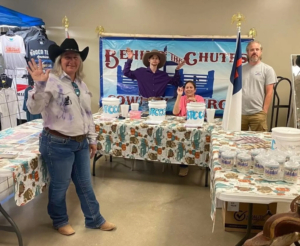
When Steve Belote moved to Amarillo in 2020 to plant and pastor Behind the Chutes Cowboy Church, his love for rodeo and Western culture inspired him to serve as a member on the fair board for the Tri-State Fair & Rodeo.

“I grew up [doing] rodeo. I was a cowboy for a long time [before] I went into the military. So, I had rodeo in me from a young age. And then when I got involved with Cowboy Church ministries, [my love for rodeo] overflowed into it,” Belote said.

Later, in Sept. 2021, Belote encouraged his congregation to get involved in reaching the rodeo attendees for Christ by setting up a booth where church members pass out “literature, handouts, [promotional materials] about the church, and give away Bibles and daily devotionals” that relate the gospel to each rodeo event.

Kay Archer, a Behind the Chutes Cowboy Church founding member, said “everything changed” when she started attending Behind the Chutes.

“I went to churches my whole life, but once I came to the cowboy church, it’s like everything changed … [and I understood that] God is open to all [people],” Archer said.

Since 2022, she has volunteered at the booth. She said each year she is surprised by how curious young people are about Jesus.

“They [say], ‘I don’t know how God is involved in this in the rodeo,’ [and] we just get to talking on that topic, and it just keeps on going and going,” Archer said. “They’re just curious. They want to know [and we get to] plant that seed.”

While his church members man the booth, Belote is behind the chutes, to “take care of the roping boxes and [other needs] back there with the ropers, and then on the other side with the bucking chutes where they have the bucking events.”

He takes that opportunity to “talk to the cowboys [about Jesus] and pray with the [rodeo] clowns.”

“It’s fun trying to put Jesus in a rodeo … [and showing cowboys that] you can worship God anywhere,” Belote said.

Behind the Chutes Cowboy Church’s booth, set up with literature, handouts, promotional materials about the church, and give away Bibles and daily devotionals for church members to engage the Tri-State Fair & Rodeo attendees with the gospel (Texas Baptists photo)

Cowboy church ‘opens up a different door’

Cowboy church ministry “opens up a different door to minister to these [cowboys] where you wouldn’t have a chance with them otherwise,” Belote said.

“You get cowboys back in the back, and they kneel down and pray [before their event]. You pray whether [you’re] religious or not,” Belote explained. “[So, by ministering to them], we’re actually making that door [to get to Jesus] wider.”

Belote recalled how a church member and high school friend, Marty, has been impacted by “the cowboy church movement.”

“I reached out, and he was just getting out of jail again, and we took him in. I got him involved with the ministry, and we got him involved in church, and for the last three years now, he’s been clean. He’s dedicated his life back to Christ,” Belote said.

“If it wasn’t for the cowboy church movement, I don’t think he’d have ever come to Christ.”

Marty volunteers at the church’s Tri-State Fair & Rodeo booth and shares his testimony with those he encounters, Belote said.

“Now, he’s got a purpose, and because he knows that Christ is with him and has helped him get through this, he’s sharing that through [our] ministry, being up there and talking to those guys while he works that booth [at the rodeo],” Belote said.

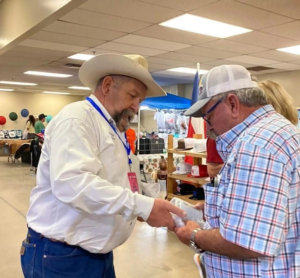
Behind the Chutes Cowboy Church member and volunteer gives Tri-State Fair & Rodeo attendee branded coffee mug (Texas Baptists photo)

Planting seeds, making disciples

Behind the Chutes has grown by having a presence at the Tri-State Fair & Rodeo, Belote said.

“I do get some locals, they come out to church because of [the booth], just to check it out because a lot of people haven’t heard about the cowboy ministry. They don’t know it’s out there,” Belote said. “So, it’s about getting the word out to people [about the ministry].”

Belote shared that another church member and volunteer has particularly contributed to growth.

“She knew a lot of barrel racers. So, with her knowing the people that she knew, she’s able to go [to the rodeo] and work that booth and share the word of Christ with [barrel racers] and bring a few to church that way,” Belote said.

The heart behind the church’s presence at the rodeo is to “go out and make disciples,” he said.

“People think Cowboy Church is just about cowboys. It’s not. It’s about Christ, and it’s about bringing everybody, no matter who they are, [to Christ],” Belote said. “We can’t save anybody, but we can sure[ly] plant a bunch of seeds.”