Texas Baptists announce WatersEdge partnership

Texas Baptists recently announced a new partnership with WatersEdge, formally known as the Baptist Foundation of Oklahoma. 

WatersEdge is a Christian financial services nonprofit connected to Baptist ministries, offering churches affordable accounting, payroll, contribution tracking, financial reporting, and online giving services designed to meet ministry needs. 

Ward Hayes, Texas Baptists’ treasurer and chief financial officer, said churches have been inquiring “about accounting services for a couple of years.” 

“We explored the possibility of establishing a church administration ministry, but in our research discovered WatersEdge. The sustained quality and value they were committed to deliver led us to partner with them for the benefit of Texas Baptist churches,” he said. 

According to a Texas Baptists news release, some churches have reported seeing $5,000 in savings on employee and software costs by switching to WatersEdge Ministry Accounting. 

WatersEdge does not require churches seeking their accounting services to affirm the 2000 Baptist Faith and Message, according to Hayes.

Per the agreement, WatersEdge will not be competing with HighGround Advisors (formally Baptist Foundation of Texas), since HighGround does not offer accounting and payroll services.

The partnership aims to give church pastors and other ministry leaders more time to focus on advancing the gospel while expending less energy and resources on managing their church’s finances. 

“We are thrilled that Texas Baptists is helping us bring our financial services to the thousands of Baptist churches within their convention,” WatersEdge Vice President Sarah Barham said in the news release. 

“We have already worked with a handful of Baptist churches in Texas [prior to the partnership] and found them all to be very solid churches with exceptional leadership. We look forward to expanding our reach even further in the great state of Texas.”

To learn more about the services WatersEdge offers and what Texas Baptist churches are involved in their accounting program, visit WatersEdge.com/accounting or call 800-949-9988. 


Trump administration fights TX, FL challenges to abortion pill

WASHINGTON—The U.S. Justice Department is fighting Florida and Texas challenges to the safety of the abortion pill mifepristone, compounding the Trump administration’s resistance to pro-life challenges by at least four other states.

In the Trump administration’s filings, the Justice Department asked a Texas federal district court on March 13 to either stay or dismiss Florida and Texas challenges to mifepristone, arguing the Food and Drug Administration is reviewing the drug’s safety. 

The federal filing follows the administration’s active attempts to stay or dismiss similar challenges to mifepristone in Louisiana, Missouri, Idaho, and Kansas.

“Given this widespread debate over the safety of mifepristone, FDA has concluded that the best path forward is for the agency to undertake a new review based on the evidence before the agency,” the Justice Department said in its March 13 filing in the U.S. District Court for the Northern District of Texas. 

“At this time, ‘FDA continues to work on the collection of the robust and timely data that is necessary for a well-controlled study with adequate statistical power.”

The Southern Baptist Ethics & Religious Commission said the federal government should allow the state action to proceed.

“Once again, the Trump administration has moved to counter efforts to protect moms and uphold the sanctity of life. This was a disappointing move—the third time it has happened this year,” said Katy Roberts, ERLC senior policy manager. “The DOJ should allow these lawsuits to progress even while the FDA’s safety review is outstanding.”

“Unfortunately, even though an abundance of clear safety data already abounds, the FDA has yet to complete the so-called ‘necessary’ safety review it promised to complete within the year. Whether due to bureaucratic inefficiency or some other reason, staying or dismissing the lawsuit are not conscionable options,” Roberts said. 

The ERLC has long advocated for life, following the will of Southern Baptists.

“Southern Baptists believe that from the moment of conception, every human life is valuable and worthy of protection. It is out of this conviction that we seek to advance the pro-life cause in every possible arena: legislative, administrative, and judicial,” Roberts said. 

“We urge the Trump administration to not turn a blind eye to the precious lives at stake and to allow efforts to protect life to proceed through the courts instead of blocking them,” she continued.

The Justice Department argued in its court filing that the states “suffer no sovereign injury” because they are still free to enforce pro-life policies, and the Justice Department is not preventing the states from enforcing abortion laws against out-of-state prescribers of mifepristone.

Additionally, granting a stay would not inconvenience the states, the Justice Department said, since states have already “waited 25 years to challenge the approval of mifepristone, nearly 10 years to challenge FDA’s 2016 action, seven years to challenge approval of the first generic equivalent, and nearly three years to challenge the elimination of the in-person dispensing requirement.”

“Having delayed so long,” the Justice Department said of the states, they “cannot seriously claim prejudice from the additional time necessary for FDA to complete its ongoing review.”

The complete report is available here.


Parents, Islamic schools sue over Texas voucher program

Three Texas Islamic schools and a group of parents are suing state Attorney General Ken Paxton and Comptroller Kelly Hancock, marking the second legal challenge this month alleging schools for Muslim students have been excluded from the new state voucher program. 

The second lawsuit, filed on Wednesday, March 11, in the U.S. District Court for the Southern District of Texas, says state officials and the voucher program director, Mary Katherine Stout, have been “unlawfully refusing to approve otherwise qualified Islamic schools for participation” in the school funding program and that it constitutes religious discrimination.

The Texas Education Freedom Accounts program, introduced by the state’s Legislature in 2025, created a $1 billion fund for private school financial aid. 

An online platform for parents to start applying opened on Feb. 4 (open through March 17), but none of the state’s accredited private Islamic schools have been listed as eligible for reimbursement through the program.

Exclusion raises concerns

Farhana Querishi, a plaintiff whose children attend Houston Quran Academy, said in a news release the comptroller’s decision to exclude Islamic schools from the program sent a “troubling message” that the state’s Muslim children and communities had fewer rights than other residents.

“No parent should have to choose between accessing a public education program and raising their child in accordance with their faith,” she said.

The dispute over the program comes amid growing hostility from Republican elected officials in Texas toward the state’s Muslim residents and community leaders, which became a focal point in the state’s Republican primaries.

Last week, Mehdi Cherkaoui, a lawyer and Muslim father whose children’s school is excluded from TEFA, also filed a lawsuit against Paxton and Hancock alleging religious discrimination. 

Though Hancock hasn’t commented publicly on the Islamic schools’ exclusion from the program, their absence and past comments he made expressing intentions to exclude them “supports an inference that the School Plaintiffs have been excluded because of their Islamic religious identity,” according to the plaintiffs. 

“While defendants’ silence is formally unexplained, the current posture suggests alignment with recent rhetoric linking all Islamic organizations to ‘terrorism,’” the complaint reads.

Abbott designates CAIR terrorist organization

In December, after Texas Gov. Greg Abbott designated the Council on American-Islamic Relations, a major Muslim civil rights group, a “foreign terrorist organization” and a “transnational criminal organization,” Hancock sent a letter to Paxton, posted on X, inquiring about the legality of excluding schools with ties to “foreign terrorist organizations” and “transnational criminal organizations.” 

The comptroller raised concerns that a private school that had hosted a CAIR event might benefit from the voucher program. He also expressed alarm over the possible inclusion of schools with ties to the communist Chinese government.

The attorney general responded that Hancock’s office had “full, exclusive statutory authority” to prohibit schools from participation in the school voucher program. And both made comments on social media about wanting to ensure the program would not fund schools with ties to Islamic terrorist organizations.

In reaction to a Washington Post story published March 11 about the schools’ exclusion, Abbott commented: “That’s right. We don’t want school choice funds going to radical Islamic indoctrination with historic connections to terrorism.”

Neither Paxton nor Hancock returned RNS’ requests for comments.

The lawsuit argues the comptroller’s decision to bar such schools from applying violates the First Amendment’s free exercise and establishment clauses and the 14th Amendment’s equal protection and due process clauses. Plaintiffs are seeking a ruling halting the exclusion of the schools before the program’s deadline March 17.  

Islamic schools not in application portal

Some parents whose children are enrolled in Islamic schools have entered the program by selecting other schools, while others have refrained from registering, refusing to select a school other than their children’s, the complaints note. After the deadline, the parents who failed to register won’t be considered in TEFA’s lottery, which determines who benefits from the funding. 

“They have created a system where Muslim families cannot even select their schools in the application portal, while thousands of non-Islamic private schools remain approved and eligible,” the complaint reads.

The three school plaintiffs, Bayaan Academy, the Islamic Services Foundation, and the Eagle Institute Excellence Academy, have not received explanation from the comptroller’s office regarding their exclusion, they said in the lawsuit.

The children of plaintiffs Layla Daoudi, Muna Hamadah, and Farhana Querishi are enrolled, respectively, at the Houston Quran Academy, the Islamic Services Foundation, and the Eagle Institute Excellence Academy.

Bayaan Academy, a 1,200-student virtual school headquartered in Galveston County, was initially approved for the program after filling out a Google form put out by the comptroller’s office in December. 

However, it was removed from the list of eligible schools following a news report highlighting it was one of the few Islamic schools included, according to the suit.

In his lawsuit filed on March 1, Cherkaoui, whose children are enrolled at the Houston Quran Academy, also argued the comptroller’s decision violates the First Amendment’s free exercise, establishment, and equal protection clauses as well as the 14th Amendment’s due process clause. 

His lawsuit also seeks a temporary restraining order to prevent religious discrimination before the March 17 deadline.


Muslim schools excluded from Texas voucher program

A Texan whose children attend an Islamic school in Houston sued Texas Attorney General Ken Paxton and Comptroller Kelly Hancock, alleging schools for Muslim students are being excluded from the state’s new voucher program.

The program, introduced by the state’s legislature in 2025, created a $1 billion fund for private school financial aid. But since Texas Education Freedom Accounts opened for applications on Feb. 4, 2026, none of the state’s accredited private Islamic schools have been listed among those eligible for reimbursement through the program. 

The “blanket exclusion of a group of private schools on the basis of their religious affiliation is a clear violation of the U.S. Constitution,” said Mehdi Cherkaoui, a father of two whose children are enrolled at the Houston Qu’ran Academy Spring, a private and accredited school excluded from the program.

Lawsuit filed 

Cherkaoui, a lawyer who represents himself, filed a lawsuit in U.S. District Court on March 1. The suit says the state unjustly targeted these schools, which Cherkaoui noted are “not schools where kids go to memorize the Qu’ran. They learn all subjects … It is done in an Islamic context.” 

In December, after Gov. Greg Abbott designated the Council on American-Islamic Relations, a civil rights group, a “foreign terrorist organization” and a “transnational criminal organization,” Hancock sent a letter to Paxton inquiring about the legality of excluding schools with ties to “foreign terrorist organizations” and “transnational criminal organizations.”

 The attorney general responded by saying his office had full authority to exclude schools from the program.

The comptroller’s letter raised concerns that a private school that had hosted a Council on American-Islamic Relations event might benefit from the voucher program. His letter, posted on X, also expressed alarm over the possible inclusion of schools with ties to the communist Chinese government.

“These circumstances appear to implicate newly enacted laws restricting property ownership, control, and financial influence by foreign adversary entities in Texas,” the letter read.

Paxton justifies TEFA exclusion

In his response to Hancock, Paxton argued the comptroller’s office had “full, exclusive statutory authority” to “prohibit schools from TEFA participation.”

“Let me be crystal clear: Texans’ tax dollars should never fund Islamic terrorists or America’s enemies,” Paxton wrote in the opinion released in late January. “There is no question that the Comptroller’s Office is statutorily charged with ensuring our school choice program is protected from abuse by terrorists or the Chinese Communist Party.”

Neither Paxton nor Hancock returned requests for comments in time for publication.

In January, Hancock announced, “no schools or organizations with ties to the Council on American-Islamic Relations” would receive “Texas tax dollars” through the TEFA program. “Texas tax dollars should never be used to support terrorists or foreign adversaries,” Hancock wrote. 

Hancock has not offered any evidence that all Islamic schools excluded from the TEFA program have ties to CAIR.

The dispute over the TEFA program comes amid growing hostility from Republican elected officials in Texas toward the state’s Muslim residents and community leaders, which became a focal point in the state’s Republican primaries. Abbott has also designated the Muslim Brotherhood as a foreign terrorist and criminal organization, which subjects the group to criminal penalties and allows the state’s attorney general to prompt legal actions to shut the group down.

In his complaint, Cherkaoui writes that Hancock’s decision constitutes religious discrimination and violates the First Amendment’s free exercise, establishment, and equal protection clauses as well as the 14th Amendment’s due process clause. 

Cherkaoui is seeking “a temporary restraining order and a preliminary and permanent injunctive relief” to stop what he describes as religious discrimination before the March 17 application deadline. 

The program, which grants up to $10,474 per student, would have covered the Cherkaoui family’s nearly $18,000 in tuition for their two children. 

Lack of Islamic schools under program

Though opposed to the voucher program for its diversion of public funds to private institutions, Texas state Rep. Salman Bhojani, a Democrat representing several Dallas suburbs, said he is surprised at the lack of Islamic schools on the program’s eligibility list: 

“I didn’t have the intuition, or even the feeling they would exclude Muslim schools,” he said. “I’m an attorney. I thought, ‘How could anybody, and especially lawmakers, blatantly violate our Constitution?’”

Bhojani, the first Muslim and South Asian to serve in Texas’ House of Representatives, called it the latest example of Texas Republicans’ leaning “further conservative and further Islamophobic” as the U.S. midterm elections approach.

Across the state, repeated attacks against Islam have heightened fears among Muslim Texans, he said, adding Muslim constituents reach out to his office to report intimidation.

“They feel like they’re treated like second-class citizens,” he said. “They’re really disheartened by what’s happening.”

Recently, he joined a group of Texas Democratic lawmakers in condemning the treatment of Islamic schools under the Texas Education Freedom Account program. The group argues it threatens to make the state legally liable and imposes an unfair burden on Muslims. Bhojani said he expects other suits challenging the exclusion to be filed in the coming weeks. 

“The [Texas] Legislature did not create this program to be implemented through opaque, one-sided standards or shifting goalposts. … The resulting patterns risk producing a program that is exclusionary and discriminatory in effect, with Muslim schools disproportionately bearing that burden,” the Democrats’ letter read. 

The document noted some schools had previously been approved and later removed without “clear, school-specific notice or articulated actual findings.” On Feb. 4, when applications opened, three Islamic schools were included out of the more than 1,500 schools approved.

The schools—Bayaan Academy, Ameen Academy, and ILM Academy—have since been removed. 


Coalition champions religious freedom in Texas schools

A coalition of organizations across Texas urged families to reject Senate Bill 11, a law allowing school boards to authorize a daily, voluntary period for students and employees to pray or read religious texts. The law was passed during the 2025 legislative session. 

By March 1, school districts were required to vote on whether to adopt these periods of prayer and religious study. 

The coalition encouraged school boards to uphold the separation of religion and government. Nearly all of Texas’ 1,200 school districts rejected S.B. 11, including those who adopted an alternative resolution to uphold existing religious freedoms in public schools. 

“We have had a spate of bad legislation coming out of the last two legislative sessions in Texas that violates the religious liberty not only of our children in public schools, but all of us,” Charles Foster Johnson, Pastors for Texas Children executive director, said.

“None of it is necessary. All of it is crassly and cynically political. It is designed to distract us while billionaire-bought legislators starve our neighborhood schools and privatize them through vouchers,” Johnson continued. 

“This bill fits into a pattern of advancing a certain narrow brand of Christianity at the expense of everyone else. That is why districts overwhelmingly have decided not to adopt it. Texas politicians need to put all this religious posturing in public schools to a full stop, and start doing their sworn duty to fund our free public schools.”

The following organizations partnered in this effort: RAC-TX, Baptist Joint Committee for Religious Liberty, Christians Against Christian Nationalism, American Civil Liberties Union of Texas, American Federation of Teachers-Texas, Americans United for Separation of Church and State, Students Engaged in Advancing Texas, National Council of Jewish Women Dallas, Texas Freedom Network, Texas Impact, Pastors for Texas Children, Faith Commons, and Freedom From Religion Foundation


Communio and Texas Baptists announce partnership

DALLAS—The Baptist General Convention of Texas and national marriage ministry Communio are announcing a new statewide partnership aimed at helping churches care for marriages, support pastors and church leaders, and reach families across Texas with the love and truth of Jesus Christ. 

“At a time when many couples and families are under growing strain, the local church is best positioned to respond not only by preaching the gospel, but by walking alongside people in their most important relationships. This partnership with Communio is timely,” BGCT Executive Director Julio Guarneri said.

Communio is a nonprofit Christian ministry that helps churches strengthen marriages and relationships as a way to share the gospel and build healthy congregations. 

Through data-informed tools, coaching, and relationship ministry programs, Communio helps churches to reduce divorce, renew families, and advance the mission of Jesus Christ. 

According to some research, 54 percent of Texas children are raised by their married, biological parents, meaning nearly half are growing up outside a married home. Additionally, 42.1 percent of all children born in Texas are born to unmarried parents. 

Texas also reports 5.8 marriages per 1,000 residents and 2.1 divorces per 1,000 residents, indicating both continued marriage formation and ongoing marital breakdown. 

Transformation evident

“We have already seen tremendous transformation coming from our partnering Baptist churches in Texas with double-digit increases in church attendance, hundreds of first-time guests, and a number of marriages saved,” JP De Gance, Communio founder and president, said.  

“I am thrilled that this new partnership with the Texas Baptists will give thousands of pastors easier access to our ministry support services. This means many more people meeting Jesus and many more thriving Christian marriages,” De Gance continued.

Ronny Marriott, senior pastor of First Baptist Church in Richardson and past BGCT president, has seen his church and community transformed by partnering with Communio in two different churches he’s led. 

“Engaging Communio as a ministry partner is like adding another staff member with tons of resources, experience, and ideas,” Marriott said.

 “Communio got to know our church, assessed our needs, and developed a fresh approach for us to accomplish our goals. They helped us move this part of our vision farther and faster than we could have on our own,” Marriott added.

Through this joint agreement, Texas Baptists churches will have direct access to Communio’s ministry experts, coaching, and tools.


Texas and Southern Baptists one year into new agreement

Texas Baptists and Southern Baptists are one year into a revised church planting agreement. The new agreement between the Baptist General Convention of Texas and the Southern Baptist Convention’s North American Mission Board took shape in response to questions about funding Texas Baptist church plants.

New partnership process

Under the new agreement, when a BGCT-affiliated church begins the church starting process, it must indicate its desire to partner solely with the BGCT or with the BGCT and NAMB, what is being referred to as the Texas Baptists + NAMB Partnership Pathway.

The Texas Baptists + NAMB pathway is an eight-step process. “The steps include an initial inquiry, beginning the process, discernment and development, assessment, funding approval, entry into the funding process, funding flow, and ongoing development,” Texas Baptists’ Director of Communications Kalie Lowrie said. 

“[The process] can take from three to 18 months from interest to funding approval, and a church will receive funding from both Texas Baptists [BGCT] and NAMB,” she said. 

“Some planters are already on the path, and the [Texas Baptists] church starting team continues refining the structure to serve Texas Baptists well and fully implement this collaboration,” she continued. 

Half a dozen churches are in the initial stages of the Texas Baptists + NAMB Partnership Pathway, Lowrie said. “We will know more after churches have been planted and begin meeting,” she added.

In 2025, Texas Baptists had 101 churches in the Texas Baptists church planting process, including those involved in the Texas Baptists + NAMB pathway. 

Funding strategies

“Texas Baptists have modified funding strategies to mirror the NAMB strategy, regardless of the church planting pathway a planter and their sponsoring church choose to pursue,” Lowrie said. 

When asked how Texas Baptists have mirrored these funding strategies, Lowrie said a fourth year of funding for the Texas Baptists’ track was added, in addition to a digital inquiry form.

Texas Baptists also made additional investments in the church starting program, Lowrie explained. In 2025, Texas Baptists invested $2.8 million in church starting efforts, with an additional $1.1 million given through donor-designated funds and $660,000 through the Mary Hill Davis Offering, for a total of $4,560,000.

Additionally in 2025, BGCT churches sent NAMB $3 million through the Annie Armstrong offering and $2 million through the SBC Cooperative Program, which designates a percentage to NAMB. 

In total, BGCT churches invested $9.56 million in the church starting program in 2025, as confirmed by Texas Baptists’ CFO Ward Hayes.

In September 2024, the BGCT Executive Board passed a recommendation from the Missions Funding Council to increase the maximum amount that may be approved for any new church start from $75,000 to $125,000 to further resource new BGCT-sponsored church starts. 

The agreement between the BGCT and NAMB extends an annual $300,000 grant that supplements the BGCT’s annual investment in church planting. This grant has been in place for almost 15 years. Previously, it included $200,000 for church plants and $100,000 for evangelism. Under the new agreement, all $300,000 are exclusive to church planting.

How church plants are funded

“Texas Baptists provides monthly financial support to church plants for up to four years. The total support a church may receive can range up to $125,000 over that period,” Clay Jacobson, Texas Baptists’ director of church starting, said. “Support is provided monthly for up to 48 months,” he added.

“The exact amount varies by church plant based on its vetted and approved planting plan … rather than a uniform decreasing annual formula,” Jacobson said.

“Texas Baptists Church Starting staff recommends funding amounts for each church plant” to the Mission Funding Council, Jacobson explained. The council has independent oversight and “consists of lay leaders and Texas Baptist ministers, all approved by the Executive Board.”

The council determines and approves the specific annual amount each church plant will receive, and the amount “may vary by church plant,” Jacobson said.

Texas Baptists Church Starting staff reviews and renews the approved amount quarterly over those 48 months. “Any changes to the overall funding of any church plant must go before the Mission Funding Council for approval,” he said.

“Whether BGCT only or BGCT + NAMB, a church plant has access to the same funding levels,” Jacobson said. “These pathways do not determine a church plant’s monthly funding amount. The plant’s strategy determines that amount.”

For church plants supported by Texas Baptists and NAMB, “funding is shared equally” upon approval by both organizations, which includes approval by the Missions Funding Council.

All funds allocated in the 2025 budget for church starts went toward approved church starts, and “all of these projects and churches in 2025 were uniquely BGCT,” Jacobson said.

Training materials available 

“NAMB has provided Texas Baptists with funding strategies, criteria, building blocks, and training in addition to the resources already developed by Texas Baptists,” Lowrie said.

NAMB’s Training Map 3.0 church planting materials and training resources are part of Send Network resources and are made available at no cost under the new agreement between NAMB and the BGCT.

“Currently, the entire Texas Baptists church starting team is certified to deliver” this training, Lowrie said.

Reason for new agreement

The BGCT and NAMB developed this new agreement after a set of comments and discussions about the nature of their church-planting relationship.

During the May 2024 meeting of the BGCT Executive Board, BGCT Executive Director Julio Guarneri explained NAMB would only fund church starts “in Texas who are affiliated with [Southern Baptists of Texas Convention] either singly or dually.”

Guarneri said the reason NAMB gave him was “the BGCT has not adopted the Baptist Faith and Message 2000.”

During the 2024 SBC annual meeting in June, Dustin Slaton, pastor of First Baptist Church in Round Rock, said his church wants to start Southern Baptist churches in Texas in partnership with the BGCT and asked if his church’s financial investment in NAMB would be reciprocated.

In response, NAMB President Kevin Ezell confirmed Guarneri’s earlier comments: “We can partner with your church to plant a church anywhere in North America outside of Texas, because those states do affirm the Baptist Faith and Message 2000.”

“My question has always been back the other way,” Ezell continued. “I would love for you to consider and for your state convention to adopt the Baptist Faith and Message 2000.”

During the 2024 BGCT annual meeting in November, Jeff Williams, pastor of First Baptist Church in Denton, made a motion to “affirm the Baptist Faith and Message 2000. The motion failed.

Through subsequent conversation, a new church planting agreement between the BGCT and NAMB was developed. The BGCT Executive Board approved the agreement in February 2025.

Grateful for continued partnership 

Clay Jacobson, Texas Baptists director of church starting, expressed his gratitude in maintaining a partnership with NAMB: “We are grateful for our partnership … and for the resources they have provided to help strengthen this agreement,” he said. 

“It is encouraging to see churches already moving through the pipeline, and we are committed to working together to plant churches and see lives transformed by the gospel of Jesus Christ,” Jacobson continued.

“Across Texas, every gospel-centered convention and network must rise to the urgency of this moment to reach the more than 16 million people who do not yet know Christ. The greatest missionary moment in Texas is now, and the opportunity before us is too great to ignore,” Jacobson said.

For more information about Texas Baptists Church Starting, visit www.txb.org/churchstarting.


Charles Wade urges ‘holy behavior’

“In classic [T.B.] Maston style, I would urge us to see the both-and. We are to be committed to personal, individual, righteous, and holy behavior. We are not only called to believe. We’re called to behave,” Charles Wade said during the T.B. Maston Foundation Awards Dinner.

Wade, pastor emeritus of First Baptist Church in Arlington, where he was pastor for 23 years, served as executive director of the Baptist General Convention of Texas from 2000 to 2008.

Maston emphasized grace and forgiveness are at the heart of God’s work, Wade, who took the last class Maston taught, said.

“Dr. Maston would insist [ethical] questions are best asked in the context of a person reading the Bible, being taught by faithful teachers and preachers, and praying regularly for God’s will to be done in their life. And though we may not always succeed, there is grace and forgiveness in the heart of God as he shepherds us into Christian maturity,” Wade said.

Maston believed Christians are called not only to personal holiness, but also to social sensitivity “in which a believer seeks to right wrongs and advocate for those who are marginalized, left out, or left behind,” Charles added.

“The church is the continuing incarnation of Christ. We are the body of Christ in this town. Christ is the head, and we are members of his body. We should be doing what he did—worship God, evangelize, disciple believers, minister to the needy, and create a fellowship where all are welcome.”

Maston addressed racism

Maston was urged to address racism because of his faith, Wade said.

“One of his favorite verses was Micah 6:8: ‘What does the Lord require of you? To do justice, and to love kindness, and to walk humbly with your God,’” Wade noted.

“He felt that perhaps his greatest contribution as a Christian ethics professor was in shining a light on racism in our culture. He first addressed the topic in 1927 and wrote about it through the 1930s, when there was still serious conversation about whether Black people were actually human,” Wade said.

“Clearly, it still took a long time—1995—before Southern Baptists finally passed a resolution admitting and repenting our complicity in racism,” Wade continued.

Wade also emphasized religious liberty, urging listeners not to allow the church to be manipulated by the government for persecution or harassment.

“To claim we are a Christian nation, founded as such, … Christians in Europe have been down that road before, and it did not end well,” he said. “Churches began to persecute using the levers of government to punish, harass, drive out, and even kill dissenters, heretics, and infidels, all to the glory of God. It cost them their credibility.”

Wades and Perryman receive ethics awards

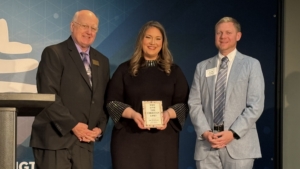
The T.B. Maston Foundation recognized Rosemary and Charles Wade and Skye Perryman for their work in Christian ethics. The recognition was part of the Maston Foundation’s Awards Dinner on Feb. 26 at First Baptist Church in Arlington.

David Morgan, executive director of the T.B. Maston Foundation, Skye Perryman, and T.B. Maston Foundation board member Kyle Tubbs. (Photo/Kendall Lyons)

The Wades, who served churches in Oklahoma, Germany, and Texas, received the inaugural T.B. Maston Legacy Award. Perryman received the T.B. Maston Christian Ethics Award.

Rosemary taught piano, elementary school, and Sunday school, as well as ministering alongside Charles and raising a family. She also served on the T.B. Maston Foundation board.

Perryman, CEO of Democracy Forward, is a Waco native and graduated from Baylor University. She holds a law degree from Georgetown University Law Center. Democracy Forward is a nonpartisan organization promoting democracy in the judicial, legislative, and educational arenas.

Time Magazine named Perryman one of their 100 Most Influential People of 2025.

“We have to remember that the fight for democracy, while it seems global and has global implications, has always been a local fight,” Perryman told dinner guests.

The Maston Foundation promotes the ethical instruction of T.B. Maston, longtime ethics professor at Southwestern Baptist Theological Seminary, through scholarships to graduate students majoring in Christian ethics and undergraduate retreats such as Young Maston Scholars.


Obituario: Santiago “Jimmy” García III

Santiago “Jimmy” García III, líder del ministerio hispano de Baptist General Convention of Texas y pastor durante muchos años, falleció el 18 de febrero. Tenía 76 años. Nació el 17 de julio de 1949. García obtuvo su licencia para predicar en la Primera Iglesia Bautista de Del Río en 1967 y fue ordenado al ministerio evangélico por la Primera Iglesia Bautista de Miles en 1971. Ese mismo año, se graduó de Howard Payne University con una Licenciatura en Biblia y Psicología. Posteriormente, obtuvo una Maestría en Divinidad de Southwestern Baptist Theological Seminary y completó estudios de posgrado en Truett Theological Seminary de Baylor University. En 2001, recibió un Doctorado honorario en Divinidad de HPU. García dirigió el trabajo hispano de la BGCT durante 18 años, trabajando con iglesias, pastores y líderes en todo Texas. Tras su jubilación de la convención, se desempeñó como pastor de la Primera Iglesia Bautista Mexicana en Dallas de 2004 a 2007. A lo largo de su ministerio, se desempeñó como pastor de la Iglesia Bautista Calvario en Fort Worth, la Iglesia Bautista Calvario en Corsicana y la Iglesia Bautista Immanuel en Miles. También sirvió en la Primera Iglesia Bautista en Duncanville. Además, se desempeñó como director de misiones para Del Río-Uvalde Baptist Association y como director asociado de misiones para San Antonio Baptist Association. García también invirtió en la educación teológica. Se desempeñó como instructor adjunto en la Dallas Baptist University y Mountain View College y dio conferencias en Truett Theological Seminary y la Universidad Bautista de las Américas. También formó parte de la junta directiva de BUA y Valley Baptist Academy. En 2018, recibió el Premio al Servicio Distinguido Dr. José Rivas por su liderazgo ministerial. Le sobreviven su esposa de 54 años, Dolores García; sus hijos, Laura, Matthew y Anna; y sus nietos. El velatorio será el miércoles 4 de marzo en Laurel Land Funeral Home, 6300 S. R.L. Thornton Freeway en Dallas, de 9 a.m. a 10 a.m., seguido del funeral de 10 a.m. a 11 a.m. En lugar de flores, la familia ha solicitado que se hagan donaciones al Fondo de Becas Santiago y Delia García en beneficio de los estudiantes de Howard Payne University.


BGCT Executive Board approves CP task force

The Baptist General Convention of Texas Executive Board approved the creation of three new task forces and approved committee and board nominees and two relationship agreements.

In addition to a task force to study possible updates to the BGCT constitution and bylaws and a task force to promote prayer, a Cooperative Program task force will conduct a comprehensive study of the funding mechanism.

The study will include how the Cooperative Program is promoted, how funds are allocated, how churches decide to participate, what is contributing to the ongoing decline in giving, and potential solutions to improve giving.

Keith Warren, executive pastor of Northside Baptist Church in Weatherford, will chair the task force. Other members include:

  • Debbie Potter, BGCT president and children’s pastor at Trinity Baptist Church in San Antonio.
  • Pete Pawelek, Executive Board member and senior pastor of Cowboy Fellowship of Atascosa County in Jourdanton.
  • Delvin Atchison, Executive Board member, African American Fellowship of Texas president, and senior pastor of Westside Baptist Church in Lewisville.
  • Tim Eng, Executive Board member and lay member of Chinese Baptist Church in Houston.
  • Victor Castillo, Texas Baptists River Ministry missionary and pastor of Rio Grande Bible Church in McAllen.
  • Michael Gossett, Executive Board member and lead pastor of Green Acres Baptist Church in Tyler.
  • Del Lopez, lay member of Iglesia Bautista Hispana in Lubbock.
  • Maria Bridwell, lay member of Calvary Baptist Church in McAllen.
  • Dillard Fisher, Executive Board member and pastor of Cross Bearers Church in Copperas Cove.

Committee and board recommendations approved

The Executive Board approved the following nominations to fill vacancies on the Committee to Nominate Executive Board Directors:

  • Dana Moore, Second Baptist Church in Corpus Christi.
  • Monica Followell, First Baptist Church in San Marcos.

The board approved the following nominations to fill Executive Board vacancies:

  • Tedrick Woods, Living Word Fellowship Church in Dallas.
  • Michael Gossett, Green Acres Baptist Church in Tyler.

Annual meeting location

When a reservation at the Henry B. González Convention Center in San Antonio could not be secured in time, the Committee on Annual Meeting recommended the 2028 Family Gathering be held at Kalahari Resorts and Conventions in Round Rock. The board approved the recommendation, sending it to messengers for a vote during the 2026 BGCT annual meeting.

Every fifth year, the BGCT annual meeting is held in July and is called the Family Gathering.

Relationship agreements approved

The Executive Board approved a new relationship agreement between the BGCT and Baptist Hospitals of Southeast Texas. Under the new agreement, the BGCT representation on the BHSET board decreases from 50 percent to 30 percent, which is in line with BGCT agreements with other Baptist hospitals.

The board also approved Baptist University of the Américas’ restated certificate of formation, bringing this agreement in line with other educational institution agreements.

Dustin Slaton, chair of the Institutional Relations Committee, explained the change is from a sole member corporation to no member corporation, which “clarifies legally [BUA is] not owned by the BGCT, run by the BGCT, managed by the BGCT,” though the BGCT still elects BUA trustees.

Other business

The following distributions from J.K. Wadley Endowment earnings were approved, for a total of $475,000:

  • BSM campus missionaries, $150,000.
  • BSM building maintenance, $150,000.
  • Muslin and refugee ministry, $100,000.
  • Western Heritage, $50,000.
  • MinistrySafe, $25,000.

The board approved updates to a set of personnel policies to bring their language into compliance with current statutes and to better care for staff. The policies relate to background investigations, eligibility for benefits, time away from work, flexible spending accounts, and health savings accounts.


BGCT Executive Board restructures, addresses challenges

Baptist General Convention of Texas Executive Board members approved a new board structure to align with recent Texas Baptists’ staffing changes. The board also heard updates on the Texas Baptist Indemnity Program and Cooperative Program receipts, as well as BGCT President Debbie Potter’s first address to the board.

Committee restructuring

With constituent parts of the Center for Cultural Engagement reassigned, a corresponding committee is no longer needed. The Executive Board approved two new committees and a reestablished committee to take its place.

The Christian Life Commission once again has its own committee. Chaplaincy will temporarily fall under the associate executive director.

Affinity Ministries, which includes African American Ministries, Texas Baptists en Español, Western Heritage, and Intercultural Ministries, falls under the purview of the Relational Development Committee. Sergio Ramos, senior director of relational development and GC2 Strong, is the staff liaison.

Texas Baptist Communications and the Cooperative Program office fall under the purview of the Resource Development Committee. Joshua Minatrea, senior director of resource development, is the staff liaison.

The Audit Committee will now fall under the Finance Committee.

Texas Baptist Indemnity Program

Since its start, Nov. 1, 2025, at least 113 churches were enrolled by the end of January in the Texas Baptists Indemnity Program, which partners with KingsCover Insurance Services to provide church property insurance. The total insured value is about $900 million, BGCT Associate Executive Director and TBIP President Craig Christina reported.

The average premium savings has been between 15 percent to 35 percent, Christina said. In addition to reduced premiums, coverages have increased, he added.

The total 2026 premium savings to churches currently enrolled was reported at $1,277,644. These same churches gave $1,646,609 to the Cooperative Program in 2025. Sixty-four of the 113 churches “saved more in premiums than they gave to [the Cooperative Program] in 2025,” Christina reported.

About 600 churches are currently in the application process.

Additionally, Covenant Solutions/Texas Baptists Indemnity Program reimbursed the BGCT around $600,000 of the 2025 start-up costs, Christina said. TBIP partnered with Covenant Solutions, located in South Carolina, to make the church insurance program available nationally.

Cooperative Program

Elaborating on BGCT Executive Director Julio Guarneri’s remarks to the Executive Board on Feb. 23, BGCT Treasurer and CFO Ward Hayes shared an update on Cooperative Program giving.

Cooperative Program giving in 2025 was 97.2 percent of 2024 receipts, or down about $721,000. The shortfall in giving was partially offset by expenses being about $699,000 under budget.

Giving to special mission offerings—Mary Hill Davis, Annie Armstrong, Lottie Moon, and Texas Baptist Hunger Offering—also declined in 2025.

The total decline in Cooperative Program receipts since 2015 is $5 million, or a 17 percent decrease in Cooperative Program giving, averaging a 2 percent decline year over year. Inflation was a compounding factor during the same 10-year period from 2015 to 2025, Hayes said. What $100 could buy in 2015 took $135 in 2025.

In 2015, BGCT endowment income contributed 7 to 8 percent of annual revenue. By 2025, endowment income made up 23 percent of the BGCT’s revenue. Up until last year, investment earnings covered the gap in Cooperative Program decline but are no longer covering the drop, Hayes said.

“Ministry organizations move at the speed of trust,” Hayes said, stating the information shared is not to instill fear but to understand the reality faced by ministry organizations nationwide.

“The Cooperative Program is still the perfect engine to run this cooperative ministry that we share,” Hayes said.

Clay in the potter’s hand

BGCT President Debbie Potter exhorted Executive Board members to stay open to being shaped by the potter, citing Isaiah 64:8: “We are the clay, and you [Lord] are our potter.”

Potter grew up as a “Nazarene pastor’s kid.” She loved being a pastor’s kid and knew at a young age she wanted to marry a pastor because she wanted to be in ministry. She attended a Nazarene college to find and marry a “nice Nazarene man” who would become a pastor.

But it didn’t turn out as she planned. She did meet and marry a “nice Nazarene man” who became a banker. Potter became a public school teacher and administrator. Then, her father lost his ministry, and her family lost their church. She felt lost herself until she and her family found a church home at Parkhills Baptist Church in San Antonio.

Potter discovered her call to children’s ministry there. Parkhills also called her into her first ministry position. She has been a children’s pastor for the last 30 years, now serving at Trinity Baptist Church in San Antonio, and is grateful for Texas Baptists who took her in and gave her a home, she said.

Seeing herself as an unlikely candidate for ministry in a Baptist church, Potter said to “look for the outliers. Always remember, God can and will do extraordinary things with ordinary people if we let him.”

Potter also urged Executive Board members to “stand up for the voiceless.” She thanked those who stood up for her as a woman in ministry. She also expressed her gratitude for the child protection policies in place among Texas Baptists and the Christian Life Commission’s work in Austin.

“God’s design takes time. Stay on the wheel,” Potter concluded.


Texas Baptists ‘are a people of the book,’ Guarneri declares

Deriving principles from Acts 10-11, Julio Guarneri grounded Texas Baptist history in the authority of Scripture: “Texas Baptists believe the Bible. We are a people of the book. Do not let anyone deceive you otherwise.”

The Baptist General Convention of Texas’ history is a source of strength for the convention’s present and future, BGCT Executive Director Guarneri told BGCT Executive Board members during their February meeting.

Reflecting on the convention’s 140-year legacy and the account of Peter’s vision leading to Cornelius’ conversion, Guarneri called for future growth, renewed vision, and increased cooperation.

Formed around cooperation

Noting there were five Baptist groups in Texas in the mid- to late-1800s, Guarneri said the vision of the BGCT’s founders “was one of cooperation for the sake of God’s mission.” Doctrinal conformity was not an organizing principle, he asserted.

“While Baptist distinctives, including sound doctrine, have always been important, the BGCT did not organize around doctrinal conformity,” Guarneri said.

Similarly, the Southern Baptist Convention, formed in 1845, did not have a convention-wide statement of faith until 1925, Guarneri pointed out.

According to a quote Guarneri shared from William W. Barnes, Southwestern Baptist Theological Seminary professor, the 1925 statement of faith was not uniformly adopted by Southern Baptists.

The 1925 statement was revised in 1963 and again in 2000.

Lack of “doctrinal centralization,” as Barnes phrased it in 1934, did not mean Southern Baptists nor Texas Baptists questioned the authority of Scripture, Guarneri explained.

However, during the decades-long Southern Baptist controversy that led, in part, to the 2000 revision of the Baptist Faith and Message, the word “inerrancy” became a litmus test for one’s view of Scripture.

Authority of Scripture

Guarneri directly addressed “chatter” about inerrancy, specifically, the assertion other conventions are committed to inerrancy while the BGCT has “a low view of the authority” of Scripture and that only those who affirm the 2000 Baptist Faith and Message believe in inerrancy.

The words “inerrant” or “inerrancy” are not in either the 1963 or the 2000 statements, Guarneri pointed out, comparing “Article I: The Scriptures” in the 1963 and 2000 statements.

Both versions of the statement, following the 1925 statement nearly verbatim, read:

“The Holy Bible was written by men divinely inspired [and] is a perfect treasure of divine instruction. It has God for its author, salvation for its end, and truth, without any mixture of error, for its matter. It reveals the principles by which God judges us; and therefore is, and will remain to the end of the world, the true center of Christian union, and the supreme standard by which all human conduct, creeds, and religious opinions should be tried.”

Article I of the 1963 and 2000 statements are not identical but are very similar, Guarneri acknowledged. Differences between the two appear in the first and last sentences.

“Those who suggest the conventions and churches who affirm the 2000 version [of the Baptist Faith and Message] are committed to inerrancy, in contrast with those who [affirm the] 1963 [version], are either ignorant or dishonest, because the word [inerrant] is not there,” Guarneri stated.

“I would argue … our commitment to the authority of the Scriptures is higher than others, because we do not elevate man-made confessions of faith above the Bible,” Guarneri contended. “If your conscience is going to submit to anything, let it be to the scriptures of the Old and New Testament, not to a man-made confession of faith. That’s where we stand.”

Cooperation amid polarization

“Today, we are surrounded by a culture of tribalism,” Guarneri said. “People are emotionally invested in their tribe … around politics, or religious beliefs, or ethical issues. … The tendency is to see others that are not in full agreement with me as the enemy and to attack them and to demean them and perhaps even dehumanize them,” he continued.

Sadly, this tribalism has crept into churches, resulting in people making decisions based around labels, Guarneri added.

“We need to be different [from] the culture around us,” Guarneri asserted. “We need to return to our commitment of cooperation.”

Guarneri also addressed declining Cooperative Program receipts, saying the 25-year decline in BGCT Cooperative Program receipts is not unique. The SBC Cooperative Program receipts have been declining for 35 years, he said.

Guarneri attributed the decline, in part, to increased inflation reducing the buying power at the same time costs have increased. Also, churches are sending less Cooperative Program dollars to the BGCT and SBC as their receipts decline and needs and costs increase.

“Our response should be to neither fear nor fixate on the dollars … nor lament the ways things used to be,” he said.

Rather, he proposed four things based on Acts 10-11 for ministries to focus on instead: The biblical foundation for cooperation, the legacy of cooperation as a Baptist people, prayer for God to reawaken churches, and a commitment to collaborate for the sake of the kingdom.

Unity amid diversity

Citing Numbers 2:2, how the Israelite tribes were to camp around the tabernacle, each family under their own banner, Guarneri asserted: “The church today would honor God most and would be most effective with every local congregation retaining their identity, their autonomy, their uniqueness, and recognizing that we together are one body in Christ.”

“We don’t have to agree on everything to be on mission together. We are called to unity in diversity for the sake of God’s glory,” he continued.

“Sound doctrine is important. We must agree on orthodox Christian doctrine. We must hold up Baptist distinctives, but we must give room for diversity in secondary and tertiary doctrines,” Guarneri said, noting Texas Baptist churches differ over Calvinism and Arminianism, end-times views, Communion, and women in ministry.

Though Texas Baptists interpret some of these matters differently, “what is constant is our commitment to the authority, inspiration, sufficiency, and infallibility of the Holy Scriptures,” Guarneri contended.

In all his travel around Texas and meeting with hundreds of Texas Baptist pastors, he has not yet met a pastor in Texas who doesn’t believe the Bible is authoritative and infallible, he added.

“Let us rise up and claim our identity, our legacy as a Baptist people who cooperate together,” Guarneri encouraged Executive Board members. “One hundred and forty years of cooperation for God’s mission, the Great Commandment, and the Great Commission demand it, and the glory of God is worthy of it.”

This report does not follow the exact chronology of Julio Guarneri’s address.