Around the State: Lincoln and the Bible

Houston Baptist University’s Dunham Bible Museum will present a lecture titled “Lincoln and the Bible” by Ronald White Feb. 26 at 7 p.m. White is the author of three books on Lincoln and is a professor of American religious history. The lecture is free.

A free meeting for families interested in domestic or international adoption will be held March 13 at Buckner Children’s Home in Dallas. Participants will learn about the adoption process, fees and children available for adoption. The domestic workshop will be held from 9 a.m. to 12:30 p.m., and the international adoption workshop will be held from 1:30 p.m. to 5 p.m. An application should be filled out online at www.beafamily.org before attending the workshop. For more information, call (866) 236-7823.

Greater Marshall Chamber of Commerce Board of Directors member George Carter (left) and East Texas Baptist University Board of Trustees Chair Hal Cornish (right) looked on as ETBU President Bob Riley cut the ribbon for newly renovated Fry Hall. Fry Hall is a residence hall for men that features apartment-style living.

Tickets for the fifth annual Howard Payne University Women’s Club Yellow Rose Scholarship luncheon to be held March 24 are now available. Humorist Suzie Humphreys will be the featured speaker. Tickets are $15. For tickets or more information, call (325) 649-8006.

The University of Mary Hardin-Baylor will hold a ministers’ forum March 26 at noon in Shelton Auditorium. Carol Holcomb, associate professor in the College of Christian Studies, will speak on “Women, Education and the Missionary Movement.”

Fred and Princess Cameron of Houston have been honored with Baylor University’s 2009 Founders Medal. They both have held leadership positions in various campus-related organizations such as the Baylor Law Alumni Association, Baylor University Women’s Association of Houston and the Houston Baylor Club. He is a past chairman of the Baylor board of regents and received the W.R. White Meritorious Service Award in 2002. They also have contributed to campaigns to build new facilities and supported students through endowed scholarships in law, music and athletics.

Dane Fowlkes has been named director of major gifts at East Texas Baptist University. Following a career as an international missionary, he came to the university in 2000 and has served in a variety of capacities, including his prior position of assistant professor of religion.

Dallas Baptist University has received reaffirmation of its accreditation by the Southern Association of Colleges and Schools.

Anniversaries

Larry Johnson, 25th, as director of missions for Ellis Association, Feb. 1.

Don Wilkey, 30th, as pastor of First Church in Onalaska, Feb. 2.

Tim Trammell, 25th, as associate pastor of Hillcrest Church in Cedar Hill.

Walter Rose, fifth, as pastor of Pecan Grove Church in Oglesby, March 7.

Citibank has donated $25,000 to Baptist Children & Family Services’ west side coffee house, Guadalupe Street Coffee, in support of its mission to encourage local students to stay in school and succeed in their studies so they can go on to attend college. Located in part of San Antonio where fewer than three percent of homes have a computer, Guadalupe Street Coffee is a spot where local students can use free public computers to do homework, study, meet with college advisers and hang out in a safe place.

First Church in Wink, 80th, March 21-22. The two-day event will include music by the Hubbard Family and a catered meal by Kookin’ for Christ Ministry. Former pastors will be honored, and a slide show will commemorate the congregation’s 80 years of service to the community. For more information or to make reservations for the meal, call (432) 527-3831. Richard Ray is pastor.

First Church in Tivoli, 100th, March 28. The Saturday celebration will begin with a 10:30 a.m. service followed by lunch. Former pastors Marcus Gohlke and Robbie Jordan will speak. J.A. Munson is pastor.

First Church in Meridian, 150th, March 29. The program will begin at 11 a.m. with lunch, devotionals and gospel singing. For more information, call (254) 435-6007. Richard Creech is pastor.

Retiring

Ron Horton, as director of missions of Creath-Brazos Association, Dec. 31. Prior to his 11 years of service to the association, he was pastor of Parkdale Church in Corpus Christi, First Church in Cleburne and First Church in Hamilton. He was in ministry 38 years. He is available for supply preaching and interims at (979) 777-3154.

Deaths

R.C. Hester, 88, Dec. 23 in Lubbock. A Hardin-Simmons University graduate, he was a pastor more than 41 years. Among the churches he served were Austin Street Church in Colorado City, Greenwood Church in Midland, County Line Church in County Line, Calvary Church in Friona, Pansy Church in Pansy and Elm Grove Church in Lubbock. He was preceded in death by his first wife, Mary Frances, in 1983. He is survived by his wife, Vergie; son, Rex; daughter, Weldenia Bain; four grandchildren; and five great-grandchildren.

Lila Fae Butler, Jan. 1. A graduate of Baylor University, she was the wife of Will Edd Langford, a Texas, Tennessee and California pastor. After their move west, she was a part of the original music faculty of Golden Gate Seminary, also serving as secretary to the president. She also was dean of women at California Baptist College. She was recognized as the pastor’s wife of the year by the Southern Baptist Convention of California. She was preceded in death by her first husband in 1961. She later married another Baptist pastor, Carl Butler, who also preceded her in death. She is survived by her son, Bruce Langford; sister, Mauriece Johnston; step-daughters, Carol and Nancy Butler; step-son Bill Butler; and grandchildren.

Harold Reeves, 86, Feb. 3 in Lubbock. Reeves was a missionary to Thailand and a Houston-area pastor for about 30 years. A Baylor University and Southwestern Seminary graduate, he and his wife, Rose, were appointed as missionaries to Thailand in 1952. They started two churches and founded an English-language ministry, the Baptist Student Center in Bangkok. He also was the Asian representive of the Southern Baptist Convention Radio & Television Commission in Fort Worth nine years. His career in Houston began in 1974, when he became pastor of Clear Lake Church. In 1980, he was called as pastor of Eastwood Church in the University of Houston area, where he stayed 10 years. From 1990 until 1992, he was on staff at First Church in Houston. He left there to become pastor of Riverview Church, in the southeast part of the city, until 1998. His final ministry position was as chaplain of the Terrace retirement community in Webster. When he left there in 2005, he moved to Lubbock. He is survived by his wife of 60 years; and daughters, Ahnna Parker and Sara Singleton; and four grandchildren.

Events

First Church in La Vernia will hold its sixth annual bluegrass gospel concert Feb. 28 at 6 p.m. The concert will feature the Bailey Family, the Bluegrass Gospel Boys and Blue Creek. For more information, call (830) 253-1239. David Gale is pastor.

Don Piper, author of 90 Minutes in Heaven, will speak at Westbury Church in Houston April 3 at 7 p.m. A love offering will be taken to support Houston-area Baptist Student Ministries. In 1989, Piper was involved in a head-on collision and was declared dead at the scene. Ninety minutes later, he revived. He will share the story of his experiences during the 90 minutes he was clinically dead.

A “Fireproofing Your Marriage” conference will be held April 3-4 at Calallen Church in Corpus Christi. Darin and Caren Griffith will lead the conference which will offer tools to foster relationship building. For more information or to reserve a spot, call (361) 241-4272. Jack Willoughby is pastor.

First Church in Mexia will celebrate the 25th anniversary of its Easter pageant April 3-5. The production will be presented at 7 p.m. nightly and also at 3 p.m. Sunday. As part of the celebration, the church is hosting an alumni banquet at 5 p.m. Sunday between the two performances. To reserve tickets or to make banquet reservations, call (254) 562-5576. Pastor Marcus Sheffield and Minister of Music Marc Wilson have been a part of all 25 productions.

The Heights Church in Richardson will hold its second annual car and motor show April 4 from noon to 4 p.m. Last year, more than 100 vehicles were displayed, everything from a 1926 Ford to a 2008 Aston Martin Roadster. Also included were a collection of World War II military vehicles and an antique fire truck. The cost to show is $10 or 10 canned food items per entry. All proceeds from the day will benefit God’s Food Pantry of Plano. Registration is available at heightscarshow.com. Gary Singleton is pastor.

Ordained

Richard Adams, Jerry Beasley, Steve Bedell, Jeff Ford, Dustin Howard and Tommy Needham as deacons at First Church in Amarillo.

Marc Couch, Valcee Cox, Reg Cranford, A.J. Pirkle Jr., Bobby Sledge and Robert Williams as deacons at First Church in Big Spring.

Revivals

Calvary Church, Mercury; Feb. 22-25; evangelist, Robert Barge; music, Chuck Campos; pastor, Steve Carter.

Fairview Church, Grand Prairie; March 1-4; evangelist, Jim Palmer; music, Bill and Ivy Jean Sky-Eagle; pastor, Carl Allen.

Waddill Street Church, McKinney; March 1-4; evangelist, Robert Barge; music, Jeff Mize; pastor, Woody Wilson.

First Church, Runge; March 8-12; evangelist, Robert Barge; pastor Heath Powers.


SBC Executive Committee postpones vote on Broadway

Lyn Robbins, left, discusses action with Stephen Wilson, chair of the Executive Committee's bylaws work group.

NASHVILLE, Tenn. (ABP) — The Southern Baptist Convention Executive Committee has asked a Texas church to clarify its views on homosexuality before determining whether its toleration of gay members violates a constitutional ban on churches that "act to affirm, approve or endorse homosexual behavior."

A motion referred to the committee by the SBC last June seeks to declare Broadway Baptist Church in Fort Worth "not to be in friendly cooperation" with the denomination.

While the original motion did not state the cause of the action, SBC leaders interpreted it to be in response to news stories about a controversy within the congregation over whether to allow same-sex couples to be photographed together in a church directory. Rather than vote up or down, the church opted for a compromise that used candid photos of members instead of separate family portraits to illustrate the membership.

The full Executive Committee voted unanimously and without discussion Feb. 17 for a recommendation "that the study of whether Broadway Baptist Church of Fort Worth, Texas, should continue to be considered to be in friendly cooperation with the Southern Baptist Convention, and further inquiries and continued communications with the church be made, with the goal of arriving at an appropriate report to the convention at its June 2009 annual meeting in Louisville, Kentucky."

The vote came after long discussions in two subcommittees open to the press under background rules forbidding direct quotation or attribution.

In written correspondence with the Executive Committee, church leaders said members hold a "variety of views" on homosexuality, but the church has not acted in a way that violates the constitutional membership requirement.

Several Executive Committee members said the church's clear declaration that it does not affirm homosexuality seemed in tension with the admission that five of its 1,400 church members are openly gay and two of the five are assigned to a committee.

The Executive Committee asked the church to provide more information about the congregation's views on homosexuality and the church before it reports back to the convention on the referred motion at the SBC annual meeting in June.

Jorene Taylor Swift, minister of congregational care at Broadway Baptist Church, greets Paige Patterson, president of Southwestern Baptist Theological Seminary.

Church leaders appealed to Southern Baptist leaders to help them to get past a number of difficult issues troubling the church, adding that homosexuality isn't one of the major ones.

"We are not a church where homosexuality is a defining issue," church leaders said in a letter. "While we extend Christian hospitality to anyone — including homosexuals — we do not endorse, approve or affirm homosexual behavior."

The SBC, the nation's second-largest faith group behind Roman Catholics, changed its constitution in 1993 to exclude churches that are welcoming and affirming of gays. In the past, the amendment has been interpreted to apply to churches that take some formal action, like ordaining or licensing a gay minister or conducting a ceremony to bless a same-sex union.

In 2006, an SBC-affiliated state convention with a similar policy said a church could be expelled for simply being perceived as affirming homosexual behavior.

The next scheduled meeting of the Executive Committee is June 22, just prior to the SBC annual meeting scheduled June 23-24..

If Broadway Baptist Church is disfellowshipped, it will have implications for four of its active members who teach at Southwestern Baptist Theological Seminary, including the church's choir director and Sunday morning worship leader. Southwestern requires all full-time faculty members to belong to a Southern Baptist church.

"We are pleased that we were received so graciously," Lyn Robbins, a Broadway member and the church's general counsel, said after the vote. "We believe that we are in friendly cooperation with the Southern Baptist Convention. Our purpose here today was to express that and also to share who Broadway is and what we are about."

Robbins said the church members at the meeting would relay the Executive Committee's request for more information back to the church, and he anticipates Broadway will be willing to have more communication.

"Nothing happened today that makes me believe that we cannot reach a conclusion that will be in the best interest of both Broadway and the SBC," he said.


–Bob Allen is senior writer for Associated Baptist Press.

Related ABP stories:

Texas church targeted for ouster from SBC over homosexuality (6/18/2008)

Broadway Baptist votes to retain Brett Younger (3/11/2008)

Fort Worth congregation subject of latest Internet-fueled struggle (2/21/2008)


Baptist, Orthodox leaders hold groundbreaking talks in Europe

PRAGUE, Czech Republic (ABP) — European Baptist and Orthodox scholars convened Feb. 8-11 in talks aimed to promote understanding between two Christian groups often at odds over issues like proselytizing and the separation of church and state.

The International Baptist Theological Seminary in Prague, Czech Republic, was host for the "Christian Mission in Orthodox Context" colloquium. The seminary co-sponsored the event with the Orthodox faculty of St. Clement of Ohrid University in Sofia, Bulgaria.

Planners called the meeting, spearheaded by Parush Parushev, academic dean at IBTS and a Bulgarian, a major initiative for both institutions.

"We are delighted at the developing cooperation between ourselves and St Clement of Ohrid University in Sofia," said IBTS Rector Keith Jones. "It complements the partnership we have had for the past decade with the Orthodox Academy at Vilemov in Moravia on the theology of creation care."

Discussing points of tension 

The aim of the colloquium, attended by more than 30 participants from Orthodox, Baptist, free evangelical and Pentecostal traditions, was to discuss points of tension and opportunities for enriching Christian witness in secularized European contexts with a majority Orthodox religious presence.

"Much of the difficulties and the challenges faced by the baptistic faith communities in the interactions with Orthodox religious communities and the governments of culturally Orthodox countries arise from misunderstandings related to the Orthodox notion of canonical territories (and largely of Orthodox canon law), evangelical emphases on religious freedom and the nature of religious proselytism," said a web page announcing the event.

Other papers discussed social ministries, shared spiritual roots of Russian Baptists and Russian Orthodox and writings of the famed Russian author Fyodor Dostoyevsky.

A press released termed the event "highly successful." At an informal social event on the final night, Jones and Orthodox professor Emil Trajchev exchanged gifts as a sign of the continuing partnership.

Making local connections 

Internationally, the Baptist World Alliance has held preliminary discussions with the Orthodox Ecumenical Patriarchate in Istanbul, but formal dialogue has not yet been inaugurated. Baptist and Orthodox scholars and church leaders have begun to make such connections in local contexts, however.

Baptist leaders in Russia recently applauded the election of Metropolitan Kirill as primate of the Russian Orthodox Church as "a clear vote for openness and dialogue." Leaders of the Russian Union of Evangelical Christians-Baptists said Kirill, who directed the church's ecumenical relations for 20 years, fully supported the dialogue and fraternity with Russia's Protestants started by his predecessor, Patriarch Alexei II, who died in December.

In visits to Russia and the Republic of Georgia in 2008, BWA General Secretary Neville Callam asked Orthodox representatives for cooperation in facing secularism and ministry to the poor and marginalized.


–Bob Allen is senior writer for Associated Baptist Press.


Wayland senior defines future, call with semester in Africa

PLAINVIEW – Jessica Riemersma has believed since she was a young girl that she would one day visit Africa. She just didn’t know exactly when that would be.

So, when Wayland Baptist University afforded her the opportunity to spend a semester there doing mission work, she knew it was meant to be.

Wayland senior Jessica Riemersma (right) and her missions partner Heather Williams enjoy a relaxing camel ride during their debriefing retreat in Africa. (PHOTOS/Courtesy of Wayland Baptist University)

A senior biology major from Glendale, Ariz., Riemersma recently returned from West Africa as a semester missionary through a partnership involving Go Now Missions of the Baptist General Convention of Texas and the International Mission Board.

While the application process took only a few months, God’s preparation for Riemersma’s Africa experience covered several years.

Jessica recalled that she first felt the call to ministry in Africa when she was about 10 years old.

“We had missionaries from Mozambique visit our church, and they would come back often to tell us what God was doing there,” she said, adding that over the years, several other encounters with African culture kept the dream alive of traveling there one day.

While at Wayland, she began exploring missions opportunities and considered applying for the summer of 2007. Since her parents lacked a peace about overseas travel then, she chose not to apply. But she started praying then for the people group she might have been working with.

When applications for summer 2008 came out, she again started researching available assignments. When her mother suggested semester missions, she looked even further and found the Hands on Africa program that hit nearly every country on the continent.

“It really jumped out to me,” she said. “I don’t know why, but I had this feeling I had to go there.”

Jessica Riemersma, along with her mission partner Heather Williams, spent months discipling a man known as “Dad,” a new believer who could not read the Bible himself.

Riemersma chose an assignment that involved relational evangelism. In short, missionaries become immersed in the culture, learn the language and build relationships with native citizens in order to open doors to presenting the gospel.

While she worked in Africa, that assignment often involved Bible storying—a chronological storytelling technique to share events from the Bible with people unfamiliar with the gospel message. The curiosity of the people who listened to the stories opened doors to further opportunities to share the gospel, often well outside cultural norms.

“One day, I got to share the gospel with 15 men at one time, and that is just unheard of in African culture,” she said.

Riemersma and her missions partner, University of Kansas student Heather Williams, often used New Testament passages, mostly because they had another resource for Africans curious about hearing more. The village had a radio device called a Proclaimer, and it played the New Testament in the peoples’ native tongue.

One major part of their assignment was continuing to disciple an older man they referred to as “Dad,” a patriarchal figure in the village. The girls read to him from Galatians and other passages and walked him through the journey of growing in his faith.

Jessica Riemersma of Wayland Baptist University spends time with village children in an effort to better learn the native language for her semester in Africa.

The student missionaries enjoyed participating in the wedding of one of Dad’s daughters, which involved much African tradition and community participation. But some African traditions were a little harder to accept.

“People would sometimes come to our door at all hours, screaming our names and wanting us to come outside,” she said. “They were so fascinated with white people, and sometimes we had to lock our doors just to have some personal time alone and with God.”

Despite the cultural differences, Riemersma said she felt at home in the country and learned many lessons about herself and about ministry.

“I think I automatically loved the people and embraced them because I had been praying for them for so long. But I don’t know that I really knew how to love them at first,” she said.

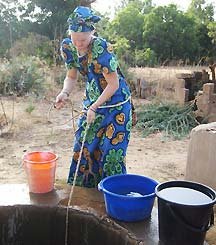
Jessica Riemersma puts her muscle into drawing water by buckets from a water well for the bath of an African woman she befriended while serving as a semester missionary in West Africa. 

“I had to learn to be completely selfless and give of myself to them, everything that First Corinthians 13 said to do. I couldn’t be rude to them since I was there to serve them. I had to understand what real unconditional love entails.

“It takes every ounce of your being to love someone, and I couldn’t do it without God’s help. I learned a lot about being available for people and not having my own agenda.”

Another lesson involved honing her career plans to fit a call to ministry, whether that takes her overseas again or elsewhere. Before the semester, she was leaning toward physical therapy, but now nursing seems a more appropriate fit since it would require less schooling and would open doors on the mission field.

“I just realized there that my sole purpose in life is to tell people about Jesus. That’s what brings me the most joy,” she said. “It scares me to say that I’d do full-time missions, because it’s a huge sacrifice. But I know if I’m not doing what God called me to do, I’ll never be happy.”


Kay Warren: Following Christ means being ‘seriously disturbed’

WACO—Becoming a disciple of Jesus Christ means being willing to say “yes” unconditionally to God, knowing he likely will lead his followers into uncomfortable places, Kay Warren told a group at Baylor University.

For Warren, it meant becoming a global advocate for people with HIV/AIDS, for orphans and for other marginalized and vulnerable groups.

Her husband, Rick, is pastor of Saddleback Church in Lake Forest, Calif., and author of The Purpose Driven Life.

Kay Warren described her transformation from a “suburban mom” and pastor’s wife to global activist for orphans and advocate for people with HIV/AIDS. Warren talked with participants at The Next Big Idea conference at Baylor University. (BAYLOR PHOTOGRAPHY/Robert Rogers)

Accepting Christ’s invitation to deny self, take up a cross and follow him means being “dangerously surrendered, seriously disturbed and gloriously ruined,” she told The Next Big Idea conference, an event sponsored by Baylor’s School of Social Work, Truett Theological Seminary and the Leadership Network.

Warren told participants both at a conference plenary session and workshop how she became “seriously disturbed” a few years ago by reading an article about AIDS in Africa.

“The article said there were 12 million children in Africa orphaned by AIDS. And I couldn’t name a single one of them. There were 33 million people with AIDS. And I couldn’t name a single person who was HIV-positive,” she said.

“It rocked my world. It was a pivotal moment when I said ‘yes’ to God, and he broke my heart. It turned my life upside-down.”

That kind of “signpost moment” happens when a Christian becomes “so broken by brokenness, so disturbed, that you feel like you can’t live with it another second,” Warren explained.

Discipleship also means allowing Christ to “gloriously ruin” one of his followers for the normal life he or she knew before, she added. Warren explained for her, it meant transformation from “a suburban mom with a minivan” to an outspoken advocate for HIV-positive people worldwide.

“The pursuit of the American dream in and of itself will ruin you. Pursuit of health, wealth and happiness will ruin you. And so will following Christ. If you’re going to be ruined, why not be ruined for something that matters—something that lasts?” she asked.

Being “gloriously ruined” means following the example of Christ to “take on pain that isn’t our own,” she said. In Warren’s case, one of the first and most memorable examples involved an encounter with an HIV-positive woman who was living—and dying—under a tree because she had been expelled from her village.

“Nothing in my faith had prepared me to talk to a dying, homeless woman living under a tree,” she said. “Nobody should have to die alone.”

Being a disciple of Christ means doing what Jesus did—“making the invisible God visible” and caring for “the least, the last and the lost,” Warren said.


Contact with global partners gave church expanded vision

WACO—When Lynne Hybels and her husband, Bill, started a church in suburban Chicago 33 years ago, they had two dreams. As a young pastor, he wanted to plant the kind of church where people who were far away from God could be reconciled to him. As a social worker, she wanted to develop a community of faith who wouldn’t be afraid to confront “the messiness of life.”

Willow Creek Community Church in South Barrington, Ill.—now one of the nation’s largest and most influential megachurches—combined those two visions by ministering to the spiritually broken people God led to their congregation and by expanding its outreach to meet needs and confront injustice internationally.

Lynne Hybels told participants at The Next Big Idea Conference how Willow Creek Church, near Chicago, became transformed through its global partnerships in developing countries. (BAYLOR PHOTOGRAPHY/Robert Rogers)

Through its global partnerships with churches in Latin America and Africa, Willow Creek gained a deep sense of responsibility to mediate God’s love to hurting and oppressed people, Lynne Hybels told participants at The Next Big Idea Conference at Baylor University. Baylor’s School of Social Work and Truett Theological Seminary jointly sponsored the event in conjunction with the Leadership Network.

Willow Creek ventured into caring ministries incrementally, she noted. The church began by offering recovery ministries, support groups and other programs for troubled people who came to the church who “who needed the compassion of God mediated to them through caring people,” she said.

Next, the church began extension ministries—entering partnerships with other churches, groups, social-service agencies and organizations already meeting needs in the communities around Willow Creek.

The most significant step of faith involved entering partnerships with churches internationally—first in Latin America, later in Africa—that were transforming their communities.

Rather than going to churches in developing nations and presuming to have all the answers, Willow Creek learned from those indigenous Christians and was inspired by their selfless devotion, she stressed.

“We were transformed by our global partners,” Hybels said.

Contact with Christians around the world has affected the way Willow Creek members view news reports about war, poverty, disease and suffering around the world, she added.

“We are all part of the human family,” Hybels said. “Every member of the family is as important to God as you are. … If there is tragedy anywhere in the world, it is touching my family.”


‘Next big idea’ an old idea that looks radically different

WACO—The “next big idea” actually is 2,000 years old, but it has “moved and morphed” into something quite different than what Americans and Europeans have known.

“The church is the next big idea—much bigger than we imagine,” said Michael Stroope, associate professor of missions at Baylor University’s Truett Theological Seminary. “But it’s not where it used to be, and it’s not where it once was.”

Stroope addressed The Next Big Idea conference, an event sponsored by Baylor’s School of Social Work, Truett Theological Seminary and the Leadership Network.

“We need to redraw our ecclesiastical maps,” Stroope said. About 100 years ago, 81 percent of the Christian church was of Anglo-Saxon heritage. Now, 60 percent of the global church is African, Asian or Latin American, he noted.

David Garland (center), dean of Truett Theological Seminary and Baylor University’s interim president, and Mike Stroope, associate professor of Christian missions at Truett, visit with participants at The Next Big Idea Conference. (BAYLOR PHOTOGRAPHY/Robert Rogers)

The growth center of Christianity has moved to the developing world, Stroope said. In Africa, people are turning to faith in Christ at a rate of 23,000 a day, and in Latin America and Asia, churches are “bursting at the seams,” he reported.

“The church is more diverse than what we think,” he added. “The church is more dynamic and vibrant than we think.”

Unlike the missionary movement of the last couple of centuries, Christianity today is spreading due largely to migration—often forced migration due to war and poverty, he observed.

“Migration is the new mission. Refugees are carrying the gospel with them,” he said.

Christians in the United States can learn important lessons from their brothers and sisters in the developing world, but it requires a shift from a mindset of Christendom, colonialism and “the church as corporation,” Stroope insisted.

“Instead, we must move toward the church as cruciform—living toward the cross, giving ourselves away,” he said. “We must move from benevolence to brotherhood and sisterhood, from security to risk and from our rights to what is right.”

Stroope urged what he called “transmergence”—a coined term he defines as “crossing over to another who is radically different in a way that is transformational to both parties.”


Service central to becoming an externally focused church

WACO—Chase Oaks Church in Plano and LifeBridge Christian Church in Longmont, Colo., minister 817 miles apart. But they stand side-by-side in their response a devastating question-and-answer.

Q: If their church evaporated, would anybody outside the church notice?

A: Probably not.

Eric Swanson of the Leadership Network discusses the characteristics of externally focused churches with participants at The Next Big Idea Conference at Baylor University. (BAYLOR PHOTOGRAPHY/Robert Rogers)

Glen Brechner, pastor of leadership at Chase Oaks, and Rick Rusaw, senior minister at LifeBridge, acknowledged the pain of that answer. But they told participants at the Next Big Idea Conference at Baylor University their response also revolutionized their churches.

Baylor’s Truett Theological Seminary , the Baylor School of Social Work and the Leadership Network sponsored the conference on the Baylor campus Feb. 9-11. It brought church leaders and academic researchers together to discuss how congregations could make a difference in their communities.

Both Chase Oaks and LifeBridge were successful churches by conventional standards, Brechner and Rusaw recalled. They enjoyed vibrant worship, pulled members together into meaningful small groups, and operated a plethora of programs.

“But we were an internally focused church,” Brechner acknowledged. “We had lots of programs. We were a really busy church. Our church was healthy, … but so focused on the church that it did not effectively reach the community and meet community needs.”

Leaders at LifeBridge had a hunch they were in the same predicament. That prompted them to pose the question that became “the turning point for our church,” Rusaw reported. “We asked, ‘If our church disappeared, would anybody miss us?’”

The realization that they made little impact outside their own membership alarmed leaders at both churches, Brechner and Rusaw said. So, both congregations decided they must serve others—for the very existence of the churches, the benefit of their communities and the fulfillment of God’s kingdom.

Their response places them within an emerging trend, noted Eric Swanson, a staff member of Leadership Network who works with “externally focused” churches.

“God is taking the church and placing it back in the community,” where it can make a difference in the lives of all kinds of people, Swanson observed.

Churches exist in a context that involves three key variables, he said. They are the needs and dreams of the city, the callings and capacities of the church, and the mandates and desires of God. Service is the “sweet spot” where all three of those variables intersect, he added.

Rick Rusaw, senior minister at LifeBridge Christian Church in Longmont, Colo., told participants at The Next Big Idea conference how his congregation reached a turning point by asking, “If our church disappeared, would anybody miss us?” (BAYLOR PHOTOGRAPHY/Matthew Minard)

The place where the interests of the church and God overlap is where salvation takes place, where individuals come to know Jesus as their Savior, he said. And the place where the mandates of God and the needs of the city overlap is called “common grace”—where the overall welfare of the community is served, such as police and fire protection.

To illustrate those two areas of overlap, Swanson cited 16th century church reformer John Calvin, who observed: We pay taxes to provide for common grace, and we pay our tithes to support saving grace.

The point of overlap exclusively between church and city is a sensitive zone, where struggle for control can exist, Swanson said. This is why separation of church and state is important, so that one does not dominate the other, he added.

But the “sweet spot”—the place in the middle, where God’s mandates, the city’s dreams and the church’s capabilities all intersect—is service, Swanson said.

“That’s where churches serve and bless their cities,” he noted. Churches’ ministry to the needs of people in the community achieves “the things God wants, the city wants and the churches can do.”

The trend toward service is bubbling up from within churches, explained Diana Garland, dean of the Baylor School of Social Work, and a prolific researcher of American church life.

The Church Census, which studied more than 100 congregations across 15 years, asked families to tell how their church can help them, offering almost 50 options from a variety of aspects of family life, she said.

“Help in serving others outside our family” was the No. 1 request in every age category, except for couples in their 20s and 30s, whose greatest desire is help for developing strong marriages, Garland said. And even for those younger adults, “serving others outside our family” ranked second.

That strong desire to serve others transcends family types, from families headed by married couples, to remarried couples and divorced singles, she said.

“The most interesting challenge for the church is to offer guidance and support for families … that are grounded in the beliefs and values of the Christian faith,” Garland said. “Only the church can ground these life issues in Christian values and practices. … These families are asking their churches to ground their service in Christian mission.”

That’s exactly the track taken by Chase Oaks and LifeBridge churches.

LifeBridge’s mission is to “help people know Christ, grow in Christ and live gracefully,” Rusaw said. Chase Oaks disbanded most of its programs and focused members on “connecting to God, connecting to people and connecting to need,” Brechner added.

Both congregations re-tooled their standards for members, stipulating they are expected to attend worship (LifeBridge’s “know Christ” and Chase Oaks’ “connecting to God”), participate in small groups that study the Bible (“grow in Christ”/“connecting to people”) and serve others (“live gracefully”/“connecting to need”).

But service transcends the categories, Rusaw indicated, noting, “We believe you grow best when you serve.”

Chase Oaks conducts four churchwide ministry projects per year. But it also serves on a smaller, more direct and more continuous scale, Brechner said. Each adult life group is expected to have a “bridge”—an ongoing human-needs ministry in the community. During every fourth meeting, each life group meets at its bridge and serves non-members in the community.

Similarly, LifeBridge has linked its small groups with 54 partner organizations in its community—from schools, to nonprofit groups and other social-service organizations.

In fact, LifeBridge intentionally avoids starting ministries, because that would waste resources and pass up opportunities to build relationships outside the church, Rusaw said.

“We won’t start something that already exists,” he said. “The church has one thing that every agency in your community needs—people. They need volunteers. So, the church is not the competition (to nonprofits, schools and social-service groups). Partner where you can partner.”

Often, the church’s service not only meets the felt needs of the community, but it also reaches deeper to transform lives. For example, through LifeBridge’s service in public schools, hundreds of teachers and coaches and administrators have come to faith in Christ, Rusaw reported.

That relates to something Swanson has seen as he’s worked with externally focused churches: Good deeds prepare the way for people to hear the good news of Christ.

But externally focused, service-oriented churches are, like Christ, committed to meet people’s needs, whether or not they respond spiritually, he noted.

“Evangelism is or ultimate motive, not our ulterior motive,” he said. “We always want people to come to Christ, but even if no one comes to Christ, we’ll still keep doing these acts of service.”

So, service improves lives, strengthens churches and changes communities, Swanson said.

Referencing Jesus’ Great Commandment, he added: “Spiritual transformation occurs when people are loving God with all their heart, soul, mind and strength. Societal transformation occurs when people are loving their neighbors as themselves.”


Why serve? Most Christian volunteers say it’s a God thing

WACO—A Baylor researcher has confirmed what many church nominating committees and volunteer coordinators have suspected. Christians age 50 and older volunteer for service because they believe God wants them to do it.

Dennis Myers, associate dean for graduate studies in Baylor University’s School of Social Work, reported his findings during a workshop the social work school sponsored in conjunction with Truett Theological Seminary and the Leadership Network.

Researchers surveyed 7,500 people in 35 churches nationally, and conducted in-depth follow-up interviews with 25 volunteers from those churches—most of them age 50 or older.

Truett Theological Seminary’s worship band lead in song at The Next Big Idea Conference.

Most volunteers, in general, find motivation for service in a search for significance, recognition or guilt reduction. But research reveals Christians tend to volunteer as a response to God, whether they express it in terms of obedience to divine commands, a way of showing gratitude for blessings, a call to service, a sense of giftedness for a task or a desire to share their faith, Myers noted.

Christian volunteers also cite as reasons for service relationship benefits—both with recipients of ministry and other volunteers—and personal benefits such as a sense of “making a difference” or “feeling good” about what they do.

Myers recommended seven ways to invite and nurture volunteers age 50 and older:

Embrace God’s perspective. Recognize service as a sacred act and volunteers as God’s instruments. “God is at work through ordinary people,” he said. “It’s a matter of tuning in and realizing when people walk into our presence, God is walking up.”

Mediate sacred transactions. Rather than just filling positions, help to link people in search of God’s purpose together with needs and opportunities.

Broaden the definition of 50-plus volunteers. View homebound senior adults not only as recipients of ministry, but also as a volunteer pool who may be able to pray, send cards or make phone calls. Recognize that age 50-plus caregivers who may be tending to an ailing spouse or aging parent or rearing a grandchild already are in a position of service.

Listen for the calling. “Take the time to hear people’s stories,” Myers said. People are more effective and fulfilled when they are serving in a place where they feel called by God.

Explore the faith and service connection. “Faith grows because of service. It’s transformational,” he said.

Celebrate what God is doing. Draw attention to God instead of people. Rather than embarrassing workers through a volunteer recognition service, give volunteers the opportunity to give testimony publicly about how they see God at work.

Create contracts. Formal written agreements may not be necessary, but clearly define expectations and make clear the time-period involved for a volunteer commitment.


Debt retirement feels like “stimulus package” to church leaders

WICHITA FALLS—It wasn’t loaves and fishes, but dollars and cents the congregation of First Baptist Church in Wichita Falls brought together. The result was still astounding—the payment of $8.4 million in debt in seven months.

“The great thing was the whole church contributed. I’m not going to tell you that every single person in the church contributed, but it truly was a churchwide effort. It wasn’t one of two people writing a check, but a church coming together in a common purpose. Our people who have been financially generously blessed gave generously. But those who didn’t have a lot to give still contributed what they could,” Pastor Bob McCartney said.

That sense of community and ownership also struck Minister of Media Rod Payne. “In this day and age, for something like this to happen is truly incredible,” he said.

{youtube}WdTzc-CggfI{/youtube}
First Baptist Church in Wichita Falls, Texas, paid off the last $8.4 million debt on its $23 million worship center at the end of 2008.

“And the really neat thing is that many people were able to give because they made changes in the way they lived to enable them to give. Some gave the money they had been using to go out to eat. Others gave up other things to give themselves the opportunity to give. To see people make these lifestyle changes, that was what was really impacting,” Payne said.

Challenged to "level the mountain" 

The campaign began last April when Interim Pastor Bill Anderson challenged the North Texas congregation to “level the mountain.”

“The church got behind that,” said McCartney, who was called as the church’s pastor in June. And now the church can pursue new ministry ventures with the $365,000 a year that was going into debt retirement.

Church planting is one of things the church is working toward, along with a variety of ministries outside the church, especially in low-income neighborhood

New college minister 

“One of the things we did immediately was add a college minister to our staff,” McCartney said. “When I came here, God gave me a burden for Midwestern State University, and we’re going to reach out to the students there.”

While the money came from the pockets of the people in the pews, Payne gives God all the glory.

“It’s not a thing where we’re saying, ‘Hey, look at us,’ but that the sovereign God of the universe saw fit to give our church a stimulus package,” he said.


Simple steps lead to ‘next-level’ ministry to communities

WACO—Churches can strengthen the ministries they provide to their communities by taking five key steps, ministry specialist Amy Sherman told participants at the Next Big Idea conference at Baylor University.

The “next level” of ministry effectiveness is attainable by:

Moving from commodities to relationships.

Benevolence ministries become frustrating when they focus merely on giving people things but do not develop relationships, said Sherman, a senior fellow at the Sagamore Institute for Policy Research and director of the Center on Faith in Communities.

Participants sing during the Next Big Idea conference at Baylor University.

A good way to break past this barrier is to ask benevolence recipients, “Is there something you would like to learn or change that would help you in avoiding your problems?” she said.

One church that sponsored a food and clothing closet asked this question and learned people in their neighborhood needed tutoring, English-as-a-Second-Language training and ministry for their children while they shopped in the food pantry, she said.

The new ministries provided opportunities for friendship that enriched lives.

Moving from emergency relief to betterment and development.

Rather than merely run a soup kitchen, a church can turn it into a jobs-training program by hiring some recipients of the ministry as kitchen apprentices, Sherman suggested.

Engage more of the congregation in ministry.

“Use small groups in your church to engage more people in ministry,” she said. “Community service is in the DNA of what small groups should be about.

“And don’t just leave it up to them. Prepare (local service-provider) partners that are willing to use volunteers in their work.”

She describe how a church choir participates in a local Christmas store for low-income families, a men’s Bible study class “adopts” boys who need male role models, and a Mothers of Preschoolers program created a parallel MOPS program for teen mothers.

Get more strategic in collaboration.

Second Baptist Church in Springfield, Mo., wanted to make a difference in its community but realized the task was too big for one church alone, she reported. So, they invited participants from other churches to meet for breakfast once a month and also invited local leaders, such as the mayor and sheriff, to “come and talk about what the churches could do to improve the city.”

Ultimately, the churches banded together to conduct a citywide tutoring program. They ensure that every third grader in Springfield will learn to read, because learning to read by that stage in a child’s life is a key indicator in whether she or he will drop out of school later.

Move from ministering “to” to ministering “with.”

“Ask people about their dreams for their community,” Sherman said. “And recognize the people … we’re trying to reach have gifts, too. Work with them.”


It takes a village to renew community and build healthy society

WACO—On a corner lot in Shreveport, La., where dealers once sold drugs, flowers bloom and vegetables grow in a community garden. More significantly, a sense of community has blossomed in the Allendale neighborhood after neighbors recaptured an ancient idea—the village.

Mack McCarter, a Disciples of Christ minister, returned to his hometown in northern Louisiana about 15 years ago after 18 years serving churches in Texas. He wanted to see if he could help renew community, one neighborhood at a time.

Mack McCarter, founder of Community Renewal International, made friends in Shreveport’s Allendale neighborhood, enlisting some residents to become block leaders and designate their homes as Haven Houses. (PHOTOS/David Westerfield/Community Renewal International)

He did, and in the distressed neighborhoods where residents have adopted his approach to community renewal, crime has dropped more than 40 percent.

McCarter, founder of Community Renewal International, presented his systematic approach to neighborhood renewal at The Next Big Idea Conference, an event at Baylor University sponsored by Baylor’s School of Social Work , Truett Theological Seminary and the Leadership Network.

When he was still serving a church in the Texas Panhandle, McCarter began to think about community renewal by asking five questions:

• What kind of world does God want?

• What kind of society makes possible that kind of world?

• What kind of people makes possible that kind of society?

• What kind of environment makes possible that kind of person?

• What do we have to do to make that kind of environment possible?

The first question was the easiest, he decided. God wants a world where people love their neighbors as they love themselves. But in a society where many people don’t even know their neighbors, answers to the other questions proved more elusive.

Workers with Community Renewal International work alongside neighborhood residents in a Fuller Center for Housing “building blitz” in Shreveport’s Allendale area.

“People are disconnected, and that disconnection has opened the door to massive dysfunction,” McCarter said.

The kind of “others-centered” person who can nurture a loving society must be both competent and compassionate, he decided.

“Competent people have the willingness and ability to access and appropriate resources outside themselves which enable them to grow—skillfully, socially, spiritually, physically, intellectually and emotionally,” he said. “Compassionate people live a lifestyle devoted to seeking the good of others as one seeks his or her own good.”

He began to study social systems, trying to discover what kind of society would make possible a world where people love their neighbors. Philosopher Elton Trueblood, historian Arnold Toynbee and social analyst Lewis Mumford shaped his understanding of how and why civilizations develop, decline and ultimately collapse.

As he studied the varied ways people have built civilizing structures, he discovered only one societal model has endured for millennia.

“Only the village has never failed,” he concluded.

McCarter sees the village as a caring community built on a foundation of mutually enhancing relationships. Once the relational foundation is in place, members of the village make sure other needs are met, such as safety, housing, meaningful work, health care and education.

Residents of a poor Shreveport neighborhood work in the Allendale Garden of Hope and Love, a community garden that occupies a vacant lot once frequented by drug dealers.

With his theoretical paradigm for community renewal in place, McCarter set developing structures to turn theory into reality. He began by going into one Shreveport neighborhood, looking for people who were willing to make friends with people in their block.

“I figured out of 300,000 people in Shreveport/Bossier City, about 1,000 want to hurt other people. The rest care about other people. But society won’t be saved by individual random acts of kindness. The key is connecting caring people,” he said.

McCarter began connecting the willing by enlisting them in his “We Care Renewal Team.”

Members of the team—who now number 39,000 in Shreveport/Bossier city—agree simply to identify themselves as caring people who want to develop friendships with their neighbors.

Community Renewal also designates Haven Houses—a private residence inhabited by a block leader who agrees to spend one hour a week, three weeks a month intentionally getting to know people and connecting them with each other through events such as block parties.

Finally, Community Renewal has developed Friendship Houses, also called “Internal Care Units,” in high-crime areas.

“We move in missionaries who live in these Friendship Houses. They go there to serve and win the trust of their neighbors, starting with children and youth,” McCarter explained.

The Friendship Houses serve as community centers where after-school tutoring programs, adult education classes and other programs are made available. In time, they also become places where neighbors care for each other’s needs.

From Shreveport/Bossier City, the community renewal program has been replicated in 20 other cities around the United States, as well as an international pilot project in Camaroon.

The Pew Partnership for Civic Change gave McCarter’s community renewal model its “Solution for America” designation, and the White House Conference on Community Renewal cited it as a “Best Practice Model.” Community Renewal International received the Social Entrepreneurship Initiative Award from the Manhattan Institute.

While Community Renewal leaders appreciate the national attention, they particularly value the opinions of people who have seen them up-close for years. The organization’s website includes an endorsement by Caddo Parrish Sheriff Steve Prator: “I applaud what you are doing and the pillars you stand on. There is now peace and quiet in areas that were once No-Man’s-Land, and that’s refreshing.”