Supreme Court: Sect can’t force Utah city to erect monument

WASHINGTON (ABP)—In a groundbreaking free-speech case, the Supreme Court said the city of Pleasant Grove, Utah, can’t be forced to accept the gift of a monument to a small religious sect’s precepts—even though the town already displays a donated monument to the Ten Commandments in its city-owned Pioneer Park.

But in Pleasant Grove City v. Summum, the opinion of a unanimous court also made clear the decision turned on whether the Decalogue monument was government speech or private speech—not on the religious content of the speech itself. That means the existing monument could be open to a challenge under the First Amendment’s Establishment Clause, which bans government endorsement of religion.

The court’s decision overturns an earlier one by the 10th U.S. Circuit Court of Appeals. A panel of the lower court had said the sect, called Summum, has as much right to erect a monument in the park as the Fraternal Order of Eagles did in the 1960s, when it donated the Ten Commandments monument.

Leaders of the sect, based in nearby Salt Lake City, asked Pleasant Grove officials in 2003 to display the monument to the “Seven Aphorisms of Summum,” which the 33-year-old group says were handed to Moses on Mount Sinai along with the Decalogue.

The courts long have established that government entities providing public forums for private speech—such as speakers’ corners in city parks—cannot discriminate in what sorts of speech are allowed. But the Supreme Court said the Ten Commandments monument and other privately donated displays in the park have effectively become government speech, and therefore, the city can refuse to endorse some messages.

Some supporters of church-state separation, including the Baptist Joint Committee for Religious Liberty, had filed a friend-of-the-court brief urging the justices to take up the church-state issues the case raised.

“Because of the peculiarities of Tenth Circuit jurisprudence, Summum couched its legal claims principally in the language of free speech and viewpoint discrimination,” the brief said. “The proper locus of its complaint is, however, the Establishment Clause—which the Founders intended to serve as the principal bulwark against the government’s resort to rank denominational prejudice.”


Arts and crafts mean more than fun and games at San Angelo church

SAN ANGELO—Nobody ever accused First Baptist Church in San Angelo of being a single-interest congregation—unless that interest is seeing people come to know Christ as Savior.

Bringing the congregation’s varied interests into a single-minded focus of reaching others was the idea of June Doerr, who thought of using hobbies as an evangelism tool almost 20 years ago.

Women in the jewelry-making class at First Baptist Church in San Angelo enjoy the fellowship as much as the challenge of creating fashion accessories.

The idea didn’t gel then, but last fall, she presented the idea to Associate Pastor Ronnie Laughlin, who affirmed it and arranged for space for the Reaching Others Through Arts and Crafts ministry.

“The whole idea was to fellowship and do whatever it is that you do, and through that reach some people we might not reach otherwise,” she said.

Classes have included calligraphy; oil, pastel and watercolor painting; jewelry making; card making; woodworking; knitting and crocheting; and games such as 42, mahjong and bridge.

“It’s really nice,” Doerr said. “We have a lot of new faces, and people move around from one area of interest to another and learning different things. We’ve even had one homeschool student who has this time as a part of his curriculum,” she said.

“The reason we call it ROTAC is because we left ‘Baptist’ out of it so that we could reach people throughout the community,” Doerr explained.

“We have several people who come from other churches and at least three who don’t go to church anywhere.”

Before each class begins, the group gathers for a prayer circle—an important time for many participants, Doerr said.

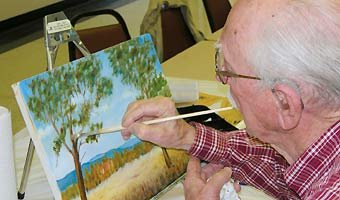
Jesse Kidd learns oil painting techniques at the Reaching Others Through Arts and Crafts ministry of First Baptist Church in San Angelo.

In addition to learning and refining various skills, the group also has been used for ministry projects. Several in the group are making place cards for First Baptist’s upcoming Annie Armstrong Easter Offering meal. In the past, the group has made bookmarks to be taken to homebound members of the church.

Jesse Kidd, a 30-year missionary to Brazil who has lived at Baptist Memorials Ministries in San Angelo 19 years, took up oil painting in December. Teacher Jo Anne Chandler, says he is learning the techniques quickly.

He, too, is pleased with his progress as an artist, but “I really just enjoy doing this,” Kidd said. “And we have such a good time together.”

Chandler agreed the painting was secondary. “It’s a real good fellowship time, and we really enjoy praying for each other. I love to paint, but mainly it’s the fellowship. It’s a relaxing time, and I really enjoy being with Christian friends.”

Although she is not a member of First Baptist, Lola Newman also has found a place to restore her soul.

“I love the camaraderie and the social aspect, but also the peacefulness. And I’m learning to do something I’ve always wanted to do,” she said.

Several—like Ovida Jackson in the jewelry-making group—have lost spouses and find companionship in the group.

“I truly enjoy the fellowship, but I also just like doing something with my hands. I lost my husband a year and a half ago, and this gets me out of the house,” she said.

The ministry can be done anywhere, Doerr noted. The group has no budget—everyone has their own supplies. All that was needed was a place to meet.

And for some, it might be where they meet Jesus.


From prison to presidency? Lyons seeks National Baptist Convention comeback

WASHINGTON (RNS)—Henry J. Lyons, former president of the National Baptist Convention, USA, who was imprisoned on charges of fraud a decade ago, is one of two candidates running to be the group’s next president this September.

The other candidate, Julius R. Scruggs of Huntsville, Ala., confirmed he and Lyons are the two certified candidates announced at the convention’s mid-winter meeting.

Lyons resigned from the presidency of the historically black denomination in 1999 after being convicted of swindling millions from corporations wanting to market products to church members. He was released from prison in 2003.

Lyons could not be reached for comment, nor could the church’s current president, William J. Shaw, who is completing his second five-year term.

Scruggs, the vice president-at-large of the denomination, declined to address his feelings about Lyons’ run and past imprisonment, saying, “I have no comment on that.”

To become certified, candidates for the denomination’s presidency had to turn in letters of support from 100 churches by Jan. 1, he said.

Lyons is pastor of New Salem Missionary Baptist Church in Tampa, Fla. His new presidential run is not his first attempt to regain a position in his denomination.

In 2007, he ran again for the presidency of the Florida General Baptist Convention but was defeated.

Cheryl Townsend Gilkes, professor of African-American studies at Colby College in Maine and an assistant pastor of a Massachusetts church with ties to the NBCUSA, said it would be inappropriate for Lyons to lead the denomination again.

“If the National Baptist Conven-tion wants to be relevant in the 21st century … they need new leadership,” she said.

“While we forgive him, we embrace him and we love him and he stumbled and made a mistake—and people do make mistakes—sometimes, as Paul says, everything is lawful but not everything is helpful. His becoming president … again would not be helpful.”

Scruggs, the pastor of First Missionary Baptist Church in Huntsville for more than 32 years, said he is running in hopes of expanding the mission work of the denomination beyond Africa and other locations.

“Some of our individual churches do mission work in Haiti,” he said. “I’d like to see our convention have a presence there.”

Scruggs also said he’d like to see the denomination develop a public policy commission to better address issues such as health care and public education.


Texas Hope 2010: Harleton church reaching out to neighbors

As part of Texas Hope 2010, members of Oak Grove Baptist Church in Harleton are reaching out to their neighbors.

Each member of the church is praying by name for someone whom they know either is not connected to a church or is not a Christian, said Pastor Mike Midkiff. As they pray, members are looking for ways to build relationships with those they are praying for and looking for opportunities to meet specific physical, emotional and spiritual needs.

“Oak Grove voted unanimously to be a part of Texas Hope 2010. After all, this what the church is commissioned to do,” Midkiff said. “I have asked the members to pray daily for someone they know personally who is not connected to a local church or does not have a life-changing relationship with Jesus. As they are praying for these individuals, do not be surprised if the Lord brings the person before them at the grocery store, basketball game or in a restaurant. We need to be ready to minister to those whom we are praying for in tangible ways that show that we care and love them.”

Later in the year, the church plans to train members how to effectively share their faith with people for whom they are praying, Midkiff said.

“Texas Hope 2010 made me realize that in my four years as pastor of Oak Grove I have not led the church in teaching them how to share their faith in Christ,” he said. “I am looking forward to teaching how they can use their own life-changing experience with Christ to be used by God to present the gospel to the one they have been praying for to receive Christ as Savior.”


Fairness Doctrine still dead, but groups worry about possible return

WASHINGTON—A move to require broadcasters to provide equal time to all sides of controversial issues has religious radio programs worried, even though no formal proposal has been introduced and the White House likely wouldn’t support it.

At issue is the idea of reinstating the Fairness Doctrine, which policed public airwaves from 1949 to 1987 in hopes of giving voice to all sides of an issue. The Federal Communications Commission scrapped the policy when it was judged ineffective and a possible violation of free-speech rights.

Although fears about a resurrected Fairness Doctrine have circulated for years, concern grew in recent months after Democrats won the White House and solid majorities in Congress.

Two Senate Democrats—Debbie Stabenow of Michigan and Tom Harkin of Iowa—both recently made comments to radio host Bill Press about reinstating the Fairness Doctrine.

That’s enough to worry Tom Minnery, senior vice president of government and public policy on Focus on the Family Action. Focus on the Family founder James Dobson built his career on the airwaves; Focus programs reach 220 million listeners in 155 countries, according to the group.

“The idea that serious politicians would try to take a huge bite out of the First Amendment takes my breath away,” Minnery said. “I hope they try it, because I believe this is a fight they cannot win, and it will expose the liberal element for what it is—highly intolerant.”

Michael DePrimo, special counsel for the Mississippi-based American Family Association, said reinstating the Fairness Doctrine would quell Christian talk radio.

“We wouldn’t want to run another program with a contrary viewpoint. That would defeat the purpose of our ministry,” DePrimo said. “It would be very problematic for us to give equal time to those who do not share our religious beliefs.”

What’s more, Ashley Horne, a federal policy analyst for Focus on the Family, said the Fairness Doctrine would gut Christian programming of any Christian content touching on controversial issues.

“They would rather not air a topic on abortion or homosexual marriage because that would require them to air time on a group that violates their beliefs,” she said.

Still, all the talk about resurrecting the Fairness Doctrine is just that—the idea has yet to gain serious traction on Capitol Hill, at the FCC or the White House. In fact, President Obama is skeptical about the need for a renewed Fairness Doctrine.

“As the president stated during the campaign, he does not believe the Fairness Doctrine should be reinstated,” White House spokesman Ben LaBolt told FOXNews.com.

Even some liberal groups, including the Washington-based Center for American Progress, don’t support the Fairness Doctrine.

“Simply reinstating the Fairness Doctrine will do little to address the gap between conservative and progressive talk …,” the center said in a position paper.

In addition, legal scholars aren’t sure the Fairness Doctrine would survive a court challenge—never mind the thorny legislative and political process of reviving it.

“I think there are some significant hurdles to adoption,” said Gene Policinski, vice president of the First Amendment Center of the Freedom Foundation.

Even so, religious broadcasters are nonetheless rallying their supporters to keep the Fairness Doctrine dead. The American Center for Law and Justice, a conservative law firm founded by religious broadcaster Pat Robertson, has collected 230,000 signatures in support of the Broadcaster Freedom Act, introduced by Rep. Mike Pence, R-Ind., which would prevent the Fairness Doctrine from returning.


Carter: Christians have duty to pursue peace in Holy Land

WASHINGTON (RNS)—Former President Jimmy Carter’s recent book, We Can Have Peace in the Holy Land: A Plan that Will Work, reviews the contributions of past U.S. presidents toward peace in Israel and Palestine, and advances his hopes that President Obama might be able to complete the task.

Members of Hamas security forces sit in front of anti-Israel graffiti in the northern Gaza Strip. (PHOTO/REUTERS/Mohammed Salem)

The 85-year-old Nobel Peace Prize winner talked about the spiritual, as well as political, issues surrounding the quest for peace in the Holy Land. Some answers have been edited for length and clarity.

Q: What do you say to fellow evangelical Christians who believe peace won’t come to Israel until Jesus returns, that what you suggest is a kind of fool’s errand?

A: Well, that’s a prediction with which I don’t agree, because you may be talking about 1,000 years or 100 years—nobody knows. The Bible says nobody knows when the time will come. You cannot just assume that we have to have war and suffering and strife and persecution for hundreds of years. That’s not what the Bible says, and that’s not what Jesus intended, for people to suffer until he comes back. …

What a lot of Christians forget is that we worship the Prince of Peace. We don’t worship the Prince of War or Strife or Hatred and Animosity or Persecution or Suffering. As a Christian, my duty is to bring peace, particularly to the Holy Lands.

Q: Why do you believe you were successful in brokering peace between Israel and Egypt?

A: Because I took a balanced position. I was neutral between Israel and the Arabs, and it was an extremely unpopular thing to do because all of the political figures in America are 100 percent for Israel. If you are in Congress—both then and now—and you say anything critical of Israel or supportive of the other side, you are looked upon as unworthy to hold public office.

As president, I was pretty much impervious to pressure from any side. And I think that is the role that Obama has assumed for himself. In fact, (Special Middle East Envoy) George Mitchell is already under attack from some of the Israeli supporters just for being “neutral” or “balanced.”

Q: How does this particular moment in time hold a new and different opportunity for President Obama in bringing a lasting peace to Israel and Palestine?

Former President Jimmy Carter

A: It’s new and different because of him and because he was willing to address the issue forthrightly. He’s willing to start working on it the first day he’s in office, which is the same thing I did when I came into office—and not wait until the last year he’s in office.

I think (Obama) will take full advantage of what Theodore Roosevelt called the “bully pulpit.” With his intelligence and with his eloquence, he’s able to put to the American people the reasons why he takes stands or actions that might otherwise be more controversial or even criticized.

Q: Is there a spiritual appeal that can be made not just to Christians but also to Jews and Muslims in that part of the world that you haven’t heard lately?

A: I think so. There’s not any real difference among the three major religions concerning their commitment to peace and the alleviation of suffering or moral values. All of us share the same basic moral values, and I think peace is an integral part of the scriptures of all three major religions.

Q: If you had a chance to speak to fellow evangelicals about the importance of this issue right now, what would you say?

A: I’d point out that the ones that have been persecuted most harshly in the West Bank and Gaza have been the Palestinian Christians.

When I first went over there in 1973, 15 percent of all the Palestinians were Christians, but they’d been forced out at a much more rapid rate than the Palestinian Muslims. Now there are only about 50,000 Palestinian Christians left in Palestine. About half of them are in Bethlehem itself. And Bethlehem has now been completely surrounded by a high Israeli wall.


Baptist Briefs: Peace activists gather in Rome

Baptist peace activists gather in Rome. Between 300 and 400 Christians attended the Global Baptist Peace Conference in Rome. Sponsors of the 2009 gathering included the Italian Baptist Union, Baptist Peace Fellowship of North America, International Ministries of American Baptist Churches USA, Evangelical Baptist Church of Georgia, Baptist Union of Great Britain and the Cooperative Baptist Fellowship. Anna Maffei, president of the Italian Baptist Union, spoke about the effects of violence on children. Gustavo Parajón, a Baptist pastor and physician in Nicaragua, described trauma in his country resulting from conflict between the Sandinista government that led Nicaragua between 1979 and 1990 and the Contra forces who opposed them. A leader in mediation efforts between the two parties, Parajón talked about the church’s nonviolent witness that helped transform armed conflict into peaceful resolution.


Disaster relief workers busy in 2008. More than 83,000 trained Southern Baptist disaster relief volunteers responded to about 50 disasters during 2008, preparing 7.9 million meals and logging 119,000 volunteer days. Volunteers also completed 9,300 chainsaw jobs, 2,427 mud-out jobs and 295 roofing assignments, cared for about 1,200 children and purified 247,000 gallons of water, according to a report compiled by the North American Mission Board.


NAMB commissions its largest group. The North American Mission Board conducted the largest commissioning service in its history when 144 missionaries and chaplains were sent forth recently at First Baptist Church in Rincon, Ga. They represented 29 state Baptist state conventions, the Canadian National Baptist Convention and the Convention of Southern Baptist Churches in Puerto Rico and U.S. Virgin Islands.


Church planting website streamlined. The Southern Baptist Convention’s North American Mission Board church-starting website had an extreme makeover. The site—www.churchplantingvillage.net—has been streamlined, updated and made more user-friendly. The new site is readable and navigable in nine languages—English, Spanish, Korean, French, Arabic, Chinese, Hindi, Russian and Vietnamese. German and Portuguese will be added soon. The site includes a resource library with church planting-related topics such as administration, assessment, church plant models, church planting fundamentals, communications, marketing, doctrine/theology, finances/stewardship and a list of vendors for needs like websites, purchasing equipment and hiring consultants.


SBC registration opens. Registration for messengers and local hotels is open for the June 23-24 Southern Baptist Convention annual meeting at the Kentucky Exposition Center in Louisville. Churches can register their messengers online at www.sbc.net to avoid waiting at the counter upon arrival at the convention. By registering online, the SBC website gives a church a messenger reference number form to be printed out and presented by each messenger at the SBC registration booth in exchange for a nametag and a set of ballots. The appropriate church-authorized representative must complete all online registrations. The traditional registration method also is available for those churches that are unable or may not opt to access the online registration. Registration cards are available from state convention offices.


School offers “bright hope” to children in Ethiopian village

BANTU, Ethiopia—This year, impoverished children in one Ethiopian village have something they’ve never known before—hope for the future.

Getahun Tesema, director of Buckner Ethiopia (right), poses with Ethiopian President Girma Wolde Giorgis at the inauguration ceremony to celebrate the opening of a new school in Bantu, Ethiopia. (PHOTOS/BUCKNER)

Children attending the Bantu school, founded by Buckner International and Bright Hope, receive two meals a day, two school uniforms, daytime clothing, shoes, schoolbooks and supplies, personal hygiene materials and medical treatment.

“The people in this community earn about $11 a month,” said Bright Hope project manager Nebiyou Tesfaye. Isolated on a muddy dirt road, the community is occupied by farmers, walking barefoot with large bales of crops on their backs, and dozens of small children.

Ethiopian President Girma Wolde-Giorgis gave the land in Bantu to Buckner in 2006 to build the school for the community. But it’s much more than just a school.

“We are the ones who provide them with food, showers, soap, drinking water, clothes, shoes, vaccinations, everything,” Tesfaye said.

At the school, 200 children ages 4 to 7 learn everything from math to English in eight classrooms.

After morning classes end, all the children line up single file with their hands on each other’s shoulders to walk across the way to the dining hall. There they receive their largest meal of the day—a bowl of rice.

In addition to studying English, Amharic, math, phonics and other subjects, children also receive food, clothing and medical treatment at the Bantu school. (PHOTOS/BUCKNER)

Café manager Fikru Gebremariam said most of the children do not have food at home.

“Food is important for the children because it builds their bodies and makes them strong,” he said.

Marta Admasu, the principal of the school, explained the community’s growing excitement since the school opened.

“We are experiencing great happiness at this time. The children have food, soap, shoes, toothbrushes, clothing. Because of this, they feel very happy.”

In addition to education, Tesfaye said, they help the community by “teaching them about sanitation and how to prevent disease and infection.”

A child at the Bantu school leads his class to recite the English numeric system. (PHOTOS/BUCKNER)

Future plans for the school include building a house for guests and mission teams who choose to work with the children short term. They also hope to give the school “international” status, teaching American and British curricula, along with others, to promote future growth opportunities for students. The school’s ultimate goal is for every child to go to college.

“We desperately need books for the teachers and for the students,” Tesfaye said. “We need workbooks and educational books. If we want them to go to college, they need to read.”

Kyle Henderson, pastor of First Baptist Church in Athens, is part of the Buckner E-Team, a group of churches that helped support construction of the new school project and attended the inauguration in February.

Two years ago, he stood on an empty field with a group of pastors and the president of Ethiopia in the same location where a thriving school and community center resides today.

“I got to stand in a completed school with hundreds of children being reached,” Henderson said. “They recited English letters, numbers and animals. In just a few months, these kids have moved from dirt floors and no teaching aids to qualified teachers, in excellent facilities, and a new future.”


Lanny Hall to return to Hardin-Simmons as president

ABILENE—Hardin-Simmons University trustees elected as their school’s president Lanny Hall, president of Howard Payne University in Brownwood and a past president and chancellor at Hardin-Simmons.

Hall will be the 15th president in Hardin-Simmons’ 118-year history, returning to the university where he started as a student more than 40 years ago and where he served a decade as president.

“Dr. Hall knows and loves the school and has an exciting vision for enhancing its academic excellence and facilities,” Trustee Chairman Hilton Hemphill said. “He has extensive experience in fundraising and in the financial management of a university.”

Hall

Lanny Hall

Hall began his administrative career in higher education in 1986 as executive vice president and chief academic officer at Howard Payne, leaving there to take over the reins as president of Wayland Baptist University in Plainview.  

Hall served as president at Hardin Simmons 10 years before being named chancellor in 2001.  As chancellor, he held the Haggerton Chair of political science and served as executive director of the HSU Institute for Leadership.

During his administration, Hardin-Simmons more than doubled in endowment and experienced growth in enrollment, academic programs and campus facilities.  

Under his leadership, the university added numerous new campus buildings, including the Skiles Social Sciences Building and the Connally Missions Center.  

“Carol and I love the work in which we have been engaged over the last 20 years,” Hall said. “We welcome the opportunity to put all of our experience, ability, talent and energy to work again for Hardin-Simmons University.”

The presidential search committee and the search advisory committee jointly evaluated numerous candidates who were identified from across the country. The committees included trustees, faculty, staff, members from various HSU boards and the HSU student body president.  

“Personal interviews were conducted with the top 10 candidates with more in-depth visits with the four finalists,” Hemphill said.  

Hall was a member of the Texas House of Representatives from 1979 to 1984 and served in key government leadership positions at the national level.
Hall earned his Ph.D. in educational administration from the University of Texas in Austin in 1985.

He and his wife, Carol, have two children—Lana McCutchen and Chad Hall—and three grandchildren.

“With an understanding of HSU’s history and heritage, and with abiding respect for the solid fiscal foundation that the University enjoys today, I look forward to the high privilege of leading HSU,” Hall said.

Hardin-Simmons began looking for a new president shortly after Craig Turner left last summer to accept the presidency at Catawba College in Salisbury, N.C.


School sued for censoring religious message

NASHVILLE, Tenn. (ABP) — An elementary school in Mt. Juliet, Tenn., is being sued for censoring the word "God" out of posters promoting a student-led prayer event.

A lawsuit filed March 3 by the Alliance Defense Fund said administrators at Lakeview Elementary School ordered students and parents either remove signs promoting a "See You at the Pole" event or edit out religious language. With too little time to redo the posters, parents in the suit complied by covering the phrases like "In God We Trust," "Come and Pray" and a theme Bible verse with green paper.

Filed on behalf of 10 parents and the children, the lawsuit claims school officials violated the plaintiffs' First Amendment rights both by limiting their free speech and establishing hostility toward their religion. It seeks injunctive relief, nominal damages and curt costs.

Here's one of the posters at the center of the lawsuit. (ADF)

It isn't the first time the school has landed in hot water over religion. Last year a federal judge ruled the school unconstitutionally endorsed religion by allowing a group of parents to pray in the school cafeteria and pass out fliers to students during school hours. 

U.S. District Judge Robert L. Echols ruled that such accommodation excessively entangled the school with religious purposes of Praying Parents, a loose-knit organization of parents who gather to pray for the school. Echols said the constitution demands that public schools be neutral toward religion and that by promoting the group administrators effectively promoted its religious views.

Echols said students could still make flyers for "See You at the Pole," though. School policy allows such posters as long as they contain a disclaimer that the event is not sponsored by Lakeview.

For that reason, some members of the Praying Parents group said they were astonished last September when a school employee told them that posters their children made could not be displayed because they contained the word "God."

The parents obscured the religious phrases as directed but later complained about what they viewed as censorship and an attempt to belittle their religion. They said their children want to participate in future public prayer events but now fear reprimand if they do.

"Christian students shouldn't be censored for expressing their beliefs," Alliance Defense Fund Senior Counsel Nate Kellum said in a press release about the lawsuit. Kellum said school officials "appear to be having an allergic reaction to the ACLU's long-term record of fear, intimidation and disinformation" with regard to religious expression in public schools. 
 
Brent Walker, executive director of the Baptist Joint Committee for Religious Liberty, said he sympathizes with school administrators attempting to negotiate complicated church-state issues amid competing voices, but based on what he knows about the case, "It looks to me like the school clearly overreacted" by censoring religious content altogether.


–Bob Allen is senior writer for Associated Baptist Press. 


Updated: Baylor presidential search committee named

WACO—Baylor University Regents Chairman Howie Batson named 14 current members of the school’s governing board to a committee charged with searching for the university’s next president and 10 representatives of various Baylor constituencies to a nonvoting advisory committee.

Last fall, the Baylor Faculty Senate, the Baylor Alumni Association and Baylor Student Government each passed resolutions urging regents to include as voting members of the presidential search committee representatives from Baylor’s constituent bodies, but Batson chose an all-regent search committee.

baylor statue“We’ve been respectful of the spirit of the resolutions,” Batson told reporters in a March 5 conference call. “They wanted to be included. They wanted to be heard.”

But ultimately, according to accrediting agencies and Baylor’s governing documents, regents alone hold responsibility for selecting the university’s chief executive officer, he concluded.

Faculty, alumni, students respond to announcement

“It’s not the process we would have preferred. That’s obvious from the resolution we passed. But it is the process we have,” said Georgia Green, chair of the Baylor Faculty Senate, who was named to the advisory committee.

Green pledged to do her best to provide input into the search process on behalf of faculty, adding, “No president at any university can be successful without the support of the faculty, and that’s certainly true at Baylor.”

Baylor’s presidential search is the “number one issue” on the minds of alumni and donors—particularly the need to have “a process that is as inclusive and transparent as possible,” Baylor Alumni Association President David Lacy of Waco said. “This is what alumni and donors want, and it’s paramount to the future of Baylor in finding the most-qualified leader.”

The Baylor Alumni Association wants what is best for the university—including finding the most-qualified president to lead the school, Lacy stressed.

“Although it was our request that all constituents would be given a voting role in the final selection, … (the Alumni Association) is committed to continue working toward finding the most qualified leader,” he said. “We know from talking to alumni, that Baylor’s alumni desire inclusiveness, transparency and increased communication in this search process. These are the top priorities for alumni and donors for a successful process, …(the Alumni Association) will remain vigilant in advocating for these priorities.”

“We believe strongly that the best outcome for Baylor is achieved if the voices of all the stakeholders are formally voiced and factored into the process of finding the most-qualified president. The board of regents could have furthered its commitment to an inclusive process by giving all stakeholders an official, voting role in the process. The historically supportive Baylor alumni donor base that we represent clearly remains supportive of the most open and inclusive search process possible. This process has been proven to be effective in many other higher education institutions, and significantly enhances the communication and trust between all the stakeholder groups.”

A Baylor Student Government leader expressed disapproval regarding the lack of student voting representation on the search committee.

“We are disappointed with both our selection to an advisory role and the level of student representation on the advisory committee. The board has signaled—through its selections—which constituencies it considers priority, and the committee’s composition appears to suggest that students are not at the top of that list.  Students have proven both the ability and desire to contribute input in the presidential search and were handed a significantly diminished role,” Student Body President Bryan Fonville said.

“Communication between the board and Student Government was minimal in the lead-up to this decision.  Throughout this process, we were fully cooperative, hoping that we might be met with the same level of cooperation and consideration.  That was not the case.

“The board was provided with the opportunity to select both an undergraduate and a graduate student, which has become the norm at top-tier universities.  With the selection of two students—undergraduate and graduate—the concerns of both student constituencies would be more fully represented.”

“As the representative organization for Baylor’s student body, we simply want what’s best for Baylor.  And, what’s best for Baylor is what’s best for students.  Today’s announcement is not in the best interest of both Baylor and its students.”

Batson noted he researched the presidential search policies of at least 20 universities, but determined there is no single procedure followed across-the-board.

But Lynn Tatum, immediate past-president of the American Association of University Professors, took issue with the process the regents are following.

“The Baylor process does not conform with best practices at the nation’s top universities,” said Tatum, senior lecturer in religion and associate director of Middle Eastern studies at Baylor.

“The usual process is to have a search committee composed of a rough parity between regents and faculty, with a few other representatives such as students and/or staff,” he said, citing as examples Yale, Rice, Duke, Cornell, Stamford and Princeton universities.

“A few schools will have a committee made up entirely of faculty, working in tandem with a regents’ committee,” Tatum added, pointing to MIT, Cal Tech and Harvard as examples.

At the Baylor board’s February meeting, regents charged Batson, pastor of First Baptist Church in Amarillo, to establish the committees. He issued an invitation to all regents not rotating off the board after its May meeting to participate in the presidential search, and 14 accepted an appointment to the committee. Tommy Bowman of Waco was the lone returning regent who declined a seat on the search committee.

Bowman “did not believe that his work schedule would permit the time that this effort is likely to require,” said John Barry, Baylor’s vice president for marketing and communciations.  “As a board member, he will still have a vote on the final candidate, but Tommy felt that he shouldn’t agree to serve on the presidential search committee if he couldn’t guarantee full participation.”

Committee chairs outline goals

Joe Armes, chief operating officer of Hicks Holdings in Dallas, will chair the search committee, and Ken Hall, president of Buckner International, will chair the advisory committee.

Batson praised Armes as “an accomplished senior executive who is very committed to Baylor’s 2012 vision and (who) has served in many leadership roles during his eight years on the board of regents.” He praised Hall for his “long and distinguished record of accomplishment in Baptist life” as a pastor, agency head and denominational leader.

“Both have demonstrated over a long period of time a commitment to Baylor and a desire to see her prosper,” he said.
As chair of the search committee, Armes said his goals are to “conduct a search that is rigorous, collaborative and inclusive, seeking the benefit of the collective wisdom of the entire Baylor family.”

While the search committee has not scheduled its organizational meeting yet to determine specific operating procedures, he anticipated working closely with the advisory committee—holding some meetings jointly and some individually.

The committee enters the process with no predetermined candidate, he stressed.

“We want to identify, recruit and hire the best man or woman to lead Baylor forward,” said Armes, a layman at Park Cities Baptist Church in Dallas.

Hall said he expects the presidential search process will be inclusive and will promote unity within the Baylor family.

“My hope and prayer will be that this search will show how the constituents of Baylor can work together to find the best and brightest candidates,” he said.

Members of the advisory committee have been promised the selection process will be open, both in terms of potential presidents and in communication with Baylor’s constituents, Hall said.

“I’ve been assured there’s not a secret candidate” for president, he noted. “And I’ve been assured I will be able to talk to Texas Baptists.”

Search committee named

The search committee includes four Texas Baptist pastors—Stan Allcorn from Pioneer Drive Baptist Church in Abilene, Duane Brooks from Tallowood Baptist Church in Houston, Bobby Dagnel from First Baptist Church in Lubbock and Ramiro Peña from Christ the King Baptist Church in Waco.
Other members of the search committee are Wes Bailey, an insurance executive from Waco; Albert Black, president of On-Target Supplies and Logistics in Dallas; Stephen Carmack, chair and chief executive officer of Legacy Bank in Hinton, Okla.; Harold Cunningham, a retired Baylor administrator from Crawford; Gary Elliston, an attorney in Dallas; Sue Holt Getterman, a philanthropist from Waco; Neal “Buddy” Jones, owner of HillCo Partners in  Austin; John Reimers, a dentist from Beaumont; and Dary Stone, vice chairman of Cousin Properties in Dallas.

Batson named the search committee more than seven months after regents fired John Lilley as president—halfway through his contract—for “failing to bring the Baylor family together.”

Lack of togetherness in the “Baylor family” has plagued the university at least six years. Robert Sloan stepped down as Baylor’s president in 2005 after two tumultuous years in which the Faculty Senate twice gave him “no confidence” votes, and the regents voted three times on his continuing employment.

The regents unanimously elected Lilley about nine months after Sloan and the board agreed to the terms of his departure, but they fired him after a little more than two and a half years.

Last August, regents approved Batson’s appointment of David Garland, dean of Baylor’s Truett Theological Seminary, as the university’s interim president.

Batson, who rotates off the regents board after May, is not a member of the search committee. When asked if he would be considered as a presidential candidate, he replied the board needs to conduct “a national, comprehensive search,” and he is “very, very happy at First Baptist Church of Amarillo.”

Garland “expressed no interest in the permanent job,” Batson noted, but added he is “doing an outstanding job” as interim.

While regents haven’t precluded anyone from consideration, Batson said he questioned the wisdom of an interim ever being considered among a field of candidates for a permanent post.

Advisory committee named

With the exception of at-large members named by the regents chair, members of the advisory committee were selected by the groups they represent, Batson said. He characterized the advisory committee as “very ecumenical” and “very eclectic.”

In addition to Hall, a past president of the Baptist General Convention of Texas, other members of the advisory committee include Baylor faculty, staff, student government and alumni.

Faculty Senate representatives are Green, associate dean of the Baylor  School of Music, and Jaime Diaz-Granados, chair of the psychology and neuroscience department. Thomas Hibbs, dean of the Honors College, represents the Council of Deans, and Batson named religion professor Mikeal Parsons as at-large faculty representative.

Angela Funai, director of foundation and corporate development at Baylor, represents the Staff Council, which she chairs.
Thomas Phillips, retired Texas Supreme Court chief justice, represents the Baylor Alumni Association. Also named as alumnus-at-large was Randy Lee Pullin, a life member of the Baylor Alumni Association.

Clifton Robinson, chairman of Specialty Property, was named to represent the Waco community, and Chelsea Saylors, a senior University Scholar from Rowlett, represents Baylor Student Government.

“The presidential search committee has the responsibility to recommend the best finalist for the board’s consideration in selecting Baylor’s next president, and it will do so having been informed by a steady flow of very good information from the presidential search advisory committee,” Batson said. “We’re grateful that all these members of the Baylor family have stepped forward to assist in this very important process that is so critical to our university’s future.”

The presidential search committee has established a website at www.baylor.edu/president/search/ that will be updated with the latest news as the presidential search process unfolds. Through an online form on the website, individuals are invited to provide input regarding the university’s next chief executive, Batson stressed.
 

With additional reporting Bob Allen of Associated Baptist Press and Editor Marv Knox


Texas Tidbits: Howard Payne lectures

Denison & Tillman featured in Howard Payne lectures. “Ethics and Evangelism and the Problem of Hunger” is the theme of the second annual Currie-Strickland Lectures in Christian Ethics, from 1:30 to 5 p.m., April 27 at Howard Payne University . Speakers are Bill Tillman, T.B. Maston professor of Christian Ethics at the Logsdon School of Theology at Hardin-Simmons University, and Jim Denison, recently named theologian-in-residence with the Baptist General Convention of Texas after serving 10 years as pastor of Park Cities Baptist Church in Dallas. The theme of the lectures ties to Texas Hope 2010, a BGCT initiative to share the gospel of Christ with every Texan by Easter 2010 and meet human needs. The Currie-Strickland Lectures were established by a gift from Gary and Molli Elliston of Dallas to honor the life and work of David Currie, executive director of Texas Baptists Committed, and in memory of Phil Strickland, longtime director of the BGCT Christian Life Commission. There is no charge to attend the lectures. For more information, contact Louise Sharp at Howard Payne University at (325) 649-8008 or e-mail lsharp@hputx.edu.


Logsdon programs receive ATS approval. The Association of Theological Schools, the accrediting agency for post-baccalaureate theological schools in North America, granted approval to two programs of Hardin-Simmons University’s Logsdon Seminary . In the fall 2009 semester, Logsdon will begin offering a doctor of ministry program. And Logsdon’s extension campus at the South Texas School of Christian Studies in Corpus Christi has been approved for degree-granting status.


McCall to deliver HSU Maston Lectures. “Neither Jew nor Greek” is the theme when Baptist statesman Emmanuel McCall delivers the T.B. Maston Lectures at Hardin-Simmons University’s Logsdon Seminary at 7 p.m., April 13, and 9:30 a.m., April 14. Lectures are free and open to the public. McCall, founding pastor of The Fellowship Group in Atlanta, Ga., is vice president of the Baptist World Alliance and past moderator of the Cooperative Baptist Fellowship. He serves on the faculty at Mercer University’s McAfee School of Theology.


Wayland honors Weir Trust. Wayland Baptist University presented its Distinguished Benefactor Award and Keeper of the Flame Award to the Leroy and Merle Weir Charitable Trust. Janice Torgeson of Frost Bank, who has administered the trust since 2000, accepted both awards at Wayland’s homecoming chapel service. In the last nine years, the Leroy and Merle Weir Charitable Trust distributed more than $7.8 million in scholarship funds to seven Baptist universities, and more than $1.7 million has been distributed to those universities to help build Christian study centers and Student Union buildings. During that time, Wayland has received almost $996,000 in scholarship funds from the trust, $100,000 for the Pete and Nelda Laney Student Activities Center and an additional $100,000 for the proposed new Bible building and missions center that is part of the Second Century Campaign.