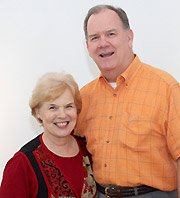
San Antonio couple addresses medical needs of Banjara people in India

NORTH INDIA—When Macarena Aldape cleans a wound or treats a rash, her Banjara patients often ask her why she is helping them.

The Banjara people’s socio-economic status often limits their access to healthcare, education and jobs with decent wages.

Banjara children often have limited access to medical care and health education. (PHOTO/Hali Thomas)

“The same God who created you created me and loves us,” Macarena Aldape, a registered nurse, tells her patients. “As a nurse, Christian, woman and mother, I try to show them love and acceptances. It is what God has told us to do—to love our neighbors as ourselves. That’s what I try to do.”

Macarena Aldape and her husband, Eddie, who serve as Cooperative Baptist Fellowship field personnel in India, hold medical camps twice a month in cities across northern India. Often, they conduct a camp for six to seven hours in one location and then conduct another one in the afternoon at another location.

The extreme poverty in which many of the Banjara people live prevents them from seeking the care of a physician. The Aldapes, natives of San Antonio, provide a variety of medical services—from treating diseases and common illness to providing education about good health practices.

“When a person learns something, that knowledge is power,” Macarena Aldape said. “It makes them feel so good about themselves. It makes a world of difference to them.”
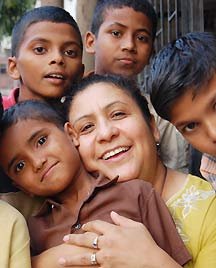
Macarena Aldape and her husband, Eddie, hold medical camps twice a month in cities and villages throughout northern India. (PHOTO/Hali Thomas)

The Aldapes are also work to educate people about HIV/AIDS. With limited health education and medical care, many do not know that they are infected. Eddie Aldape said in one Banjara community, about half the adults are HIV-positive.

In 2006, the Aldapes started a boys’ home to serve families living in extreme poverty that could no longer care for their children. About 100 boys wanted to live in the home, but only 50 could be accepted. Many of these children come from homes where at least one parent is infected with HIV/AIDS. The Aldapes predict that the need for children’s home will increase in the next few years and more children are orphaned by AIDS.

Rajesh, the oldest of the three children, was 5 years old when he came to live at the boys’ home. His parents, who were both HIV-positive, did not want to separate their children, but also recognized that they could no longer provide them with adequate care.

“When Rajesh’s father’s health went from bad to worse, he called us over to make a promise to him that we would take good care of Rajesh,” Eddie Aldape said. “He also asked us to take the other two boys once his wife was not able to care for them. He apologized over and over and he had never before seen the love of God. He and his wife accepted Christ as their personal savior and became active members of the local church. He has since gone on to be with the Lord.”

The Aldapes conduct medical clinics at the boys’ home and other children homes. They dream of outfitting a school bus or van with medical equipment and supplies. Such a mobile clinic would give them more flexibility and “go wherever the needs are.”

“Fellowship Baptists have a vision to reach out to marginalized people –those that have been ignored and neglected,” said Macarena Aldape. “For me, it is an answered prayer to have people that care that much for others and send people all over the world to work. Through CBF we are doing the work of many others in India. It is a privilege to know that there are people out there that still care for those nobody else does.”


Decades after breaking color barrier, Wayland grad still focused on education

PLAINVIEW—George May had never experienced racism. In fact, he was unfamiliar with its scope and practice. After all, where he was from, nearly everybody was black.

A native of San Andres, Colombia, May came to the United States in search of an education in 1950. His pastor, C.W. McCullough, a missionary in San Andres, recommended a small school in West Texas. But in an era of institutionalized segregation May initially was not allowed to enter Wayland Baptist College in Plainview.

George May, 82, the first black student to graduate from Wayland Baptist University, talks with Jordy Williams and Jordy’s fiancée, Rachel Morgan, following a Legacy Luncheon held on the Wayland campus. (PHOTOS/Wayland Baptist University)

May heard of ABT Seminary in Nashville, a school for black pastors affiliated with American Baptist College—founded in part by O.L. Hailey, a former president of Wayland. With his admission to Wayland blocked, May loaded a bus and struck out for Nashville, in search of an education. While at the seminary, May received a call from Wayland President Bill Marshall.

“He called me and asked me to return the following year,” May said.

In 1951, Wayland Baptist College became the first four-year, liberal-arts college in the formerly Confederate South to integrate voluntarily when the school admitted Annie Taylor, a teacher from Floydada, to take summer courses. May and classmate Bonnell Williams were the first black students to enroll full-time at Wayland. In 1953, May became the first black student to graduate from a Baptist college in Texas.

May’s hunger for a formal education developed early. As a young boy in San Andres, May would spend his free time at his pastor’s home. He ran errands and did odd jobs for the pastor, and he would spend his free time reading the pastor’s magazines from the United States.

“I did not have access to magazines from outside,” May said. “It was a delight to just sit around and read.”

Getting admitted into Wayland was the first hurdle May had to clear, but it wasn’t the last.

“My second problem was, where do I go to get my hair cut?” he said. “I didn’t know where to go. I didn’t know where to find the black community. I went to the barber adjacent to the campus, and he slammed the door on me.”

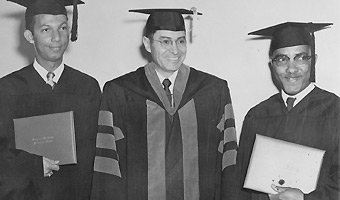
George May (right) stands with classmate Bonnell Williams and Wayland Baptist College President A. Hope Owen at graduation in 1953. May, whose name came before Williams alphabetically, was the first black student to graduate from Wayland. (PHOTOS/Wayland Baptist University)

Marshall heard about May’s haircut experience and visited the young student in his dorm room that evening.

“He said, ‘George, by this weekend we will have our own barber shop,’” May said. “I was very humbled by his humility.”

Sure enough, Wayland opened a barber shop in the basement of the administration building to cater to students of all races.

May said he and Williams also created a dilemma for the Baptist churches in town.

“They didn’t know what to do with these two black kids coming to their churches,” he said. “Their pastors and deacons all met, and the decision was that one of us would go to College Heights and the other to First Baptist Church. I went to College Heights.”

It’s been 58 years since May began breaking barriers to further the cause of education. Now, at age 82, he is at it again. Upon graduating from Wayland, May embarked on a career in ministry that saw him serve as pastor of his home church in San Andres as well as churches throughout Texas and into Ohio. In 1972, May teamed with his former mentor, McCullough, to co-pastor the South Park Baptist Church in Houston where he served 20 years.

In 1993, May returned to San Andres and his home church, where he served his third stint as pastor. While there, he became increasingly aware of the need for education among the people of San Andres. In 1998, May opened the Christian University of San Andres. The school operated from 1998 to 2003, graduating approximately 70 students. But the school fell on hard times as funds dried up and a building project sits incomplete.

May now spends his time trying to raise money for the school that could mean so much to his native island. Nearly 75 percent of San Andres’ population is unemployed. May believes a quality education can help bolster the economy of San Andres.

“Kids here have problems and with higher education we could help them,” he said. “With education they could set up their own businesses and become productive.”

Christian University of San Andres is currently an unused, unfinished building, sitting on about 20 acres of land donated by May. The school’s founder speaks to groups and other colleges and universities trying to raise awareness of the needs of the people of San Andres—and raise money to support the school.

“It is estimated that we are going to need to raise $3 million to put it in good order. To complete the building and maybe start another building,” he said.

May remains in good health. He exercises every day and takes his medication, and as long as he is able, he will be working to further the cause of the Christian University of San Andres.

“We live in hope,” he said.


Graduating social work student gains tools for ministry in homeland

WACO—The tsunami that struck the southern part of Thailand in 2004 was devastating for thousands of Thais who saw their dreams washed away. It was painful, too, for Walai Jantawiboon, a first-generation Chinese born in Thailand, and then project coordinator of relief services in the wake of the disaster.

But in an unexpected way, that work brought Walai to the point of pursuing her own dream—advanced education in social work—and that brought her to Waco and the Baylor School of Social Work in 2006.

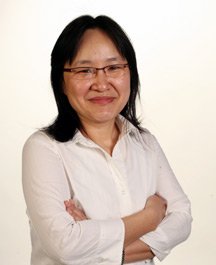
Walai Jantawiboon

“I took the responsibility without being aware that it takes more than just a heart to really help people,” Walai said regarding her relief work. “Our project team responded well to physical needs, but the lack of sensitivity to the people’s psychological and emotional needs was so prevalent.”

She learned about Baylor through a religious organization with which she worked in Thailand. Although she was raised a Buddhist, she became a Christian at 17, so Baylor’s integration of faith and education seemed the right place for her.

“Social work cannot be inclusive without the spiritual part,” she said. “People need hope, and that hope comes from the spiritual connection.”

When she arrived in the United States, it was her first time in the country, but she had one friend in Waco already, although she had yet to meet her.

“I met Melissa Ishio on the Internet four days before I arrived in Waco. She was looking for a renter in Waco, and she also was completing her MSW” degree, Walai said.

Ishio, now back in Japan with her husband and family, served as Walai’s mentor, introducing her to Baylor, Waco and all things Texan. Melissa and sons, Joshua and Justice, became a new family to Walai, helping her through many transitions.

“I never lacked for support from anyone here,” Walai said. “Everyone has been very sensitive to my culture, my needs. My classmates have been so supportive.”

Walai’s first two field placements in the program were working with older adults, and she found that it was a good fit. This spring she spent the semester at the New York Academy of Medicine in its Social Work Leadership Initiative—the first Baylor student placement at the institute.

tsunami

Walai Jantawiboon (left) chats with a Thai woman in the village of Khao Lak, Thailand. Starting in 2005, Jantawiboon took a position as tsunami recovery project coordinator in the village. The village lacked basic necessities such as food and water, and financial aid was bottlenecked because of poor money management in the country. (Baylor Lariat Photo)

While there, she worked on several projects on a macro level—policy development with local and national governments, data research, program implementation and evaluation, resource mobilization and community building.

“It was my first time to do macro work, but I learned many skills, and I have more confidence,” she says.

In June, she will return to the home she shares with her mother in Bangkok and to her four siblings, who live in the city or nearby. And, she goes back with new dreams. She would like to develop a research team and interview survivors of the tsunami about their quality of life, five years after the storm. But she would also like to develop a community for those who were orphaned or abandoned after the tsunami. The difference is that now she not only can picture it, but she has the skills to know how to accomplish it.

“Whatever work I am about to do, I have the tool box and have been taught well how to use the tools to help people become the experts in their own lives.”


Children’s home alum brings hope and healing to girls, moms & mentors

CORPUS CHRISTI—Most teenaged girls like rollercoaster rides, and that may account for the positive response Jenny Broughton receives from her audience. After all, young people who hear her story about surviving the trauma of neglect, abuse and the murder/suicide of her parents describe it as an emotional rollercoaster.

During a recent “It’s a Girl Thing” conference in her hometown of Corpus Christi, Broughton—a South Texas Children’s Home Ministries alum—moved seamlessly from humorous tales of imitating ’60s model Twiggy to impress her heartthrob, to the sobering details of early verbal, physical and sexual abuse.

Inspirational speaker Jenny Broughton, who grew up at South Texas Children’s Home Ministries, poses with 12 girls from the children’s home who attended a conference in Corpus Christi earlier this year.

Her story of survival and success particularly resonated with 12 girls from South Texas Children’s Home Ministries who were eager to hear how she went from obscurity to inspiring audiences throughout the country with her message of hope and healing.

"My father was in the Navy and gone most of the time, so my mother was like a single mom caring for five children,” Broughton shared. “When Mom was drunk or angry, she would often tell me: ‘You were an accident, Jenny. I didn’t mean to have you.’”

When she was 11 years old, Broughton’s father came home briefly to attend a funeral. But his visit did not turn out the way she had hoped. While she and her siblings were at school, her father strangled her mother to death and then shot himself.

“I was suddenly orphaned and sent to live at South Texas Children’s Home Ministries along with two of my brothers. I lived in one of the cottages with a housemom and several other girls on a beautiful ranch. But I felt alone, angry and scared to death,” Broughton said.

“I didn’t realize it at the time, but Jesus was there, loving me through the staff at the home. We read the Bible daily, but I couldn’t believe God’s word would ask me to trust a man, considering all the pain men had caused in my life—especially a man I could not see.”

A defining moment for 19-year-old Jenny Broughton came when she met Billy Graham in 1973. Broughton gave her testimony at the Southern Baptist Convention in Dallas and sat on stage between Graham and then-Governor Jimmy Carter.

Finally, one sweltering summer night, in the loving arms of her housemother, Jenny realized that even though she was a victim who had been sinned against, she also had sinned against God and others.

“I knew that night that I was a spiritual orphan and that Jesus was stopping by for me again,” Broughton told her audience. “It was like he was asking, ‘What do you want me to do for you, Jenny girl?’

“I wanted so badly to see and understand. I wanted to know this man Jesus and that he loved me. I wanted someone to care and to know that I was not an accident. I gave my heart to the Lord that night and began a journey with God that changed my life forever.”

Carissa, a senior living at South Texas Children’s Home Ministries, was deeply moved by Broughton’s message.

“Jenny Broughton was amazing. She was on the level and put a lot of herself into her message. It was like she was saying, ‘I know what you are going through, and I’m here to help.’ It is hard when your family is falling apart and you don’t know what to do. Jenny showed us you can get through it, like she did, and she did it through Christ.”

Broughton’s husband, Sam, serves as pastor of Ethnos Church, a Baptist mission congregation in Oklahoma City. As a pastor’s wife, inspirational speaker, mother, grandmother and teacher, she has had ample opportunities to meet women and learn about their needs.

“I’ve learned that many women and girls have suffered and never been comforted when something hard happened in their lives,” she said. “Their needs were not met, and no one ever came along to say ‘I’m so sorry and sad you have been hurt.’ In my years at the children’s home, God used houseparents, caseworkers and counselors to bring healing to my life and open the doors that he wanted me to walk through.”

Jenny Broughton talks with girls from South Texas Children’s Home Ministries. (PHOTOS/South Texas Children’s Home Ministries)

Diane Gryseels, a counselor at the STCHM family counseling office in Corpus Christi, remembers Broughton’s teenage years and continues to support her today.

“Jenny loved to attend meetings and always wanted to meet the speakers,” Gryseels recalled.

“One Christian speaker Jenny really identified with was the very humorous Marge Caldwell. When Jenny was 12, I introduced her to Marge. Once Jenny realized her sense of humor could be used for God’s glory, she began to deal with her life issues and grew in her ability to use personal experiences and humor to draw people to God.”

When she was 19, she had the opportunity to give her testimony at the Southern Baptist Convention in Dallas. She was seated on stage between then-Governor Jimmy Carter and Billy Graham, who also spoke that night.

“It was a defining moment for Jenny,” Gryseels said.

Now, as a professional inspirational speaker, Broughton connects with people of all ages—but particularly with teenaged girls.

“Teens identify with the abuse Jenny experienced, her low self-esteem issues, and her tales of making a fool of herself and learning to laugh about it. It helps them see what God can do in their life if they let him,” Gryseels noted.

Carissa admits that she was an atheist when she first began living at South Texas Children’s Home Ministries but that after a few months, she said, “I opened my heart and let Christ in.”

“After the ‘Girl Thing’ conference, I began to try harder to stay near Christ and stay in the word each day,” Carissa said. “When I went home over Easter weekend, I led my mom to the Lord. We are a lot closer now and it is great. I discovered that what Jenny said is true. God does stop by our lives, and if we listen, we can hear him.”

“Every generation has their share of pain and suffering,” Broughton reflected. “And it isn’t easy to grow up in a children’s home and deal with the reasons you find yourselves there. But I want girls and boys alike to realize that the children’s home is not the end of the line for them. It is, instead, an open door of opportunity to break the cycle of unhealthy behaviors in their families and make it possible for them to achieve their dreams and become what they’ve always hoped to be.”

Sarah Pitzer, an “It’s a Girl Thing!” organizer, is grateful for how Broughton touched the lives of girls from all over South Texas.

“The way Jenny shares about her encounters with truth is so freeing. She simply says that at the toughest times in her life, God came to visit. We all want to have hope—a hope that God loves, cares and hears and that he will rescue us. And, of course, as we discover in his word, he does, and he will.”


Texans follow their calling to Greece, work among Albanian refugees

ATHENS, Greece—When he taught at Houston Baptist University, Bob Newell often challenged young ministerial students to be sensitive to the need to keep their call alive and growing.

“I reminded them that ministers, especially in the latter stages of their careers, should be careful, lest they lose some of the vitality of their ministry commitment and simply settle for coasting until retirement,” Newell said.

Bob Newell (right), a Cooperative Baptist Fellowship worker among Albanians in Greece, shows the “Albanians in Athens” photo exhibit by Houston photographer Gary Barchfeld— which will be on display at the CBF general assembly in Houston— to Vili Minaroli, Albanian ambassador to Greece, and his wife, Lejla. (PHOTO/CBF)

Knowing the potential for such stagnation existed, Newell and his wife, Janice, continued their own personal and professional growth throughout their careers, so that as their ministry matured, they themselves would be ready to meet new challenges.

It came as no surprise the Newells were prepared for the calling they began to recognize in the late 1990s to work with Albanian refugees. At the time, Newell was pastor at Memorial Drive Baptist Church in Houston, where his wife served as organist.

The inkling of a call started at a conference in Stockholm, Sweden, when Newell learned about ethnic cleansing and tensions among Balkan people. When he returned to the States, he learned that Houston had become home to more than 500 Kosovar Albanian refugee families, and relatives of a church member were beginning a ministry among Albanians in Kosovo.

“Seemingly at every turn, factors conspired to alert us to a fresh concern for ministry among Albanians,” Mrs. Newell said. “Bob led the church to focus its ministries on Albanian people; as a result, Albanian children became members of my children’s choir, and we led ministry teams to work with Albanians in Macedonia and Kosovo.”

By then, the Newells were convinced God was calling them to some form of cross-cultural ministry in the final chapter of their careers. They began to explore opportunities through the Cooperative Baptist Fellowship. In 2003, they were commissioned as CBF field personnel to Athens, Greece.

CBF Missionaries Bob and Janice Newell

“We were not surprised that, after prayer and conversation, we both sensed a powerful tug toward the needs of Albanian immigrants in Athens,” Newell said.

Everything matched. Houston was about the same size as Athens. Their skill sets, abilities and experience equipped them for innovative ministry. They had worked on a university campus and in a local church.

“In addition, our years of experience in working with ecumenical and interfaith groups, merged with Bob’s training in sociology/anthropology to help us to be somewhat prepared for an assignment which focused on the needs of a minority ethnic group with Muslim, Christian and atheistic backgrounds, living in a foreign cultural milieu dominated by the Greek Orthodox Church,” Mrs. Newell said.

“For us, this opportunity to serve has been a genuine gift from God,” her husband observed. “Our gifts have been utilized. We have been challenged to remain alive and growing in our ministry. And we have found adventure, excitement and fulfillment—despite the terrific challenges associated with learning two languages and adapting to different cultures.”

The Newells’ primary ministry venue is through PORTA—the Albania House in Athens. Located in a neo-classical house, built in 1916, the distinctive facility houses an art gallery, library, and four classrooms. The center offers a variety of programs—such as language and computer classes—to a large group of non-Christian Albanian refugees. Meanwhile, about 300 Albanian Christians take advantage of Bible studies, evangelism and Christian discipleship programs, marriage and family enrichment, social events and relationship and reconciliation workshops at PORTA.

A photo exhibit, “Albanians in Athens – a Positive Picture,” was created by Gary Barchfeld, a professional photographer from Houston. Barchfeld and his wife, Martha, went to Athens three times to take photos of Albanians at work, worship and play. Sixteen photos were included in an exhibition that was shown first at PORTA and now is traveling to churches throughout the United States. It will conclude its United States tour at the CBF General Assembly in Houston, July 2-3.

“This traveling exhibit has literally put a face on the ministry among Albanians in Athens,” Mrs. Newell said.


Conservative ‘National Day of Prayer’ supporters upset over Obama snub

WASHINGTON (ABP) — Conservative organizers of National Day of Prayer-related events expressed disappointment that President Obama chose not to mark the day May 7 in the same elaborate fashion as his predecessor.

But some groups that support strong church-state separation applauded Obama for pulling back from the emphasis that President Bush placed on the event, which in recent years has come under fire for being dominated by conservative evangelicals. And at least one conservative Jewish leader also defended Obama’s decision.

{youtube}QIVd7YT0oWA{/youtube}

Many Religious Right leaders have roundly criticized Obama for choosing not to observe the day with any sort of White House ceremony. “We are disappointed at the lack of emphasis on prayer on this National Day of Prayer,” said James Dobson in a Capitol Hill press conference with members of Congress to mark the event May 7.

The Focus on the Family founder’s wife, Shirley, has long been the chairperson of the privately funded National Day of Prayer Task Force, which coordinates the Capitol Hill observance of the event as well as similar ceremonies around the country. Earlier, she issued her own statement expressing dismay that Obama did not plan anything resembling the prominent prayer-day observance that Bush held in the East Room of the White House each of his eight years in office.

Rep. Randy Forbes (R-Va.), who led the press conference following a lengthy prayer service in a House office building, said organizers were disappointed that the White House didn’t even send an official representative of the executive branch to the Capitol Hill ceremony

“I think the president missed a wonderful opportunity," he said.

Obama did, shortly after the Capitol Hill ceremony ended, issue the traditional proclamation marking the day.

“Let us remember those who came before us, and let us each give thanks for the courage and compassion shown by so many in this country and around the world,” he said.

“Let us also use this day to come together in a moment of peace and goodwill. Our world grows smaller by the day, and our varied beliefs can bring us together to feed the hungry and comfort the afflicted; to make peace where there is strife; and to lift up those who have fallen on hard times. As we observe this day of prayer, we remember the one law that binds all great religions together: the Golden Rule, and its call to love one another; to understand one another; and to treat with dignity and respect those with whom we share a brief moment on this Earth.”

Presidents since Harry Truman have declared a similar day calling on Americans of faith to humble themselves, give thanks and pray for the good of the nation and the world. President Reagan standardized the observance to the first Thursday in May.

President Obama, with faith advisor Joshua DuBois in the background, signs his official proclamation declaring the 2009 National Day of Prayer. (PHOTO/White House)

However, in the two decades since then, the event has become closely associated with Dobson’s task force. Critics have decried the group, which limits its leadership and the speakers at many of its events to conservative evangelical Christians, for its exclusivity.

In recent years, some critics have staged rival events that are more ecumenical in nature.

Online applicants to become coordinators for the task force must affirm an evangelical Christian statement of faith that upholds biblical inerrancy. They must also list the name of their local church and describe their involvement in it.

Earlier this year, two religious-liberty groups asked Obama to shun the task force’s celebration and declare a more “inclusive” National Day of Prayer.

As president Obama has shown unprecedented sensitivity to adherents of minority faiths as well as non-believers. He acknowledged atheists in his inaugural address Jan. 20, and during an April 6 appearance in Turkey said that "one of the great strengths of the United States" is that, although “we have a very large Christian population, we do not consider ourselves a Christian nation or a Jewish nation or a Muslim nation. We consider ourselves a nation of citizens who are bound by ideals and a set of values."

While many conservative Christians lambasted Obama for his statement — and did so again at the May 7 press conference — other religious leaders and groups applauded him for it, as well as his decision not to observe the National Day of Prayer in the fashion of Bush.

Americans United for Separation of Church and State issued a statement thanking Obama for not re-creating Bush-style observances. Nathan Diament of the Union of Orthodox Jewish Congregations — usually an ally of Religious Right leaders — said in a May 5 blog entry that their criticism of Obama’s decision “is inappropriate — and, moreover, not in keeping with the purpose of the observance which is to unify Americans through a national moment of reflection and aspiration to higher purposes.

Joshua DuBois, the director of Obama’s White House Council on Faith-Based and Neighborhood Partnerships, did not immediately respond May 7 to a reporter’s inquiry about Obama’s reasoning in not continuing the ceremony.

But White House Press Secretary Robert Gibbs was asked about the subject in his regular May 6 press briefing. “Prayer is something that the president does every day,” he said.

One Baptist leader said that he thought the entire enterprise was “misguided.”

Brent Walker, executive director of the Baptist Joint Committee for Religious Liberty, said in a May 5 post on the Washington Post/Newsweek “On Faith” blog, that it isn't "government's job to tell the American people what, where or when to pray.

“Although most presidents have issued prayer proclamations, two of the most ardent supporters of religious freedom, Thomas Jefferson — author of the Virginia Bill Establishing Religious Freedom — and James Madison — father of the Constitution — opposed them.”

Walker concluded: “Exhorting our country to repentance and prayer is altogether proper. Who would argue we don't need it? But it's more appropriately called for by the preachers, priests and prophets among us — not civil magistrates, the Congress or even an American president.”


–Robert Marus is managing editor and Washington Bureau Chief for Associated Baptist Press.

Related ABP stories:

Groups urge Obama to proclaim 'inclusive' day of prayer (4/23)

Ecumenical and evangelical groups tentatively join in day of prayer (5/5/2006)

Bush salutes National Day of Prayer, but some Christians decry politicization (5/6/2004)


Buckner explores affiliation with Baptist Memorials Ministries

DALLAS—Dallas-based Buckner Retirement Services has announced it is exploring an affiliation with Baptist Memorials Ministries in San Angelo.

Buckner and Baptist Memorials have entered into a letter of intent, which would open the way for an affiliation starting Jan. 1, 2010. The affiliation would join the two nonprofit organizations’ leadership, business and marketing functions for increased service to elders, leaders of both entities noted.

Buckner served 1,210 residents in 2008 on its five campuses, offering independent living, assisted living, memory care and skilled care. Baptist Memorials has a population of about 600 residents annually, including 400 in its Memorials Village and High Rise facilities and 200 in skilled care. Both entities are related to the Baptist General Convention of Texas.

Pearl Merritt, president of Buckner Retirement Services, said the connection of the two faith-based retirement organizations provides greater strengths to both.

“Buckner operates retirement communities in Longview, Dallas, Houston, Beaumont and Austin—all east of I-35,” she explained. “With this affiliation, we can now offer a full continuum of care to elders in West Texas through a like-minded community committed to excellence in elder care and culture change in the retirement industry.”

Baptist Memorials President Pat Crump called the potential affiliation “exciting,” noting the connection with Buckner will “give Texans a true statewide choice when they seek a retirement community that will offer them quality care in a faith-based context.”

Buckner International President Ken Hall termed the joining of the two entities “a cause for celebration in the Texas retirement industry.”

“Buckner and Baptist Memorials both have strong reputations for their quality of care and their leadership in retirement service provision. This affiliation will cause a lot of people in the field of services to elders to take note,” Hall said.


L.L. Morriss, influential Baptist pastor, dies at 89

L.L. Morriss, longtime Baptist pastor and denominational worker, died May 1 in Longview at age 89.

Morriss, a preacher from the age of 15, was ordained in 1938 and was pastor at Texas churches in Angus, Mt. Zion, Gresham, Noonday, Judson, Cayuga, New London, Cameron, Baytown, Mount Pleasant, and First Church in Midland, where he served more than 20 years.

He was director of the evangelism division of the Baptist General Convention of Texas from 1975 until 1981, and he served as director of the Christian Education Coordinating Board from 1981 to 1985, before his retirement.

He also served as chairman of the BGCT Executive Board, chairman of the BGCT Human Welfare Commission, president of the Baptist Training Union of Texas and parliamentarian for the Southern Baptist Convention for five years.

He also was a trustee for East Texas Baptist College, Howard Payne University, Baylor University and Dallas Baptist University.

He was a field supervisor for the Southwestern Theological Seminary doctor of ministry program.

A noted writer and speaker, he wrote numerous articles for denominational periodicals and a book, The Sound of Boldness.

He received the Distinguished Service Award from Texas Baptist Men in 1970, the W.T. Tardy Alumni Award for service from East Texas Baptist College in 1978, and was twice awarded the George Washington Honor Medal from the Freedom Foundation. The University of Mary Hardin-Baylor, East Texas Baptist College and Baylor University each conferred honorary doctorates on him.

He was preceded in death by his first wife, Faye, in 1993; brothers, Robert and Thomas; and infant twin sisters, Dorthy and Doris. He is survived by his wife of 12 years, Mary; son, Lester Jr.; step-children, Jim Dean, Bob Dean and Debra Summers; two grandsons; six step-grandchildren; two great-granddaughters; and two step-great-granddaughters.


Religious freedom panel adds Nigeria to list of world’s worst violators

WASHINGTON (ABP) — The U.S. Commission on International Religious Freedom added Nigeria to its list of the world's worst violators of religious freedom in an annual report released May 1.

Citing sectarian violence, attempts to expand Sharia law and complaints by Christians in the north of discrimination at the hands of Muslim-controlled governments, the advisory panel for the first time designated Nigeria a "Country of Particular Concern."

Nigeria joins 12 other nations identified as the world's worst violators. They include Burma, China, Eritea, Iran, North Korea, Sudan and Uzbekistan — countries all on a separate list of CPCs managed by the U.S. State Department.

The panel, an independent government commission created by an act of Congress in 1998, urged the State Department to also add Iraq, Pakistan, Turkmenistan and Vietnam to the list, along with Saudi Arabia, which the State Department lists as a CPC but has indefinitely waived any policy response to violations of religious freedom.

Commission Chair Felice Gaer said in the past the government has sometimes followed the panel's recommendation to add countries to the list, though not immediately, due to disagreement about the seriousness of the violations or for reasons of diplomacy.

The commission has recommended that the Secretary of State designate Turkmenistan as a CPC every year since 2000, for example, but the government has never done so.

Sometimes members of the bipartisan panel disagree among themselves. In December the commission declared Iraq a Country of Particular Concern. Four of the 10 commissioners, including Richard Land, head of the Ethics & Religious Liberty Commission of the Southern Baptist Convention, dissented from the recommendation, saying Iraq should instead remain on a "Watch List" of nations that require attention but do not meet thresholds of a CPC.

Commissioner Nina Shea said about half of Iraq's 1.4 million Christians have been killed or left the country, jeopardizing Iraq's future as a diverse and free country.

This year's report adds Russia, Somalia and Venezuela to the Watch List. They join Afghanistan, Belarus, Cuba, Egypt, Indonesia, Laos, Tajikistan and Turkey. Laos rejoined the Watch List after being removed in 2005. This year the commission dropped Bangladesh from the Watch List, citing improved conditions, but will continue to monitor the situation there.

Commissioners said religious freedom in Venezuela has deteriorated since Hugo Chavez became president in 1998. Somalia was added because religious freedom protection is increasingly circumvented by warlords, local authorities and prevailing social attitudes. Russia came under scrutiny largely due to establishment of a new body in the Ministry of Justice with unprecedented power to control religious groups.

Commissioner Michael Cromartie described North Korea as the "worst violator of religious freedom of any country in the world."

Chairwoman Gaer said it was "not a good year for religious freedom" in China, citing crackdowns on protestors during the Summer Olympics in Beijing and conditions in Tibet she said are "now worse than any time since the commission was formed." She also said more unregistered Protestants were arrested in China than the year before.

The commission said it is also monitoring religious liberty concerns in Kazakhstan, where laws against "extremism" have been used to target minority sects, and Sri Lanka, based on attacks targeting members of religious minorities and proposed laws against religious conversion.

The commission delayed its report on India, pending a first-time visit there scheduled in June. The commission had hoped to send a delegation to Cuba in April, a country on its Watch List, but Cuban officials denied visas.


–Bob Allen is senior writer for Associated Baptist Press.


ABP directors give posthumous award to Herb Reynolds

DALLAS (ABP) — The late Herbert H. Reynolds, longtime president of Baylor University, was praised recently by one of Congress' most ardent defenders of church-state separation as a mentor who "ignited my passion for religious liberty and separation of church and state."

"Dr. Reynolds sent me on a journey that would change my life," said Rep. Chet Edwards (D-Texas) in a videotaped tribute during an April 23 banquet in Dallas honoring Reynolds' contributions to the Baptist principle of religious freedom. Reynolds died in 2007.

Members of Reynolds' family were on hand to receive the Associated Baptist Press Religious Freedom Award on his behalf. The posthumous honor was bestowed by ABP's board of directors in conjunction with its semi-annual meeting.

Joy Reynolds accepts award on behalf of her late husband from ABP board chair Dan Lattimore.

Edwards noted that early in his congressional career Herb Reynolds sent him a copy of a famous speech defending church-state separation that George W. Truett, then pastor of First Baptist Church in Dallas, delivered on the United States Capitol steps in 1920.

Truett's address and Reynolds' patient tutelage galvanized the young congressman's commitment to religious liberty as integral to both American democracy and Christian theology, Edwards said. Since then, Edwards has become widely known for his strong stands on strict church-state separation.

"I think [Reynolds] knew what he was doing to awaken me to the cause of religious liberty," he said. "Whatever I've been able to accomplish in Congress [related to religious liberty] is totally to the credit of Dr. Reynolds…. If he were here he would remind us that protecting religious liberty is an uphill fight that always requires diligence."

Edwards, a 2003 recipient of the ABP award, represents the Central Texas congressional district surrounding Waco, where Baylor is located. He attends Calvary Baptist Church in Waco.

Joy Reynolds, accepting the award on her late husband's behalf, thanked ABP's directors and guests at the banquet for honoring Reynolds' great passion for one of his favorite causes. "Herb truly believed in religious freedom," she said. "His favorite thing to say was that God wants free worshipers and no other kind."

{youtube}2_gUlGcDLMo{/youtube}

In a brief address, Steven Sadler, senior lecturer in religion at Baylor, emphasized that Reynolds through his leadership "embodied the spirit of first Amendment freedoms," contributing not only to academic freedom but also to the value of a free press and to the role of ABP as an independent news service. 

Sadler said Reynolds supported religious liberty by:

Protecting academic freedom. Reynolds understood that "freedom of speech in the classroom was absolutely necessary" for the integrity of a faith-based community of learning. Reynolds, Sadler recalled, told Baylor faculty on his first occasion to address them as president, "I shall be prepared to resign at any time I am unable to guarantee you the freedom from undue constraint and an independent voice in the life of this institution."

Protecting students' freedom of speech. As an example, Reynolds led the effort to create a more sophisticated evaluation of faculty that gave a voice to students and teachers.

Protecting theological education. Reynolds' vision led to the creation of Baylor's George W. Truett Theological Seminary. Rather than theological education that spoon feeds students a "set of provincial truths," Reynolds "made sure freedom of speech was imbedded in theological education."

The ABP board meeting was its first since a staff reorganization last fall. Longtime ABP Executive Editor Greg Warner announced last August that he was stepping down for health reasons.

In October, longtime Baptist communications professional David Wilkinson, assumed the newly created position of executive director. He functions as the news service's chief executive officer with primary responsibilities in administration and fund raising.

Warner's editorial responsibilities were assumed by Robert Marus, former news editor and Washington bureau chief, who was promoted Jan. 1 to the new position of managing editor. Marus also continues to head the Washington bureau.

Veteran Baptist journalist Bob Allen returned to ABP's staff in October to fill the new position of senior writer.

Wilkinson, in his executive director's report, told the board that ABP has had a remarkable past, but that even the most effective organizations must change the way the way they do their business without doing damage to their core mission.

"I'm convinced that ABP is a trusted source of news and information for progressive Baptists and many traditional Baptists," he said. "There is a considerable amount of respect in Baptist life for ABP and its role. We are the reporters, the documenters, the chroniclers of the Baptist movement and the Baptist understanding of the gospel."

He continued: "But we are more than that; we are also the truth-tellers whose stories, whose questions, whose reporting speaks to power and holds organizations and their leaders accountable to those who elected them and to those whom they were appointed to serve. We are the proverbial watchdogs in Baptist life. Now, that may not be the most attractive moniker to have … but of all God's people in the world, it is Baptists who should be the No. 1 champions of that vital role."

In other action, ABP directors approved four nominees to the board. Harriet Harral, a Fort Worth, Texas, organizational consultant, and Brian Unger, a Liberty, Mo., accounting executive, are returning to the board after absences they took to avoid conflicts of interest. Harral, who resigned to serve a three-year term as an elected official of the Cooperative Baptist Fellowship, is a member of Broadway Baptist Church in Fort Worth. Unger, who took a leave of absence to serve as a health-benefits advocate for Warner as the former editor began his transition to permanent medical disability, is a member of Second Baptist Church in Liberty.

The board also approved new members Anne Guidry, a Jackson, Miss., communications executive and member of Northminster Baptist Church, and Kyle Reese, pastor of Hendricks Avenue Baptist Church in Jacksonville, Fla.


UMHB students ‘soled out’ for Third World orphans

BELTON—University of Mary Hardin-Baylor students gained a little better understanding of how much of the world lives when they recently went barefoot for one day to identify with children in developing countries who have no shoes.

The idea grew out of a conversation in March between Student Body President Tatenda Tavaziva and football player Max Taylor as they stood in line for lunch one day. They realized they shared a desire to do something that would be meaningful and could get the entire campus involved, including faculty and staff.

By the time their sandwiches were delivered, their ideas were in place, including thoughts about how to spread the word and a plan to put shoes on children’s feet in an orphanage in Haiti.

As he participated in Sole to Soul, donning a suit but no shoes, he recognized it as an experience that made him feel uncomfortable, awkward and self-conscious.

“I certainly felt odd this morning,” Theodore said. “From the moment I crawled out of bed, when I would normally put on houseshoes to go get the paper, I didn’t.

“Later, I had to take my car into the shop. So, I parked my car and walked through the gravel parking lot, which was quite painful. Then, I walked into the shop, and the first thing the guy sees are my bare feet. I am wearing a tie and not shoes. The guy started laughing and asked, ‘Where are your shoes?’ And it became an opportunity to tell him what we are doing at UMHB.”

Although the final count of participants was hard to estimate, there were barefoot students and faculty in every classroom, in chapel, in the dining hall and walking across campus throughout the day.

Those who chose not to shed shoes were encouraged to join the effort by donating $10 to buy a pair of shoes for a child in the Hope for the Hungry Foundation’s Haiti orphanage.

Throughout the day, students stopped by the Student Campus Activites office to drop off $10 bills, and by the end of the day, more than enough money had been contributed to put shoes on every child in one Haitian orphanage, with money left over.

Students donated more than $2,500, and four large boxes of shoes were prepared for shipping to Haiti.

“We prayed if God was not behind this we wanted it to fail, but God seemed to have supported it every step of the way,” Tavaziva said.

Taylor hopes to use Sole to Soul as a steppingstone for his future plans. He sees himself continuing this type of work and was thankful the project allowed him to get his feet wet—so to speak.

“Right now, all I can think about is the people in Haiti we are going to help,” Taylor said. “Maybe one day, I can take Sole to Soul nationwide and will be able to help many more.”


Churches offer networking, training programs for unemployed

A growing number of Texas Baptist churches have decided in the current recession, the New Testament admonition to “bear one another’s burdens” means helping unemployed people find jobs.

One week before Easter, Bear Creek Baptist Church in Katy launched an interactive Job Connection page on its website that allows employers to post online potential job opportunities.

“Some have already found jobs,” Adult Pastor Aaron Morris said, less than three weeks later.

Job postings have ranged from part-time positions as sales associates or clerical workers to specialized listings for licensed journeyman plumbers, mechanical engineers and underwater drillers.

“Bear Creek Baptist Church does not make any promises or commitments regarding posted employment opportunities. This information is simply a way to provide our church family news of any positions that may become available through the membership of Bear Creek,” a disclaimer on the site states.

To help families in financial difficulty, Bear Creek also offers both long-term and short-term classes in personal financial management and stewardship, Morris noted.

Hampton Road Baptist Church in DeSoto started its Job Seekers program in mid-March at the initiative of David Clifton, who lost his job last year after more than 30 years in sales and management.

After his job loss, Clifton started attending a Career Connection class at a Presbyterian church in North Dallas. He benefited from the networking opportunities the program offered, as well as the chance to learn skills to help in a job search.

“More than anything, it was an encouragement,” he said.

Since there was nothing comparable in the south part of Dallas County, Clifton and Robert Nowell started the Job Seekers ministry at Hampton Road Baptist. The group meets each Tuesday evening to share information about possible job opportunities and to hone interviewing skills and work on their resumes.

After six months without employment, Clifton recently started a new job, just before his severance package expired. So, he knows firsthand about the current job market—crucial information for some people who haven’t looked for a job in 20 or 30 years.

“There are a lot of people who really don’t know what’s involved in securing a job today. They still think it’s about typing up a three-page paper resume. They don’t know about networking or about Internet resources.”

Having recently been where the people in the Job Seekers program are now, Clifton has a passion for the ministry.

“I’ve come to believe you shouldn’t try to start a ministry unless God gives you a burden for the people,” he said. “I have a burden for the people who are in this situation.”

In February, First Baptist Church in Georgetown launched its Careers in Transition ministry. Each Wednesday from 9 a.m. to 11 a.m., unemployed people—about half from the church and half from the community—meet to share their resumes and potential leads for jobs.

Volunteers share their expertise in helping people secure employment. One volunteer leader is a retired auditor “who went through transitions in his own career” and led a similar ministry to out-of-work people in a church he previously attended, Executive Pastor Kirk Kriegal explained. Another leader has professional experience in training job applicants.

Participants learn how to give a “90-second elevator speech” introducing themselves in a way that would make a positive impression on employers, as well as tips for interviewing and resume-writing.

Kriegal has promoted the “Careers in Transition” ministry at Georgetown Chamber of Commerce meetings, and the church has advertised in the local newspaper.

“We will keep it going as long as there’s a need,” he said.